
A lot of business owners hit the same roadblock: they need a site that can sell, but they don’t need the same kind of store setup. That’s where Shopify Vs Wix gets interesting. Shopify is built ecommerce-first, while Wix is a website builder first with ecommerce tools added on top.
That difference matters more than most marketing pages admit. In this comparison, we’ll look at ecommerce features, pricing, ease of use, performance, integrations, customer support, and the real trade-offs that show up once your site starts getting traffic and orders. We’ll also cover which platform offers better value for money in 2026, so you can make a cleaner decision for your online business.
Quick Verdict: Shopify Vs Wix In 2026
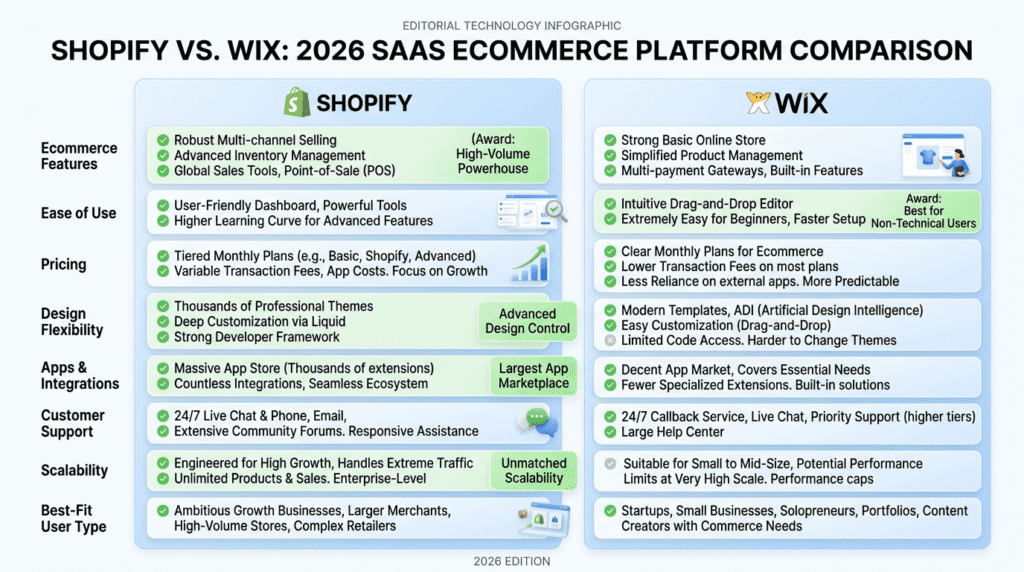
Shopify and Wix can both help you build an online store, but they solve different problems. If selling products is the heart of the business, Shopify usually gives you more room to grow. If you want a simple, flexible website with light ecommerce, Wix is often easier to live with.
Complete Verdict Table
| Category | Shopify | Wix | Winner |
|---|---|---|---|
| Best overall for ecommerce | Built for serious online selling | Good for simple stores | Shopify |
| Ease of use | Simple, but ecommerce-focused | More beginner-friendly and flexible | Wix |
| Pricing | Higher long-term costs | Lower starting costs | Wix |
| Ecommerce features | Stronger inventory, checkout, shipping, and sales tools | Solid for basic ecommerce | Shopify |
| Design flexibility | Good themes, more structured | More creative control | Wix |
| Apps and integrations | Larger ecommerce app ecosystem | Strong general website app marketplace | Shopify |
| Customer support | Better for ecommerce-specific issues | Strong general website support | Shopify |
| Best for small business websites | Best if selling is the priority | Best if content, services, or local presence matter most | Depends |
Best For
- Shopify: Ecommerce brands, growing stores, dropshipping, multichannel selling, and businesses that need advanced features.
- Wix: Small business websites, service providers, beginners, creators, and stores with simpler selling needs.
Not Ideal For
- Shopify: Users who mainly need a simple website and only sell occasionally.
- Wix: Businesses that expect complex inventory, scaling ecommerce operations, or advanced selling workflows.
Bottom Line
Choose Shopify if ecommerce is the core of your business. Choose Wix if you want a more user-friendly website builder with basic-to-moderate ecommerce features.
Shopify Vs Wix Ecommerce Features Compared
Shopify Is Built Around Selling Products
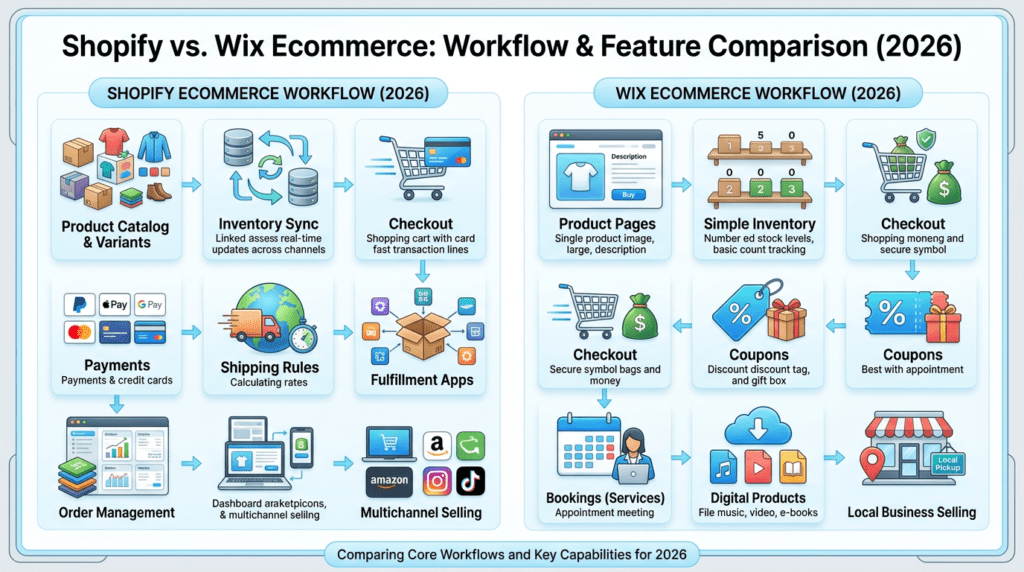
Shopify is an ecommerce platform first, and that shows up in the day-to-day workflow. Product management, checkout, inventory tracking, shipping rules, tax handling, and order management are all built around helping store owners sell more efficiently.
That becomes important fast if you’re running a real online store, not just adding a few products to a website. A Shopify store is usually easier to manage when you have many SKUs, different product variants, or sales channels that need to stay in sync. Shopify also integrates well with tools for fulfillment, ads, email, and social commerce, which matters more as the business grows.
Where beginners sometimes overestimate Shopify is in design freedom. It’s not hard to use, but it does feel more structured than a general website builder. That structure is part of why it works so well for ecommerce. The trade-off is that if you want a highly custom content-heavy site, you may feel boxed in a bit.
Wix Ecommerce Works Best For Simpler Stores
Wix offers ecommerce tools that cover the basics well: product pages, checkout, payments, coupons, digital products, bookings, subscriptions, and standard inventory management. For many small businesses, that’s enough.
This is where Wix and Shopify start to diverge in a practical way. Wix provides a smoother path for people who care about the site as a whole, not just the store. A photographer, consultant, local service business, or creator might want strong pages, portfolio sections, and a simple online store all in one place. Wix handles that mix nicely.
The limitation shows up when the store gets more serious. A bigger catalog, more complicated shipping needs, or higher order volume can make Wix feel less specialized than Shopify. It’s not that Wix can’t sell. It’s that it’s better suited to lighter ecommerce operations than a business built entirely around online sales.
Checkout, Payments, And Transaction Fees
Checkout is one of the biggest difference makers in the Shopify vs Wix comparison. Shopify gives you Shopify Payments in supported regions, plus third-party payment options. Wix also supports multiple payment methods through Wix Payments and other gateways.
The real issue isn’t just which payment buttons are available. It’s how costs stack up as you grow. Shopify and Wix charge differently depending on the plan, the payment method, and whether extra transaction fees apply. If you process a small number of sales, the difference may not feel huge. Once monthly revenue rises, even a small fee gap can start to matter.
A common mistake is focusing only on the starting plan price and ignoring payment fees. For an online store doing steady sales, that can lead to a misleading cost comparison. The better question is: what will this cost when you’re actually selling every day?
Inventory, Shipping, And Order Management
This is one of the clearest places where Shopify takes the lead. Shopify is built to handle more detailed inventory workflows, shipping rules, fulfillment apps, and multi-channel selling. If you need a system that can keep up with growth, Shopify usually makes the operational side easier.
Wix can manage products and orders well enough for smaller stores, local pickup, or simpler shipping setups. It also works fine for businesses that sell a limited catalog or combine ecommerce with appointments and services. But as order volume rises, the admin side can start to feel less robust.
Here’s the practical difference:
- A local bakery selling 20 items a week probably doesn’t need advanced shipping logic.
- A DTC brand shipping nationwide with multiple variants, bundles, and return workflows probably does.
That’s why the right choice depends on what kind of online store you’re running, not just whether you want to sell online.
Ecommerce Winner: Shopify For Serious Selling
If ecommerce is the main event, Shopify is the safer pick. It’s built for product sales from the ground up, and that shows in inventory, checkout, shipping, and operational flexibility. Wix can absolutely sell, but Shopify is stronger when the store needs to scale.
Shopify Vs Wix Pricing And Long-Term Value For Money
Shopify Pricing In 2026
Shopify pricing is built around ecommerce growth, so the monthly bill is only part of the story. Plans change over time, but Shopify generally starts with a basic plan, then moves up as you need more staff access, better reporting, and lower payment costs. That structure makes sense if you’re serious about selling, but it can surprise first-time users who only look at the headline monthly rate.
The bigger cost issue is that Shopify often gets more expensive as the store matures. A small shop may start with one plan, then add paid apps for reviews, subscriptions, bundles, upsells, or advanced shipping rules. On top of that, premium themes can add a one-time cost, and POS-related tools may matter if you sell in person as well as online.
Payment fees matter too. If you use Shopify Payments, you can avoid some extra transaction fees that come with outside gateways, but you still pay card processing costs. If you don’t use Shopify Payments, the effective cost can rise fast, especially once sales volume grows. That’s why Shopify’s real price is often closer to a stack of monthly fees than one simple plan.
For a new store, that’s not always a dealbreaker. But for a business watching margins closely, the full cost picture becomes important pretty quickly.
Wix Pricing In 2026
Wix usually has a lower entry point, which is part of why many first-time site owners start there. It offers website plans and business/ecommerce plans, so you’re not forced into a commerce-heavy setup from day one. That makes Wix appealing for businesses that want a normal website first and an online store second.
The practical upside is that a Wix plan can cover a lot of basics without much extra spending. You can get hosting, templates, design tools, and core business features in one place. For small businesses, that bundled setup can keep monthly costs easier to predict than a more modular platform.
Still, Wix can become more expensive than expected if you keep adding paid apps or need higher-tier plans for business features. It’s also worth remembering that Wix and Shopify charge differently depending on how you sell, which payment methods you use, and how many third-party tools you lean on. For a small business with a simple catalog, Wix is generally the cheaper path. For a store that keeps expanding, the gap can narrow.
Hidden Costs To Consider On Both Platforms
A lot of people compare base plans and stop there. That’s where budgeting goes wrong. The real cost depends on how much outside help and extra software you need over time.
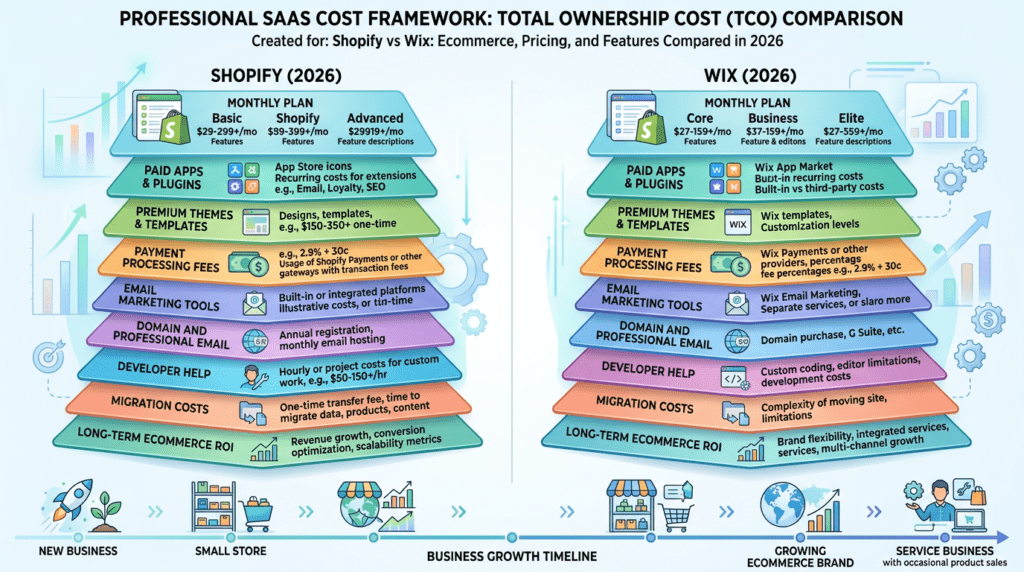
Here are the main costs that often show up later:
- Paid apps and integrations
- Premium templates or themes
- Email marketing tools
- Payment processing fees
- Domain and email costs
- Developer or designer help
- Migration costs if switching later
The last one is easy to overlook. If you outgrow a platform and move away later, you may pay for redesign work, redirects, content cleanup, and store migration. That can be a real cost, not just a technical headache.
The more complicated your business gets, the more these extras matter. A solo creator with a few products may never notice them much. An ecommerce team running multiple campaigns probably will.
Shopify Vs Wix Value For Money By Business Stage
Value for money changes a lot depending on where the business is right now. A platform can be a poor fit in one stage and a smart buy in another.
| Category | New Business Validating an Idea | Small Business Selling a Few Products | Growing Ecommerce Brand | Service Business With Occasional Product Sales |
|---|---|---|---|---|
| Best short-term value | Wix | Wix | Shopify | Wix |
| Best long-term value | Depends on growth path | Depends on catalog complexity | Shopify | Wix |
| Main reason | Lower upfront cost and simpler setup | Enough features without overpaying | Better ROI when sales operations get serious | Website-first tools matter more than commerce depth |
| Biggest risk | Outgrowing the setup later | Paying for tools you don’t need | Higher total cost if sales stay small | Overpaying for ecommerce depth you won’t use |
For a new business, Wix often makes more sense because it reduces upfront pressure. If you’re still testing offers, traffic, and conversion, paying for a heavier ecommerce stack can be premature.
For a small business selling just a few products, Wix can still hold up well if the store stays simple. The risk is that the business grows faster than the platform setup, and then the migration cost hits later.
For a growing ecommerce brand, Shopify usually starts making more sense because the extra spend can be tied to revenue, not just tools. Once order volume, shipping complexity, and sales channels expand, the cost feels more like infrastructure than overhead.
For a service business that only sells a few digital products or add-ons, Wix often delivers better value. In that case, the website matters more than the store, so a lighter setup is usually the smarter spend.
Pricing Winner: Wix For Lower Cost, Shopify For Ecommerce ROI
Wix usually wins if your main goal is keeping monthly costs lower. Shopify can still be the better value when ecommerce is producing enough revenue to justify the higher total spend. So the real question isn’t just which platform costs less. It’s which one pays off more for the kind of business you’re running.
Shopify Vs Wix Ease Of Use And Website Building Experience
Wix Is More User-Friendly For Beginners
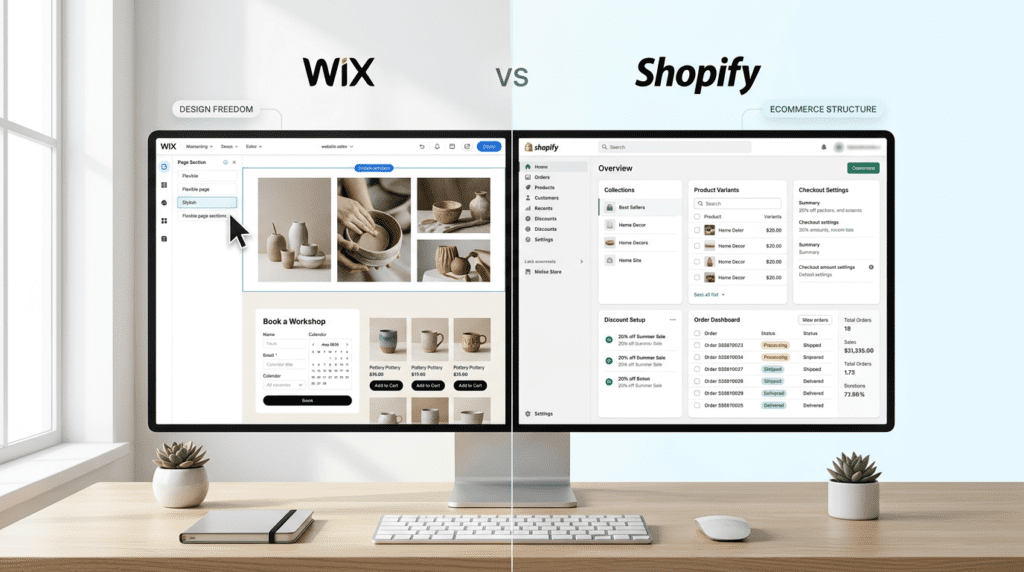
Wix is usually easier for beginners because it feels familiar right away. The drag-and-drop editor gives users a lot of control without making them think too hard about ecommerce structure. That matters more than people expect, especially for freelancers, local businesses, and first-time site owners who just want to get something live.
The template and onboarding experience also lowers the barrier to entry. You can build a Wix site without knowing much about product architecture, shipping rules, or catalog setup. That’s one reason Wix and Shopify attract different types of users even before pricing enters the conversation.
The trade-off is that this freedom can create messy websites if someone keeps moving things around without a plan. It’s easy to overdesign or make pages inconsistent. Beginners often enjoy that flexibility at first, then later wish there were more guardrails.
Shopify Is Easier For Managing Ecommerce Workflows
Shopify is not as freeform, and that’s part of the point. It is built for store operations, so the platform tends to guide you toward product pages, collections, checkout, inventory, and sales channels. Once you accept that structure, daily ecommerce tasks get easier to manage.
That difference matters when you’re running an actual online store, not just a website with a buy button. Adding products, updating variants, tracking orders, and managing discounts feels more organized in Shopify. It can take a little more time to learn up front, but the workflow usually gets smoother as the store grows.
A common mistake is assuming “easier” always means less clicking. Sometimes the better system is the one that reduces confusion later. Shopify is often that system for ecommerce teams because it keeps the store logic more consistent.
Design Flexibility And Template Control
Wix gives you more visual freedom, which is great when your site needs to look custom without hiring a designer. You can shape the layout around your brand story, service pages, or content-heavy homepage. For agencies, creators, and local businesses, that flexibility can be a big advantage.
Shopify themes are more structured. That can feel limiting at first, but it also keeps store pages focused on conversion behavior. Product grids, cart flows, and mobile shopping tend to stay cleaner because the design system is built around shopping first.
Here’s the trade-off in plain terms:
- Use Wix if you care more about visual control
- Use Shopify if you care more about consistent ecommerce structure
Neither approach is perfect for everyone. Wix can feel more creative but also more open to mistakes. Shopify can feel more rigid, but that rigidity helps once sales matter.
Setup Time For A Beginner
Setup time depends on what you’re actually trying to launch.
- A simple Wix business website can often go live faster because the pages are straightforward
- A simple Wix online store still takes time, but the process stays fairly approachable
- A Shopify store usually takes longer because you’re setting up products, payments, shipping, taxes, and policies in a more complete way
Beginners often underestimate how long store setup takes, especially if they need product photos, shipping rules, and legal pages. Shopify makes more sense when you’re ready to do that work properly. Wix is easier when you want to launch quickly and refine later.
Ease Of Use Winner: Wix For Building, Shopify For Selling
On pure website building, Wix is easier for most beginners. On ecommerce operations, Shopify becomes easier to live with over time. That split is the real difference between the two platforms.
Shopify Vs Wix Features, Marketing Tools, And Advanced Features
Core Website Features
Both platforms cover the basics, but they don’t shine in the same places. Wix is often stronger for general website tasks like pages, image galleries, forms, menus, blogs, and appointment booking. That makes it a natural fit for service businesses, consultants, and local brands that need more than just a store.
Shopify also handles core pages and blogging, but those tools are clearly secondary to commerce. If you’re building a content-first site, Shopify can do the job, yet it rarely feels as natural as Wix. That difference matters for businesses where the website itself drives leads, not just product sales.
For example, a marketing consultant with a few digital products may find Wix more comfortable. A DTC brand with 80 products and regular promos will usually care more about store structure than page-building freedom.
Ecommerce Marketing Features
Shopify and Wix both support common sales tools like discount codes, abandoned cart recovery, and product promotions. The gap shows up once you start stacking marketing tactics together. Shopify offers a deeper ecommerce marketing ecosystem, especially when you add apps for upsells, cross-sells, subscriptions, and retention.
Wix includes useful marketing features too, but many users hit its ceiling sooner. That’s fine for a small catalog or a business that sells occasionally. It’s less ideal when you’re trying to build repeat purchase behavior, segment customers aggressively, or run more advanced promotions.
One thing people overestimate is how much a single built-in feature matters. The bigger question is whether the platform can support the whole marketing workflow. Shopify usually has more room for that long-term.
SEO Features On Shopify And Wix
Both platforms can support search traffic, but the outcome depends more on execution than platform branding. You can edit metadata, create content, build landing pages, and manage redirects on both. Shopify and Wix also support SEO-friendly content structures if you set them up well.
The practical difference is in consistency and site behavior. Shopify’s structure can be easier to scale when you have many products and collections, while Wix may feel more flexible for page-level content and service pages. Neither one guarantees rankings. Weak content, bad internal linking, and slow pages can hurt either platform.
What often gets ignored is maintenance. As a site grows, SEO gets harder to manage because you’re handling more pages, more redirects, and more overlapping content. That’s where the platform’s organization starts to matter.
Advanced Features For Growing Businesses
This is where Shopify and Wix really start to separate. Shopify generally gives growing ecommerce businesses more room to expand into automation, customer segmentation, B2B selling, international selling, POS, wholesale, subscriptions, and reporting. It also integrates well with a large app ecosystem when the built-in tools are not enough.
Wix has grown a lot, and Wix Studio plus the Wix app ecosystem give users more options than before. But the advanced feature set still tends to be broader on Shopify, especially for businesses with a serious store operation. That’s why Shopify users often stay longer once the business becomes dependent on ecommerce.
A lot of beginners don’t think about future complexity. Then they hit it. Common pain points include:
- needing better inventory workflows
- wanting more automation
- running multiple sales channels
- handling international orders
- adding staff roles and approvals
Those are the moments when “good enough” stops being enough.
Feature Winner: Shopify For Commerce, Wix For General Websites
If the site is mostly about content, brand, or services, Wix usually feels more complete. If the site is built to sell and scale, Shopify takes the lead. That’s the simplest way to think about the features gap.
Shopify Vs Wix Performance, Scalability, And Reliability
Site Speed And Technical Performance
Both Shopify and Wix are hosted platforms, so you’re not managing your own server. That makes life easier, but it doesn’t mean every site will feel fast. Speed still depends on how much you add to the site, how large your media files are, and how many third-party scripts you load.
Shopify usually handles storefront performance well, especially when the site is built cleanly and the app count stays under control. Wix can also perform well, but heavy design elements, extra widgets, and too many embeds can slow things down. In other words, neither platform saves you from poor site decisions.
This matters because performance problems often show up later, not on day one. A site can feel fine with a few pages and then become sluggish after more products, more apps, and more content get added. That’s when user experience starts to suffer.
Ecommerce Scalability
Shopify is usually better suited for scale because it’s built to handle more operational complexity. As catalog size, order volume, and sales channels increase, the platform tends to stay more manageable. That includes things like inventory control, fulfillment processes, and multichannel selling.
Wix can absolutely support a legitimate store, but growth can expose its limits faster. The bigger the catalog and the more moving parts you add, the more likely you are to want a system built around commerce from the start. That’s not just about feature count. It’s about how cleanly the whole store runs under pressure.
This is where many businesses make a mistaken bet. They choose a platform for the first 20 products, then discover it feels different at 200 products or 2,000 monthly orders. The site still works, but operations become harder.
Security, Hosting, And Maintenance
Since both are hosted platforms, users get several practical advantages without running separate infrastructure:
- SSL
- Platform updates
- Hosting included
- Checkout security
- Reduced technical maintenance
That simplicity is a big reason small businesses choose either wix and shopify instead of self-hosted software. You don’t need to patch servers or manage hosting on your own.
The day-to-day difference is mostly about admin burden. With either platform, you spend less time on technical upkeep and more time on content, products, and sales. For owners who don’t want to manage hosting, that’s a real benefit. It also means you’re dependent on the platform’s rules and limits, which is the trade-off for convenience.
Performance Winner: Shopify For Ecommerce Scale
For larger stores and more demanding ecommerce workflows, Shopify is the safer bet. Wix can work well for smaller sites, but Shopify is better equipped for scale, consistency, and store reliability as operations grow.
Shopify Vs Wix Integrations, Apps, And Customer Support
Shopify Integrations And App Marketplace
Shopify’s app ecosystem is one of the biggest reasons growing brands stay with it. If you run a store long enough, you usually outgrow the basic setup and need tools for accounting, shipping, reviews, subscriptions, analytics, or marketplace syncing. That’s where Shopify tends to pull ahead.
The Shopify app store covers a wide range of ecommerce jobs:
- Accounting and bookkeeping
- Email marketing
- Shipping and fulfillment
- Dropshipping
- Product reviews
- Subscriptions
- Analytics
- Marketplaces
- POS
In practice, this matters because most stores don’t stay simple for long. A small brand might start with a basic catalog, then later need a better upsell app, a returns tool, or tighter inventory syncing across sales channels. Shopify makes that growth path easier because many integrations are built with ecommerce workflows in mind.
That said, the app ecosystem can become a problem if you install too much. Beginners often assume more apps mean more power, but every extra app can add cost, slow the site, or create conflicts. The real advantage isn’t just having more apps. It’s having more reliable options when your store gets more complex.
Wix Integrations And App Market
Wix also has a useful app marketplace, but it serves a different kind of business. The Wix app market is strong for bookings, forms, events, chat, marketing, restaurants, and local service add-ons. It’s often a better fit for a Wix site that needs a few business tools around a main website.
Wix provides plenty for light commerce and local operations. You can extend a Wix store with apps for simple ecommerce, but the ecosystem isn’t as deep for advanced selling workflows. That’s the main difference between Wix and Shopify at this level.
Where Wix excels is convenience. A florist, consultant, photographer, or gym might only need a few extra features beyond the core site. In those cases, the Wix app store is usually enough. But if you’re trying to run a more serious ecommerce operation, you may notice the limits sooner than you expect.
The common mistake is choosing Wix because it can do “a little ecommerce,” then later needing more specialized tools for fulfillment, reporting, or multichannel sales. That’s when users start comparing Wix vs Shopify all over again.
Customer Support Comparison
Support matters more than most buyers expect. When a store breaks, the issue usually isn’t design. It’s checkout, shipping, payments, taxes, or an app conflict. That’s why the quality of help can affect revenue, not just convenience.
Shopify support tends to be more commerce-focused. That’s useful if you need help with products, checkout settings, payment setup, or shipping rules. Shopify users often benefit from this because the platform is built around ecommerce from the start.
Wix support is broader. It’s often a better experience for general website-building problems, template questions, and content management issues. If you use Wix mainly for a business website with a small store attached, that broader support style may be enough.
The downside is that support quality can feel different depending on what you’re trying to solve. A beginner asking about design changes may do fine on either platform. A store owner dealing with inventory, payments, or a fulfillment workflow usually has a smoother path on Shopify.
Reporting And Analytics Integrations
Reporting becomes more important as soon as you stop guessing and start making decisions from data. If you sell 20 products or 2,000, you need to know what’s moving, what’s stale, where traffic comes from, and which campaigns actually generate sales.
Shopify generally offers deeper ecommerce reporting, especially as you move into paid apps, sales channels, and larger catalogs. It also integrates well with outside analytics and marketing tools. That matters for businesses that want a clearer view of revenue by product, channel, or customer segment.
Wix includes solid basic analytics and can connect to third-party tools too. For a small business site, that may be perfectly fine. But once your store grows, reporting depth starts to matter more. If you’re trying to improve conversion rates, manage inventory, or measure ad performance, shallow data gets frustrating fast.
This is one of those features people underestimate. At first, basic charts seem enough. Later, they’re not.
Integrations And Support Winner: Shopify For Ecommerce, Wix For Simpler Websites
If your business depends on integrations, automation, and store operations, Shopify takes the lead. If you mainly need a straightforward site with a few business tools, Wix is usually easier to live with.
—
Shopify Vs Wix Pros And Cons
Shopify Pros
Shopify offers a lot to like if your business is built around selling online.
- Strong ecommerce features
- Scales better for growing stores
- Large app ecosystem
- Better checkout and selling workflows
- Strong multichannel selling
- More advanced inventory and fulfillment options
The biggest long-term benefit is structure. Shopify is built for commerce, so many of the messy parts of selling online are already organized for you. That can save time once orders start coming in regularly.
Shopify Cons
Shopify also has real trade-offs.
- Higher long-term pricing
- App costs can add up
- Less flexible visual editor than Wix
- May be more platform than some small businesses need
- Third-party transaction fees if not using Shopify Payments
The issue isn’t just cost. It’s complexity. Many beginners overestimate how many Shopify features they’ll use right away. Then they end up paying for apps and upgrades before the store is really ready for them. If you only need a simple site and a few products, Shopify can feel heavier than necessary.
Wix Pros
Wix is appealing for a different set of reasons.
- Very user-friendly
- Flexible drag-and-drop design
- Lower starting cost
- Good for small business websites
- Strong templates and built-in tools
- Easier for service businesses, portfolios, and local brands
For many users, Wix is easier to understand on day one. That matters. A local business owner or freelancer usually wants to launch quickly, manage content without stress, and avoid a steep learning curve. Wix provides that kind of experience better than Shopify.
Wix Cons
Wix also has limitations that become clearer as a business grows.
- Less powerful for advanced ecommerce
- Can become limiting for scaling stores
- Fewer specialized ecommerce integrations
- Less robust inventory and fulfillment ecosystem
- Migration can be difficult if business needs change later
The biggest risk is starting with Wix because it feels simpler, then realizing later that you need a more capable ecommerce platform. That switch can be painful, especially if you’ve built traffic, collected customer data, and structured your site around the old setup.
—
Shopify Vs Wix Use Cases: Which Platform Fits Your Business?
Best For Small Business Websites
Wix is often the better choice for businesses that need a website first and an online store second. Think restaurants, salons, consultants, photographers, local service providers, and portfolio sites.
For these users, the website usually supports the business rather than driving all of it. They need pages, contact forms, bookings, and maybe a small store for a few products or gift cards. Shopify can do some of that, but it’s usually more platform than they need.
Best For Ecommerce Stores
If the business model depends on product sales, Shopify is the stronger fit. That includes DTC brands, online stores, dropshipping businesses, subscription products, and merchants who expect order volume to grow.
Shopify is built for ecommerce from the ground up. That shows up in product management, checkout, shipping, sales channels, and the Shopify app store. If you’re trying to run a serious online store, use Shopify.
Best For Creators And Service Providers
Creators and service providers sit in the middle. They may sell digital products, coaching, memberships, consultations, or a few physical products. Either Wix or Shopify can work here, but the better choice depends on how central commerce is.
Use Wix if:
- Your main need is a strong website
- You sell a few products or services
- You want simpler setup and design control
Use Shopify if:
- Sales are becoming a real revenue stream
- You expect to add more products over time
- You need stronger ecommerce automation or reporting
For a course creator selling one course and a few downloads, Wix may be enough. For a creator building a real store with bundles, upsells, and repeat purchases, Shopify usually becomes the better long-term fit.
Best For Beginners
Beginners often assume the easier platform is always the better one. It’s not that simple.
Wix is easier at the start. Shopify is often easier later if your goal is an actual ecommerce business. That’s the key difference.
If you’re just learning how to launch a site, Wix may feel more comfortable. If you’re learning how to sell online, manage orders, and grow revenue, Shopify’s structure can be more helpful over time. The learning curve is steeper, but the business workflow is cleaner.
Best For Growing Companies
This is where the decision starts to matter more. Once a business grows, the platform has to handle more than just pages and products. You start needing automation, team access, reporting, shipping logic, inventory controls, and better integrations.
Shopify is usually the better choice for growing companies because it handles that complexity more naturally. Wix can still work, but the business may eventually run into friction. That friction shows up in manual tasks, limited workflows, or workarounds that don’t scale well.
If you know growth is coming, it’s worth thinking beyond launch day.
—
Honest Trade-Offs: What Most People Miss When Choosing Shopify Or Wix
The Cheapest Option May Not Be The Best Value
A lower monthly bill doesn’t always mean lower total cost. Wix is generally the cheaper starting point, but Shopify can create better value if your business depends on ecommerce performance and operational efficiency.
That’s the trap. People compare plan prices and stop there. But the real question is whether the platform helps you make more money, save time, or avoid migration later. For a business that sells regularly, paying more for Shopify may be worth it. For a service business with a small store, it may not be.
Design Freedom Can Create Maintenance Problems
Wix gives you more freedom on the page. That sounds great until you need consistency across dozens of pages or products.
A flexible editor can lead to uneven layouts, messy mobile views, or pages that are hard to standardize later. This is especially common when beginners build everything themselves. At first, it feels empowering. Over time, it can turn into maintenance work.
Shopify is more structured, which can feel restrictive. But that structure often helps stores stay cleaner and more conversion-focused as they grow.
Ecommerce Complexity Usually Increases Over Time
Most businesses start simple. Then they add subscriptions, bundles, international shipping, sales channels, automation, and more detailed reporting. That’s normal.
The problem is that a platform that works well at the start may not keep up later. Wix can handle basic ecommerce, but complex store needs often push users toward Shopify. That’s why it’s smart to choose based on the business you expect to have in 12 to 24 months, not just the one you have today.
Switching Platforms Later Can Be Painful
Moving from one platform to another is never just a design project. You have to think about products, URLs, SEO, customer records, order history, app replacements, and downtime risk.
Common migration pain points include:
- Product data cleanup
- URL redirects
- SEO losses during transition
- Customer account handling
- Rebuilding page layouts
- Replacing apps and automations
- Re-testing checkout and shipping settings
If you already know your store will need advanced ecommerce later, switching early can save a lot of frustration. If you’re unsure, the safer path is to choose the platform that fits your likely growth path, not just your current workload.
When To Consider Shopify Or Wix Alternatives
There are cases where neither platform is the perfect fit.
You may want an alternative if:
- You want WordPress-level ownership and customization
- You need enterprise ecommerce
- You want marketplace-first selling
- You need a very low-cost starter option
That doesn’t mean Shopify and Wix are bad choices. It just means the best tool depends on the business model. For most users, one of these two platforms will still be the more practical option.
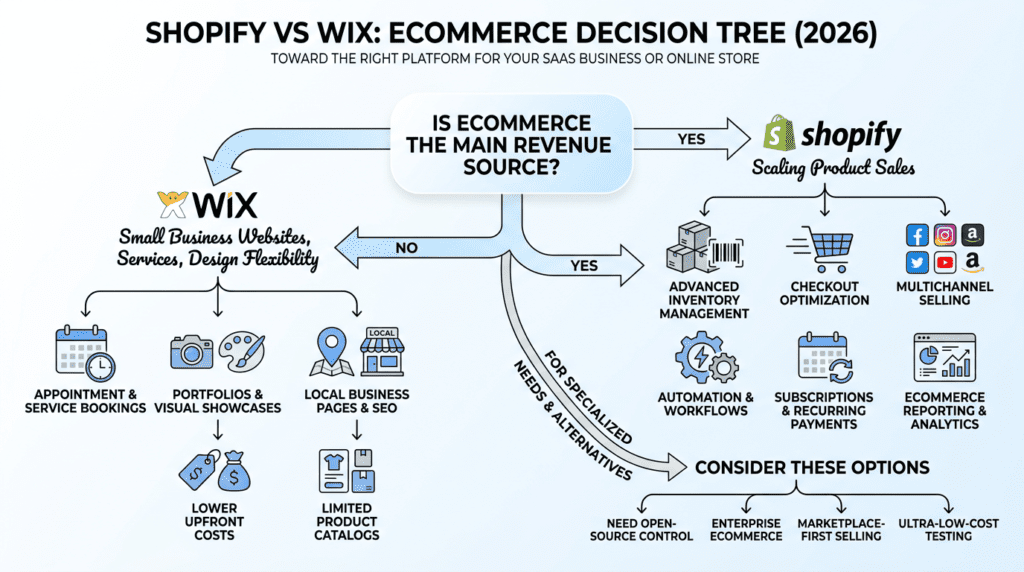
Shopify Vs Wix Decision Guide: Which Should You Choose?
Choose Shopify If…
Choose Shopify if ecommerce is your main business model and your store needs room to grow.
It is the better fit when you:
- Plan to scale product sales
- Need stronger inventory or fulfillment tools
- Want deeper ecommerce integrations
- Care about checkout optimization
- Expect to use automation, subscriptions, or multichannel selling
Choose Wix If…
Choose Wix if you want a simpler website builder and your site is more about presence than complex selling.
It is the better fit when you:
- Run a small business or service business
- Need a user-friendly setup
- Sell only a limited number of products
- Value design flexibility more than advanced ecommerce
- Want lower upfront costs
- Need bookings, portfolios, menus, or local business pages
Choose Neither If…
Choose neither if your needs fall outside what either platform does best.
Consider another option if you:
- Need full open-source control
- Already rely on a complex WordPress setup
- Need enterprise-level custom ecommerce
- Sell mostly through marketplaces
- Want the absolute cheapest way to test an idea
Quick Decision Checklist
Use this quick checklist to narrow it down:
- Is ecommerce your main revenue source?
- Will you sell more than a handful of products?
- Do you need advanced shipping or inventory?
- Is design freedom more important than selling tools?
- Will you need third-party integrations?
- Are you optimizing for upfront cost or long-term growth?
If most answers point to selling and scaling, Shopify is the safer choice. If they point to website-first simplicity, Wix is usually enough.
—
Final Recommendation: Shopify Vs Wix Winner For 2026
Overall Winner For Ecommerce: Shopify
Shopify is the stronger choice for businesses where online selling is central to the model.
Its advantages in ecommerce features, integrations, checkout, scalability, and advanced selling tools make it the better platform for stores that expect to grow.
Overall Winner For Simple Business Websites: Wix
Wix is the better choice for users who want a user-friendly builder, more creative control, and a polished small business website with optional ecommerce.
It works especially well when the website supports the business rather than drives the entire business.
Best Value Recommendation
Wix usually offers better upfront affordability, while Shopify often delivers better long-term value for ecommerce-focused businesses.
That comes down to fit: cheaper is not always better if the platform slows down growth later.
Final Bottom Line
Pick Shopify if you are building an online store.
Pick Wix if you are building a website that may also sell products or services.
—
FAQs About Shopify Vs Wix
Is Shopify Better Than Wix For Ecommerce?
Yes, Shopify is generally better for ecommerce because it is built specifically for online selling, inventory, checkout, payments, and store growth.
Is Wix Cheaper Than Shopify?
Usually, yes at the start, but total cost depends on apps, payment fees, premium features, email tools, and whether your site later needs more advanced ecommerce capabilities.
Which Is Easier To Use, Shopify Or Wix?
Wix is usually easier for building and designing a website, while Shopify is often easier for managing ecommerce operations once the store is running.
Can A Small Business Use Shopify Or Wix?
Yes, both can work for small businesses, but the right choice depends on whether the business is product-led or website, content, or service-led.
Does Shopify Or Wix Have Better Customer Support?
Both offer support, but Shopify support is typically stronger for ecommerce-specific issues, while Wix support is more helpful for general website-building questions.
Which Platform Has Better Integrations?
Shopify generally has better ecommerce integrations, while Wix has useful integrations for general small business websites, bookings, forms, and marketing.
Can You Switch From Wix To Shopify Later?
Yes, but switching can involve product migration, SEO redirects, design rebuilding, app replacement, and possible downtime.
Is Wix Good Enough For An Online Store?
Yes, for simple online stores, small catalogs, local businesses, digital products, and light ecommerce. It can become limiting for larger or more complex stores.
Which Platform Performs Better As A Business Grows?
Shopify usually performs better for ecommerce growth because it has stronger scalability, apps, automation, analytics, and fulfillment options.