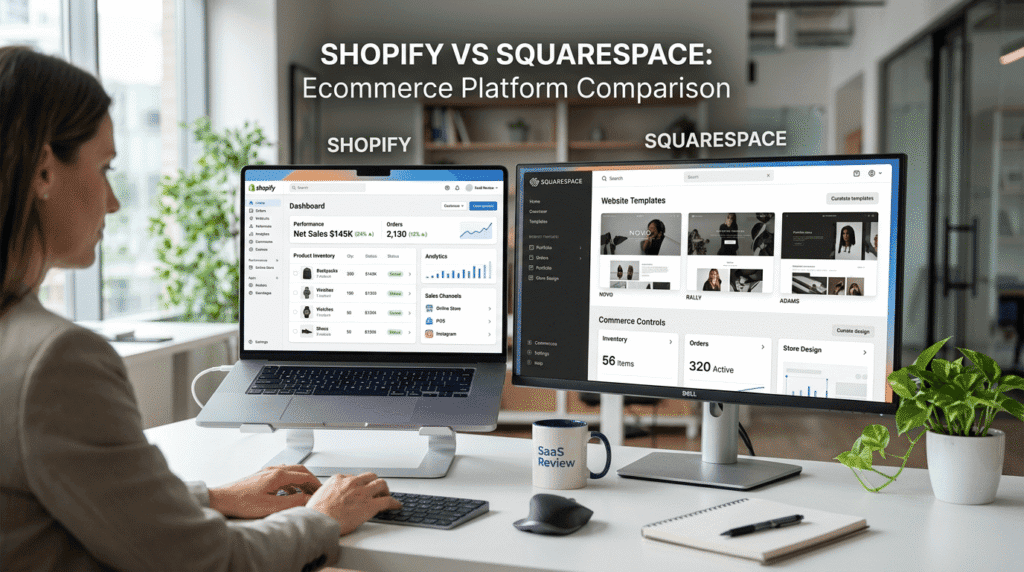
A lot of business owners hit the same wall: they want to sell online, but they also want a site that looks polished without becoming hard to manage. That’s where the Shopify Vs Squarespace decision gets real. Shopify is built first for ecommerce, while Squarespace is built first for design, with ecommerce features layered in.
That difference matters more as your store grows. A small brand selling a few products may care most about simplicity and visual control. A larger store may care more about inventory, checkout, shipping, and integrations. In this Shopify vs Squarespace comparison, we’ll look at pricing, features, ease of use, design, integrations, support, performance, and the best fit for different business needs in 2026.
Quick Verdict: Shopify vs Squarespace
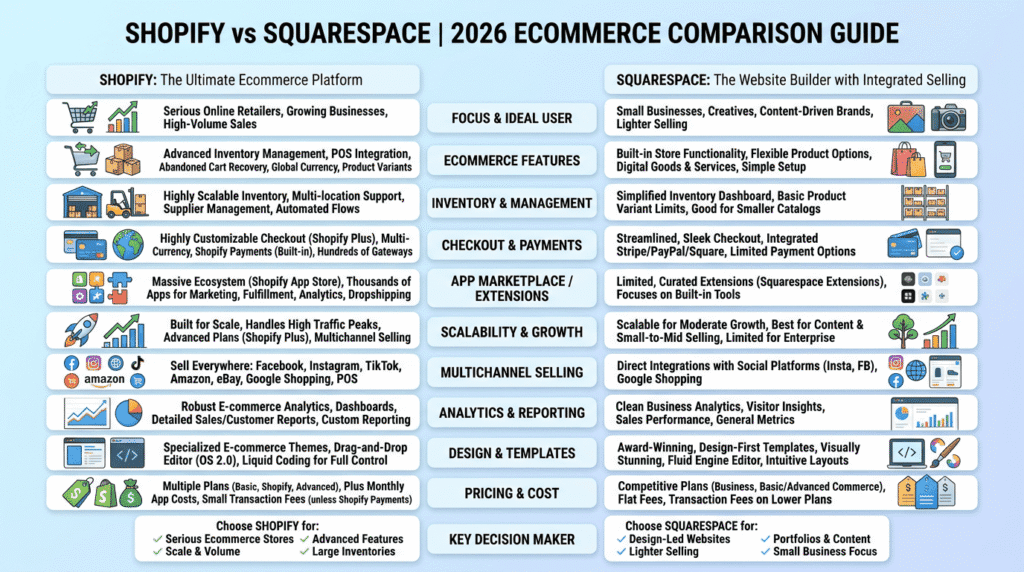
Complete Verdict Table
| Category | Shopify | Squarespace | Better Choice |
|---|---|---|---|
| Ecommerce features | Advanced selling tools, inventory, checkout, apps | Solid basics for smaller stores | Shopify |
| Design | Good themes, ecommerce-focused | Excellent templates and visual editing | Squarespace |
| Ease of use | Easy, but more ecommerce settings | Very user-friendly for simple sites | Squarespace |
| Pricing | Higher long-term cost, app expenses | Lower entry cost, fewer ecommerce extras | Depends |
| Integrations | Large app marketplace | Smaller integration ecosystem | Shopify |
| Scalability | Better for growth and larger stores | Better for smaller catalogs | Shopify |
| Value for money | Strong if ecommerce is core | Strong if design + simple selling matters | Depends |
Best For
- Shopify: ecommerce brands, growing online stores, dropshipping, multichannel sellers, and businesses that need advanced functionality.
- Squarespace: small business websites, service providers, creators, portfolios, restaurants, and simple stores that care about design.
Not Ideal For
- Shopify may be overkill for businesses selling only a few products.
- Squarespace may feel limiting for complex ecommerce, large inventories, or advanced automation.
Bottom Line
Use Shopify if selling online is the main part of your business. Use Squarespace if you want a beautiful, easy-to-manage website with light-to-moderate ecommerce built in.
Shopify vs Squarespace Ecommerce Features Compared
Product Management, Inventory, and Variants
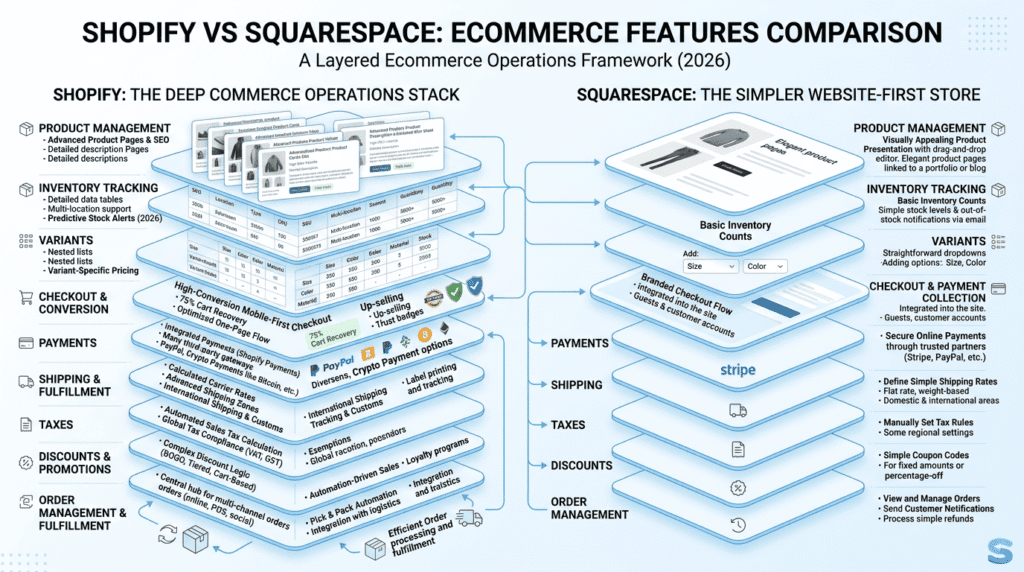
This is where Shopify and Squarespace start to separate in a meaningful way. Shopify was built for ecommerce, so it handles larger catalogs, inventory tracking, product variants, SKUs, and collection organization with less friction. If you’re running a shop with lots of moving parts, that extra structure matters.
Squarespace is simpler, and that’s the point. For a smaller Squarespace store, adding products and managing basic inventory is usually straightforward. It works well when you have a modest catalog and don’t need a lot of operational complexity. A local candle maker, freelance illustrator, or course creator with a few physical products can often manage a Squarespace store without feeling buried in settings.
The trade-off shows up as the business grows. Once you’re juggling size options, variants, seasonal products, bundles, or repeated stock changes, Shopify tends to feel more organized. Shopify users also get more room to expand product workflows without rebuilding the store later. Squarespace still works for ecommerce, but it’s easier to outgrow.
Where Shopify Is Better for Inventory
Shopify gives you more control over inventory as your business gets more serious. You can manage product variations more cleanly, keep track of stock across a larger store, and organize products in ways that fit a growing ecommerce operation. That matters if you sell apparel, supplements, beauty products, or anything with multiple sizes and colors.
Where Squarespace Is Easier for Small Stores
Squarespace is often easier for beginners because there are fewer moving parts. You’re not dealing with as many ecommerce settings, so the setup feels lighter. For someone launching a simple online store as part of a broader website, that ease of use can be a real advantage.
Checkout, Payments, and Transaction Fees
Checkout is one of the biggest differences in the Shopify vs Squarespace comparison. Shopify’s checkout is built to support ecommerce at scale, and that becomes important fast. It supports Shopify Payments in eligible regions, third-party gateways, abandoned cart recovery, and a checkout experience that is designed to convert.
Squarespace also supports online selling, but the payment setup is more limited in scope. For smaller stores, that may be enough. If you’re only processing a few orders each week, you may not care about advanced checkout behavior right away. But once order volume rises, the details start to matter.
Transaction fees can also change the math. Shopify pricing can look higher at first, but the real cost depends on whether you use Shopify Payments, what plan you’re on, and how much you rely on paid apps. Squarespace may appear simpler on paper, but if its ecommerce functionality doesn’t meet your needs, the cost of working around those limits can show up later in lost time or missed sales.
Why Checkout Matters More Than Most Buyers Expect
A lot of first-time store owners focus on design and ignore checkout. That’s a mistake. A smoother checkout can reduce cart abandonment, especially if you sell products with repeat buyers. Shopify usually gives you more room to improve that process over time.
Who Should Care Most
- Use Shopify if checkout optimization is a priority.
- Use Squarespace if you want basic payment collection without a lot of setup.
- Be cautious if you expect to scale sales quickly, because checkout limitations are harder to fix later than design issues.
Shipping, Taxes, Discounts, and Order Management
For operations, Shopify is usually the stronger ecommerce platform. It gives you more flexible shipping rules, tax settings, discount logic, and order workflows. That matters if you need to handle different shipping zones, coupon strategies, fulfillment steps, or changing tax requirements.
Squarespace keeps things simpler, which can be a plus for straightforward businesses. If you’re selling a small product line or offering a handful of items with simple shipping, you may not need more. But that simplicity comes with limits. As soon as you need layered discount rules, more detailed fulfillment processes, or more advanced order management, Shopify starts to pull ahead.
In practical terms, Shopify is the better choice for stores that want ecommerce operations to feel organized instead of improvised. Squarespace is fine when the store is an extension of the website. Shopify is better when the store is the business.
Shopify’s Operational Edge
Shopify offers more tools that support day-to-day ecommerce work, not just storefront design. That includes better handling of shipping configurations, discount setups, and order processing. For merchants who ship often, that difference saves time.
When Squarespace Still Makes Sense
Squarespace is still a reasonable choice if you only need basic shipping and simple promotions. A small local bakery taking online orders or a service business selling a few add-ons may not need the deeper ecommerce functionality Shopify provides.
Shopify vs Squarespace Pricing and Value for Money
Monthly Plans and What Each Platform Includes
When you compare Shopify Vs Squarespace on price, the real question is what you get at each level, not just the monthly bill. Both platforms offer plans that can work for a new online store, but they package their features very differently.
Shopify is built around ecommerce from the start, so even its entry plans are centered on selling. That means you’re paying for an online store engine first, with tools like checkout, product management, shipping support, and payment handling included in the core experience. As you move up, you usually get stronger reporting, more staff accounts, and better operations tools. For a business that expects to sell steadily, that structure makes sense. For a store that only needs a few products online, it can feel like more platform than you need.
Squarespace takes a different path. Its plans are tied to the broader website builder experience, so you’re not just paying for ecommerce features. You’re also getting design tools, content pages, blogging, and a polished site builder that’s easier to shape into a full brand site. On lower plans, ecommerce is either limited or absent, while the business-focused and commerce-focused tiers unlock selling tools. That means Squarespace is often easier to justify if the store is only one part of the business.
A practical way to think about it:
- Shopify plans make the most sense when the store is the business.
- Squarespace plans make more sense when the website is the business, and ecommerce is part of it.
The included features also affect how far each plan stretches. Shopify often includes stronger ecommerce functionality sooner, but you may need add-ons to match the marketing or content flexibility some users expect. Squarespace tends to give you a more complete-looking site out of the box, but its selling tools are not as deep. That trade-off matters more as the site grows.
If you’re comparing a Shopify plan and a Squarespace plan side by side, don’t stop at the headline price. Look at what each one leaves out. A lower monthly price can still cost more in the long run if you need extra tools to fill gaps.
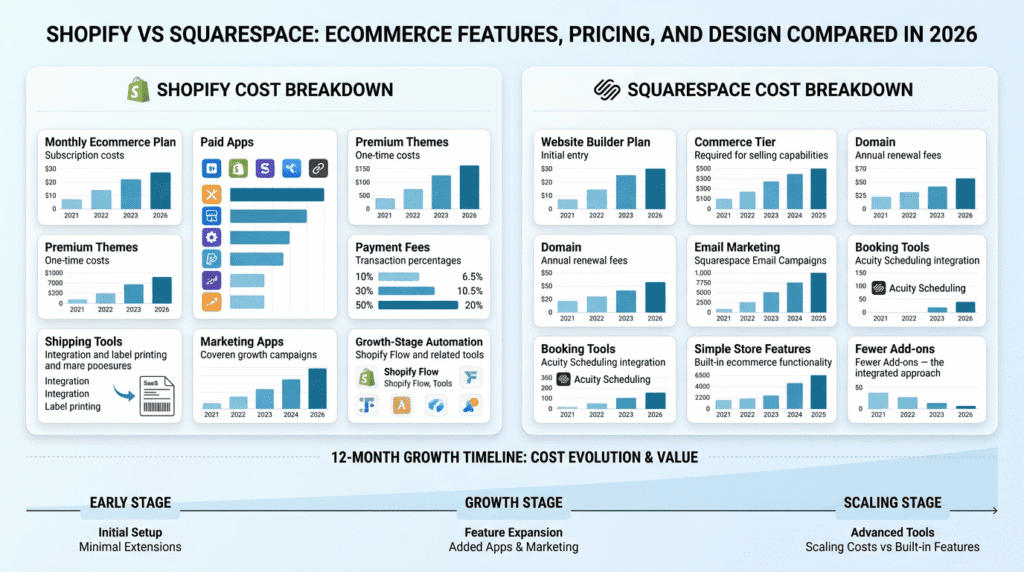
Hidden Costs: Apps, Themes, Domains, and Transaction Fees
This is where many new buyers get surprised. The starting monthly price is only part of the real cost.
On Shopify, the biggest extra expense is usually apps. The Shopify app store is huge, which is great when you need a specific tool, but those apps add up fast. You may pay for email marketing, subscriptions, upsells, product reviews, bundles, CRM tools, shipping automation, or loyalty features. One app might be $9/month, another $29/month, and a third might be $59/month or more. A store that looks simple at launch can quietly become much more expensive once the owner starts adding business-critical features.
Premium themes are another factor. Shopify has free themes, but many serious stores eventually want a more distinctive look or better merchandising control. Paid themes can cost a few hundred dollars upfront. That’s not outrageous, but it’s still part of the real budget.
Squarespace can also carry extra costs, but they usually show up differently. You may spend less on add-ons because the platform covers more basic website needs natively. Still, premium domains, email marketing services, booking tools, scheduling, or third-party widgets can increase the total. Squarespace also has a smaller integration ecosystem, so when users hit a feature gap, they sometimes end up paying outside the platform instead of inside it.
Transaction fees matter too. If you do not use the platform’s preferred payment setup, you may face extra charges on sales. That’s especially important for stores processing higher order volume. Even a small fee difference becomes meaningful when monthly revenue rises. A store doing $10,000 in monthly sales feels that cost very differently from a store doing $500.
Here’s the hidden-cost pattern most owners miss:
- Early stage: monthly plan price matters most.
- Growth stage: apps, themes, and payment fees start to matter more.
- Scaling stage: operational tools and automation can become the biggest line items.
So while Shopify can become more expensive as a store grows, that cost is not random. It usually grows because the business is asking the platform to do more.
Long-Term Value for Small Businesses
For small businesses, value depends less on the platform itself and more on how the business sells.
If you run a product-focused ecommerce brand, Shopify often pays for itself because it supports growth without forcing a rebuild later. That matters for stores planning to expand product lines, test ads, add sales channels, or use more advanced workflows. The platform’s higher cost can be easier to justify when revenue depends on smooth operations. In that case, a few extra monthly dollars are small compared with the time saved on inventory, checkout, and marketing coordination.
If you run a service business, studio, local brand, or creator site with a small store attached, Squarespace can be the better value. You may not need advanced inventory logic or a large app stack. What you need is a clean website, a simple online store, and a low-friction way to manage everything in one place. For those users, paying for a heavier ecommerce platform can be unnecessary.
A useful rule:
- Choose the platform that matches your next 12 months, not just your current week.
That’s where long-term value really shows up. A store owner who starts with Squarespace because the catalog is tiny may later feel boxed in once the business adds more products, shipping rules, or automation needs. On the other hand, a small business that jumps into Shopify too early may spend months paying for features it barely touches.
For many small businesses, the best value comes from avoiding overbuying. The right platform is the one that supports growth without forcing extra tools too soon.
Shopify vs Squarespace Ease of Use and Website Design
Which Platform Is More User-Friendly for Beginners?
For beginners, Squarespace usually feels easier at first. The setup is more visual, the editing is more intuitive, and it’s simpler to get a polished site live without worrying about too many commerce settings. That makes a difference for business owners who want to publish fast and learn as they go.
Shopify is not hard to use, but it asks more of the user up front. The dashboard is organized around products, orders, discounts, shipping, and customer activity. That’s great once you understand the flow, but it can feel heavy if you’re just trying to make a nice-looking site. Many first-time users underestimate how much store setup happens behind the scenes. Products, collections, taxes, shipping zones, and checkout settings all need attention before launch.
That difference becomes obvious in real life:
- A freelancer selling a few digital services may get comfortable with Squarespace in a day.
- A growing ecommerce seller may accept Shopify’s learning curve because the platform handles more moving parts later.
Beginner confusion also shows up in different ways. With Squarespace, users often struggle less with setup and more with deciding how to organize pages or product presentation. With Shopify, the struggle is usually operational: choosing apps, understanding settings, and keeping the store clean as more products and sales channels get added.
So if speed and simplicity matter most right now, Squarespace often wins on ease of use. If you’re willing to spend more time learning a platform that can support a busier online store later, Shopify is still straightforward once the basics click.
Template Quality, Customization, and Brand Presentation
Design is one of the biggest reasons people compare Shopify and Squarespace in the first place. Both offer template-based site building, but the feel is different.
Squarespace is known for polished templates and strong visual structure. It gives brands a cleaner starting point, especially if they care about photography, layout, and a refined look. That’s why it works so well for designers, consultants, restaurants, agencies, and creators who want the site to look premium without hiring a developer right away. The templates are often the fastest path to a professional result.
Shopify themes are more ecommerce-centered. They’re built to help shoppers browse products, compare items, and move through checkout smoothly. That matters a lot for a store with many SKUs or clear merchandising needs. The design can still look sharp, but the visual style often feels more store-first than brand-first.
The trade-off is simple:
- Squarespace gives you more visual elegance out of the box.
- Shopify gives you more structure for selling at scale.
Customization also works differently. Squarespace makes it easy to adjust content and page layout without feeling technical, but there are limits when you want very specific ecommerce behavior. Shopify gives more room to grow, but deeper customization can require apps or development work. That means the brand presentation can become more powerful over time, but not always more convenient.
Mobile responsiveness matters too. Both platforms do well here, but the final result depends on the template and how much custom work you’ve done. A poorly chosen theme can make even a good store feel clunky on mobile. That’s one reason many users overestimate the value of a beautiful demo theme and underestimate how it performs once products, variants, and promotions are added.
Content, Blogging, and Non-Store Pages
This is where Squarespace still stands out for many businesses. It handles content pages, blogs, landing pages, and portfolio-style layouts in a way that feels natural. If your website needs to explain services, tell a brand story, publish articles, or showcase work, Squarespace usually makes that easier.
For a local business, that can mean a homepage, service pages, testimonials, a blog, and a small store all living together without much friction. For a creator, it might mean a clean site with a newsletter signup, event pages, and a few products. For agencies, it often means the site can do double duty as a marketing asset and a sales tool.
Shopify can handle non-store pages, but it’s not as smooth for content-heavy builds. The blogging system is functional, but not as flexible as what many users expect from a full website builder. If content marketing is a major part of your strategy, Shopify may need more help from apps or custom setup. That creates extra work over time, especially if your team is publishing often.
This matters because many businesses start with “just a store” and later realize they need more than product pages. They need educational content, lead generation pages, brand storytelling, and SEO-friendly articles. Squarespace is often stronger early in that kind of setup. Shopify can still do the job, but it’s less natural unless ecommerce is the dominant priority.
Shopify vs Squarespace Advanced Features, Integrations, and Marketing Tools
App Marketplace and Third-Party Integrations
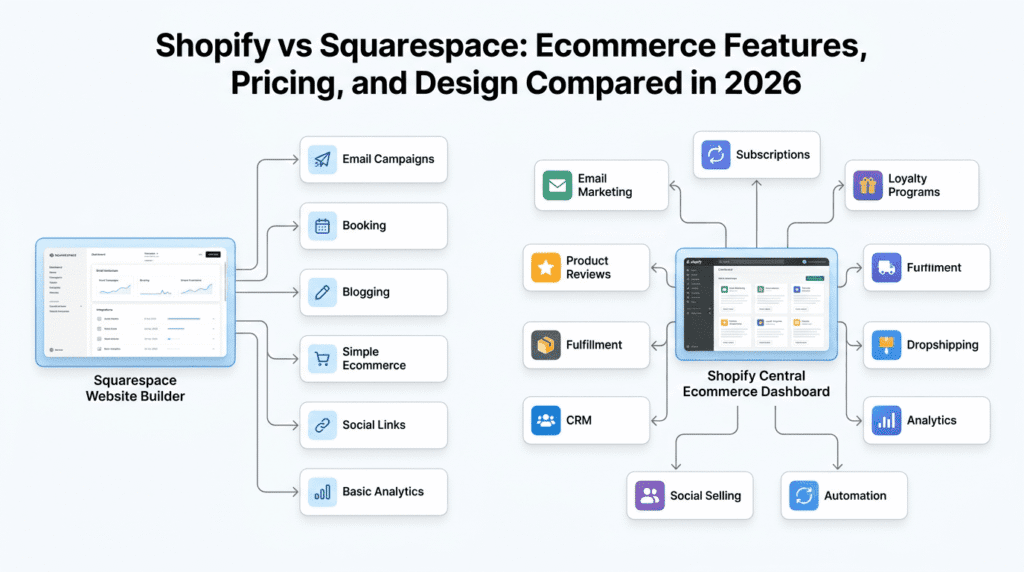
Shopify’s app ecosystem is one of its biggest strengths, and it becomes more valuable as a business grows. The app marketplace gives you options for accounting, subscriptions, reviews, loyalty programs, upsells, fulfillment, dropshipping, CRM, and more. That flexibility is a major reason many growing stores use Shopify. When you need a specific workflow, there’s often a app for it.
Squarespace takes a more restrained approach. It offers integrations, but the ecosystem is smaller and less expansive. That’s fine if you only need a handful of tools. It becomes limiting when your business depends on connecting many systems together.
Here’s the practical difference:
| Category | Shopify | Squarespace |
|---|---|---|
| Best for | Stores that need many specialized tools | Sites that need fewer moving parts |
| Pricing impact | Can rise fast with paid apps | Often stays simpler |
| Workflow flexibility | High | Moderate |
| Scaling usefulness | Strong for growth | Better for basic operations |
| Risk | App overload and monthly creep | Hitting feature limits sooner |
The hidden frustration with Shopify is not lack of options. It’s too many options. Beginners can overinstall apps and end up with a messy stack that slows the site or complicates support. Squarespace’s smaller ecosystem avoids some of that chaos, but you may feel the wall sooner if the business gets more complex.
SEO, Email Marketing, and Social Selling Features
Both platforms support ecommerce marketing, but they push it in different ways.
Squarespace does well when content and presentation are part of the marketing plan. It gives users a clean website, decent page structure, and enough SEO control for many small businesses. That can be enough for a service brand, a boutique, or a small product catalog that relies on strong visuals and straightforward content.
Shopify tends to be stronger when the marketing is tied closely to selling. It supports product feeds, sales channels, and ecommerce-focused tools that help merchants move from traffic to order. That matters when a brand sells through multiple places at once, like a website, social media, and marketplaces.
Email marketing is another area where the experience diverges. Shopify users often lean on apps or native tools like Shopify Email to handle campaigns and automation. That gives flexibility, but the setup can feel fragmented if you’re not used to managing several tools. Squarespace also offers email marketing options, and for smaller businesses that want a simple all-in-one flow, that can be appealing. But once campaigns become more advanced, both platforms may still push you toward external services.
Social selling is stronger on Shopify, especially for product-first businesses. If you want to use social platforms as real sales channels rather than just traffic sources, Shopify usually has the edge. That’s one reason many ecommerce brands choose it early: the store is built to connect with the rest of the selling stack.
The main misconception here is that “marketing tools” means the same thing on both platforms. It doesn’t. Squarespace is often enough for brand marketing. Shopify is better for sales-driven marketing.
Reporting, Analytics, and Automation
As a business gets more serious about ecommerce, reporting becomes more important than people expect. Early on, owners care about getting the store live. Later, they care about knowing what’s selling, which products are lagging, where customers drop off, and which channels are worth the spend.
Shopify generally gives stronger ecommerce reporting, especially as you move into higher plans or add tools. That makes it easier to track orders, customers, sales performance, and store behavior in a way that supports decision-making. For a growing ecommerce operation, that can save time and reduce guesswork. It also helps when multiple people manage the business.
Automation is where Shopify often becomes more valuable long term. As order volume grows, manual tasks start to hurt. Abandoned cart follow-up, fulfillment triggers, customer tagging, inventory alerts, and segmented marketing can all reduce busywork. Shopify can support that workflow better than a simpler website builder, especially when paired with the right app stack.
Squarespace has reporting and basic automation too, but it’s more limited. That’s usually fine for smaller stores or service businesses that do not need deep ecommerce operations. The challenge comes when the owner wants to understand patterns at scale. At that point, the simpler system can start to feel like a ceiling.
A good way to judge this section is to ask:
- Do you need to see sales clearly?
- Or do you need to act on sales automatically?
If the answer is both, Shopify is usually the stronger platform. If the answer is mostly “just enough to stay organized,” Squarespace can still be sufficient.
Shopify vs Squarespace Performance, Customer Support, and Scalability
Website Performance and Store Reliability
Both platforms are hosted, so you don’t have to manage servers, security patches, or uptime on your own. That’s a big reason many business owners compare Shopify and Squarespace in the first place. The difference is how much control you get, and how that control affects day-to-day performance.
Shopify is built for ecommerce at scale, which means it’s designed to handle a busy online store with lots of products, traffic spikes, and checkout activity. In normal use, that makes it a strong choice for brands that expect growth. The trade-off is that a Shopify store can get slower if you keep stacking on apps, custom scripts, and heavy page elements. A store with 15 apps and large image files won’t feel as lean as a cleaner setup. That’s not really a Shopify flaw so much as a reality of how flexible platforms work.
Squarespace takes a more controlled approach. Because the environment is tighter, it’s often easier to keep a site looking and feeling consistent. For a small business site or a lighter ecommerce setup, that simplicity helps. Fewer moving parts usually means fewer chances for something to break. The downside is that you also get less room to fine-tune performance as your needs grow.
A simple way to think about it:
- Use Shopify if you care more about long-term ecommerce reliability and growth.
- Use Squarespace if you want a polished site with less setup friction and fewer technical layers.
For most beginners, the hidden frustration is not speed on day one. It’s what happens after the site starts growing. Shopify can become more demanding to manage, but it also gives you more options to improve performance when traffic and sales increase. Squarespace is easier to keep tidy, but it can feel boxed in once you start asking for more from the platform.
Customer Support and Help Resources
Support is one of those topics that looks similar on marketing pages but feels very different when you’re stuck at 9 p.m. trying to fix a checkout issue.
Shopify has the edge here because of its scale. It offers a large help center, community forums, live support options, and a wide ecosystem of experts, developers, and agencies. That matters more than people expect. When you run into a problem that isn’t covered in the docs, the odds are better that someone else has already solved it on Shopify. If you want to hire help later, the marketplace is also much larger, which makes it easier to find someone who knows the platform well.
Squarespace also provides documentation, guides, and customer support, and many users find the platform approachable enough that they need support less often. That’s a real advantage for simple sites. When the setup is straightforward, you may not need a huge support network.
But here’s the catch: when your business gets more complex, support depth starts to matter more. A creator selling a few products might never notice the difference. A store owner managing subscriptions, shipping rules, and multiple sales channels will notice quickly.
In practical terms:
- Shopify support helps most when your store becomes operationally important.
- Squarespace support helps most when you want a cleaner, less technical build process.
One thing buyers often miss is the value of the third-party ecosystem around support. With Shopify, you’re not just buying software. You’re also buying access to a larger pool of specialists. That can save time later, especially if you ever need custom work, troubleshooting, or migration help.
Scalability for Growing Ecommerce Stores
Scalability is where the Shopify vs Squarespace comparison gets very clear.
If you’re starting with 5 or 10 products, both platforms can work. If you’re moving toward 100 products, then 500, then 2,000+, the gap starts to widen. Shopify is usually the better fit because its ecommerce structure is built for volume. You can manage larger catalogs, more complex inventory, more staff involvement, and more tools connected to the store.
Squarespace can absolutely support ecommerce, but it tends to feel better suited to smaller product lines and simpler operations. Once you add more products, more variants, more fulfillment steps, or more integrations, the platform can start to feel restrictive. It’s not that it stops working. It’s that you spend more time working around the platform instead of with it.
Here’s where scalability shows up in real life:
| Category | Shopify | Squarespace |
|---|---|---|
| Catalog growth | Handles large catalogs better | Best for smaller catalogs |
| Fulfillment complexity | Better for multi-step workflows | Better for simpler fulfillment |
| Staff access | Stronger for growing teams | More limited for larger operations |
| Integrations | Broad app ecosystem | Smaller integration range |
| Reporting needs | Better for deeper ecommerce tracking | Fine for basic store reporting |
| Long-term flexibility | Stronger for expansion | More limited for advanced growth |
This matters most for businesses that expect to add channels over time. For example, a small apparel brand may start with a simple site, then later add wholesale, subscriptions, bundled products, retail syncing, and automation. Shopify is better prepared for that path. Squarespace can support a lot of brands early on, but growth eventually exposes the limits.
If you know the store will stay small, Squarespace may be enough. If you’re building something that could become a larger ecommerce operation, Shopify is the safer long-term move.
Real-World Use Cases: Who Should Choose Shopify or Squarespace?
Best Platform for a Small Business Website
For many local businesses, Squarespace is the more practical choice. That includes consultants, photographers, salons, restaurants, coaches, designers, and service providers that need a professional online presence first and an online store second.
Why does Squarespace work so well here? Because most small service businesses don’t need a huge ecommerce engine. They need:
- A clean site
- A few service pages
- A contact form
- Maybe online booking
- Possibly a small shop for merch, gift cards, or downloads
Squarespace keeps all of that fairly simple. The templates look good fast, and the editing process is friendly for non-technical users. That means less time fiddling with settings and more time getting the site live.
Shopify can still work for a small business website, but it often feels like more machine than you need. If your main goal is to look professional and generate leads, not run a product-heavy ecommerce operation, Shopify may add complexity without adding much value.
Use Squarespace if:
- Your site is mostly about services or content
- You only need light ecommerce
- You want a design-first build with minimal setup stress
Use Shopify if:
- Product sales are already central to your business
- You expect the store to become more important soon
- You’re planning to add commerce features over time
Best Platform for a Serious Ecommerce Store
This is where Shopify is the better choice almost every time.
If the business depends on product sales, checkout flow, inventory control, shipping logic, and conversion optimization, Shopify is built for that reality. It gives store owners more room to scale their operations without changing platforms later. That matters because platform changes are expensive, time-consuming, and risky for SEO and sales.
A serious ecommerce store usually needs more than a simple product page. It needs:
- Strong inventory management
- Better discount logic
- Shipping and fulfillment tools
- More app integrations
- Reporting that helps you make decisions
- Support for sales channels beyond the website
Shopify handles those needs better than Squarespace. It’s not just about having more features. It’s about having the structure to use those ecommerce features without constantly running into ceilings.
Squarespace can still support a small brand selling a limited number of products. But if the store is expected to become a real revenue engine, Shopify is the platform that makes more sense from the start.
A good rule of thumb: if you already think in terms of conversion rate, average order value, abandoned carts, and inventory turnover, use Shopify.
Best Platform for Creators, Bloggers, and Digital Products
This category is more nuanced because both Shopify and Squarespace can work, but they solve slightly different problems.
Squarespace is often easier for creators who care about content and presentation. If you sell coaching, downloads, memberships, portfolio work, or digital services, Squarespace gives you a straightforward way to combine content pages, blog posts, and sales pages without making the site feel too commerce-heavy. For many creators, that balance is exactly what they want.
Shopify can also work for digital products and memberships, but it often relies more on apps and extra setup. That isn’t a dealbreaker, but it does mean the platform may feel heavier than necessary if your business is mostly content-led.
Here’s the practical difference:
- Use Squarespace if the brand is centered on articles, pages, visuals, and simple selling.
- Use Shopify if digital products are part of a larger ecommerce plan or if you want stronger store operations around them.
For bloggers and course creators, the biggest mistake is assuming ecommerce power always equals better business fit. It doesn’t. If the store is only one piece of the business, simplicity can be more valuable than depth.
Best Platform for Agencies and Growing Brands
Agencies and growing brands usually need flexibility, which is why Shopify tends to win this segment.
As soon as a business has multiple team members, more complex workflows, or a need for custom reporting and integrations, Shopify becomes easier to build around. The larger app ecosystem, stronger developer support, and broader third-party options make it a better fit for serious growth.
That’s especially true for:
- Ecommerce brands with internal marketing teams
- Agencies managing multiple store builds
- Businesses that need custom integrations
- Brands planning omnichannel selling
- Companies that may want developer help later
Squarespace can still serve a growing brand, but it’s usually better for a brand that wants a good-looking site with manageable ecommerce rather than a platform to build deep operations on top of.
If your team expects to add tools for automation, subscriptions, customer retention, fulfillment, or personalization, Shopify gives you more room to expand without rebuilding everything.
Honest Trade-Offs Most Buyers Miss
Shopify’s Power Comes With More Complexity and Cost
Shopify is often the better ecommerce platform, but that doesn’t mean it’s the easier business decision.
The main thing buyers underestimate is the number of decisions Shopify creates over time. At first, that can feel exciting. You get apps, themes, integrations, and tools for almost everything. But each added layer can create extra cost, more setup work, and more things to maintain.
That becomes a real issue when the store grows. A business that starts with a $39/month or $105/month plan may eventually add:
- A paid email tool
- A subscription app
- A reviews app
- A shipping app
- A bundle app
- A theme upgrade
- Developer help
Before long, the monthly spend can climb far beyond the base plan. This is one reason some smaller businesses feel surprised by Shopify later. The platform itself may still be worth it, but the total cost of running the store is often higher than expected.
Shopify is the better choice if ecommerce is core to revenue. It’s less attractive if you only need a few products on a site and don’t want an expanding stack of tools.
Squarespace’s Simplicity Can Become a Limitation
Squarespace’s biggest strength can also become its biggest problem.
The platform is easy to live with in the early stages. The site looks polished, the setup is manageable, and you don’t have to think about too many moving parts. For a lot of business owners, that’s a relief. But as needs grow, the same simplicity can start to feel restrictive.
What usually happens is this:
- You want a more advanced ecommerce workflow.
- You need a better integration.
- You want more control over product management.
- You need a feature the platform doesn’t handle cleanly.
- You start looking for workarounds or outside tools.
That’s the point where some users realize they’ve outgrown the platform. And the frustrating part is that this doesn’t always happen all at once. It tends to show up as small limitations that accumulate.
Squarespace is best when you value ease of use and design over advanced ecommerce functionality. If you expect your store to stay relatively simple, that’s fine. If you think the business will become more operationally complex, it may feel limiting later.
Migration, Ownership, and Future Flexibility
This is the trade-off most buyers don’t want to think about, but they should.
Switching platforms later is rarely fun. If you start on one platform and move to the other, you’ll likely deal with at least some combination of:
- Product data migration
- URL redirects
- SEO cleanup
- Rebuilding templates or layouts
- Reconnecting integrations
- Reviewing app dependencies
- Updating tracking and analytics
For a small site, that may be manageable. For a larger ecommerce business, it can be a serious project.
That’s why platform fit matters so much upfront. If you expect to stay simple, Squarespace can save time and stress now. If you expect to grow into a more serious ecommerce operation, Shopify may save you from a painful move later.
A smart way to think about it:
- Start with Squarespace if your business is content-led, local, or lightly transactional.
- Start with Shopify if the store is likely to become a main revenue channel.
- Don’t pick based only on how the site feels today. Think about what the business will need in 12 to 24 months.
That long-term view matters more than most people realize. Platform choice is easy to change in theory, but in practice, migrations take time, money, and focus away from the business itself.
Shopify vs Squarespace Decision Guide
Choose Shopify If Ecommerce Is the Main Business Model
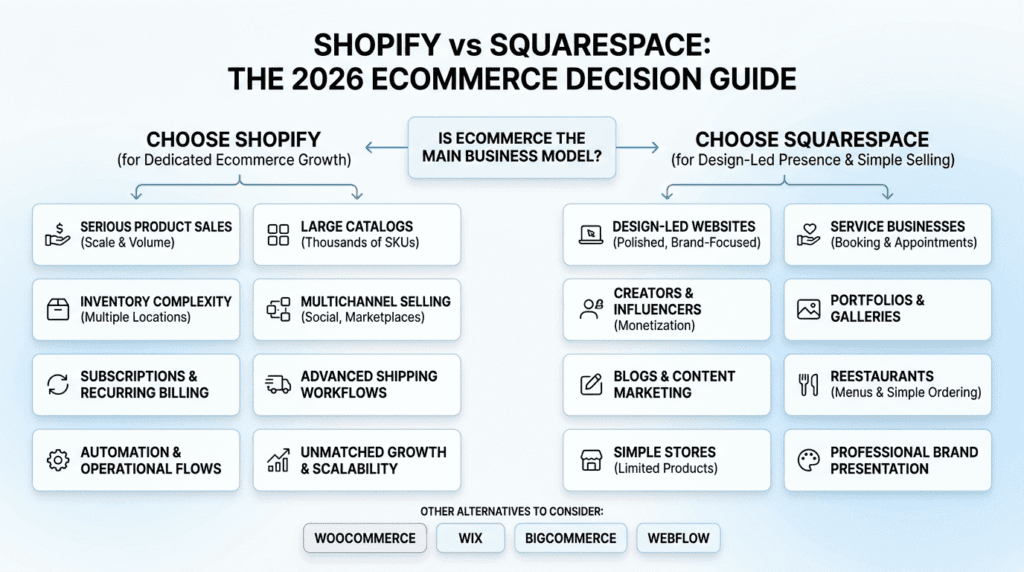
Choose Shopify if your business depends on selling products online and you want a platform built for commerce first. It is the stronger fit when you need multichannel selling, dropshipping, subscriptions, complex shipping rules, larger inventories, or workflows that may grow more sophisticated over time.
If your store is expected to become a core revenue engine, Shopify gives you more room to scale without rebuilding your setup later.
Choose Squarespace If Design and Simplicity Matter Most
Choose Squarespace if your priority is a polished website with selling as a secondary feature. It works especially well for portfolios, service businesses, appointment-driven marketing, blogs, and small shops that want a clean site without extra operational complexity.
If you want a simple setup and a design-forward presence more than deep ecommerce controls, Squarespace is usually the better fit.
When Shopify and Squarespace Alternatives Make More Sense
In some situations, neither platform is the perfect long-term choice. WooCommerce makes more sense if you want WordPress control and ownership. Wix can be a better option if you want beginner-friendly flexibility with broad site-building tools. BigCommerce is worth considering for businesses that want more built-in ecommerce depth. Webflow may be the right move for design-heavy sites that need custom presentation and tighter creative control.
If your needs are unusually specific, it is worth comparing those alternatives before committing.
Final Recommendation: Is Shopify or Squarespace Better in 2026?
The Overall Winner Depends on What You Sell
Shopify is the better overall ecommerce platform in 2026, while Squarespace is the better choice for design-led websites with lighter selling needs.
That is the simplest way to decide: if commerce is the business, Shopify wins; if the website is the business and ecommerce is only part of it, Squarespace often fits better.
Practical Recommendation by Business Stage
For beginners building a service site, portfolio, or simple brand presence, Squarespace is the easier and more elegant starting point. For small businesses that mainly sell products and expect to grow, Shopify is the safer choice from day one. For creators and content-led brands, the better option depends on whether the site is built around storytelling or transactions. For established stores, Shopify is usually the clear pick because it handles scale, operations, and expansion more effectively.
If you want the shortest answer: start with Squarespace for simplicity, choose Shopify for serious selling.
Shopify vs Squarespace FAQs
Is Shopify better than Squarespace for ecommerce?
Yes, Shopify is better for most serious ecommerce stores because it has stronger checkout, inventory tools, apps, integrations, automation, and scalability.
Is Squarespace cheaper than Shopify?
Often yes upfront, but the better value depends on your selling needs, transaction fees, app costs, and whether you will outgrow the platform later.
Which is easier to use, Shopify or Squarespace?
Squarespace is generally easier for building a website, while Shopify is often easier for managing ecommerce once the store is running.
Can I switch from Squarespace to Shopify later?
Yes, but you should plan for migration of products, pages, URLs, SEO redirects, customer data, and design work.
Which platform is better for small business owners?
Squarespace is better for service-based small businesses and simple stores, while Shopify is better for product-based businesses that expect to grow.
Do Shopify and Squarespace both support integrations?
Yes, but Shopify has a much larger app ecosystem and is better for advanced ecommerce workflows.