
SaaS hosting refers to the infrastructure that powers software delivered through the software as a service model. Instead of installing software locally, users access the application through the internet while the backend runs on cloud infrastructure. This approach has become the foundation for modern SaaS platforms and many applications hosted in the cloud.
For a SaaS business, infrastructure decisions matter more than many founders initially expect. The hosting provider affects performance, uptime, scaling ability, and overall reliability. Platforms such as AWS and DigitalOcean are widely used when building a SaaS because they offer scalable cloud services that help applications grow without major infrastructure changes.
The right infrastructure can help scale your SaaS smoothly as the user base grows. Choosing a strong SaaS hosting platform allows SaaS companies to deploy applications efficiently, maintain performance, and build a successful SaaS product that supports customers reliably.
What Is SaaS Hosting
SaaS hosting is the infrastructure environment used to run and deliver SaaS applications. In the software delivery model known as software as a service, applications run on remote servers instead of local devices.
Users access the software through the internet, while the backend systems operate on cloud-based infrastructure. This approach simplifies software deployment and allows SaaS providers to update applications continuously without requiring users to install any software.
Understanding SaaS and Software as a Service
The SaaS model has become one of the most widely used ways to deliver modern software solutions. Instead of purchasing software once and installing it on individual machines, users subscribe to the software and access the application through a browser, enjoying a pay-as-you-go pricing model.
• Definition: SaaS is a software delivery model where applications run on remote infrastructure and users access the software online.
• Cloud-based delivery: SaaS platforms host applications on servers located in cloud data centers.
• Examples: Modern SaaS companies include collaboration tools, project management software, and CRM platforms.
This model allows SaaS providers to deliver updates seamlessly while customers access the software through a simple interface.
What Makes SaaS Hosting Different
SaaS hosting environments are designed differently from traditional website hosting. These platforms must support continuous deployment, high availability, and large numbers of users accessing the application simultaneously.
• Multi tenant infrastructure: A single SaaS application can serve many customers using shared infrastructure.
• Continuous deployment: SaaS platforms frequently deploy updates without interrupting the application.
• Scalable architecture: Infrastructure must support scaling as usage grows.
Because SaaS applications run continuously, the hosting environment must maintain stable performance across all users.
Why SaaS Hosting Matters for SaaS Businesses
Infrastructure plays a critical role in the success of SaaS companies. The hosting platform directly affects the reliability and scalability of the SaaS solution.
• Infrastructure reliability: Stable servers help maintain uptime for SaaS applications.
• Performance optimization: Efficient infrastructure helps SaaS platforms deliver fast response times.
• Long term scaling: The right hosting solution supports scaling as the SaaS business grows.
For SaaS providers, choosing a scalable hosting environment helps ensure that applications remain reliable as the number of users increases.
How SaaS Hosting Works
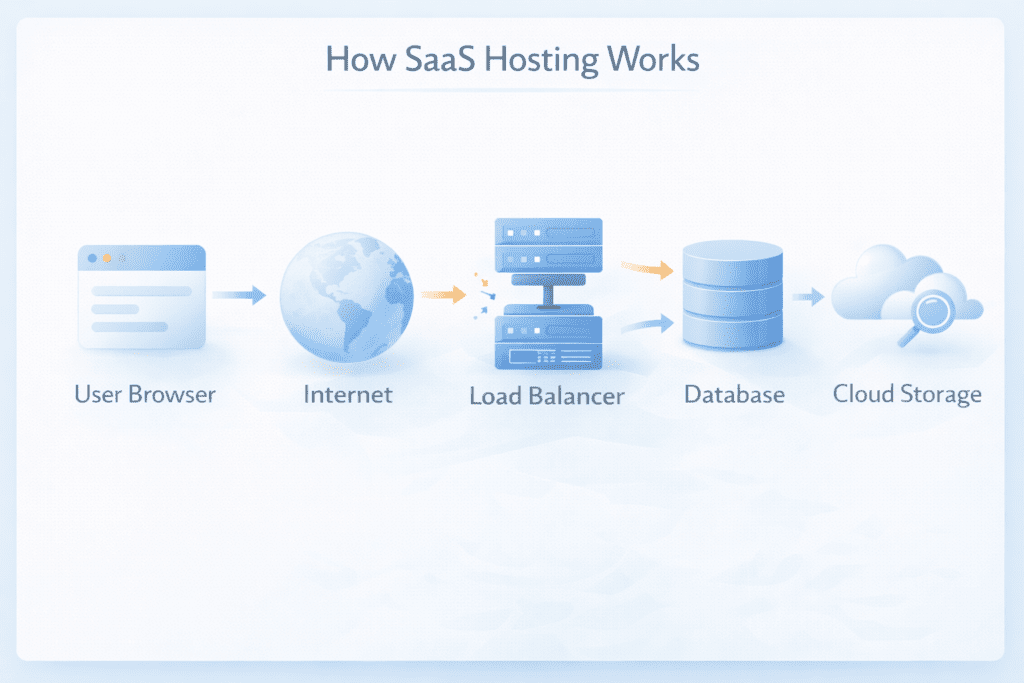
Behind every SaaS platform is a complex infrastructure that keeps applications running smoothly. SaaS hosting environments combine cloud servers, databases, and networking systems to deliver software through the internet.
Instead of installing software on local machines, SaaS applications run on remote servers. Users access the application through a browser while the backend infrastructure processes requests and manages data.
This system allows SaaS providers to deploy updates, scale resources, and deliver services seamlessly to customers.
Infrastructure Behind SaaS Platforms
SaaS platforms rely on layered infrastructure to run applications efficiently. Each layer of the system performs a different role in delivering the software.
• Cloud infrastructure layers: Applications operate on distributed cloud servers across global data centers.
• Distributed application architecture: Workloads are spread across multiple systems to improve reliability.
• Backend infrastructure: The backend handles authentication, processing requests, and managing application logic.
This infrastructure model allows SaaS applications to support thousands of users without major performance issues.
Compute Resources for SaaS Applications
Compute resources are responsible for running the core application logic in a SaaS platform. These resources handle user requests, process tasks, and manage application operations.
As a SaaS application grows, compute requirements increase as well.
• Application servers: These servers run the application code and handle user interactions.
• Load balancing systems: Traffic is distributed across multiple servers to prevent overload.
• Container based infrastructure: Containers allow applications to deploy consistently across environments.
Using distributed compute resources helps SaaS companies maintain stable performance while scaling their platforms.
Services Powering SaaS Platforms
Modern SaaS platforms depend on multiple supporting services that keep applications running efficiently. These services manage data, communication between systems, and application monitoring.
• Managed database services enhance the ease of use and performance for SaaS applications. Databases store user data and application information.
• API infrastructure: APIs allow different components of the SaaS platform to communicate.
• Messaging systems: Background tasks and asynchronous processes run through messaging services.
• Monitoring services: Monitoring tools track application performance and detect system issues.
These supporting services help SaaS providers manage complex applications while maintaining reliability and performance.
SaaS Hosting Architecture Explained
The architecture behind a SaaS platform determines how efficiently the application runs and how easily it can grow. SaaS companies usually design their infrastructure to support many users while maintaining stable performance.
Two common architecture models are used in SaaS platforms. One relies on shared infrastructure for multiple customers, while the other assigns separate infrastructure for each client.
Understanding these approaches helps explain how SaaS applications deliver services to users.
Multi Tenant SaaS Architecture
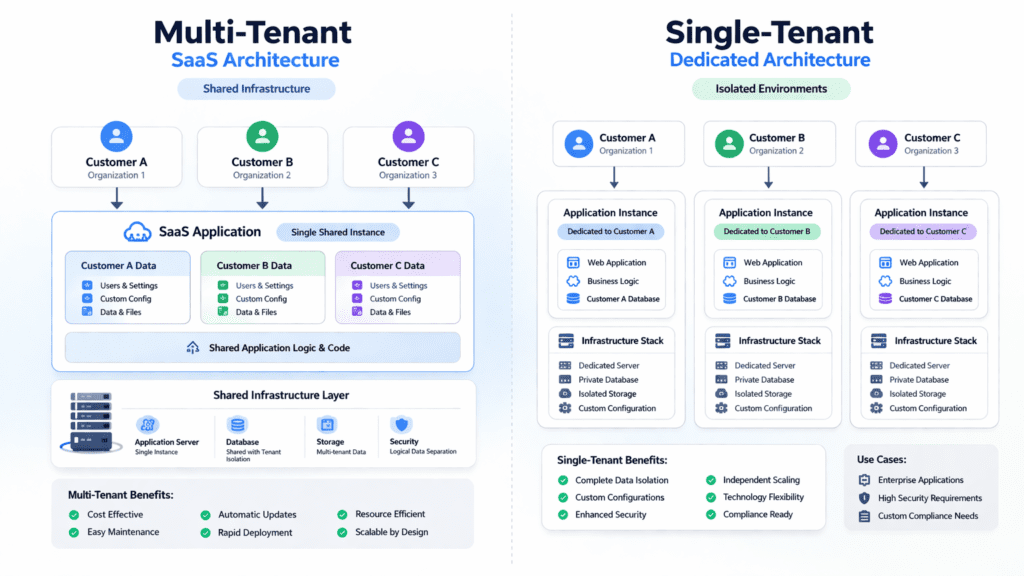
Multi tenant architecture is one of the most widely used approaches in SaaS platforms. In this model, a single SaaS application serves multiple customers using shared infrastructure.
Each customer uses the same core application while their data remains logically separated within the system.
• Single application: One SaaS application serves multiple organizations.
• Shared infrastructure: Server resources are used by many users at the same time.
• Efficient resource usage: SaaS companies can reduce infrastructure costs by sharing resources.
This architecture allows SaaS providers to scale their platforms efficiently while maintaining a consistent user experience.
Single Tenant SaaS Architecture
Single tenant architecture uses a different approach. Instead of sharing infrastructure, each customer receives a dedicated environment.
In this setup, every client operates on a separate instance of the SaaS application.
• Dedicated infrastructure for a cloud hosting provider ensures reliability and performance. Each customer runs on an isolated environment.
• Greater customization: SaaS providers can tailor configurations for specific clients.
• Improved data isolation: Data is stored separately for each organization.
Single tenant architecture is sometimes used by SaaS companies that require strict security controls or custom configurations for enterprise clients.
Infrastructure Layers in SaaS
A SaaS platform typically operates across multiple infrastructure layers. Each layer performs a specific role in delivering the application.
• Application layer: This layer runs the core SaaS application and processes user requests.
• Database layer: The database stores user data, configuration settings, and application records.
• Compute infrastructure: Servers and compute resources execute the application logic.
• Networking systems: Network infrastructure manages communication between services.
When these layers work together, SaaS platforms can deliver reliable applications while supporting large numbers of users.
Infrastructure Components Needed for SaaS Hosting
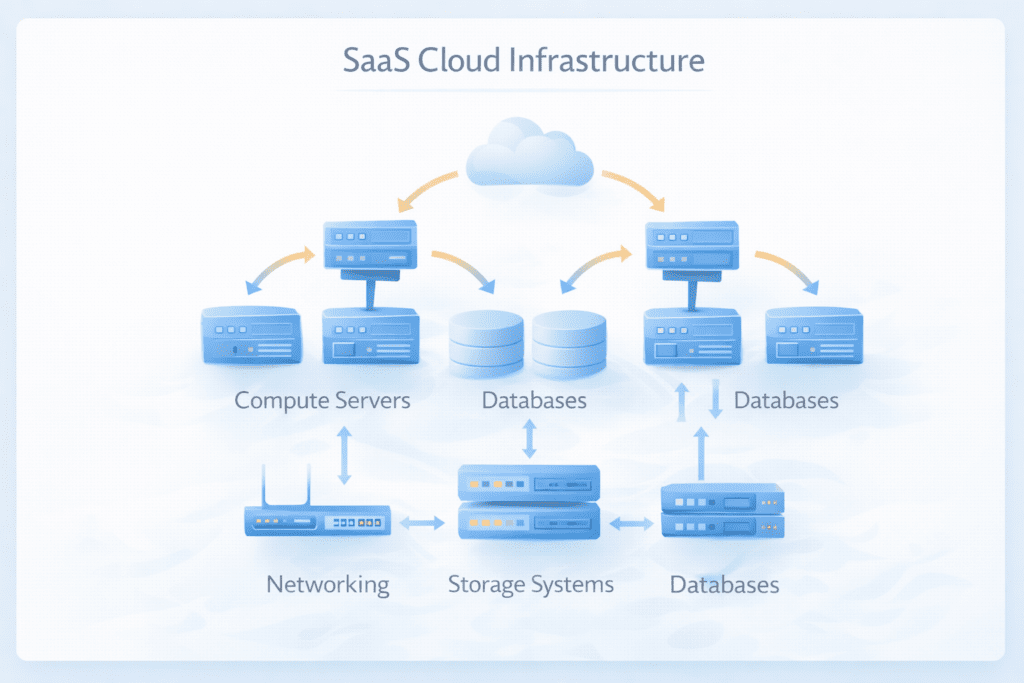
Running a SaaS platform requires multiple infrastructure components working together. These components support application performance, data management, and traffic handling.
Without the right infrastructure, SaaS applications may struggle to maintain reliability as usage grows. Modern SaaS providers typically rely on distributed systems designed to support scalable cloud environments.
Compute Infrastructure
Compute infrastructure forms the core of a SaaS platform. These systems run application logic, process user requests, and execute background tasks.
As a SaaS application grows, compute resources must expand to handle additional workloads.
• Virtual machines: Virtual servers provide isolated environments for running applications.
• Containers: Container platforms simplify application deployment across infrastructure.
• Server clusters: Multiple servers operate together to handle higher workloads.
Using distributed compute resources allows SaaS providers to scale applications more efficiently.
Databases for SaaS Applications
Databases store the core data used by SaaS applications. This includes user information, application settings, and operational records.
Because SaaS platforms often handle large volumes of data, database design plays a critical role in performance.
• Relational databases: Structured databases store application data in organized tables.
• Distributed databases: Data is stored across multiple systems to improve reliability.
• Database scaling strategies: Systems expand database capacity as application usage grows.
Efficient database infrastructure helps SaaS companies maintain consistent performance.
Storage Infrastructure
SaaS platforms also require reliable storage systems to manage files, application assets, and backups.
These systems ensure that data remains accessible and protected.
• Object storage systems: Cloud storage platforms manage large files and application assets.
• Backup systems: Automated backup processes protect data against failures.
• Recovery solutions: Recovery infrastructure helps restore data after system incidents.
Reliable storage infrastructure helps SaaS providers protect customer data and maintain service continuity.
Networking and Load Balancing
Networking systems connect different infrastructure components within a SaaS platform. These systems manage communication between servers, databases, and application services.
Load balancing systems also distribute traffic across multiple servers.
• Traffic distribution: Load balancers spread user requests across servers.
• Global infrastructure networks: Distributed networks reduce latency for global users.
• Infrastructure stability: Traffic management systems prevent server overload.
Strong networking infrastructure allows SaaS platforms to maintain performance even as traffic increases.
Key Features of SaaS Hosting Platforms
SaaS hosting platforms include several important features that support reliable applications. These features help SaaS companies maintain performance, security, and scalability.
Scalability for SaaS Applications
SaaS platforms must support growth as the number of users increases. Infrastructure designed for scalability allows applications to expand resources when needed.
• Scalable infrastructure: Systems increase capacity as workloads grow.
• Auto scaling systems: Infrastructure adjusts resources based on traffic.
• Flexible resource allocation: Applications can use additional compute resources when necessary.
Scalable infrastructure allows SaaS companies to support growing customer bases.
High Availability and Reliability
High availability ensures that SaaS applications remain accessible to users even if part of the infrastructure fails.
Hosting platforms often include redundant systems to maintain uptime.
• Redundant infrastructure: Multiple servers operate simultaneously to prevent service interruptions.
• Failover systems: Backup systems automatically replace failed infrastructure.
• Multi region deployments: Applications operate across multiple data center locations.
These strategies help SaaS providers maintain consistent uptime.
Security for SaaS Platforms
Security is a critical requirement for SaaS applications because these platforms manage sensitive user data.
Hosting platforms implement several security measures to protect infrastructure.
• Data encryption: Encryption protects data during storage and transmission.
• Identity management: Authentication systems control user access.
• Application security: Security frameworks protect SaaS applications from threats.
Strong security infrastructure helps SaaS providers protect their platforms and customer data.
Performance Optimization
Performance optimization ensures that SaaS applications respond quickly and maintain stable user experiences, contributing to customer support satisfaction.
Hosting platforms rely on several technologies to improve performance.
• CDN integration: Content delivery networks distribute application assets globally.
• Server optimization: Infrastructure tuning improves system efficiency.
• Application caching can significantly improve ease of use for end-users. Cached data reduces server processing time.
These performance strategies help SaaS platforms deliver fast and reliable applications.
Types of SaaS Hosting Infrastructure
The infrastructure behind a SaaS platform can vary depending on the needs of the application. Some SaaS companies rely on fully managed cloud platforms, while others manage their own infrastructure.
Each approach offers different levels of control, complexity, and scalability.
Cloud Hosting for SaaS
Cloud hosting has become one of the most common infrastructure choices when building a SaaS platform. In this model, SaaS applications run on distributed cloud servers instead of a single physical server.
Cloud hosting allows SaaS providers to scale resources based on demand.
• Flexible infrastructure: Cloud platforms allow applications to scale resources as usage grows.
• Global cloud networks: Infrastructure often runs across multiple data center locations.
• High availability: Distributed servers help maintain uptime during system failures.
Because of these advantages, cloud hosting is widely used by modern SaaS companies.
Managed Hosting Platforms
Managed hosting platforms provide fully managed infrastructure for SaaS platforms. In this model, the hosting provider handles system maintenance, infrastructure management, and performance optimization.
This approach helps SaaS companies focus on application development rather than infrastructure operations.
• Reduced operational complexity: Infrastructure management is handled by the hosting provider.
• Managed updates: Platform maintenance and updates are handled automatically.
• Operational support: Managed services help maintain infrastructure stability.
Managed hosting platforms are commonly used by smaller SaaS teams that want to simplify infrastructure management.
Self Managed Infrastructure
Some SaaS companies choose to manage their own infrastructure directly. This approach gives teams full control over server configuration and deployment processes.
However, self managed infrastructure usually requires experienced DevOps teams.
• Full infrastructure control: Teams manage server configuration and deployment.
• Custom infrastructure design: Platforms can build specialized environments.
• Operational responsibility: Teams must maintain infrastructure stability and security.
This approach is often used by larger SaaS companies with dedicated infrastructure teams.
Best Cloud Platforms for SaaS Hosting
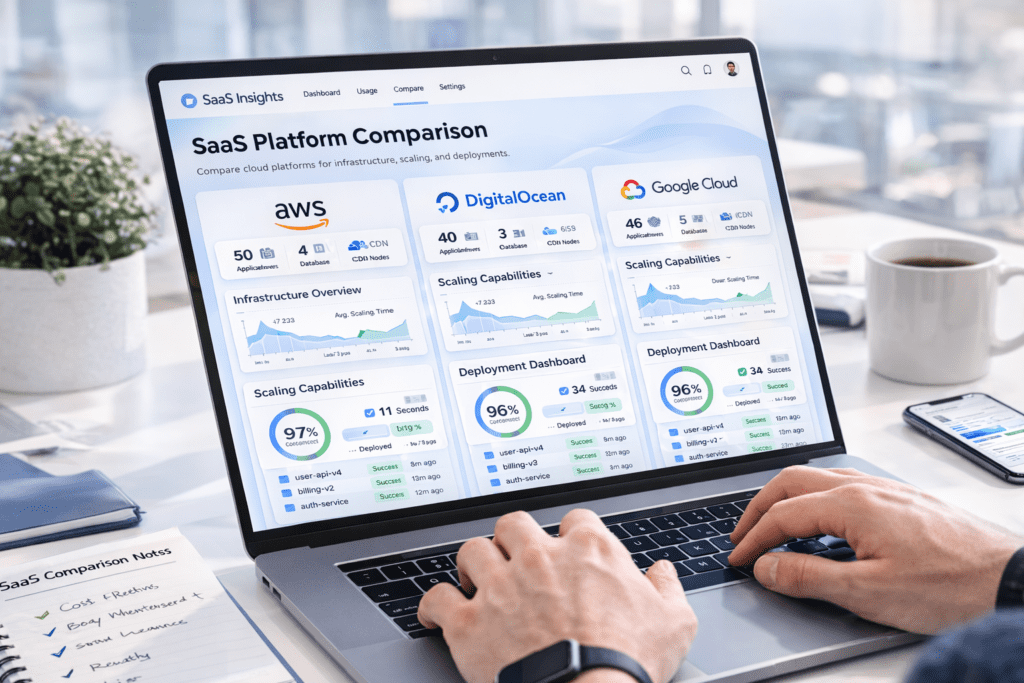
Several cloud platforms are widely used when building SaaS platforms, often provided by a reliable cloud hosting provider. These platforms provide scalable infrastructure, developer tools, and global cloud services.
| Platform | Infrastructure Type | Best For | Scalability | Developer Ecosystem |
|---|---|---|---|---|
| AWS | Cloud infrastructure | Enterprise SaaS platforms | High | Extensive |
| DigitalOcean | Cloud infrastructure | Startup SaaS platforms | High | Developer friendly |
| Google Cloud | Cloud infrastructure | Growing SaaS applications | High | Advanced tools |
AWS Enterprise Infrastructure for SaaS Platforms
AWS is one of the most widely used cloud platforms for SaaS hosting. Many SaaS companies rely on AWS because of its large ecosystem of cloud services and global infrastructure.
The platform provides advanced tools that support application scaling and infrastructure management.
Key Platform Features
• Advanced compute services: AWS provides flexible compute infrastructure for SaaS platforms.
• Large ecosystem of tools: Developers can access numerous cloud services and APIs.
• Global data center network: Applications can deploy across multiple regions.
Best For
Enterprise SaaS platforms and large scale applications that require powerful infrastructure.
DigitalOcean Developer Friendly SaaS Hosting Platform
DigitalOcean is a cloud platform commonly used when building a SaaS platform. It focuses on simplicity and developer friendly infrastructure.
Many startup SaaS teams choose DigitalOcean because it simplifies infrastructure management.
Key Platform Features
• Simple infrastructure management: Developers can deploy servers quickly.
• Developer focused tools: The platform provides tools designed for software teams.
• Easy server scaling: Applications can increase compute resources as traffic grows.
Best For
Startup SaaS businesses and smaller development teams.
Google Cloud Scalable Infrastructure for SaaS Applications
Google Cloud provides enterprise level infrastructure used by many modern software as a service platforms. The platform focuses on high performance infrastructure and advanced data tools.
It also integrates machine learning services that support modern SaaS applications.
Key Platform Features
• High performance compute: Google Cloud provides scalable infrastructure for SaaS applications.
• Global infrastructure: Applications can deploy across multiple regions.
• Machine learning tools: AI powered tools support modern SaaS platforms.
Best For
Growing SaaS platforms that require scalable infrastructure and advanced development tools.
Cost Factors of SaaS Hosting
Infrastructure costs are an important consideration when building a SaaS platform. Unlike traditional software, SaaS applications run continuously on cloud infrastructure, which means operating costs grow as the application scales.
Understanding these cost factors helps SaaS companies plan sustainable infrastructure for long-term growth, especially when considering their pricing strategies.
Compute Costs
Compute infrastructure runs the core logic of a SaaS application. These resources process requests, run application code, and handle user interactions.
Compute costs typically depend on how many servers or virtual machines are running.
• Virtual machines: Running compute instances on cloud platforms increases infrastructure expenses.
• Container infrastructure: Container systems can help optimize compute usage.
As usage grows, SaaS companies often increase compute capacity to maintain performance.
Storage Costs
SaaS platforms store large volumes of user data, application files, and system logs. Storage infrastructure must expand as data usage grows.
• Database storage: Databases store application data and customer information.
• File storage: SaaS applications often store files such as documents and media assets.
Cloud platforms charge based on the amount of data stored and retrieved.
Network and Data Transfer Costs
Data transfer is another cost factor for SaaS platforms. Each time users access the application, data moves between servers and client devices.
These transfers generate network usage charges.
• Traffic usage: Higher application traffic increases network costs.
• API calls: SaaS applications often rely on APIs that generate additional traffic, which can be optimized through AI-powered solutions.
Network costs usually increase as the user base grows.
Scaling Costs
Scaling infrastructure allows SaaS platforms to support more users. However, scaling also increases operational costs.
As additional servers, storage systems, and networking resources are added, infrastructure expenses grow.
SaaS companies must carefully balance scaling with cost efficiency.
Best Hosting Platforms for Building a SaaS Application
Selecting the right infrastructure platform is one of the most important decisions when building a SaaS application. The platform must support performance, scalability, and developer productivity.
Infrastructure Considerations
Several factors influence which platform works best for a SaaS platform.
• Platform reliability: Infrastructure stability helps maintain application uptime.
• Developer ecosystem: Platforms with strong developer tools simplify application development.
• Infrastructure scalability: Scalable infrastructure allows SaaS platforms to grow.
These factors help SaaS companies select infrastructure that supports long term application growth.
Popular Platforms Used by SaaS Companies
Several cloud platforms are commonly used by SaaS companies.
• AWS: A widely used cloud platform offering a large ecosystem of services.
• DigitalOcean: A developer friendly cloud platform often used by startup SaaS teams.
• Google Cloud: A scalable infrastructure platform supporting modern software as a service platforms.
These platforms provide flexible infrastructure environments for SaaS development.
How SaaS Companies Scale Their Applications
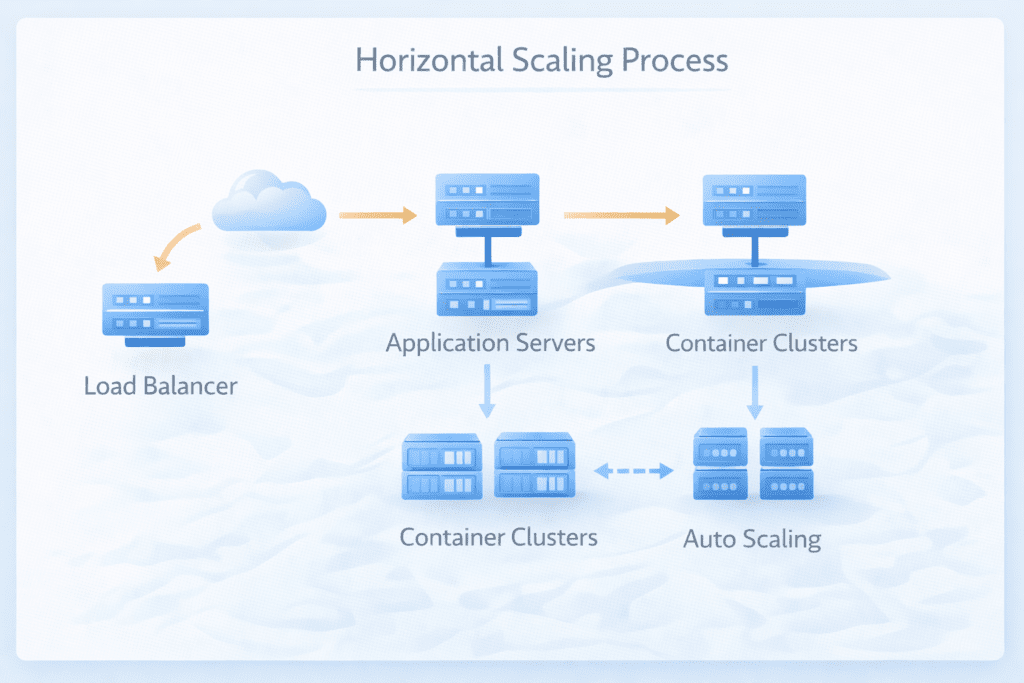
Scaling is essential for SaaS platforms because the number of users often grows over time. Infrastructure must adapt to increased demand without reducing performance.
Horizontal Scaling
Horizontal scaling increases system capacity by adding more application servers.
• Additional application servers: Multiple servers run the same application.
• Distributed workloads: Requests are distributed across servers.
This approach helps SaaS platforms support larger numbers of users.
Auto Scaling Infrastructure
Auto scaling systems automatically adjust infrastructure resources based on application demand.
• Automated resource allocation: Infrastructure expands when usage increases.
• Traffic based scaling: Servers scale based on application traffic.
Auto scaling allows SaaS platforms to maintain stable performance without manual intervention.
Load Balancing Systems
Load balancing distributes traffic across multiple servers.
• Traffic distribution: Incoming requests are spread across server clusters.
• Infrastructure stability: Balanced workloads prevent server overload.
Load balancing helps maintain reliable performance during high usage periods.
Microservices Architecture
Modern SaaS platforms often use microservices architecture. Instead of running a single large application, the system is divided into smaller services.
Each service operates independently and communicates through APIs.
This architecture improves scalability and simplifies application maintenance.
Tools and Services Powering Modern SaaS Platforms
Modern SaaS platforms rely on many supporting tools that help maintain infrastructure stability and application performance.
Monitoring and Observability Tools
Monitoring systems track infrastructure performance and application behavior.
• Infrastructure monitoring: Systems track server performance and resource usage.
• Application performance monitoring: Tools measure response times and system reliability.
Monitoring helps SaaS providers identify issues before they affect users.
DevOps Automation
DevOps automation tools simplify infrastructure management and deployment.
• CI/CD pipelines: Automated pipelines deploy application updates.
• Infrastructure automation: Automation tools manage infrastructure configuration.
These systems reduce manual work and improve deployment reliability.
Deployment Infrastructure
Deployment systems allow SaaS platforms to release updates efficiently.
• Container orchestration: Platforms such as Kubernetes manage container deployments.
• Cloud deployment services: Cloud platforms provide tools for automated application deployment.
These systems allow SaaS teams to deploy updates frequently while maintaining system stability.
Building a SaaS Platform Without Infrastructure Problems
Infrastructure planning is a critical part of building a successful SaaS platform. Poor infrastructure decisions can create performance issues and scaling limitations.
Planning Infrastructure Early
Planning infrastructure during the early development stages helps avoid long term problems.
• Designing scalable systems: Infrastructure should support future growth.
• Planning infrastructure growth: SaaS platforms must anticipate increasing workloads.
Early planning helps SaaS companies build stable platforms.
Choosing the Right SaaS Hosting Platform
Selecting the right SaaS hosting platform affects performance, reliability, and scalability.
• Infrastructure capability: The platform must support application workloads while considering the pricing model for better cost management.
• Developer ecosystem: Strong developer tools simplify development.
• Scalable architecture: Infrastructure should support long term growth.
Choosing the right infrastructure platform helps SaaS companies build reliable applications.
Avoiding SaaS Infrastructure Mistakes
Several mistakes commonly affect new SaaS platforms.
• Poor architecture planning: Weak infrastructure design can limit scalability.
• Underestimating infrastructure needs: SaaS platforms often grow faster than expected.
Avoiding these mistakes helps maintain stable infrastructure.
What Most SaaS Founders Miss About SaaS Hosting
The infrastructure behind SaaS platforms is often more complex than it initially appears. Many SaaS founders focus on building the application but underestimate the importance of infrastructure planning.
Scaling infrastructure introduces new challenges related to performance, cost management, and security.
Infrastructure complexity, cloud costs, and performance optimization become more important as the platform grows.
Understanding these challenges early helps SaaS companies build stronger infrastructure.
Common Mistakes When Choosing SaaS Hosting
Selecting the wrong infrastructure platform can limit the success of a SaaS application.
Several common mistakes appear when SaaS companies evaluate hosting platforms.
• Choosing a hosting provider that cannot scale: Infrastructure limitations can prevent application growth.
• Ignoring infrastructure costs: Cloud infrastructure expenses increase as usage grows.
• Poor architecture planning: Weak system design can create performance bottlenecks.
• Not preparing infrastructure for scaling: Applications must support future growth.
Avoiding these mistakes helps SaaS platforms maintain reliable infrastructure.
Frequently Asked Questions
What is SaaS hosting?
SaaS hosting refers to the infrastructure used to run software delivered through the software as a service model. Applications operate on cloud servers while users access the software through the internet.
How does SaaS hosting work for software as a service platforms?
SaaS hosting environments provide cloud infrastructure, databases, and networking systems that allow SaaS applications to run continuously and deliver services to users online.
Which SaaS hosting provider is best for startups?
Platforms such as DigitalOcean are commonly used by startup SaaS teams because they provide developer friendly infrastructure and simple server management.
Can you build SaaS without cloud infrastructure?
Building SaaS without cloud infrastructure is possible but uncommon. Most SaaS platforms rely on cloud infrastructure because it provides scalability and global availability.
How do SaaS companies scale their applications?
SaaS companies scale applications by adding servers, using auto scaling systems, implementing load balancing, and adopting distributed architectures such as microservices.
What infrastructure is required for SaaS hosting?
SaaS hosting typically requires compute infrastructure, databases, storage systems, networking infrastructure, and monitoring tools.
Is AWS better than DigitalOcean for SaaS hosting?
AWS provides a large ecosystem of services and global infrastructure. DigitalOcean focuses on simplicity and developer friendly tools. The best choice depends on the needs of the SaaS application.

Final Thoughts on SaaS Hosting
SaaS hosting plays a critical role in modern software as a service platforms. The infrastructure behind a SaaS application determines how well the platform performs, scales, and supports users.
Choosing the right infrastructure when building a SaaS platform helps companies maintain reliability and performance as their user base grows.
Cloud platforms such as AWS, DigitalOcean, and Google Cloud provide scalable environments that allow SaaS applications to grow without major infrastructure changes.
For SaaS companies aiming to build long term success, selecting the right infrastructure platform is one of the most important decisions in the development process.