
Picking the wrong keyword research tool usually doesn’t fail loudly. It fails slowly. You publish content around weak keyword ideas, your search volume estimates don’t line up with reality, and months later you realize the rankings you wanted were never realistic. That’s why the Ahrefs Vs Google Keyword Planner decision matters more in 2026 than it did a few years ago.
The tricky part is that these two tools solve different problems, even though people compare them as if they’re direct substitutes. Ahrefs is built for SEO depth. Google Keyword Planner is built around Google Ads planning, with some useful spillover for organic keyword research. If you expect both to behave the same way, you’ll misread the data and make poor calls on which keyword to target, which pages to build, and where your traffic should come from.
Why keyword research tool choice matters in 2026
Search is more competitive now, and the margin for error is thinner. A keyword with 2,000 monthly searches can still be useless if the first page is dominated by giant brands, forums, and pages with strong backlinks. On the other hand, a lower-volume keyword with clear intent can drive steady organic traffic for months or years.
The tool you use shapes what you see. Some tools surface more keyword ideas, some estimate search volume more confidently, and some help you understand ranking difficulty. In 2026, that difference affects more than SEO. It affects PPC bidding, content planning, local SEO, and even how quickly a small site can find its first wins.
What most buyers misunderstand about Ahrefs and Google Keyword Planner
A lot of buyers assume Ahrefs and Google Keyword Planner are two versions of the same research tool. They’re not. Ahrefs is an SEO platform with a keyword explorer, backlink data, and competitor analysis built in. Google Keyword Planner is a free tool inside Google Ads that shows search volume ranges, competition level, and keyword suggestions for ad campaigns.
That misunderstanding creates bad expectations. People open Google Keyword Planner and want exact organic keyword scores. Or they open Ahrefs and expect it to replace Google’s own keyword data for PPC planning. Both tools are useful, but they’re useful for different jobs. If you mix those jobs together, the output gets muddy fast.
Hidden frustrations with keyword ideas, visibility, and ranking data
The biggest frustration is that keyword data always looks cleaner than it really is. Search volume estimates are just estimates. Even Ahrefs, which uses clickstream data and its own models, can’t show exact demand. Google Keyword Planner often groups terms into ranges unless you’re spending enough in Google Ads, which makes early-stage research feel vague.
Then there’s visibility. A tool may show 50 keyword ideas, but only a handful are truly worth chasing. Beginners often don’t realize that a keyword with strong volume can still have poor click potential if Google fills the results page with ads, featured snippets, maps, or AI answers. That’s where keyword research gets frustrating in real use: the numbers are there, but the opportunity is still hidden.
Why expectations change for SEO, PPC, and long-term keyword strategy
Your goals change the right tool. If you’re building a blog, affiliate site, or SaaS content engine, you need a tool that helps with ranking, keyword difficulty, and competitive analysis. If you’re running Google Ads, you need data that supports ad campaigns, budget decisions, and broad keyword discovery.
Long-term keyword strategy is where this matters most. SEO usually rewards precision and depth. PPC rewards fast testing and commercial intent. Google Keyword Planner is useful for finding a basic keyword and estimating competition level, but Ahrefs is stronger when you need to compare search volume and competition against actual ranking difficulty. That difference becomes even more important once you move past one-off posts and start building a real content system.
Quick Verdict: Ahrefs Vs Google Keyword Planner
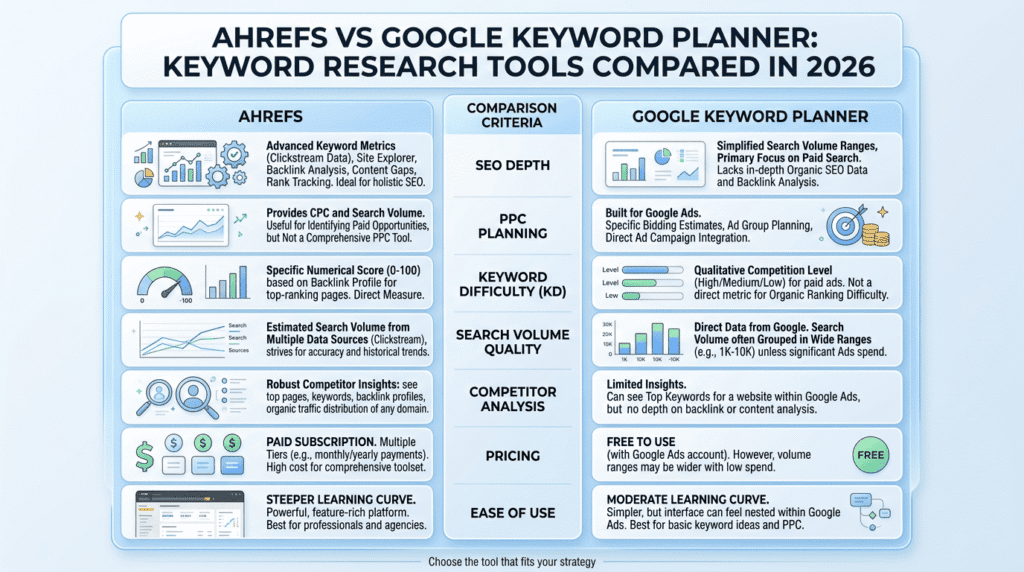
Complete comparison table
| Category | Ahrefs | Google Keyword Planner |
|---|---|---|
| Best For | SEO-driven keyword research, competitor analysis, and content planning | Free keyword ideas, PPC planning, and broad campaign discovery |
| Not Ideal For | Budget-conscious users who only need occasional basic keyword ideas | Deep SEO analysis, competitor research, and ranking prioritization |
| Starting Price | Starts around $99/month | Free with a Google Ads account |
| Free Plan | No true free plan | Yes, free to use |
| Ease of Use | Moderate learning curve | Easier for beginners |
| Key Strength | Strong keyword data, keyword difficulty, and traffic potential | Direct Google data and ad-focused keyword suggestions |
| Biggest Limitation | Costs money and can feel heavy for casual users | Search volume ranges and limited SEO depth |
| Overall Recommendation | Best for serious SEO work | Best for free keyword discovery and PPC support |
Ahrefs is the stronger choice for most SEO-heavy users because it helps you evaluate real ranking opportunities, not just keyword ideas. Google Keyword Planner is better when you need a free tool and you care more about ad planning or broad discovery than deep organic analysis.
If you’re running a blog, affiliate site, or SaaS content strategy, Ahrefs usually gives you more useful direction. If you’re early, tight on budget, or mostly managing Google Ads campaigns, Google Keyword Planner is the safer starting point.
Best for SEO-driven keyword research
Use Ahrefs if your main goal is ranking. It gives you much richer keyword data, stronger competitor insights, and better ways to judge whether a keyword is actually worth targeting. You can check keyword difficulty, see related keywords, review the first page of Google, and estimate traffic potential in one workflow.
That matters because SEO isn’t just about picking the biggest keyword. It’s about choosing the best keyword you can realistically rank for. Ahrefs is built for that kind of decision-making.
Best for free keyword ideas and PPC planning
Google Keyword Planner is the better fit when you want free keyword ideas tied to Google Ads. It’s especially useful for broad research, early validation, and building ad campaigns without paying for a premium SEO tool.
It also helps when you need a rough list of keywords fast. A small business can use it to brainstorm service terms, seasonal queries, or local keyword clusters before spending money. The trade-off is that the data is less precise for organic SEO, and the tool is clearly shaped around PPC keyword data.
Bottom line on which tool is better for most users
For most SEO users, Ahrefs wins. For most PPC users, Google Keyword Planner wins. That sounds simple, but it’s the honest answer.
If you only want one tool and your business depends on organic traffic, Ahrefs is the better long-term buy. If you need a free tool for ad research or occasional keyword search, Google Keyword Planner is enough. The wrong choice usually isn’t fatal, but it does make keyword research slower and less reliable.
Ahrefs Vs Google Keyword Planner: Core Differences That Matter Most
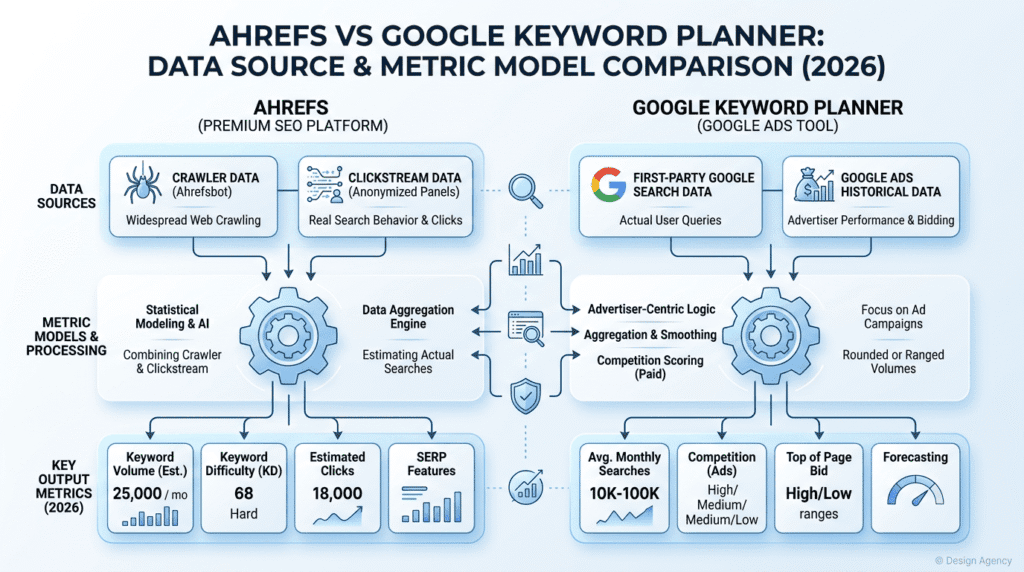
Keyword data sources and how each tool builds its metric estimates
Ahrefs and Google Keyword Planner do not build their numbers the same way. Ahrefs blends clickstream data, crawler data, and modeling to estimate search volume and traffic potential. Google Keyword Planner pulls from data from Google, but the results are shaped by Google Ads behavior, account activity, and how Google chooses to group queries.
That’s why the same keyword can look different in both tools. Ahrefs might show a tighter monthly search volume estimate, while Google Keyword Planner may show a range or bucket. Neither is “wrong.” They’re just built for different purposes. Ahrefs is trying to estimate organic opportunity. Google Keyword Planner is trying to support ad planning inside Google Ads campaigns.
Keyword ideas, visibility, and ranking potential compared
Ahrefs usually gives more keyword ideas and more useful variation around a seed keyword. It surfaces related keywords, question terms, and keyword gaps that help you build a fuller content map. That’s valuable when you need more than a simple list of keywords.
Google Keyword Planner is broader but less nuanced. It can be good for finding new keyword ideas quickly, but it doesn’t always help you understand which terms deserve content, which deserve ads, and which are just noisy variations. For ranking, Ahrefs is better because it gives you more context around visibility and likely traffic.
SEO depth versus advertising-focused keyword planning
This is the main split. Ahrefs is an SEO tool. Google Keyword Planner is an advertising tool that can be used for SEO in a limited way.
If you’re planning content, trying to understand competitive keyword opportunities, or checking keyword difficulty score for organic searches, Ahrefs is built for that. If you’re planning PPC keyword lists, estimating bids, or organizing ad campaigns, Google Keyword Planner fits the workflow better. It’s easier to make the right decision once you stop treating them as direct replacements.
What Ahrefs and Google Keyword Planner each do better in practice
Ahrefs is better at helping you choose where to compete. It gives you more useful structure around ranking, backlinks, and traffic potential. That’s the kind of information that saves time when your site is small and every post matters.
Google Keyword Planner is better at helping you move quickly without paying for another subscription. It can be a solid free keyword generator for broad discovery, especially if you already use a Google Ads account. It’s less helpful when you need serious organic SEO prioritization, but it’s still handy for quick campaign brainstorming.
Ahrefs Vs Google Keyword Planner: Keyword Research Features Compared
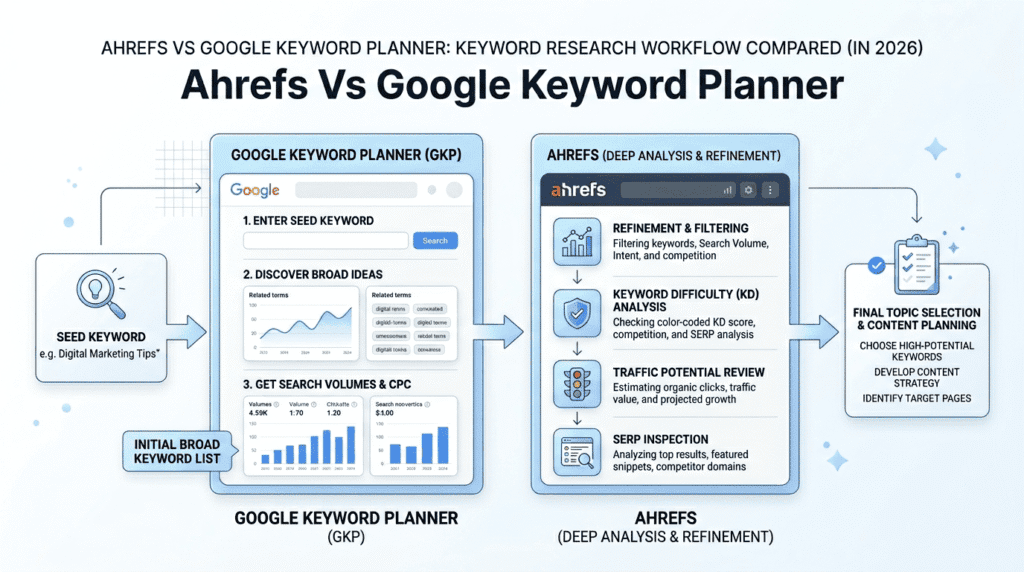
Finding keyword ideas for new content
Ahrefs tends to be stronger when you need to build a real content plan from one seed keyword. You can start with a seed keyword and uncover dozens or hundreds of related keywords, question variants, and long-tail angles. That helps a content team shape clusters instead of one-off articles.
Google Keyword Planner can also generate keyword suggestions, but they’re usually more campaign-oriented and less strategic for content. If you’re a blogger, affiliate site owner, or SaaS marketer trying to identify blog topics, Ahrefs usually gives you better raw material. If you just need a list of keywords to feed into a Google Ads account, Google Keyword Planner is enough.
Search volume, metric quality, and data confidence
Search volume is where the differences start to matter in practice. Ahrefs provides search volume estimates with more SEO context, while Google Keyword Planner often shows broad volume ranges unless you’re active in paid campaigns. That makes Ahrefs better for comparing keyword volume and deciding which page to build first.
Still, you shouldn’t treat either tool like a perfect source of truth. Ahrefs can be off on niche terms, and Google Keyword Planner can overgeneralize because of how it clusters terms. A smart workflow usually checks keyword data in both tools, then sanity-checks it with Google Trends or Google Search Console when possible.
Keyword difficulty, ranking signals, and SEO prioritization
Ahrefs has a real advantage here. Its keyword difficulty metric helps you estimate how hard it might be to rank, and that’s useful when you’re building a site from scratch or trying to scale without wasting content budget. It also lets you inspect SERP competition, backlink strength, and traffic potential.
Google Keyword Planner doesn’t give you a meaningful SEO difficulty framework. It tells you about competition level in an ad context, which is not the same thing as organic ranking difficulty. That distinction trips people up all the time. A keyword can look “low competition” in ads and still be brutal to rank for in organic search.
Competitor research and content gap discovery in Ahrefs
This is one of the biggest reasons many teams use Ahrefs. You can compare your site against competitors, find keyword gaps, and discover which pages are driving organic traffic for other sites. That makes it much easier to build a keyword strategy that isn’t based on guesswork.
For example, a SaaS brand can use Ahrefs to find keywords competitors rank for that their own site misses. A local business can use the same approach to uncover service-area terms and location pages. Google Keyword Planner doesn’t really do that. It’s useful for broad discovery, but not for deep competitive research.
Google Keyword Planner for broad keyword discovery and campaign planning
Google Keyword Planner is still useful when the job is simple. If you’re launching a new Google Ads campaign, testing a service page, or just trying to get a quick list of keywords, it does the basics well. The interface is familiar, and the data comes from Google, which makes it feel direct.
But the tool is shaped by advertising needs. It’s not built to tell you which keyword is the best keyword for a long-term content asset. It’s built to help you plan bids, budgets, and broad search themes. That makes it reliable for PPC keyword data, but weaker for serious SEO work.
Ahrefs Vs Google Keyword Planner: Ease of Use and Workflow
Beginner experience in Google Keyword Planner
Google Keyword Planner is easier for beginners because it feels familiar and doesn’t overwhelm you with too many layers. You enter a keyword or website, get keyword ideas, and review volume and competition data. For someone using it inside a Google Ads account, the workflow is straightforward.
The problem is that “easy” doesn’t always mean “clear.” Beginners often misunderstand the numbers, especially when volume is shown in ranges instead of exact figures. That can lead to bad assumptions about demand, especially if they’re trying to use the tool for organic SEO rather than ad planning.
Ahrefs learning curve for SEO-focused users
Ahrefs takes more time to learn, but that’s partly because it gives you more to work with. You’ll deal with keyword difficulty, traffic potential, SERP breakdowns, and competitor analysis. That’s a lot if you just want a basic keyword list.
Once you understand the workflow, though, Ahrefs becomes more efficient for professional keyword research. The extra data helps you make better decisions faster. A content manager, affiliate marketer, or SEO freelancer usually gets more value out of that complexity than a casual user would.
Which tool makes keyword research faster
Google Keyword Planner is faster for basic keyword discovery. You can move quickly, especially if you only need a short list of keyword ideas for ad campaigns or a rough content brainstorm.
Ahrefs is faster once you’re doing serious work. It takes more effort up front, but it saves time later because you can filter by keyword difficulty, examine ranking pages, and prioritize topics without jumping between multiple tools. If your workflow includes research, validation, and competitor review, Ahrefs usually wins on total speed.
Where each platform slows down real workflows
Google Keyword Planner slows down when you need better keyword data. Search volume ranges, limited SEO depth, and ad-centric labeling make it awkward for organic planning. You end up cross-checking everything somewhere else.
Ahrefs slows down when the use case is simple. If you just want one free keyword tool for quick brainstorming, the subscription cost and interface complexity can feel heavy. That’s the real trade-off: Google Keyword Planner is easier and free, while Ahrefs is more powerful but expects you to know what you’re looking for.
Ahrefs Vs Google Keyword Planner: Pricing and Value for Money
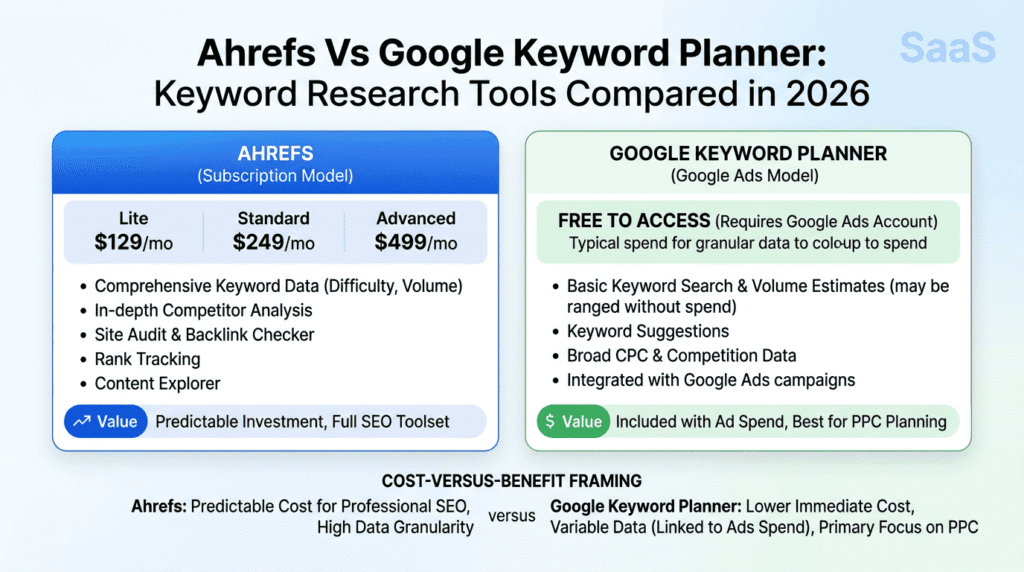
Ahrefs subscription cost and who gets the most value
Ahrefs is not a casual budget pick. Its plans typically start around the low-to-mid $100s per month, and the pricing climbs quickly as you need more reports, tracked keywords, users, or export capacity. That can feel steep if you only need a basic keyword research tool a few times a month. But if you live inside SEO, the cost starts making sense faster than people expect.
The best value usually goes to agencies, in-house SEO teams, affiliate sites, and content brands that need more than simple keyword ideas. Ahrefs gives you deeper keyword data, competitor analysis, backlink context, and content gap workflows in one place. That means fewer separate tools and less guessing. A team working on 50 to 500 pages of content can use ahrefs to make better ranking decisions week after week, which is where the subscription often pays for itself.
The catch is obvious: if you’re not using it often, the math gets ugly. A solo blogger who checks a handful of keyword ideas each month may never recover the monthly cost. You’re paying for depth, not just access.
Google Keyword Planner cost, access, and limitations
Google Keyword Planner is free, but it isn’t truly “free” in the way most people imagine. You need a Google Ads account, and Google designed the tool for ad campaigns first, not organic SEO. In practice, that means you can open it without running big ad spend, but some users find the data is more limited unless the account is active. The tool is easy to access, yet it’s built around Google Ads workflows, not detailed SEO planning.
For simple keyword discovery, it works fine. You can generate keyword ideas, view search volume ranges, and get broad competition signals. That’s enough for early brainstorming or a first pass on a ppc keyword list. But the moment you want better keyword difficulty context, richer organic keyword ideas, or more confidence in ranking potential, the limits show up fast.
It’s strongest when the goal is low-cost validation. A local business, a startup, or a first-time site owner can use GKP to test demand before spending real money on content or campaigns. Just don’t confuse that with professional keyword research at scale.
Hidden costs of relying on only one tool
This is where a lot of buyers get trapped. If you rely only on Ahrefs, you may overpay for data you don’t always need. If you rely only on Google Keyword Planner, you may save money upfront and lose it later through weak targeting, missed opportunities, or content that never gains traction. The real cost is often time, not software.
Ahrefs and Google Keyword Planner solve different problems. Ahrefs is better for organic strategy, competitive research, and filtering based on keyword difficulty. Google Keyword Planner is better for broad keyword discovery and ad planning. Using only one means you’ll eventually hit blind spots in either SEO or PPC. That can mean publishing content around the wrong keyword, underestimating competition level, or missing better variants that tools like ahrefs or semrush would surface faster.
For many teams, the smartest setup is not “pick one forever.” It’s use GKP for cheap discovery, then use ahrefs to pressure-test the list before creating content.
Which tool is better for budget-conscious keyword strategy
If your budget is tight, Google Keyword Planner is the obvious starting point. It gives you enough data to build a basic keyword list, estimate monthly search volume, and sanity-check demand without paying for a premium stack. For a small site, that can be enough in the early months.
But if budget-conscious means “I want the best return on every article I publish,” Ahrefs usually wins. One strong ranking page can justify a month of subscription cost. The difference is that Ahrefs helps you avoid weak topics, while GKP mostly helps you find them. If you’re doing serious SEO and need a clearer path to organic traffic, ahrefs offers more value even at a higher price.
For a lean team, the best compromise is often this: start with GKP, use Google Trends and Google Search Console to confirm demand, then upgrade to ahrefs once your content program needs sharper prioritization. That sequence keeps spend under control without locking you into shallow data.
Ahrefs Vs Google Keyword Planner: Performance for SEO and Ranking Decisions
Which tool is better for SEO keyword research
For SEO keyword research, Ahrefs is the stronger tool by a wide margin. It gives you keyword difficulty, ranking signals, traffic potential, competing pages, and a clearer view of what it may actually take to rank. Google Keyword Planner can show interest and broad competition, but it doesn’t give you the same organic search context. That matters when you’re trying to decide whether a keyword is worth chasing.
In practical terms, ahrefs helps you build a more disciplined SEO strategy. You can filter by keyword difficulty score, inspect the first page of Google, and compare pages already ranking for similar terms. That makes it easier to separate a basic keyword with real ranking potential from one that looks good in a spreadsheet but is too competitive in reality. GKP is useful, but it’s not a true organic SEO prioritization engine.
Using Ahrefs for ranking analysis and content targeting
Ahrefs is especially useful when you need to move from keyword ideas to a content plan. You can open the Keywords Explorer, check keyword volume, review SERP competition, and estimate how hard ranking might be before you spend a few hours writing. That saves real money because content creation is the expensive part, not the research.
It also helps with long-tail targeting. Suppose you’re building a site around local SEO or a niche ecommerce category. Ahrefs can show related keywords, parent topics, and keyword gap opportunities that Google Keyword Planner will usually flatten into broader buckets. That difference matters when you’re trying to rank faster with lower authority. You’re not just chasing search volume; you’re looking for traffic potential that fits your site’s current strength.
A content team might use ahrefs to find a seed keyword, then narrow the list to a few pages that balance difficulty and demand. That’s the difference between busywork and actual publishing strategy.
Using Google Keyword Planner for early-stage keyword validation
Google Keyword Planner is better when you’re still asking a simpler question: does this topic have enough demand to justify work? It’s useful in the early stages of keyword research, especially for new sites, ad campaigns, or a quick check before a landing page launch. If you just want broad keyword ideas and rough search volume estimates, it does the job.
That said, GKP is best used as a validation layer, not a decision engine. It can tell you that a topic gets searched, but it won’t tell you whether you have a realistic shot at ranking. It also leans heavily toward ad-focused data, so some users end up optimizing for the wrong metric. For PPC, that’s fine. For organic SEO, it’s incomplete.
A lot of teams use gkp to sort demand and then move the shortlist into ahrefs for a deeper pass. That workflow is simple, fast, and usually more reliable than trusting either tool alone.
Where each tool can mislead your ranking decisions
Both tools can lead you astray if you read the numbers too literally. Ahrefs can make a keyword look more attractive than it really is if the top pages are strong brands, pages with fresh backlinks, or content types your site can’t match yet. Google Keyword Planner can make a keyword feel safer because the competition signal is broad and ad-oriented, not a direct measure of organic ranking difficulty.
The main mistake is treating volume as the whole story. A keyword with 2,000 monthly searches and weak intent can be worse than a 200-search term with strong buying intent and a realistic path to page one. That’s why search volume and competition should be read together, not separately. Tools give you clues, not guarantees.
Use ahrefs to pressure-test ranking potential. Use Google Keyword Planner to confirm there’s real demand. If you ignore either layer, you’ll end up with a list of keywords that looks good in theory and stalls in practice.
Ahrefs and Google Keyword Planner: Real-World Use Cases
Best for bloggers and content sites
For bloggers and content sites, Ahrefs usually becomes more valuable once the site is past the very early stage. If you’re trying to build organic traffic from informational content, ahrefs helps you find keyword ideas with better traffic potential and less wasted effort. That matters because bloggers rarely have unlimited time to publish.
Google Keyword Planner can still help at the start, especially if you’re validating a niche or looking for broad topic clusters. But once you need to pick between ten similar articles, Ahrefs is better for ranking decisions. It shows which keywords are easier to win, which pages already rank, and where the content gap is. That saves time and reduces the chance of writing something that never gets visibility.
Best for agencies and SEO teams
Agencies and SEO teams usually get the most value from Ahrefs. They need repeatable research, competitive audits, keyword gap work, and a clean way to explain priorities to clients. Ahrefs supports that workflow much better than GKP because it offers deeper keyword data and more organic context.
Google Keyword Planner still has a place, especially when an agency is planning ad campaigns or validating commercial demand. But for professional keyword research, it’s too limited as the main system. Agencies need to compare search volume and competition quickly, then back it up with ranking evidence. That’s exactly where Ahrefs earns its keep. If you’re managing multiple client sites, the time saved can be substantial.
Best for ecommerce keyword research
Ecommerce teams often need both tools, but for different reasons. Google Keyword Planner is useful for finding broad product demand, category terms, and ppc keyword data for ad campaigns. Ahrefs is better for identifying organic keyword opportunities, comparison terms, and category page targets that can build long-term visibility.
A store selling running shoes, for example, can use GKP to estimate interest in broad terms like “trail running shoes” and then use ahrefs to find longer phrases with lower keyword difficulty. That combination helps avoid building pages around overly crowded terms. Ecommerce SEO gets messy fast, so having clearer ranking context matters more than raw keyword volume.
Best for PPC and paid search planning
For PPC, Google Keyword Planner is the clear winner. It was built for Google Ads campaigns, and its keyword suggestions are directly relevant to ad planning. You can see broad demand, estimate bid intent, and structure ad groups more efficiently. For anyone running Google Ads, it’s the more natural starting point.
Ahrefs can still help with paid search by revealing related keywords, competitor pages, and content angles that improve landing pages. But if the core task is ad setup, Google Keyword Planner is more practical. It gives you the data you need faster, without making you wade through organic SEO layers that don’t matter as much for paid traffic.
Best for beginners building a keyword strategy
Beginners usually do best with Google Keyword Planner first. It’s free, simpler, and less overwhelming. You can learn the basics of keyword search, build a list of keywords, and understand how keyword volume connects to demand. That’s enough to get started without paying for a premium plan on day one.
Once the site starts growing, Ahrefs becomes the better upgrade. Beginners often struggle to tell whether a keyword is worth the effort, and that’s where Ahrefs helps most. It adds structure to a keyword strategy by showing difficulty, competition, and traffic potential. In short, GKP teaches you how to start; Ahrefs helps you make better choices after you start.
Honest Take: What Most Blogs Miss About Ahrefs Vs Google Keyword Planner
Why “best keyword tool” depends on the job
There isn’t one best keyword research tool for every task. That sounds obvious, but a lot of buyers still look for a single winner and end up disappointed. If you need organic SEO depth, Ahrefs is better. If you need basic demand checks or PPC planning, Google Keyword Planner is often enough. The job decides the tool.
This is also why comparisons like google keyword planner vs ahrefs can get noisy. People argue from different goals. One person wants keyword ideas for a new blog. Another wants ppc keyword data for ad campaigns. Those are not the same problem, even if they use the same search box. Once you separate the job from the tool, the decision gets a lot easier.
Why search volume alone is not enough
Search volume looks clean, but it can be misleading. A keyword with strong monthly search volume may still be a weak target if the intent is off, the pages ranking are too strong, or the click behavior is poor. Ahrefs helps by adding keyword difficulty and traffic potential. Google Keyword Planner gives you a broad volume range, but it doesn’t explain how realistic the ranking path is.
This matters because many teams chase the highest keyword volume and wonder why rankings stall. A better approach is to weigh keyword data, intent, and competition together. In organic SEO, a smaller term with the right intent can beat a bigger one that sounds attractive on paper. The number alone is never the strategy.
Why free tools can work until your strategy gets serious
Free tools can carry you further than some people admit. Google Keyword Planner, Google Trends, and Google Search Console can help you find keyword ideas, validate topics, and spot early patterns. For a new site or small content program, that may be enough. You don’t need to pay for a full-stack system before you understand your market.
The problem shows up when the strategy gets serious. As soon as you’re publishing consistently, tracking ranking changes, or competing in a crowded niche, free data starts feeling thin. You need better keyword search context, more competitive analysis, and more confidence in what to publish next. That’s where ahrefs starts to justify itself.
Why Ahrefs is not always necessary for every site
Ahrefs is excellent, but it’s not mandatory for every site. A small local business, solo coach, or early-stage startup may not need a premium subscription right away. If the site has a narrow offering and only a few service pages, Google Keyword Planner plus Search Console might cover most of the workload.
The mistake is buying ahrefs before you have a process that can use it well. If you’re not publishing regularly or you don’t know how to act on the data, the tool won’t magically improve SEO. It’s better to buy it when you have enough content, enough competition, and enough traffic goals to make the data useful.
Common Mistakes When Comparing Ahrefs Vs Google Keyword Planner
Choosing a tool based only on price
Price is the easiest number to compare, which is why it causes so many bad decisions. Google Keyword Planner looks like the obvious win because it’s free, while Ahrefs can cost well over $100 per month. But the cheaper tool is not always the lower-cost choice in practice. If the free tool leads to weaker targeting, you can waste hours on content that never ranks.
That said, buying ahrefs too early can be just as wasteful. The right question is not “Which is cheaper?” It’s “Which tool helps me make better keyword choices for this site, right now?” A budget-conscious strategy should factor in content costs, not just software costs.
Treating keyword metrics as exact numbers
Neither tool gives you perfect numbers. Search volume is an estimate, not a guarantee. Keyword difficulty is a model, not a prophecy. Even Google Keyword Planner’s data can shift depending on account activity, targeting settings, and how Google groups terms. If you treat the numbers as exact, you’ll overtrust the tool.
The smarter move is to look for direction, not certainty. If ahrefs shows a keyword as difficult and GKP shows weak commercial signal, that’s useful. If both point toward interest, that’s useful too. The point is to combine inputs, not worship one metric. Real keyword research is messy, and the tools reflect that.
Ignoring keyword intent and ranking difficulty
This is the mistake that hurts most sites. People find a keyword with decent volume, assume it’s a good target, and publish without checking what the searcher actually wants. A keyword can have strong volume and still be the wrong fit if the intent is informational, transactional, local, or mixed in a way your page can’t satisfy.
Ahrefs helps expose this problem faster because it surfaces ranking pages and difficulty context. Google Keyword Planner does less of that, so the risk is higher if you stop there. Before you choose a keyword, ask what the search engine is rewarding on page one. If your page can’t match that pattern, the keyword probably isn’t the right one.
Overlooking how each tool fits a different stage of keyword research
Ahrefs and Google Keyword Planner are often compared as if they’re direct substitutes. They’re not. GKP is good at the early stage: idea generation, demand checks, and ad planning. Ahrefs is stronger at the middle and later stages: prioritization, competitive analysis, and ranking strategy. When you use them out of sequence, the workflow gets clumsy.
A practical setup is simple. Start broad with Google Keyword Planner or a free keyword generator, then refine with ahrefs once you know the topic is worth pursuing. That layered approach gives you better keyword data without forcing you to rely on one tool for everything. It also keeps your seo workflow closer to how ranking decisions are actually made.
When Ahrefs Vs Google Keyword Planner Works Better Together
The strongest keyword research setup is often not one tool or the other. It’s using Google Keyword Planner for broad discovery, then using Ahrefs to sort the useful keyword ideas from the noisy ones. That matters because both tools solve different problems. One is built around ad planning. The other is built around SEO decisions and content competitiveness.
If you only use one, you usually miss something. GKP can surface fresh keyword ideas fast, especially when you start with a seed keyword. Ahrefs gives you better context on ranking, keyword difficulty, traffic potential, and what’s already working in the first page of Google. Used together, they close a lot of gaps that show up in real work.
Using Google Keyword Planner for seed keyword discovery
Google Keyword Planner is useful when you’re staring at a blank page and need a basic keyword list fast. Drop in a seed keyword, a URL, or a product theme, and it spits out keyword suggestions tied to Google ads data. That makes it a handy free keyword generator for early brainstorming, especially when you don’t yet know how people phrase the topic.
The catch is that the list can be broad and a little messy. You’ll often get a mix of PPC keyword ideas, commercial terms, and loosely related keywords that look useful but don’t all fit your content plan. Still, for the first pass, that’s fine. You’re not trying to perfect the list yet. You’re trying to widen the net and capture the obvious keyword opportunities.
Using Ahrefs to refine keyword ideas and evaluate ranking opportunity
Once you’ve got a raw list, Ahrefs is better at cleaning it up. Its Keywords Explorer gives you deeper keyword data, including keyword difficulty, search volume estimates, traffic potential, and related keywords that are closer to actual ranking opportunities. That’s where Ahrefs starts to separate a real content target from a keyword that just looks good on paper.
This is also where Ahrefs helps with practical SEO judgment. A keyword might show decent monthly search volume, but if the results are dominated by large brands, the competition level may be too high for your site. Ahrefs makes that easier to see. It also helps you compare keyword ideas side by side, spot keyword gaps, and build content around terms that can actually bring organic traffic instead of just impressions.
Building a keyword strategy from both tools
The most useful workflow is simple: use GKP to cast a wide net, then use Ahrefs to narrow it down. That gives you both breadth and depth. Google Keyword Planner is often better at surfacing beginner-friendly keyword ideas tied to Google search behavior. Ahrefs is stronger at turning that list into an SEO strategy with clear priorities.
A typical process might look like this:
- Start with one seed keyword in Google Keyword Planner.
- Export the list of keywords and remove obvious duplicates or irrelevant phrases.
- Check the remaining terms in Ahrefs for keyword difficulty, traffic potential, and ranking signals.
- Group the surviving keywords into topic clusters.
- Build content around the easiest wins first, then move into more competitive terms.
That workflow is especially useful for blogs, agencies, and ecommerce teams that need more than a list of keyword suggestions. They need a plan.
A practical workflow for better SEO visibility
For most sites, the best results come from combining keyword research and content planning in the same pass. Use Google Keyword Planner when you want quick keyword search ideas tied to Google ads campaigns or broad market demand. Then use Ahrefs to decide which topics deserve a page, which ones should become supporting articles, and which ones should be ignored for now.
A local seo agency might use GKP to find service-related keyword ideas across cities, then use Ahrefs to see whether those terms are realistic to rank for. A SaaS brand could do the same for feature-led content. The workflow isn’t flashy, but it’s efficient. And in keyword research, efficient usually wins.
Buying Guide: How to Choose Between Ahrefs and Google Keyword Planner
Choosing between these tools gets easier when you stop thinking in terms of “best overall” and start thinking about the job in front of you. If your work depends on organic visibility, competitive analysis, and long-term SEO execution, Ahrefs is usually the better fit. If you mainly need free keyword ideas or you’re working inside Google ads, Google Keyword Planner is often enough.
The decision usually comes down to two things: how deep you need the data, and how often you’ll use it. A solo blogger doing occasional keyword research has different needs from an agency managing dozens of pages, clients, or ad campaigns.
Choose Ahrefs if your goal is better SEO insights
Use Ahrefs if ranking is the real goal. It’s the stronger research tool for evaluating keyword difficulty, comparing search volume with real traffic potential, and seeing what kind of content already wins on the first page of Google. That makes it much easier to build an SEO strategy that isn’t based on guesswork.
Ahrefs also gives you more room to grow. If you care about competitor research, keyword gap analysis, content clusters, or finding low keyword difficulty terms with real organic upside, Ahrefs gives you the structure to do that. It’s especially useful for teams that need repeatable workflows, not one-off keyword lookups.
Choose Google Keyword Planner if you need simple keyword ideas
Google Keyword Planner makes sense if your main need is fast, simple keyword discovery. It’s a free tool, and that alone matters for new sites, small businesses, and anyone testing a content niche with limited budget. You can use it to collect basic keyword ideas, estimate search volume, and support Google ads campaigns without paying for a larger platform.
It’s also easier to approach. The interface is less intimidating than Ahrefs, and most beginners can get useful keyword suggestions without much training. The trade-off is that it won’t help you deeply assess ranking opportunity. So if your keyword strategy is still at the early, exploratory stage, GKP is usually the cleaner starting point.
When the free option is enough
Google Keyword Planner is enough when your needs are modest. If you only publish a few pages a month, run occasional PPC tests, or need a rough sense of search volume and competition, you may not need more. It’s also fine for brainstorming a list of keywords before you commit to a content calendar.
The limitation shows up when your site grows. Free keyword data can get blurry, and you may start asking questions GKP can’t answer well: Which topic is easier to rank? Which keyword is worth prioritizing first? Which pages are cannibalizing each other? At that point, the free tool starts to feel thin.
When paying for Ahrefs becomes worth it
Ahrefs becomes worth it when bad keyword decisions start costing real time or money. If you’re publishing often, managing multiple sites, or trying to turn SEO into a measurable traffic channel, better keyword data pays off. Even a few avoided mistakes can justify the subscription.
That said, it’s not automatically necessary. If your site is small and your publishing pace is slow, the monthly cost can be hard to defend. But if you’re actively competing in organic search, the added depth in keyword research, ranking analysis, and content planning usually saves more than it costs.
Final Verdict: Ahrefs Vs Google Keyword Planner

The short version is this: Ahrefs is better for most serious SEO work, while Google Keyword Planner is better for free keyword ideas and ad planning. If your business depends on ranking and organic traffic, use Ahrefs. If you just need a no-cost way to explore keyword ideas, GKP is the easier choice.
Best For
Ahrefs is best for people who need better keyword research, stronger SEO judgment, and more control over content decisions. That includes agencies, content sites, ecommerce brands, and in-house teams that publish regularly. Google Keyword Planner is best for beginners, advertisers, and anyone who wants a free tool for basic keyword planning.
If you’re still early in your process, GKP gets you moving fast. If you’re trying to scale, Ahrefs gives you the structure to do it with less guesswork.
Not Ideal For
Ahrefs is not ideal if you only want simple keyword suggestions and don’t plan to use the deeper features. It can feel expensive when all you need is a quick keyword lookup. Google Keyword Planner is not ideal if you need reliable SEO prioritization, competitor insight, or better visibility into which keyword is actually worth targeting.
That’s the real split. One tool is built to help you choose a ranking path. The other is built to help you explore broad demand.
Bottom Line
If you care about SEO results, Ahrefs is the better research tool. If you care about free keyword discovery and basic Google ads planning, Google Keyword Planner is enough. For many teams, the best setup is actually both: GKP for initial keyword ideas, then Ahrefs for filtering, validation, and ranking strategy. That combination gives you a cleaner list of keywords and a much better shot at choosing the right ones.
Frequently Asked Questions About Ahrefs Vs Google Keyword Planner
Is Ahrefs better for SEO than Google Keyword Planner?
Yes, Ahrefs is better for SEO. It gives you deeper keyword data, better keyword difficulty context, and stronger ranking analysis than Google Keyword Planner.
GKP is useful for basic keyword ideas, but it wasn’t built to guide organic SEO decisions. Ahrefs is the better choice when ranking matters.
Can Google Keyword Planner help with keyword research for SEO?
Yes, Google Keyword Planner can help with SEO keyword research, especially at the early stage. It’s good for brainstorming a list of keywords and checking broad search volume estimates.
The problem is depth. It won’t tell you much about keyword difficulty, traffic potential, or how realistic it is to rank.
Which tool gives better keyword ideas?
Ahrefs usually gives better keyword ideas for SEO, while Google Keyword Planner gives broader ideas for ads and general discovery. Ahrefs is stronger when you want keyword ideas that can actually support content planning.
GKP is still useful if you need a free keyword generator, but many of the suggestions need extra filtering.
Is Ahrefs worth it for beginners?
Sometimes, but not always. Ahrefs is worth it for beginners who are serious about building SEO traffic and plan to use the platform often.
If you’re only doing occasional keyword research, the cost can be hard to justify. In that case, Google Keyword Planner may be enough for now.
Should I use Ahrefs and Google Keyword Planner together?
Yes, using both together is often the smartest approach. Google Keyword Planner helps you discover broad keyword ideas, and Ahrefs helps you narrow them into realistic SEO targets.
That workflow gives you better keyword research, cleaner prioritization, and fewer wasted content decisions.