
Picking an SEO tool isn’t really about features on a pricing page. It’s about whether the tool helps you make better decisions fast enough to matter. That’s where Ahrefs Vs Moz becomes a real business choice, not just a software comparison. One platform tends to attract users who want deeper data and heavier research. The other appeals to people who want a cleaner workflow and less friction.
The problem is that a lot of buyers compare them like they’re interchangeable. They’re not. If you run content, backlinks, site health checks, or client reporting at scale, the wrong tool creates wasted hours, missed opportunities, and a lot of second-guessing.
Why Ahrefs vs Moz matters for SEO buyers
This comparison matters because SEO tools shape the way teams work. A keyword research habit built around one platform can lead you to different opportunities than the other. The same goes for backlink analysis, rank tracking, and site audit work. If your team relies on the wrong data depth or an awkward interface, that friction shows up in actual output.
For freelancers and agencies, the stakes are even higher. You’re not just buying access. You’re buying speed, confidence, and enough clarity to explain SEO decisions to someone else.
The biggest confusion around Ahrefs and Moz
The biggest confusion is that people often ask which tool is “better” without saying what they need it for. Ahrefs is often treated like the power user option, while Moz gets framed as the simpler one. That’s directionally true, but it misses the practical point. A smaller site owner may not need the deepest backlink index if they just want to track a few keywords and clean up basic issues.
There’s also confusion around metrics. Moz domain authority is widely referenced, but it’s not the same thing as ranking power in Google. Ahrefs domain rating is useful too, but it’s still a model, not a direct search engine signal. Buyers sometimes overtrust the score and undercheck the actual links.
Honest take on what each SEO tool is trying to do
Ahrefs is built like a serious research tool first and a reporting platform second. It’s strong when you need to explore competitive data, backlink profiles, and keyword opportunities with depth. Moz, especially Moz Pro, feels more accessible. It’s designed for teams that want core SEO tasks without getting buried in a dense interface.
That difference matters. Ahrefs is often a better fit when research drives revenue. Moz can be a smarter choice when execution speed and ease of use matter more than exhaustive data hunts.
Why pricing, data quality, and workflow matter more than feature lists
Feature lists can look close on paper. The real gap appears when you use the platform every week. Pricing matters because an SEO tool isn’t a one-time purchase; it’s a recurring operating cost. Data quality matters because bad backlink or keyword data leads to bad priorities. Workflow matters because a clunky audit or slow report process costs time every single month.
That’s why the better question isn’t “Which tool has more features?” It’s “Which tool helps me ship better SEO work with less noise?” In practice, that answer often depends on your budget, your team size, and how much depth you actually need.
Quick Verdict: Ahrefs vs Moz at a glance
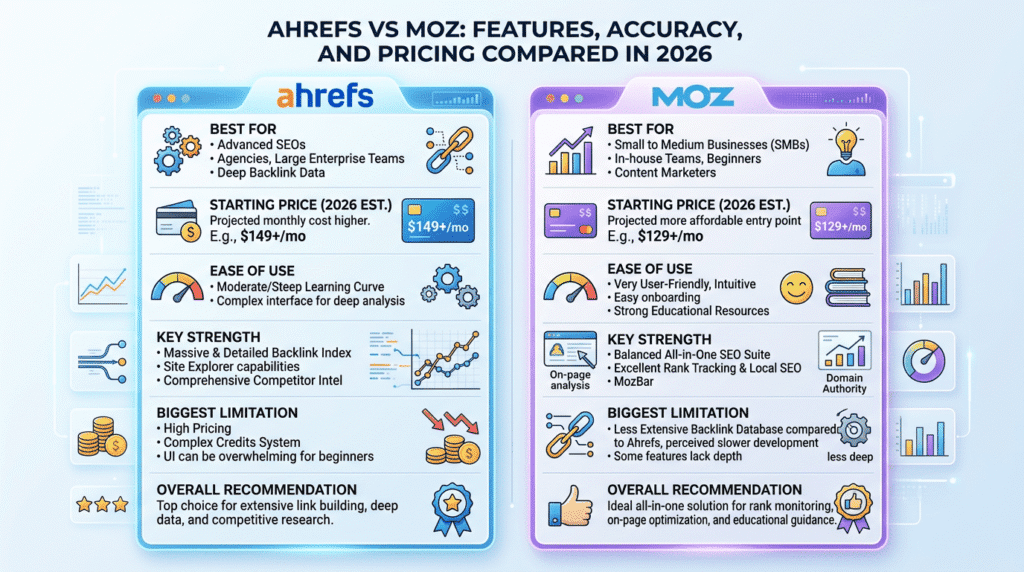
Complete comparison table
| Category | Ahrefs | Moz |
|---|---|---|
| Best For | Deep keyword research, backlink analysis, and competitive SEO research | Simpler SEO workflows, smaller teams, and beginner-friendly use |
| Not Ideal For | Budget-conscious users who only need light SEO tools | Teams that need deep backlink data and aggressive competitive research |
| Starting Price | Typically starts around $129/month | Moz Pro typically starts around $49/month |
| Free Plan | No true free plan; limited free tools only | No full free plan; limited free tools and trials may be available |
| Ease of Use | Powerful, but can feel dense at first | Easier for most beginners to learn |
| Key Strength | Strong backlink index and robust research depth | Clean workflow and approachable core SEO features |
| Biggest Limitation | Higher cost and more complexity | Less depth in competitive research and backlink intelligence |
| Overall Recommendation | Best for serious SEO research and growth teams | Best for simpler SEO operations and smaller budgets |
Ahrefs is usually the better fit if SEO is tied directly to growth and you need strong research depth every week. Moz makes more sense if you want a lighter, easier system and don’t need the full weight of an enterprise-style research stack. The bottom line is simple: if you live in keyword data and links, Ahrefs usually pulls ahead. If you want a calmer workflow and lower starting cost, Moz is often the easier buy.
Best For
Ahrefs is best for in-house SEO teams, agencies, publishers, and affiliates who need detailed backlink analysis, keyword research, and competitor discovery. It’s also a strong fit for users who know they’ll use the platform often enough to justify the higher monthly cost.
Moz is best for small businesses, solo consultants, local companies, and newer SEO users who want something easier to manage. If the goal is regular monitoring, basic audits, and straightforward reporting, Moz can cover the job without as much overhead.
Not Ideal For
Ahrefs is not ideal if your budget is tight and you only need a few SEO checks each month. If you’re mostly tracking a handful of pages, the cost can feel hard to justify.
Moz is not ideal if your work depends on broad competitive coverage, larger backlink research, or deeper link gap analysis. Teams that outgrow simple workflows usually start noticing the limits pretty quickly.
Bottom Line
If you want the stronger research platform, Ahrefs is usually the better long-term pick. If you want a more accessible SEO tool with a gentler learning curve, Moz is the cleaner entry point. The right choice depends less on brand reputation and more on how much SEO work you actually need to do.
Ahrefs Vs Moz: Which SEO tool is best for your workflow?
Ahrefs for keyword research and backlink analysis
Ahrefs is the stronger choice when your workflow depends on digging into search demand, competitor pages, and link profiles. Its keyword research tends to feel more expansive, especially when you’re looking for long-tail ideas, SERP features, and content gaps. The backlink analysis side is where Ahrefs really earns its reputation. If you regularly need to see who links to whom, what changed, and where link opportunities might exist, it’s built for that.
That depth matters in real campaigns. A content team can use it to identify topics with commercial intent. An agency can use it to explain why a client’s competitor is outranking them. An affiliate site operator can use it to find pages worth building links toward instead of guessing.
The trade-off is that Ahrefs can feel like more tool than some users need. If you only publish a few pages a month, the extra depth may sit unused while the bill keeps coming.
Moz for simpler SEO workflows and beginner-friendly use
Moz works better when you want the essential SEO tasks in a cleaner package. The interface is usually less intimidating, and that matters more than people admit. Some teams don’t need a giant analysis tool. They need a clear place to check rankings, review a site audit, and monitor basic backlink activity without getting lost in dozens of reports.
This is where Moz tends to make more sense for smaller businesses. A local service company, for example, may care more about local visibility, on-page SEO cleanup, and steady rank tracking than about running competitive deep dives all week.
Moz also feels easier for non-specialists. If the person using the platform is not a full-time SEO professional, simpler workflows reduce mistakes. That’s a real advantage, even if the data depth is lower.
Which SEO tool should you use if you care most about SEO growth?
If growth depends on finding new opportunities faster than competitors, Ahrefs usually has the edge. It gives you more to work with when you’re building content plans, studying link profiles, or mapping SERP behavior. That extra depth often leads to better prioritization, especially for sites trying to scale from dozens to hundreds of pages.
If your growth comes from steady execution rather than constant research, Moz can be enough. It won’t always surface the same volume of ideas, but it can still support a disciplined SEO strategy. The key is matching the tool to the way you actually operate.
A lot of teams overbuy. They pay for a heavy platform and use maybe 20% of it. Others underbuy and end up fighting missing data later. The smart move is to choose the tool that fits your current workflow with enough room to grow.
Ahrefs or Moz for solo site owners, agencies, and teams
Solo site owners usually split into two groups. If you’re technical, publish often, and care about backlinks, Ahrefs is hard to beat. If you want something easier to manage and cheaper to keep around, Moz is often the safer start.
Agencies tend to lean toward Ahrefs because client work often requires deeper research and stronger proof. That said, small agencies with simple retainers may prefer Moz if they’re mostly handling maintenance and reporting.
For teams, the decision usually comes down to process. If multiple people need to move through the platform quickly, Moz can reduce friction. If the team has dedicated SEO specialists who want richer data and don’t mind a steeper learning curve, Ahrefs is usually the stronger fit.
Ahrefs vs Moz features compared for everyday SEO work
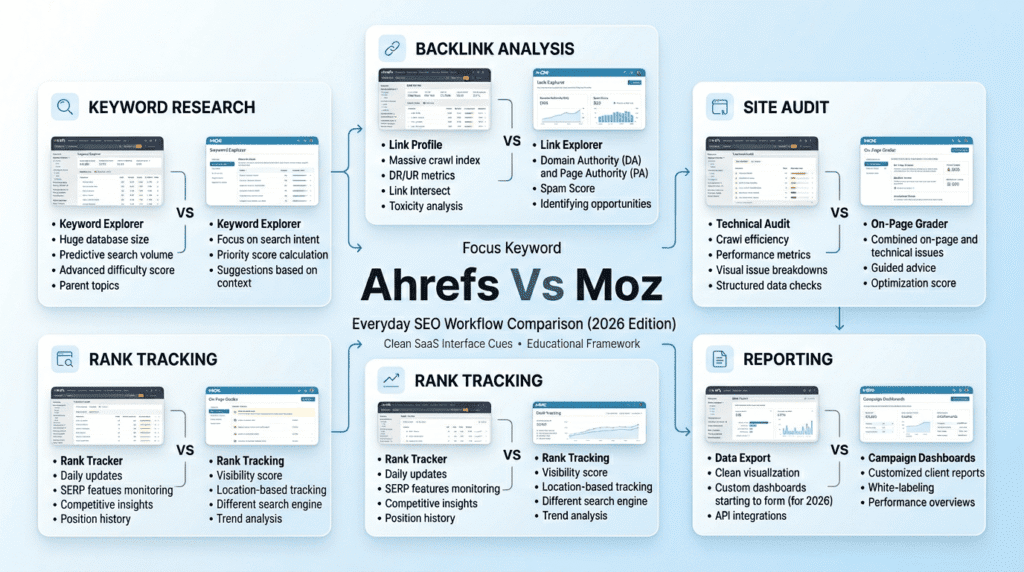
Keyword research: Ahrefs vs Moz keyword research depth
Ahrefs is generally the better keyword research tool when you need volume, variation, and competitive context. It tends to surface more keyword ideas and gives you more angles for filtering by intent, difficulty, and related terms. That matters when you’re building a content plan for a blog, SaaS site, or affiliate property and need more than a handful of obvious terms.
Moz covers the basics well enough, but it usually feels lighter. For smaller campaigns, that can be perfectly fine. For a site trying to scale from 50 pages to 500, the difference becomes more obvious. You start wanting more keyword clusters, more SERP context, and better ways to compare opportunities.
The practical issue is not just breadth. It’s confidence. Better keyword research reduces wasted content. That’s where Ahrefs tends to stand out.
Backlink analysis: backlink data quality and link gap visibility
Backlink analysis is one of the clearest separation points in this ahrefs vs moz comparison. Ahrefs has long been known for strong backlink data, and it remains one of the better options for understanding link profiles, referring domains, and competitor link strategies. If you’re doing outreach, competitive analysis, or link gap discovery, that depth is valuable.
Moz provides useful backlink information too, but it’s usually not the first choice for users who need the most complete picture. The gap becomes noticeable when you’re comparing multiple competitors or trying to prioritize links that could actually move the needle.
Here’s the part buyers often miss: more backlink data isn’t automatically better if you don’t use it well. But if links are a major part of your SEO strategy, missing data can create blind spots. That’s why agencies and affiliates often favor Ahrefs, while smaller users may be satisfied with Moz’s lighter approach.
Site audit: Ahrefs site audit vs Moz site audit
Both platforms offer a site audit, but they’re not equally central to the user experience. Ahrefs site audit gives you a solid technical overview and works well for spotting common crawl problems, broken links, redirect issues, and performance-related SEO issues. It’s useful if you want to run recurring checks and fold them into a broader research workflow.
Moz also handles site audits in a more straightforward way. For many users, that’s enough. If your technical SEO needs are mostly basic cleanup, the simpler presentation can actually help. You’re less likely to get buried in data you won’t act on.
The limitation for both tools is the same: they’re helpful, but they’re not a full replacement for a dedicated technical SEO platform on larger sites. Once a site grows, audits often need more granular crawl controls and deeper diagnostic context than either platform provides on its own.
Rank tracking: how Ahrefs and Moz handle tracking over time
Rank tracking is important because SEO work is slow, and memory gets fuzzy. Both tools can help you monitor movement over time, but the experience is different. Ahrefs tends to feel more research-heavy, so rank tracking often sits inside a broader analysis workflow. Moz’s version is usually simpler and easier for newer users to understand.
For a solo site owner, that simplicity can be enough. You can check whether a keyword moved, whether a page gained traction, and whether a campaign is trending in the right direction. For larger teams, though, rank tracking often needs more segmentation, more reporting clarity, and better prioritization across many pages.
This is one of those areas where tool choice depends on scale. If you only track 20–50 keywords, either platform may work. If you’re tracking hundreds or thousands, the surrounding workflow starts to matter a lot more than the raw ranking number.
SEO reporting and workflow features that matter in practice
Reporting is where tools often look better in demos than they do in real life. Ahrefs gives you strong raw data, but some teams find that the reporting flow still requires manual cleanup before clients or managers can digest it. Moz is often easier to explain because the presentation is more approachable.
Still, the real question is not which report looks prettier. It’s which report you can use every month without wasting time. A clean workflow matters when your team is juggling audits, keyword updates, and backlink checks across multiple sites. Even a few extra minutes per client adds up fast.
A practical example: an agency managing 15 local businesses may value Moz because it keeps reporting simple and predictable. A content-driven affiliate team, on the other hand, may care more about Ahrefs because the underlying SEO data is richer and more useful for prioritizing what to publish next.
Ahrefs vs Moz accuracy: what you can trust and what you cannot
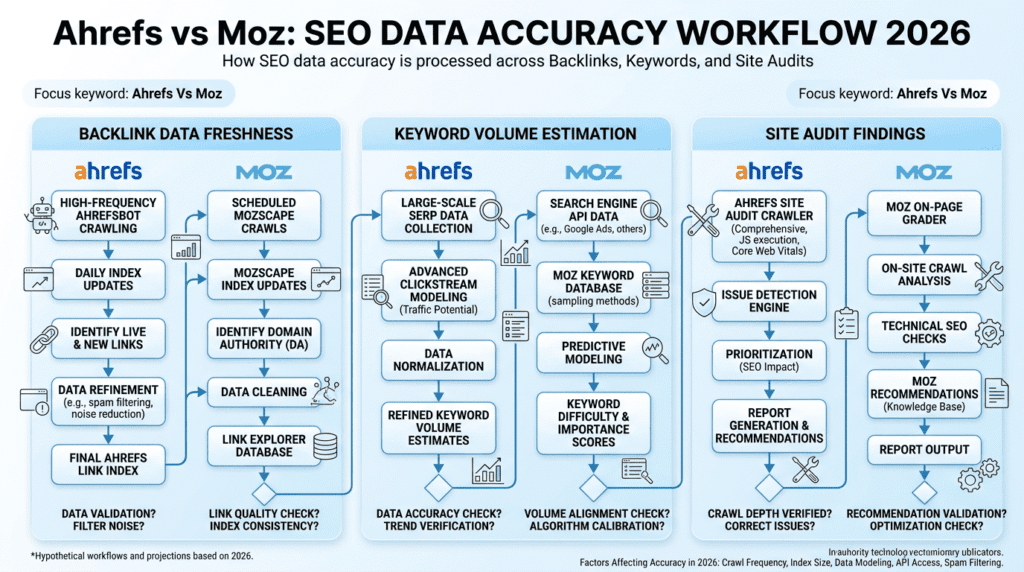
Accuracy is where a lot of Ahrefs Vs Moz comparisons get messy. People expect one tool to be “right” and the other to be “wrong,” but SEO doesn’t work that cleanly. These platforms are collecting data from different crawlers, updating at different speeds, and estimating search behavior from incomplete signals. So the real question isn’t whether Ahrefs or Moz is perfect. It’s which one is more dependable for the job you’re doing.
That matters because small accuracy gaps can change decisions. A backlink that shows up in one tool but not another can affect outreach. A keyword that looks like a 200-volume term in one platform and a 90-volume term in another can change content priorities. If you’re using the data to decide where to spend time and money, the tool’s blind spots matter just as much as its strengths.
Backlink data accuracy and freshness
Ahrefs is usually stronger when the work depends on backlink analysis. It tends to surface more links, more referring domains, and more recent changes, which makes it easier to spot new competitors, lost links, and active campaigns. That doesn’t mean every link is perfect or that Moz misses everything. It means Ahrefs usually gives you a broader and faster-moving view of the backlink graph.
Moz is still useful for backlink checks, especially if you want a cleaner, simpler read on a site’s link profile. But in day-to-day use, its link index often feels smaller and slower to update. That matters when you’re tracking fast-moving campaigns, doing link building, or comparing a site against aggressive competitors. If a page gained 40 links this month and only 12 show up in one tool, the output is still useful—but not equally useful.
Keyword data accuracy and search volume differences
Keyword research data is never exact because no tool sees the full search engine picture. Ahrefs and Moz both estimate volume, difficulty, and click potential, but they often arrive at different numbers. That’s normal. What matters is whether the estimates are consistent enough to guide your content plan.
Ahrefs usually gives you deeper keyword research coverage and more long-tail variation, which is helpful when you’re building topic clusters or trying to find keywords with commercial intent. Moz can be easier to digest, but its keyword set and volume estimates may feel narrower in tougher niches. If you’re comparing terms like “best CRM for small business” versus “CRM,” the differences in suggested volume and difficulty can become large enough to shift your content strategy.
The practical rule is simple: don’t obsess over the exact number. Compare keywords inside the same tool, not across tools, and use the data directionally. If Ahrefs says a keyword is growing and Moz says it’s flat, the trend matters more than the decimal precision.
Site audit findings and technical issue reliability
A site audit is only useful if it flags issues you can actually act on. Ahrefs and Moz both catch core SEO problems like broken links, missing tags, redirect issues, and indexability problems. But they don’t always rank issues the same way, and they won’t always surface the same technical details.
Ahrefs often feels more detailed and more useful for larger sites because it exposes a wider range of crawl data and problem types. Moz is usually easier to understand at a glance, which can be a win if you don’t want to dig through a long list of alerts. Still, both tools can overstate minor issues and understate the real business impact. A missing meta description might be marked clearly, while a messy internal linking structure that hurts crawl flow can take more interpretation.
That’s why technical SEO teams often use the audit as a starting point, not the final word. The tool shows symptoms. You still have to decide which symptoms actually affect rankings, crawling, or conversions.
What most blogs miss about SEO tool accuracy
The biggest mistake is treating accuracy like a single scoreboard. It isn’t. Ahrefs, Moz, and even semrush are all using different models, and each one can be “more accurate” in one area while being weaker in another. A backlink tool may be excellent at link discovery but mediocre at traffic modeling. A keyword tool may show a nice clean volume number but miss the intent behind the search.
The second missed point is operational: accuracy only helps if your workflow can use it. A slightly better backlink index is useless if your team can’t review it quickly. A more exact keyword estimate doesn’t matter if your content process is too slow to act on it. From an SEO point of view, the best tool is the one that gives you usable data often enough to make better decisions, not the one that looks smartest in a demo.
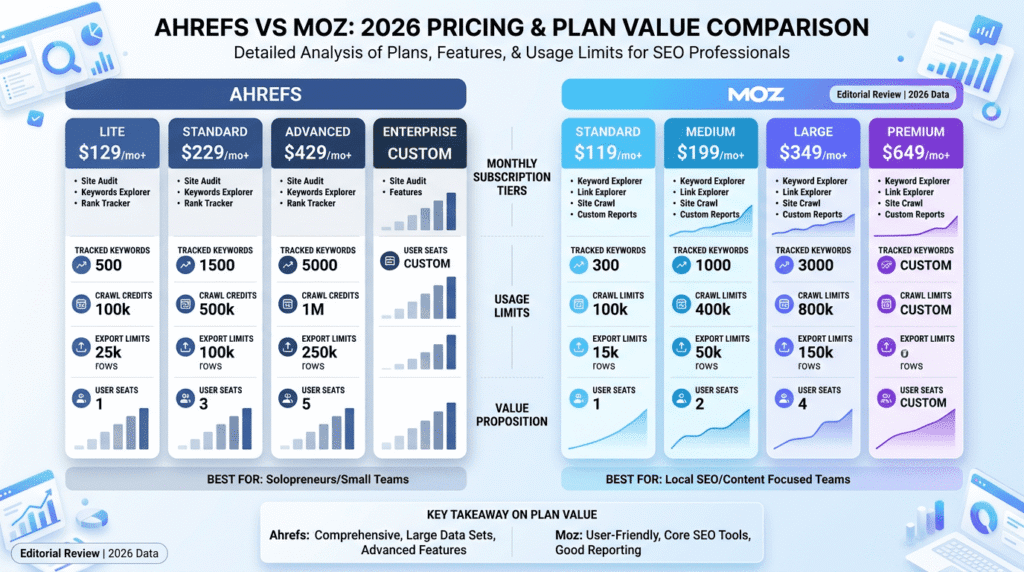
Pricing is where the comparison gets real fast. Ahrefs and Moz both sit in the premium SEO tool category, but they don’t feel equally priced once you factor in plan limits, user needs, and how often you’ll actually use the data. A solo blogger looking for basic keyword research has a different budget problem than an agency managing 20 client sites.
The hidden issue is that the cheapest plan on paper can become expensive once you hit usage caps. Some users only compare monthly price and miss the cost of add-ons, extra seats, or needing to upgrade sooner than expected. That’s where value starts to separate from sticker price.
Moz Pro pricing vs Ahrefs pricing
Moz Pro typically starts lower than Ahrefs, which is one reason many beginners test it first. Ahrefs pricing is usually higher, especially once you move into plans that make the platform feel fully usable for serious research work. Exact plan pricing changes often, but the gap is usually large enough that Moz looks friendlier for smaller budgets.
The real comparison, though, isn’t just “cheaper vs more expensive.” It’s what each price buys you. Moz Pro often makes sense if you want a simpler SEO platform and don’t need the deepest backlink analysis every day. Ahrefs costs more because it leans into larger data coverage, stronger research depth, and a heavier workflow for users who live inside the tool.
What you actually get at entry-level plans
At entry level, both tools are more limited than their marketing pages make them seem. Moz Pro’s lower tier is usually enough for light audits, rank tracking, and basic keyword research. Ahrefs entry plans often give you stronger research capabilities, but they can feel tight once you start doing repeated competitor checks, large backlink reviews, or multi-project tracking.
That’s the trap. A beginner may assume the base plan will cover “normal SEO work,” then realize normal work includes a lot more searches, reports, and exports than expected. If you’re managing even 3 to 5 sites, your usage can climb quickly. What looked like a manageable monthly expense can become a restricted setup pretty fast.
Limits that affect real-world usage
This is where most buyers get frustrated. It’s not the price itself. It’s the friction inside the plan.
Common pressure points include:
- Tracked keywords: Often capped by plan tier, which matters if you follow dozens of pages across multiple sites.
- Crawl or audit limits: Large sites can hit these faster than expected, especially ecommerce or content-heavy domains.
- Report and export limits: Agencies often need CSV exports, shareable reporting, and repeat pulls.
- User seats: One person can work inside a tool cheaply; a team usually can’t.
- Data refresh frequency: Some lower plans slow down the workflow more than the price suggests.
In practice, a 50,000-page ecommerce store and a 12-page local service site are not playing the same game. The first one may need a higher Ahrefs or Moz tier just to keep the site audit usable. The second might get by on a lower plan for months.
Free trial, upgrade pressure, and long-term cost concerns
Both platforms can create upgrade pressure quickly because the limits show up during real work, not during sign-up. Moz has traditionally been more approachable for people who want to test the waters, while Ahrefs is often harder to evaluate fully without paying. If there’s a free trial or limited-access offer available, it’s usually not enough to simulate a busy month of SEO work.
Long-term, the bigger cost question is whether the tool saves enough time to justify the subscription. A solo consultant may not need the same depth as a 5-person team. If you’re only checking rankings once a week and doing light audits, paying for a premium platform can feel wasteful. But if the tool replaces three separate workflows, the math changes.
Is Ahrefs or Moz better value for the money?
Ahrefs is usually better value for users who actively use backlink analysis, keyword research, and competitive research every week. You pay more, but you usually get more data and a stronger growth workflow. Moz is better value for smaller teams, beginners, and businesses that want a cleaner SEO tool without paying for maximum depth they won’t use.
So the value question is really about intensity. If SEO is a core channel, Ahrefs often earns its price. If SEO is one part of a broader marketing stack, Moz can be the smarter spend.
Ahrefs vs Moz ease of use: which SEO tool is easier to live with?
Ease of use sounds like a soft factor until you’re the person responsible for logging in every week and making the tool work. Then it becomes a serious issue. A research tool that’s technically powerful but annoying to navigate can slow down content planning, audits, and client reporting. The best SEO platform is the one your team will actually use without dragging out every task.
Learning curve for beginners
Moz is usually easier for beginners to understand. Its labels, reports, and workflows feel less crowded, so a new user can get to the basics faster. If you’re just trying to run a site audit, track a few keywords, and check domain authority, Moz often feels less intimidating.
Ahrefs has a steeper learning curve because it exposes more data and gives you more ways to slice it. That’s great once you know what you’re looking at. It’s less great when you’re still learning how to separate useful signals from noise. A first-time user may open Ahrefs and feel like they need a tutorial before they can trust anything on screen.
Dashboard clarity and daily workflow
Moz generally wins on dashboard clarity. It keeps the surface area smaller, which helps when you want to move quickly. Ahrefs, by contrast, is built for heavier research sessions. That’s useful, but it can make the daily workflow feel busier than it needs to be.
The difference shows up in routine tasks. Checking a few keywords in Moz is straightforward. Running a deeper competitor comparison in Ahrefs can produce more useful insight, but it may take more clicks, more filtering, and more interpretation. If you work in bursts and want a clean dashboard, Moz feels calmer. If you spend hours inside SEO data, Ahrefs feels more like a true analysis tool.
Reporting, exports, and client-friendly usability
For agencies and freelancers, reporting matters almost as much as research. Moz is often easier for client-facing summaries because the outputs feel simpler and less overwhelming. That can help when a client wants a quick explanation instead of a 12-tab data dump.
Ahrefs gives you more to work with, but that also means more editing before you send anything to a client. Exports can be very useful, especially for backlink analysis and keyword research, yet the raw data often needs cleanup. A marketing manager might appreciate the detail. A non-SEO client usually won’t.
Where Moz feels easier than Ahrefs
Moz feels easier when the work is repetitive and straightforward. If you’re doing basic rank tracking, simple audits, or entry-level content planning, it’s less likely to get in your way. It also tends to feel friendlier for solo operators who don’t want to spend an hour learning a new interface.
That ease matters when SEO is only part of your day. If you’re a coach, local business owner, or small ecommerce seller, you probably don’t want a complicated SEO tool taking over your workflow. Moz makes more sense in those cases because the learning cost stays lower.
Where Ahrefs feels more powerful than Moz
Ahrefs feels more powerful when the work gets serious. Once you start comparing competitors, mapping backlink gaps, and building content around search demand, the added complexity starts paying off. You get more angles, more data paths, and a better sense of what’s actually driving performance.
It’s not just that Ahrefs has more features. It’s that those features are tied together in a way that helps experienced users move from research to action faster. That’s why advanced teams often tolerate the heavier interface. The payoff is real if you know how to use it.
Ahrefs and Moz use cases: which tool fits your SEO goals?
The cleanest way to choose between Ahrefs and Moz is to start with your actual job, not the feature list. A content team, a link builder, a technical SEO specialist, and a solo site owner all need different things from the same platform. What feels “best” on paper can be clumsy in real use if it doesn’t match the workflow.
Best for keyword research and content planning
Ahrefs is usually the stronger choice for keyword research and content planning. It tends to surface more ideas, more long-tail variations, and more competitive context, which helps when you’re mapping content around real search demand. That makes it useful for blogs, affiliate sites, SaaS content teams, and niche publishers that need depth.
Moz can still handle keyword research, but it’s better for lighter planning than for large-scale content strategy. If you only need to validate a handful of keyword opportunities each month, Moz may be enough. If you’re building content at scale and care about search engine intent, Ahrefs generally gives you more to work with.
Best for backlink analysis and link building
Ahrefs is the clear favorite for backlink analysis and link building. It’s better at finding links, comparing competitors, and showing where link opportunities might exist. If your work includes outreach, broken-link recovery, or gap analysis, that extra backlink data can save a lot of time.
Moz is still useful for checking authority and getting a basic read on a site’s link profile, but it doesn’t usually match Ahrefs for depth. A small agency might use Moz for quick qualification and Ahrefs for the actual link-building push. That split workflow is common for a reason.
Best for site audits and technical SEO checks
Moz is often easier for light technical SEO checks, especially if you want a simpler view of crawl issues. Ahrefs is stronger when the site gets larger, the audit needs more detail, or the problems are tied to broader site structure. For a small business site with 20 pages, either tool may be enough. For a larger ecommerce catalog or a content site with hundreds of URLs, Ahrefs usually provides more usable context.
The catch is that neither tool replaces a hands-on technical review. A site audit can highlight broken pages, redirects, and missing tags, but it won’t always tell you whether a problem is urgent. That’s where human judgment still matters.
Best for agencies, freelancers, and in-house marketers
Agencies and in-house marketers often lean toward Ahrefs when the team needs deeper analysis and stronger competitive research. It’s more expensive, but it also fits a heavier reporting and strategy workflow. Freelancers who serve multiple clients may like it for the same reason, especially if they need to move between backlink analysis, keyword research, and site audits without switching tools.
Moz can be the better fit for smaller freelancers or lean in-house teams that want to keep the stack simple. If the business doesn’t need a large SEO platform every day, Moz is easier to justify. The difference usually comes down to volume: more sites, more stakeholders, more reporting, more need for depth.
Best for beginners versus advanced SEO users
Moz is usually better for beginners because it reduces decision fatigue. It’s easier to learn, easier to explain, and easier to use consistently. That can matter more than raw power when you’re still building confidence.
Ahrefs is better for advanced users who already know how to read SEO data and want a stronger research tool. It rewards experience. If you understand backlink profiles, keyword opportunities, and technical patterns, Ahrefs gives you more room to work. If you’re still figuring out the basics, Moz may feel like the better first step.
Ahrefs vs Moz vs Semrush: where each SEO tool fits
If you’re comparing Ahrefs Vs Moz, Semrush usually enters the picture fast. That’s because the real choice isn’t just “which SEO tool is better.” It’s which platform fits the way you work, the depth of data you need, and how much time you can spend inside the tool every week.
Ahrefs tends to appeal to users who want stronger backlink analysis, deeper keyword research, and a more research-heavy workflow. Moz is often easier for newer users who want a cleaner experience and fewer moving parts. Semrush sits in the middle for many teams because it tries to cover more marketing tasks, not just SEO. That can be a win or a headache depending on how much complexity you actually want.
Ahrefs vs Moz vs Semrush comparison table
| Feature | Ahrefs | Moz Pro | Semrush |
|---|---|---|---|
| Best For | Deep keyword research and backlink analysis | Simpler SEO workflows and smaller teams | All-in-one marketing and SEO teams |
| Free Trial | Limited/free tools only | Yes, usually 30 days | Yes, usually 7 days |
| Starting Price | Typically starts around $129/mo | Typically starts around $99/mo | Typically starts around $139.95/mo |
| Key Strength | Strong backlink data and broad research depth | Easier interface and solid core SEO basics | Broad feature set across SEO and marketing |
| Biggest Limitation | Can feel expensive fast | Less depth than Ahrefs in some areas | More complexity, more noise |
| Overall Fit | Best for serious SEO work | Best for straightforward SEO management | Best for teams that use more than SEO |
From a practical point of view, Ahrefs is the most research-focused. Moz is the most approachable. Semrush is the broadest. None of them is perfect, and the “best” one depends on how often you actually use the platform.
Keyword research tool strengths across the three platforms
Ahrefs usually wins when the job is pure keyword research. It tends to surface more keyword ideas, better clustering opportunities, and stronger competitive signals around what ranking pages are doing. For content teams that build topics around search intent, that matters. You’re not just collecting keyword lists; you’re trying to find terms that can realistically move traffic.
Moz still does keyword research well enough for smaller sites and simpler editorial plans. It’s easier to manage if you only need a few keyword lists, rank checks, and basic SERP insights. Semrush goes wider, with extra content and PPC style data layered in, but that breadth can make it feel heavier than needed if you only want SEO data.
The trade-off is simple: Ahrefs usually gives you more depth, Semrush gives you more surface area, and Moz gives you less friction. A solo blogger might not need the extra layers. A content-led agency probably will.
Backlink analysis and backlink data comparison
This is where Ahrefs separates itself most clearly. Its backlink analysis is still one of the main reasons people pay for it. The index is strong, the filtering is useful, and the link discovery workflow is easier to trust when you’re hunting for competitor links or reviewing a prospect list. Ahrefs also tends to be faster at showing you what changed, which helps when you’re monitoring lost or newly acquired backlinks.
Moz has useful backlink data, but it’s not usually the first choice for link builders who need deep coverage. It can still support basic outreach and brand monitoring, though. Semrush also offers solid backlink tools, and it’s good enough for many teams that want one platform for content, audits, and links. Still, if backlink data is the center of your process, Ahrefs and Semrush and Moz are not equal here. Ahrefs is the more common serious choice.
A realistic way to think about it: if you’re building links weekly, Ahrefs pays off faster. If you just want occasional backlink checks, Moz is often enough.
Site audit and SEO reporting differences
Moz and Ahrefs both cover site audit work, but they approach it differently. Moz usually feels simpler, which can be helpful if you want a cleaner list of technical issues and don’t need to dig through dozens of filters. Ahrefs tends to give you broader diagnostics and more room to investigate problems, which is useful when a site has layered issues across indexing, internal links, and crawlability.
Semrush is often the strongest if you want reporting across a bigger marketing stack. It can combine SEO reporting with broader campaign data, which agencies like because it gives them more to package for clients. The catch is that more reporting options do not always mean better reporting. Some teams end up spending extra time cleaning dashboards instead of acting on the audit itself.
If your team needs a simple audit to support on-page SEO and technical SEO fixes, Moz can be easier to live with. If you need deeper issue investigation or more competitive research around those issues, Ahrefs usually has the edge.
Which SEO tool is best if you are comparing Semrush vs Ahrefs vs Moz?
If you’re comparing semrush vs ahrefs vs moz, start with your daily workload instead of feature checklists. Ahrefs is usually the strongest fit for SEO professionals who live in research, links, and content strategy. Moz is the better fit for users who want a calmer interface and more predictable daily use. Semrush is the strongest “platform” choice if you want SEO plus extra marketing functions and can handle the complexity.
For agencies, Semrush and Ahrefs often make more sense than Moz because both scale better when the workload gets messy. For smaller businesses, Moz can still be the smarter choice because it’s easier to learn and harder to overcomplicate. That’s the part buyers miss: the best tool is not always the one with the biggest feature list. It’s the one your team will keep using after the first month.
Hidden trade-offs most buyers overlook before choosing Ahrefs or Moz
Why more data does not always mean better decisions
A bigger dataset sounds great until it starts slowing you down. Ahrefs can show more keyword ideas, more backlink entries, and more competitive signals, but that extra volume can create noise if you don’t have a clear process. SEO teams often assume more data automatically means better strategy. It doesn’t. It usually means more filtering, more validation, and more chances to overthink a page that only needed a few good edits.
Moz can actually be useful here because it limits the temptation to drown in data. That makes it easier for newer users to stay focused on the right handful of pages, links, and keyword opportunities. The downside is obvious: when a site gets bigger, those guardrails can turn into blind spots.
When simpler SEO tools save time
Simple tools save time when the work is repetitive. If you only need to check rank tracking, run a quick site audit, and review a few keyword groups each week, a lighter workflow is a real advantage. Moz is often enough for that. You can get in, review the basics, and get out without spending 20 minutes deciding which report to trust.
That matters more than people admit. A small business owner or solo marketer rarely has hours to babysit a research tool. They need a seo tool that reduces decisions, not one that creates new ones. The catch is that simplicity has a ceiling. Once you start competing in harder niches, the lack of depth starts to show.
Scaling concerns as your site or client list grows
Scaling is where Ahrefs usually pulls ahead. One site is manageable in almost any platform. Five sites is still fine. But once you start handling multiple brands, larger content libraries, or client accounts with different reporting needs, the difference becomes obvious. Ahrefs generally gives you more room to research at scale, while Moz can feel more like a single-site or lighter-team tool.
Semrush often wins here for agencies because it supports broader workflows and client-style reporting. Still, the more sites you manage, the more you’ll care about export limits, seat limits, and how much time the platform takes to organize data. This is where buyers get burned. They choose a plan based on starting price, then discover the real cost is time.
Reality check on “all-in-one” SEO tool expectations
No seo platform replaces judgment. That sounds obvious, but it’s the point most buyers miss. Ahrefs, Moz, and Semrush can all help with keyword research, backlink analysis, and site audits, but none of them will tell you which SEO strategies fit your market, your content capacity, and your conversion goals.
That’s why “all-in-one” should be treated carefully. It usually means “covers more of the workflow,” not “does everything well.” If you need a focused research tool, Ahrefs is often the better choice. If you need a cleaner operational tool, Moz may be enough. If you want one platform that touches many marketing tasks, Semrush is stronger. The right answer depends on what you’ll actually use three months from now, not what looks impressive in a demo.
Final verdict: Ahrefs vs Moz and which SEO tool you should choose

When Ahrefs is the better choice
Ahrefs is the better choice if your work depends on deep keyword research, backlink analysis, and competitive research. It’s especially strong for agencies, content teams, affiliate publishers, and in-house marketers who need more than a basic seo tool. If you routinely compare pages, analyze link opportunities, or build campaigns around search data, Ahrefs usually justifies the extra cost.
It also tends to be the better fit when you expect to grow. A site with 50 pages and a site with 5,000 pages create very different research demands. Ahrefs handles that bigger workload more naturally than a simpler platform.
When Moz is the better choice
Moz is the better choice if you want a more manageable workflow and don’t need the deepest data on every report. It works well for small businesses, beginners, consultants with a few clients, and teams that care more about clarity than volume. If your main tasks are rank tracking, light audits, and occasional keyword research, Moz Pro can be enough.
It’s also easier to hand off inside a small team. That can matter when the person running SEO is not a full-time specialist. A cleaner interface often leads to better follow-through.
Final recommendation for different buyer types
If you’re a solo publisher or SEO beginner, Moz is usually the safer starting point unless you know you’ll need deeper backlink and keyword coverage soon. If you’re an agency, growth-stage brand, or experienced seo professional, Ahrefs is usually the stronger long-term buy. If you’re managing SEO plus broader marketing work, Semrush may be the better middle ground.
In simple terms: choose Ahrefs for depth, Moz for simplicity, and Semrush for breadth. That’s the real decision.
Ahrefs vs Moz: the short answer
Ahrefs vs Moz comes down to this: Ahrefs is stronger for serious research and scaling, while Moz is easier to use and often better for lighter SEO workflows. If your priority is maximum data depth, choose Ahrefs. If your priority is a cleaner daily experience, choose Moz. If you need a broader marketing platform, look at Semrush too.
Frequently Asked Questions About Ahrefs Vs Moz
Is Ahrefs better than Moz for keyword research?
Yes, Ahrefs is generally better than Moz for keyword research. It tends to give you deeper data, more competitive insight, and a stronger workflow for finding content opportunities. Moz can still work for basic planning, but Ahrefs is usually better when keyword research is a major part of your SEO process.
Is Moz Pro worth it compared with Ahrefs?
Yes, Moz Pro can be worth it if you want a simpler seo tool and don’t need the full depth of Ahrefs. It’s often a better fit for beginners, smaller sites, and teams that want less complexity. If you need advanced backlink analysis and larger-scale research, Ahrefs is usually the better spend.
Which tool has better backlink data, Ahrefs or Moz?
Ahrefs has better backlink data in most real-world SEO workflows. Its index is stronger for link discovery, competitive link research, and tracking link changes over time. Moz still covers backlink basics, but it usually isn’t the first choice for serious link builders.
Can Moz compete with Ahrefs for site audit and SEO work?
Moz can compete for basic site audit and day-to-day SEO work, especially on smaller sites. It’s easier to use and often faster for straightforward checks. Ahrefs is stronger when the audit gets more technical or when you need to connect audit findings to broader research.
Should you choose Ahrefs vs Moz vs Semrush for your SEO budget?
Choose based on what you’ll use most often. Ahrefs is usually the best fit for deep SEO work, Moz for simpler workflows, and Semrush for teams that want a broader marketing platform. If your budget is tight, don’t pay for depth you won’t use. The best tool is the one that matches your actual workload, not the biggest feature list.