
A lot of teams buy an SEO toolset thinking it will solve both search visibility and content planning. That’s where the friction starts. In practice, the best choice in the Ahrefs Vs Buzzsumo debate depends on whether you need hard search data, content discovery, or a mix of both. The wrong pick usually shows up a month later, when the blog calendar is full but organic traffic is flat.
This matters more in 2026 because content teams are under pressure to do two jobs at once: rank in the search engine and create pieces people actually share. Ahrefs and BuzzSumo can both support that work, but they do it in very different ways. One is built around SEO data and backlinks. The other is focused on content research, trending topics, and social engagement.
Quick Verdict: Ahrefs vs BuzzSumo at a Glance
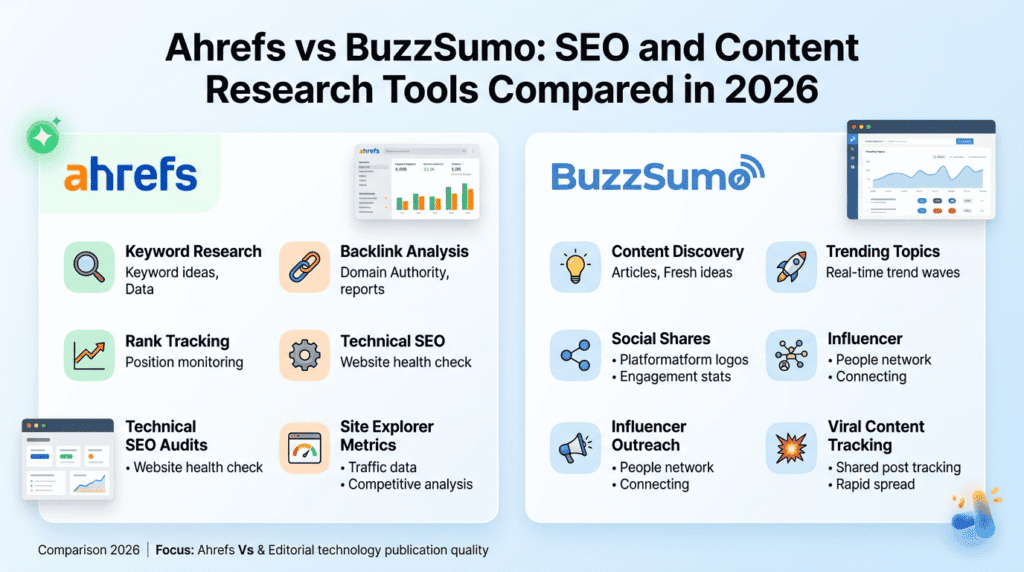
Complete Comparison Table
| Category | Ahrefs | BuzzSumo |
|---|---|---|
| Best For | SEO teams, agencies, publishers, and site owners who need keyword research, backlink analysis, and technical SEO audits | Content marketers, PR teams, and social teams who need content discovery, trending topics, and influencer outreach |
| Not Ideal For | Teams that only need lightweight content ideation or social listening | Teams that need deep SEO data, backlink research, and site-level organic traffic analysis |
| Starting Price | Typically starts around $129/month for Lite plans, with higher tiers for larger teams | Typically starts around $199/month, with more advanced plans for agencies and enterprise users |
| Free Plan | No permanent free plan; limited free tools and trials may be available | No strong free plan for ongoing professional use |
| Ease of Use | Moderate; powerful but can feel dense at first | Easier for topic research and content discovery, especially for non-SEO users |
| Key Strength | Strong SEO data, keywords explorer, site explorer, and backlinks | Fast content research, social shares, viral content tracking, and influencer discovery |
| Biggest Limitation | Can be more than many content teams need, and ahrefs limits monthly credits | Limited for deep SEO audits and technical site analysis |
| Overall Recommendation | Best if SEO is the main goal | Best if content discovery and social validation are the main goal |
Best For
Ahrefs is the better fit if your work depends on keyword research, backlink analysis, rank tracking, or technical SEO audits. It’s the stronger all-in-one SEO option for teams that need access to core seo data every day. Agencies, affiliate publishers, and in-house SEO managers usually get more from it because it connects topic research to ranking potential.
BuzzSumo is better for teams focused on content marketing, social media, and idea generation. If your process starts with finding trending topics, top-performing content, or shared content across the web, BuzzSumo is often the faster tool.
Not Ideal For
Ahrefs is not the cleanest choice if you only need buzzworthy headlines, influencer tracking, or lightweight content ideas. It can feel oversized when the main task is brainstorming.
BuzzSumo is not the best seo option if you need deep domain comparison, backlink data, or technical SEO diagnostics. It’s useful, but it won’t replace a real SEO toolset.
Bottom Line
If your team lives in search data, Ahrefs is the safer long-term buy. If your team lives in content discovery and social validation, BuzzSumo is more practical. Most growing teams eventually realize that buzzsumo and ahrefs solve different problems, and the right answer is often to use each one where it’s strongest.
Ahrefs vs BuzzSumo: Core Differences in SEO and Content Research
How Ahrefs and BuzzSumo approach SEO differently
Ahrefs is an SEO toolset first. Its strength is giving you the numbers behind search behavior: keywords, backlinks, ranking pages, and site health. That makes it useful for seo analysis, seo competitor analysis, and planning content around actual search demand instead of guesswork.
BuzzSumo comes from the content side. It helps you spot what people are sharing, what’s getting attention, and which ideas are resonating across the web. That’s not the same as search optimization, and that’s the point. It’s better for content research than technical ranking work.
The difference sounds simple until a team tries to use one tool for both jobs. Then they hit the usual wall: the content team wants trending content and social proof, while the SEO team wants organic traffic data and backlink gaps.
Where BuzzSumo is stronger for content marketing research
BuzzSumo is built for finding the most shared content and spotting patterns in social engagement. That’s valuable when you need fast content ideas or want to validate a topic before writing. It’s especially helpful for content creators, PR teams, and brands that care about content marketing and social media.
It also works well when you need to study content popularity and social response instead of just rankings. A team launching a product page, webinar series, or thought leadership campaign can use BuzzSumo for content ideation, then shape the angle based on what already gets engagement.
Where Ahrefs is stronger for SEO and keyword discovery
Ahrefs is stronger when you need actual search data. Its keywords explorer and site explorer help you estimate demand, inspect ranking pages, and understand what it might take to earn organic traffic. That matters when you’re building content strategies that need to scale, not just get likes.
It’s also stronger for backlink analysis. If you’re trying to understand why a competitor outranks you, or where link opportunities might exist, Ahrefs gives you the kind of detail BuzzSumo doesn’t.
How the two tools fit together in a modern workflow
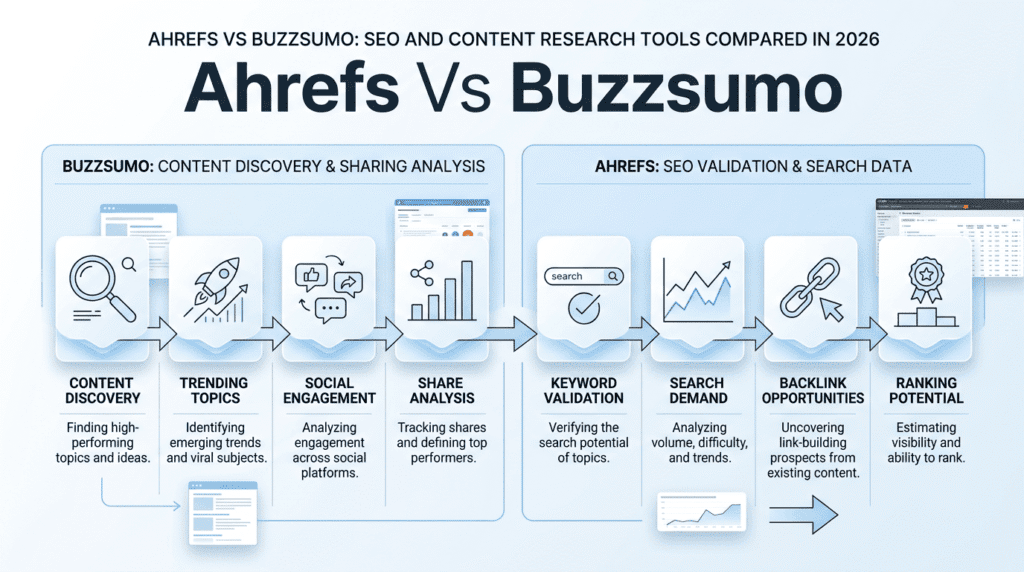
In a practical workflow, BuzzSumo can be the starting point and Ahrefs the validation step. You might use BuzzSumo to discover trending topics, then use Ahrefs to check whether those topics have search demand and realistic ranking potential.
That combo is useful for content marketing and seo teams that can’t afford to publish blindly. BuzzSumo helps you avoid boring topics. Ahrefs helps you avoid topics that look exciting but won’t move the needle in search.
Ahrefs vs BuzzSumo: Feature Differences That Matter Most
Keyword research and SEO data in Ahrefs
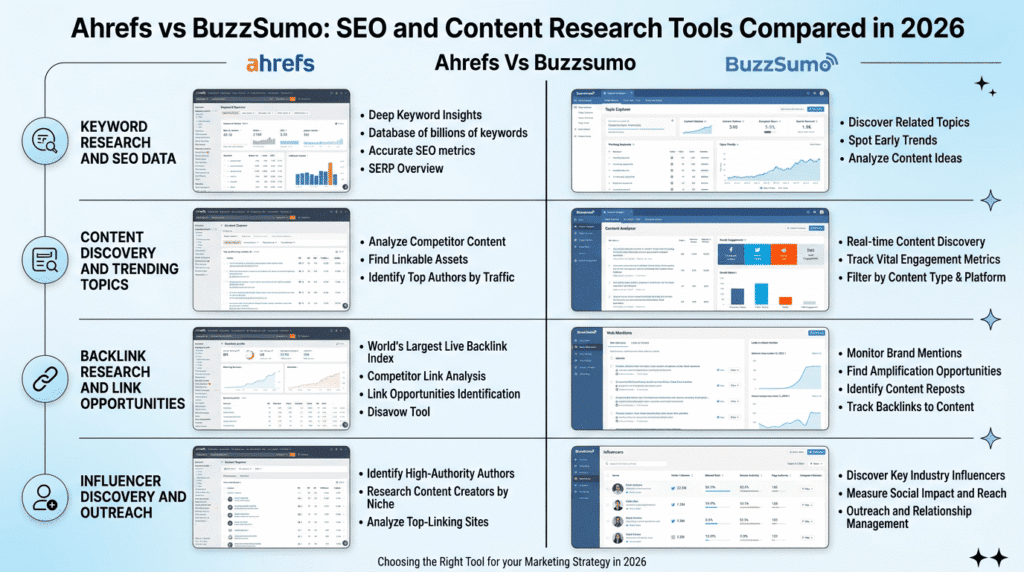
Ahrefs is stronger for keyword research because it gives you more context around ranking difficulty, search intent, and potential traffic. It’s the kind of data teams use when deciding whether a topic belongs in a blog post, landing page, or support article.
The catch is that ahrefs limits monthly credits, so heavier users can run into friction fast. If you’re doing repeated audit work, competitor analysis, or large batch keyword reviews, that matters. Smaller teams may not notice. Agencies usually do.
Content discovery and trending topics in BuzzSumo
BuzzSumo is better when the job is content discovery. You can quickly find trending topics, monitor shared content, and see which angles are generating engagement. That makes it useful for editorial planning and campaign ideas.
It’s not just about volume. It’s about pattern recognition. If a topic keeps showing up across the web with strong social shares, that’s often a decent signal for content creation. Not a guarantee, just a better starting point than guessing.
Backlink research and link opportunities in Ahrefs
Ahrefs is the clear winner for backlink analysis. It’s one of the main reasons people buy it. You can study backlinks, compare domains, and find pages that earn links consistently. That’s valuable for seo strategies that depend on authority growth.
This matters because link building is rarely efficient without data. Tools like Ahrefs show where competitors are getting attention, which pages attract links, and which content formats might be worth recreating or improving.
Influencer discovery and outreach in BuzzSumo
BuzzSumo has an edge in influencer discovery and outreach because it ties people to content performance. If someone consistently shares or amplifies posts in your niche, that can be useful for content marketing and social media campaigns.
It’s especially practical for PR and collaboration work. A brand can use BuzzSumo to build a media database, identify relevant voices, and start outreach with some evidence behind the relationship. That usually beats blind email pitching.
Content strategies and topic validation in both tools
Both tools can support content strategies, but they do it differently. BuzzSumo validates whether a topic has social momentum. Ahrefs validates whether it has search potential.
That distinction saves time. A lot of teams still confuse popular with profitable. A topic can look great in social feeds and still produce weak organic traffic. Or it can have solid search volume and almost no shareability. The right tool helps you see which problem you’re actually solving.
Ahrefs vs BuzzSumo: Performance Comparison for Real Content Marketing Work
Testing methodology for SEO and content research tasks
In real work, the comparison isn’t about features on a pricing page. It’s about how quickly each tool helps you answer the next decision: what to write, what to optimize, and what to ignore.
For this kind of comparison, the most useful tests are simple. Look at how each tool handles topic discovery, search demand checks, competitor analysis, and content performance review. Then compare the time it takes to move from idea to action. The fastest tool is usually the one that reduces second-guessing, not the one with the biggest dashboard.
Finding topics that can boost your SEO
Ahrefs is better when the goal is to boost your seo with topics that have ranking potential. You can check keyword difficulty, estimate traffic, and review pages already winning in search. That gives you a clearer sense of whether a topic belongs in your publishing plan.
BuzzSumo can still help here, but in a different way. It can surface topic ideas that have social traction, which is useful when your team wants content that spreads beyond search. A good editorial team often uses both signals: search demand from Ahrefs, social interest from BuzzSumo.
Evaluating search demand and content potential
Ahrefs is the stronger tool for evaluating search demand because it’s built around SEO data. That makes it more reliable for teams that care about long-term organic traffic instead of short-lived spikes.
BuzzSumo is better for content potential in a broader sense. If a topic has strong engagement, multiple formats around it, and obvious audience interest, it may still be worth creating even if search volume is modest. That’s where editorial judgment matters. Not every win shows up in keyword charts.
BuzzSumo is useful when you want to see whether content has social proof before you invest time in it. If a topic keeps getting shared, cited, or repeated across different channels, that’s a signal worth paying attention to.
It’s not a substitute for SEO data, though. Social shares don’t always translate to search performance. A piece can go viral and still fail to rank. That’s why BuzzSumo is best treated as a content research tool, not a full seo tool.
Using Ahrefs for search intent and ranking potential
Ahrefs is better for reading search intent and estimating whether you can realistically rank. That matters because content teams often create pages that are too broad, too competitive, or too disconnected from what searchers actually want.
Its site explorer and keywords explorer help you compare pages and see what search engine results are rewarding right now. For teams serious about seo optimization, that’s the part that keeps content from becoming wasted production. The work is slower, but it’s usually more dependable.
BuzzSumo vs Ahrefs: Ease of Use and Workflow Fit
Which tool is easier for beginners
BuzzSumo is usually easier for beginners because it feels narrower. You can jump in, search a topic, and start seeing trending content, social shares, and top-performing posts without learning a complex dashboard first. That matters if you’re a solo creator, marketer, or small agency trying to move fast.
Ahrefs has a steeper learning curve. It gives you more depth, but that depth comes with more screens, more reports, and more chances to get lost if you don’t already understand SEO terms like keywords explorer, site explorer, or technical seo audits. For a new user, the first hour in Ahrefs can feel like work.
Which tool works better for SEO teams
SEO teams usually get more out of Ahrefs because the workflow is built around search engine analysis, backlink analysis, rank tracking, and competitor research. If your team needs to audit pages, find keyword gaps, monitor organic traffic, and document recommendations, Ahrefs gives you the structure to do that without stitching together a bunch of separate tools.
BuzzSumo can still help the team, but it plays a smaller role. It’s stronger when the team wants to validate content ideas, check which formats are getting social engagement, or spot trending topics before they peak. That’s useful, just not enough on its own for a serious SEO workflow.
Which tool is faster for content marketers
BuzzSumo is often faster for content marketers because it gets to the point. Search a topic, find the most shared content, scan headlines, and move on. If you’re planning a blog calendar or trying to shape content ideas for the next 30 days, that speed is hard to ignore.
Ahrefs takes longer, but it can save time later. A content marketer might spend more time inside Ahrefs at first, then use the data to avoid writing into dead topics. That trade-off is common: BuzzSumo helps you move quickly, while Ahrefs helps you move with more confidence. The best choice depends on whether your bottleneck is ideation or validation.
How buzzsumo and ahrefs differ in daily use
In day-to-day work, the difference is pretty simple. BuzzSumo is lighter and more editorial. Ahrefs is heavier and more analytical. One helps you react to trending content and social signals. The other helps you build content strategies around search demand, backlinks, and ranking potential.
A practical way to think about it: BuzzSumo is what you check when you want content inspiration and social proof. Ahrefs is what you open when you want to understand why a page ranks, how hard a keyword will be, or where your site needs an audit. Teams that mix seo and content usually feel both tools are useful, but for different parts of the workflow.
Ahrefs vs BuzzSumo: Pricing and Value for Money
Pricing differences between Ahrefs and BuzzSumo
Ahrefs and BuzzSumo both sit in the premium software category, but they price for different buyers. Ahrefs typically starts around the low double digits on entry-level access for limited use, then climbs quickly as you need more reports, projects, or users. BuzzSumo is usually sold as a content research platform with pricing that often begins in the same general range, though the practical cost rises fast once you need broader search limits or team access.
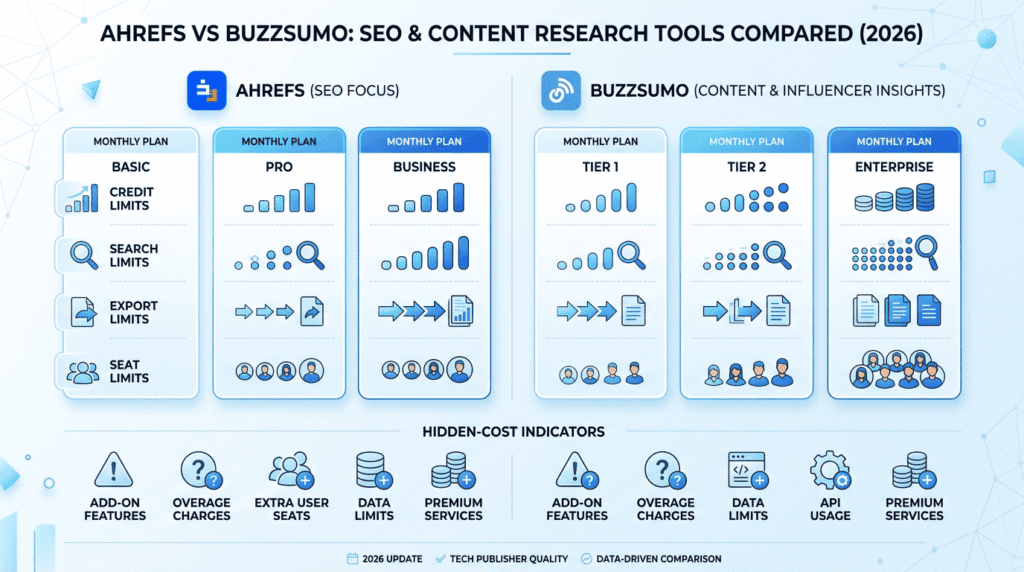
The real issue isn’t just the monthly fee. It’s how fast you hit limits. Ahrefs often uses monthly credits and report caps. BuzzSumo usually limits searches, exports, alerts, or users depending on the plan. That means the cheapest plan can look fine on a pricing page and still feel tight after a few real work sessions.
Which tool offers better value for content marketing
For pure content marketing, BuzzSumo often feels like better value because it’s focused on the work many teams actually do every week: content discovery, trending topics, social shares, and topic validation. If your team mainly needs content ideas and a way to spot what people are already engaging with, paying for all of Ahrefs’ extra SEO depth may be unnecessary.
Ahrefs offers better value if content marketing and seo are tied together in your process. A blog post that gets discovered but never ranks is only partially useful. Ahrefs helps you estimate search demand, assess competition, and find keyword opportunities that can turn a topic into lasting organic traffic. That’s a different kind of value, and for many businesses it’s the more durable one.
Hidden costs and plan limitations to watch
This is where buyers get frustrated. Ahrefs can be expensive if multiple people need access, because seat-based costs and monthly credit limits can slow down shared workflows. One strategist may burn through credits on audits and competitor analysis, then another team member gets stuck waiting. That’s a real operational bottleneck, not just a pricing annoyance.
BuzzSumo has its own friction. You may run into limits on searches, exports, or saved alerts right when a campaign gets active. That can be awkward for agencies or brands doing large-scale content research. If you need to monitor several topics, track influencers, and export results for a team, the plan can feel cramped sooner than expected.
A few things to check before buying either tool:
- Search limits: How many queries you can run each month.
- Exports: Whether CSV or report exports are capped.
- Users: How many seats are included before extra charges apply.
- Alerts and monitoring: Whether trend alerts or content monitoring are limited.
- Credits: Whether core actions consume monthly credits fast.
When all-in-one SEO pricing makes more sense
All-in-one SEO pricing makes sense when your team needs access to core seo plus research, audits, rank tracking, and backlink analysis in one place. In that setup, Ahrefs can replace several smaller tools, which helps justify the cost. That’s especially true for agencies, SaaS brands, and ecommerce teams that rely on recurring seo analysis.
If your needs are more editorial than technical, though, an all-in-one stack can be overkill. A content team that only wants content ideas, social proof, and influencer discovery may be better off with BuzzSumo and a lighter seo tool elsewhere. The best value comes from matching the platform to the actual workflow, not to the largest feature list.
Ahrefs vs BuzzSumo for Content Marketing and SEO Strategy
Using Ahrefs for content strategies that rank
Ahrefs is stronger when the goal is to build content strategies that can hold rankings over time. It helps you look at keyword research, search demand, difficulty, and competitor pages in one place, which makes planning more disciplined. Instead of guessing which blog post might work, you can see where the organic traffic is likely to come from and what kind of page the search engine already rewards.
That matters when content creation needs to support revenue, not just impressions. A SaaS brand might use Ahrefs to map product-led topics, compare competing pages, and identify gaps where there’s clear intent but weak coverage. The payoff is slower than chasing a viral content idea, but it’s usually more stable.
Using BuzzSumo for content ideas that spread
BuzzSumo is better when the goal is to find content ideas that spread across social channels. It helps you spot viral content, see what has been shared the most, and filter topics by engagement. That makes it useful for editorial teams that care about reach, brand visibility, and audience reaction.
This is also where BuzzSumo feels more natural for content ideation. You can browse shared content across the web, find angles that already proved they work, and then turn that into your own version with a better hook or fresher data. For publishers, coaches, and marketers who publish often, that kind of fast validation can save a lot of wasted drafts.
Combining SEO and content workflows without overlap
The cleanest workflow is often split in two stages. Use BuzzSumo first to discover trending content, see what’s getting social shares, and narrow the list of topics. Then use Ahrefs to check keyword opportunities, estimate ranking difficulty, and verify whether the topic can actually drive organic traffic.
That keeps the tools from stepping on each other. BuzzSumo is doing discovery and social listening. Ahrefs is doing seo validation. If you try to use either one for everything, you end up fighting the software instead of working with it. Teams that understand this split usually get better results with less busywork.
Which tool fits content marketing and SEO goals better
If your main goal is content marketing and seo together, Ahrefs usually has the edge. It connects topic selection to rankings, backlinks, and search performance, which makes it more useful for long-term growth. BuzzSumo is excellent for content discovery and audience response, but it doesn’t go nearly as far once you need technical seo depth or keyword modeling.
So the better choice depends on your target. If you care most about content popularity and social engagement, BuzzSumo fits. If you care most about ranking, traffic, and durable SEO strategies, Ahrefs is the stronger buy. In mixed teams, the two tools work best as companions, not replacements.
Ahrefs vs BuzzSumo: Outreach, Influencer Discovery, and Link Building
BuzzSumo for influencer research and outreach
BuzzSumo has a clear advantage when influencer research is part of the job. Its media database features make it easier to find writers, publishers, and influencer profiles tied to specific topics. That helps when you need outreach targets for a launch, a guest post campaign, or a content promotion push.
The workflow is practical. You search a topic, find people who regularly engage with or share that subject, and build a list for outreach. For content marketing and social media teams, that can be a lot more useful than a generic contact database. It’s less about raw volume and more about relevance.
Ahrefs is stronger for backlink prospecting because it is built around site explorer data, backlinks, and authority signals. If you’re trying to understand where a competitor earned links, which pages attract citations, or what kind of content gets references from other sites, Ahrefs is the more precise tool.
That precision matters for scaling link building. You can study link patterns, identify pages worth replicating, and use backlink analysis to prioritize outreach targets that are more likely to move the needle. For SEO teams, that’s often a better use of time than manually guessing which sites might respond.
Which tool is better for outreach workflows
BuzzSumo is better for outreach when the goal is relationship-based promotion. Ahrefs is better when the goal is link acquisition and authority building. Those are related, but they’re not the same.
A PR-led team might prefer BuzzSumo because it helps them find the right people to contact around trending topics. An SEO-led team usually prefers Ahrefs because it shows where backlinks already exist and where opportunities are more likely to be valuable. If outreach is part of broader content marketing, BuzzSumo feels lighter. If outreach is part of ranking growth, Ahrefs tends to win.
When outreach needs both buzzsumo and ahrefs
The strongest campaigns often use both tools. BuzzSumo can surface the people and publications talking about a topic right now. Ahrefs can show which pages in that topic already earned backlinks and why. Together, they give you both the audience map and the authority map.
That combination is especially helpful for launches, original research, and thought leadership. A brand can use BuzzSumo to identify social and influencer interest, then use Ahrefs to find link-worthy gaps and build a cleaner outreach list. When the campaign needs reach and ranking at the same time, buzzsumo and ahrefs make more sense as a pair than as competing options.
Honest Take: What Most Blogs Miss About Ahrefs Vs Buzzsumo
The cleanest way to judge Ahrefs Vs Buzzsumo is to stop treating them like direct clones. They solve different parts of the same problem. One helps you understand how a topic can rank in a search engine. The other helps you see whether people are actually sharing, reacting to, or amplifying that topic across the web.
That difference sounds small on paper. In real work, it changes everything. A topic can look promising in one tool and fail in the other. That’s not a bug. It’s the normal tension between seo demand and social engagement.
Why the better tool depends on the job, not the brand
The right pick depends on what you need to do on Tuesday afternoon. If you’re trying to build a page that earns organic traffic over months, ahrefs usually fits the job better. If you need content ideas, trending topics, or a quick read on what’s spreading right now, buzzsumo has the edge.
That’s why a lot of “which is better” debates miss the point. The best seo tool is the one that matches the current task. Keyword research, site explorer checks, and backlink analysis belong in one bucket. Content discovery, shared content tracking, and influencer scanning belong in another. If your workflow crosses both, you’ll feel the gap fast.
The reality of using BuzzSumo without strong SEO data
BuzzSumo can show you what’s getting shared, but that doesn’t always mean it will rank. A post can have strong social shares and still produce weak organic traffic. That happens because social popularity and search intent don’t behave the same way.
This is where content teams get tripped up. They pick a trend because it looks hot, then realize the search volume is thin or the keyword competition is brutal. BuzzSumo is useful for content discovery, but without SEO validation, it can push teams toward topics that feel alive and still underperform in search. That’s especially painful when you’re trying to optimize content for both discovery and long-term traffic.
The reality of using Ahrefs without content distribution insight
Ahrefs is strong for keyword research, seo audits, and backlink research, but it can make content planning feel a little too tidy. A keyword may look like a good target, yet the format may not travel well on social, email, or LinkedIn. In other words, it may rank slowly and spread even more slowly.
That matters for teams that care about content marketing and seo at the same time. You can build pages around strong keywords and still miss the buzz around a topic. Without distribution insight, you may produce content that is technically sound but easy to ignore. Ahrefs for seo is excellent. It just doesn’t tell the full story of whether people will share it, cite it, or talk about it.
Why growing teams often need both tools for different reasons
Growing teams usually hit a split in responsibilities. SEO people want organic traffic, rankings, and technical seo audits. Editors and social teams want content ideas, trending content, and social engagement signals. Those are related goals, but not identical ones.
That’s where buzzsumo and ahrefs start to work better as a pair than as rivals. One supports strategy and creating content around what people care about. The other supports seo analysis, link building, and domain comparison. If a team has enough budget and enough output volume, using both can cut down on bad bets. If the budget is tight, you usually need to choose the one that solves the bigger bottleneck first.
Who Should Choose Ahrefs vs BuzzSumo
Best fit for SEO-first marketers
Choose Ahrefs if your main job is ranking pages, finding keyword opportunities, and checking why competitors are pulling in organic traffic. It’s the stronger fit for teams that live in site explorer, keywords explorer, and rank tracking more than in social dashboards.
This is usually the right choice for affiliate sites, SaaS blogs, ecommerce brands, and publishers that care about search engine visibility first. If you need detailed backlink analysis, technical seo audits, and a better view of how a page performs in search, ahrefs is the more useful platform. It’s not just about data volume. It’s about using that data to make ranking decisions with fewer blind spots.
Best fit for content teams and editors
BuzzSumo fits content teams that need to move quickly from topic discovery to publishable ideas. It’s strong when editors want to find the most shared content, spot trending topics, and figure out what angle already has social proof.
That makes it helpful for blogs, agencies, media teams, and content creators who care about content marketing and social media performance. If your workflow starts with brainstorming and ends with distribution, buzzsumo for content is usually more practical than a heavy seo-first stack. It won’t replace seo strategy, but it can make content ideation feel less random. For teams publishing several times a week, that speed matters.
Best fit for agencies and in-house teams
Agencies often need both tools because client work is messy. One client wants seo optimization and content audits. Another wants influencer research and social listening and content research. A third wants all of it, but in one monthly report.
In-house teams face a similar issue. The seo lead wants authority growth. The content lead wants stronger topic validation. The demand gen team wants content ideas and keyword opportunities that support campaigns. If you’re supporting multiple channels or multiple stakeholders, the difference between ahrefs and buzzsumo becomes more operational than theoretical. You’re not buying features. You’re buying fewer handoffs and less guesswork.
Which tool is better for beginners vs advanced users
Beginners usually find BuzzSumo easier because the output is more obvious. You search a topic, look at what’s being shared, and get a fast sense of what people respond to. The learning curve is lighter, especially for non-technical marketers.
Ahrefs takes more time to learn, but it pays off more for advanced users. There’s a lot more going on in seo analysis, backlink checks, and competitor analysis, and that depth can feel overwhelming at first. Still, once a team understands how to read the data, Ahrefs becomes hard to replace. If you’re new and need quick content ideas, BuzzSumo is friendlier. If you’re serious about ranking growth and willing to learn the system, Ahrefs is the stronger long-term asset.
Final Verdict: Which Tool Is Better for Content Marketing?

Final recommendation for SEO-focused buyers
If your priority is ranking in search, Ahrefs is the better choice. It gives you stronger access to core seo data, deeper keyword research, better backlink visibility, and a more useful view of what your competitors are doing.
That matters most for teams building pages meant to compound over time. A blog post can pick up social shares and still fail to move organic traffic. Ahrefs helps reduce that risk. It’s the better fit when the content plan starts with search demand and ends with conversions, leads, or affiliate revenue.
Final recommendation for content-led teams
If your team lives closer to editorial planning, social posting, and trend monitoring, BuzzSumo is the better fit. It’s easier to find what’s already working, what’s getting shared, and which angles are gaining traction right now.
That doesn’t mean it replaces seo tools. It means the day-to-day workflow is more useful for teams that care about content discovery and social engagement first. If your biggest challenge is finding ideas that people will actually pay attention to, BuzzSumo does that job well.
Final recommendation for teams that want one platform
If you only want one platform, choose based on the primary bottleneck. Pick Ahrefs if you need an all-in-one seo toolset that can support keyword research, site explorer work, audits, and backlink strategy. Pick BuzzSumo if the pain point is topic discovery, trending content, and outreach around shared content across the web.
The honest answer is that neither tool fully replaces the other. Ahrefs and BuzzSumo overlap a little, but they were built for different jobs. For most serious teams, the right setup is not “which one wins.” It’s “which one should come first.”
Conclusion on Ahrefs Vs Buzzsumo
Ahrefs vs Buzzsumo is really a question about where your workflow starts. If it starts with search, Ahrefs leads. If it starts with content discovery and social proof, BuzzSumo leads. The best choice is the one that matches how your team actually plans, publishes, and measures results.
Frequently Asked Questions About Ahrefs Vs Buzzsumo
Is Ahrefs Vs Buzzsumo better for SEO?
Ahrefs is better for SEO. It’s built around keyword research, backlink analysis, rankings, and audits, while BuzzSumo is more focused on content discovery and social performance.
If your main goal is organic traffic, Ahrefs gives you the more useful data. BuzzSumo can support topic selection, but it shouldn’t be your primary seo platform.
Which is better for content marketing, Ahrefs or BuzzSumo?
BuzzSumo is better for content marketing. It helps you find trending topics, see what gets social shares, and spot content ideas with real engagement behind them.
Ahrefs is still useful if your content strategy depends on search. But for editorial planning and content discovery, BuzzSumo usually feels more direct.
Can BuzzSumo and Ahrefs be used together?
Yes, and that’s often the strongest setup. BuzzSumo can help you find topics that get attention, then Ahrefs can validate whether those topics have keyword demand and ranking potential.
That combination works well for teams that want content ideas and keyword opportunities in the same workflow. It’s especially useful when content needs to perform in both search and social channels.
Is Ahrefs worth it if I already use BuzzSumo?
Yes, if SEO matters to your business. BuzzSumo does not replace backlink analysis, technical seo audits, or deeper keyword research.
If you already use BuzzSumo for idea generation, Ahrefs adds the missing search layer. That’s important for teams trying to turn content into stable organic traffic instead of short-lived attention.
Which tool is better for outreach and influencer research?
BuzzSumo is better for outreach and influencer research. Its media database and social signals make it easier to find people and publishers around a topic.
Ahrefs is stronger for backlink prospecting and authority building, but BuzzSumo is usually the better starting point when outreach depends on content popularity and social reach.