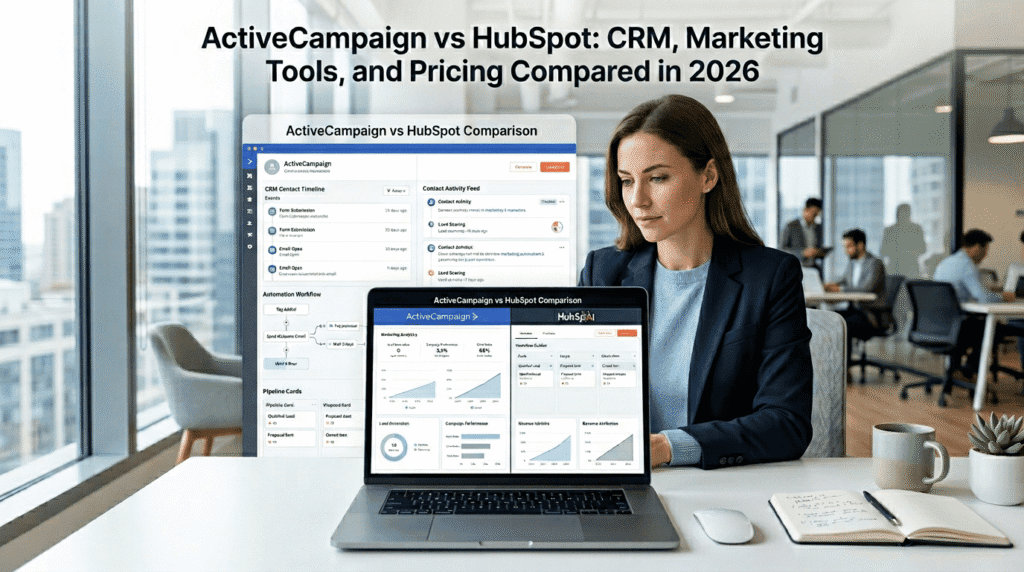
A lot of teams start comparing Activecampaign Vs Hubspot only after they’ve already outgrown a basic email tool or a simple free CRM. That’s usually when the real pressure shows up: leads are slipping, follow-up gets messy, and sales can’t see what marketing is doing. At that point, the choice isn’t just about features. It’s about which platform can actually keep your business organized without turning every workflow into a project.
The comparison gets tricky because ActiveCampaign and HubSpot both promise CRM, automation, and better visibility. But they solve the problem in different ways. One leans harder into deep automation and email-driven workflows. The other tries to be the central system for marketing and sales. That difference matters more than most buyers expect, especially once you have multiple users, more complex pipelines, or a team that needs clean handoffs.
Why Activecampaign Vs Hubspot is such a common comparison
This matchup comes up because both platforms sit in the same buying lane: businesses that want more than a newsletter tool, but don’t necessarily want a heavy enterprise stack. ActiveCampaign appeals to teams that care about automation depth and practical email marketing. HubSpot attracts buyers who want a broader CRM and marketing hub with a cleaner all-in-one structure.
The overlap is real. Both can manage contacts, automate follow-up, and support sales and marketing together. But the experience feels different in real use. That’s why people compare them side by side instead of treating them as interchangeable CRM platforms.
What buyers usually misunderstand about activecampaign vs hubspot
A common mistake is assuming one platform is simply “better” because it has more features. That’s not how this decision usually works. HubSpot often looks more complete on paper, especially for teams that want a polished dashboard and a wide toolset. ActiveCampaign often looks leaner, but it can be more efficient if your main job is to automate communication and move leads through a specific workflow.
Another misunderstanding is pricing. Buyers see a starter plan and assume the real cost will stay near that number. In practice, both platforms get expensive as contacts, users, and advanced features increase. The price gap can widen fast once a team needs professional-level automation or reporting.
The biggest frustrations with CRM and marketing platforms as businesses grow
Growth creates friction in predictable places. A team starts with one person sending campaigns, then adds sales reps, then wants better attribution, better lead routing, better automation, and cleaner reporting. Suddenly the platform that felt simple starts demanding more setup, more admin time, and more internal training.
That’s where frustration tends to show up:
- lead data becomes inconsistent
- sales and marketing stop trusting the same numbers
- automations break when fields or stages change
- onboarding new users takes longer than expected
- reporting looks good until someone asks for custom detail
The problem isn’t usually the software alone. It’s that scaling exposes weak workflows. A tool that is fast to start can still be hard to run well at 5,000 contacts or with a 10-person team.
Honest take on where hubspot and activecampaign each make sense
If you want a platform that feels broader, more structured, and easier to build a company-wide system around, HubSpot usually fits better. It’s especially useful when marketing, sales, and service teams need one shared CRM and a more centralized view of the customer.
If you care more about strong automation, practical email marketing, and keeping costs tied closer to what you actually use, ActiveCampaign often makes more sense. It’s a better fit for teams that want targeted workflows without paying for a large suite they won’t fully use. The right choice depends less on brand and more on how much process your team is ready to manage.
Quick Verdict: Activecampaign Vs Hubspot in 2026
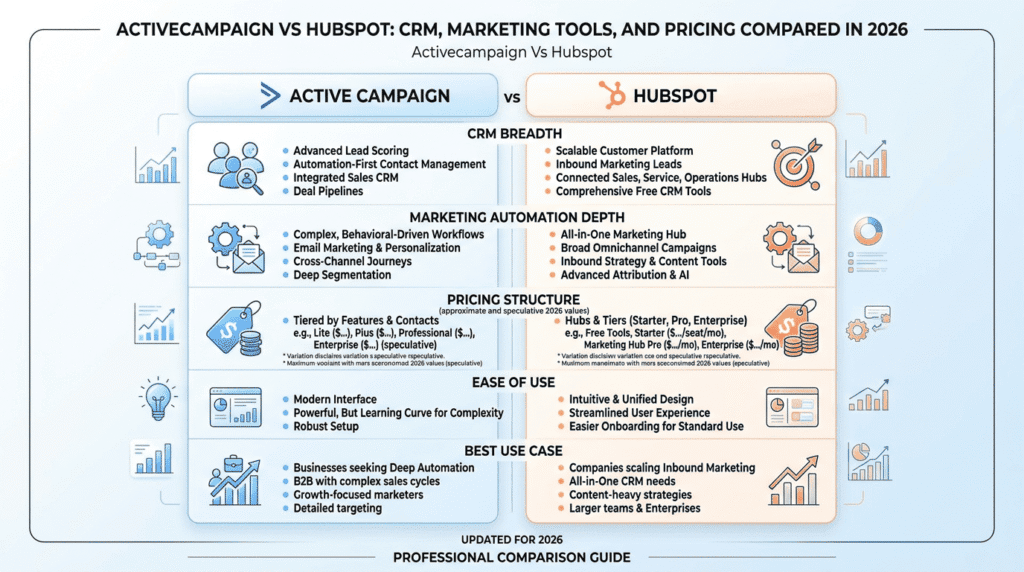
Quick verdict table
| Category | ActiveCampaign | HubSpot |
|---|---|---|
| Best For | Deep automation, email-first teams, lean ops | All-in-one CRM, sales and marketing alignment |
| Not Ideal For | Teams wanting a broad, polished suite with minimal setup | Budget-sensitive buyers and teams that only need core email automation |
| Starting Price | Typically starts around $15/month, with higher tiers rising by contacts and features | Free CRM available; paid marketing hub plans usually start higher and increase fast |
| Free Plan | No permanent free plan | Yes, free CRM and limited starter tools |
| Ease of Use | Good once set up, but automation takes some learning | Easier at the surface, especially for new users |
| Key Strength | Flexible automation builder and strong email workflows | Broad CRM, marketing hub, and sales visibility |
| Biggest Limitation | Less of an all-in-one business suite | Costs can climb quickly at higher pricing levels |
| Overall Recommendation | Best if automation matters more than platform breadth | Best if you want a central system for growth |
Best for teams that want deeper sales and marketing automation
ActiveCampaign is usually the better pick when the main goal is to build real marketing automation workflows that do more than send a basic follow-up. It works well for teams that want to segment leads, trigger behavior-based emails, and connect sales actions to campaign logic without too much overhead from a large suite.
This is where activecampaign wins for a lot of operators. A course creator, agency, or ecommerce brand often needs fast-moving segmentation and email logic more than a huge CRM suite. If the team is comfortable designing workflows and keeping the data clean, ActiveCampaign can feel sharper and more practical.
Best for teams that want an all-in-one CRM and marketing hub
HubSpot makes more sense when the business wants one system for CRM, marketing, and sales visibility. The platform is built to support wider customer relationship management needs, not just automation. HubSpot also offers a more unified experience for teams that need marketing and sales to stay aligned in one place.
That matters when multiple departments rely on the same customer data. If a company needs the dashboard, pipeline, and contact record to tell the same story across teams, HubSpot is usually the safer long-term choice. It’s less about one killer feature and more about reducing operational chaos.
Not ideal for budget-sensitive buyers or teams with simple needs
Neither platform is the cheapest answer once you move past basic use cases. HubSpot’s pricing model can become hard to justify for small teams, especially when marketing hub plans and add-ons stack up. ActiveCampaign is usually cheaper at the start, but activecampaign charges more as contact lists grow and advanced features kick in.
If your business only needs a simple CRM and email marketing, both platforms may be more than you need. A smaller company might get better value from a lighter tool like Brevo or another basic starter platform. Paying for depth you won’t use is a common mistake.
Bottom line on hubspot vs activecampaign value
For value, the answer depends on what “value” means in your business. If you define value as broader system control and a cleaner all-in-one setup, choose HubSpot. If you define value as stronger automation at a lower entry cost, ActiveCampaign is usually the better fit.
The honest takeaway is that hubspot vs activecampaign is less about which one is “best” and more about how much structure your team actually needs. HubSpot is the stronger platform for company-wide organization. ActiveCampaign is often the smarter buy for teams that want real marketing automation without the bigger platform tax.
Activecampaign Vs Hubspot: CRM, Marketing Tools, and Pricing Compared
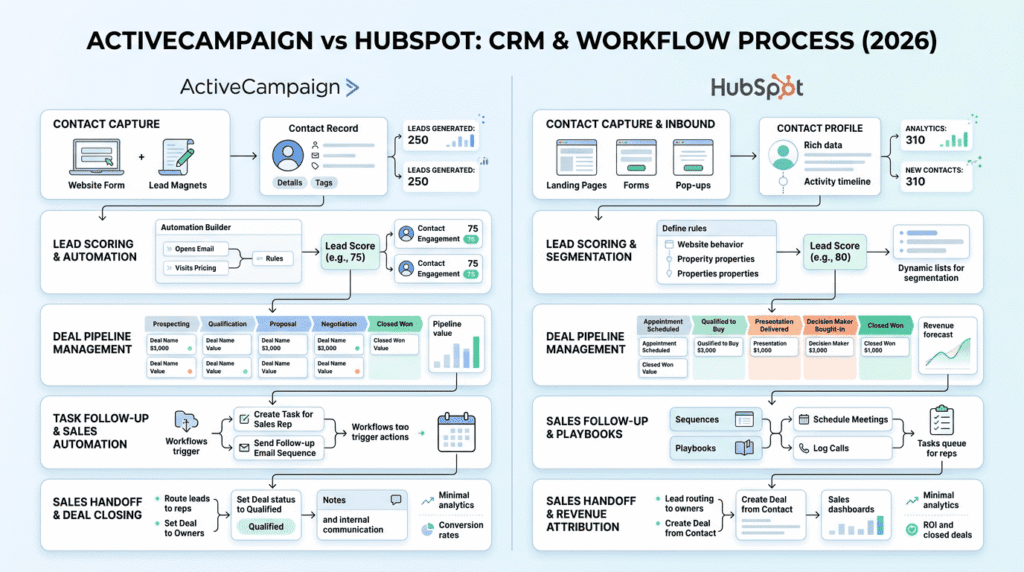
CRM features in Activecampaign and Hubspot
HubSpot’s CRM is the stronger all-around system if you want a broad customer database with built-in sales tracking, contact timelines, and a more complete view of activity across teams. HubSpot also provides a free CRM, which is a big reason many buyers start there. That free layer makes it easy to test the core experience before paying for marketing hub upgrades.
ActiveCampaign’s CRM is more focused. It supports contact tracking, deal management, and pipeline management, but it doesn’t try to be as broad or as polished as HubSpot’s system. That narrower scope can be a benefit if you want to move fast and keep the interface lighter. It can also be a limitation if your team wants deeper customer relationship management across several departments. In practice, hubspot scores higher for CRM breadth, while ActiveCampaign tends to feel more efficient for smaller sales teams that care about execution over complexity.
Marketing automation and marketing hub differences
This is where the split gets clearer. ActiveCampaign is built around automation first. The automation builder gives users a lot of control over triggers, tags, sequences, and follow-up paths. For many teams, that’s the whole reason to use it. ActiveCampaign provides real marketing automation tools without forcing you into a huge ecosystem.
HubSpot’s marketing hub is broader and more structured. It covers campaign tools, forms, landing pages, reporting, and customer journey work inside a more complete marketing hub environment. The trade-off is cost and complexity. HubSpot marketing hub professional starts at a much higher level than basic starter plans, and the upgrade path can feel steep once you want serious automation. If your team needs marketing automation tools and a full suite around them, HubSpot is powerful. If you mainly want to automate behavior-based email and lead follow-up, ActiveCampaign is usually more direct.
Sales pipeline and pipeline management comparison
HubSpot usually feels more natural for teams that want a shared sales pipeline tied tightly to the CRM. It is easier to see deal stages, activity history, and contact progress in one place. That makes it stronger for teams with a structured sales process or multiple reps who need the same playbook.
ActiveCampaign handles pipeline management well enough for many small teams, but it is not as expansive. It works best when the pipeline supports the automation rather than replacing a full sales system. A small agency can absolutely run deals inside ActiveCampaign. A larger team with layered approvals, forecasting, or custom sales process reporting will usually find HubSpot easier to scale.
Email marketing and campaign building differences
ActiveCampaign is especially strong for email marketing. It gives marketers flexible segmentation, strong automation, and practical tools for building targeted campaign flows. The email side feels built for action, not just design. That’s useful when you need to send different follow-ups based on behavior, purchases, or lead source.
HubSpot also offers solid email marketing, but it leans harder into the full marketing system. You get more context around forms, pages, contacts, and reporting, which is helpful if your campaign depends on multiple channels. Still, HubSpot’s email tools are often better for teams that already live in the marketing hub rather than teams that only need high-performing email sequences.
Integration options and ecosystem depth
Both tools have a strong integration ecosystem, but HubSpot’s is broader and easier to extend across departments. HubSpot connects with a wide range of tools for ads, sales, content, support, and reporting. That matters when the CRM needs to be the center of the stack.
ActiveCampaign also supports plenty of integrations, especially with tools used by marketers, ecommerce brands, and service businesses. It connects well enough for most practical workflows. The main difference is scope. HubSpot can feel like the larger operating system. ActiveCampaign feels more like a highly capable automation layer that sits neatly around your existing tools.
Dashboard, analytics, and reporting comparison
HubSpot’s dashboard is stronger for teams that want a shared operational view. It brings together CRM data, campaign results, and sales activity in a way that feels useful to managers. HubSpot also handles analytics more comfortably when you need cross-team reporting, especially in larger setups.
ActiveCampaign includes reporting too, but it is more focused on campaign and automation performance. That’s often enough for smaller teams. The limitation shows up when leadership wants custom reporting, deeper attribution, or a more complete picture of marketing and sales combined. At that point, HubSpot’s reporting depth is usually easier to work with, even if it costs more.
Activecampaign Vs Hubspot: Ease of Use and Onboarding
Ease of use for beginners vs growing teams
HubSpot is usually easier to grasp at the start. The interface is clean, the CRM feels familiar, and new users can usually get value without a long training cycle. That matters for small teams where nobody has time to become the dedicated systems person.
ActiveCampaign can feel simpler in some areas and more technical in others. The basic workflow is easy enough, but once users start building deeper automation, the learning curve becomes more noticeable. That isn’t necessarily bad. It just means the platform rewards users who are willing to think through structure instead of relying on a few default templates.
Onboarding experience in Hubspot and Activecampaign
HubSpot’s onboarding is generally more guided, especially if you move into paid tiers. The platform pushes users toward setup steps that help the system feel complete faster. For teams with several users, that can save time early on.
ActiveCampaign’s onboarding is more self-directed. You can move quickly if you already know what you want to automate, but beginners sometimes hit friction when tagging, segmentation, and workflow logic start interacting. That’s where setup errors happen. A campaign can look fine on the surface and still break because a trigger or field wasn’t defined cleanly.
How much setup each platform needs before it feels useful
HubSpot often feels useful sooner because the free CRM and starter tools give you a usable base immediately. Even light teams can log contacts, track deals, and begin seeing value without a lot of custom work. That lowers the barrier for adoption.
ActiveCampaign usually requires a bit more intentional setup before it pays off. You get more benefit once your segments, tags, and automations are mapped correctly. For a business with 1,000 to 5,000 contacts, that setup time can be worth it. For a solo operator who just wants something that works in a day, it may feel like more work than expected.
What the dashboard experience is like day to day
HubSpot’s dashboard tends to feel more like a command center. It’s useful when several people need to check the same data and keep sales and marketing aligned. The downside is that the breadth can create clutter if the team keeps adding tools and reports without a clear owner.
ActiveCampaign’s dashboard is more focused on the tasks that drive campaigns and automation. It’s not trying to show everything at once. That can be a relief for marketers who want to jump into segments, workflows, and email performance quickly. The trade-off is that it may not satisfy teams that want a broader executive view in one place.
Where customization helps and where it slows teams down
Customization is one of the hidden costs in both platforms. It helps when a business has a clear process and wants the software to mirror it. It slows teams down when they customize before they understand their own workflow. That’s a common mistake, especially with CRM and marketing automation tools.
HubSpot gives more room to customize across the stack, which is useful but can create admin sprawl. ActiveCampaign lets users customize key automation paths and messaging with less overhead, but it also means teams must be more disciplined about naming, tagging, and maintaining structure. The software doesn’t solve that for you. It just makes the process easier if you’ve already defined it well.
Activecampaign Vs Hubspot Pricing: What You Actually Pay for
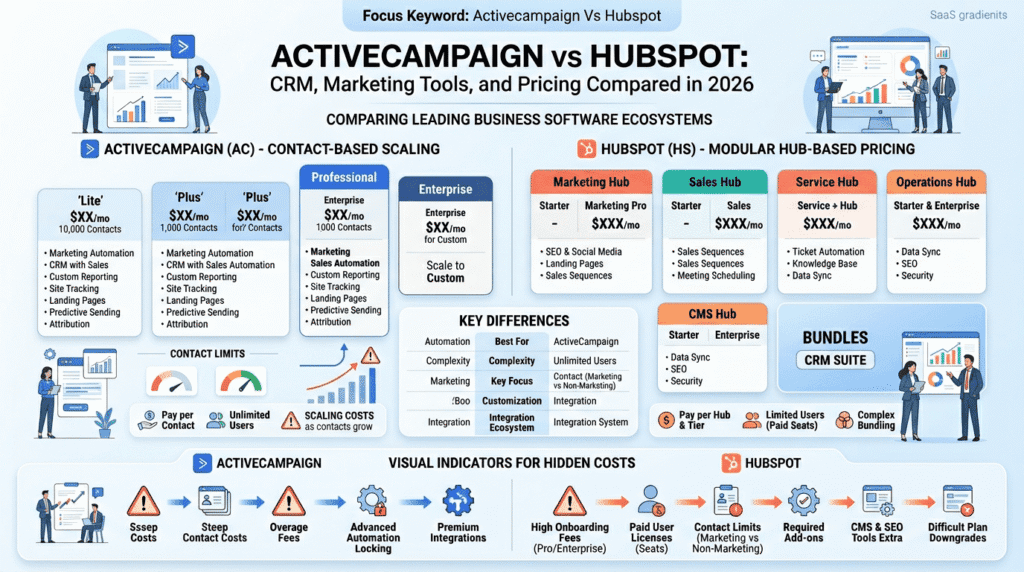
Starting price and plan structure
Pricing is where the Activecampaign Vs Hubspot debate gets real fast. On paper, both platforms can look manageable at the starter tier. In practice, the plan structure changes the story. ActiveCampaign’s entry plans usually start in the low tens of dollars per month, while HubSpot’s paid pricing often begins with a free CRM and then moves into paid marketing hub plans that climb quickly once you need more than the basics.
That difference matters because the first number you see is rarely the number you end up paying. ActiveCampaign charges mainly around contact volume and feature tier. HubSpot uses a more modular pricing model, and once you need the marketing hub, sales tools, automation, or advanced reporting, you can end up stacking costs across several products.
For a small business trying to run email marketing and automation without buying a giant software suite, ActiveCampaign often feels easier to budget for. For a company that wants customer relationship management, marketing campaigns, and sales visibility in one place, HubSpot’s structure can make sense, but it rarely stays cheap for long.
Activecampaign offers versus Hubspot marketing hub bundles
ActiveCampaign keeps the offer tighter. You’re usually paying for CRM, automation, email, and workflow depth in one package. That’s why it tends to appeal to teams that want real marketing automation tools without buying an oversized stack. The setup is less sprawling, and the value is easier to measure if your main goal is to automate follow-up, segmentation, and campaign behavior.
HubSpot takes the opposite route. It bundles tools into the Marketing Hub, Sales Hub, and Service Hub, which sounds flexible until the team starts needing multiple bundles at once. HubSpot also offers a free CRM, but the free layer is not the same as having a full marketing and crm system. The moment you want better landing pages, more automation, stronger pipeline management, or custom reporting, you’re usually moving into paid pricing levels.
That’s the trade. ActiveCampaign is often the sharper buy when you want a focused stack. HubSpot is more attractive when you want a broader platform and you’re willing to pay for the convenience of having marketing and crm under one roof.
Hidden costs that affect total spend
The sticker price is only part of the bill. The real cost shows up in onboarding, add-ons, extra seats, list growth, implementation help, and the time your team spends learning the system. HubSpot users often run into higher costs because the platform is built for expansion. More contacts, more users, more features, and more sophisticated workflows can all push the price up. ActiveCampaign has its own limits too, especially as your contact list grows and your marketing automation becomes more advanced.
There are also operational costs people forget. If your sales team needs a cleaner CRM process, you may need outside help to customize pipelines and dashboards. If your marketing team wants deeper analytics or more polished landing pages, you may need a separate tool or a higher-tier plan. These are not deal-breakers. They’re just the kinds of costs that show up after the trial period ends.
A local agency with 2–5 users may do fine on a starter plan for a while. A SaaS company with 20,000+ contacts and multiple workflows can discover that the monthly cost is no longer about the software alone. It’s about keeping the system workable.
When Hubspot becomes expensive as you scale
HubSpot tends to get expensive when a team moves past the basic CRM and starts relying on the marketing hub for daily operations. That’s especially true if you need better automation, attribution, reporting, and tighter sales process control. Once you move into higher pricing tiers, the jump can feel steep, especially for smaller companies that only need a few advanced features.
The pressure point is usually not the first paid plan. It’s the step after that. HubSpot’s marketing hub plans and HubSpot Marketing Hub Professional can be useful, but the platform is designed for scaling teams, and scaling usually means paying more for access to better tools. HubSpot Professional can deliver a lot, but many smaller businesses don’t actually need everything it includes.
That’s why some teams feel fine at the start and frustrated six months later. They didn’t buy the wrong tool. They bought a tool whose pricing model rewards growth in a way that can outpace lean budgets.
Value for money based on team size and goals
If you’re a small team focused on email marketing, follow-up, and simple automation, ActiveCampaign usually gives stronger value for money. You get more practical automation depth for the price, and that matters when your team is trying to do real marketing automation without paying for extra suite overhead. ActiveCampaign wins here because it does less as a platform, but what it does is often the part teams use every day.
HubSpot makes more sense when the business needs a broader sales and marketing hub with cleaner visibility across the funnel. If your team cares about shared CRM data, sales pipeline reporting, and an all-in-one system that multiple departments can use, HubSpot can justify the higher price. The value is not just in features. It’s in reducing tool sprawl.
A simple rule helps here: if your main goal is email marketing and automation, use ActiveCampaign. If you need customer relationship management plus a wider operational system, choose HubSpot and accept that the bill may climb faster than expected.
Activecampaign and Hubspot: Automation, CRM, and Sales Pipeline Trade-Offs
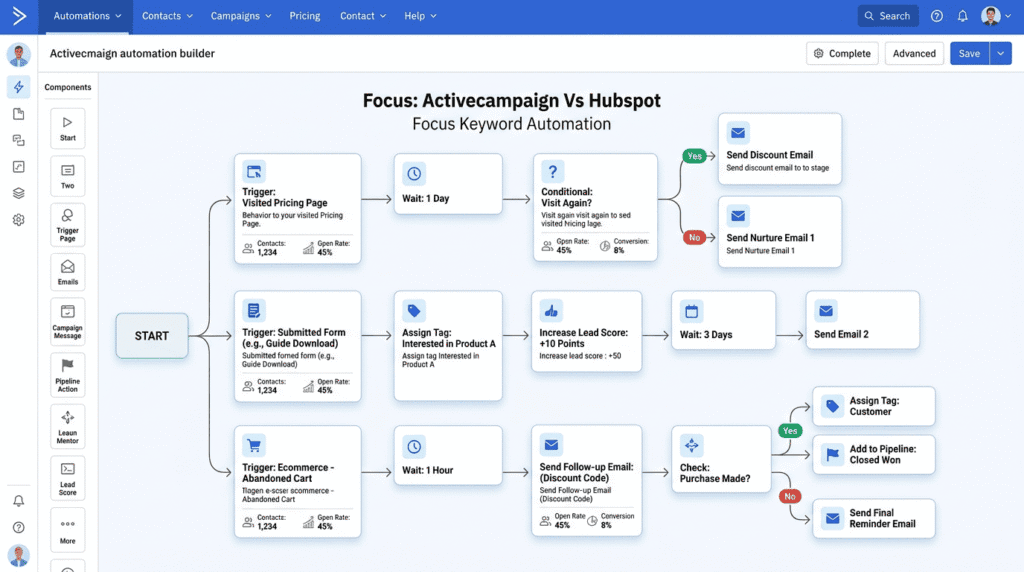
When Activecampaign automation is the stronger choice
ActiveCampaign is built for teams that want to automate real marketing work without fighting the software. Its automation builder is where the platform earns its reputation. You can create layered workflows, trigger follow-up based on behavior, and customize customer journeys in ways that feel practical instead of bloated. For many marketers, that’s the point. The platform is less about being everything and more about doing automation well.
This is where ActiveCampaign provides a strong edge for smaller teams, course creators, ecommerce brands, and agencies that need fast segmentation and follow-up. You can automate based on page visits, form fills, tags, email engagement, and sales activity. That means the same CRM can support lead nurturing, post-purchase campaigns, and re-engagement without forcing the team into a complicated maze.
The limitation is that ActiveCampaign is not trying to be a giant all-in-one suite. If your business needs broad marketing and crm coverage, plus a full shared operating system across departments, it can feel narrower than HubSpot. But for real marketing automation, that narrowness is often the advantage.
When Hubspot CRM and pipeline management are the stronger choice
HubSpot’s CRM and pipeline management are stronger when the business needs clarity across sales and marketing, not just clever automation. The interface is designed to make deals, contacts, and tasks easy to follow. For sales teams, that can be a huge relief. You get cleaner visibility into the sales pipeline, better handoff between teams, and less friction when multiple people need to work from the same crm data.
HubSpot also scores well when reporting and collaboration matter. Managers can see where leads are getting stuck, which stages convert, and how marketing campaigns affect the pipeline. That’s useful for organizations with longer sales cycles or more stakeholders. A B2B team with SDRs, AEs, and marketers often benefits from the structure more than from ultra-deep automation.
The downside is cost and complexity. HubSpot provides strong crm features, but the deeper you go, the more you’ll feel the platform’s pricing model and the need to stay organized. If your sales process is simple, some of HubSpot’s power can become overhead.
Sales and marketing alignment differences
Both platforms support sales and marketing alignment, but they do it differently. ActiveCampaign tends to align teams through automation and data tagging. Marketers create the journey, sales sees the signals, and follow-up gets triggered based on behavior. That works well when the team wants speed and customized workflows without too much admin work.
HubSpot aligns teams through shared visibility. Marketing, sales, and service can all work from the same crm structure, which helps when several people need a common view of accounts and deals. HubSpot also connects more naturally across departments because the ecosystem is designed that way from the start.
The trade-off is simple: ActiveCampaign is better when the workflow needs to be built around action. HubSpot is better when the organization needs a shared operating layer. One is more flexible. The other is more centralized.
How each platform handles lead tracking and follow-up
Lead tracking in ActiveCampaign is strong when the goal is to automate follow-up based on behavior. Tags, scoring, and workflow triggers let teams respond quickly after form submissions, page visits, or email engagement. A marketer can separate webinar attendees from buyers and send different campaign paths without much manual work.
HubSpot takes a more structured route. It gives teams a clearer crm view of where each lead sits, what was logged, and what the next step should be. That helps sales reps who need consistency more than creativity. Follow-up is easier to manage when the record is already centralized.
The practical difference is this: ActiveCampaign helps you respond. HubSpot helps you track. If your bottleneck is timing, ActiveCampaign is usually better. If your bottleneck is visibility, HubSpot has the edge.
Key trade-offs that matter after the first 90 days
The first 90 days often hide the real pain. Early on, both platforms feel useful. The workflows are new, the dashboard is clean enough, and the team is still exploring. After that, the problems become clearer. ActiveCampaign can feel less polished for larger teams that want broad CRM governance. HubSpot can feel expensive and heavy once the company starts pushing into more advanced marketing and crm use.
This is where the platform choice starts affecting operations. Do you want a focused system that automates well, or a broader system that organizes more of the business? Teams often answer too quickly at purchase time. Six weeks later, the answer is different.
If your growth plan depends on deep automation and lean execution, ActiveCampaign keeps more value in the stack. If the business is moving toward cross-team visibility, shared reporting, and more formal pipeline management, HubSpot may be worth the higher commitment.
What Most Blogs Miss About Hubspot vs Activecampaign
The reality of scaling from simple workflows to complex operations
Most comparisons stop at feature checklists. That misses the part that actually hurts: scale changes how the software feels. A workflow that works fine for 300 contacts can become awkward at 15,000 contacts. A crm that feels clean for one sales rep can feel messy when five people start editing records at once. That’s the real issue in hubspot vs activecampaign debates.
ActiveCampaign usually starts strong because the automation is powerful and the setup feels practical. But once a team needs more formal governance, more users, and deeper reporting, the system can require more care. HubSpot does the opposite. It feels broad and capable early, but that broader design can create cost and admin pressure as the business grows.
The hard truth is that growth exposes platform bias. One system is optimized for automation depth. The other is optimized for business-wide structure. Those are not the same thing.
Why dashboard convenience can hide deeper costs
A clean dashboard can create false confidence. Teams see a nice home screen, a few charts, and a clear pipeline, and assume the platform will stay easy. Then they hit limits in customization, permissions, reporting depth, or pricing tiers. The dashboard still looks great, but the operating cost has moved somewhere else.
This happens in both platforms, just in different ways. HubSpot’s dashboard convenience can make a larger org feel organized even when the underlying plan costs are rising fast. ActiveCampaign’s simpler dashboard can hide the amount of manual setup needed to make the system truly match the business.
That’s why interface quality is not the same as operating value. A good dashboard saves time. It doesn’t remove the need for process design.
Hidden frustrations around customization, reporting, and admin work
Customization is one of those features that sounds useful and then becomes a weekly task. In ActiveCampaign, you can customize enough for serious campaign work, but some teams still want more native crm structure and cleaner custom reporting. In HubSpot, the customization is broader, but the admin work can become heavier because there are more moving parts to manage.
Reporting causes similar frustration. Teams want a quick answer: which campaign drove revenue, which pipeline stage is leaking, and what’s happening by source. In reality, the answer can require setup, clean crm data, and disciplined workflow rules. If the team doesn’t maintain the system, analytics get noisy fast.
This is where both platforms ask for maturity. They’re not “set it and forget it” tools. They reward businesses that can keep data clean and processes stable.
When a platform feels great early but becomes harder later
This is common, and it’s why buyer regret happens. A platform can feel perfect in month one because the team only uses 20% of it. By month four, the business wants more users, more automation, better reporting, and less manual admin. That’s when the friction starts.
HubSpot often feels amazing early for teams that want structure and visibility. Later, the broader suite can feel expensive or overbuilt. ActiveCampaign often feels simple and powerful early. Later, teams realize they need more built-in governance or a more unified sales and marketing layer.
The lesson is not to fear either platform. It’s to ask what the business will need after the first wave of setup. That’s where the better choice usually reveals itself.
Who Should Choose Hubspot vs Activecampaign
Choose Hubspot if you need a broader sales and marketing hub
Choose HubSpot if your business wants one connected system for crm, marketing, and sales activity. It’s a strong fit for companies with a longer sales cycle, multiple team members in the pipeline, and a real need for shared visibility. HubSpot connects marketing and crm in a way that helps leaders track the whole funnel, not just the next email.
It’s also the better fit when the team values standardized processes. If you want structured lead tracking, cleaner reporting, and a platform that can support sales and marketing across departments, HubSpot is usually the stronger long-term choice. The price is higher, but so is the amount of operational control.
Choose Activecampaign if automation value matters more than suite depth
Choose ActiveCampaign if your main priority is email marketing and automation that actually saves time. It’s a better fit for teams that want to automate follow-up, build segmented campaigns, and keep the crm lean. ActiveCampaign is built for businesses that care about response speed and workflow flexibility more than a giant suite.
That makes it a smart choice for agencies, creators, ecommerce brands, and small B2B teams. If you do not need a full marketing hub, there’s no reason to pay for one. ActiveCampaign includes enough crm and automation features to carry a lot of businesses without the overhead of a broader platform.
Best fit for small businesses
Small businesses usually get more value from ActiveCampaign unless they already know they need a larger system. The lower starting price, tighter feature set, and stronger automation focus make it easier to adopt without hiring help. A small team can usually get useful results faster, especially if the goal is simple lead nurturing and campaign follow-up.
HubSpot can still work for small businesses, but it often makes more sense when the business is already thinking about scale, team handoffs, and a more formal sales process. If you’re not there yet, the extra cost and admin can be hard to justify.
Best fit for growing sales teams
Growing sales teams usually lean toward HubSpot. Once a company has multiple reps, shared pipeline stages, and more moving parts in the sales process, HubSpot’s crm structure becomes valuable. It helps leaders keep an eye on activity, handoffs, and performance without rebuilding the system every few months.
ActiveCampaign can still support growing teams, especially if automation is the main pain point. But when pipeline management becomes a daily sales function, HubSpot’s broader visibility usually wins out.
Best fit for marketing-led vs sales-led organizations
Marketing-led organizations often prefer ActiveCampaign because it gives them more room to automate campaigns, segment contacts, and build behavior-based journeys. It’s a strong platform for teams that think in workflows and campaign logic.
Sales-led organizations usually fit HubSpot better because the platform makes crm management and pipeline visibility central to the experience. If the revenue engine depends on reps, tasks, deal stages, and manager oversight, HubSpot lines up more naturally with that motion.
In practice, the choice often comes down to which team owns the system. If marketing runs the show, ActiveCampaign usually feels better. If sales needs the shared system, HubSpot is harder to beat.
Who Should Avoid Each Platform
When Hubspot is probably more platform than you need
HubSpot can be too much if you mainly want solid CRM and email marketing without the rest of the suite. Once you start paying for the marketing hub, sales hub, and extras, the price can climb fast. For a small team that just needs contact management, a simple pipeline, and a few automation sequences, HubSpot can feel like buying a full office building to rent one desk.
The bigger issue is operational overhead. HubSpot’s depth is real, but so is the setup. If you don’t have someone who can manage CRM data, workflows, templates, and reporting, you may spend more time learning the system than using it. That’s often where smaller teams get stuck. HubSpot works best when there’s enough volume to justify the structure, usually with a sales or marketing team that can actually maintain it.
When Activecampaign may not be enough for your CRM needs
ActiveCampaign is a strong fit when automation is the priority, but it’s not the best choice if you need a broad, enterprise-style CRM. Its CRM features are useful, yet they’re still narrower than what you get from a more complete platform. If your sales process needs advanced forecasting, layered permissions, deep deal reporting, and a wide set of native business tools, you may outgrow it.
It can also feel light for teams that want a single system for marketing and customer relationship management across multiple departments. ActiveCampaign is built for email marketing and automation first. That focus is a strength, but it means some teams end up patching in extra tools for things HubSpot handles natively. If you need one central operating system for sales and marketing, ActiveCampaign may not fully close the gap.
Cases where another option like Brevo may be a better fit
Brevo can make more sense for teams that want lower-cost email marketing and basic automation without paying for a larger CRM suite. It’s often easier to justify when the budget is tight and the goal is simple: send campaigns, manage contacts, and automate a few common workflows. For businesses that are still validating their funnel, that matters.
It’s also worth considering if your needs are more transactional than strategic. A local service business, small ecommerce brand, or lean content site may not need the depth of HubSpot or the automation focus of ActiveCampaign right away. In that case, a lighter platform can keep costs down and reduce setup friction. The trade-off is obvious: you give up depth, but you avoid paying for features you won’t use.
Final Verdict: Which Platform Delivers More Value?

The best overall choice for most buyers
For most small to midsize teams, ActiveCampaign delivers better value. It usually costs less, gives you stronger automation for the money, and is easier to justify if your main goal is email marketing and follow-up workflows. If you care about squeezing more out of every campaign without committing to a big suite, that’s where it stands out.
HubSpot has the broader platform and stronger all-in-one structure, but its value depends on whether you’ll use enough of it. If your team doesn’t need the full stack, the extra cost can be hard to defend. ActiveCampaign often wins on practical ROI because it solves the day-to-day job without forcing you into a more expensive system than you need.
The smarter choice for automation-first teams
If your business runs on behavior-based sequences, lead nurturing, and detailed workflow logic, ActiveCampaign is the smarter choice. It’s built for real marketing automation, not just a few trigger emails. That matters once your funnel gets more complex and you want to automate follow-up based on clicks, tags, purchases, or pipeline movement.
A marketer managing webinars, abandoned carts, and post-purchase sequences will usually get more usable automation for less money with ActiveCampaign. The trade-off is that you won’t get HubSpot’s broader suite around CRM, reporting, and sales operations. Still, for teams that live in automation every day, ActiveCampaign is a clear winner.
The smarter choice for CRM-first teams
If your priority is a strong CRM with a broader sales and marketing hub around it, HubSpot is the better fit. It gives you more room to grow into pipeline management, reporting, and team coordination. That makes it a better choice when the CRM is the center of the business, not just a support tool for campaigns.
This is especially true for teams that want sales and marketing in one place and need cleaner visibility into the full customer journey. HubSpot connects those pieces better than ActiveCampaign. If your team needs a more complete operating system, and the budget can handle it, HubSpot is usually the safer long-term pick.
Final recommendation based on budget, scale, and complexity
If budget is tight, use ActiveCampaign. If you want stronger automation without paying for a big suite, use ActiveCampaign. If your team is small, lean, and focused on conversion-focused workflows, ActiveCampaign is usually the better value by a wide margin.
Choose HubSpot when the organization is bigger, the CRM matters more, and the complexity is high enough to justify the pricing model. That usually means multiple users, more formal sales process management, deeper reporting needs, and a real need for a unified marketing and CRM system. The simplest way to think about it is this: ActiveCampaign is often the better tool, while HubSpot is often the bigger platform.
Frequently Asked Questions
Is Activecampaign Vs Hubspot better for email marketing?
ActiveCampaign is usually better for email marketing if you care about automation depth and campaign control. It offers more flexible workflows, better behavior-based sequencing, and stronger tools for sending the right message at the right time.
HubSpot can still handle email marketing well, especially when it’s tied to the rest of the marketing hub. But if the question is pure email marketing and automation efficiency, ActiveCampaign usually gives you more value.
Which is easier to use, Activecampaign or Hubspot?
HubSpot is easier to understand at a high level because the interface is more guided and the product is organized as a larger suite. That said, the broader system can still feel heavy once you get into setup, permissions, and advanced workflows.
ActiveCampaign is simpler for focused email and automation work, but it can feel less polished in some CRM areas. If you want quick wins, ActiveCampaign is often easier day to day. If you want a more structured all-in-one experience, HubSpot is more straightforward.
Is Hubspot worth the price for small businesses?
HubSpot is worth the price only if a small business will actually use the CRM, marketing hub, and sales tools together. If you only need a basic CRM and a few campaigns, the cost can be hard to justify.
For small teams with limited budgets, the free CRM may be useful at first. But once you move into paid plans, especially HubSpot Marketing Hub Professional, the price can rise fast. That’s where many small businesses realize they’re paying for depth they don’t fully need.
Does Activecampaign have enough CRM features for sales teams?
Yes, for many smaller sales teams, ActiveCampaign has enough CRM functionality. It supports pipeline management, deal tracking, and follow-up automation, which covers the basics well.
It becomes less convincing when you need a more advanced sales CRM with deeper forecasting, reporting, and cross-team coordination. If sales is the main engine of the business, ActiveCampaign may feel useful but limited compared with HubSpot.
Which platform is better for marketing automation in 2026?
ActiveCampaign is better for marketing automation in 2026 if you want more advanced workflow control for the price. It’s built around automation first, so the feature set tends to feel more practical for teams that rely on lifecycle campaigns and triggered follow-up.
HubSpot offers strong automation too, especially inside the marketing hub professional tiers. But if you’re comparing pure automation value, ActiveCampaign usually gives you more flexibility at a lower cost.
Can Activecampaign and Hubspot work with the same integrations?
Yes, both platforms connect with many of the same integrations, including common ecommerce, webinar, CMS, and lead capture tools. The difference is usually in how deep or smooth the integration feels, not whether it exists at all.
HubSpot generally has the larger ecosystem. ActiveCampaign still covers a lot of business needs, but if your stack is unusual or highly customized, HubSpot’s broader marketplace may be easier to work with.