A lot of teams end up comparing ActiveCampaign Vs GoHighLevel when the real problem is bigger than email alone. They need a CRM, a funnel, follow-up automation, maybe SMS, maybe landing pages, and they want one system that doesn’t turn into a mess six months later. That’s where this comparison gets practical fast.
The issue is that these two platforms solve different operational headaches. One is built around email marketing and marketing automation. The other is built for agencies that manage multiple clients and want an all-in-one system with sub-accounts, pipelines, and broader client workflows. If you buy the wrong one, the pain usually shows up later in reporting gaps, clunky handoffs, or pricing that scales in a way you didn’t expect.
Why ActiveCampaign Vs GoHighLevel Is a Common Comparison
This comparison comes up because both tools sit in the same buying window for growing businesses. They can handle CRM, automation, and lead nurturing, and both look like replacements for patchwork stacks made from Mailchimp, spreadsheets, and a separate sales tool. On paper, they overlap enough to confuse people.
In real use, though, the buyer profile is different. A solo operator or small in-house team often wants strong email automation and clean contact management. An agency usually wants to manage multiple clients, package services, and avoid building the same setup from scratch over and over. That’s why activecampaign vs gohighlevel is rarely just a feature comparison. It’s usually a business model decision.
What Buyers Usually Expect vs What Actually Matters
A lot of buyers expect the winner to be the platform with the longest feature list. That’s not really how it works. What matters more is whether the platform matches your day-to-day workflow: how you tag leads, move deals, build automations, and keep track of follow-up without creating more admin work than results.
ActiveCampaign appeals to teams that care about email deliverability, segmentation, and sophisticated automation. GoHighLevel appeals to teams that want an all-in-one platform with client management baked in. One is often easier to run for a single brand. The other can be more useful when you’re managing multiple accounts, but it usually asks for more setup discipline.
Hidden Frustrations With CRM and Automation Platforms
The hidden frustration isn’t usually the setup. It’s the scaling. A workflow that feels smooth for 300 contacts can get awkward at 30,000. CRM fields start multiplying. Automations overlap. Someone forgets to pause a campaign. Reports stop matching what the sales team believes is happening.
There’s also the deliverability issue. An email platform can have a great automation builder and still underperform if inbox placement is inconsistent. And an all-in-one tool can sound efficient until you realize you’re using only 40% of the feature set while still paying for the rest. That’s the part people miss when they compare pricing too quickly.
The Biggest Difference Between GoHighLevel and ActiveCampaign
The biggest difference between GoHighLevel and ActiveCampaign is intent. ActiveCampaign specializes in email marketing and marketing automation for one brand or one team. GoHighLevel is an all-in-one platform designed to support agencies, sub-accounts, and broader client operations.
That means activecampaign excels when email strategy and workflow precision matter most. GoHighLevel wins when the business needs one system for many client accounts, sales follow-up, funnels, and service delivery. If you need sophisticated email automation first, ActiveCampaign usually makes more sense. If you need agency-style operations, GoHighLevel takes the lead.
Quick Verdict: ActiveCampaign Vs GoHighLevel in 2026
Best For
| Your Situation | Best Monetization Model | Effort Level | Revenue Potential |
|---|---|---|---|
| Just Starting (Under 1,000 Subs) | Affiliate Marketing, Tipping | Low-Medium | Low-Medium |
| Growing Audience (1k-10k Subs) | Affiliate Marketing, Digital Products | Medium | Medium-High |
| Niche Authority (Any Size) | Digital Products, Consulting/Services | Medium-High | High |
| Large Audience (10k+ Subs) | Sponsorships, Premium Subscriptions | High | Very High |
| Existing Business/Ecommerce | Selling Your Own Products/Services | Medium | High |
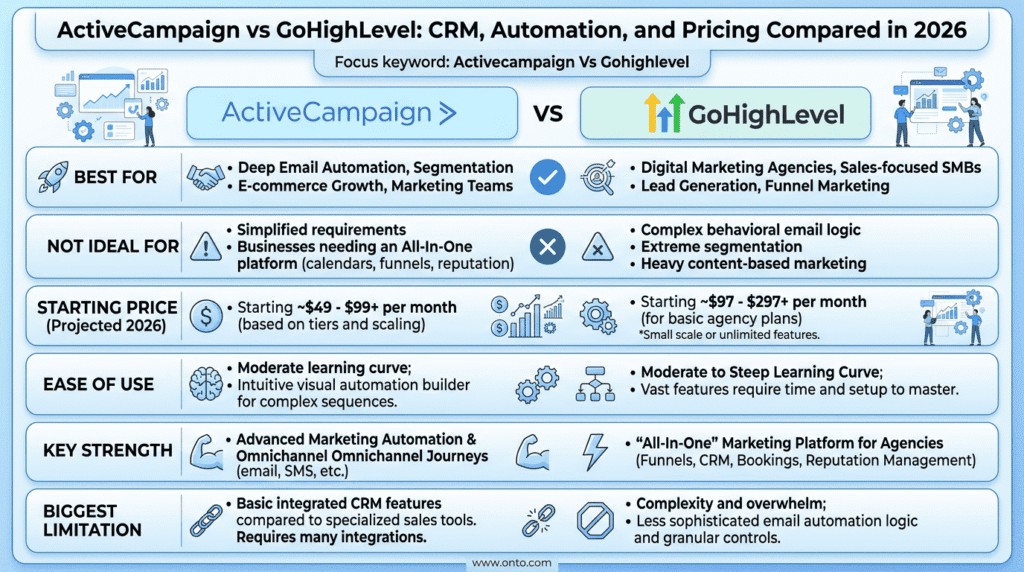
ActiveCampaign is the better fit if your business lives in email, nurturing, and lead scoring. GoHighLevel is the better fit if you’re managing multiple client accounts or want a broader all-in-one workflow stack. The quick rule is simple: one brand, stronger email automation; many clients, broader client operations.
Not Ideal For
ActiveCampaign is not ideal for agencies that need true sub-account management and a bundled client delivery model. It can do CRM and automation very well, but it doesn’t try to be a full agency operating system. GoHighLevel is not ideal for teams that want the cleanest email marketing experience or the most refined deliverability-focused setup.
If you’re a small business with one sales funnel and a few campaigns, GoHighLevel can feel like too much tool. If you’re an agency trying to sell software-like services to multiple clients, ActiveCampaign can feel too narrow. That mismatch is where people regret the purchase.
Bottom Line
Activecampaign Vs Gohighlevel comes down to business structure, not just features. ActiveCampaign is the safer choice for email-driven growth and tighter marketing automation. GoHighLevel is the stronger choice for agencies that need multiple client workspaces, funnels, and a wider service stack.
If you need an all-in-one platform for managing many clients, GoHighLevel makes more sense. If you want a focused email marketing platform with strong automation and a more polished email workflow, ActiveCampaign is usually the better long-term fit.
Complete Comparison Table: ActiveCampaign Vs GoHighLevel
CRM, Automation, Pricing, and Deliverability Snapshot
| Comparison Factor | Mailchimp | ConvertKit | MailerLite | Brevo (Sendinblue) | ActiveCampaign | Constant Contact | Moosend | GetResponse | Flodesk | Beehiiv | AWeber |
|---|---|---|---|---|---|---|---|---|---|---|---|
| Starting Price (Paid) | From $13/month | From $9/month | From $10/month | From $9/month | From $29/month | From $12/month | From $9/month | From $19/month | $38/month | From $42/month | From $14.99/month |
| Free Plan Limits | 500 contacts, 1,000 sends/month | 1,000 subscribers, limited features | 1,000 subscribers, 12,000 sends/month | Unlimited contacts, 9,000 sends/month | 14-day free trial | 14-day free trial | 30-day free trial | 30-day free trial | 30-day free trial | 2,500 subscribers, basic features | 500 subscribers, 3,000 sends/month |
| Key Feature | All-in-one marketing suite | Creator-focused automation | Budget-friendly features | Transactional email & CRM | Advanced automation & CRM | Event marketing & support | E-commerce automation | Webinars & funnels | Visually stunning emails | Newsletter monetization | Reliable autoresponders |
| Best For: | Growing small businesses | Bloggers, course creators | Startups, freelancers | Sales & marketing teams | Data-driven businesses | Service-based businesses | Budget e-commerce | All-in-one marketers | Design-focused brands | Newsletter publishers | Simplicity & support |
| Ease of Use (1-5) | 4 | 4 | 5 | 3 | 2 | 4 | 4 | 3 | 5 | 4 | 4 |
| Automation Power (1-5) | 3 | 5 | 3 | 4 | 5 | 2 | 4 | 4 | 2 | 3 | 3 |
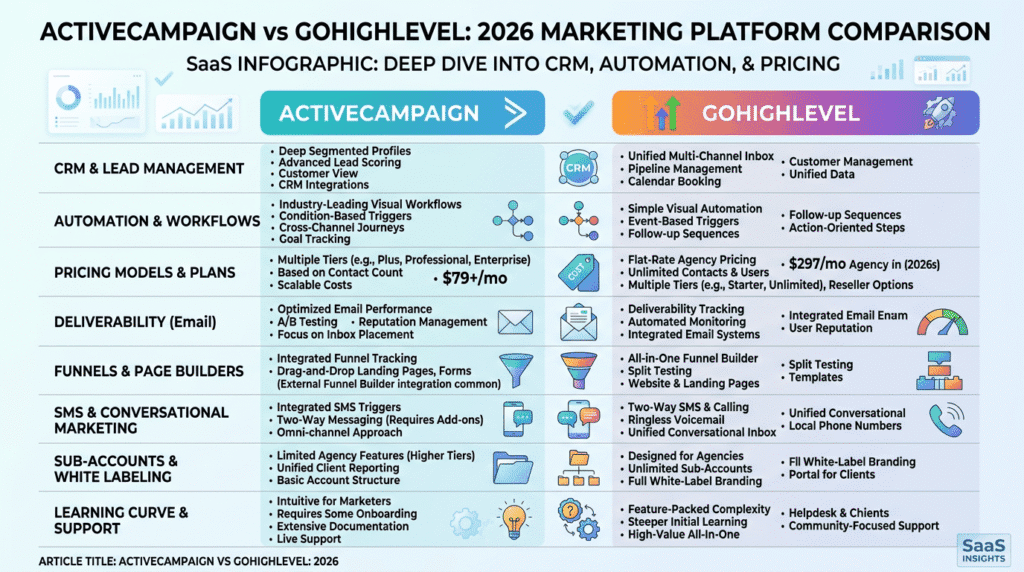
ActiveCampaign provides a stronger email-first system, while GoHighLevel offers a broader service and operations model. If the team’s main job is nurture, segmentation, and conversion through email, ActiveCampaign is easier to justify. If the job is building client workflows across several accounts, GoHighLevel’s structure is more useful.
Best Fit by Business Type
| Business Type | Better Choice | Why |
|---|---|---|
| Solo consultant or coach | ActiveCampaign | Cleaner for one brand, one list, one funnel |
| SaaS startup | ActiveCampaign | Strong lifecycle automation and segmentation |
| Local marketing agency | GoHighLevel | Built for managing multiple clients |
| Lead-gen or service agency | GoHighLevel | Better fit for funnels, follow-up, and sub-accounts |
| Ecommerce brand | ActiveCampaign | Better email marketing and segmentation focus |
| Business with one sales team | ActiveCampaign | Easier CRM and workflow control |
The best fit usually follows the operating model. If you’re managing one brand, ActiveCampaign is often simpler to maintain. If you’re managing multiple client accounts, GoHighLevel is usually the more practical system even if it takes longer to learn.
ActiveCampaign Vs GoHighLevel: Core Product Difference
ActiveCampaign for Email-First Marketing and Automation
ActiveCampaign specializes in email marketing and marketing automation. That’s the whole point of the product, and it shows in how people actually use it. You can build segmented campaigns, conditional workflows, lead scoring, and nurture paths that feel built for a single brand’s lifecycle.
It’s especially useful when the sales cycle depends on behavior-based follow-up. A SaaS trial user can be moved into one sequence, a webinar attendee into another, and a customer into a different post-purchase flow. That kind of separation is where ActiveCampaign is comfortable. It’s not flashy, but it’s structurally strong. The trade-off is that it doesn’t try to be everything, and some teams want more built-in client-account control than it provides.
GoHighLevel for Agency Workflows and Multiple Clients
GoHighLevel is built for agencies. That matters more than people think. The platform is set up around sub-accounts, client workspaces, funnels, scheduling, follow-up, and service delivery. If you’re using gohighlevel to manage multiple clients, the structure starts to make sense quickly.
gohighlevel offers a broader operational layer than ActiveCampaign. It can support sales pipelines, landing page creation, sms follow-up, reputation tools, and recurring client management in one place. That makes it useful for agencies selling marketing services or lead generation. The downside is that the all-in-one approach can feel heavier than needed if you only care about email automation and clean segmentation.
Where the Platforms Overlap
Both tools handle contacts, crm logic, automations, and funnels. Both can support lead nurturing and handoff to sales. Both can be used for email campaigns, though the experience is not equally polished.
That overlap is why the comparison gets messy. On a feature checklist, they can look close. In practice, the workflow is different. ActiveCampaign is more specialized. GoHighLevel is more generalized. One is better when the message stream is the core product. The other is better when the business is selling and managing multiple service workflows.
The Difference Between GoHighLevel and ActiveCampaign in Day-to-Day Use
The difference between GoHighLevel and ActiveCampaign shows up in daily operations. In ActiveCampaign, you usually think in terms of segments, automations, and customer journeys. In GoHighLevel, you think in terms of client accounts, funnel paths, appointments, and service workflows.
That changes how your team works. A marketer may feel at home in ActiveCampaign faster because the email and automation model is familiar. An agency operator may prefer GoHighLevel because the structure matches client delivery. If your team spends most of its time inside a workflow builder, contact list, and campaign editor, ActiveCampaign feels tighter. If you spend time switching between clients, GoHighLevel feels more natural.
CRM Comparison: ActiveCampaign vs GoHighLevel
Pipeline Management and Deal Tracking
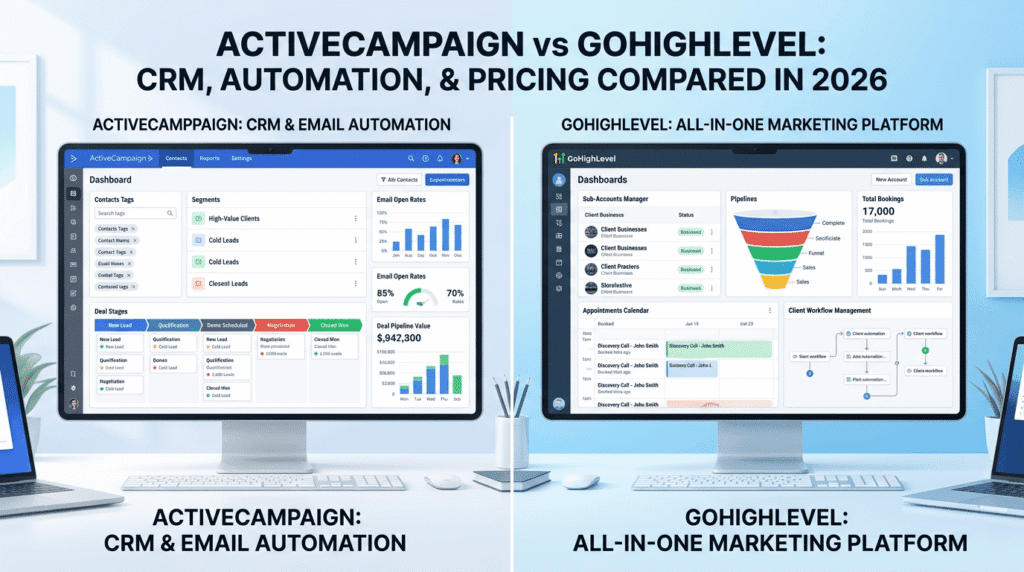
ActiveCampaign’s CRM is good for tracking deals, tagging contacts, and building sales pipelines that connect to marketing flows. It does not pretend to be a heavy sales suite, but it handles the basics well for small teams and marketing-led sales motions. You can move contacts through stages and trigger automation based on behavior.
GoHighLevel’s crm is more comfortable for agency-style pipeline management. It’s easier to think about multiple accounts, multiple lead sources, and client-specific workflows. If you need a CRM that ties together leads, appointments, and follow-up across several brands, it has the edge. The catch is that the system can feel busy if you only want a simple pipeline and clean contact view.
Contact Organization and Segmentation
ActiveCampaign’s contact organization is one of its strongest points. Tags, lists, custom fields, and behavior-based segments give you a lot of control without making the system feel broken into too many pieces. That matters when your lead sources are messy and your nurturing paths differ by persona or intent.
GoHighLevel handles segmentation well enough, but its strength is broader operational control rather than sharp email-first segmentation. If you rely on detailed audience splits for content, lifecycle, or funnel behavior, ActiveCampaign supports that style better. A course creator, for example, might separate webinar registrants, buyers, and inactive subscribers with tighter rules in ActiveCampaign than in a more general setup.
Sales Workflow Fit for Small Teams vs Agencies
For small in-house teams, ActiveCampaign usually feels easier to keep organized. One sales process, one brand, one set of contact rules. That simplicity matters when the team is under five people and everyone touches the same leads.
GoHighLevel fits agencies and service businesses that manage multiple clients or separate sales processes. Its crm is built to handle more moving parts, and that can be useful when the team is juggling lead gen, appointments, follow-up, and fulfillment. If you’re comparing activecampaign vs gohighlevel as a small team, ActiveCampaign is usually less noisy. If you’re an agency, GoHighLevel usually lines up better with daily work.
CRM Limitations That Matter as You Scale
Scaling exposes different problems in both systems. With ActiveCampaign, the pain often comes from pricing growth and the complexity of more advanced segmentation across larger databases. The CRM works, but it’s not trying to replace a dedicated enterprise sales platform.
With GoHighLevel, the issue is usually operational clarity. As sub-accounts, automations, and client workflows pile up, the dashboard can become harder to manage cleanly. That’s fine if you have a disciplined process. It’s frustrating if your team likes improvising. Neither platform is a perfect enterprise CRM, so the real question is which limitation you can live with longer.
Automation Comparison: ActiveCampaign vs GoHighLevel
Automation Builder Depth and Flexibility
ActiveCampaign has one of the stronger automation builders in this category. You can build complex email automation with triggers, goals, splits, conditional branches, and timing rules that fit sophisticated lifecycle marketing. That’s why teams that care about messaging precision usually like it.
GoHighLevel also has a capable automation builder, but it leans more toward operational and client workflow automation. It’s great for appointment follow-up, lead routing, funnel responses, and cross-channel movement. The flexibility is there, but it feels more practical than elegant. If your main question is whether you can build a deep marketing automation platform, ActiveCampaign usually takes the lead.
Marketing Automation vs Client Workflow Automation
This is where the products separate clearly. ActiveCampaign is built for marketing automation that supports one audience, one brand, and one lifecycle. Think onboarding, nurturing, reactivation, upsells, and segmented email paths. The logic is designed around marketing intent.
GoHighLevel is better at client workflow automation. That includes lead response, appointment reminders, pipeline progression, SMS follow-up, and operational sequences that agencies need to keep clients moving. If you’re running service delivery across multiple accounts, gohighlevel includes more of the surrounding system. It may not feel as refined for email marketing campaigns, but it’s often more useful for the business process around them.
Trigger Options, Logic, and Conditional Branching
Both platforms support conditional logic, but ActiveCampaign tends to feel deeper when the workflow is centered on subscriber behavior and lifecycle triggers. You can branch based on opens, clicks, tags, site activity, and custom events. That makes it strong for teams that want very specific segmentation.
GoHighLevel covers a lot of the same ground, and it adds practical triggers tied to pipeline movement, form submissions, appointments, and client workflows. For agencies, that’s enough. For brands that want intricate audience logic and smarter email routing, it can feel less precise. The difference is not that one can automate and the other can’t. It’s that the priorities are different.
What Automation Feels Like in Real Use
In real use, ActiveCampaign feels like a system you build carefully and then rely on. It rewards teams that map out journeys, cleanup rules, and contact behavior before launching. That makes it powerful, but it also means the first week can feel slower than people expect.
GoHighLevel feels more like an operating hub. You can move faster on agency tasks, but the experience can get cluttered if you keep stacking workflows without a naming system. A marketing team that wants a clean, email-first environment often prefers ActiveCampaign. A team that needs to sell gohighlevel-style services or manage several client funnels may find the broader toolset worth the extra setup.
Pricing Comparison: ActiveCampaign vs GoHighLevel
Pricing Plans and Entry-Level Cost
ActiveCampaign’s pricing is built around contacts, and that matters more than the headline number. The starter plan usually begins around $19 to $29 per month for a small list, then climbs fast as your subscriber count grows. Once you’re closer to 10,000 contacts, the monthly cost can move into the low hundreds, especially if you want the CRM, lead scoring, or more advanced automation features.
GoHighLevel takes a different route. It usually starts around $97 per month for the base account, with an agency-style model that’s less about list size and more about how many businesses you manage. The unlimited plan often sits around $297 per month. That makes the pricing feel simpler at first, but only if you actually need the extra client accounts and all-in-one tools.
The pricing gap creates a real decision point. ActiveCampaign is cheaper if you’re a single brand with a modest list. GoHighLevel makes more sense once you’re selling services, managing multiple clients, or trying to replace several tools at once.
Value for Money at Different Growth Stages
At the earliest stage, ActiveCampaign usually feels easier to justify. A solo founder, course creator, or small ecommerce brand can get email automation, segmentation, and basic CRM tools without paying for agency features they’ll never touch. If the main job is nurture sequences, newsletters, and follow-up emails, the value is straightforward.
GoHighLevel starts to look better when operations get messy. If you’re running ads, booking appointments, handling SMS, managing funnels, and supporting more than one business, the bundled setup can save a lot of tool sprawl. One platform replacing five subscriptions sounds neat, but only when the team has the patience to learn it.
That’s the hidden trade-off. ActiveCampaign is often the cleaner buy for one client or one brand. GoHighLevel becomes the stronger deal when the business model depends on multiple clients, recurring service delivery, and bundled marketing workflows.
Hidden Costs, Add-Ons, and Plan Limits
This is where pricing stops being simple. ActiveCampaign’s base plans can look reasonable, then the real bill rises because of contact tiers, users, and feature gating. Some teams also end up paying for outside tools because certain page-building, scheduling, or reporting needs are better handled elsewhere. If you want the platform to do everything, the stack can creep up faster than expected.
GoHighLevel has its own friction points. The platform includes more under one roof, but there are still limits tied to usage, sub-accounts, and technical setup. Depending on the plan, you may also run into extra costs for things like phone usage, email infrastructure, or third-party services. The promise is “all-in-one,” but in real life, a few operational pieces still sit outside the core subscription.
For buyers, the real question isn’t just monthly pricing. It’s whether you want a smaller bill with more integrations, or a larger bill with fewer apps to manage. Both can work. The wrong choice is paying for all-in-one when you only need email, or paying for a lightweight email tool when your service business needs a full funnel and CRM system.
Which Platform Feels Cheaper as You Scale
ActiveCampaign often stays cheaper for longer if your business is list-driven and not client-heavy. But once your contact count climbs into the tens of thousands, pricing can rise sharply. At that point, the cost of scaling contacts can overshadow the value of the platform unless email automation is central to revenue.
GoHighLevel often feels more stable at scale because the pricing is tied less to list growth and more to account structure. If you’re managing 5, 10, or 20 clients, the economics can become much better than stitching together separate tools for CRM, funnel building, SMS, and automation. That’s why agencies tend to prefer it.
So the pricing winner depends on the business model. ActiveCampaign is usually cheaper for one brand with a focused marketing stack. GoHighLevel can be cheaper when you’re operating as a service business or need a broader all-in-one platform that doesn’t punish growth in the same way.
Email Deliverability and Email Sending: ActiveCampaign vs GoHighLevel
Email Deliverability Expectations
ActiveCampaign has a stronger reputation for email deliverability, and that matters more than people expect. If your business depends on email marketing campaigns landing in the inbox, not spam, the platform has a long-standing edge. It’s built with email-first teams in mind, so the sending infrastructure, list management, and segmentation logic tend to feel more mature.
GoHighLevel can absolutely send emails, but its deliverability story is more uneven. Some users do fine, while others run into headaches tied to setup, domain authentication, or shared infrastructure issues. That doesn’t make it unusable. It just means the margin for error is smaller, especially if you’re sending high-volume sequences or cold-ish follow-up flows.
In plain terms, ActiveCampaign excels when email is the business. GoHighLevel works better when email is just one channel inside a broader workflow.
Sending Limits and Email Sending Workflows
ActiveCampaign’s email sending setup is built around structured campaigns, automation, and segmentation. You can create smart workflows, trigger sequences from behavior, and manage advanced branching without the platform feeling bolted together. That makes it a strong fit for lifecycle marketing, onboarding, and nurture flows.
GoHighLevel takes a more operational view. It includes email sending alongside SMS, funnels, calendars, and CRM features, which is useful for agencies and service businesses. The workflow is practical, but not always as polished. You’ll often spend more time connecting the pieces, especially if you want one smooth automation platform across several channels.
If your team sends 3 to 10 campaigns a month and depends on consistent inbox placement, ActiveCampaign usually feels safer. If you’re sending reminders, follow-ups, and appointment nudges as part of a larger client workflow, GoHighLevel’s setup can be enough.
Deliverability Risks That Buyers Often Miss
The biggest mistake is assuming email deliverability is just about the platform name. It isn’t. Domain reputation, list quality, sending volume, authentication records, and campaign structure all affect results. Still, the tool matters because some platforms make the process easier and more predictable.
With GoHighLevel, users sometimes expect every campaign to work out of the box. That’s risky. If the account isn’t configured carefully, or if teams move too fast with imports and blasts, deliverability can slip. ActiveCampaign usually offers more guardrails here, but even then, bad list hygiene will damage performance.
There’s also a practical issue with support. If your inboxing drops and you’re sending revenue-driving campaigns, you need quick answers. That’s where mature email marketing systems tend to matter. The platform can’t fix a bad list, but it can make diagnosis much easier.
When Email Performance Becomes a Deal Breaker
Email performance becomes a deal breaker when one bad send costs real money. That could be a launch sequence, an onboarding flow, or a renewal campaign. If your team needs dependable deliverability for thousands of contacts, ActiveCampaign is usually the safer bet.
GoHighLevel is better when email is supportive rather than central. If the main job is booking calls, following up with leads, and coordinating multi-channel touchpoints, the email layer doesn’t have to be perfect. But if you’re running a newsletter business, a content brand, or sophisticated email automation at scale, you’ll likely feel the limits.
That’s the line. Choose ActiveCampaign if inbox placement is a core KPI. Choose GoHighLevel if email is only one part of a wider sales and marketing motion.
Integration and Ecosystem Comparison
ActiveCampaign Integration Depth
ActiveCampaign has a deeper and cleaner integration ecosystem for mainstream marketing tools. It connects well with ecommerce, forms, webinar platforms, CRMs, and hundreds of other apps through native integrations and Zapier-style connections. That matters because most teams don’t run on one platform. They run on a mix of checkout tools, schedulers, CMS platforms, and ad systems.
For many buyers, that flexibility is the difference between a smooth stack and a fragile one. If you’re using WordPress, Shopify, Calendly, or a custom lead source, ActiveCampaign usually fits without much drama. The integrations are also more likely to support detailed tagging, contact updates, and workflow triggers that feel useful instead of decorative.
The downside is simple: more integrations can mean more setup work. A flexible stack takes discipline. If nobody owns the workflow, small connection errors can quietly break automation.
GoHighLevel Integration Options
GoHighLevel has integration options, but its strength is not breadth. It’s consolidation. The platform wants you to live inside its own tools for funnels, CRM, appointments, messaging, and lead capture. That works well if you want fewer moving parts and don’t mind a more opinionated system.
Where it gets tricky is when your business already depends on a specific external app. Using GoHighLevel often means deciding whether to adapt the workflow to the platform or connect around it. Some teams handle that fine. Others feel boxed in pretty quickly.
For agencies, the trade-off can still be worth it. If the goal is to standardize delivery across multiple clients, fewer integrations can actually reduce support work. But for product-heavy or e-commerce brands, the app ecosystem may feel thinner than expected.
What Matters More: Native Tools or App Ecosystem
This is really a strategy question. If you want a broad app ecosystem, ActiveCampaign usually wins. If you want an all-in-one platform with fewer subscriptions and a tighter internal workflow, GoHighLevel is easier to rationalize.
The best choice depends on how your business operates. A SaaS company with a product-led funnel may care more about integration depth, event tracking, and clean handoffs between tools. A marketing agency may care more about getting the job done inside one system, even if it’s less flexible.
A good rule: if your team already has a stack it likes, ActiveCampaign tends to play nicer. If you’re trying to reduce tool chaos, GoHighLevel offers a simpler center of gravity.
Integration Gaps That Affect Real Workflows
The painful gaps are usually not the obvious ones. It’s not just “Does it connect?” It’s “Does it connect in a way that keeps automation reliable?” That includes contact field mapping, trigger quality, duplicate prevention, and how well the system handles updates after an integration fires.
ActiveCampaign usually handles these workflow details better for marketing automation. GoHighLevel can manage them, but teams often need more manual testing, especially when managing multiple clients or using nested funnels. That creates a hidden support burden.
If your team is already stretched, those gaps matter. A broken integration can mean missed leads, bad attribution, or stale pipeline data. The platform that saves an hour in setup can cost ten hours in cleanup later.
GoHighLevel vs ActiveCampaign for SMS and Multi-Channel Marketing
SMS Automation and Follow-Up Workflows
GoHighLevel is much stronger when SMS is part of the plan. It includes text messaging inside the same environment as calls, pipelines, calendars, and funnels, so a lead can move from ad click to text follow-up without the team stitching together five tools. For agencies and local businesses, that’s a real operational win.
ActiveCampaign supports SMS through integrations and some connected workflows, but it’s not the native center of the product. That’s fine if email is the primary channel. It’s less ideal if your team relies on fast text follow-up after a form fill, missed call, or appointment booking.
The difference shows up in daily use. GoHighLevel makes multi-channel follow-up feel built in. ActiveCampaign makes it feel assembled.
Multi-Channel Campaign Use Cases
GoHighLevel shines in service businesses where leads need fast attention across several touchpoints. Think missed-call text backs, appointment reminders, review requests, and reactivation sequences. Those are practical, revenue-linked workflows, and the platform is designed for them.
ActiveCampaign is better for brands that use email as the main conversion engine and layer other channels more selectively. A subscription brand might use email for nurture, then send SMS only for urgent reminders or cart recovery. That’s a simpler model, and ActiveCampaign handles it well.
The marketing and sales motion matters here. If your funnel depends on speed and contact volume, GoHighLevel is built for that environment. If your funnel depends on segmentation, content-driven nurture, and controlled email marketing, ActiveCampaign is usually more elegant.
When SMS Adds Real Value
SMS adds real value when timing matters. Appointment reminders, payment nudges, abandoned lead follow-up, and local service confirmations are good examples. A text sent within 5 minutes of form submission can outperform an email sent an hour later, especially for high-intent leads.
But SMS is not magic. It can annoy users, raise compliance issues, and increase workflow complexity. Once you start mixing email, SMS, voicemails, and pipeline stages, the system gets harder to maintain. That’s where a clean workflow matters more than channel count.
A small agency might love that complexity because it sells done-for-you results. A solo founder may find it distracting. The channel only helps if someone is actually managing it.
Where SMS Can Create Complexity
SMS creates complexity when teams don’t set guardrails. Without clear rules, you end up with duplicate messages, awkward timing, and too many automation paths. That’s especially common when multiple team members can edit the same workflow.
GoHighLevel’s advantage can become a problem if the business is not disciplined. The platform makes it easy to launch a lot of messaging. It’s harder to keep that messaging coordinated over time. ActiveCampaign is simpler here because it encourages a more email-centric model.
If your business is already juggling service calls, sales follow-up, and client communication, SMS can help a lot. If you’re still cleaning up your list hygiene and basic email sequence logic, it may just add noise.
Pipeline, Sales, and Lead Management
ActiveCampaign Pipeline Strengths and Weaknesses
ActiveCampaign’s pipeline tools are solid, but they’re not the core reason most people buy it. The CRM is good enough for simple deal tracking, lead stages, and follow-up tasks. For a small sales team, that can be plenty.
The weak spot is depth. Once you want more operational control, better visibility, or client-facing coordination, the CRM can start to feel secondary to the email system. It handles the basics well, but it doesn’t always feel like a full sales command center.
That’s fine if the sales process is straightforward. It’s not ideal if your team needs a heavily customized pipeline or wants the CRM to be the center of daily activity.
GoHighLevel Pipeline Features for Agencies
GoHighLevel’s pipeline tools are much more aligned with service businesses and agencies. You can track leads, move them through stages, assign follow-ups, and connect the whole thing to automations, SMS, and appointments. That makes the CRM feel more active and less like a database.
For agencies, this matters because client acquisition often depends on fast handoffs. A lead comes in, a call is booked, reminders go out, and the pipeline updates without a lot of manual work. The system supports that kind of motion well.
There’s a catch, though. The feature set can feel busy. If your team only needs simple deal tracking, GoHighLevel may feel heavier than necessary.
Lead Handoff and Sales Team Usability
Lead handoff is where many platforms break down. Marketing captures the lead, sales needs context, and the workflow falls apart because the data isn’t clean. ActiveCampaign handles this well enough for a small team, especially when the process centers on email and basic CRM stages.
GoHighLevel tends to perform better when multiple people touch the same lead. That includes appointment setters, closers, assistants, and client managers. The platform is built to keep that activity inside one place, which reduces context switching.
Still, usability depends on who’s using it. Sales reps who want a clean, simple dashboard may prefer ActiveCampaign. Teams that need more operational steps and branching logic may be happier in GoHighLevel.
Which Platform Handles Growth Better
Growth changes the question. At first, the better platform is the one that feels easiest. Later, it’s the one that doesn’t collapse under process complexity. ActiveCampaign scales well for email-led growth, especially when the business still has one brand and one main sales motion.
GoHighLevel scales better when growth means more clients, more pipelines, more touchpoints, and more service delivery. It’s less elegant for pure email marketing, but more durable for agencies and operational teams that need a broader system.
So if your growth path looks like larger lists and more sophisticated email automation, ActiveCampaign usually wins. If growth means managing multiple pipelines and keeping the sales workflow inside one all-in-one platform, GoHighLevel is the stronger choice.
Managing Multiple Clients: Why GoHighLevel Stands Out
White-Label and Multi-Account Workflows
This is where GoHighLevel pulls ahead fast. It’s built for agencies that need sub-accounts, branding flexibility, and a repeatable way to manage multiple clients without building a custom stack every time. That design saves a lot of time once you’re serving more than a handful of businesses.
White-label options also matter if you sell software-like services. Instead of making each client feel like they’re using a generic tool, you can present the platform more like your own system. That can improve retention and make onboarding feel smoother.
ActiveCampaign doesn’t compete well here. It’s designed for one brand managing its own marketing, not for an agency juggling separate client workspaces.
Client Management for Agencies and Consultants
For consultants and agencies, managing multiple clients usually means more than just switching accounts. You need repeatable onboarding, clean reporting, shared templates, and separate contact data. GoHighLevel handles that operating model much better than ActiveCampaign.
The practical benefit is less chaos. You can standardize funnels, reuse workflow templates, and keep each client isolated. That helps avoid the common mess where one client’s automation breaks another client’s campaign logic. It also makes billing and support easier to structure.
ActiveCampaign works fine if you only support one client or use the tool internally. Once you’re serving multiple businesses, it starts to feel like the wrong kind of CRM.
When Multiple Clients Make GoHighLevel the Better Choice
If you manage 3, 5, or 15 clients, GoHighLevel usually becomes the more sensible option. It gives you the structure to scale delivery without forcing every account to live in a separate tool stack. That’s especially useful for lead gen agencies, local marketing firms, and consultants who sell ongoing service packages.
The value isn’t just the software. It’s the operational consistency. When your team can move from one client to the next using the same workflow, training gets easier and margin tends to improve.
That’s why gohighlevel wins in this category. It’s built for managing many moving parts at once, and the platform feels like it was designed with agency reality in mind.
Why ActiveCampaign Is Usually the Wrong Fit Here
ActiveCampaign can technically support multiple accounts or separate setups, but it’s clunky for that use case. The system is not designed around managing clients as distinct business units. It specializes in email marketing and marketing automation for one brand, not a portfolio of clients.
If your agency is only handling one client or using the platform to support your own business, that’s different. But for true multi-client operations, the administrative overhead gets old fast. You’ll spend more time organizing accounts than actually delivering value.
So while ActiveCampaign is excellent for email-first businesses, it’s usually the wrong tool if your day-to-day work revolves around managing multiple client accounts, sub-accounts, and repeatable service workflows.
ActiveCampaign vs GoHighLevel: Ease of Use and Setup
If your team needs something running this week, ease of use stops being a nice-to-have. It becomes the whole game. The Activecampaign Vs Gohighlevel decision often comes down to how much setup pain you’re willing to tolerate before the first campaign, pipeline, or automation actually works.
That’s where the gap gets real. ActiveCampaign usually feels cleaner for email marketing teams and solo operators. GoHighLevel asks for more upfront work, but it gives you broader control once you understand the system.
Learning Curve for Beginners
ActiveCampaign is usually easier to grasp on day one. The menus feel more focused, and the product stays close to its core job: email marketing, automation, and CRM follow-up. A small business owner can usually get comfortable with basic lists, tags, and email campaigns without needing a full onboarding call.
GoHighLevel takes longer. Not because it’s broken, but because it’s doing more. You’re dealing with funnels, CRM, sms, calendars, sub-accounts, workflows, and client-facing pieces in one place. That all-in-one setup is powerful, but beginners often waste time figuring out where one feature ends and the next starts. For agencies, that complexity is acceptable. For a one-person business, it can feel like too much platform for too little daily need.
Automation Builder Usability
ActiveCampaign’s automation builder is generally smoother if your goal is sophisticated email automation. The logic is easier to follow, and building a workflow from trigger to follow-up usually feels more natural. If you want conditional branching, lead scoring, or segmented nurture flows, ActiveCampaign specializes in that kind of work.
GoHighLevel’s automation builder is capable, but it asks more from the user. The feature set is broad, and that’s great when you’re building client systems or multi-step funnels. It’s less great when you just want a fast, clean workflow for a newsletter, abandoned lead follow-up, or webinar sequence. There’s also a practical cost to complexity: more choices, more room for mistakes, and more time spent testing.
Onboarding, Templates, and First Campaign Setup
This is where the difference becomes visible fast. ActiveCampaign provides a more guided path for a first campaign. Templates, custom fields, and core email automation pieces are easier to string together, especially for teams that already understand basic segmentation.
GoHighLevel offers a lot, but first setup can feel heavier. You may need to configure a landing page, pipeline, workflow, and messaging path before the system feels useful. That’s not a flaw if you want an all-in-one marketing and sales stack. It is a problem if you expected to send email marketing campaigns in under an hour.
A course creator, for example, might get a welcome sequence live in ActiveCampaign in one afternoon. The same creator using GoHighLevel could spend that time setting up the funnel, calendar, tags, and SMS follow-up before even sending the first message.
What Slows Teams Down in Each Platform
ActiveCampaign slows teams down when they outgrow simple email-first operations and start wanting more built-in sales tooling. It’s very good at what it does, but it doesn’t try to be everything. That can mean extra integrations and a little more juggling as you scale.
GoHighLevel slows teams down when the team isn’t agency-minded. The system is built for broad control, which helps once the workflow is established. Early on, though, that same structure can create friction. People spend too much time tuning workflow pieces instead of marketing.
In short: ActiveCampaign slows you with limits. GoHighLevel slows you with scope.
Performance Trade-Offs and Reality Check
The problem with most ActiveCampaign vs GoHighLevel comparisons is that they treat “better” like a single score. It isn’t. One platform can feel more polished while the other gives you more operational reach. Those are different wins, and they show up in different kinds of businesses.
If you only look at feature lists, GoHighLevel can seem stronger because it has more moving parts. If you look at daily execution, ActiveCampaign often feels easier to trust for email-heavy work. The right choice depends on whether you care more about consistency or breadth.
Where ActiveCampaign Is More Polished
ActiveCampaign tends to feel tighter in the areas that matter to email-driven teams. The interface is more focused, the email automation flow is more mature, and the platform is less likely to make simple tasks feel bulky. That polish matters when your team sends regular email campaigns and needs the workflow to stay predictable.
Its CRM is also easier to live with for small teams that want just enough pipeline control without a lot of overhead. You won’t mistake it for a full sales suite, but it handles core marketing automation and contact management well. The trade-off is obvious: activecampaign doesn’t try to cover every channel and every use case in one package.
Where GoHighLevel Wins on Scope
GoHighLevel wins when scope matters more than finesse. It’s built for agencies, consultants, and businesses that need multiple tools under one roof. That includes CRM, funnel tools, sms, calendar booking, and sub-accounts for different clients or brands.
This is where gohighlevel is an all-in-one platform in a way ActiveCampaign simply isn’t. If your team wants to manage multiple clients, centralize sales and marketing, and reduce tool sprawl, the broader system can be a real advantage. GoHighLevel offers more features than ActiveCampaign in the operational sense, even if some of those features feel less refined.
Common Misconceptions About “All-in-One” Platforms
A lot of buyers assume all-in-one means simpler. Usually, it doesn’t. It often means fewer integrations at the cost of more internal complexity. You get a bigger toolbox, but you also get more places to configure, test, and troubleshoot.
There’s another misconception: that one platform can replace three specialized tools without compromise. Sometimes it can. Often it can’t. An all-in-one crm may look cleaner on paper, but if deliverability, reporting depth, or team workflows start slipping, the supposed savings disappear fast.
What Most Blogs Miss About Long-Term Use
Most writeups focus on launch day. That’s the easy part. The real issue shows up after 60 to 180 days, when contact volume grows, workflows multiply, and the team needs consistency instead of novelty.
ActiveCampaign usually stays manageable longer for teams that prioritize email marketing and segmented automation. GoHighLevel often becomes more valuable once you’re running multiple funnels, handling several sub-accounts, or supporting multiple clients. But it can also become noisy if only a few features are actually in use.
That’s the part people miss: the best platform on day one is not always the best platform at month six.
Which Is Better for Your Business Model?
The better choice changes fast once you anchor it to the business model. A solo operator, a local service company, and an agency all need different things from a marketing automation platform. The feature set may look similar, but the operational reality is not.
Best for Agencies
GoHighLevel is usually the stronger choice for agencies. It’s built for managing multiple clients, separate workflows, and agency-style reporting. The sub-accounts, funnel tools, CRM layers, and automation options all fit that world better than ActiveCampaign does.
If you sell services, manage client campaigns, or want to bundle marketing and sales support into one system, GoHighLevel takes the lead. It’s also easier to sell GoHighLevel as part of a service package because the platform supports a more complete operational model.
Best for Small Businesses
ActiveCampaign is usually better for small businesses that want a focused tool without a lot of platform noise. It specializes in email marketing, contact segmentation, and practical automation. That makes it a better fit for teams that need strong follow-up but not a giant stack of extra tools.
A local business with one pipeline and a few nurture sequences may never use GoHighLevel’s extra depth. In that case, the broader system can feel like overhead. ActiveCampaign provides enough crm and automation power without forcing you to manage a mini software suite.
Best for Email-Driven Businesses
If email is the main channel, ActiveCampaign wins more often than not. Its email automation and segmentation are the center of the product, not a side feature. That matters when you care about deliverability, list logic, and campaign flow.
For creators, publishers, educators, and B2B brands that rely on regular email campaigns, ActiveCampaign feels more natural. You can build a cleaner workflow, keep the system simpler, and avoid paying for tools you don’t use.
Best for Teams Managing Multiple Clients
GoHighLevel is the obvious choice here. Managing multiple client accounts in ActiveCampaign can turn into a patchwork of workarounds and extra subscriptions. GoHighLevel was designed for this from the start.
That includes sub-accounts, client-level organization, and a structure that makes sense for agencies and consultants. If multiple clients are central to your business, GoHighLevel’s crm capabilities and account separation create a better operating environment.
Best for Users Who Want Simplicity Over Breadth
ActiveCampaign is the better fit if you want simplicity over breadth. It still gives you advanced automation, segmentation, and solid CRM features, but it doesn’t pile on as much unrelated functionality.
If your team values clear workflows, fewer moving parts, and faster setup, ActiveCampaign tends to be the less frustrating choice. It’s not the flashier platform. It’s the one that gets out of the way more often.
Common Mistakes When Choosing Between ActiveCampaign and GoHighLevel
The biggest mistakes here are surprisingly predictable. Buyers compare feature counts, ignore sending needs, and underestimate how much setup work the “better” platform actually demands. Then they spend the next month trying to patch the gap with templates, integrations, or internal workarounds.
Choosing Based on Feature Count Alone
More features don’t automatically mean a better fit. GoHighLevel clearly has a broader feature set, but that doesn’t help if your team only needs email automation and a simple pipeline. In that case, the extra tools just add weight.
This mistake happens because people confuse breadth with value. A platform can have more features than ActiveCampaign and still be the wrong choice for a smaller team. Decision-making gets a lot easier when you ask what your team will actually use in week two, not what looks impressive in a demo.
Ignoring Deliverability and Sending Needs
This is a serious miss. If email deliverability matters to your business, it should influence the decision early. ActiveCampaign has a stronger reputation for email-first performance, while gohighlevel’s deliverability isn’t the best concern buyers should ignore.
That doesn’t mean GoHighLevel can’t send email well enough for many users. It does mean you should test real campaign performance, not just assume the automation builder is the whole story. For any business that depends on consistent inbox placement, email sending quality is not a side issue.
Underestimating Setup Time and Workflow Complexity
People often buy the platform they think they’ll “grow into,” then realize setup time is the hidden tax. GoHighLevel in particular can take real effort to configure well. Funnels, workflows, CRM logic, and messaging paths all need attention before the system feels smooth.
ActiveCampaign is simpler to launch, but it still requires planning if you want good segmentation and clean automation. Either way, the first 30 days matter. If your team doesn’t have time to map the workflow, the platform choice gets messy fast.
Picking the Wrong Platform for the Wrong Business Model
This is the one that creates the most regret. Agencies who choose ActiveCampaign often end up building awkward client workarounds. Small businesses who choose GoHighLevel sometimes end up paying for all-in-one marketing features they don’t need.
The difference between GoHighLevel and ActiveCampaign becomes obvious once you line up the product with the business model. Choose the platform that matches how you work today, not the one that sounds more scalable in theory.
Final Verdict: ActiveCampaign Vs GoHighLevel

The cleanest answer is this: ActiveCampaign is the better buy for email-first teams, while GoHighLevel is the better buy for agencies and multi-client operations. The decision is less about which platform is “better” overall and more about which operating model you’re building around.
Final Recommendation
If your business depends on email marketing, targeted follow-up, and a streamlined workflow, ActiveCampaign is the safer choice. If your business needs broader sales and marketing control across multiple accounts, GoHighLevel is usually the stronger fit.
That’s the core of the Activecampaign Vs Gohighlevel decision. ActiveCampaign wins on polish and email focus. GoHighLevel wins on scope and client management.
When ActiveCampaign Is the Better Buy
Choose ActiveCampaign if you want strong marketing automation, better email workflow clarity, and a simpler setup. It’s especially good for small businesses, creators, and B2B teams that care more about contact segmentation and email performance than about having every tool built in.
It’s also the better call if you don’t need sub-accounts, white-label features, or a heavy all-in-one platform. In that world, ActiveCampaign provides enough crm power without overcomplicating the stack.
When GoHighLevel Is the Better Buy
Choose GoHighLevel if you run an agency, manage multiple clients, or want a broader all-in-one crm and funnel system. It’s built for operational scale across accounts, not just for sending better emails.
GoHighLevel is also the more logical pick if sms, landing pages, calendars, and client workflows are central to the business. In those cases, the extra complexity is the price of the capability.
Conclusion on Activecampaign Vs Gohighlevel
The activecampaign vs gohighlevel comparison really comes down to fit, not hype. ActiveCampaign excels at email-first marketing and cleaner automation. GoHighLevel takes the lead when you need more platform breadth and client management depth.
If you want simplicity and strong email execution, ActiveCampaign is usually the better long-term buy. If you need an agency-ready all-in-one system, GoHighLevel makes more sense.
Frequently Asked Questions About ActiveCampaign Vs GoHighLevel
Is ActiveCampaign better than GoHighLevel for CRM?
Yes, for small marketing teams, ActiveCampaign is often the easier CRM to live with. It gives you enough pipeline and contact management without overwhelming the user.
GoHighLevel’s crm is stronger for agencies and multi-client setups. If you need separate client systems or more operational breadth, GoHighLevel fits better.
Which platform has better automation, ActiveCampaign or GoHighLevel?
ActiveCampaign usually has the better automation experience for email-focused marketing. Its automation builder feels more polished and easier to manage.
GoHighLevel offers more types of workflows across sales, sms, and funnels. The trade-off is that the system takes more effort to set up cleanly.
How do pricing plans compare between ActiveCampaign and GoHighLevel?
ActiveCampaign’s pricing typically starts lower for small teams, while GoHighLevel’s pricing often makes more sense when you use the broader platform. The better value depends on how many tools you’d otherwise need to buy separately.
If you only need email automation and CRM, ActiveCampaign is often cheaper in practice. If you need an all-in-one stack, GoHighLevel can reduce total software cost.
Which platform is better for email deliverability?
ActiveCampaign is generally the safer choice for email deliverability. It’s built around email marketing, so inbox performance tends to be a stronger part of the experience.
GoHighLevel can work well, but buyers should test it carefully and not assume every campaign will perform the same. Deliverability matters more than feature count.
Can GoHighLevel replace ActiveCampaign for managing multiple clients?
Yes, GoHighLevel can replace ActiveCampaign for many agency and multi-client workflows. It’s built for sub-accounts, client separation, and broader service delivery.
That said, if your main need is sophisticated email automation for one brand, ActiveCampaign may still be the better tool.
Is Activecampaign Vs Gohighlevel better for beginners?
ActiveCampaign is usually better for beginners. It has a simpler path to first value and less setup friction.
GoHighLevel can still work for beginners, but it asks for more system thinking from the start. If you want speed and clarity, ActiveCampaign is the easier entry point.