
Your email marketing isn’t working like it used to. Many businesses still treat their email list like a broadcast channel, sending out endless sales pitches or generic newsletters. This approach often leads to low open rates and even lower engagement, leaving your audience feeling disconnected. The truth is, most people ignore emails that don’t offer genuine value or a personal touch. The real power of storytelling in email marketing isn’t just in what you sell, but in the compelling narratives you share.
This guide moves beyond theory to show you how to use storytelling in email marketing to build genuine trust and connection with your audience. You’ll learn practical frameworks, see real-world examples, and understand how to turn everyday experiences into compelling narratives that drive engagement and loyalty. By focusing on authentic stories, you can transform your email marketing campaigns from forgettable messages into eagerly anticipated content, ultimately helping you connect with your audience on a much deeper level.
The Core Purpose of Storytelling in Email Marketing
Generic emails are a dime a dozen in crowded inboxes. To truly stand out and build trust with readers, you need to shift your email marketing strategy from simply informing to genuinely connecting. This means embracing the power of storytelling in marketing. It’s about recognizing that your subscribers are people, not just numbers on a spreadsheet, and they respond to human experiences.
Moving Beyond “Buy Now”: Why Stories Build Deeper Connections
Most email marketing campaigns fall flat because they focus solely on the transaction. They push products or services without first establishing a relationship. Stories, however, create a bridge. They allow your brand to share experiences, challenges, and triumphs, which resonates far more deeply than a list of features or a discount code. When you share a story, you invite readers into your world, making them feel like part of something bigger than just a sale. This approach fosters a personal connection with subscribers that pure sales copy can’t.
How Narrative Builds Trust and Humanizes Your Brand
People trust stories more than direct claims. A well-crafted narrative shows, rather than tells, your brand’s values, mission, and personality. It demonstrates authenticity and allows your audience to see the human side of your business. When we share our own experiences or the journeys of our customers, we tap into a shared human experience.
This makes your brand feel more relatable and less like a faceless corporation. For example, I once helped a client struggling with low email open rates. Instead of sending out another “buy now” email, we crafted a story-driven email marketing series sharing the founder’s personal struggle that led to creating the product. The result? Their email open rates jumped by 15% and clicks increased significantly, proving that humanizing your brand through storytelling directly impacts engagement.
> The biggest mistake in email marketing is treating your subscribers as leads to convert, rather than people to connect with.
The Psychological Impact: Using Emotion to Drive Action
Storytelling is inherently emotional. When you tell a story, you evoke empathy, curiosity, joy, or even a touch of sadness. These emotions are powerful motivators. Unlike logical arguments, which can be debated, emotions create an immediate, visceral response. This emotional connection with readers can significantly influence their decision-making process. By structuring your content with a clear character, conflict, and resolution, you guide readers through an emotional journey that makes your message memorable and prompts them to take action, whether that’s clicking a link, replying to an email, or making a purchase.
Differentiating Your Brand in a Crowded Inbox
Every day, our inboxes are flooded with dozens, if not hundreds, of emails. To cut through this noise, your email needs to offer something truly unique. Storytelling provides that differentiation. While competitors might be sending generic promotions, your story-driven email marketing stands out because it’s personal, engaging, and memorable. It gives your subscribers a reason to open your email beyond just looking for a deal. This unique brand storytelling strategy not only helps increase email engagement but also builds a loyal following who look forward to your next message.
5 Essential Storytelling Frameworks for Email Marketers
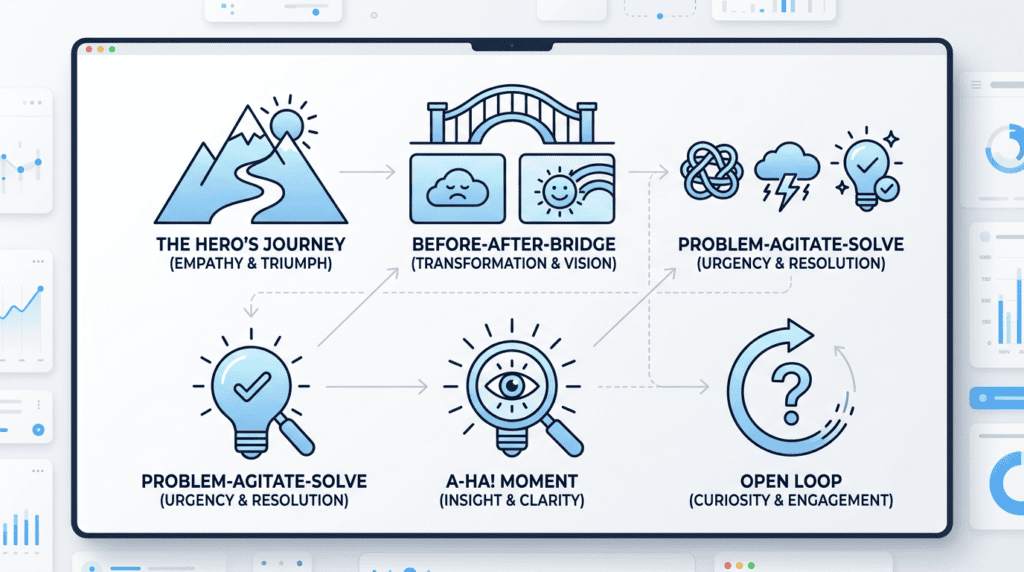
Crafting a compelling narrative for your email marketing doesn’t mean you need to invent a new plot every time. Instead, you can lean on established storytelling frameworks. These structures provide a roadmap, making it easier to organize your thoughts and ensure your message resonates with readers. They help you guide your audience through an experience, building trust and connection with every email.
The Hero’s Journey: Guiding the Subscriber to a Solution
The Hero’s Journey is a classic narrative arc where a protagonist leaves their ordinary world, faces challenges, and returns transformed. In email marketing, your subscriber is the hero, and your product or service is the wise mentor or the special tool that helps them overcome their “ordinary world” problem. This framework is powerful for showing how your solution empowers your audience.
- *Example:* Imagine an email campaign telling the story of Sarah, a small business owner overwhelmed by manual invoicing. The “call to adventure” is her frustration. She “crosses the threshold” by trying various clunky solutions. Your email then introduces your automated invoicing software as the “mentor” or “magic weapon.” The “trials” are her initial learning curve, quickly overcome. Finally, she achieves the “resurrection” of her free time and the “return with the elixir” of streamlined operations and peace of mind. This narrative arc helps subscribers see themselves in Sarah’s shoes, understanding how your business can guide them to their own resolution.
Before-After-Bridge: Highlighting Transformation
This framework is straightforward and highly effective for demonstrating value. You start by painting a vivid picture of a problem (the “Before”), then describe the ideal outcome (the “After”), and finally, position your product or service as the essential link that gets them from one state to the other (the “Bridge”). It’s a direct way to show the transformation your offering provides.
- *Example:* An email might start by describing the frustrating “before” state: “Are you spending hours every week trying to manually track your affiliate commissions, leading to missed payments and endless spreadsheets?” It then moves to the successful “after” state: “Imagine effortlessly seeing all your earnings in one dashboard, knowing exactly what’s due, and getting paid on time, every time.” The “bridge” is then introduced: “Our new affiliate tracking platform connects all your networks, automates reconciliation, and gives you crystal-clear insights, making those manual headaches a thing of the past.” This structure clearly highlights the value proposition and helps readers visualize their own improved future.
Problem-Agitate-Solve (PAS): Tapping into Reader Pain Points
The PAS framework is a persuasive copywriting staple. It begins by identifying a specific “Problem” your audience faces. Then, it “Agitates” that problem, digging into the emotional consequences and frustrations it causes. Finally, it presents your product or service as the definitive “Solve.” This approach is particularly effective for connecting with readers on an emotional level and showing empathy.
- *Example:* An email could start by describing a relatable problem: “Many content creators struggle to consistently publish high-quality articles, often getting stuck on research or writer’s block.” It then explores the frustrations it causes: “This leads to missed deadlines, inconsistent audience engagement, and the constant pressure of an empty content calendar. You feel like you’re always playing catch-up, and your brand’s growth slows down.” The email then introduces your solution: “Our AI writing assistant helps you generate outlines, research facts, and draft compelling content in minutes, freeing you up to focus on strategy and connection. It’s the tool that keeps your content machine running smoothly.”
The “A-Ha!” Moment: Sharing a Personal Discovery
This framework centers on a pivotal moment of insight or realization. It often involves a personal story where the sender (or a character) discovers a key truth, a better way of doing things, or the core idea behind a product. Sharing an “A-Ha!” moment builds authenticity and can make complex ideas more accessible and memorable for your audience.
- *Example:* An email from the founder might detail the specific moment of insight that led to the creation of a key product feature. “I remember staring at my screen at 3 AM, trying to manually segment my email list for a new campaign. It hit me then: there had to be a smarter way to personalize messages without hours of manual work. That ‘A-Ha!’ moment was the spark for our new AI-powered segmentation tool, designed to save you those late nights and boost your engagement.” This personal narrative helps humanize the brand and explains the “why” behind an offering.
The Open Loop: Creating Suspense Across Multiple Emails
An open loop is a psychological technique where you start a story or pose a question but don’t immediately provide the resolution. Instead, you leave the reader wanting to know what happens next, encouraging them to open subsequent emails in a sequence. This is excellent for welcome series or multi-part educational content, boosting open rates and sustained engagement.
- *Example:* A welcome sequence might tell a multi-part story about a common business challenge. The first email introduces the challenge and a character facing it, ending with a cliffhanger like, “But just as Sarah was about to give up on her online store, she stumbled upon a secret strategy. What was it? Find out in tomorrow’s email…” Each email then reveals a piece of the puzzle, building anticipation and encouraging clicks until the final resolution, often tied to your product or a valuable lesson.
> Tactical Takeaway: Don’t feel pressured to invent entirely new plots. Leverage these proven narrative frameworks to structure your email content, making your messages more engaging and easier to write.
Where to Find Compelling Stories for Your Emails
Finding compelling stories for your email marketing doesn’t require a degree in creative writing. The best narratives often come from everyday experiences and observations related to your business and your audience. The goal is to connect with your subscribers on a personal level, building loyalty and trust.
Mining Your Own Experiences: Founder Stories and Personal Anecdotes
Your own journey, struggles, and successes are a rich source of content. Founder stories, in particular, can humanize your brand and explain the passion behind your products. Personal anecdotes about how you overcame a challenge, learned a lesson, or discovered a solution can resonate deeply with readers facing similar situations. I’ve often found that sharing a moment where I personally struggled with a specific marketing task, like optimizing a landing page, and then detailing the steps I took to improve it, creates a strong bond. It shows I understand their pain points because I’ve lived them. This kind of authentic sharing builds a personal connection with subscribers.
Turning Customer Success into Relatable Case Studies
Your customers’ journeys are powerful testimonials. When a customer achieves a significant result using your product or service, that’s a story waiting to be told. Focus on the “before” (their problem), the “during” (how they used your solution), and the “after” (their positive results). These aren’t just dry facts; they’re narratives of transformation that inspire and inform potential buyers. Highlighting customer success stories provides social proof and demonstrates the real-world value of your offerings.
Using Behind-the-Scenes Glimpses to Build Authenticity
People are naturally curious about what goes on “behind the curtain.” Sharing glimpses of your team, your creative process, or even the challenges you face can build immense authenticity. This could be an email showing how a new product is developed, a day in the life of a team member, or even a candid look at a mistake and how you learned from it. These stories foster a sense of transparency and allow your audience to feel more connected to the people behind the brand.
Addressing Common Objections and Mistakes Through Narrative
Instead of just listing FAQs, turn common objections or mistakes into mini-stories. For example, if many potential customers hesitate due to a perceived complexity, share a story about a user who initially felt the same way but quickly mastered your tool. Or, if a common mistake prevents users from getting the most out of your product, tell a narrative about someone who made that mistake and how they corrected it, leading to better results. This approach addresses concerns proactively and provides valuable lessons.
Leveraging Industry News and Trends as a Story Hook
Stay current with your industry. Major news, emerging trends, or shifts in the market can serve as excellent story hooks. You can share your perspective, explain how a trend impacts your audience, or tell a story about how your business is adapting. This positions you as an expert and a valuable source of information, keeping your email content fresh and relevant. For instance, a new algorithm update in SEO could be framed as a challenge, and your advice or tool as the guide to navigate it successfully.
Practical Storytelling Techniques to Increase Engagement
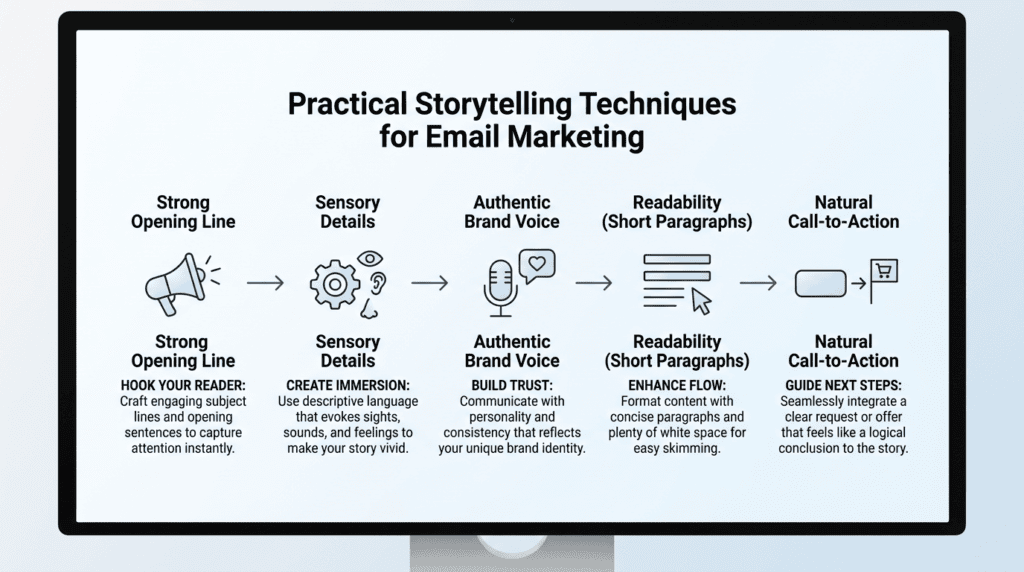
Once you have your story and framework, the next step is to present it in a way that captures attention and encourages action. Effective storytelling in email marketing isn’t just about the plot; it’s also about the delivery. These techniques ensure your emails are not only read but also remembered and acted upon.
The Power of a Strong Opening Line (The Hook)
Your subject line gets the open, but your opening line keeps the reader engaged. This “hook” needs to grab attention immediately, often by posing a question, making a bold statement, sharing a surprising fact, or starting directly in the middle of an action. It sets the tone and makes readers curious to continue. Think of it as the first sentence of a captivating novel; it needs to pull them in. A weak opening can cause even the best story to be abandoned.
Using Sensory Details to Make Your Story Vivid
Great stories engage the senses. While email is a visual medium, you can use descriptive language to evoke sights, sounds, feelings, and even smells or tastes. Instead of saying “it was hard,” describe the “late nights fueled by cold coffee” or the “frustration bubbling up as the error message flashed.” These details make your narrative more immersive and relatable, helping readers truly connect with the emotion and experience you’re sharing.
Writing with a Consistent and Authentic Brand Voice
Your brand voice is your personality. Whether it’s witty, authoritative, empathetic, or casual, maintaining a consistent voice across all your email campaigns builds recognition and trust. An authentic brand voice makes your storytelling feel genuine, not forced. It’s about sounding like a real person talking to another real person, which is crucial for building long-term relationships with your audience.
Structuring Your Email for Readability: Short Paragraphs and Pace
Even the most compelling story can lose its impact if it’s presented as a dense wall of text. For email, readability is paramount. Use short paragraphs, often just one or two sentences long. Break up your text with white space. Vary sentence lengths to create a natural rhythm. This pacing makes the email easy to scan and digest, keeping readers moving through your narrative without feeling overwhelmed.
Crafting a Call-to-Action That Naturally Concludes the Story
Your call-to-action (CTA) shouldn’t feel like an abrupt sales pitch tacked onto the end of a story. Instead, it should be the natural resolution or next logical step in the narrative you’ve just told. If your story was about overcoming a problem, the CTA should offer the tool or resource that helps the reader achieve that same victory. It’s the “and here’s how you can do it too” moment, seamlessly guiding them from inspiration to action.
Real-World Examples: Storytelling in Email Marketing Done Right
This section analyzes emails from different types of businesses to show these principles in action.
The SaaS Company: A Founder’s Story to Announce a New Feature
SaaS companies often struggle to make technical updates feel exciting. A founder’s story can bridge this gap by connecting a new feature to a real-world problem or a personal “aha!” moment. Imagine an email from a project management software founder sharing how they personally struggled to keep track of team tasks, leading them to develop a new, intuitive dashboard. This narrative doesn’t just announce a feature; it explains the *why* behind it, humanizing the brand and building a deeper connection with subscribers. It transforms a product update into a relatable journey, demonstrating the value and thought put into the solution. I’ve seen many SaaS brands effectively use this to boost engagement and adoption for new tools.
The Ecommerce Brand: A Customer’s Journey to Build Social Proof
For ecommerce, customer success stories are gold for building trust. Instead of just showing a product, an email can tell the story of a customer who used it to solve a specific problem or achieve a desired outcome. For example, a clothing brand might share an email about a customer who struggled to find comfortable, stylish workwear and how their new line transformed her daily routine and confidence. This story includes details about her initial frustration, her discovery of the brand, and her positive “after” experience. This approach provides powerful social proof, making the product’s benefits tangible and relatable to other readers. It’s a fantastic way to showcase how your products deliver value in real life.
The Content Creator: A Personal Anecdote to Promote a New Course
Content creators, whether bloggers, YouTubers, or coaches, thrive on personal connection. When promoting a new course or product, a personal anecdote can be incredibly effective. Consider a content creator launching a course on writing compelling emails. Their email might start with a story about their own early struggles with low open rates and clicks, the frustration of feeling unheard, and the specific breakthrough moment or lesson they learned that changed everything. This narrative builds empathy and positions the course as the solution to a shared problem. By sharing personal stories, they connect with their audience on an emotional level, making the course offering feel like a natural progression of their own journey and expertise.
The B2B Service: A “Behind-the-Scenes” Look at Solving a Client Problem
B2B services often deal with complex problems, and a “behind-the-scenes” narrative can effectively demonstrate expertise and build confidence. An email from a digital marketing agency, for instance, could detail a client’s initial challenge – like a stagnant lead generation – and then walk readers through the strategic steps the agency took to overcome that obstacle. This isn’t just a case study; it’s a narrative that includes the team’s thought process, the hurdles they faced, and the ultimate resolution and positive results. This kind of transparency humanizes the service, showcases problem-solving capabilities, and builds trust by letting potential clients see how the agency delivers value.
The Honest Take: Common Mistakes to Avoid in Email Storytelling

Even with the best intentions, email storytelling can go wrong. This section highlights the pitfalls that can damage trust and engagement.
The Risk of Inauthenticity: When Stories Feel Forced or Fake
One of the biggest dangers in storytelling in email marketing is a lack of authenticity. Readers are smart; they can spot a forced narrative or a story that doesn’t quite ring true. If your story feels manufactured or overly polished, it can actually erode the trust you’re trying to build. The goal is to share genuine experiences and emotions, not to invent them. Always prioritize honesty over a perfectly crafted but untrue narrative. Trying to create a story where none exists often backfires, making your brand seem disingenuous.
> Don’t try to be someone you’re not; your audience will quickly pick up on any inauthenticity, which can be more damaging than not telling a story at all.
Forgetting the “Why”: Stories Without a Clear Purpose or CTA
Every story you tell in an email marketing campaign should have a purpose. Is it to educate, entertain, inspire, or lead to a specific action? A common mistake is telling a great story that simply ends without a clear connection to your brand’s message or a call to action (CTA). If your narrative doesn’t subtly guide the reader towards understanding your product, service, or a desired next step, it’s just content, not effective email marketing. Ensure your story naturally flows into what you want your subscribers to do next, whether it’s clicking a link, replying to the email, or learning more about a product.
Overlooking Your Audience: Telling Stories That Don’t Resonate
Your audience is at the heart of effective storytelling. A story, no matter how compelling to you, won’t succeed if it doesn’t resonate with your subscribers. This often happens when marketers tell stories that are too niche, too self-focused, or simply not relevant to their readers’ pain points, aspirations, or interests. Before crafting a narrative, consider your audience segmentation and ask: “Will *they* care about this? Can *they* see themselves in this story?” Empathy is key here; put yourself in your readers’ shoes to ensure your narrative connects with their world.
The “All About Me” Trap: Making the Brand the Hero Instead of the Customer
While founder stories and behind-the-scenes glimpses are valuable, a consistent mistake is making the brand or business the sole hero of every story. In most effective marketing narratives, the customer should be the hero, and your brand or product should be the guide or the tool that helps them achieve their goals. If every email is about how great *you* are, without connecting it to how *your audience* benefits, you’re missing an opportunity to build a relationship. I’ve often seen brands fall into this trap, forgetting that readers want to know what’s in it for them. Shift the focus from “we did this” to “here’s how this helps you.”
How to Measure the Success of Your Story-Driven Emails

Understanding the impact of your storytelling efforts is crucial for refining your email marketing strategy. Metrics help you see what’s working and what needs adjustment.
Key Metrics to Track: Open Rate, Click-Through Rate, and Reply Rate
When you send story-driven emails, several key metrics provide immediate feedback. Your open rate indicates how compelling your subject line and preview text were in hooking your readers. A higher open rate suggests your narrative promise was strong enough to pique curiosity. The click-through rate (CTR) shows how well your story engaged readers and motivated them to take the next step, often clicking a call to action. Finally, the reply rate, though less commonly tracked, is a powerful indicator of deep engagement and connection. When subscribers take the time to reply, it means your story resonated enough to spark a personal conversation, which is a strong sign of building trust.
Analyzing Qualitative Feedback from Subscriber Replies
Beyond the numbers, the actual content of subscriber replies offers invaluable qualitative feedback. Pay attention to what readers say: Do they share similar experiences? Do they express gratitude or ask follow-up questions? These direct responses provide insights into how your stories are being received and understood. This feedback can inform future content, help you refine your brand voice, and even uncover new story ideas. It’s a direct line to understanding the emotional connection you’re building with your audience.
A/B Testing Story Angles to See What Resonates
A/B testing is a powerful tool for optimizing your storytelling in email marketing. You can test different story angles, narrative structures, or even subject lines that hint at different types of stories. For example, send one version of an email with a personal anecdote and another with a customer success story to a segmented portion of your list. By comparing the open rates, click-through rates, and even reply rates, you can learn which types of narratives resonate most strongly with your audience. Regular A/B testing helps you continuously refine your storytelling approach for maximum impact.
Connecting Email Engagement to Long-Term Customer Value
Ultimately, the goal of storytelling in email marketing isn’t just higher open rates; it’s about building long-term customer value and loyalty. Track how engaged subscribers – those who consistently open, click, and reply to your story emails – behave over time. Do they have higher conversion rates? Do they make more repeat purchases? Are they more likely to refer others? By connecting your email engagement metrics to broader business outcomes, you can demonstrate the tangible return on investment of your story-driven approach. I always recommend looking beyond just clicks to see how these deeper relationships translate into sustained business growth.
Final Recommendation: Start Small, Stay Consistent

You don’t need to overhaul your entire email strategy overnight. The key to mastering storytelling is to start with one small, authentic story. Choose a simple framework, focus on providing value, and be consistent. Over time, these narratives will become the foundation of a strong, trust-based relationship with your audience, turning subscribers into loyal advocates for your brand.
For those new to storytelling in email marketing, begin by identifying a single personal anecdote or a customer success story that genuinely highlights a problem and solution. Don’t overthink it; authenticity trumps perfection. If you’re an established brand struggling with engagement, focus on weaving a narrative arc through your welcome series or a specific product launch to build a personal connection with subscribers.
Ignoring the power of storytelling means your emails risk becoming just another promotional message in a crowded inbox. Without a compelling narrative, you’re leaving significant engagement and conversion potential on the table, making it harder to build trust and differentiate your brand. The cost of inaction isn’t just lost sales; it’s a missed opportunity to forge lasting relationships and build brand loyalty.
> The most impactful storytelling in email marketing isn’t about grand epics, but consistent, genuine narratives that resonate and build trust over time.
I’ve seen firsthand how a simple, well-told story can dramatically shift how an audience perceives a brand, moving them from passive readers to engaged, loyal customers.
Frequently Asked Questions (FAQs)
How long should a story-based email be?
A story-based email should be as long as it needs to be to tell the story effectively and maintain reader engagement, typically ranging from 200 to 500 words. The goal is to keep readers hooked, so prioritize clear, concise writing and break up text with short paragraphs to improve readability.
Can I use storytelling in transactional emails (e.g., order confirmations)?
Yes, you absolutely can use storytelling in transactional emails to humanize your brand and enhance the customer experience. A brief, authentic narrative about the journey of their product or the impact of their purchase can add value and strengthen the personal connection with subscribers.
Do I need to be a professional writer to use storytelling?
No, you don’t need to be a professional writer to use storytelling in email marketing; authenticity and relatability are far more important than perfect prose. Focus on sharing genuine experiences and emotions, as this is what truly helps connect with your audience and build trust.
How often should I send story-driven emails versus promotional ones?
The ideal frequency for story-driven emails versus promotional ones depends on your audience and business model, but a good starting point is a 60/40 or 70/30 split, favoring value-driven content and stories. This balance ensures you’re consistently delivering value and building a relationship, not just selling, which is key for long-term engagement and open rates.
What’s the best way to find my brand’s unique story?
The best way to find your brand’s unique story is to look inward at your origins, values, and the real-world impact you have on customers, and also outward by listening to customer feedback and testimonials. These sources provide rich material for crafting compelling narratives that resonate and build trust through storytelling in email marketing.