
Blasting affiliate links destroys subscriber trust. Many marketers treat their email list like a cash machine, sending out offer after offer without much thought for the people on the other end. This short-sighted approach might generate a few quick sales, but it ultimately erodes the very foundation of your business: the relationship with your audience.
This guide outlines a practical, ethical framework for promoting affiliate products to your email list. We’ll move beyond generic advice to show you how to build trust, provide genuine value, and generate revenue without alienating your subscribers. You will learn specific strategies for choosing the right products, crafting compelling email sequences, and measuring what actually works. The real secret to monetizing your newsletter isn’t aggressive selling; it’s becoming a trusted resource that genuinely helps your audience solve their problems.
The Foundation: Why Trust Is Your Most Valuable Asset in Affiliate Email Marketing
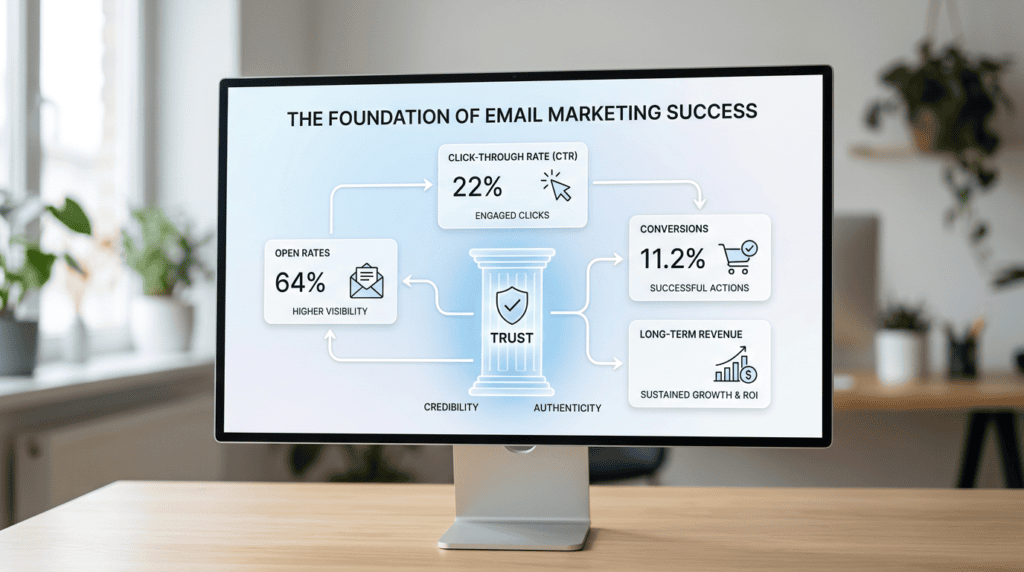
Your email list is more than just a collection of addresses; it’s a direct line to people who have given you permission to enter their inbox. This permission is a privilege, not a right, and how you use it directly impacts your long-term success when you promote affiliate products. Without trust, your open rates will plummet, your click-through rate (CTR) will suffer, and your affiliate commissions will dry up.
> Critical Takeaway: Treat every email as an opportunity to reinforce your credibility, not just to make a sale. Your subscribers are looking for solutions, not just another promotion.
I remember early in my journey, I got caught up in the hype of a “hot” product launch. I pushed it hard to my list, even though I hadn’t fully tested it myself. The sales were decent, but the backlash was immediate. My unsubscribe rate spiked, and several loyal subscribers emailed me directly, expressing disappointment. It taught me a valuable lesson: a few extra dollars aren’t worth the damage to a relationship I’d spent months building. That experience shifted my entire affiliate marketing strategy.
Moving Beyond “Hard Sells” to Genuine Recommendations
The days of simply “selling” in every email are over. Today, a successful affiliate marketing campaign focuses on providing immense value first. When you recommend affiliate products, your goal should be to genuinely help your audience solve their pain points or achieve their goals. Think of yourself as a helpful resource, not a salesperson. This means understanding your subscribers’ needs deeply and only recommending relevant affiliate products that you truly believe in. A soft sell approach, where you educate and inform before presenting an offer, builds far more rapport than a hard sell.
The Long-Term Cost of Promoting the Wrong Products
Every time you promote a product that doesn’t deliver, or one that isn’t a good fit for your audience, you chip away at your trust. This isn’t just about immediate unsubscribes; it’s about the silent damage that leads to lower open rates and a disengaged list over time. Promoting the wrong products can lead to increased spam complaints, which can hurt your sender reputation and land your future emails in the spam folder. The long-term relationship building you’ve invested in is far more valuable than any single commission. Protecting your subscriber lifetime value means being highly selective about what you promote.
Setting Subscriber Expectations: The Role of Transparency
Transparency is non-negotiable when you promote affiliate products. Your subscribers deserve to know when you’re recommending something for which you’ll earn a commission. This isn’t just good ethics; it’s often a legal requirement, especially under FTC disclosure guidelines. Clearly state that you may receive a commission if they purchase through your links. This can be a simple sentence at the top or bottom of your email. Beyond disclosures, be transparent about the pros and cons of a product. Your honesty builds credibility and shows that you’re prioritizing their best interest over your own potential earnings.
How Ethical Promotion Builds a More Engaged (and Profitable) List
When you consistently provide value and make genuine, ethical recommendations, your audience learns to trust your judgment. This trust translates directly into higher engagement. People are more likely to open your emails (improving your open rate), click on your links (boosting your CTR), and ultimately purchase the products you recommend (increasing your conversion rate). An engaged list is a profitable list. By building email authority and credibility through honest product feedback and helpful resource recommendations, you create a passive income stream that is sustainable and grows over time. This approach transforms your email list from a transactional channel into a powerful community, ready to act on your advice.
Step 1: Selecting Affiliate Products Your Audience Will Actually Thank You For
Choosing the right affiliate products is the bedrock of a successful and ethical affiliate marketing strategy. It’s not just about chasing high commissions; it’s about recommending solutions that genuinely help your email list subscribers. When you promote affiliate products that resonate, you build subscriber trust and create a long-term relationship, which is far more valuable than a quick sale.
The “Problem-First” Approach to Product Selection
Before you even think about commission rates or product features, consider your audience’s biggest pain points. What problems do your email list subscribers consistently ask about? What challenges do they face in their business or niche? Your role as an affiliate is to be a helpful resource, not just a salesperson. Start by identifying these audience pain points. For instance, if your audience struggles with content creation, you might look for tools that simplify writing or graphic design. If they need help with lead generation, then a CRM or email service provider could be a relevant affiliate product. This “problem-first” mindset ensures that any product you promote affiliate products to your list is inherently valuable.
Vetting Products: A Checklist for Quality and Relevance
Once you’ve identified a problem, finding a product that solves it effectively is the next step. This isn’t a passive process; it requires active investigation.
- Hands-on Testing: Whenever possible, use the product yourself. This is the most direct way to understand its strengths and weaknesses. If you can’t use it, get a demo or a trial. Your personal experience allows you to speak with authority and provide honest product feedback.
- Checking Reviews: Look beyond the company’s own testimonials. Search for independent reviews on platforms like G2, Capterra, or even Reddit. Pay attention to common complaints and praise. Do these align with the problems your audience faces?
- Understanding the Company’s Reputation: Research the company behind the product. Do they have good customer support? Are they known for innovation or for abandoning products? A reputable company adds credibility to your recommendation.
- Relevance to Your Niche: Does the product fit naturally within your content and the topics you usually discuss? Promoting a random product, even if it’s good, can feel jarring to your audience and erode trust.
> Tactical Takeaway: Always prioritize products you’ve personally used and found genuinely helpful, as this authentic experience is impossible to fake and builds immense credibility with your audience.
Analyzing Affiliate Program Terms: What to Look For
Understanding the terms of an affiliate program is crucial for maximizing your revenue and ensuring a fair partnership.
- Commission Rates: These vary widely. Some programs offer a flat fee, others a percentage of the sale. Look for competitive rates, but don’t let a high commission blind you to a poor product. A lower commission on a highly relevant, high-converting product can often outperform a high commission on something your audience doesn’t need.
- Cookie Duration: This refers to how long a cookie stays on a user’s browser after they click your affiliate link. A longer cookie duration (e.g., 60 or 90 days) means you have a better chance of earning a commission if the subscriber takes a few weeks to decide. Shorter durations (e.g., 24 hours) require quicker conversion.
- Payment Terms: How often do they pay? What’s the minimum payout threshold? Do they pay via PayPal, bank transfer, or another method? Knowing these details upfront helps with financial planning and tracking affiliate sales.
When to Promote High-Ticket vs. Low-Ticket Offers
Your affiliate marketing strategy should include a mix of offers. Low-ticket digital products, like e-books or templates, are often easier for subscribers to purchase, especially if they’re new to your list. They can serve as an entry point, building initial trust and showing immediate value. High-ticket affiliate offers, such as expensive software subscriptions, courses, or services, typically require more nurturing and a deeper relationship with your audience. I’ve found that promoting a high-ticket item too early in a relationship can feel pushy, but after I’ve delivered consistent value and built authority, my audience is much more receptive to investing in a premium solution I recommend. Consider where your audience is in their journey and what they’re ready to buy.
Step 2: Segmenting Your Email List for Maximum Relevance and Conversions
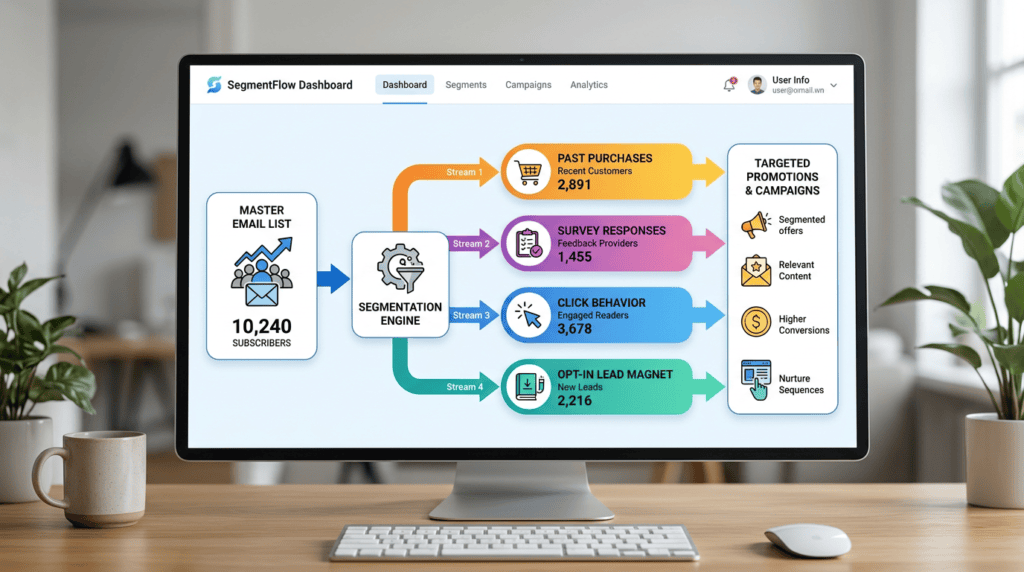
Sending generic emails to your entire list is a common mistake that leads to low engagement and missed opportunities. Effective email marketing campaign relies heavily on segmentation. By dividing your email list subscribers into smaller, more targeted groups, you can deliver highly relevant affiliate promotions that speak directly to their specific needs and interests. This boosts open rates, click-through rates (CTR), and ultimately, conversions.
Why Sending the Same Offer to Everyone Doesn’t Work
Imagine you have subscribers interested in SEO tools, others focused on content writing, and some who are just starting out with general online business advice. Sending an email about advanced keyword research software to someone who’s still learning how to set up a website is a mismatch. It’s irrelevant to them, likely to be ignored, and might even lead to unsubscribes. This “spray and pray” approach dilutes your message, wastes your efforts, and can damage the long-term relationship you’re trying to build with your audience. Your goal is to promote affiliate products that feel like a personal recommendation, not a mass advertisement.
Practical Segmentation Methods for Affiliate Promotions
There are several effective ways to segment your list, allowing for targeted email broadcasts.
- Based on Past Purchases: If you sell your own products or have tracked affiliate sales, you know what your subscribers have already bought. Avoid promoting something they already own or a direct competitor. Instead, recommend complementary products.
- Survey Responses: Periodically survey your audience about their biggest challenges, goals, or interests. This direct feedback is invaluable for creating segments. For example, if a survey reveals a group struggling with email marketing, you can segment them for a campaign promoting an email service provider.
- Click Behavior: Your email service provider (ESP) can track which links subscribers click. If someone consistently clicks on links related to “AI writing tools,” you can tag them as interested in that topic. This behavioral data is a powerful indicator of intent.
- Opt-in Lead Magnet: The lead magnet a subscriber opted in for often indicates their primary interest. Someone who downloaded a guide on “Starting a Blog” is likely interested in different affiliate products than someone who downloaded “Advanced SEO Strategies.”
Using Tags to Identify Subscriber Interests and Intent
Tags are labels you apply to individual subscribers within your email service provider. They are incredibly flexible and allow you to create dynamic segments. For example, you might tag subscribers with:
- `interested_in_seo_tools`
- `beginner_blogger`
- `purchased_x_product`
- `clicked_affiliate_link_y`
These tags then allow you to filter your list and send highly relevant affiliate products promotions. When I’m planning an email marketing campaign, I often start by thinking, “Which tags would make this offer most relevant?” This helps me craft content that truly resonates.
Creating a “VIP” Segment for High-Value Offers
A “VIP” segment isn’t just for your highest spenders, but for your most engaged and loyal subscribers. These are the people who consistently open your emails, click your links, and respond to your calls to action. They’ve demonstrated a higher level of trust and engagement. This segment is ideal for promoting high-ticket affiliate offers, exclusive subscriber discounts, or early access to new products. They are more likely to appreciate and act on these special offers because of the established relationship.
Step 3: Crafting High-Converting Affiliate Email Campaigns (With Examples)
Once you’ve selected relevant products and segmented your audience, the next step is to craft compelling email campaigns. The goal is to promote affiliate products in a way that feels helpful and natural, leading to clicks and sales without resorting to hard sell mistakes. This involves a strategic approach to content, timing, and presentation.
The “Value-First” Sequence: Educate Before You Pitch
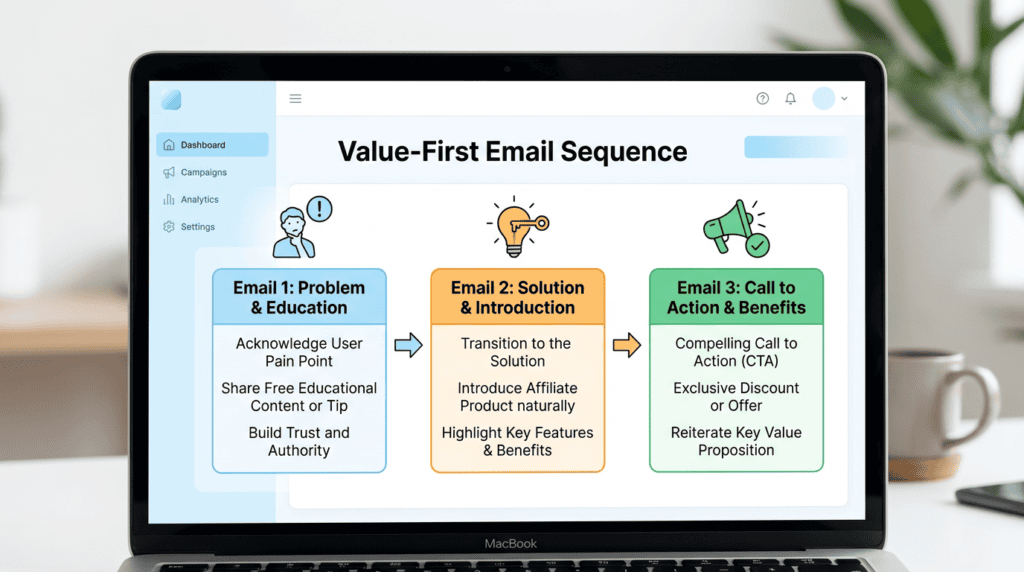
This is perhaps the most critical component of ethical affiliate marketing. Instead of immediately pushing a product, you first provide immense value related to the problem the product solves. A common structure is a 3-part email sequence templates:
- Email 1: Problem & Education: Introduce the problem your audience faces. Explain *why* it’s a problem and offer actionable advice or insights on how to approach it. No product pitch here, just pure value.
- Email 2: Solution & Introduction: Build on the first email. Introduce the *type* of solution needed for the problem. Then, subtly introduce the affiliate product as an ideal tool that fits this solution. Focus on its benefits and how it helps implement the concepts from Email 1.
- Email 3: Call to Action & Benefits: Reiterate the product’s key benefits, share a specific use case, and provide a clear call to action to check out the product via your affiliate links. You might include a testimonial or a brief personal story here.
This value to pitch ratio ensures your subscribers feel educated and supported, not just sold to.
The “Case Study” or “Personal Story” Angle
People connect with stories. A case study email or personal story selling approach can be incredibly effective for affiliate product reviews. Instead of just listing features, show how the product transformed a real situation.
- Example: “How I Solved [Problem X] Using [Affiliate Product]” – This type of email showcases a real-world result. You might describe a specific challenge you faced (e.g., “I used to spend hours manually scheduling social media posts…”) and then explain how [Affiliate Product] provided the solution (“…but then I discovered [Product Name], which cut my scheduling time by 70%.”). This demonstrates honest product feedback and helps your audience visualize their own success.
When I write these, I focus on the transformation, not just the tool. Highlighting the “before and after” makes the product’s value tangible.
The “Bonus Stack” Method: Adding Your Own Value
To sweeten the deal and differentiate your offer, consider adding your own unique bonus for anyone who buys through your affiliate link. This is a powerful way to increase conversion rates and provide extra value. Your bonus should complement the affiliate product and solve an additional problem or simplify its use.
- Example: If you’re promoting a course on Facebook Ads, your bonus might be:
- A custom ad copy template.
- A short video tutorial on setting up the Facebook Pixel.
- A 15-minute strategy call to review their first ad campaign.
This method not only encourages purchases but also reinforces your authority and helpfulness, further building subscriber trust.
Writing Affiliate Email Subject Lines That Get Opened
Your subject line is the gatekeeper to your email’s content. A strong subject line is crucial for high open rates. Avoid clickbait, but aim for clarity and curiosity.
- Direct Subject Lines (Clear Value):
- “Solve [Problem] with This Tool”
- “My Top Recommendation for [Specific Need]”
- “Get [Benefit] with [Product Name]”
- Curiosity-Driven Subject Lines (Intrigue):
- “The Secret to [Desired Outcome]?”
- “Are you making this [Mistake]?”
- “What if you could [Achieve Something Easily]?”
Test different approaches to see what resonates best with your specific audience. A good subject line makes subscribers want to click and learn more about the helpful resource recommendations inside.
Step 4: Structuring Your Promotional Emails for Trust and Action
Crafting an affiliate email isn’t just about dropping a link; it’s about building a narrative that leads your subscribers to a helpful solution. The structure of your email plays a huge role in maintaining trust and driving action. You want your audience to feel like they’re getting a recommendation from a trusted friend, not a hard sell from a stranger.
The Critical Importance of FTC Disclosure
Transparency isn’t just good practice; it’s a legal requirement in many regions, especially in the US with the Federal Trade Commission (FTC) guidelines. When you promote affiliate products to your email list, you *must* disclose your relationship. This builds trust and keeps you compliant. Hiding this information can damage your credibility and lead to legal issues.
> Always place your affiliate disclosure clearly and conspicuously in every email containing affiliate links. Don’t bury it in tiny font or at the very bottom where it might be missed.
A simple, clear statement works best. You can use phrases like:
- “Full disclosure: This email contains affiliate links, which means I may earn a commission if you make a purchase through my link, at no extra cost to you.”
- “Heads up! Some links in this email are affiliate links. If you buy through them, I might get a small commission.”
- “Just so you know, I’m an affiliate for [Product Name] and may receive a commission if you decide to buy.”
I’ve found that being upfront about my affiliate relationships actually *increases* trust. My subscribers appreciate the honesty, and it reinforces that I’m not trying to trick them into buying something.
Balancing Educational Content with a Clear Call-to-Action (CTA)
The core of an effective affiliate email is the value-to-pitch ratio. You can’t just send an email with a product description and a “buy now” button. Your subscribers joined your list for valuable content, not constant sales pitches. The best approach is to educate first, then introduce the product as a solution to a problem you’ve just discussed.
Think of it as a helpful conversation. You identify a common pain point your audience faces, explain why it’s a problem, and then present the affiliate product as the best tool or resource to overcome it. The call-to-action (CTA) should be clear, concise, and tell the subscriber exactly what you want them to do next. Avoid multiple CTAs that can confuse your audience. Focus on one primary action, like “Learn More Here” or “Get [Product Name] Today.”
Using Social Proof and Testimonials Ethically
Social proof is a powerful persuader. When people see that others have benefited from a product, they’re more likely to consider it themselves. This can include:
- Direct testimonials: Quotes from satisfied users, ideally with names and photos.
- Case studies: Brief stories illustrating how someone achieved a specific result using the product.
- Statistics: Data showing the product’s effectiveness (e.g., “helped 10,000 businesses save time”).
The key is authenticity. Never invent testimonials or exaggerate results. Use real feedback from real users. If you’ve used the product yourself (which you should be doing, as discussed in previous sections), your personal experience serves as powerful social proof. Sharing a screenshot of your own results or a brief video demonstrating the product can be incredibly effective in building credibility and encouraging clicks.
The Anatomy of a Single, High-Impact Affiliate Email
A well-structured affiliate email guides your reader logically from a problem to a solution. Here’s a breakdown of the key components:
The Hook
Start with something that grabs attention and relates directly to your audience’s interests or pain points. This could be a question, a bold statement, or a surprising statistic. The goal is to make them want to read more.
The Problem
Clearly articulate a specific challenge or desire your subscribers have. This shows you understand their needs and builds empathy. Make them feel heard and understood.
The Solution (Product Intro)
Once the problem is established, introduce the affiliate product as the ideal solution. Explain *how* it solves the problem, focusing on benefits rather than just features. This is where you connect the product to their needs.
The Proof
Back up your claims with evidence. This is where you can weave in your personal experience, a short testimonial, or a compelling statistic. Show, don’t just tell, that the product delivers on its promises.
The CTA
End with a single, clear call-to-action. Tell your subscribers exactly what to do next to get the solution. Use action-oriented language and make the link easy to find.
Honest Take: Common Mistakes That Destroy Trust and Kill Conversions
Affiliate email marketing can be incredibly profitable, but it’s also easy to get wrong. Many creators, especially when starting out, make fundamental errors that erode subscriber trust and ultimately lead to poor conversion rates. Avoiding these pitfalls is just as important as implementing best practices.
> The biggest mistake you can make in affiliate email marketing is prioritizing short-term commission over the long-term relationship with your subscribers.
My own journey has taught me that a quick buck often comes at the cost of future revenue and a damaged reputation. It’s a lesson I learned early on when I promoted a product I hadn’t fully vetted, and the negative feedback from my list was a harsh but necessary wake-up call.
Mistake #1: Over-Promoting and Causing List Fatigue
Bombarding your email list with constant sales pitches is a surefire way to increase unsubscribe rates and send your emails straight to the spam folder. Subscribers join your list for value, not to be sold to every day. When you over-promote, your audience becomes fatigued, stops opening your emails, and eventually tunes you out entirely. This kills your open rates and click-through rates (CTR) for *all* your emails, not just the promotional ones. Find a healthy balance between valuable content and strategic promotions.
Mistake #2: Promoting Products You Haven’t Used
This is a critical error that undermines your authority and credibility. If you haven’t personally used, tested, or thoroughly researched a product, how can you genuinely recommend it? Your audience expects you to be an expert or at least someone with direct experience. Promoting products blindly, just for the commission, makes you look disingenuous. It’s essential to provide honest product feedback based on your own experience. Stick to recommending products that you genuinely believe in and would use yourself.
Mistake #3: Hiding Your Affiliate Relationship
As discussed earlier, transparency is non-negotiable. Attempting to hide your affiliate links or failing to disclose your relationship is not only unethical but can also lead to legal trouble with bodies like the FTC. Subscribers are smart; they can often tell when you’re trying to be sneaky. This erodes trust faster than almost anything else. Always be upfront and clear about your affiliate links. It builds a stronger, more honest relationship with your audience.
Mistake #4: Ignoring Performance Data and Subscriber Feedback
Sending emails without tracking their performance is like driving blind. Many marketers focus only on clicks and sales, but ignore crucial metrics like open rates, unsubscribe rates per campaign, and even direct replies from subscribers. If your open rates plummet after a specific promotion, or if you see a spike in unsubscribes, that’s valuable feedback. Ignoring these signals means you’re missing opportunities to refine your approach, understand what resonates (or doesn’t), and optimize your email marketing strategy for better results.
Step 5: Measuring What Matters: Tracking Your Affiliate Email Performance

Once your affiliate email campaigns are live, the work isn’t over. To truly optimize your efforts and maximize your revenue, you need to rigorously track and analyze your performance. This isn’t just about counting commissions; it’s about understanding subscriber behavior, identifying what works, and refining your strategy for long-term success.
Key Metrics Beyond Just Clicks and Commissions
While clicks and commissions are important for tracking immediate revenue, they don’t tell the whole story. To get a comprehensive view of your email marketing campaign health, you need to look at a broader set of metrics:
- Open Rates: This tells you how compelling your subject lines are and how engaged your audience is with your brand. A declining open rate can signal list fatigue or irrelevant content.
- Click-Through Rate (CTR): This measures how many people clicked a link after opening your email. A low CTR might indicate that your email content isn’t persuasive enough or your call-to-action isn’t clear.
- Unsubscribe Rates Per Campaign: A high unsubscribe rate for a specific email or campaign is a red flag. It suggests the content was irrelevant, too salesy, or simply didn’t resonate with your audience.
- Segment Engagement: How do different segments of your list respond to your emails? This helps you understand which types of offers or content appeal to specific groups, allowing for more targeted email marketing.
- Conversion Rate: Beyond just clicks, how many of those clicks actually resulted in a sale? This is the ultimate measure of your email’s effectiveness in driving revenue.
Using UTM Parameters to Accurately Track Sales Sources
To truly understand which emails and campaigns are driving sales, you need to use UTM parameters. These are small snippets of code you add to the end of your affiliate links. They allow analytics tools (like Google Analytics) to tell you exactly where your traffic and sales are coming from.
For example, instead of just `affiliatelink.com/product`, you might use `affiliatelink.com/product?utm_source=email&utm_medium=newsletter&utm_campaign=productlaunch_may`. This lets you see that a sale came from your email newsletter, specifically from your “product launch” campaign in May. This level of tracking is crucial for attributing revenue correctly and understanding the ROI of your email efforts. Without UTMs, you’re guessing which email or promotion led to a conversion.
How to A/B Test Your Affiliate Emails for Better Results
A/B testing, also known as split testing, involves sending two slightly different versions of an email to a small portion of your audience to see which performs better. The winning version is then sent to the rest of your list. This is a powerful way to optimize your email campaigns over time.
You can A/B test various elements:
- Subject Lines: Test different angles (curiosity, urgency, benefit-driven).
- Calls-to-Action (CTAs): Experiment with wording, button colors, or placement.
- Email Angles: Try different approaches to your content (e.g., a case study vs. a direct review).
- Email Length: See if shorter or longer emails resonate more with your audience.
I’ve personally seen A/B testing a subject line increase my open rates by 10-15%, which directly translates to more clicks and potential sales. It’s a simple yet highly effective strategy for continuous improvement.
Interpreting the Data: When to Double Down and When to Stop a Promotion
Collecting data is only half the battle; interpreting it is where the real strategy comes in. Look for patterns and trends. If a particular type of email or product consistently generates high open rates, CTRs, and conversions, that’s a signal to “double down.” Consider creating more content around that topic or promoting similar products.
Conversely, if an email campaign consistently underperforms with low engagement and high unsubscribe rates, it’s time to “stop the promotion” or at least re-evaluate your approach. Don’t be afraid to cut your losses on underperforming offers. This data-driven decision-making protects your list’s health and ensures you’re investing your time and effort into strategies that actually work. Your goal is to maximize subscriber lifetime value, and sometimes that means saying no to a promotion that isn’t serving your audience.
Advanced Strategy: Integrating Affiliate Offers into Your Existing Funnels
Beyond standalone email marketing campaigns, the most effective way to promote affiliate products is by weaving them naturally into your existing communication funnels. This approach leverages automation and context, making your recommendations feel less like a sales pitch and more like a helpful resource.
Placing Affiliate Recommendations in Your Welcome Sequence
Your welcome sequence is prime real estate for introducing relevant affiliate products. As new subscribers join your list, they’re highly engaged and eager for solutions. Instead of immediately pitching, integrate a helpful resource recommendation within the first few emails. This could be a tool that solves a common problem your audience faces, or a foundational product that complements the free content they just opted in for. Frame it as a “must-have” or “my go-to tool for X,” building trust from the start. This early, value-driven promotion sets the stage for future affiliate marketing efforts.
Using Affiliate Offers as Downsells or Cross-Sells
Strategic placement within your sales funnels can significantly boost affiliate revenue. If a subscriber declines your own product offer, a relevant affiliate product can serve as a downsell, still providing a solution and generating commission. Conversely, if they purchase your product, a complementary affiliate offer can be a valuable cross-sell, enhancing their experience. For example, if you sell a course on SEO, you might cross-sell an affiliate link to a keyword research tool. This method ensures your affiliate offers are always relevant to the subscriber’s current journey and needs.
Creating a Permanent “Tools I Use” or “Resources” Page
An evergreen “Tools I Use” or “Resources” page on your website is an invaluable asset for promoting affiliate products. This dedicated page acts as a curated list of your recommended products, software, and services, all linked with your affiliate IDs. The key is to drive email traffic to this high-value page. Periodically, in your newsletter or broadcast emails, mention this page as a helpful resource for your audience. This allows subscribers to browse at their own pace, making purchases when they’re ready, and positions you as an authority providing helpful resource recommendations.
Hosting Webinars to Promote High-Ticket Affiliate Products
For high-ticket affiliate offers, webinars are an incredibly powerful promotion strategy. A live or pre-recorded webinar allows you to provide extensive value, teach a specific skill, and then naturally introduce a premium affiliate product as the ultimate solution. This format builds immense credibility and allows for detailed demonstrations, case studies, and Q&A sessions. The interactive nature helps overcome objections and builds a strong connection, leading to higher conversion rates for these more significant investments.
Final Recommendations: Building a Sustainable Affiliate Revenue Stream

rough your email list isn’t about chasing quick sales; it’s about cultivating a long-term relationship with your subscribers. The most successful affiliate marketing strategy hinges on becoming a trusted advisor, consistently delivering value, and recommending with integrity.
For those ready to commit to this long-term vision, focusing on ethical affiliate marketing and a value-first content approach is non-negotiable. You should prioritize building subscriber trust above all else, meticulously vetting products, and segmenting your list to ensure maximum relevance. This path leads to consistent, growing revenue and a highly engaged audience.
If your primary goal is rapid monetization without the commitment to deep audience understanding or product vetting, you might find short-term gains, but this approach is ultimately unsustainable. It risks list fatigue, high unsubscribe rates, and a damaged reputation. Avoid any strategy that prioritizes immediate commission over the long-term health of your email list. The cost of inaction – or rather, the cost of *wrong* action – is significant. You could erode years of trust, diminish your brand authority, and ultimately limit your earning potential far more than any temporary sales boost.
> Your email list is a relationship, not a transaction ledger; nurture it with value, and affiliate revenue will naturally follow.
I’ve seen firsthand how a genuine commitment to serving your audience through thoughtful affiliate product recommendations can transform a business.
Frequently Asked Questions (FAQs)
How often can I promote affiliate products to my email list?
The ideal frequency for promoting affiliate products to your email list depends heavily on your audience’s engagement and the value you consistently provide. Aim for a healthy value-to-pitch ratio, ensuring most emails deliver free content or insights before any direct promotion. Monitor your open rates and unsubscribe rates closely to gauge your audience’s tolerance.
Do I need a large email list to make money with affiliate marketing?
No, you do not need a massive email list to generate significant affiliate revenue; a highly engaged, smaller list often outperforms a large, unengaged one. Focus on building subscriber trust and relevance within your niche, as even a few hundred dedicated subscribers can lead to substantial affiliate sales.
What’s the best way to disclose that I’m using an affiliate link?
The best way to disclose an affiliate link is clearly and conspicuously at the very top of your email, before any links or promotional content appear. Use simple, direct language like, “Full disclosure: This email contains affiliate links, meaning I may earn a commission if you purchase through them.” This adheres to FTC disclosure guidelines.
Can I promote competing affiliate products?
Generally, it’s best to avoid promoting directly competing affiliate products within the same email marketing campaign or in close succession. Promoting similar products can confuse your audience and dilute your recommendation’s authority, making it harder for subscribers to make a clear choice.
What if a product I promoted turns out to be bad?
If a product you promoted turns out to be bad or fails to meet expectations, address it immediately and transparently with your subscribers. Acknowledge the issue, explain any steps you’re taking (e.g., contacting the vendor), and offer alternatives or apologies to maintain your credibility and build subscriber trust.
How do I find good affiliate programs for my niche?
To find good affiliate programs for your niche, start by looking at products and services you already use, love, and genuinely recommend. Check if those companies have an affiliate program. Additionally, explore major affiliate networks like ShareASale, ClickBank, or Impact Radius, which host thousands of offers across various niches.