
Your email list isn’t converting enough. Many affiliate marketers treat their email reviews like mini-blog posts, stuffing them with features and generic calls to action. This approach often falls flat because it ignores the unique relationship you have with your subscribers. Writing effective affiliate product reviews in emails requires a distinct strategy, one built on personal connection and direct communication, not just information dumping.
This guide breaks down the exact process for writing affiliate product reviews *inside* your emails. We’ll move beyond generic templates and show you how to craft compelling, authentic reviews that build trust and drive conversions directly from your subscribers’ inboxes. You will learn the key elements, structure, and psychological triggers that turn a simple email into a powerful sales tool. The real secret isn’t just *what* you say, but *how* you say it within the intimate setting of an email, transforming casual readers into buyers.
The Core Difference: Why Email Reviews Outperform Blog Post Reviews for Your Warm Audience
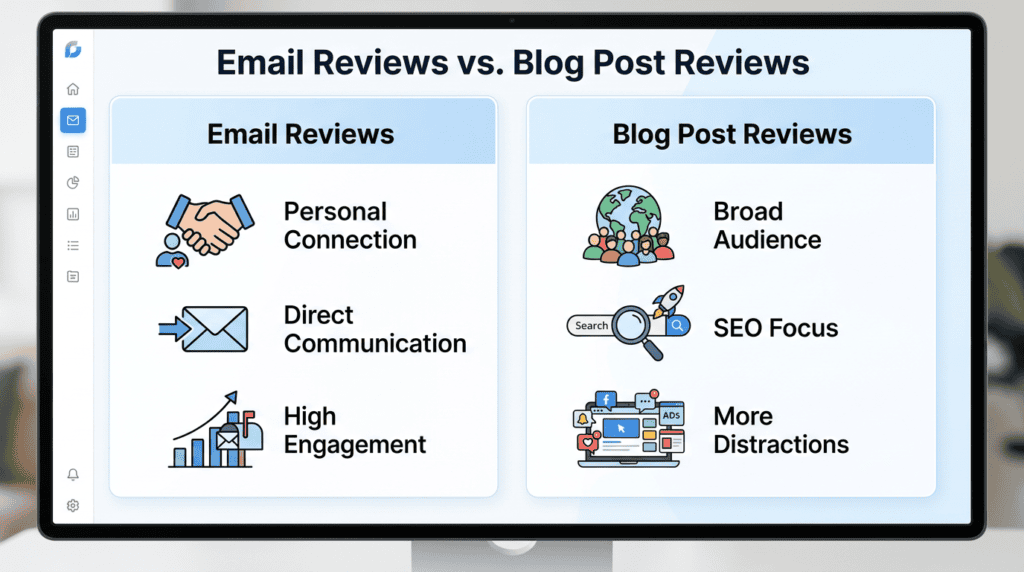
It’s a common mistake to simply copy-paste blog content into an email. While blog posts aim to capture new traffic and educate a broad audience, email reviews target people who already know you. This fundamental difference means your affiliate email marketing strategy needs to be far more nuanced. You’re not just presenting information; you’re leveraging an existing relationship to make a recommendation. This is where the real power of writing affiliate reviews for email lies – in the pre-established rapport.
> Don’t treat your email list like a search engine. Subscribers expect a personal touch and genuine recommendations, not a rehashed article.
Leveraging the Power of Personal Connection and Trust
Your subscribers opted into your list because they trust your insights or value your content. This isn’t a cold audience; it’s a warm one, often actively seeking your guidance. When you deliver affiliate product reviews in emails, you’re tapping into this existing trust. People are more likely to act on a recommendation from someone they feel connected to, rather than a random website. This personal connection is your biggest asset for driving conversions and boosting sales. We’re not just selling products; we’re offering solutions through a trusted voice.
The Advantage of Direct, Uninterrupted Communication
Unlike a blog post, which competes with countless other tabs and distractions, an email lands directly in your subscriber’s inbox. When they open it, you have their undivided attention, at least for a moment. This direct line of communication allows you to tell a more focused story and guide them through your review without external noise. It’s a powerful opportunity to present your honest product reviews in newsletters and make a compelling case for why a specific product is right for them. This directness can significantly impact your affiliate sales.
Higher Engagement Rates: Clicks, Opens, and Conversions
Because of the personal connection and direct delivery, well-crafted affiliate product reviews in emails often see higher engagement. Your open rate and CTR (click-through rate) can climb when your subject lines promise value and your email copy delivers. When I started focusing on genuine problem-solving in my email reviews, rather than just listing features, I saw my click-through rates jump by over 30% on specific product promotions. This translates directly into more people visiting the product page and, ultimately, more commission for you. The goal isn’t just opens; it’s getting them to click those affiliate links and convert.
Segmenting Your Audience for Hyper-Relevant Recommendations
One of the most powerful aspects of email marketing is the ability to segment your audience. You wouldn’t recommend a beginner’s tool to an advanced user, or a high-ticket item to someone who’s only ever engaged with free content. By segmenting your email list for affiliate offers, you can send highly relevant affiliate product reviews in emails to the right people at the right time. This personalization drastically increases the likelihood of conversions because you’re addressing specific needs and pain points, making your recommendations feel tailor-made.
The 7-Part Anatomy of a High-Converting Affiliate Review Email
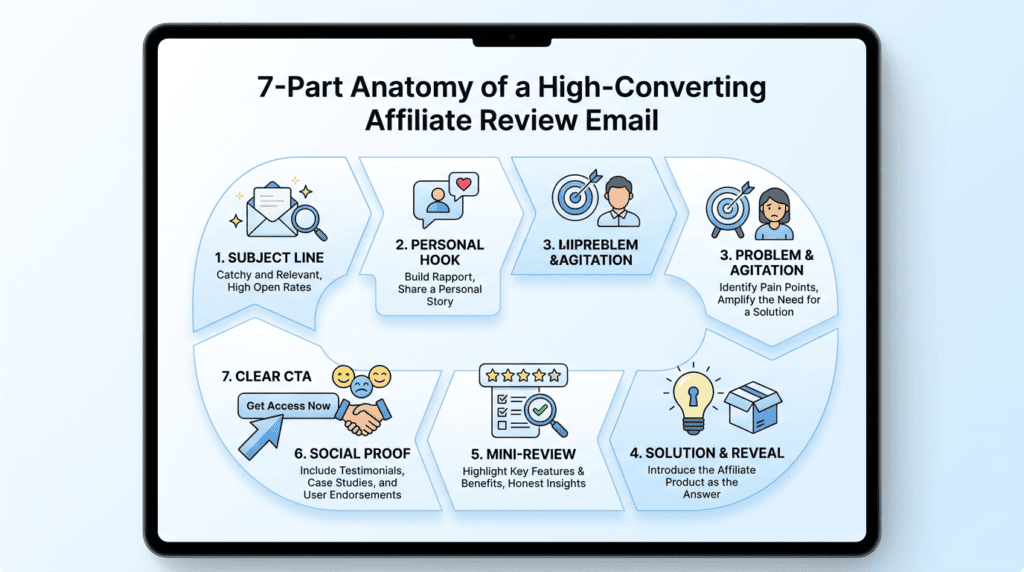
Crafting effective affiliate product reviews in emails means understanding each piece of the puzzle. It’s not just about listing features; it’s about guiding your subscribers through a narrative that resonates with their needs and builds trust. This section will break down the essential components of an effective review email, from subject line to P.S.
1. The Subject Line: Sparking Curiosity Without Sounding Like Spam
The subject line is your email’s gatekeeper. Its job is to get the email opened, not to sell the product. You want to pique curiosity without resorting to clickbait or sounding like a generic sales pitch. The goal is to make your subscribers feel like they’re about to read a personal recommendation from a trusted source, not just another promotion.
- *Examples: “My honest take on [Product Name],” “Is [Product Name] worth it? A quick review,” “The tool that changed my [process/workflow]”*
Notice how these examples hint at a personal experience or a solution to a common problem. “My honest take” immediately signals authenticity, which is crucial for building trust. “Is [Product Name] worth it?” directly addresses a common question and invites the reader to find the answer within your email. The “tool that changed my [process/workflow]” example focuses on a tangible benefit, hinting at a transformation without giving away all the details. We’ve seen subject lines like “The $49 tool that saved me 10 hours a week” consistently outperform generic ones, leading to higher open rates and more clicks.
2. The Personal Hook: Connecting the Product to Your Own Story
Once the email is open, your first few sentences need to immediately connect with the reader. This is where your personal story comes in. Briefly share your own experience with the problem the product solves. This isn’t about the product yet; it’s about establishing common ground and demonstrating that you understand your audience’s struggles. This personal touch is key to making your affiliate product reviews in emails feel authentic.
3. The Problem & Agitation: Highlighting the Pain Point the Product Solves
After your personal hook, clearly articulate the specific problem or challenge your audience faces. Don’t just state the problem; agitate it slightly. Describe the frustration, the time wasted, or the missed opportunities caused by this issue. This step helps your subscribers recognize themselves in your email and makes them more receptive to a solution. The more deeply you can articulate their pain, the more they’ll value your eventual recommendation.
4. The Solution & Reveal: Introducing the Affiliate Product
Now, and only now, introduce the affiliate product as the solution to the problem you’ve just highlighted. Frame it as something you discovered or started using to overcome that specific challenge. This isn’t a hard sell; it’s a natural progression from problem to solution, positioning the product as a helpful tool rather than just another item for promotion.
5. The Mini-Review: Focusing on 2-3 Key Outcomes & Benefits
- *Note: This isn’t a full blog post; focus on the most impactful results.*
This is the core of your affiliate product review within the email. Instead of listing every feature, focus on 2-3 key outcomes or benefits that directly address the problem you discussed. What specific results did you achieve? How did it make your life or business better? Use concise, benefit-driven language. For instance, instead of “It has a project management feature,” say “It helped me organize client tasks, cutting my project delivery time by 15%.” This keeps the email digestible and impactful, driving interest without overwhelming the reader.
> Tactical Takeaway: For email reviews, always prioritize tangible benefits and results over a comprehensive list of features. Your subscribers care about what the product *does for them*, not just what it *is*.
6. The Social Proof & Authenticity: Proving It’s Not Just You
To further build trust and overcome skepticism, briefly include a form of social proof. This could be a quick mention of how others in your community have benefited, a statistic if available, or even just reinforcing that your experience isn’t unique. This adds weight to your recommendation and shows that the product’s value extends beyond your personal use case. It reinforces the idea that this is a valuable recommendation, not just a personal opinion.
7. The Clear Call-to-Action (CTA): Guiding the Next Step
Every affiliate review email needs a clear, singular call-to-action. What do you want your subscribers to do next? Typically, this is to click your affiliate link to learn more, watch a demo, or make a purchase. Make your CTA prominent and easy to find. Use action-oriented language and consider repeating it once or twice in the email, perhaps after the mini-review and again at the end. Ensure your links are clearly visible and tell the reader exactly what to expect when they click.
From Blank Page to Sent: A Step-by-Step Writing Workflow
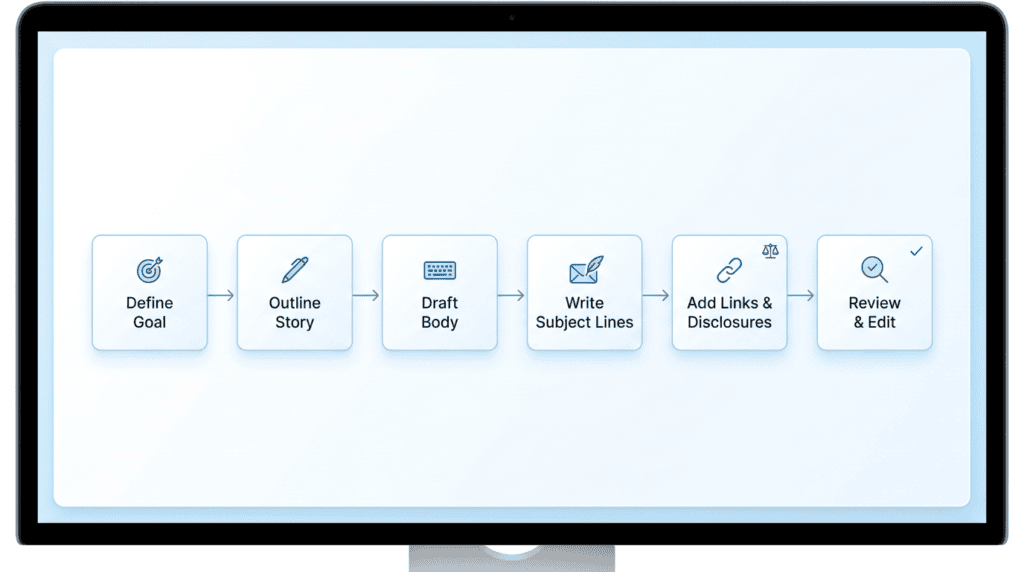
Writing affiliate product reviews in emails doesn’t have to be a daunting task. By following a structured workflow, you can consistently produce high-converting emails that resonate with your audience and drive sales. This practical, repeatable process helps you move efficiently from an idea to a sent campaign.
Step 1: Define the Single Goal of Your Email
Before you write a single word, clarify the primary objective of this specific email. Is it to drive immediate sales for a flash discount? Is it to educate subscribers about a new tool and warm them up for a future promotion? Or is it simply to build awareness and trust around a product you love? Having a single, clear goal will dictate your tone, content, and call-to-action, ensuring every element of your email works towards that one purpose. Without this clarity, your email can become unfocused and ineffective.
Step 2: Outline Your Personal Story or Use Case
Think about your own journey with the product. What problem did you face? How did you discover the solution? What was your “aha!” moment? Jot down a few bullet points that capture this narrative. This outline will serve as the backbone for your personal hook and problem/agitation sections, making your affiliate product reviews in emails feel authentic and relatable. I often find it helpful to think about the specific metric or workflow improvement I experienced. For example, when I first started using a particular AI writing tool, I outlined how it cut my content creation time by 30% for certain tasks, which became a core part of my story.
Step 3: Draft the Body Copy Following the 7-Part Anatomy
With your goal and story outlined, start drafting the email body. Follow the 7-part anatomy we just discussed, moving sequentially from the personal hook through to the CTA. Focus on getting your thoughts down, emphasizing benefits and outcomes. Don’t worry about perfection at this stage; just get the core message across. This structured approach ensures you hit all the necessary points for a compelling review.
Step 4: Write at Least 5 Subject Line Variations for Testing
Never settle for your first subject line idea. Write at least five distinct variations. Experiment with different angles: curiosity-driven, benefit-driven, question-based, or even a direct statement. This practice is crucial for optimizing your open rates. You can then A/B test these variations with a small segment of your audience to see which performs best before sending to your entire list.
Step 5: Add Your Affiliate Links (and Disclosures!) Correctly
This step is critical for both conversions and compliance. Insert your affiliate links naturally within the email where appropriate, typically on the product name, a “learn more” phrase, and within your CTA. More importantly, always include a clear and conspicuous disclosure that you may earn a commission if they purchase through your link. This builds immense trust and is often a legal requirement.
> Critical Warning: Failing to disclose affiliate relationships can severely damage your audience’s trust and lead to legal issues. Always make your disclosure clear, concise, and easy to spot.
Step 6: Review and Edit for Tone, Clarity, and Compliance
Before hitting send, meticulously review your email. Check for:
- Tone: Does it sound like you? Is it helpful and trustworthy?
- Clarity: Is the message easy to understand? Are there any confusing sentences?
- Readability: Are sentences varied in length? Is there enough white space?
- Compliance: Is your affiliate disclosure present and clear? Are all links working correctly?
Read it aloud to catch awkward phrasing. A polished email reflects professionalism and attention to detail, reinforcing your authority and trustworthiness.
Email Review Examples: How Different Creators Drive Sales
Understanding the theory is one thing; seeing it in action is another. These scenarios illustrate how different types of creators can adapt the principles of writing affiliate product reviews in emails to their specific niche and audience, driving conversions through tailored messaging.
Scenario 1: The Blogger Reviewing a Keyword Research Tool
A blogger focused on SEO and content marketing has an email list of aspiring writers and small business owners. They want to promote a specific keyword research tool.
Their email might start with a personal anecdote about struggling to find profitable keywords in the past, leading to wasted content efforts. They’d agitate the pain point of low organic traffic and content that doesn’t rank. The tool would be introduced as their “secret weapon” for uncovering hidden keyword gems. The mini-review would focus on 2-3 key benefits: how it helps identify low-competition keywords, analyze competitor strategies, and track ranking progress. The CTA would invite subscribers to try the tool for themselves, perhaps with a special trial link. This approach directly addresses the core needs of their audience, making the recommendation highly relevant.
Scenario 2: The YouTuber Reviewing Camera Gear
A YouTuber specializing in videography tutorials has an audience interested in improving their video quality. They’re reviewing a new mirrorless camera.
Their email would open with a story about their own journey from using basic equipment to needing professional-grade gear for their growing channel. They’d highlight the frustration of blurry footage, poor low-light performance, or limited creative control. The camera would be presented as the solution that elevated their production value. The mini-review would focus on its exceptional autofocus, superior image stabilization, and user-friendly interface for video creators. They might include a link to a specific video review on their channel for visual proof, followed by an affiliate link to purchase the camera. This leverages their visual expertise and existing content.
Scenario 3: The Business Coach Reviewing a CRM Software
A business coach with an email list of entrepreneurs and small business owners wants to promote a Customer Relationship Management (CRM) software.
The email would begin with the coach’s personal experience of juggling client communications, follow-ups, and sales pipelines manually, leading to missed opportunities and overwhelm. They’d agitate the problem of disorganized client data and lost leads. The CRM would be introduced as the system that brought order to their client management. The mini-review would emphasize how it streamlines client communication, automates follow-ups, and provides clear sales pipeline visibility, leading to increased client retention and sales. The CTA would encourage a free trial or a demo, positioning the software as an essential tool for scaling their business.
Scenario 4: The Health & Wellness Creator Reviewing a Supplement
A health and wellness creator, perhaps focusing on fitness or nutrition, wants to review a specific protein powder.
Their email might start with a personal story about struggling to meet their protein goals or finding a supplement that tastes good and doesn’t cause digestive issues. They’d agitate the common problems of inadequate nutrition for muscle recovery or the frustration of chalky, unpalatable supplements. The protein powder would be introduced as their go-to solution.
The mini-review would highlight its clean ingredients, excellent taste, and how it supports their recovery and energy levels without bloating. The CTA would link directly to the product page, perhaps with a discount code, emphasizing how it fits into a healthy lifestyle. We’ve found that for physical products, showing how it integrates into daily life, like “I mix this into my morning smoothie every day,” significantly boosts engagement and clicks.
Balancing Authenticity and Sales: How to Write Reviews That Don’t Alienate Your List

Selling through email is a privilege, not a right. Your subscribers have given you permission to enter their inbox, and abusing that trust with overly aggressive or disingenuous promotions can quickly lead to unsubscribes and a damaged reputation. The key to successful affiliate marketing in emails is finding the sweet spot where you provide genuine value while still driving sales.
The “Help, Don’t Hype” Philosophy
When you approach your email marketing with a “help, don’t hype” mindset, you naturally build a stronger connection with your audience. Instead of just listing features, focus on how a product genuinely solves a problem or improves a situation for your readers. This value-first affiliate email marketing strategy ensures your recommendations feel like a service, not a sales pitch. I’ve found that when I genuinely believe in a product and can articulate its real-world benefits, my conversion rates naturally climb because my audience trusts my judgment. This approach is crucial for writing affiliate reviews for email that resonate.
Disclosing Your Affiliate Relationship Without Killing the Vibe
Transparency isn’t just a legal requirement; it’s a trust-builder. Hiding your affiliate disclosure or making it hard to find will erode credibility faster than almost anything else. The goal is to disclose clearly and concisely without making it sound like an apology. A simple line at the top or bottom of your email, or even integrated naturally within the copy, works best.
> Always include a clear, unambiguous affiliate disclosure in every email containing affiliate links. This isn’t optional; it’s a legal and ethical necessity that protects both you and your audience’s trust.
You can say something like, “Full disclosure: I’m an affiliate for [Product Name], so if you purchase through my link, I’ll earn a small commission at no extra cost to you.” This honest product reviews approach reinforces your integrity.
Mentioning a Flaw or Limitation to Build Credibility
No product is perfect, and your audience knows that. When you’re writing high-converting product reviews, acknowledging a minor drawback or limitation can actually boost your credibility significantly. It shows you’ve thoroughly tested the product and aren’t just blindly promoting it. For example, if a tool is powerful but has a steep learning curve, mention it. Then, offer a solution or context, like “While it takes a bit of time to master, the results are absolutely worth the initial effort.” This nuanced perspective helps overcome subscriber skepticism in emails and builds deeper trust.
Focusing on the Reader’s Transformation, Not Just Product Features
Your subscribers aren’t buying a product; they’re buying a better version of themselves or a solution to a pressing problem. When crafting compelling product recommendations, shift your focus from what the product *is* to what it *does* for the user. Instead of saying, “This software has 50 templates,” say, “This software helps you create stunning designs in minutes, even if you’re not a graphic designer, saving you hours each week.” This storytelling in affiliate email copy helps your audience visualize the positive outcome, making the offer far more appealing and driving higher sales.
Common Mistakes to Avoid When Sending Affiliate Reviews via Email
Even experienced marketers can fall into traps when promoting affiliate products via email. Avoiding these common missteps is just as important as implementing best practices. These mistakes can quickly diminish your open rate, click-through rate (CTR), and ultimately, your affiliate commissions.
Mistake 1: The “Feature Dump” Email That Reads Like a Brochure
One of the quickest ways to lose your audience’s attention is to send an email that simply lists every feature of a product. This isn’t email copywriting for affiliate sales; it’s a spec sheet. Your subscribers are busy, and they don’t want to wade through technical jargon. Instead, focus on the 2-3 most impactful benefits and how they directly address your audience’s pain points. I once received an email that was literally a bulleted list of software features, and it felt so impersonal and unhelpful that I immediately archived it. Prioritize the “why” and the “what’s in it for them” over an exhaustive list of product capabilities.
Mistake 2: Using Generic, Soulless Swipe Copy from the Vendor
Vendors often provide swipe copy to help affiliates promote their products. While these can be a starting point, simply copying and pasting them into your emails is a huge mistake. This generic content lacks your unique voice, personal experience, and the specific context of your relationship with your audience. It screams “sales pitch” rather than “trusted recommendation.” Always rewrite swipe copy in your own words, injecting your personality and specific use cases. This personalization in affiliate email campaigns is vital for building trust and engaging email subscribers with reviews.
Mistake 3: Hiding the Affiliate Disclosure or Making It Unclear
As mentioned earlier, transparency is non-negotiable. Attempting to hide your affiliate link disclosure in emails, using tiny font, or burying it at the very bottom of a long email is not only unethical but can also lead to legal issues. More importantly, it destroys the trust you’ve worked hard to build. Make your disclosure clear, easy to read, and prominent enough that subscribers can’t miss it. This adherence to compliance guidelines for affiliate emails is critical for long-term success.
Mistake 4: Creating a Sense of False Urgency or Scarcity
While creating urgency in affiliate emails can be an effective tactic, it must be genuine. Fabricating deadlines or claiming limited stock when it’s not true will quickly backfire. Your audience will catch on, and your credibility will suffer irreparable damage. Only use urgency or scarcity when there’s a legitimate reason, such as a time-limited discount from the vendor or a bonus you’re offering for a specific period. Authenticity always wins over manipulation.
Mistake 5: Sending the Same Review to Your Entire, Unsegmented List
Not all your subscribers are interested in the same products. Sending a review for a high-end camera to someone who only reads your posts about budget smartphone photography is a waste of an email and can lead to unsubscribes. This is where segmentation comes in. Segmenting email list for affiliate offers allows you to send highly relevant content to specific groups of subscribers who are most likely to be interested. For example, if you have a segment interested in AI writing tools, send them reviews of NeuronWriter or Jasper. This targeted approach significantly boosts your increase affiliate email click-through rate and overall conversions.
Advanced Tactics: Using Email Sequences for More Complex Affiliate Promotions
While a single, well-crafted email can drive sales, some affiliate products benefit from a more extended, strategic approach. Email sequences allow you to build a stronger case, address objections, and nurture your leads more effectively, ultimately leading to higher affiliate sales.
The “Problem-Agitate-Solve” 3-Part Sequence
This classic copywriting framework works incredibly well for affiliate product reviews in emails.
- Email 1 (Problem): Focuses entirely on a specific pain point your audience experiences. No product mention yet, just empathy and validation of their struggle.
- Email 2 (Agitate): Deepens the understanding of the problem, explaining the negative consequences of not solving it. This builds tension and desire for a solution.
- Email 3 (Solve): Introduces your affiliate product as the ideal solution to the problem discussed in the previous emails. This is where your main review email fits in, highlighting how the product delivers the transformation.
This email sequence for product reviews allows you to warm up your audience and make the product introduction feel like a natural, welcome solution rather than an abrupt sales pitch.
Integrating a Review Email into Your Welcome or Nurture Sequence
Don’t wait for a special promotion to send affiliate product reviews. Strategically integrate them into your existing automated sequences. For instance, after a new subscriber has been through your initial welcome series and received some valuable free content, you might introduce a tool that complements what you’ve been teaching. This is a powerful way of monetizing email list with reviews, as new subscribers are often highly engaged and looking for solutions. I often include a recommendation for a foundational tool, like an email service provider or a website builder, within the first few weeks of my nurture sequence, as it’s directly relevant to their journey.
Using Case Study Emails to Support Your Main Review
For higher-ticket items or more complex software, a single review email might not be enough to convince skeptical buyers. This is where case study emails shine. These emails can detail how you (or someone you know) used the product to achieve specific, measurable results. They provide powerful social proof and concrete evidence of the product’s effectiveness. A case study email can be sent *before* your main review to build anticipation, or *after* to reinforce the value and address lingering doubts. It’s an excellent way of building trust with email subscribers by showing, not just telling.
Following Up with a Q&A or “Last Chance” Email
After your main review email, it’s often beneficial to send follow-up emails. A Q&A email can address common questions or objections you anticipate your audience might have, further solidifying the product’s value. You can even invite subscribers to reply with their questions, making the campaign interactive. If there’s a genuine deadline for a discount or bonus, a “last chance” email can be highly effective for creating urgency in affiliate emails and driving final conversions. Remember, these should be genuine deadlines, not fabricated ones, to maintain your long-term credibility.
Final Recommendation: Your Go-To Framework for Writing Affiliate Emails

This section summarizes the key takeaways into a final, actionable recommendation. The most effective affiliate review emails are not sales pitches; they are powerful case studies delivered personally. Start with a genuine problem you faced, explain how the product provided a specific solution, and focus on the transformation it enabled. Always prioritize your audience’s trust over a quick commission. By rooting your review in an authentic story and providing clear value, you create an asset that serves your audience and drives revenue naturally.
For those with an established, engaged email list, especially in niches like digital marketing, software, or online business, writing affiliate product reviews in emails is a powerful strategy. This approach works best for creators who are willing to genuinely use and evaluate products, then share their honest experiences. If your goal is to build long-term trust and foster a loyal audience while monetizing your expertise, this framework for crafting compelling affiliate emails is for you.
However, if you’re looking for quick, high-volume sales without investing in authentic reviews or building a relationship with your subscribers, this strategy won’t serve you well. Similarly, if your email list is cold or unsegmented, simply sending out product reviews will likely lead to low open rates and minimal conversions, potentially damaging your list health. The cost of inaction here isn’t just lost commission; it’s the missed opportunity to cultivate a highly responsive audience that trusts your recommendations for years to come.
> Authenticity in your affiliate product reviews in emails is your most valuable asset for sustainable conversions and sales.
I’ve personally seen how a single, well-crafted email review, born from genuine experience, can outperform dozens of generic promotions.
Frequently Asked Questions (FAQs)
How often can I send affiliate product reviews to my email list?
The ideal frequency for sending affiliate product reviews to your email list depends heavily on your audience’s engagement and your overall email marketing strategy. Aim for a balance that provides value without overwhelming subscribers; many successful marketers find that one to two dedicated review emails per week, interspersed with other valuable content, works well.
Do I need to include an affiliate disclosure in every single email?
Yes, you absolutely need to include a clear affiliate disclosure in every single email that contains affiliate links, as it’s a legal and ethical requirement. This builds trust with your audience and ensures compliance, often placed near the top or bottom of the email in a noticeable but unobtrusive way.
What’s the best way to track clicks and conversions from my emails?
The best way to track clicks and conversions from your affiliate product reviews in emails is by using UTM parameters on your affiliate links, combined with your email service provider’s analytics and the affiliate program’s own tracking dashboard. This comprehensive approach allows you to see exactly which email campaigns are driving the most sales and commission.
Can I review a product I got for free?
Yes, you can review a product you received for free, but it’s crucial to disclose that fact transparently in your affiliate product reviews in emails. Honesty about how you acquired the product further enhances your credibility and helps build trust with your audience.
What if a product I recommended changes or is no longer good?
If a product you’ve recommended changes or is no longer good, it’s essential to address it transparently with your audience. Send an update email explaining the changes, offering alternatives, or even retracting your recommendation if necessary; maintaining trust is more important than any single commission.
Should my affiliate review email link to a blog post or directly to the sales page?
Whether your affiliate review email should link to a blog post or directly to the sales page depends on your specific goal and the complexity of the product. For simpler products or when your email copy is highly persuasive, a direct link can drive quick conversions, while linking to a detailed blog post allows for more in-depth information and can capture organic search traffic.