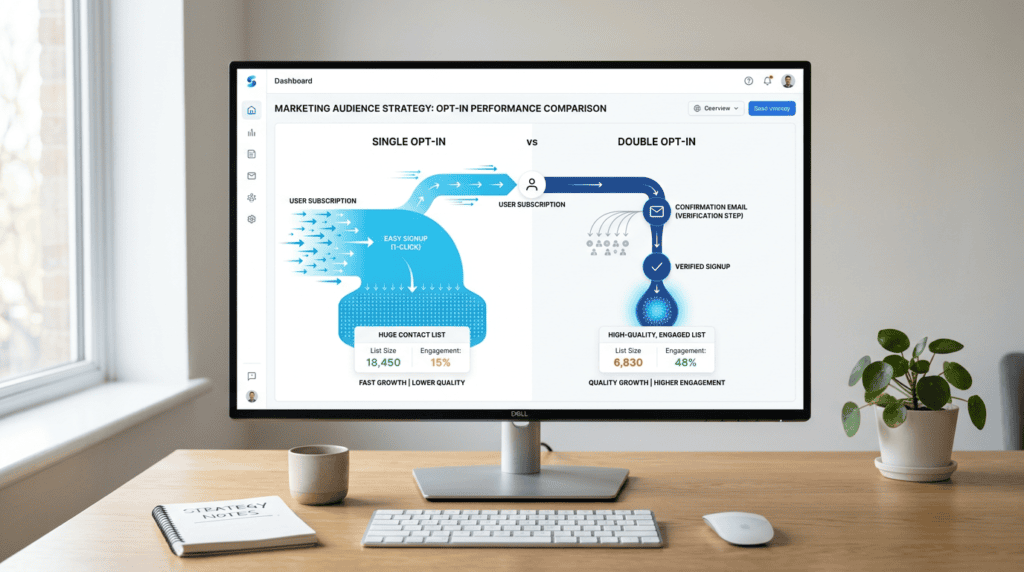
Choosing the wrong opt-in method costs you money. Many businesses overlook a critical decision when building their email list: whether to use double opt-in vs single opt-in. This choice isn’t just a technical detail; it directly impacts your list’s quality, your email deliverability, and ultimately, your marketing ROI. Ignoring this decision or defaulting to the easiest option can lead to wasted ad spend, low engagement, and a perpetually underperforming email list.
This guide directly compares double opt-in and single opt-in to help you decide which email list-building strategy is right for your business. We’ll move beyond simple definitions to explore the real-world impact on list growth, email deliverability, engagement rates, and long-term list quality, so you can make an informed choice.
Quick Verdict: Which Opt-In Method Should You Choose?
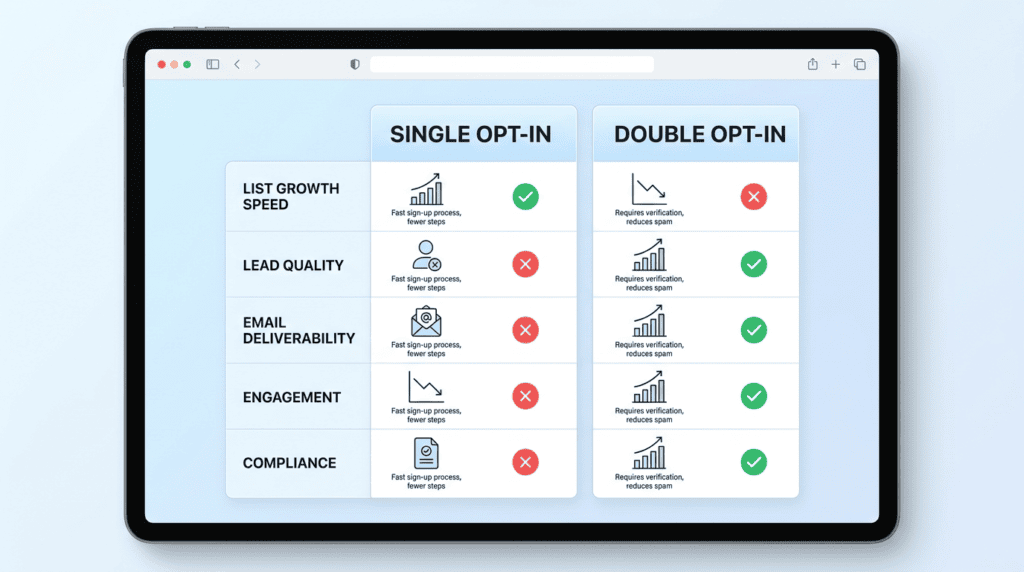
Deciding between double opt-in and single opt-in isn’t about finding a universally “better” option, but rather the *right* option for your specific business goals. I’ve seen countless businesses struggle with high bounce rates or low email open rates because they didn’t align their opt-in strategy with their desired subscriber quality. For example, a client once switched from single opt-in to double opt-in and, despite a temporary dip in raw signup numbers, saw their email campaign performance metrics like clicks and conversion rate jump by over 30% within three months. This happened because they started attracting genuinely interested subscribers rather than just collecting email addresses.
> Critical Warning: Don’t just pick the method that promises the fastest list growth. Prioritize list quality and email deliverability rates above all else for sustainable marketing growth.
Complete Verdict Table
| Factor | Single Opt-In | Double Opt-In | Winner |
|---|---|---|---|
| List Growth Speed | Faster, frictionless sign-up | Slower, requires confirmation | Single Opt-In |
| Lead Quality | Lower, risk of typos & spam | Higher, verified & engaged leads | Double Opt-In |
| Email Deliverability | Lower, higher bounce & spam rates | Higher, protects sender reputation | Double Opt-In |
| Initial Engagement | Lower, no immediate action required | Higher, first interaction is a click | Double Opt-In |
| GDPR/Compliance | Compliant, but harder to prove | Stronger proof of explicit consent | Double Opt-In |
| Ease of Setup | Easiest, often the default | Requires an extra confirmation email | Single Opt-In |
Best For
- Single Opt-In: Situations where rapid list growth is the primary goal, such as at in-person events, for lead magnets with broad appeal, or in low-risk industries. This method is ideal if you’re prioritizing volume and are prepared to regularly clean email database entries to manage fake email addresses and high bounce rates.
- Double Opt-In: Businesses focused on long-term value, high-quality leads, protecting email deliverability, and building a highly engaged community. This is essential for industries with strict compliance needs, like those under GDPR compliance standards, where proving explicit consent is crucial. It helps prevent spam trap protection issues and maintains a strong sender reputation score.
Bottom Line
Choose Single Opt-In for maximum list growth velocity, accepting the trade-off of lower lead quality and higher list churn. This approach can bring in a lot of traffic to your signup form, but you’ll need robust email verification tool processes in place to manage the inevitable influx of fake email addresses and bots. While it feels faster upfront, the ongoing work of email list hygiene can be substantial, impacting your email marketing list health.
Choose Double Opt-In for a healthier, more engaged, and more profitable email list over the long term. While the double opt-in process adds an extra step (the confirmation email link), it acts as a powerful filter, ensuring that only genuinely interested subscribers join your audience. This leads to better email open rates, higher clicks, and ultimately, improved conversion rate optimization. For most businesses, the benefits of Double Opt-In – especially in terms of email deliverability rates and subscriber lifetime value – outweigh the initial friction of a slightly slower subscriber list growth. It’s a strategic investment in the quality of your marketing database.
Understanding the Core Mechanics: How Each Opt-In Process Works
Before diving into the deeper implications, it’s helpful to understand the fundamental steps involved in each opt-in method. This isn’t just about a single click; it’s about the entire user journey from signup form to becoming an active subscriber on your email marketing list.
The Single Opt-In (SOI) Workflow Explained
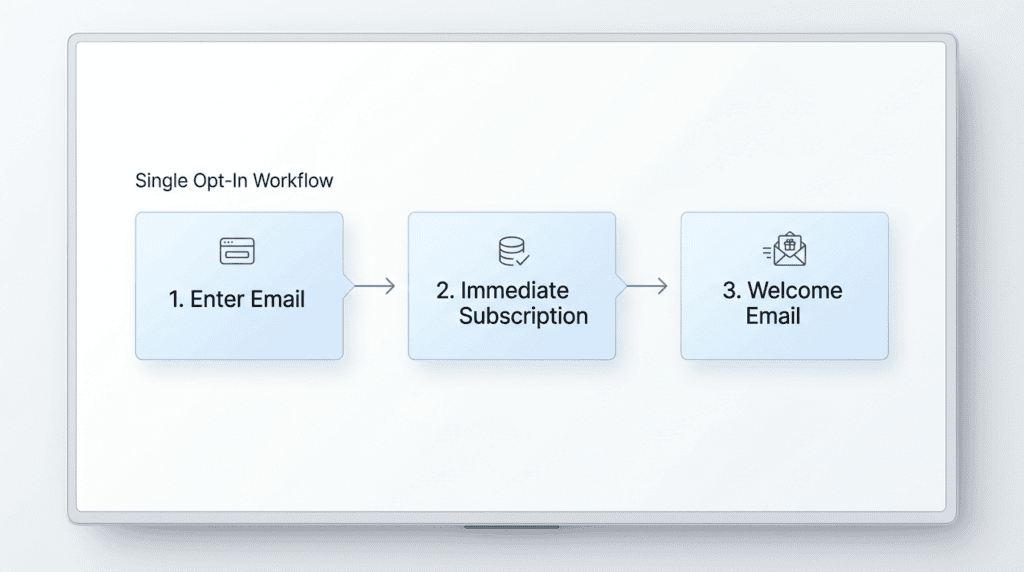
The single opt-in process is straightforward and designed for minimal friction. It’s often the default setting in many email service provider (ESP) platforms due to its simplicity.
- Step 1: A user enters their email address into a sign-up form on your website, landing page, or pop-up.
- Step 2: They are immediately added to your email list and typically receive an automated welcome email or access to a lead magnet.
> The key takeaway here is its one-step, frictionless process. There’s no additional action required from the user to join your list. This direct approach can feel very user-friendly.
The Double Opt-In (DOI) Workflow Explained
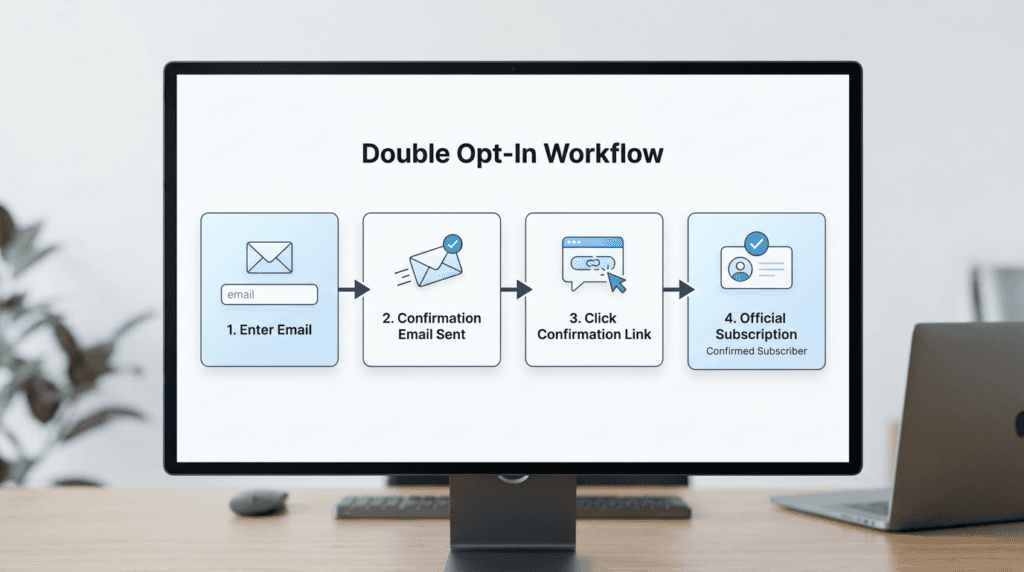
The double opt-in process adds an extra layer of verification, ensuring that the subscriber truly intends to join your list and that their email address is valid. This extra step is crucial for email list hygiene and compliance.
- Step 1: A user enters their email address into a sign-up form.
- Step 2: They immediately receive an automated confirmation email asking them to verify their address. This email contains a unique confirmation link.
- Step 3: The user clicks the confirmation link in the email.
- Step 4: Only after clicking the link are they officially added to your email list and receive your welcome sequence or lead magnet.
> The key takeaway is its two-step process that requires explicit confirmation. This additional verification step is what differentiates it significantly from single opt-in. When I first started building my niche sites, I found setting up the confirmation email and welcome sequence for DOI took a bit more thought in my ESP, but the peace of mind it offered was worth it.
The Impact on List Growth: Speed vs. Quality
The choice between single and double opt-in directly influences how quickly your email list grows and, more importantly, the quality of the subscribers you acquire. It’s a classic trade-off that every lead generation strategy must consider.
Why Single Opt-In Grows Your List Faster
Single opt-in is undeniably the faster route for subscriber list growth. Its primary advantage lies in removing any barriers between a user expressing interest and becoming a subscriber.
- Frictionless Subscriber Experience: With no extra steps, the initial conversion rate on your sign-up form tends to be higher. Users don’t need to check their inbox or take a second action, which can be a significant hurdle for some. This ease of use often translates to a larger volume of initial sign-ups.
- Capturing “Low Intent” Leads: SOI gathers emails from users who might be casually interested but not motivated enough to complete a second step. This can be beneficial for broad marketing campaigns where the goal is sheer volume.
The hidden cost of this speed, however, is often overlooked. While your list count might look impressive, this velocity can lead to list bloat, where your database contains a significant number of typos, fake email addresses, or even spam bots. These low-quality entries require more aggressive list hygiene later on, which can be time-consuming and costly. You’re essentially trading immediate list size for potential long-term issues with email deliverability rates and engagement.
How Double Opt-In Prioritizes Quality Over Quantity
Double opt-in, by its very nature, acts as a filter, ensuring a higher standard of subscriber quality. This method focuses on building a robust and engaged audience rather than just accumulating email addresses.
- The Confirmation “Filter”: The extra step of clicking a confirmation link effectively weeds out unengaged subscribers, spam bots, and incorrect email addresses from the start. If someone isn’t willing to take that second action, they likely weren’t genuinely interested in your content or offers anyway. This proactive approach prevents fake emails from ever entering your primary database.
- Building a List of Active Subscribers: A confirmed subscriber is, by definition, an engaged one. They’ve proven they can receive and open your emails, and they’ve actively chosen to join your list. This leads to a clean email database filled with individuals more likely to interact with your email campaigns.
Real-world data consistently shows a drop-off at the confirmation step; industry benchmarks often report a 20-30% drop-off in sign-ups between the initial form submission and the final confirmation. While this means slower subscriber list growth, the resulting list boasts significantly higher engagement metrics and better conversion rates over the long term. This is because you’re building a list of truly interested individuals, which is invaluable for any permission-based marketing effort.
Deliverability and Sender Reputation: The Most Critical Factor
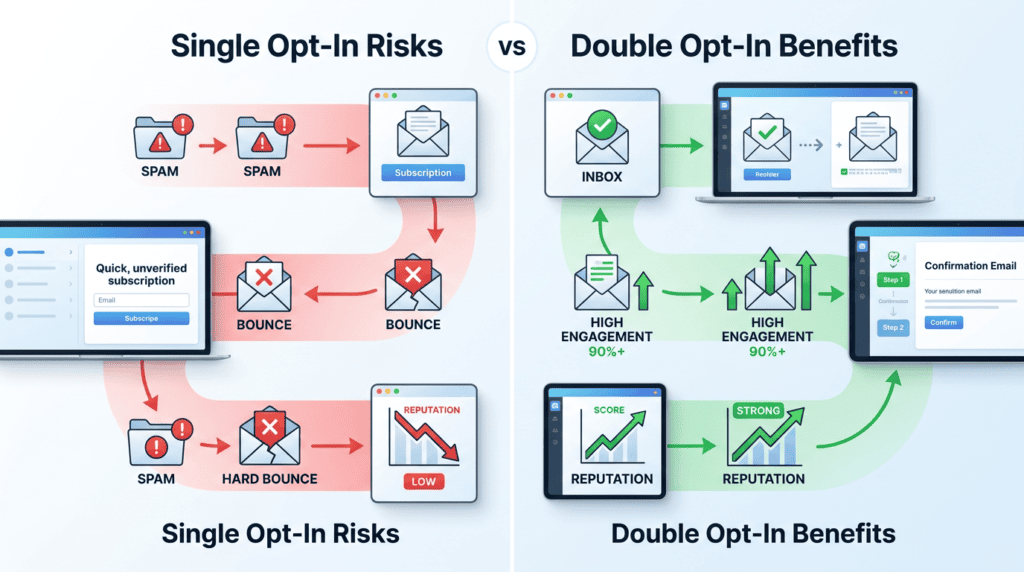
Beyond list size and quality, the impact on your email deliverability rates and sender reputation score is arguably the most critical factor when choosing an opt-in method. Your ability to land in the inbox directly affects the success of all your email marketing efforts.
How Single Opt-In Puts Your Sender Reputation at Risk
While single opt-in offers speed, it introduces several risks that can severely damage your sender reputation and, consequently, your email deliverability.
- Higher Hard Bounce Rates: When users submit typos or fake emails, these addresses result in hard bounces when you send emails. A high volume of hard bounces signals to Email Service Providers (ESPs) like Gmail, Outlook, and Yahoo that your list quality is poor. This can lead to your emails being flagged as spam or even blocked entirely.
- Increased Spam Complaints: Subscribers who didn’t genuinely intend to join your list, or who forgot they signed up, are far more likely to mark your emails as spam. A high spam complaint rate is a red flag for ESPs, indicating that your content might be unsolicited, regardless of your intentions.
- The Danger of Spam Traps: Single opt-in lists are more susceptible to collecting spam traps. These are inactive or fake email addresses used by ESPs to identify senders with poor list hygiene practices. Hitting a spam trap can severely damage your sender reputation, leading to widespread inbox placement issues or even getting your domain blacklisted. I once inherited an old single opt-in list for a client, and after a few campaigns, our email open rates plummeted. We discovered a high number of spam traps, which required a complete overhaul of their email list hygiene and a temporary reduction in sending volume to rebuild trust with ESPs.
Why Double Opt-In is the Gold Standard for Deliverability
Double opt-in is widely considered the best practice for maintaining excellent email deliverability and a strong sender reputation. It proactively addresses the issues that plague single opt-in lists.
- Virtually Eliminating Hard Bounces: The confirmation process ensures that the email address is valid and active before it ever joins your main list. If a user enters a typo, they won’t receive the confirmation email, and thus won’t be added. This drastically reduces your hard bounce rates, keeping your list clean and signaling good practices to ESPs.
- Lowering Spam Complaint Rates: Subscribers who have explicitly confirmed their interest are far less likely to report your emails as spam. They know they signed up and are expecting your communications, leading to a much healthier spam complaint rate. This active consent is a powerful indicator of a willing recipient.
- Proving Quality to ESPs: A clean, engaged list built through double opt-in is the number one signal to ESPs that you are a legitimate and responsible sender. This proactive validation of each subscriber improves your inbox placement and ensures your valuable content reaches its intended audience. It’s about building a contact list quality that ESPs can trust.
> For any serious email marketing strategy, especially those focused on long-term audience growth and conversion, prioritizing deliverability through double opt-in is non-negotiable. It protects your ability to communicate with your audience effectively.
Engagement Metrics: What the Data Really Shows
When we talk about the effectiveness of an email list, size isn’t the only metric that matters. In fact, it’s often a vanity metric. What truly counts is how engaged your subscribers are. This is where the differences between double opt-in vs single opt-in become very clear.
Analyzing Open and Click-Through Rates (CTR)
The initial action a double opt-in (DOI) subscriber takes is clicking a link to confirm their interest. This simple step sets a powerful precedent for future engagement. They’ve already proven they’re willing to take action. This translates directly into better email campaign performance.
- Initial Engagement Boost with DOI: Because DOI requires a user to actively click a confirmation link, they’re already demonstrating a higher level of intent. This first interaction often leads to better habits, meaning they’re more likely to open subsequent emails and click on your content.
- Long-Term Metrics: Data consistently shows that DOI lists boast significantly higher email open rates and click-through rate improvement compared to single opt-in (SOI) lists. While an SOI list might look bigger on paper, a DOI list is packed with genuinely interested individuals. You might see open rates 5-10% higher and CTRs that are 1-2% better, which adds up to a lot more traffic and potential sales over time.
- The “Vanity Metric” of List Size: A smaller, highly engaged DOI list is almost always more valuable and profitable than a large, unengaged SOI list. I’ve personally managed campaigns where a 5,000-person DOI list generated more revenue and had fewer spam complaints than a 20,000-person SOI list. It’s about quality, not just quantity.
> Tactical Takeaway: Don’t chase raw subscriber numbers if it means sacrificing engagement. A smaller, more active subscriber engagement base will always deliver better ROI for your marketing efforts.
The Effect on Subscriber Churn and Unsubscribe Rates
The method you choose for building email lists also has a direct impact on how long people stay on your list and how often they opt-out.
- SOI and Higher Churn: With SOI, it’s easier for unqualified leads, bots, or even accidental sign-ups to land on your list. These individuals are quicker to unsubscribe, mark your emails as spam, or simply become inactive. This leads to higher subscriber churn and unsubscribe rates, forcing you to constantly acquire new leads just to maintain your list size.
- DOI and Subscriber Loyalty: Engaged subscribers who made a conscious choice to join your list through a double opt-in process are far more likely to stay. They’ve invested a small amount of effort, which indicates a stronger interest in your content or offers. This leads to greater subscriber lifetime value and a more stable, loyal audience for your email marketing list.
Legal and Compliance Considerations (GDPR, CASL, etc.)
In today’s regulatory environment, privacy and consent are paramount. Your opt-in method comparison isn’t just about conversion; it’s about legal protection.
Is Single Opt-In Compliant?
The compliance landscape can be tricky, and single opt-in often sits in a gray area.
- The Gray Area: While SOI isn’t explicitly illegal under most regulations like GDPR (General Data Protection Regulation) or CASL (Canada’s Anti-Spam Legislation), it makes proving “explicit, unambiguous consent” much more difficult. These laws require clear evidence that a user willingly agreed to receive communications.
- The Burden of Proof: With SOI, if a subscriber complains or a regulatory body investigates, the burden is entirely on you to prove they opted in. This can be challenging without a clear verification step. You might have an IP address and a timestamp, but that’s often not enough to definitively show intent.
Why Double Opt-In is the Safest Bet for Compliance
For businesses serious about regulatory compliance laws and avoiding legal headaches, double opt-in is the clear winner.
- Creating an Audit Trail: The double opt-in process provides a timestamped, digital record of explicit consent. The user fills out the form, receives a confirmation email link, and then clicks it. This sequence creates an undeniable audit trail that proves they knowingly and willingly subscribed.
- Meeting the “Unambiguous” Standard: It’s the clearest way to demonstrate a user understood what they were signing up for and actively agreed to it. This meets the “unambiguous” standard required by many privacy regulations.
- Peace of Mind: Implementing DOI gives you significant peace of mind. You know your email database is built on solid, verifiable consent, reducing your legal risk and ensuring you’re aligned with global GDPR compliance standards. I’ve advised countless clients on this, and the ones who switch to DOI always express relief knowing they’re protected.
> Critical Warning: Relying solely on single opt-in for your email marketing list can expose you to significant legal risks and fines, especially if you operate in regions with strict data privacy laws.
Real-World Scenarios: When to Choose Single vs. Double Opt-In
Deciding between double opt-in vs single opt-in isn’t a one-size-fits-all choice. It depends heavily on your business model, goals, and risk tolerance.
When Single Opt-In Might Make Sense
There are specific, limited situations where the speed of single opt-in might outweigh its drawbacks, but always with caveats.
- Scenario 1: In-Person Events & Retail: If you’re collecting email addresses at a physical event, trade show, or retail store, asking for a later confirmation can be impractical and lead to a huge drop-off.
- Strategy: Follow up with an aggressive re-engagement campaign immediately. Send a welcome email that clearly states what they signed up for and offers an easy opt-out. Implement strict, automated list cleaning rules to remove inactive subscribers quickly.
- Scenario 2: Top-of-Funnel Lead Magnets: When your primary goal is mass awareness or to quickly capture a large volume of leads for a free resource (like an ebook or webinar), SOI can be faster.
- Strategy: Understand that many of these leads will be “low intent.” Your marketing automation workflow needs to be robust, designed to filter and nurture these leads, eventually pushing them towards a more engaged action. Implement strict, automated email list hygiene rules to remove fake email addresses and those with high bounce rates.
When Double Opt-In is Non-Negotiable
For most businesses focused on long-term growth, quality, and deliverability, double opt-in is the superior and often essential choice.
- Scenario 1: Ecommerce Businesses: Your email list is vital for transactional emails (order confirmations, shipping notices) and driving repeat purchases. Protecting email deliverability rates is crucial. A high-quality, engaged list ensures your important messages land in the inbox, not the spam folder.
- Scenario 2: Affiliate Marketers & Bloggers: For many in the MMO space, your email list is your most valuable asset. It’s your direct line to your audience. Protecting its quality and engagement directly impacts your income from promotions and product sales. A clean email database built with DOI ensures your sender reputation score stays high.
- Scenario 3: High-Value B2B Services: If you’re selling expensive software, consulting, or other B2B services, you need to attract qualified sales leads, not just fill a database. The double opt-in process acts as the first step in qualifying a prospect, ensuring they have genuine interest before you invest further resources in nurturing them. I always recommend DOI for my clients in this space because the subscriber acquisition cost is higher, and you can’t afford to waste resources on unengaged contacts.
How to Implement Your Chosen Strategy
Setting Up Single Opt-In with Your Email Marketing Service
When you’re ready to build your email list, you’ll find that most email marketing service providers (ESPs) like Mailchimp, ConvertKit, or ActiveCampaign often have single opt-in as the default setting for new signup forms. This means a user enters their email address, clicks submit, and they’re immediately added to your list. To confirm this, or to make sure you’re using SOI, you’ll typically look within your ESP’s list settings or form settings. It’s usually a straightforward checkbox or radio button option labeled something like “Enable double opt-in” – if it’s unchecked, you’re running single opt-in.
Setting Up Double Opt-In and Optimizing Your Confirmation Email
To enable double opt-in, you’ll usually find a clear option to turn it on within the same list settings or form settings area of your email service provider. Once enabled, the next critical step is to optimize your confirmation email. This isn’t just a formality; it’s your first real interaction with a potentially high-quality subscriber.
Here are some best practices for your confirmation email:
- Use a clear, action-oriented subject line. Something like “Action Required: Confirm Your Subscription to [Your Brand]” or “Please Confirm Your Email Address to Get Started.” This sets the right expectation.
- Reinforce the value of subscribing. Remind them what they signed up for and what benefits they’ll receive. Briefly mention the great content, exclusive offers, or lead magnet they’re waiting for.
- Make the confirmation button large and obvious. The primary goal of this email is a click. Use a prominent, clear call-to-action button that says “Confirm My Subscription” or “Yes, I Want These Emails.”
- Tell them exactly what to expect next. After they click the confirmation link, what happens? Will they be redirected to a thank-you page? Will their welcome email arrive immediately? Clarity improves the user experience and reduces friction.
Final Recommendation: The Verdict for Long-Term Success

For the vast majority of online businesses, the long-term benefits of Double Opt-In – higher engagement, superior deliverability, and a more valuable list – far outweigh the short-term appeal of faster list growth from Single Opt-In.
While Single Opt-In has niche applications, such as at in-person events where immediate capture is key, the risks to your sender reputation and the cost of managing a low-quality list make it a poor choice for building a sustainable, profitable email marketing channel. Start with Double Opt-In. It builds a healthier foundation for your business from day one.
> Choose Double Opt-In if you value a high-quality, engaged audience and want to protect your email deliverability and long-term business growth.
If you opt for Single Opt-In for the sake of speed, you’re essentially trading immediate list size for future headaches. You’ll likely face higher bounce rates, more spam complaints, and a constant battle with list hygiene, all of which can significantly impact your email campaign performance and ultimately, your bottom line. I’ve seen too many businesses chase vanity metrics only to realize they’re paying for a database full of unengaged contacts. Prioritizing quality over quantity with double opt-in is a strategic move that pays dividends.
Frequently Asked Questions (FAQ)
Can I switch from single opt-in to double opt-in?
Yes, you can and should. You can enable double opt-in for all new subscribers moving forward. For your existing list, you can run a re-engagement or re-confirmation campaign to clean your list and verify consent.
Does double opt-in hurt conversion rates?
It reduces the initial sign-up-to-subscriber conversion rate because some users won’t complete the confirmation step. However, it increases the conversion rate of your email campaigns over the long term due to higher engagement and better deliverability.
Which email marketing platforms support both opt-in types?
Virtually all major email service providers, including ConvertKit, Mailchimp, ActiveCampaign, AWeber, and MailerLite, allow you to choose between single and double opt-in for your lists or forms.
Will I lose subscribers if I use double opt-in?
You will “lose” potential subscribers who don’t complete the confirmation step. However, these are often low-quality leads (typos, spam bots, unengaged users) that would have likely hurt your list health anyway. You are filtering for quality, not losing valuable leads.
How does opt-in method affect my email marketing costs?
Using single opt-in can lead to a larger list size, which may push you into a higher pricing tier with your ESP. Since many of these subscribers are unengaged, you end up paying for dead weight. A leaner, more engaged double opt-in list is often more cost-effective.