prospects, and grow your online business. When comparing ClickFunnels vs ConvertKit, it’s important to understand that these platforms are designed with different goals in mind. ClickFunnels focuses on creating high-converting sales funnels, landing pages, and checkout experiences, while ConvertKit is built primarily for email marketing, audience management, and automated communication. Although both tools help businesses generate revenue online, they approach the customer journey from different angles.
In this ClickFunnels vs ConvertKit comparison, we’ll break down the key differences between the two platforms, including features, pricing, ease of use, automation capabilities, and overall value. Whether you’re a content creator looking to build and engage an email list, an entrepreneur selling digital products, or a business owner focused on maximizing conversions, understanding the strengths and limitations of each platform can help you make the right choice. By the end of this guide, you’ll have a clear understanding of which solution aligns best with your business goals and growth strategy.
Why ClickFunnels Vs ConvertKit is a common decision for online businesses
When an online business starts to grow, the first real bottleneck is usually not traffic. It’s what happens after someone shows interest. That’s where Clickfunnels Vs Convertkit comes up again and again, because one tool is built to move people through a sales funnel, while the other is built to keep an email list engaged and converting over time.
The problem is that both can seem like they overlap just enough to make the choice feel messy. A founder wants landing pages, forms, automated follow-up, and sales. A solo creator wants a simple workflow that doesn’t turn into a patchwork of tools by month three. Those needs sound similar, but the operational trade-offs are not.
What entrepreneurs usually expect from funnels vs email marketing
Most entrepreneurs want a funnel that captures leads, sends the right message, and closes the sale with minimal friction. They also want email marketing that runs in the background, so they can send emails, nurture a subscriber, and automate follow-up without babysitting every step. In practice, the funnel side is usually about conversion paths and pages. The email side is about long-term relationship building.
That’s why the clickfunnels and convertkit decision often comes down to workload, not features on a checklist. One platform may help you build sales funnels faster. The other may be better for email marketing efforts that compound over time.
Where buyers often get confused before comparing ClickFunnels and ConvertKit
The biggest confusion is assuming a page builder and an email marketing platform are interchangeable. They’re not. ClickFunnels is often chosen for a sales funnel builder and landing page builder workflow. ConvertKit is usually chosen as an email service and subscriber management system first, with enough landing pages and forms to support a simpler funnel.
People also underestimate the number of subscribers they’ll manage, the number of pages they’ll need, and whether they actually need a full funnel stack or just a clean email marketing workflow. That’s where the difference between clickfunnels and convertkit starts to matter in real usage.
The biggest trade-off between clickfunnels and convertkit
The trade-off is simple: ClickFunnels is stronger when the goal is to build sales funnels and sell products through structured pages. ConvertKit is stronger when the goal is to grow an email list, automate email sequences, and keep email marketing organized as the business scales.
If you try to force either tool into the other’s job, you usually end up paying for features you don’t use or layering on extra integrations to cover gaps. That’s not always bad, but it does affect speed, cost, and how clean your workflow feels.
Quick Verdict: ClickFunnels Vs ConvertKit at a Glance
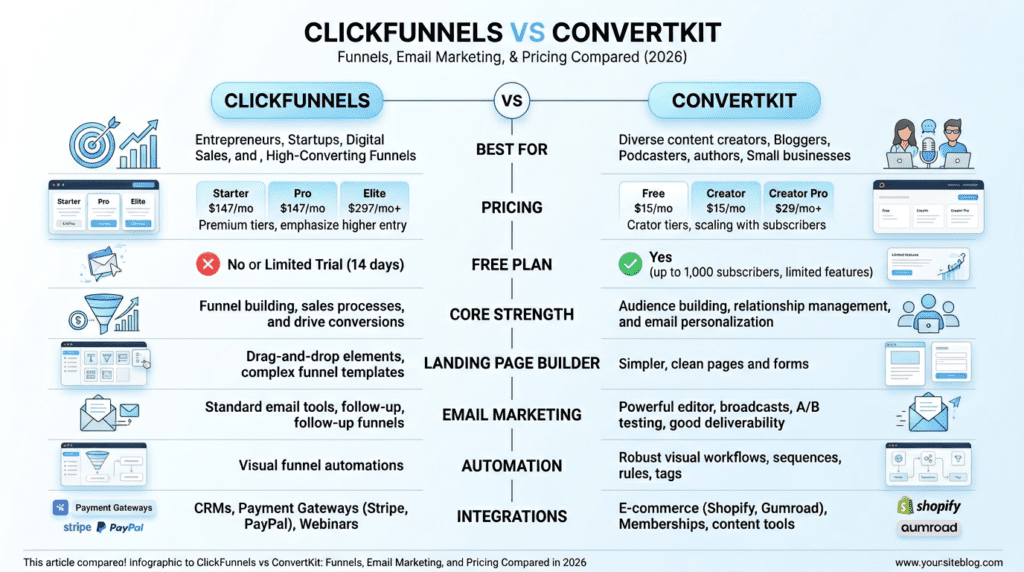
Complete Comparison Table
| Category | ClickFunnels | ConvertKit |
|---|---|---|
| Best For | Building sales funnels, landing pages, and product-selling workflows | Email marketing, subscriber growth, and creator-focused automation |
| Starting Price | Typically starts around $97/mo, with higher tiers above that | Offers a free plan; paid plans typically start around $9/mo and scale by subscriber count |
| Free Plan | No widely used free plan | Yes, a free plan is available |
| Core Strength | Funnel structure and conversion-focused page building | Email marketing automation and list management |
| Main Weakness | Email marketing depth can feel limited compared with a dedicated email platform | Funnel building and page customization are simpler than a dedicated sales funnel builder |
| Landing Page Builder | Strong, built for funnel pages and offers | Solid for simple pages and opt-ins, but less advanced |
| Email Marketing | Included, but not the main reason most people choose it | Core feature set; built to send emails, broadcasts, and sequences |
| Automation | Built for funnel-based automation and follow-up paths | Strong workflow automation for subscriber segmentation and email sequences |
| Split Test | Available for funnel pages and offers | Available on paid plans for testing email and page elements |
| Integrations | Supports common app connections and payment tools | Broad integrations with creators’ tools, ecommerce, and automation platforms |
| Best Use Case | High-converting sales funnels and direct-response offers | Newsletter growth, lead nurture, and long-term email marketing |
| Overall Recommendation | Best if your business depends on funnel-led selling | Best if your business depends on email-led growth |
Best For
ClickFunnels is best for entrepreneurs who need a funnel-first system. That includes course creators, coaches, agencies, and ecommerce brands that want to build sales funnels, create a landing page quickly, and move visitors toward a purchase with fewer moving parts.
ConvertKit is best for creators and online businesses that care more about the email list than the page stack. If your main workflow is capturing a subscriber, sending a sequence, segmenting by behavior, and building a newsletter-driven business, ConvertKit usually fits better.
Not Ideal For
ClickFunnels is not ideal if you mainly want a polished email marketing platform with deep newsletter control and clean subscriber tagging. It can do email, but that’s not where it feels strongest.
ConvertKit is not ideal if you need a full funnel builder with aggressive sales-page testing, complex checkout flows, and more elaborate page design. It can build landing pages, but it’s not trying to be a heavyweight funnel machine.
Bottom Line
There isn’t a universal clear winner. The better platform depends on whether your business is built around conversion pages or around ongoing email marketing. If you’re looking to drive more sales through structured funnels, ClickFunnels makes more sense. If your growth depends on subscriber nurturing, ConvertKit usually gives better long-term value.
ClickFunnels Vs ConvertKit: What Each Platform Is Built to Do
ClickFunnels for landing pages, funnels, and selling products
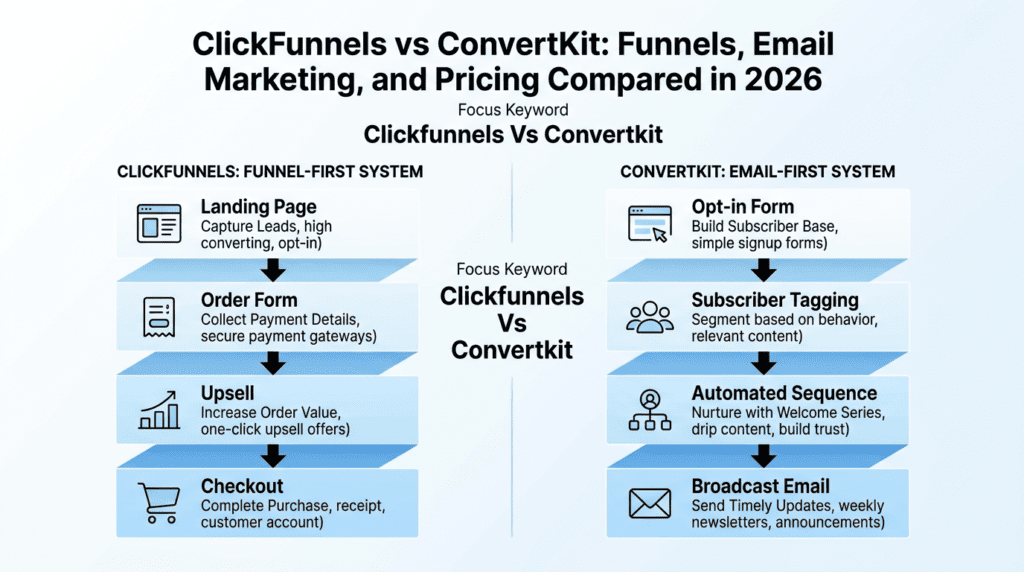
ClickFunnels is built around one job: guide a visitor through a sales funnel and remove friction before the sale. That’s why it’s popular with people selling digital and physical products, coaching packages, webinars, and membership site offers. The platform is designed to help you build landing pages, order steps, upsells, and follow-up flows in one place.
In practice, that means less stitching together separate tools just to make one funnel work. A founder can launch a product page, connect checkout, and use templates to move faster. The upside is speed. The downside is that once the business gets more complex, the page builder and funnel logic can feel more opinionated than flexible.
ConvertKit for email marketing, subscriber growth, and workflow automation
ConvertKit is an email marketing platform first. More precisely, convertkit is an email service built for creators who need to grow an email list, send emails consistently, and automate subscriber follow-up without dealing with a heavy CRM. Its biggest strength is keeping the email workflow clean and usable.
That matters because many businesses don’t need a giant stack. They need landing pages and forms that capture leads, an email sequence that starts the relationship, and workflow automation that tags people based on actions. ConvertKit handles that well. It’s especially useful for newsletters, lead magnets, digital products, and creator businesses that rely on email marketing campaigns instead of complex sales infrastructure.
Where clickfunnels and convertkit overlap
There’s real overlap, and that’s why the comparison gets muddy. Both platforms can build landing pages, capture leads, automate follow-up, and support some form of funnel logic. Both can help you send emails, connect tools, and move a subscriber through a workflow.
But the overlap doesn’t mean they’re equal. ClickFunnels leans into sales funnels and conversion paths. ConvertKit leans into subscriber organization and email marketing automation. So yes, both can support an online business, but they solve different operational problems. One is closer to a funnel builder. The other is closer to an email marketing engine with lighter page-building support.
The difference between clickfunnels and convertkit in real business use
The difference between clickfunnels and convertkit becomes obvious when you look at daily work, not feature lists. A sales team or creator running paid ads may care more about funnel pages, split test results, and checkout flow. A blogger, newsletter operator, or educator may care more about segmentation, broadcasts, and automated email sequences.
A practical example: a course creator launching a webinar offer might prefer ClickFunnels for the opt-in page, registration flow, and post-webinar sale. But if that same creator is focused on list growth and ongoing email marketing efforts, ConvertKit often becomes the better operational home. That’s the real split. ClickFunnels is better when the page and purchase path matter most. ConvertKit is better when the subscriber relationship matters most.
ClickFunnels Vs ConvertKit: Feature Differences That Matter Most
Landing page and funnel building in ClickFunnels
ClickFunnels has the stronger page builder for people who want to build sales funnels quickly. The drag-and-drop editor is made for conversion-focused layouts, so you can build a landing page, an order page, or a thank-you page without feeling like you’re fighting the software. Templates help a lot here, especially if you’re trying to launch fast.
The trade-off is that the platform pushes you toward its own funnel logic. That’s useful if you want a guided workflow. It can be frustrating if you want deep customization options or a very specific design system. For many teams, that’s fine. They care more about speed and high-converting pages than pixel-perfect control. But if you’re scaling a brand with a complex site architecture, the limits show up sooner than you’d expect.
Email marketing automation in ConvertKit
ConvertKit’s advantage is email marketing. It’s easier to manage a subscriber, set up automated email sequences, and segment people based on behavior. You can send a broadcast, build a newsletter workflow, and keep your list organized without a lot of clutter. The system is built to automate nurture, not just trigger basic follow-up.
This is where convertkit feels cleaner than a funnel-first tool. If your business relies on consistent email marketing campaigns, tag-based organization, and simple marketing automation, ConvertKit usually feels more natural. The limitation is that its email marketing features are strong enough for most creators, but not as deep as some enterprise-style marketing platforms. That’s not a flaw for most users. It’s just a boundary.
Workflow automation and subscriber management
Workflow automation is one of the more practical differences. ConvertKit handles it well because its entire system is built around the subscriber and how that person moves through your list. You can automate a welcome series, move people into a different sequence, and customize follow-up based on actions. That’s useful when your email list grows and you need structure without a lot of manual sorting.
ClickFunnels has automation too, but it feels more tied to funnel events and sales behavior. That’s useful if you’re selling through a funnel. It’s less useful if your core goal is long-term subscriber management. A growing business often discovers this after the first few launches. The system works fine at 500 subscribers. At 10,000 or 25,000 subscribers, the workflow choice starts affecting daily operations, team time, and how much manual cleanup you’re doing.
Split test capabilities for campaigns and pages
Split test features matter most when you’re spending money on traffic or optimizing conversion rates. ClickFunnels is typically the better choice here because it’s built around funnel pages and offer testing. That makes it easier to test page variations, improve the landing page, and tune the funnel based on performance.
ConvertKit does offer testing on certain paid plans, but it’s more email-centered. That means testing subject line changes, message framing, or page variations for simpler lead capture flows. For creators who mainly care about improving open rates and email marketing efforts, that’s enough. For businesses trying to optimize a purchase funnel, ClickFunnels usually gives a more direct workflow.
Integrations and how each platform connects with other tools
Both platforms can integrate with other tools, but they do it for different reasons. ClickFunnels often connects with payment processors, webinar tools, CRM platforms, and other funnel-related apps. ConvertKit integrates with ecommerce, course, and creator tools that support content, tags, and subscriber actions.
If you need to integrate ClickFunnels and ConvertKit, that’s a common setup. Some businesses use ClickFunnels for the funnel and ConvertKit for email marketing automation. That can work well, but it adds another layer to manage. More tools mean more handoff points, more chances for sync issues, and more time spent checking whether tags, forms, and purchases are actually flowing correctly.
ClickFunnels Vs ConvertKit Pricing and Value for Money
ClickFunnels pricing and what you actually get
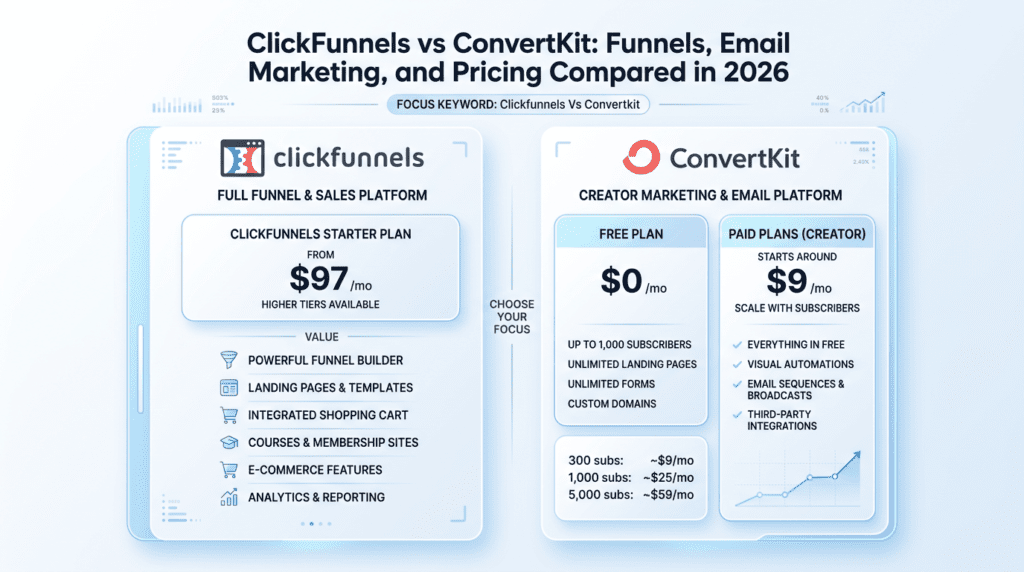
ClickFunnels pricing typically starts around $97 per month, with higher tiers that can move well past that depending on features and scale. What you’re paying for is not just a page builder. You’re paying for a sales funnel builder, funnel templates, checkout-oriented workflows, and tools meant to support selling from the same stack.
That pricing can make sense if a funnel is directly tied to revenue. A business closing even a few extra sales each month may justify the subscription quickly. But if you only need a simple landing page and a light email workflow, the price point can feel steep. The real question is whether you’re using the funnel system enough to offset the monthly cost.
ConvertKit pricing and plan limits
ConvertKit offers a free plan, which lowers the barrier for new creators and small businesses. Paid plans typically start around $9 per month, but the cost rises with the number of subscribers. That’s the part people miss. The platform stays approachable at first, then becomes more expensive as the email list grows.
That scaling model makes sense for email marketing because the value usually increases with list size. Still, it can surprise a business that grows quickly. A subscriber increase from 1,000 to 5,000 can change monthly costs in a meaningful way. On the plus side, you’re paying for an email marketing platform that is designed around automation, organization, and long-term list use, not just page hosting.
Hidden costs that affect growing online businesses
The hidden cost is usually workflow sprawl. If you use ClickFunnels for pages and ConvertKit for email marketing, you may need extra integrations, more troubleshooting, and occasional fixes when a tag or form doesn’t pass correctly. That’s not rare. It’s just the cost of splitting responsibilities across tools.
There’s also the practical cost of limitations. If ClickFunnels can’t do everything you need on the email side, you may still need another platform. If ConvertKit doesn’t support the sales funnel complexity you want, you may need a separate funnel tool. In either case, the real expense is not only the subscription. It’s the extra setup time, the maintenance, and the operational drag when your workflow grows beyond a simple launch.
Which platform gives better value for different business stages
For early-stage creators, ConvertKit often gives better value because it offers a free plan, simpler setup, and strong email marketing automation without demanding a large monthly commitment. It’s a sensible starting point if your priority is building an email list and nurturing subscribers.
For businesses that already know they need a funnel-led sales engine, ClickFunnels can be worth the higher cost if it replaces multiple tools and helps build sales funnels faster. The value is strongest when the funnel is central to revenue, not just a nice extra. For many users, that’s the real decision: use a lower-cost email-first platform to grow patiently, or pay more for a funnel-first system that may shorten the path to sales.
ClickFunnels Vs ConvertKit Ease of Use and Setup Experience
How easy ClickFunnels is for building funnels fast
ClickFunnels is built for speed when your main goal is to launch a funnel, not to tinker forever. The drag-and-drop editor makes it possible to get a landing page, order form, or webinar funnel live without hiring a developer. That said, the first few hours can still feel clunky if you’re new to sales funnels. There are a lot of moving parts: page steps, automation rules, upsells, checkout behavior, and tracking.
For a course creator or ecommerce brand, that structure is useful once it clicks. You can reuse a template, customize the messaging, and connect the pieces into a working workflow. The friction is usually in the setup logic, not the design itself. People often expect a simple page builder and find a broader sales system instead.
How ConvertKit handles email workflows and automation
ConvertKit is usually easier to grasp if you think in terms of subscribers, tags, forms, and email sequences. The interface is cleaner than most marketing platforms, and the workflows tend to make sense once you understand the basic logic. You’re not building a sales funnel in the same visual way as ClickFunnels. You’re building email marketing systems that react to behavior.
That makes ConvertKit feel lighter at the start. A creator can build a form, send new subscribers into an email sequence, and automate follow-up without touching code. The catch is that some users want more visual control. If your business depends on high-converting pages first and email second, ConvertKit can feel less direct because its strength is the email marketing workflow, not the funnel layout.
Beginner friction points in each platform
The biggest beginner issue with ClickFunnels is complexity hiding behind convenience. It looks like it should be simple, but a real funnel usually needs checkout rules, split test logic, integrations, and a few technical decisions you can’t ignore. If you only want a landing page and a newsletter signup, it can feel like too much platform for the job.
ConvertKit has the opposite problem. It’s easier to start, but users sometimes hit limits when they want more visual control over pages or more advanced page-style customization options. A beginner may set up a good email sequence quickly, then realize they still need another tool to build sales funnels or sell digital and physical products in a more complete way.
- ClickFunnels friction: More setup depth, more moving parts, stronger learning curve.
- ConvertKit friction: Simpler start, but less page-building power.
- Common mistake: Choosing based on the dashboard instead of the actual workflow you need.
Which platform is easier to manage as your subscriber list grows
ConvertKit usually stays easier as the number of subscribers rises, especially for creators running newsletters, lead magnets, and automated email sequences. The system is designed around audience growth, segmentation, and consistent sending. As the list gets bigger, the main challenge becomes organization, not tool overload.
ClickFunnels can still work at scale, but it becomes more operational when your email list grows and your funnel logic gets more layered. That’s where teams often notice the difference between a page-driven system and an email-first system. If your workflow is mostly about nurturing subscribers over time, ConvertKit tends to stay calmer. If your workflow is centered on campaigns, offers, and conversions tied to specific pages, ClickFunnels can still be the stronger sales funnel builder, even if it asks for more active management.
ClickFunnels Vs ConvertKit Automation and Workflow Comparison
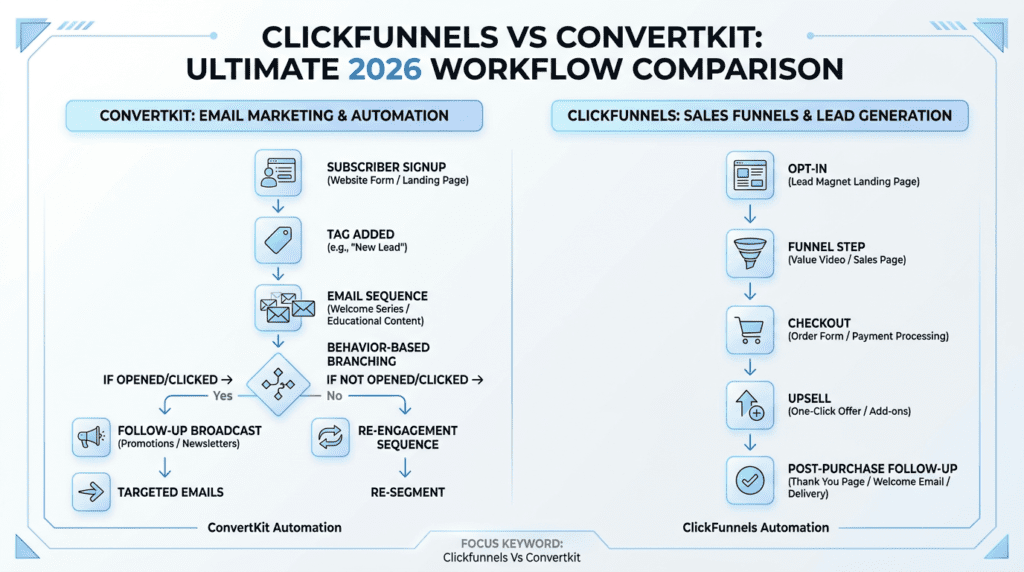
Email automation in ConvertKit
ConvertKit is the clearer choice for email marketing automation. Its tags, triggers, and sequences make it easier to build automated email sequences that react to what a subscriber does. Someone can join a list, click a link, buy a product, or skip a sequence, and the system can adjust the next message accordingly.
This matters because email automation isn’t just about saving time. It’s about keeping the email marketing campaign relevant enough that people keep opening. A newsletter audience of 2,000 subscribers can be managed manually for a while, but once you’re sending weekly broadcasts and segmented sequences, manual work gets messy fast. ConvertKit’s workflow automation is built for that kind of ongoing communication.
Funnel automation in ClickFunnels
ClickFunnels handles automation from the funnel side. That means it’s better at moving someone from opt-in to checkout to upsell to follow-up without asking you to stitch together five separate tools. If a visitor opts in on a landing page, ClickFunnels can route them through the next step of the funnel with fewer handoffs.
The upside is obvious: fewer gaps in the buyer journey. The downside is that funnel automation can become rigid if you want deeper subscriber behavior logic. ClickFunnels is good at sales funnels, but it’s not as naturally centered on long-term subscriber nurturing as ConvertKit. It’s more about guiding action in the moment than managing a large email list over months.
Workflow automation for lead nurturing and follow-up
This is where the difference gets practical. ConvertKit is usually stronger for lead nurturing because it’s built around the subscriber relationship. You can tag people by interest, send them into different email marketing paths, and keep the workflow tied to content behavior. A coach, for example, might send webinar attendees into one email sequence and non-buyers into another.
ClickFunnels can automate follow-up too, but the workflow usually starts with the funnel step, not the ongoing relationship. It’s excellent when the next move is clear: register, buy, upgrade, book a call. It’s less elegant when your business depends on multiple rounds of nurturing, slower trust-building, or a newsletter-led sales cycle.
When automation matters more than page design
If the business depends on volume and repeated follow-up, automation usually matters more than a prettier landing page. A strong page can lift conversions, but a weak workflow can quietly kill revenue after the first opt-in. That’s why many founders end up valuing ConvertKit more once the email list becomes the real asset.
For a course seller running launches, page design still matters. For a blogger monetizing with email marketing efforts, automation is often the bigger lever. When the goal is to automate follow-up across 500, 5,000, or 50,000 subscribers, the system behind the emails matters more than the color of the form button.
ClickFunnels Vs ConvertKit for Selling Products and Growing an Online Business
Selling digital products with ClickFunnels
ClickFunnels is strong when you want to sell products through a controlled sales page journey. That includes digital and physical products, low-ticket offers, order bumps, upsells, and upsell sequences that can improve average order value. For someone selling a mini course or workshop, the funnel structure can make the checkout path feel clean and intentional.
The trade-off is that you’re paying for a more complete sales funnel builder, so it makes the most sense when the funnel itself is central to revenue. If your business is mostly content-led and your offers are occasional, the platform can feel heavier than you need. But if high-converting sales pages and structured checkout flows matter, ClickFunnels is often the more direct tool.
Selling through email with ConvertKit
ConvertKit is better when selling happens through trust and repeated email marketing campaigns. It helps you build an email list, segment subscribers, and send emails that move people toward a purchase over time. That works especially well for digital products, coaching, consulting, and newsletter-based businesses.
A practical example: a creator might write one broadcast to a warm subscriber segment, then follow with an automated email sequence for people who clicked but didn’t buy. That kind of follow-up can outperform a single landing page push because it respects timing. ConvertKit isn’t trying to replace every sales funnel element. It’s helping you sell through consistent communication.
Where each platform works better for entrepreneurs
Entrepreneurs who need fast launches, checkout flows, and one-page campaigns usually lean toward ClickFunnels. It’s better when the business model depends on sales pages doing a lot of the work upfront. The platform is especially useful if you want to build sales funnels without duct-taping several tools together.
ConvertKit works better for entrepreneurs who grow through audience building first. If the email list is the main asset, and the business relies on newsletters, launches, or recurring promotions, ConvertKit gives you a cleaner system. The difference between ClickFunnels and ConvertKit is really about where you want the workflow to start: on the page or in the inbox.
Best fit by business model: creator, coach, course seller, or service provider
The cleanest way to think about ClickFunnels and ConvertKit is by business model:
- Creator: ConvertKit usually wins if the business is built on newsletters, content, and subscriber growth.
- Coach: Either can work, but ConvertKit is often better for nurturing leads, while ClickFunnels is better for booked-call or challenge funnels.
- Course seller: ClickFunnels is stronger for launch funnels, order bumps, and structured checkout paths.
- Service provider: ConvertKit often fits better for relationship-driven email marketing, unless the service offer is sold through dedicated funnel pages.
There isn’t one clear winner for every online business. The better platform depends on whether you need a sales funnel machine or a subscriber nurturing system.
ClickFunnels and ConvertKit Integration: Can You Use Both Together?
What the clickfunnels and convertkit integration actually does
Yes, you can integrate ClickFunnels and ConvertKit, and for some businesses that’s the smartest setup. In plain terms, the integration lets leads captured in ClickFunnels move into ConvertKit so you can keep sending emails and managing subscribers without manual export work. It connects the funnel side to the email service provider side.
That matters because ClickFunnels is strong at capturing attention and closing sales, while ConvertKit is stronger at long-term email marketing. The integration with ClickFunnels lets one platform handle the page and checkout experience while the other handles subscriber communication. For many teams, that split is cleaner than forcing one tool to do everything.
How the integration helps you send emails and automate follow-up
This setup is useful when the funnel creates the lead and ConvertKit handles the nurture sequence. Someone opts in on a ClickFunnels landing page, gets tagged in ConvertKit, and then enters an automated email sequence. That workflow can save hours every week and reduce the chance that a lead falls through the cracks.
A common use case is webinar follow-up. ClickFunnels captures the registration, then ConvertKit sends reminders, replay links, and a post-event offer. That’s a stronger workflow than trying to manage everything manually. It also gives you more room to customize messages by behavior, which usually matters more than people expect when the list grows beyond a few hundred subscriber contacts.
When integrating both platforms makes more sense than choosing one
Using both platforms makes sense when your business has two distinct jobs: converting visitors and nurturing subscribers. If ClickFunnels is already working for your landing page and checkout flow, and ConvertKit is better for email marketing automation, there’s no reason to force a single-platform compromise.
This is especially true for course launches, webinar funnels, and content-driven offers. A business looking to drive more sales may find that using both ClickFunnels and ConvertKit gives a better balance of conversion power and retention. It’s not the cheapest path, but it can be the most operationally stable once the funnel and email list both matter.
Integration limitations and setup considerations
The limitation is that integration doesn’t erase platform boundaries. You still need to maintain two systems, troubleshoot two sets of settings, and understand where each subscriber action is happening. That can create setup friction if your team is small or your workflow is still changing every month.
You also need to be careful with tags, list structure, and automation rules so contacts don’t get duplicated or routed incorrectly. For a solo entrepreneur, that can be manageable. For a growing team, it’s another process to document. Integration is helpful, but it’s not invisible.
Honest Take: Where ClickFunnels Wins and Where ConvertKit Wins
Why ClickFunnels is stronger for page-driven conversions
ClickFunnels wins when the page is the main event. It’s built for sales funnels that need direct response behavior: opt in, buy, upgrade, book, or apply. The page builder, funnel templates, and checkout structure are all aligned with that goal. If the business depends on turning cold traffic into action fast, ClickFunnels is the sharper tool.
It’s also a better fit when you care about controlling the entire path from landing page to purchase. That kind of control can lift conversion rates, but it usually comes with more setup work. The payoff is strongest when the funnel is high-volume or tied to a clear offer.
Why ConvertKit is stronger for email-first growth
ConvertKit wins when the business grows through subscribers, not just campaigns. It’s more natural for email marketing, newsletter publishing, and long-term nurturing. The platform keeps the workflow focused on people, tags, and sequences instead of forcing everything through a sales page.
That makes it a better fit for creators, educators, and businesses with slower buying cycles. If the email list is the real engine, ConvertKit usually feels easier to live with. It’s less flashy than a funnel platform, but it tends to be the more sustainable email marketing platform for ongoing growth.
The real reason many businesses eventually need both
The reality is that many businesses outgrow the either-or question. They need strong landing pages and they need solid email marketing. A funnel can get the lead, but the email sequence often closes the sale later. That’s why the combo of ClickFunnels and ConvertKit shows up so often in real operations.
A business can start with one tool and add the other later, but the split usually reflects how the workflow matures. ClickFunnels handles the front of the journey. ConvertKit handles the relationship after opt-in. Together, they cover more of the sales process without forcing one platform to pretend it does everything equally well.
What most comparison articles miss about long-term workflow needs
Most comparisons stop at features and pricing. That misses the real issue: workflow maintenance. A platform can look great when you’re setting up one funnel or one newsletter, then become awkward when you have 12 campaigns, 8 tags, 4 lead magnets, and multiple subscriber segments to manage.
Long-term, the better choice is the one that matches how your business actually operates week after week. If your work is mostly page-driven, ClickFunnels will feel more natural. If your work revolves around email marketing and subscriber nurturing, ConvertKit will age better. If you need both jobs done well, using both platforms is often the most realistic answer.
Common Mistakes When Choosing ClickFunnels Vs ConvertKit
Choosing a funnel builder when email automation is the bigger need
A lot of buyers get drawn to the page builder first. That makes sense. A polished landing page feels like progress. But if your real problem is turning a subscriber into a repeat buyer, the page is only the first step. You need email marketing, segmentation, and an email sequence that can keep working after the opt-in.
This is where people misread ClickFunnels vs ConvertKit. ClickFunnels can build a strong funnel, but if your business depends on newsletters, launches, lead nurturing, and long-term follow-up, ConvertKit usually fits better. A funnel without a solid email workflow often leaks money. You get traffic, maybe a few conversions, then silence.
Choosing an email platform when landing pages are the priority
The opposite mistake happens too. Some business owners want a full sales funnel builder, then choose an email marketing platform because it looks simpler or cheaper. ConvertKit is built for email marketing automation first. It does build landing pages and forms, but it’s not trying to be a full conversion-focused funnel system.
If you need a webinar funnel, checkout flow, upsell path, or a tightly controlled sales sequence, that gap matters. You can still make it work by integrating tools, but that adds steps. For a lean team, extra workflow pieces often mean more setup time and more things to break later.
Ignoring subscriber segmentation and follow-up workflows
This is the quiet mistake that hurts the most. People focus on the front end and ignore what happens after signup. If every subscriber gets the same message, your email marketing starts to feel generic fast. A first-time lead, a buyer, and a webinar no-show should not live in the same follow-up path.
ConvertKit is stronger here because it makes subscriber management and workflow automation easier to structure. You can tag by behavior, send automated email sequences, and keep the list organized as it grows. ClickFunnels can handle parts of the funnel, but it is not usually where you want to run a complex long-term subscriber system.
A simple example: a course creator might need one path for people who downloaded a free guide, another for webinar registrants, and another for buyers who need upsell emails. If that sounds like your world, segmentation should matter more than the look of the page.
Overlooking how split testing affects conversion decisions
Split testing gets mentioned a lot, but people rarely think through what it changes operationally. Testing a headline, offer, or landing page layout is useful only if you’re getting enough traffic to make the results meaningful. If your list is small, a split test can burn weeks without giving you a clear answer.
ClickFunnels is stronger for page-level testing, especially when you’re trying to improve sales funnels and optimize a landing page fast. ConvertKit can support testing in an email marketing context too, but it is not built around the same style of page optimization. The mistake is assuming testing itself solves the business problem. It doesn’t. It only helps when you already know where the bottleneck is.
Which Platform Is Better for Your Situation?
ClickFunnels vs ConvertKit for beginners
For beginners, the better choice usually depends on what kind of beginner you are. If you want one platform to help you build a simple funnel, collect leads, and sell a product without stitching together multiple tools, ClickFunnels is often easier to understand at first. The trade-off is that the interface can feel heavy when you only need a few core steps.
ConvertKit is friendlier if your main goal is email marketing and growing a subscriber list. Its setup is less intimidating, and the logic around forms, sequences, and tags tends to make more sense for creators. If you’re new and mainly trying to send emails, build landing pages, and automate follow-up, ConvertKit usually feels less overwhelming.
ClickFunnels vs ConvertKit for solo entrepreneurs
Solo entrepreneurs usually feel the pain of tool overload faster than anyone else. You do not want five disconnected apps just to collect leads, send emails, and sell one offer. ClickFunnels is useful if your whole workflow centers on one or two sales funnels and you want fewer moving parts on the front end.
ConvertKit makes more sense when your business is built around an email list, regular broadcasts, and repeat communication. A solo creator or consultant often needs to nurture a small number of subscribers well, not run a huge funnel machine. If your weekly workflow involves writing, segmenting, and sending email marketing campaigns, ConvertKit is the more natural fit.
ClickFunnels vs ConvertKit for creators selling digital products
Creators selling digital products sit in the middle, which is why this comparison gets messy. If you sell a course, template, workshop, or membership site and care about conversion-focused pages, ClickFunnels helps you build sales funnels that can move people from interest to checkout quickly.
ConvertKit works better if your product is sold through trust-building over time. A newsletter, launch sequence, and automated email sequence can do a lot of the heavy lifting. For many creators, the best setup is not either/or. It’s a landing page in one place and email marketing in another, with a clean integration between the two.
ClickFunnels vs ConvertKit for businesses focused on email marketing automation
If email marketing automation is the center of your business, ConvertKit is usually the better call. That’s especially true when you have multiple subscriber groups, recurring launches, or behavior-based follow-up. It’s built to automate communication without making the workflow feel like a maze.
ClickFunnels can support follow-up, but it is not as strong when the main job is managing an email list over time. Businesses that rely on automated email sequences, content delivery, and subscriber tagging tend to outgrow a funnel-first setup pretty quickly. If you’re looking to drive more sales through relationship-based email, ConvertKit is the safer choice.
When to choose ClickFunnels, when to choose ConvertKit, and when to use both
Use ClickFunnels if your priority is building sales funnels, landing pages, and direct-response paths that convert fast. Use ConvertKit if your priority is email marketing, subscriber growth, and workflow automation that keeps working after the first click.
Use both when your business needs both front-end conversion and long-term nurture. That usually happens with course sellers, coaches, and digital product brands that launch periodically and want a tighter path from opt-in to purchase. If you already have a decent email list and need a better funnel, using both can be the practical answer. If you’re just starting, don’t overcomplicate it.
Final Verdict: Clickfunnels Vs Convertkit

The simplest way to decide based on your business goals
The easiest way to choose is to ask one question: where does your business actually make money? If the answer is through pages, offers, and a conversion-focused funnel, ClickFunnels fits better. If the answer is through list growth, nurturing, and repeat sending, ConvertKit fits better.
That’s the cleanest difference between ClickFunnels and ConvertKit. One is built to move people through a sales path. The other is built to manage subscriber relationships and email marketing campaigns over time. Once you see it that way, the decision gets much less confusing.
Final recommendation for funnel-first businesses
Choose ClickFunnels if you need to build landing pages, sales pages, checkout flows, or a membership site and want a more unified funnel builder. It is the stronger option when the page itself is the sales engine and you care about high-converting conversion paths more than deep email structure.
It’s also the better fit if you run short campaigns, webinars, or product launches where speed matters. The limitation is that your email marketing efforts may eventually need a stronger outside system if your workflow gets more sophisticated.
Final recommendation for email-first businesses
Choose ConvertKit if your business lives on the subscriber list. That includes newsletters, evergreen nurture, launches, and ongoing email marketing automation. It’s a more focused email marketing platform, and that focus shows up in how naturally it handles tags, sequences, and broadcasts.
It also offers a free plan, which is helpful for newer creators testing their offer. Just don’t expect it to replace a full sales funnel builder if your pages and checkout logic are central to revenue.
Bottom line on ClickFunnels vs ConvertKit in 2026
The bottom line is simple: ClickFunnels is the stronger funnel builder, and ConvertKit is the stronger email marketing platform. The clear winner depends on whether you need conversion pages or subscriber automation more right now.
For many online businesses, the smartest move in 2026 is not picking the “best” tool in a vacuum. It’s choosing the platform that solves the biggest bottleneck in your workflow today. If your bottleneck is pages, choose ClickFunnels. If it’s email, choose ConvertKit. If both matter equally, using both may be the most realistic setup.
Frequently Asked Questions About Clickfunnels Vs Convertkit
Can you use ClickFunnels and ConvertKit together?
Yes, you can use ClickFunnels and ConvertKit together. A common setup is to use ClickFunnels for the landing page and sales funnel, then send leads into ConvertKit for email marketing automation and follow-up.
That workflow is popular because it keeps each tool focused on its strongest job. The main downside is extra setup. You need to connect the integration correctly and make sure tags, forms, and automated email sequences are mapped the way you want.
Is ClickFunnels better than ConvertKit for email marketing?
No, ClickFunnels is not better than ConvertKit for email marketing. ConvertKit is the stronger email service provider, especially if your business depends on broadcasts, subscriber segmentation, and automated email sequences.
ClickFunnels can support email inside a funnel, but it is not as strong for long-term list management. If email is the core of your workflow, ConvertKit usually makes more sense.
Is ConvertKit good for landing pages and funnels?
Yes, ConvertKit is good for basic landing pages and simple funnel-style workflows. You can build landing pages, forms, and sequences without needing another tool right away.
It’s not ideal if you want a complex sales funnel with multiple steps, upsells, or heavy conversion testing. In that case, a dedicated funnel builder still does the job better.
Which platform is better for selling products online?
ClickFunnels is usually better for selling products online, especially if you need a more controlled funnel and checkout experience. It works well for digital and physical products when the goal is direct conversion.
ConvertKit can sell products too, but it is better when the sale happens through email marketing and relationship building. If your sales depend on trust and repeated touchpoints, it can be enough.
Do you need both ClickFunnels and ConvertKit for workflow automation?
Not always, but some businesses do. If your workflow is simple, one platform may be enough. If you need to build sales funnels in one place and automate email marketing in another, using both can be the cleaner setup.
That combination is especially useful when a funnel captures leads and ConvertKit handles the long-term nurture. It gives you more flexibility, but it also adds another integration to manage.
What is the main difference between ClickFunnels and ConvertKit?
The main difference is focus. ClickFunnels is built for funnels, landing pages, and sales conversion. ConvertKit is built for email marketing, subscriber growth, and automation.
That difference shapes everything else, from setup to pricing to daily workflow. Once you know whether your bigger need is a funnel or an email system, the choice gets much easier.