
A lot of teams don’t lose time because they picked the wrong email marketing platform. They lose time because they picked one that looked simple on day one and then got stuck with limits on day thirty. That’s why the Brevo Vs Constant Contact decision matters in 2026. The real question isn’t which tool has more features on paper. It’s which one actually fits how you send, segment, automate, and grow without creating extra work.
The mistake most buyers make is assuming these two tools solve the same problem in the same way. They don’t. Constant Contact leans into simplicity and familiarity. Brevo is built more like a flexible marketing system with email, SMS, automation, transactional sending, and CRM-style contact management under one roof. That difference sounds small until your list grows, your workflow gets messier, or you need more than a basic campaign.
Why this Brevo vs Constant Contact comparison matters
For small businesses, creators, local brands, and ecommerce teams, the first email platform often becomes the long-term one. That’s where the stakes get real. Switching later means moving lists, rebuilding automations, reworking templates, and re-learning reporting. It also means new pricing surprises, especially when your contact list or email volume grows faster than expected.
This comparison matters because Brevo and Constant Contact are often lumped together as “easy email tools,” but their business logic is different. One is often better for teams that want quick publishing and light marketing. The other is better when you need more control over campaigns, segmentation, and contact-based workflow logic.
What most buyers misunderstand about Brevo and Constant Contact
The biggest misunderstanding is assuming pricing works the same way. It doesn’t. Constant Contact pricing is usually driven by contact count and plan tier. Brevo pricing tends to scale more with email volume, with contact storage playing a different role depending on the plan. That changes the economics a lot if you have a large list but send less often, or a smaller list but send frequently.
Another common miss is automation depth. Constant Contact offers practical automation basics that work well for simple follow-ups and newsletters. Brevo offers more advanced workflow flexibility, which matters once you want actions based on behavior, tags, or lifecycle stage. If you only need a weekly newsletter, that extra depth can be overkill. If you need real segmentation, it can be the difference between a workable system and a cramped one.
Honest take on who each email marketing tool is built for
Constant Contact is built for users who want a straightforward marketing platform with a familiar setup and low friction. Think local businesses, service brands, nonprofits, and small teams that value speed over complexity. It’s also a decent fit for users who don’t want to spend a lot of time learning the software.
Brevo is built for teams that expect their workflow to evolve. It tends to make more sense for growing small businesses, ecommerce brands, agencies, and companies that want email, SMS, and transactional messaging in one platform. If you care about scaling contact management, automation, and cross-channel communication, Brevo usually has the better ceiling.
Hidden frustrations users run into after setup
The pain usually shows up after the first few campaigns. In Constant Contact, the friction is less about setup and more about limits. Users often realize they want more nuanced segmentation, more flexible automation, or better control over how contacts move through the system. That’s when the platform can feel a little boxed in.
With Brevo, the frustration is usually different. The platform gives more control, but it can feel less instantly obvious. Some users spend extra time figuring out the workflow, adjusting templates, or learning how contact management connects to campaigns. That’s not necessarily a flaw. It’s the trade-off for getting a more capable system.
Quick Verdict: Brevo vs Constant Contact at a Glance
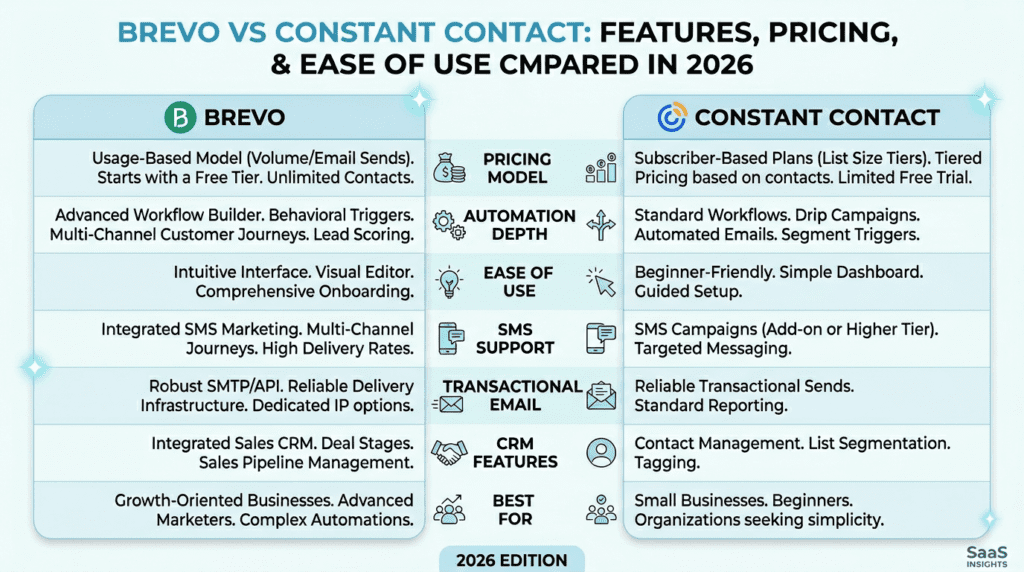
Complete Comparison Table
| Category | Brevo | Constant Contact |
|---|---|---|
| Best For | Growing teams needing email, SMS, automation, and transactional sending in one platform | Small businesses that want simple newsletters and easy campaign publishing |
| Not Ideal For | Users who want the most beginner-friendly interface with almost no setup learning | Teams that need deeper automation, advanced segmentation, or multi-channel workflows |
| Starting Price | Plans often start around a low monthly tier, with pricing that can scale by email volume | Usually starts with a paid tier based on contact count; pricing rises as lists grow |
| Free Plan | Yes, a free plan is commonly available with sending limits | Typically offers a trial or limited introductory access, depending on current offers |
| Ease of Use | Moderate; flexible but takes longer to learn | Very easy; one of the main reasons people choose it |
| Key Strength | Strong workflow flexibility and more advanced marketing tools | Simple publishing and low-friction campaign creation |
| Biggest Limitation | More moving parts can slow beginners down | Less depth for advanced automation and scaling |
| Contact Storage Model | Often more favorable for larger lists, depending on plan structure | Scales more directly with contact count |
| Automation Depth | Stronger, with more behavior-based workflow options | Solid basics, but not as flexible |
| SMS Support | Available | Limited compared with Brevo |
| Transactional Email | Included through Brevo’s broader platform offering | Not a core strength |
| CRM Features | Built-in contact and pipeline-style management | Basic contact management, lighter CRM feel |
| Overall Recommendation | Better for growth-minded teams that want one platform for more than newsletters | Better for users who want a simple, dependable email tool right away |
Brevo is the better pick if you want room to grow into automation, segmentation, SMS, and transactional sending without jumping between tools. Constant Contact is the safer choice if your main goal is to create and send campaigns quickly with minimal learning curve. The bottom line is simple: Brevo usually wins on depth, while Constant Contact wins on simplicity.
Best For
Brevo is best for small businesses and ecommerce brands that want one platform for email marketing, transactional email, and more advanced contact management. It’s also a stronger fit for teams that expect their contact list and workflow to become more complex over time.
Constant Contact is best for users who want a clean, dependable tool for newsletters, announcements, and basic automation. If you’re sending a few campaigns a month and don’t want to wrestle with settings, it stays out of your way.
Not Ideal For
Brevo is not ideal if your team wants the absolute easiest interface and no learning curve. It can feel like more system than some users need.
Constant Contact is not ideal if you already know you need deeper automation, tighter segmentation, or better multi-channel growth tools. It can handle the basics, but advanced users often outgrow it.
Bottom Line
If you want the most straightforward path to getting campaigns out the door, Constant Contact makes sense. If you want a more scalable marketing solution with more control, Brevo is usually the smarter long-term choice. The better tool depends less on brand preference and more on how fast your workflow is likely to evolve.
Brevo vs Constant Contact: Which Email Marketing Tool Fits Your Goals?
Brevo and Constant Contact for small businesses
Small businesses usually care about two things: time and overhead. They want something that works without hiring help, and they don’t want to pay for features they’ll never use. On that front, Constant Contact feels easier at the start. It’s built for simple execution, especially for teams sending newsletters, local promotions, or event updates.
Brevo makes more sense when the business is still small but already thinking ahead. A shop with recurring promotions, abandoned cart messaging, or lead follow-up needs may benefit from Brevo’s broader toolkit. It’s not just about sending a campaign. It’s about managing the contact list and customer journey in one place.
Constant Contact users who need simplicity fast
If your main concern is getting a campaign live without a lot of training, Constant Contact is usually the smoother path. The editor, list tools, and general navigation are built to reduce friction. That matters for owners or assistants who may only touch the platform once or twice a week.
The trade-off is that simplicity can come with ceilings. Once you want more specific segmentation or more layered automation, you may feel the platform is guiding you toward a simpler workflow than the one you actually need.
Brevo users who want more workflow flexibility
Brevo fits better when the workflow itself matters, not just the campaign. If you need triggers based on behavior, separate journeys for different lead types, or more control over transactional and promotional messaging, Brevo offers more room to work. It also tends to suit teams that want email, SMS, and CRM-style data in one platform.
That extra flexibility isn’t free. It can mean more setup time and a little more troubleshooting. But for users who care about control, that’s often a worthwhile trade-off.
Which platform makes sense as your list and campaigns grow
Growth changes the math. A list of 500 contacts is easy to manage almost anywhere. A list of 5,000 or 50,000 contacts changes how pricing, segmentation, and sending structure matter. Constant Contact can still work well at that stage, but the cost and feature trade-offs become more visible.
Brevo generally scales better for teams that send based on behavior, event timing, or lifecycle stage. If your email campaign strategy is getting more layered, Brevo often has more staying power. If your campaigns are still mostly one-off announcements and newsletters, Constant Contact may remain perfectly adequate.
Brevo vs Constant Contact Features Compared
Email marketing essentials in Brevo and Constant Contact
Both platforms cover the basics well enough. You can build an email campaign, manage a contact list, use a template, and track open rate and clicks. For standard email marketing, either tool can get the job done.
The difference shows up in how much structure each platform gives you around those basics. Constant Contact focuses on accessible email creation and easy contact management. Brevo adds more system-level features, including deeper automation, SMS, and transactional options that expand what a campaign can do after it’s sent.
Campaign creation and editing experience
Constant Contact’s campaign builder is designed for speed. It’s approachable, and the drag-and-drop editor is easy to understand if you’ve never used a marketing platform before. You can move through the workflow quickly, make edits without much second-guessing, and publish with minimal friction.
Brevo’s builder gives more control, but that control can slow you down. You may spend more time adjusting structure, checking logic, or working through a template layout. For experienced marketers, that’s fine. For first-time users, it can feel less immediate. Still, the upside is that Brevo often gives you more room to customize the campaign the way you want it.
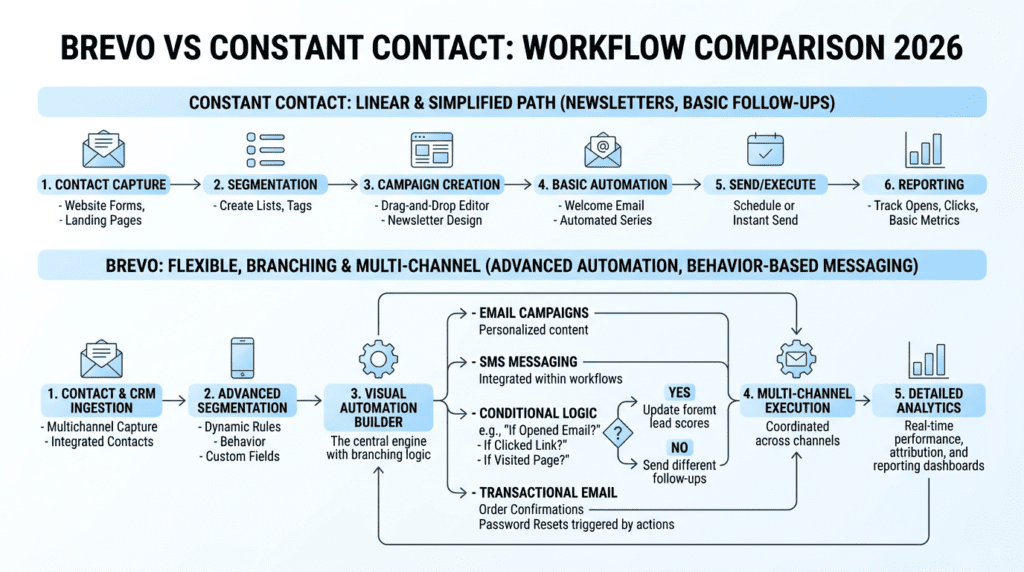
Automation workflow differences
This is where the gap starts to matter. Constant Contact supports useful automation for welcome messages, follow-ups, and simple lead nurturing. That’s enough for a lot of small businesses, especially those just getting serious about email automation.
Brevo goes further. It can support more advanced workflow paths based on user actions, tags, and other behavior signals. That matters if you’re building onboarding flows, post-purchase follow-ups, or segmented nurture sequences. A course creator, for example, might use Brevo to send one workflow to webinar attendees and another to buyers. Constant Contact can do part of that job, but Brevo is more built for it.
List management and contact segmentation
Contact management is another area where the difference is easy to miss at first and hard to ignore later. Constant Contact handles contact lists and custom fields well enough for standard email marketing. You can organize subscribers and keep your list clean without much effort.
Brevo offers more flexibility around segmentation and contact data. That matters when your audience is not just “subscribers” but multiple audience types with different buying intent. A good segmentation setup can improve campaign relevance, and that often has a real impact on click-through rates. It’s not magic, though. It only works if your team actually maintains the data.
Integration options and ecosystem fit
Constant Contact provides a solid set of common integrations for small businesses, including many popular tools used in ecommerce, local marketing, and simple lead capture. If your stack is modest, it will probably fit well enough.
Brevo tends to feel more like a broader system. It can work well with websites, CRMs, ecommerce tools, and APIs that need more direct control. That makes it more attractive if your business runs on multiple channels or if your dev team wants more flexibility. The downside is that a broader system often takes more planning. It’s less plug-and-forget.
Inbox deliverability and sending reliability
Deliverability is one of those areas people ignore until campaigns start underperforming. Both tools are built to send reliably, but your actual inbox placement depends on list quality, sender reputation, content, and consent practices. No platform fixes a bad list.
Constant Contact has long been used by businesses that want a dependable sending environment with low operational stress. Brevo also offers solid deliverability foundations and adds transactional capabilities, which can be important for order confirmations and system notifications. The bigger issue is usually not the platform itself. It’s whether your team keeps spam complaints low and maintains a clean contact list.
Brevo vs Constant Contact: Ease of Use and Setup
Which platform is easier for beginners
Constant Contact is easier for beginners, and it’s not close. The interface is built to feel familiar, the steps are clearly laid out, and users usually don’t need much training to send their first newsletter. That matters when the person managing email is also running sales, admin, or customer service.
Brevo asks for a little more attention up front. It’s still usable, but the learning curve is more visible because the platform offers more options. If you only want to send a few emails a month, that extra complexity can feel unnecessary. If you want to build a real system, though, the added effort starts to make sense.
Dashboard layout and daily workflow differences
Constant Contact keeps the daily workflow simple. You log in, find your contacts, build a campaign, and send. That straightforward structure is one of the reasons constant contact users tend to stick with it when their needs stay basic.
Brevo’s dashboard is more feature-rich, which is helpful once you know your way around. You can move between campaigns, automation, contact management, and transactional tools from one platform. But that also means more choices on screen and a slightly heavier setup feel. For teams with a tight schedule, that can be a real annoyance early on.
How much time each tool takes to launch a campaign
A basic campaign in Constant Contact can usually be put together faster, especially if you already have a contact list and a simple template in mind. Many users can move from draft to send in less than an hour once they know the platform.
Brevo may take longer the first few times because you’re often thinking through segmentation, workflow logic, and setup details at the same time. The trade-off is that the extra work can pay off later when the same campaign structure is reused across multiple audience groups or channels.
Where constant contact wins on simplicity
Constant Contact wins when the goal is minimal friction. It’s easier to explain to a junior team member, easier to manage for a solo owner, and easier to keep moving without a lot of internal process. That simplicity is a real business advantage when time is short.
It also helps reduce decision fatigue. Some marketing platforms give you too many paths for a basic use case. Constant Contact keeps the workflow narrower, which can actually improve execution for teams that don’t want to overthink every send.
Where Brevo takes more learning but gives more control
Brevo takes more time to learn, but it gives more control over the actual marketing workflow. You can organize contacts more deliberately, build more layered automation, and connect promotional and transactional messaging more cleanly.
That matters once your business stops behaving like a simple newsletter operation. If you’re running a store, a lead funnel, or a multi-step customer journey, Brevo’s complexity starts to look less like clutter and more like capability. The learning curve is real, but so is the upside.
Brevo Pricing vs Constant Contact Pricing
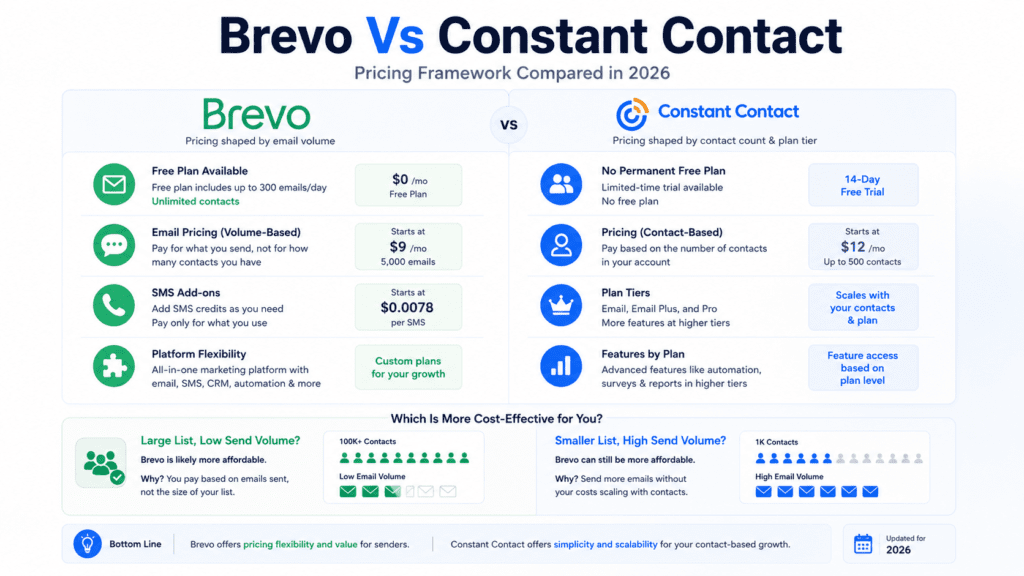
Pricing is where the Brevo Vs Constant Contact decision gets less tidy. On paper, both tools look approachable. In real use, the bill can change fast depending on your contact list, sending volume, and whether you need extras like SMS, advanced automation, or multiple users. That’s why pricing should be judged against your workflow, not just the first monthly number you see.
Brevo pricing structure and plan limits
Brevo offers a more mixed pricing model than Constant Contact. You can pay based on email volume, and in some cases the cost scales more with the number of emails you send than the number of contacts you store. That’s a big deal for businesses with a large contact list but moderate sending frequency. Brevo also includes a free plan, though limits are tight, and the branding and sending caps can get restrictive quickly for serious email marketing.
The real advantage is flexibility. Brevo includes options for marketing emails, transactional email, CRM features, and SMS in one platform, so you’re not always buying separate tools for separate jobs. But that flexibility can make the plan structure feel a little harder to read at first. A team trying to estimate monthly spend may need to map out contact count, email volume, and automation needs before the price makes sense. If you send 50,000 emails to 10,000 contacts, the pricing logic can look very different from a newsletter brand sending one or two campaigns a month.
Constant Contact pricing and contact-based scaling
Constant Contact is easier to understand, but it scales in a more traditional way. Pricing is usually tied to the size of your contact list, so the number of contacts becomes the main cost driver. That makes budgeting simpler at the start, especially for small businesses that just want a predictable monthly bill.
The trade-off shows up as your list grows. If you keep importing leads, past customers, and inactive contacts, the monthly cost can rise even if your actual campaign output stays the same. Constant Contact supports a lot of beginner-friendly email marketing workflows, but the model can feel expensive for teams with large databases and modest sending volume. For a local business with 500 contacts, the cost may feel manageable. For a brand sitting on 25,000 contacts, it gets harder to ignore.
Value for money at different list sizes
This is where the comparison becomes practical. If you’re running a small list and want the least confusing setup, Constant Contact often feels like the safer buy. It gives you a straightforward path, decent core tools, and less decision fatigue. For a solo marketer or a small nonprofit, that simplicity has real value.
Brevo starts to look better when your business cares more about scale, workflow, and sending efficiency than about a polished beginner experience. If you have 5,000 to 20,000 contacts but only send a few campaigns per month, Brevo can offer stronger value because you may not be punished as much for holding a bigger list. It’s also appealing if you want email plus transactional messages in one place instead of stitching together separate services.
Hidden costs to watch for
Hidden costs are where both platforms can surprise people. With Constant Contact, the obvious issue is contact-based scaling, but there are also costs tied to higher tiers if you want more advanced automation or richer features. If your team needs stronger segmentation, ecommerce support, or more detailed reporting, you may end up moving up a tier sooner than expected.
Brevo has its own pressure points. SMS usage adds cost, higher sending volumes can change the math, and some teams underestimate how quickly they’ll outgrow the free plan. There’s also the real operational cost of learning a slightly more complex workflow. That doesn’t show up on the invoice, but it matters. If your team wastes 2 hours a week navigating a clunky setup, the cheaper plan is not always the cheaper choice.
Which platform is cheaper for common email marketing needs
For very small lists and simple campaigns, Constant Contact can be the easier budget decision because the pricing is direct and the workflow is familiar. For businesses that care about volume, automation, or storing more contacts without paying only for list size, Brevo often becomes the better long-term value.
A simple way to think about it: choose Constant Contact if you want predictability and don’t mind paying based on contacts. Choose Brevo if your pricing needs to scale with the number of emails you send or if you want more tools in one platform. For many growing brands, that difference is the whole story.
Brevo vs Constant Contact: Automation and Workflow Comparison
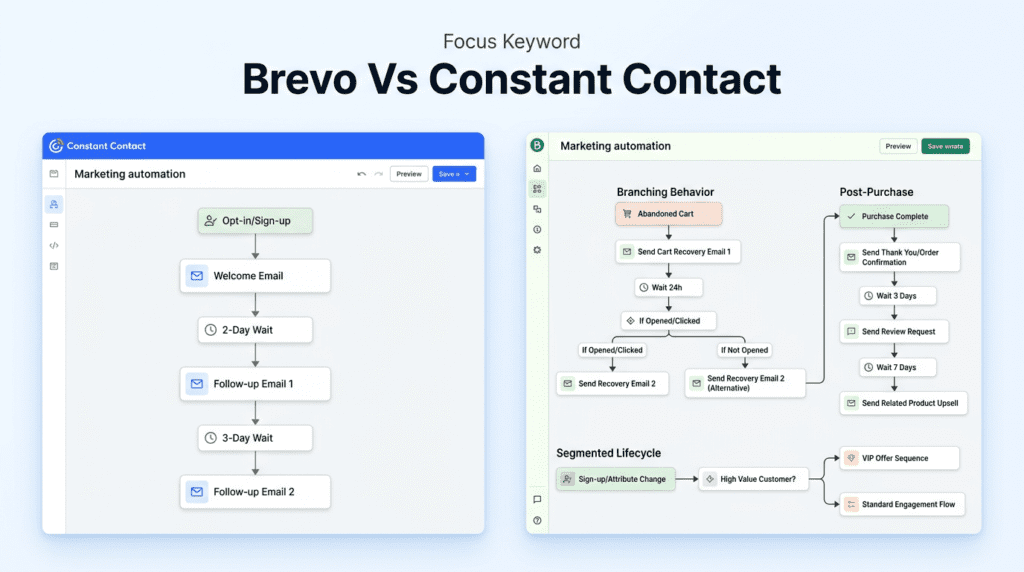
Automation is where the difference between Brevo and Constant Contact gets obvious fast. Both can handle basic follow-ups, but they do not treat workflow depth the same way. If you only need a welcome email or a simple reminder sequence, either platform can work. Once you start building behavior-based paths, lead scoring logic, or more layered lifecycle campaigns, the gap widens.
Basic automation in Constant Contact
Constant Contact keeps automation approachable. You can set up common sequences like welcome emails, birthday messages, and simple follow-ups without much friction. That’s useful if your team is small and you don’t want to spend half a day mapping out triggers before sending the first campaign.
The downside is that Constant Contact’s automation tends to stay in the “good enough” zone for many users. It handles basic marketing automation well, but it doesn’t feel built for complicated branching or highly customized decision trees. If you’re just trying to automate a newsletter workflow or a simple re-engagement sequence, that may be fine. If you want to react to multiple behaviors at once, you’ll feel the ceiling.
Brevo workflow depth and branching options
Brevo gives you more room to build. You can create workflows based on behavior, events, timing, and contact actions, which opens the door to more advanced customer journey design. That matters for businesses running multiple offers, abandoned cart follow-ups, lead nurturing, or post-purchase sequences.
The benefit is control. The frustration is that control takes time. Brevo’s workflow builder asks you to think like an operator, not just a sender. If your team is not used to mapping conditions, delays, and branching logic, setup can feel heavier than expected. But once it’s in place, the system can do more of the repetitive work for you.
Which tool handles lifecycle campaigns better
Brevo is the stronger choice for lifecycle campaigns. It gives you more options to segment based on behavior, trigger messages after specific actions, and adjust your customer journey as people move from lead to buyer to repeat customer. That’s valuable if you’re trying to run email marketing campaigns that feel timely instead of generic.
Constant Contact can still support lifecycle basics, especially for smaller teams. But if the goal is to build layered sequences tied to engagement, purchases, or site activity, Brevo is simply better equipped. A coaching brand, ecommerce store, or SaaS company with multiple onboarding steps will usually get more from Brevo’s structure.
Automation limits that matter as your business grows
The biggest automation limitation is not whether a tool can send an email. It’s whether it can keep up as the workflow gets more complicated. Constant Contact can start to feel narrow when you need multiple branches, detailed segmentation, or cross-channel actions. That becomes noticeable once your list grows past a few thousand contacts and your campaigns stop being one-size-fits-all.
Brevo can handle more, but that doesn’t mean everyone should use the most complex setup possible. Overbuilding workflows is a real mistake. A small business with five products and one newsletter does not need a maze of triggers. Still, if you expect to expand into advanced automation later, Brevo leaves more headroom.
Best platform for hands-off email marketing
Brevo is the better choice for hands-off email marketing because it supports more automation depth and more flexible workflow design. It’s the better fit if you want messages to respond to user behavior without constant manual work.
Choose Constant Contact if you want easy automation that you can set up quickly and leave alone. It works well for simple needs. Choose Brevo if you want your system to do more of the thinking and you’re willing to invest a little more time upfront.
Integration Comparison: Brevo and Constant Contact
Integrations matter more than most buyers expect. The email tool itself might look fine, but if it doesn’t connect cleanly to your store, CRM, or website, the whole workflow gets messy. You end up exporting lists, fixing field mismatches, and chasing down missing data. That’s where integration depth starts affecting day-to-day work.
Core integration categories
Both platforms connect to the basics: website builders, forms, ecommerce tools, and common marketing apps. That covers a lot of standard use cases for small businesses. If you just need to sync a contact list, trigger a notification, or capture leads from a form, either platform can usually handle it.
The difference is in how far those connections go. Constant Contact offers a friendly set of integrations that works well for simple marketing setups. Brevo tends to feel broader, especially if you care about automation triggers, CRM flow, or messaging across multiple channels. For teams with a clean stack, the gap may not matter. For teams with a messy stack, it absolutely does.
Ecommerce and CRM connections
Brevo is stronger when ecommerce and CRM data need to move together. It can connect email marketing, contact management, transactional email, and automation in one place, which is useful if you want order data or customer activity to shape your campaigns. That’s especially helpful for stores sending abandoned cart messages, post-purchase follow-ups, or product recommendations.
Constant Contact supports useful ecommerce connections too, but it feels more limited if your business wants a deeper CRM-style workflow. It’s fine for straightforward contact management and basic follow-up. It’s less compelling when the goal is to manage a more connected customer lifecycle across sales and marketing.
Third-party app flexibility
Brevo usually has the edge in flexibility because it plays nicely with more technical and workflow-driven setups, including API-driven work. That matters if your team uses custom forms, internal tools, or a more layered stack. You do not need to be a developer to benefit from that, but the platform clearly leaves more room for technical growth.
Constant Contact is easier to live with if you want established apps and standard connections without much tinkering. It’s the less stressful route for many small businesses. Still, once the workflow becomes more specialized, the platform can feel like it was built for a narrower set of use cases.
When integration depth changes the decision
Integration depth becomes decisive when email is not your only channel. If you’re syncing customer data, managing lead capture, or tying messages to purchases and site behavior, Brevo usually makes more sense. If you only need a newsletter tool that plugs into a few common services, Constant Contact may be enough.
A good rule: the more moving parts in your marketing stack, the more likely Brevo is to fit better. If your setup is simple, Constant Contact’s cleaner workflow may save you time.
Which platform fits a more connected marketing stack
Brevo fits a more connected marketing stack. It is better for brands that want email, CRM, automation, and transactional messages to work together without a bunch of manual handoffs.
Constant Contact fits a simpler stack where the goal is to send campaigns, manage a list, and keep things moving with minimal technical overhead. If you need one platform that acts like the center of your marketing operations, Brevo is usually the stronger pick.
Brevo vs Constant Contact for Campaign Performance
Campaign performance is not just about who has prettier screens. It’s about how quickly you can build something useful, how much control you have over the design, and whether the platform helps your messages land in the inbox and earn clicks. Both Brevo and Constant Contact can produce solid results, but they push users in different directions.
Designing campaigns that get opened and clicked
Good campaign performance starts with the message, not the software. Still, the platform affects how easily you can test, adjust, and send polished email marketing campaigns. Constant Contact leans into speed and simplicity, which helps beginners publish a clean email campaign without overthinking every block. That can be a real advantage when you need to send fast.
Brevo gives more room for structure and targeting. If you’re building campaigns based on segmentation, user behavior, or purchase history, that extra control can lift open rate and click-through rates because the message is more relevant. A generic newsletter sent to 10,000 people will usually underperform a targeted message sent to 2,000 people who actually care.
Template quality and creative control
Constant Contact is known for being approachable, and its templates reflect that. You can get a decent-looking campaign out the door quickly, even if you’re not design-savvy. The drag-and-drop editor keeps things simple, which is why many constant contact users stick with it for years.
Brevo is more customizable, but it asks a bit more from the sender. The creative controls are useful when you want a more tailored layout, but they can also slow down a rushed team. If you need something polished in 15 minutes, Constant Contact often feels easier. If you want more flexibility and are willing to tweak, Brevo is the more adaptable tool.
Reporting and performance tracking
Constant Contact provides straightforward reporting that covers the basics well. You can see opens, clicks, and other core results without digging through too many layers. That’s enough for many small businesses that just want to know whether the campaign worked.
Brevo tends to appeal more to teams that want deeper tracking around behavior and workflow performance. It can be more useful if you care about what happens after the first send, not just the first open. That matters when you’re testing different segments or trying to improve conversion over time instead of chasing vanity metrics.
Inbox and engagement considerations
Neither platform can guarantee the inbox, but both give you the standard pieces needed to support deliverability. List quality still matters more than the tool. If your contact list is full of inactive addresses, old imports, or poorly collected leads, your inbox placement will suffer no matter what platform you use.
Constant Contact is often comfortable for teams that want reliable sending without complexity. Brevo can be just as effective, especially when your segmentation is cleaner and your automation is better targeted. The hard truth is that engagement often improves when the platform helps you send less junk to the wrong people.
What affects real campaign results beyond the interface
The interface matters less than most buyers think. Your results depend more on list quality, message timing, offer relevance, and consistency. A well-timed campaign sent to a smaller, engaged list often beats a larger blast with weak targeting.
That’s why this comparison is not only about features. Constant Contact can make it easier to stay consistent. Brevo can make it easier to refine and optimize. If your team has the discipline to use segmentation and automation well, Brevo may produce better long-term results. If you need speed and reliability with less setup, Constant Contact may deliver better day-to-day performance.
What Most Blogs Miss About Brevo vs Constant Contact
A lot of comparisons stop at features and pricing. That misses the real issue. The difference between Brevo and Constant Contact is not just what they can do today. It’s how they feel after 6 months of growth, more contacts, and more pressure to do better work with less time.
Trade-offs between simplicity and flexibility
The biggest trade-off is simple. Constant Contact is easier to grasp, easier to launch, and easier to explain to a small team. Brevo gives you more room to build, but it asks for more patience. That trade-off is not theoretical. It shows up when someone needs to build a new workflow, update a contact list, or connect another app and realizes the platform behaves very differently.
If you value speed and comfort, Constant Contact wins early. If you value control and room to grow, Brevo wins later. That is why some teams feel happy with Constant Contact for years, while others eventually feel boxed in by it.
How list growth changes the value equation
List growth changes everything. A platform that feels cheap at 500 contacts may feel expensive at 10,000. A platform that feels manageable at 5 campaigns a month may feel clunky at 20. The number of contacts, the number of emails you send, and the complexity of your workflow all change the equation.
This is where constant contact vs brevo stops being a feature debate and becomes a business model question. If your list grows fast but your sending volume stays modest, Brevo can be easier to justify. If your list stays smaller and you want a predictable workflow, Constant Contact can remain the better fit.
Why beginner-friendly does not always mean better long term
Beginner-friendly is useful, but it can also hide limits. Constant Contact helps new users move quickly, which is great when you’re just getting started. But if your business later needs more advanced segmentation, more integrations, or more campaign logic, you may run into friction.
Brevo is not as instantly comfortable, but it can age better for teams that expect to build more sophisticated systems. That does not mean every beginner should start there. It means the easy choice today can become the annoying choice tomorrow if your workflow expands.
When a platform feels good early but becomes limiting later
A platform feels good early when it removes decision fatigue. It becomes limiting when you notice repeated work, awkward workarounds, or missing control in the places that matter. That usually happens after the first few successful campaigns, when the real operational issues start showing up.
If you’ve been using constant contact for years and only now feel the pain of list-based pricing, limited workflow depth, or shallow segmentation, that’s not unusual. It’s a sign the tool matched your early needs but not your current ones. Brevo is often the better choice for teams already thinking beyond basic email sends, while Constant Contact remains a strong fit for teams that want dependable simplicity and don’t need to push far past the basics.
Common Mistakes When Choosing Between Constant Contact and Brevo
Picking based on price alone
Price gets attention first, but it’s a poor decision shortcut. Brevo and Constant Contact don’t just differ on monthly cost; they differ on how they charge, what they include, and how that affects your workflow once your list starts growing. A plan that looks cheaper on paper can turn awkward fast if you send a high number of campaigns or need extra users, SMS, or deeper automation.
This is where buyers get tripped up. Someone with a 5,000-contact newsletter might assume the cheaper starting tier is the smarter pick, then realize the real cost shows up through contact limits, email volume, or add-ons. On the flip side, Constant Contact can feel easier to budget for at first, especially for small businesses, but the value shifts depending on whether you actually need the extra polish or just need to send a clean email campaign every week.
Ignoring automation needs until later
A lot of teams choose a platform for basic email marketing, then discover six months later that they need more than a welcome series. By then, the workflow is already built, the contact list is in place, and moving becomes a hassle. That’s why automation should be part of the decision on day one, even if you only plan to use 2 or 3 basic flows now.
Constant Contact supports useful starter automation, but Brevo offers more control once you want branching based on behavior, purchase activity, or lead stage. If you know you’ll eventually want abandoned cart reminders, re-engagement paths, or different customer journey paths for buyers and non-buyers, don’t pretend you won’t care later. That’s usually when teams feel boxed in.
Overlooking integration requirements
This one is easy to miss because integrations sound optional until your stack gets messy. If your form tool, ecommerce store, CRM, calendar, or WordPress site doesn’t connect cleanly, someone ends up copying data by hand. That’s not just annoying. It creates delays, duplicate contacts, and bad segmentation.
Brevo and Constant Contact both support useful integrations, but the fit depends on your setup. A brand using Shopify, a CRM, and a sales notification workflow will care more about connection depth than a solo creator sending one monthly newsletter. If your business depends on a connected workflow, check whether the platform can actually pass the right data in both directions, not just sync names into a contact list.
Choosing the wrong tool for your email volume
Email volume changes the math fast. If you send one newsletter a month, almost any platform can work. If you send weekly promotions, product updates, and transactional messages, the difference between list-based pricing and volume-based pricing becomes much more obvious. Brevo often makes more sense when sending volume is high because it scales more naturally around the number of emails you send. Constant Contact is easier when the priority is a steady contact-based marketing routine.
A business with 2,000 contacts but 20,000 monthly sends may feel Brevo’s model fits better. Another business with 15,000 contacts and a light send schedule might care more about simplicity than sending mechanics. The mistake is treating all email marketing tools as if they behave the same once you start moving real traffic.
Misjudging how much time setup and management really take
Setup time is usually underestimated. People see drag-and-drop editors and assume the workflow will be painless. Then they spend hours cleaning imports, fixing custom fields, organizing segments, testing templates, and learning how one platform handles automation triggers differently from another.
Constant Contact usually gets the edge for speed because it is more straightforward out of the box. Brevo can take a little longer to configure, but that extra setup often pays off if you need more advanced control later. The real issue is not just launch time. It’s the weekly management burden after the first campaign goes out. If your team is small and already overloaded, a platform that saves 30 minutes today can save or waste several hours over a month.
Brevo vs Constant Contact: Which Is Better for Different Use Cases?
Best for beginners
Constant Contact is usually the safer starting point for beginners who want to send a newsletter without fighting the software. The interface feels familiar, the core workflow is easy to follow, and the learning curve is lighter than Brevo’s. If your main goal is to build a contact list, pick a template, and send a simple email campaign, Constant Contact keeps things manageable.
Brevo can still work for beginners, but it asks for a bit more setup discipline. That’s not always bad. It just means first-time users may need more time to understand contact management, automation options, and how the platform organizes different message types.
Best for small businesses sending regular campaigns
For small businesses that send consistent promotions, updates, or product announcements, both tools can work well, but the better fit depends on the shape of the campaign calendar. Constant Contact is strong when the team wants a repeatable routine and minimal friction. It supports many small-business marketing habits without making the workflow feel heavy.
Brevo becomes more attractive when those campaigns are tied to customer actions or a broader sales process. A local retailer, ecommerce brand, or service business that wants a cleaner bridge between email marketing and transactional messages may find Brevo more practical. It gives more room to grow without forcing a platform switch later.
Best for workflow-driven email marketing
Brevo wins here. If your email strategy depends on behavior-based automation, custom journeys, segmentation, and messages that change based on what people do, Brevo is the better fit. It handles more complex workflow logic, which matters when you’re running lifecycle campaigns instead of just monthly blasts.
Think about a SaaS company that needs onboarding emails, trial nudges, usage-based notifications, and reactivation emails. That kind of setup needs more than basic scheduling. Constant Contact can support straightforward sequences, but Brevo offers the deeper workflow structure that makes that kind of system easier to manage.
Best for teams that want simple, fast execution
Constant Contact is the better choice when speed and simplicity matter more than depth. Teams that need to get a campaign out today, not next week, often prefer its cleaner path from draft to send. The platform reduces decision fatigue, which is a real advantage for small teams with no dedicated marketer.
This is especially useful if multiple people touch the same account but only one person handles the actual sends. Less complexity usually means fewer mistakes, fewer broken segments, and fewer “where did this setting go?” moments. That matters more than people expect.
Best for growing businesses that need more control
Brevo is the stronger long-term option for growing businesses that know their email program will become more complex. As your list grows, your campaigns usually split into more segments, more customer journeys, and more transactional messaging. Brevo is built to handle that kind of expansion with more flexibility around workflow design and contact organization.
The difference becomes clearer once you start asking for more from the platform: better segmentation, more advanced automation, and tighter coordination between marketing and operational emails. If you expect your team to need that control within the next 6 to 18 months, Brevo is often the better bet.
Final Verdict: Brevo Vs Constant Contact

Which tool wins overall
Brevo wins overall for flexibility, automation depth, and long-term scaling. Constant Contact wins for simplicity, speed, and beginner-friendly execution. That’s the real difference between Brevo Vs Constant Contact in 2026. One is the stronger operational marketing platform. The other is the easier place to send straightforward campaigns without much setup stress.
For most readers, the choice comes down to how much control they want over the next year. If you need a simple tool now and don’t expect much complexity, Constant Contact is fine. If you want room to build more serious automation and handle more than basic newsletters, Brevo is usually the stronger pick.
When Brevo is the better choice
Choose Brevo if you care about workflow depth, email volume, or mixing marketing and transactional messaging in one platform. It’s a better fit for teams that want more control over segmentation, branching logic, and list behavior. It also tends to make more sense when your email program is tied closely to ecommerce or product activity.
Brevo is especially useful when you want one platform instead of stitching together multiple tools. If you’re already thinking about CRM handoffs, SMS, API connections, or event-based messages, Brevo gives you more room to build without hitting a ceiling too early.
When Constant Contact is the better choice
Choose Constant Contact if your priority is ease of use and fast execution. It’s a better match for small businesses that mainly need newsletters, event promotions, announcements, and a reliable weekly sending rhythm. The platform is less intimidating, which matters when email marketing is only one part of a busy workload.
It also makes sense for teams that don’t want to spend much time learning software. If you’d rather keep the workflow simple than manage a more technical system, Constant Contact is the more comfortable choice. That’s not a small thing when you’re sending campaigns under real time pressure.
Final buying advice for email marketing in 2026
If you’re still unsure, look at your next 12 months, not just today. Constant Contact is the safer pick for simplicity. Brevo is the better pick for growth, control, and more advanced workflow needs. The right answer depends less on feature checklists and more on how your email program is likely to evolve.
For a solo operator or local business with a modest newsletter, Constant Contact often feels easier from day one. For a brand that expects segmentation, automation, and transactional messaging to matter more over time, Brevo is the stronger long-term platform.
Frequently Asked Questions About Brevo Vs Constant Contact
Is Brevo better than Constant Contact for email marketing?
Brevo is better for advanced automation, segmentation, and workflow flexibility. Constant Contact is better if you want a simpler setup and easier day-to-day sending.
If you’re running basic newsletters, Constant Contact is often enough. If your business needs behavior-based campaigns or more control over contact management, Brevo is usually the smarter option.
Is Constant Contact easier to use than Brevo?
Yes, Constant Contact is easier to use for most beginners. The dashboard, campaign setup, and editing tools are more straightforward.
Brevo takes a little more time to learn because it offers more control. That extra complexity is useful later, but it can slow down first-time users.
How does Brevo pricing compare with Constant Contact pricing?
Brevo pricing often scales more with email volume and plan features, while Constant Contact pricing is more tied to list size and tier selection. That means the cheaper option depends on how many contacts you have and how often you send.
A business with a larger contact list but lighter sending may prefer Constant Contact. A business with higher send volume may find Brevo more cost-efficient.
Which platform is better for automation workflows?
Brevo is better for automation workflows. It offers deeper branching, behavior-based logic, and more room for lifecycle campaigns.
Constant Contact supports useful automation, but it’s better suited to simpler sequences like welcomes, reminders, and basic follow-ups.
Can Constant Contact users switch to Brevo easily?
Yes, but it still takes planning. You can usually export contacts and move basic data, but automation paths, custom fields, and list logic often need to be rebuilt manually.
The switch is easier if your workflow is simple. It gets more complicated if you’ve built several active campaigns and segmented lists over time.
Which tool is better for long-term email marketing growth?
Brevo is better for long-term growth. It gives you more room to expand your workflow, add automation, and handle more complex messaging as your business matures.
Constant Contact can still support growth, but it is more likely to feel limiting once your email program becomes more operational and less basic.