
The Beehiiv Vs Convertkit decision usually shows up right when a newsletter starts getting real traction. At first, both look capable enough. Then the details start mattering: how fast you can publish, how clean your automation feels, whether you can actually grow the subscriber list without fighting the software, and if the platform helps you make money instead of just sending emails.
That’s where the choice gets less obvious. Beehiiv and ConvertKit are both strong newsletter platforms, but they solve slightly different problems. One leans harder into growth and monetization. The other leans more into email marketing flexibility and creator-friendly automation. If you pick the wrong one, the issue usually isn’t that it “doesn’t work.” It’s that it starts to feel clumsy once your newsletter, subscriber base, or sales process gets more serious.
Why Beehiiv Vs Convertkit is a common creator decision
This is a common fork in the road for newsletter creators because both platforms target people who want to build an audience, not just blast emails. Beehiiv appeals to creators who care about newsletter growth, referrals, ad revenue, and paid subscriptions. ConvertKit attracts creators who want stronger automation, tagging, and a more mature email marketing setup.
A solo creator with 1,000 subscribers may not feel the difference right away. But once you start thinking about segmented campaigns, recurring newsletters, lead magnets, or selling a digital product, the platform’s personality becomes obvious. That’s why the Beehiiv vs ConvertKit comparison keeps coming up.
The biggest mistake is assuming all newsletter tools are just sending systems. They’re not. Some are closer to a growth engine. Some are better workflow tools. Some try to do both and end up making you compromise somewhere.
A lot of buyers also focus too much on the free plan or the lowest starting price. That’s risky. A platform that feels simple at 200 subscribers can become annoying at 5,000. Export restrictions, automation limits, branding lockouts, and upgrade pressure tend to show up later, after you’ve already built around the tool.
Hidden frustrations that show up after you start sending
The pain usually starts in small ways. Maybe your landing page template feels too rigid. Maybe the automation builder is powerful but slow to manage. Maybe you can send newsletters easily, but setting up a clean email sequence takes more clicks than expected.
There’s also the operational side. A newsletter creator who wants to publish twice a week, sell a digital product, and track which subscriber came from which referral source can run into friction fast. Tools that look “creator-friendly” on the surface can still be awkward when you’re juggling growth and monetization at the same time.
Why expectations matter for monetization and growth
If your main goal is to monetize a newsletter, you need to know what the platform is actually designed to support. Beehiiv offers stronger built-in monetization and growth tools, but ConvertKit can still be the better fit if your business depends on email automation, audience segmentation, and selling products through more flexible funnels.
The wrong expectation creates disappointment. If you expect ConvertKit to feel like a growth-first media platform, you may think it’s missing pieces. If you expect Beehiiv to replace a deeper marketing stack, you may run into workflow limits. The better question isn’t which one is “better.” It’s which one matches how you actually plan to grow and monetize.
Quick Verdict: Beehiiv vs ConvertKit at a Glance
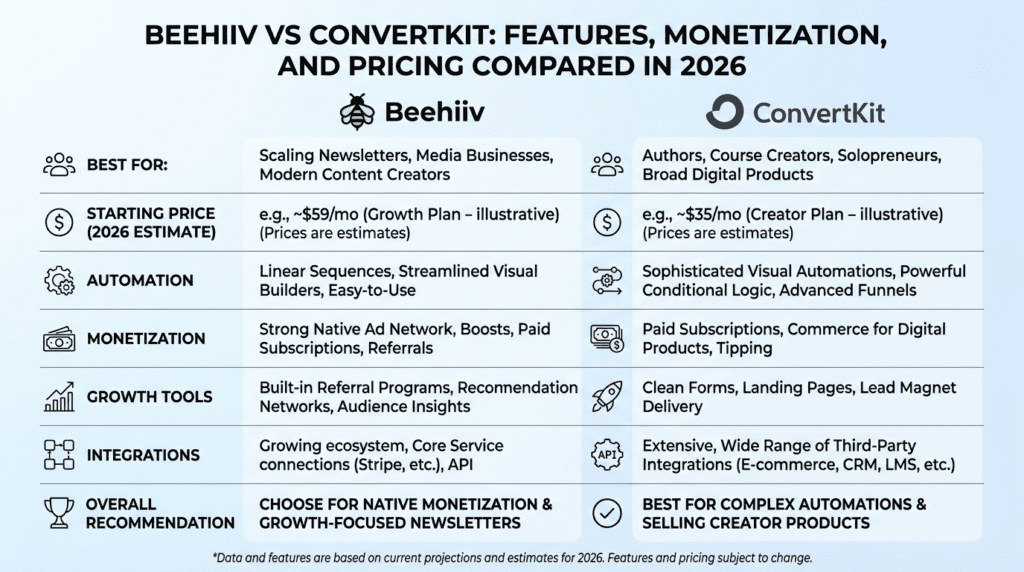
Complete Comparison Table
| Category | Beehiiv | ConvertKit |
|---|---|---|
| Best For | Newsletter creators focused on growth and monetization | Creators and businesses that need flexible email marketing and automation |
| Starting Price | Free plan available; paid plans typically start around $39/month | Free plan available; paid plans typically start around $29/month |
| Free Plan | Yes, with core publishing tools and branding limits | Yes, with list and feature limits that push upgrades as you scale |
| Ease of Use | Easier for newsletter publishing and creator-style workflows | Easier for structured email marketing once you learn the system |
| Automation | Good for simple-to-moderate workflows | Stronger for tagging, branching, and automated email sequences |
| Monetization | Built-in ad network, paid subscriptions, referrals | Digital product sales and creator commerce, but fewer native monetization tools |
| Growth Tools | Strong referral and recommendation-style growth features | More limited native growth tools, stronger on audience management |
| Landing Pages | Solid newsletter landing page and signup options | Flexible forms and pages, especially for lead capture |
| Integrations | Good, but narrower than some full marketing stacks | Broader integration ecosystem and creator tool fit |
| Subscriber Management | Clean for newsletter publishers | Better for detailed segmentation and tagging |
| Best Scaling Fit | Great for media-style newsletter growth | Better for advanced automation and product-based creator funnels |
| Biggest Limitation | Less flexible for deep marketing workflows | Fewer built-in monetization and newsletter growth tools |
| Overall Recommendation | Choose if growth and monetization are the priority | Choose if automation and email marketing depth matter most |
Best For
Beehiiv is best for creators who want to build a newsletter first and monetize it without stitching together extra tools. It fits writers, operators, media-style publishers, and solo creators who want referral growth, ad revenue, and paid subscriptions in one place.
ConvertKit is best for creators who need stronger automation, segmentation, and a more traditional email marketing setup. If your newsletter is part of a broader sales system, especially around a digital product, course, or funnel, it usually feels more complete.
Not Ideal For
Beehiiv is not ideal if you need deep automation branching, advanced customer journeys, or a wide integration stack for multiple business systems. It can feel too opinionated once your workflow gets more complex.
ConvertKit is not ideal if you want built-in monetization and newsletter growth features from day one. It can handle the job, but you may need more outside tools to match what Beehiiv offers natively.
Bottom Line
If you want the stronger creator-first newsletter platform, Beehiiv is usually the cleaner choice. If you want the more flexible email marketing platform, ConvertKit is often the safer long-term pick. The right answer depends on whether your priority is growing a newsletter or running a broader email business around it.
Beehiiv vs ConvertKit: Core Feature Differences That Matter Most
Both platforms handle the basics well. You can send broadcasts, manage a subscriber list, and publish a newsletter without much friction. That part is not where the real separation happens.
Beehiiv feels more purpose-built for newsletter publishing. The editor, publishing flow, and creator-centric layout make it easier to move fast if your main job is writing and sending. ConvertKit feels more like a true email marketing platform. It still works for newsletters, but its structure leans toward segmentation, tags, and campaign logic. For a creator who sends one or two newsletters a week, Beehiiv can feel simpler. For someone running multiple email campaigns, ConvertKit usually gives more room to grow.
Automation workflows and subscriber journeys
This is where ConvertKit pulls ahead. Its automation is more flexible, especially when you need branching logic, tag-based actions, or automated email sequences tied to behavior. If a new subscriber joins from one lead magnet, clicks a link, and then gets moved into a separate sequence, ConvertKit handles that kind of workflow more naturally.
Beehiiv has automation too, but it’s less of a marketing operations machine. It’s fine for simpler journeys, welcome sequences, and basic follow-up logic. The trade-off is that you get a cleaner interface and less setup pain. The downside is obvious once you try to do more advanced routing. You may find yourself wishing for more control than the system wants to give you.
Landing page and signup form options
Both tools offer landing page and signup form functionality, but they approach it differently. Beehiiv puts more weight on newsletter growth pages and subscriber capture that feels native to publishing. It’s a good fit if you want a fast signup page without spending half a day adjusting design details.
ConvertKit gives you more flexibility for forms and landing pages tied to different campaigns. That matters if you’re building separate funnels for a free guide, webinar, digital product, or audience segment. It’s not always prettier out of the box, but it can be more practical for businesses with multiple entry points.
Integration depth and ecosystem fit
ConvertKit usually wins here. It has a broader integration footprint and tends to fit better into a more traditional creator business stack. If you use ecommerce, membership tools, course platforms, or CRM-style systems, that flexibility matters.
Beehiiv does integrate with important tools, but the ecosystem feels narrower. That’s not necessarily bad. It just means the platform is more opinionated. If you prefer a cleaner, fewer-tools setup, that can be a plus. If your business relies on many connected systems, ConvertKit is usually easier to plug into the rest of your workflow.
Beehiiv is built for newsletter growth in a way ConvertKit isn’t. That shows up in the referral program, recommendation features, and built-in growth tools. These are the kinds of features that help a newsletter gain traction without requiring a separate stack.
ConvertKit can support growth, but it’s more indirect. It’s stronger at converting and nurturing people once they’re already on your list. That’s a useful distinction. Beehiiv helps you get subscribers. ConvertKit helps you work those subscribers more intelligently.
Beehiiv Monetization vs ConvertKit Monetization
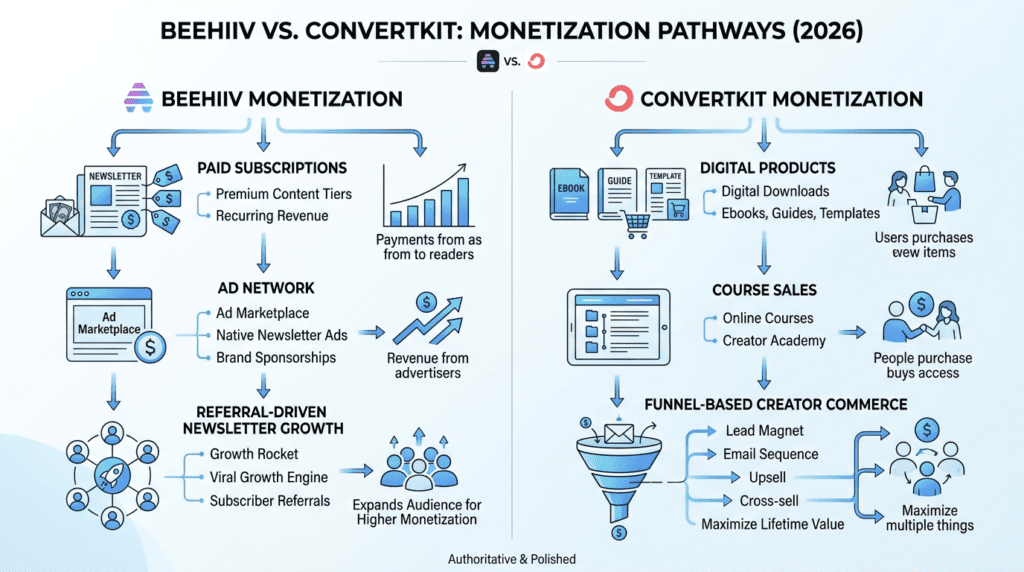
Beehiiv monetization tools for creators
Beehiiv offers some of the most creator-friendly monetization tools in the newsletter space. The big draw is that it lets you make money inside the platform instead of bolting on extra software. That includes paid subscriptions, referral-based growth incentives, and access to its ad network for eligible newsletters.
For a creator trying to monetize early, that matters. A newsletter with 2,000 to 10,000 subscribers may not be a giant media business, but it can still support sponsored placements, subscriber upgrades, or paid content if the audience is engaged. Beehiiv makes those paths more visible. It doesn’t guarantee income, of course. But it removes a few common setup barriers.
ConvertKit monetization options and limitations
ConvertKit can absolutely help you sell digital products, courses, and paid offers. That’s where it shines. If your monetization model is tied to selling directly to your audience, ConvertKit is often more useful than people expect.
The limitation is that monetization is less native to the newsletter itself. You can build a strong sales funnel with forms, sequences, and audience segments, but it doesn’t feel as purpose-built for newsletter revenue. There’s less of a built-in media-business mindset. That means more setup, more connecting pieces, and sometimes more manual thinking.
Beehiiv has the edge for sponsorships and paid newsletter models. It was clearly designed with newsletter monetization in mind, and that makes a difference when you want to grow and earn in the same place. If your long-term plan includes ad inventory, premium editions, or sponsor relationships, Beehiiv tends to feel more natural.
ConvertKit is better when your revenue comes from products rather than the newsletter itself. A creator selling an online course, coaching package, or paid community may care more about the lead-to-sale journey than newsletter monetization features. In that case, ConvertKit can be the more useful business tool, even if it’s less flashy.
What creators can realistically expect from each platform
Most creators won’t make meaningful revenue just because a platform has monetization features. That’s the hard truth. A paid newsletter still needs trust, consistency, and a specific audience problem worth paying for. A sponsorship model still needs enough reach and a clear niche.
Beehiiv gives you more built-in ways to experiment with monetization, which lowers friction. ConvertKit gives you stronger tools to sell once the audience is there. If you’re not yet sure how you’ll monetize, Beehiiv makes it easier to test. If you already know you’ll sell digital product offers, ConvertKit may produce a cleaner path.
Beehiiv vs Kit vs ConvertKit: Automation and Email Marketing Comparison
When Beehiiv is built for simpler creator workflows
Beehiiv is a strong fit when you want your newsletter operations to stay simple. If your workflow looks like: publish, send, grow, and maybe add a basic welcome sequence, it works well. The interface feels focused on creators who don’t want to manage a heavy backend.
That simplicity matters more than people admit. A newsletter creator who sends weekly content usually doesn’t want to spend an hour building out logic trees every time they add a new subscriber path. Beehiiv reduces that friction. It’s not trying to be a giant marketing suite. That’s part of the appeal.
When ConvertKit wins for more flexible automation
ConvertKit is the better choice when automation is part of the business model, not just a convenience. Its tagging system, subscriber actions, and branching logic make it easier to build more advanced journeys. That matters if you want different automated paths for buyers, webinar registrants, content subscribers, and abandoned checkout leads.
This is where kit and beehiiv start to feel very different in practice. Beehiiv is smoother for publishing. ConvertKit is stronger for behavior-driven email marketing. If you plan to keep adding funnels over time, ConvertKit usually ages better.
Newsletter automation vs full email marketing platform needs
A newsletter automation system and a full email marketing system are not the same thing. That distinction matters. Beehiiv can absolutely support a newsletter business, but it’s less suited for teams that need deeper customer journeys. ConvertKit is closer to a full email marketing tool, even if it still feels creator-friendly.
If your business sends content, promos, lead nurture, and product launches, ConvertKit usually fits better. If your business mostly publishes content and monetizes the audience directly, Beehiiv may be enough, and then some.
Trade-offs for creators who plan to scale
Scaling creates annoying little pressures. More subscriber segments. More lead magnets. More product offers. More automation branches. More chance for setup mistakes. The platform that felt “simple” at 500 subscribers can feel cramped at 25,000.
Beehiiv scales well for newsletter growth, but the trade-off is workflow depth. ConvertKit scales well for automation, but the trade-off is that you’ll often need to work harder to get the same built-in growth and monetization benefits. If you expect your creator business to become more complex over time, ConvertKit is usually the safer operational bet. If you expect the newsletter itself to remain the center of the business, Beehiiv may be the better choice.
Beehiiv vs ConvertKit Pricing and Value for Money
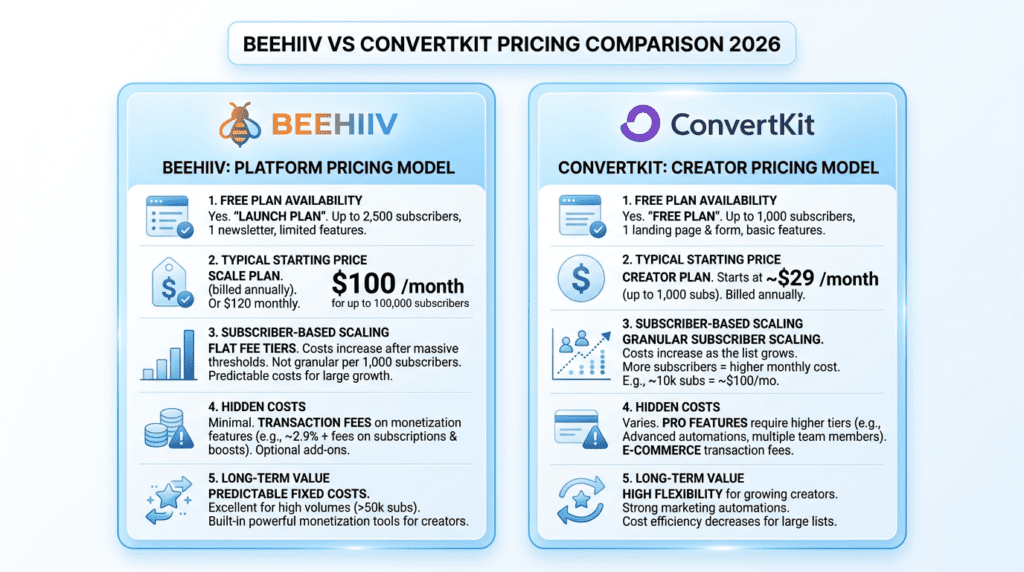
Starting price and plan structure
Beehiiv typically starts with a free plan and paid tiers that commonly begin around $39/month. ConvertKit also offers a free plan, with paid plans that typically start around $29/month. Exact pricing can change based on subscriber count and plan tier, so the real number depends on how large your email list gets.
That matters because newsletter platforms rarely stay at the entry price for long. A solo creator can start cheap, but a list with 5,000 to 10,000 subscribers will usually trigger a higher plan. So the “starting price” is useful, but it’s not the whole story.
Free plans and upgrade triggers
Both platforms use free plans as a way to let you start building, then nudge you upward once you hit practical limits. Beehiiv’s free plan is attractive if you want to start a newsletter without paying immediately. ConvertKit’s free plan is also useful, especially if you’re testing lead capture or simple email automation.
The catch is that upgrade triggers are usually operational, not emotional. You don’t upgrade because the dashboard looks nicer. You upgrade because branding limits, automation restrictions, or subscriber caps start getting in the way. That’s when the cost becomes real.
Hidden costs and feature lockouts
The visible subscription fee is only part of the cost. You also need to think about feature lockouts. Some tools reserve the best automation, segmentation, or monetization features for higher tiers. Others restrict branding removal, advanced forms, or team features.
There’s also the hidden cost of switching later. If you migrate from one platform to another after building a subscriber list, the actual expense includes time, risk, and possible disruption to your email delivery setup. For a creator with a small list, that might be manageable. For a business with tens of thousands of subscribers, it’s a headache you want to avoid.
Which platform offers better long-term value
Beehiiv often offers better value if your main goal is newsletter growth and monetization. You get built-in tools that would otherwise require separate services. That can reduce the total stack cost, even if the subscription itself isn’t the cheapest.
ConvertKit often offers better value if your business depends on automation, segmentation, and selling digital products. In that case, you’re paying for a more capable email system, not just a newsletter tool. The value comes from workflow efficiency. If it saves you from patching together three other tools, the math starts to make sense.
Pricing reality for solo creators vs growing businesses
A solo creator sending one newsletter a week can often get pretty far on a free plan or a lower-cost tier. At that stage, price sensitivity is real, and Beehiiv vs ConvertKit may come down to which free plan feels less limiting.
For a growing business, the calculation changes. A company with multiple lead magnets, sequences, and product launches should care more about automation depth than a $10 difference in starting price. The right platform is the one that reduces friction as your list, offers, and subscriber segments get more complicated.
Beehiiv vs ConvertKit: Ease of Use, Setup, and Daily Workflow
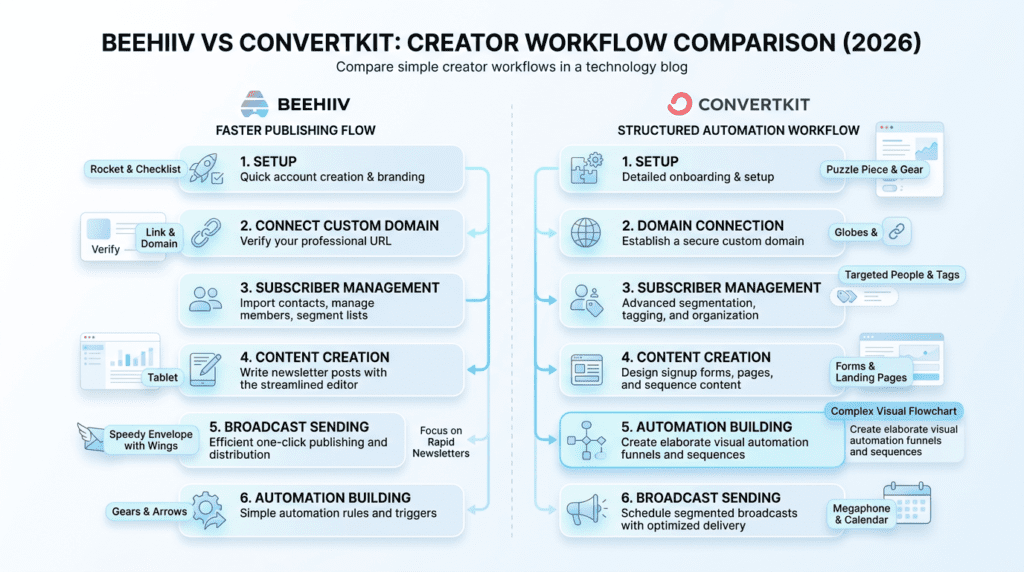
Onboarding experience for beginners
Beehiiv usually feels faster at the start. You can get through setup, connect your sender domain, and publish a first newsletter without spending much time digging through menus. The interface is built around the idea that you’re running a newsletter first, not a full marketing machine. That matters when you just want to launch and start sending.
ConvertKit takes a little more patience. It’s still usable, but there are more choices upfront, especially if you start exploring forms, tags, sequences, and automation. That flexibility is useful later, but it can feel like too much on day one. For a solo creator building a newsletter from scratch, Beehiiv is often easier to get moving. ConvertKit makes more sense if you already know you’ll need structured subscriber paths and more control over your email marketing.
Managing subscribers, segments, and broadcasts
Both platforms handle subscriber management well, but they approach it differently. Beehiiv keeps the workflow straightforward: grow the newsletter, segment the audience, and send broadcasts without a lot of friction. It’s clean for creators who want fewer moving parts and less setup overhead.
ConvertKit is more detailed. Tags, segments, and rules can create a much more tailored email list experience, but that also means more decisions every time you organize people. If you’re sending one newsletter a week to a simple audience, Beehiiv feels lighter. If your subscriber base needs multiple paths, products, and behavioral splits, ConvertKit gives you more room to manage that complexity.
Content creation and publishing workflow
Beehiiv leans into publishing. Drafting, formatting, and sending an email newsletter feels close to a content editor built for creators who publish often. There’s less operational drag, which helps if your main job is writing.
ConvertKit’s content workflow is solid, but it’s more email marketing oriented than media oriented. That’s not a flaw, just a different emphasis. If your process includes broadcasts, automated sequences, product launches, and lead nurture, the structure fits. But if your day revolves around writing a newsletter and getting it out quickly, Beehiiv usually feels more direct.
Where each platform feels faster or more complex
Beehiiv is faster when the goal is simple: create a newsletter, grow the subscriber base, and monetize later through built-in options. It tends to feel less cluttered because there are fewer layers between you and the send button.
ConvertKit gets more complex as soon as you start using its stronger automation and segmentation features. That’s the trade-off. The complexity is useful, but it can slow down smaller teams or first-time newsletter creators who don’t need all of it yet.
If you’re the kind of creator who wants to move fast and keep the workflow lean, Beehiiv often wins on day-to-day ease. If you’re already running launches, funnels, and multiple audience paths, ConvertKit’s extra structure starts to pay off.
Beehiiv vs ConvertKit: Growth Tools and Audience Building
Beehiiv is the stronger platform for referral-driven newsletter growth. Its referral program is built in, which makes it easier to encourage subscribers to share your newsletter without stitching together extra tools. That matters because referral systems only work when they’re simple enough for readers to actually use.
ConvertKit doesn’t center growth in the same way. You can still build an audience, but the platform is less focused on viral loops and more focused on relationship-based email marketing. That’s a real difference. Beehiiv is trying to help you grow the newsletter itself. ConvertKit is more about helping you communicate with the list you already have.
Audience growth features inside Beehiiv
Beehiiv offers a stronger set of newsletter growth tools out of the box. That includes options tied to referral mechanics, discoverability, and monetization paths that encourage audience expansion. For creators who care about growth and monetization at the same time, that combination can be valuable.
The catch is that these tools work best when you already have a decent content cadence and a reason for readers to share. A bare-bones newsletter with weak positioning won’t magically grow just because the platform has built-in growth features. Beehiiv helps amplify momentum, but it doesn’t replace the need for consistent writing, sharp topic selection, and a clear audience promise.
ConvertKit’s list-building and creator tools
ConvertKit does a good job with list-building, but in a different way. It gives creators forms, landing pages, segmentation, and automated follow-up paths that help convert traffic into subscribers and then into buyers. That makes sense for creators selling digital products, courses, coaching, or services.
It’s less about viral acceleration and more about conversion quality. A creator can build a steady email list using ConvertKit, but the platform expects you to drive traffic through content, products, social channels, or partnerships. If your growth plan depends on referrals and audience sharing inside the email platform itself, Beehiiv is more obvious. If your plan depends on funnels and follow-up, ConvertKit is often stronger.
Beehiiv is usually the better choice for pure newsletter growth. It offers more built-in systems that support subscriber expansion and audience sharing without much extra setup. That makes it attractive for media-style newsletters and creators who want growth to be part of the platform, not a separate project.
ConvertKit is better when growth is tied to conversion. If your audience-building strategy depends on lead magnets, product funnels, and segmented follow-up, it gives you more room to do that well. So the answer depends on what “growth” means in your business. If you mean more subscribers through newsletter-native tools, Beehiiv wins. If you mean building a list that converts, ConvertKit has the edge.
Beehiiv vs ConvertKit: Integrations and Ecosystem Fit
Native integration coverage
ConvertKit has the broader reputation for integration depth. It connects well with a lot of common creator and business tools, which is helpful when your workflow includes ecommerce, course platforms, forms, CRMs, and automation layers. That kind of compatibility matters more as your stack gets bigger.
Beehiiv’s native integration set is improving, but it’s generally leaner. For many newsletter creators, that’s enough. If you only need a few core connections, you may never notice the gap. But once your business starts relying on several systems working together, the difference becomes harder to ignore.
Third-party connections that matter most
The important question isn’t just how many integrations exist. It’s whether the ones you actually depend on are supported cleanly. For many creators, that means payment tools, landing page builders, analytics, WordPress, and maybe a course platform or ecommerce app.
ConvertKit usually fits better when your business stack is broader and more operationally layered. Beehiiv fits better when your stack is lighter and centered around publishing. If you use a lot of third-party tools, spend a few minutes checking whether the exact connection you need is native, indirect, or dependent on Zapier-style workarounds. That’s where hidden friction shows up later.
WordPress, landing page, and creator stack compatibility
For WordPress users, both platforms can work, but they support different habits. Beehiiv is convenient if your site exists mainly to support the newsletter and capture signups. ConvertKit works well if WordPress is one part of a larger lead-generation system with multiple opt-ins and funnels.
Landing pages are another useful clue. Beehiiv offers simple newsletter-focused landing page options, which is enough for many creators. ConvertKit gives you more flexibility if you want landing pages tied to automation, tagging, and lead capture logic. If your creator stack is lightweight, Beehiiv feels cleaner. If it’s more layered, ConvertKit is easier to plug into the rest of the workflow.
When integration gaps become a real problem
Integration gaps usually don’t matter when you’re small. They matter when your business starts depending on automation across platforms. That’s when manual exports, duplicate contact management, and broken tracking become real headaches.
If you plan to sell a digital product, run webinars, manage launches, or connect your newsletter to multiple lead sources, ConvertKit is often the safer fit. Beehiiv can still work, but you’ll want to confirm the exact tools in your stack before you commit. A missing integration doesn’t always kill the setup, but it can create enough friction to slow campaigns and increase manual work.
Beehiiv vs ConvertKit: Real-World Trade-Offs for Different Creator Types
Beehiiv is usually the better pick for solo newsletter creators who want to publish consistently without dealing with a complicated setup. It’s easier to keep the workflow focused on writing, sending, and growing. That matters when you’re running everything yourself and don’t want a platform that demands constant configuration.
ConvertKit can still work for solo creators, especially if monetization will come from products or launches later. But if the main goal is building a newsletter and keeping operations simple, Beehiiv tends to feel less heavy.
Beehiiv is the stronger choice for publishers, commentary newsletters, and media-style brands. It offers more built-in support for newsletter growth and monetization, which fits businesses that think in terms of audience scale and recurring publishing. The platform feels like it was designed for people who want the newsletter itself to be the product.
ConvertKit can serve this use case, but it’s usually better for creators with more complicated funnels than for publisher-style operations. If your business is content-led, Beehiiv is generally the cleaner fit.
Best choice for creators selling digital products
ConvertKit is often better for creators who sell digital products. Its automation, segmentation, and email sequences make it easier to move people from signup to education to purchase. That’s useful for course creators, coaches, and template sellers who need more than a simple broadcast tool.
Beehiiv does offer monetization features, but it’s less built around product funnel logic. If your revenue depends on guiding subscribers through a structured buying process, ConvertKit is usually the more practical choice.
Best choice for creators who want simpler monetization
Beehiiv is the better option if you want simpler monetization tied directly to the newsletter. Built-in ad and paid subscription paths can make the business model easier to understand, especially for smaller creator operations. You don’t need to assemble as many parts to start earning.
That simplicity comes with a trade-off. Beehiiv’s monetization works best when your newsletter already has some momentum. If you’re still early, the revenue may be modest at first. Still, for creators who want an easier route to monetization without building a full funnel system, Beehiiv is often the better fit.
Best choice for users who need advanced automation
ConvertKit wins when advanced automation matters. It has the stronger tools for automated email sequences, tag-based logic, and subscriber behavior tracking. That makes it a better fit for businesses with launches, content upgrades, and multi-step nurture flows.
Beehiiv can handle basic automation needs, but it’s not trying to be the deepest automation platform. If you need sophisticated paths that react to clicks, purchases, and subscriber actions across a bigger stack, ConvertKit is the stronger email marketing platform.
What Most Blogs Miss About Beehiiv vs ConvertKit
Monetization is not the same as revenue readiness
A lot of articles treat monetization as if built-in tools automatically create income. They don’t. Beehiiv can make it easier to turn a newsletter into revenue, but you still need audience size, engagement, and a topic advertisers or readers care about. ConvertKit can support product sales more directly, but you still need a real offer and a list that trusts you.
That’s the part people skip. Monetization tools reduce friction, but they don’t replace demand. A newsletter with 500 active subscribers and a clear niche may earn more than a larger list with weak engagement. The platform helps, but the business model does most of the work.
Growth tools only matter if you can actually use them
Beehiiv’s growth tools are useful, but they aren’t magic. Referral programs, discoverability features, and audience-sharing mechanics work best when your content is worth forwarding. If the newsletter is bland, readers won’t refer it just because the system exists.
ConvertKit’s growth path has the same issue, just in a different form. Its list-building tools work best when you already have traffic sources and a clear conversion path. So the real question isn’t which platform has more growth features. It’s which growth system matches the way you already attract people.
Email marketing needs change as your list grows
A platform that feels perfect at 1,000 subscribers can feel awkward at 25,000. Early on, simplicity matters most. Later, segmentation, automation, and integration depth start to matter more. That’s why some creators outgrow Beehiiv’s lightweight setup and others get tired of ConvertKit’s extra complexity.
This is where buyers get trapped. They choose based on their current stage, not where the business is heading. If you expect to stay newsletter-first, Beehiiv stays attractive. If you expect to build layered campaigns, sell offers, and manage multiple audience paths, ConvertKit is safer long term.
Why the right platform depends on your business model
Beehiiv and ConvertKit solve different problems, even though they overlap. Beehiiv is built for creators who want newsletter growth and monetization in one place. ConvertKit is stronger for creators who need robust email marketing tools, automated email sequences, and product-driven workflows.
So the better choice depends on what you’re building. A media-style newsletter, a commentary brand, or a paid newsletter model usually points toward Beehiiv. A creator business with funnels, courses, lead magnets, and segmented follow-up usually points toward ConvertKit. That’s the real deciding line.
Common Mistakes When Choosing Beehiiv or ConvertKit
Choosing based on features you will not use
This happens a lot. Buyers compare long feature lists and end up choosing the platform with the most options, not the one that fits the actual workflow. If you’re only sending one newsletter a week, advanced automation can become dead weight. If you’re selling products, a lightweight publishing-first setup can leave you stretched.
The smarter move is to match the platform to your daily habits. Most creators use only a small slice of any email tool. Pick the one that makes your core work easier, not the one that looks strongest on paper.
Overvaluing automation before list growth
Automation feels important because it sounds strategic. And it is, once you have an audience. But a strong automated funnel on a tiny list won’t do much for revenue. That’s why Beehiiv often makes more sense early for newsletter growth, while ConvertKit becomes more powerful once your list and offer stack are in place.
A lot of creators reverse the order. They spend weeks building email sequences before they have enough subscribers for those sequences to matter. First get the traffic, content, and signup flow working. Then layer in more advanced automation.
Ignoring pricing jumps as subscribers increase
Pricing looks simple at the start and then gets less friendly as the subscriber count climbs. That’s true for both platforms, even if the price structure differs. A free plan or low starting tier can hide the real cost of growth.
Before choosing, check what happens at 1,000, 5,000, 10,000, and beyond. A newsletter that is cheap at launch can become expensive once it starts performing. That doesn’t mean the platform is bad. It means you need to plan for the stage you’re trying to reach, not just the one you’re in today.
Picking the wrong platform for your monetization plan
If your plan is built around paid subscriptions, sponsorships, and newsletter-native revenue, Beehiiv is usually the more natural fit. If your plan is built around digital products, lead nurturing, and conversion-focused email marketing, ConvertKit is better aligned.
The mistake is trying to force one business model into the wrong tool. A creator who wants to sell digital products may find Beehiiv’s monetization tools helpful, but still feel boxed in by the lighter automation. A newsletter publisher may find ConvertKit powerful, but more operational than necessary. Choose the platform that matches how you expect to earn.
When Beehiiv Is the Better Choice
Beehiiv is usually the better choice when the newsletter itself is the business. That matters more than people expect. If your main goal is building an audience, growing a subscriber base, and eventually earning from that attention, beehiiv is built around that model from the start. The product feels like it was designed for newsletter creators who care about publishing speed, audience growth, and simple revenue paths more than deep CRM-style complexity.
It tends to work well for solo creators, niche publishers, and media-style brands that want one place to write, send, and grow. If you’re creating a newsletter around a topic like AI tools, finance, parenting, local business, or ecommerce, beehiiv keeps the workflow tight. You can move from idea to send without spending half your day untangling settings. That’s a real advantage when the whole business depends on consistent publishing.
Best fit for growth and monetization-focused users
Beehiiv has a clearer edge when growth and monetization are front and center. It offers built-in growth tools like referrals, recommendations, and newsletter-friendly monetization features that feel native to the platform instead of bolted on. For creators who want to grow a newsletter and start testing revenue faster, that reduces friction.
The bigger point is this: beehiiv is often the more practical choice for people who want to monetize a newsletter without building a heavy-stack workflow. You can start with a free plan, then move into paid plans as your list and revenue strategy become more serious. For many creators, that’s enough. They don’t need a complex funnel engine on day one. They need momentum, a clean editor, and tools that help a newsletter grow without turning into a technical project.
Situations where Beehiiv’s simplicity is an advantage
Beehiiv’s simplicity helps in situations where speed matters more than branching logic. If you’re sending one or two newsletter issues a week, running a paid newsletter, or building an audience around content and sponsorships, less complexity is often better. You don’t want to spend 45 minutes building automations for a workflow you’ll use once a month.
That said, simplicity does come with trade-offs. Beehiiv is not the best fit if you need highly detailed segmentation, layered email marketing automation, or a long chain of behavior-based sequences. But if your priority is to keep the business moving and avoid setup drag, that simplicity is a feature, not a weakness. It helps smaller teams stay consistent, which is usually what newsletter growth depends on anyway.
When ConvertKit Is the Better Choice
Best fit for email marketing and audience segmentation
ConvertKit is the stronger choice when your list needs more than a basic newsletter flow. If you care about segmentation, tags, subscriber behavior, and targeted email marketing, ConvertKit gives you more control. It’s better for users who don’t just want to send a newsletter, but want to build a more structured email marketing system around it.
That matters for creators with mixed audiences. A course creator, for example, may need one group for leads, another for buyers, and another for people who downloaded a lead magnet but never opened the welcome sequence. ConvertKit handles that kind of list logic more naturally. It’s also a better fit if you already think in terms of campaigns, funnels, and automated paths instead of just weekly broadcasts.
Best fit for creators with more complex funnels
If your business depends on automated journeys, ConvertKit usually earns its place. It supports more flexible automation than beehiiv, which makes a difference once your funnel gets layered. You might want to move subscribers through a welcome sequence, tag them based on link clicks, then send different follow-ups depending on what they bought or didn’t buy.
That level of control is useful, but it also means more setup. ConvertKit is not always the fastest platform to learn if you just want to publish a simple newsletter. Still, for creators selling digital products, coaching, memberships, or courses, the extra structure can be worth it. The automation becomes part of the sales system, not just an email feature.
Situations where ConvertKit’s flexibility is worth it
ConvertKit makes sense when you expect the email list to support multiple offers or audience paths over time. If you’re building one product now but plan to add more later, the platform can grow with that complexity. It also fits better if you rely on advanced segmentation to keep campaigns relevant and avoid blasting the same message to everyone.
There’s a trade-off, though. ConvertKit can feel heavier than beehiiv for creators who mostly want a newsletter platform, not a full email marketing platform. The flexibility is real, but so is the extra work. If you don’t need advanced workflows yet, some of that power just adds friction. The best sign that ConvertKit is right is simple: if you already know how you want to segment, sequence, and automate, then you’re likely to use what it offers.
Buying Guide: How to Choose Between Beehiiv and ConvertKit
If newsletter growth is the main goal, beehiiv usually has the edge. It’s built around helping you grow a newsletter with fewer moving parts. Referral programs, recommendations, and creator-friendly growth tools are all more central to the product. That can save a lot of time if you’re trying to move from zero to your first 1,000 or 10,000 subscribers without juggling extra apps.
ConvertKit can still grow a list, of course, but it’s not as obviously centered on newsletter growth mechanics. It’s stronger when growth is tied to automation and funnel management. So the decision comes down to your operating style. If you want the platform to actively support audience growth, beehiiv is the cleaner pick. If growth matters mainly as a side effect of a bigger email strategy, ConvertKit may still be enough.
If your priority is monetization
If monetization is the main reason you’re choosing a platform, beehiiv is often easier to start with. It gives newsletter creators more direct paths to earn from an audience, especially if you’re thinking about sponsorships, paid subscriptions, or newsletter-first revenue models. The platform feels aligned with creator monetization, not just email delivery.
ConvertKit can still help you sell digital products, memberships, or services, and that matters for creators whose revenue comes from offers rather than ads or paid newsletters. But if your audience growth and revenue plan are tightly connected to publishing a newsletter, beehiiv usually feels more native. The platform removes a few steps from the process, which is helpful when you’re trying to turn subscribers into income without building a bigger tech stack.
If your priority is automation
If automation is the priority, ConvertKit is the better choice. It handles automated email sequences, tagging, and behavior-based logic more comfortably than beehiiv. That makes it better for creators who want multiple funnels, lead magnet follow-ups, and segmented campaigns that react to what a subscriber does.
Beehiiv can support basic automation, but it’s not trying to be the most advanced automation engine. That’s the key difference. For some creators, basic is fine. For others, especially those with digital products or more complex audience paths, ConvertKit’s automation flexibility will save time later. The hidden cost with more advanced automation is setup and maintenance. If you won’t use that control regularly, it can become dead weight.
If your priority is ease of use
If ease of use matters most, beehiiv is usually simpler day to day. The interface is easier to move through, and the publishing workflow feels more direct. That’s useful for creators who want to create a newsletter, schedule it, and get back to work. You can stay focused on content instead of constantly adjusting infrastructure.
ConvertKit is still usable, but it asks for more decision-making. Tags, sequences, segments, and automations can get messy if your system isn’t organized. That’s not a flaw for everyone, but it can slow down beginners or solo creators who just want a smoother weekly publishing rhythm. If your business is small and the newsletter is your main content channel, simplicity usually wins more often than power.
If your priority is long-term scalability
For long-term scalability, the right answer depends on what you mean by scale. If you mean a larger newsletter business with sponsorships, audience growth, and productized content, beehiiv scales cleanly. If you mean a bigger email marketing system with funnels, segmentation, and multiple offers, ConvertKit scales better in that direction.
A practical way to think about it: beehiiv scales the newsletter business model, while ConvertKit scales the email marketing model. That difference matters once you’re past the first few hundred subscribers. The platform you pick should match the kind of complexity you expect at 5,000, 25,000, or 100,000 subscribers, not just the one you need today. If you’ll eventually need deep automation and audience branching, start with ConvertKit. If you expect to keep the model centered on publishing and monetization, beehiiv is likely the better long-term fit.
Final Verdict: Beehiiv Vs Convertkit

Beehiiv vs ConvertKit recap for creators
Beehiiv is the stronger choice for creator-first newsletters that want growth tools, simpler publishing, and built-in monetization paths. ConvertKit is stronger for email marketing depth, segmentation, and automation-heavy businesses. That’s the cleanest way to separate them.
If you’ve been comparing beehiiv vs convertkit because both look good on the surface, the real difference is operational. Beehiiv helps you run a newsletter business. ConvertKit helps you run a more complex email system. Both can work, but they reward different business models.
Final recommendation based on common use cases
For most solo newsletter creators, beehiiv is the easier recommendation. It keeps the workflow lighter and supports newsletter growth without demanding too much setup. For creators selling digital products, running funnels, or managing more advanced subscriber paths, ConvertKit is usually the smarter pick.
If you’re still unsure, ask one simple question: do you want a newsletter platform first, or an email marketing platform first? That answer usually settles it.
Beehiiv is the better choice when…
Beehiiv is the better choice when you want to grow a newsletter, keep publishing simple, and monetize through creator-friendly tools like referrals, sponsorships, or paid subscriptions. It’s also a strong fit if you’re a solo operator and don’t want your email platform turning into a second job.
It’s the right move when your priority is speed, not complexity. If you’d rather send consistently than design complex automations, beehiiv is probably the better fit.
ConvertKit is the better choice when…
ConvertKit is the better choice when your email list needs segmentation, automation, and multiple subscriber journeys. It’s especially strong for creators with courses, coaching, memberships, or digital products that rely on targeted follow-up.
If you already know your funnel logic and need a platform that can support it, ConvertKit gives you more room to build. That extra flexibility is what makes it valuable, even if it takes more time to set up.
Frequently Asked Questions About Beehiiv Vs Convertkit
Beehiiv is usually better for newsletter-first businesses. It focuses more on publishing, growth, and monetization, while ConvertKit leans harder into broader email marketing.
If your main goal is to build and grow a newsletter, beehiiv is often the cleaner choice. If your newsletter is part of a larger marketing funnel, ConvertKit may fit better.
Does Beehiiv have better monetization than ConvertKit?
Yes, beehiiv generally has better built-in monetization for newsletter creators. It’s more aligned with paid newsletters, sponsorships, and audience-driven revenue.
ConvertKit can still help you monetize through digital products and offers, but it’s less centered on newsletter-native revenue features.
Which platform is easier for beginners to use?
Beehiiv is usually easier for beginners. The setup feels simpler, and the day-to-day publishing workflow is less cluttered.
ConvertKit is still approachable, but its automation and segmentation options can make the platform feel more technical once you start building more advanced workflows.
Can I migrate from ConvertKit to Beehiiv easily?
Yes, you can migrate an email list from ConvertKit to beehiiv, but “easy” depends on how much automation you’ve built. A basic subscriber list is simple enough. Complex tags, sequences, and segments take more planning.
That’s the part people underestimate. The move itself is one thing. Rebuilding the workflow is usually where the real effort shows up.
Is ConvertKit still worth it in 2026?
Yes, ConvertKit is still worth it in 2026 if you need stronger automation and email marketing depth. It remains a solid choice for creators with funnels, products, and segmented audiences.
If you only need a simple newsletter, though, it can be more platform than you need.
Which platform is better for email marketing long term?
ConvertKit is better for long-term email marketing depth. It gives you more room to build complex automations, targeted sequences, and segmented campaigns.
Beehiiv is better long term if your business model is built around newsletter growth and monetization. The better platform depends on which of those two paths matters more.