
Running email campaigns today feels a lot like navigating a legal minefield. One wrong step, and you could face hefty fines, damaged sender reputation, and a loss of trust from your subscribers. Many business owners, especially those just starting out or scaling quickly, often overlook the complex web of email marketing regulations that govern how we communicate with our audience. It’s not enough to simply build a list and send messages; you need to understand the legal framework that dictates everything from how you collect consent to how you handle unsubscribe requests.
Ignoring these rules isn’t just risky; it’s a direct threat to your business’s longevity. Whether you’re sending promotional offers, newsletters, or transactional updates, every email you dispatch falls under specific legal requirements designed to protect consumer privacy and prevent spam. Staying on the right side of the law means understanding key legislation like CAN-SPAM and GDPR, which can feel overwhelming when you’re trying to grow your business. This guide aims to simplify these complex topics, offering a clear, actionable path to compliance.
The Two Pillars of Modern Email Marketing Compliance
When you’re building an online business, especially in the “Make Money Online” (MMO) space, your email list is often your most valuable asset. But that asset comes with responsibilities. Two major pieces of legislation stand out as the foundational pillars for almost all modern email marketing regulations: the CAN-SPAM Act in the United States and the General Data Protection Regulation (GDPR) in the European Union. These laws set the standard for how businesses interact with recipients, and understanding their scope is non-negotiable for anyone sending commercial messages.
Understanding the CAN-SPAM Act (U.S. Law)
The CAN-SPAM Act, or “Controlling the Assault of Non-Solicited Pornography And Marketing Act,” became law in the U.S. in 2003. It primarily focuses on commercial email messages and gives recipients the right to stop receiving unwanted emails. Unlike some other laws, CAN-SPAM doesn’t require prior consent before sending a commercial email, but it does lay out strict rules for how those emails must be sent and how opt-out requests are handled. Essentially, it’s about making sure your emails are truthful, clearly identified, and easy to escape from.
Understanding the GDPR (E.U. Law)
The GDPR, which took effect in May 2018, is a much broader and more stringent data privacy law from the European Union. While CAN-SPAM focuses mainly on commercial email content and opt-outs, GDPR covers the entire lifecycle of personal data, including how it’s collected, stored, processed, and deleted. For email marketing, this means a much higher standard for consent. You generally need explicit, unambiguous consent from individuals before you can add them to your marketing list or send them promotional emails. It also grants individuals significant rights over their data, like the “right to be forgotten.”
Why You Likely Need to Comply with Both
Here’s where things get interesting, and often, a little tricky for businesses. Many entrepreneurs assume they only need to worry about the laws in their own country. However, the internet makes geographical boundaries almost irrelevant. If you’re running an online business, there’s a very high probability you’ll have subscribers or potential customers in both the U.S. and the E.U., not to mention other regions with their own privacy laws. For instance, I once helped a client audit their subscriber database after they received a GDPR complaint. Even though they were based in Texas, about 15% of their list had E.U. IP addresses at the time of signup. We had to implement a double opt-in process and update their privacy policy to reflect GDPR compliance, even for their U.S.-based operations, just to be safe.
This global reach means you can’t pick and choose which laws to follow. If you send an email to someone in Germany, GDPR applies. If you send one to someone in California, CAN-SPAM (and potentially CCPA) applies. The safest and most practical approach for most businesses is to adopt the highest standard of compliance, which often means adhering to GDPR’s stricter consent requirements. This strategy helps protect you across the board, minimizing your risk of penalties and building stronger trust with all your subscribers. It’s about proactive protection rather than reactive damage control.
Key Differences at a Glance
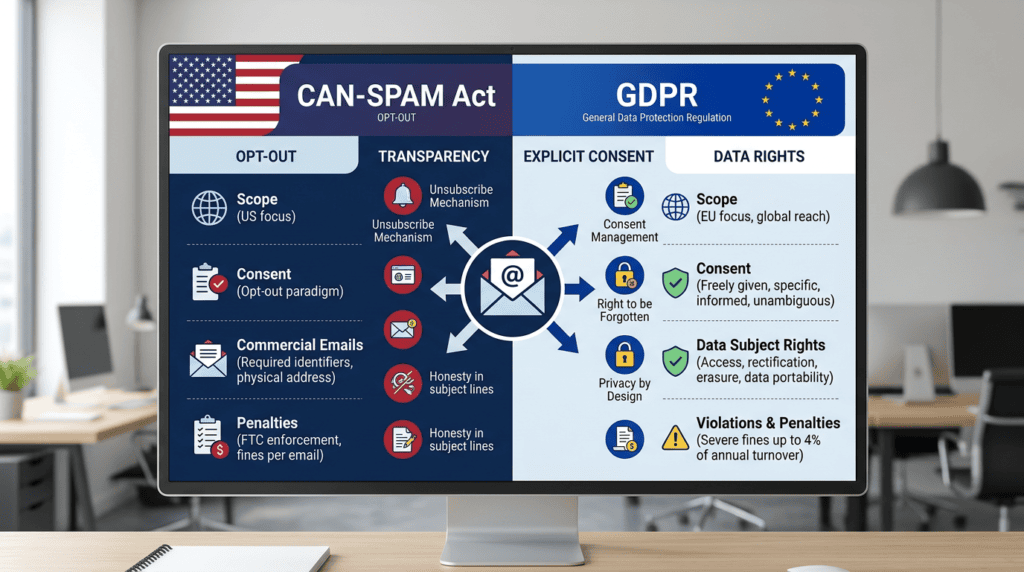
Navigating the nuances between these two major regulatory frameworks can be complex. This table offers a quick comparison of their core principles, highlighting the key distinctions that impact your email marketing regulations strategy.
| Comparison Factor | CAN-SPAM Act (U.S.)
How to Comply with the CAN-SPAM Act: A 7-Point Checklist
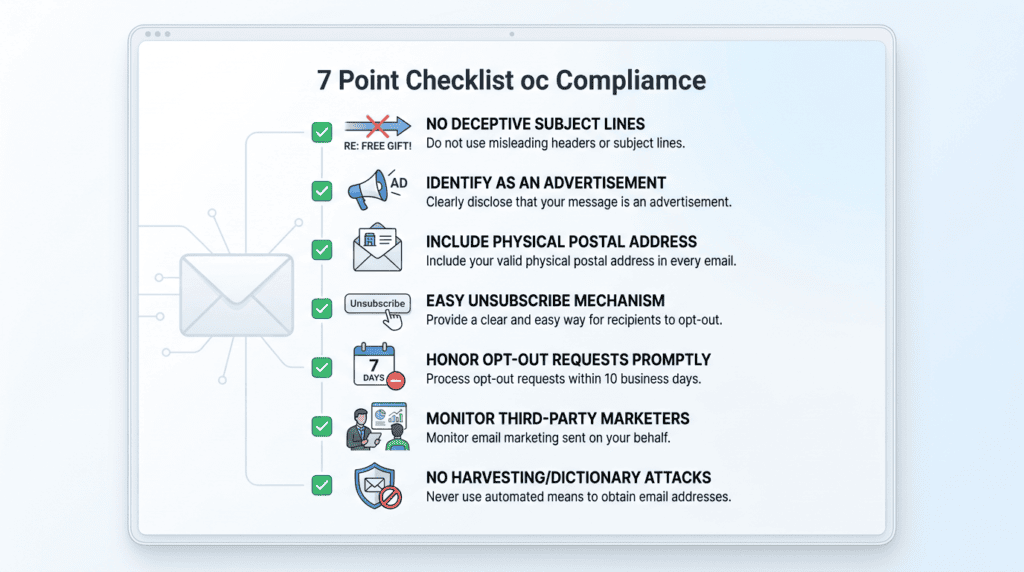
Navigating the CAN-SPAM Act doesn’t have to feel like a legal maze. This U.S. law sets clear rules for commercial email, focusing heavily on transparency and the recipient’s right to say “no.” Following these seven points will help ensure your email marketing campaigns stay on the right side of the law and avoid potential penalties. It’s all about respecting your recipients and being upfront about your intentions.
1. Don’t Use Deceptive Subject Lines or “From” Names
Your email’s header information needs to be accurate. This means the “From,” “To,” and “Reply-To” fields should correctly identify the person or business sending the message. More importantly, your subject lines can’t be misleading. They must accurately reflect the content of the email. Don’t use a subject line like “Your Order Confirmation” if the email is actually a sales pitch for a new product. The goal is transparency; recipients should know what they’re opening before they even click.
2. Identify the Message as an Ad
The CAN-SPAM Act requires that you clearly and conspicuously disclose if your email is an advertisement. This doesn’t mean you need to put “[AD]” in your subject line, but the commercial nature of the message should be obvious to the recipient. Often, a simple statement in the email footer, like “You are receiving this email because you opted in to receive marketing messages from [Your Company Name],” or “This is an advertisement,” can fulfill this requirement. The key is that it shouldn’t be hidden or hard to find.
3. Include a Valid Physical Postal Address
Every commercial email you send must include a valid physical postal address. This can be your business’s street address, a post office box you’ve registered with the U.S. Postal Service, or a private mailbox registered with a commercial mail receiving agency. This requirement helps recipients identify the sender and provides a tangible point of contact, reinforcing trust and accountability in your email marketing regulations compliance efforts.
4. Provide a Clear and Obvious Unsubscribe Mechanism
Recipients must have a clear and easy way to opt-out of receiving future emails from you. This means including an unsubscribe link or mechanism in every commercial email. The link should be easy to find, read, and understand. Don’t use tiny fonts, obscure language, or hide it among other links. It should be a one-click process, or at most, a few simple steps, without requiring the user to log in or jump through hoops.
5. Honor Opt-Out Requests Promptly
This is where many businesses can stumble, leading to potential fines and damage to their sender reputation. Once a recipient requests to unsubscribe, you must honor that opt-out request within 10 business days. During this 10-day window, you cannot send them any more commercial emails. The unsubscribe mechanism itself must remain operational for at least 30 days after the email is sent.
I once worked with a client who had a fantastic product but a messy email list. They were getting complaints because their unsubscribe process was broken, and people kept getting emails even after opting out. We had to implement a robust list cleaning process and an automated system to process unsubscribe requests immediately. It wasn’t just about avoiding CAN-SPAM penalties; it was about protecting their brand and ensuring their email marketing strategy was built on permission, not annoyance. Ignoring these requests is a surefire way to get flagged as spam, hurting your deliverability and overall marketing efforts.
6. Monitor What Others Do on Your Behalf
If you use an email service provider (ESP) or hire a third-party agency to handle your email campaigns, you are still legally responsible for their compliance with CAN-SPAM. This means you can’t just outsource your email marketing and wash your hands of the legal requirements. You need to ensure that any third-party senders adhere to all the regulations, including proper disclosure, unsubscribe mechanisms, and honoring opt-out requests. Always include compliance clauses in your contracts with these partners and conduct regular compliance checks.
7. Avoid “Email Harvesting” and Automated List Building
The CAN-SPAM Act strictly prohibits using software or other automated means to collect email addresses from websites or online services. This practice, known as “email harvesting” or “scraping,” is illegal. You also can’t use dictionary attacks to generate email addresses or automatically register for multiple email accounts. Your subscriber list must be built through legitimate means, primarily through explicit opt-ins where individuals willingly provide their email address. Buying third-party lists, especially those not built with verifiable consent, is also a risky practice that can violate these email marketing regulations.
How to Comply with GDPR for Email Marketing
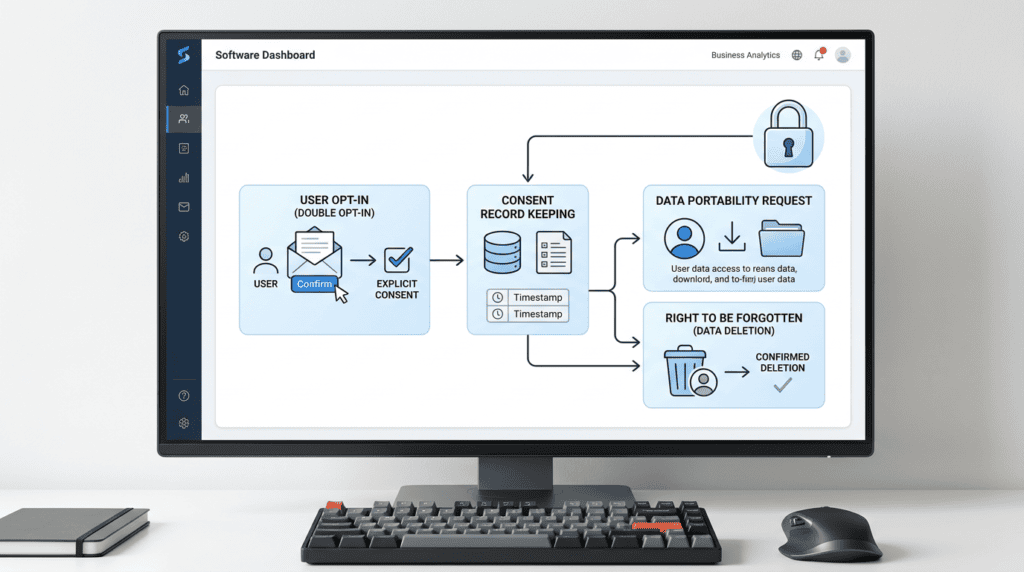
The General Data Protection Regulation (GDPR) is a comprehensive data privacy law from the European Union that significantly impacts how businesses handle personal data, including email addresses, of EU citizens. Even if your business isn’t based in the EU, if you market to or collect data from individuals in the EU, GDPR email marketing compliance is non-negotiable. It’s a much stricter framework than CAN-SPAM, built on the principle of explicit consent and individual rights over their data.
Securing Explicit and Unambiguous Consent
Under GDPR, the standard for consent is much higher. You can’t rely on implied consent or pre-checked boxes. Instead, you need explicit and unambiguous consent. This means individuals must actively and clearly agree to receive your marketing communications. They need to understand exactly what they’re consenting to, who is collecting their data, and for what purpose. A double opt-in process, where a user signs up and then confirms their subscription via a link in a confirmation email, is often considered best practice for demonstrating this level of active consent. This ensures the person truly wants to be on your list and helps maintain a high-quality subscriber list. It’s about building a permission-based email marketing foundation.
When we first started adapting our email campaigns for GDPR, the biggest shift was moving away from any form of passive consent. We had to re-evaluate every signup form, ensuring clear language, separate checkboxes for different types of marketing (e.g., newsletters vs. product updates), and a prominent link to our privacy policy. It felt like a lot of work upfront, but the resulting list quality and engagement were noticeably higher because every subscriber had genuinely opted in. This focus on explicit consent requirements is central to GDPR’s approach to protecting user data.
The Right to Be Forgotten: Handling Data Deletion Requests
GDPR grants individuals the “right to be forgotten,” also known as the right to erasure. This means if an EU resident asks you to delete their personal data, you generally must comply without undue delay. This includes their email address and any associated data you hold. You need a clear process in place to handle these data deletion requests efficiently and completely. Simply unsubscribing them isn isn’t enough; you must remove their data from your active databases and any backups, unless there’s a specific legal reason to retain it.
Data Portability: Providing Users with Their Data
Another key individual right under GDPR is data portability. If an EU resident requests it, you must provide them with a copy of the personal data you hold about them in a structured, commonly used, and machine-readable format. This allows them to easily transfer their data to another service provider. For email marketing, this might include their email address, subscription date, and any preference center settings they’ve chosen. Having a system to quickly extract and provide this information is a crucial aspect of GDPR compliance.
Maintaining Records of Consent
To demonstrate GDPR compliance, you must be able to prove that you obtained valid consent from your subscribers. This means maintaining detailed records of consent for each individual. These records should include:
- When consent was given (date and time).
- How consent was given (e.g., via a specific web form).
- What the individual was told at the time of consent (e.g., a copy of the privacy policy or terms of service they agreed to).
- Who gave consent (e.g., the email address).
- Whether consent was withdrawn and when.
These consent records are vital for any compliance audit checklist and provide a legal basis for processing personal data for your email campaigns.
Appointing a Data Protection Officer (DPO): When Is It Necessary?
Not every business needs to appoint a Data Protection Officer (DPO), but it’s a critical requirement for certain organizations under GDPR. You must appoint a DPO if:
- You are a public authority or body (except for courts acting in their judicial capacity).
- Your core activities involve regular and systematic monitoring of data subjects on a large scale.
- Your core activities consist of processing special categories of data (e.g., health data) or data relating to criminal convictions and offenses on a large scale.
A DPO’s role is to inform and advise the organization on its GDPR obligations, monitor compliance, and act as a contact point for data subjects and supervisory authorities. For many small to medium-sized businesses, especially those not dealing with sensitive data or large-scale monitoring, a DPO might not be necessary, but understanding these requirements is key to your overall GDPR compliance strategy.
Common Email Marketing Mistakes That Violate Regulations
Even with the best intentions, it’s easy to trip up on `email marketing regulations`. Many businesses make common errors that can lead to significant penalties and damage their reputation. Understanding these pitfalls is crucial for maintaining compliance.
- Mistake 1: Assuming a “Soft Opt-In” is Always Enough:
A “soft opt-in” often refers to an implied consent where an existing business relationship (like a past purchase) is used as a basis for sending marketing emails. While CAN-SPAM is more lenient and allows this as long as an unsubscribe option is present, GDPR has much stricter explicit consent requirements. For any subscribers in the EU, relying solely on a soft opt-in is a risky move. You need clear, affirmative action from the individual to send them commercial messages.
- Mistake 2: Burying the Unsubscribe Link:
This is a classic blunder that directly violates `email marketing regulations`. Both CAN-SPAM and GDPR demand that recipients can easily opt out of your emails. Hiding the unsubscribe link in tiny, light-grey text at the bottom of a long email, or requiring multiple clicks and a login to complete the process, is a surefire way to get reported for spam. It frustrates subscribers and signals to email service providers (ESPs) that you’re not playing by the rules, leading to deliverability issues.
- Mistake 3: Buying or Renting Email Lists:
This practice is a direct violation of consent principles under GDPR and highly risky under CAN-SPAM. When you buy or rent a list, you have no verifiable record of consent from those individuals. They haven’t explicitly given *you* permission to email them. Sending unsolicited commercial email messages to such lists almost guarantees high spam complaints, low engagement, and can quickly get your domain blacklisted. It’s a shortcut that leads to long-term problems for your `email marketing strategy`.
- Mistake 4: Forgetting Transactional Emails Have Rules, Too:
Transactional emails, like order confirmations, shipping updates, or password resets, are generally exempt from some of the stricter commercial email rules because their primary purpose isn’t promotional. However, this doesn’t mean they’re a free-for-all. They still must have accurate header information, not contain misleading subject lines, and their primary content must genuinely be transactional. You can’t sneak in a bunch of marketing pitches and call it a transactional email; that’s a clear violation of `email marketing regulations`.
The Real-World Consequences of Non-Compliance

Ignoring `email marketing regulations` isn’t just about abstract legal concepts; it carries concrete, often devastating, financial and reputational risks for your business.
- Financial Penalties: How Much Could a Violation Cost?:
The fines for non-compliance are substantial. Under CAN-SPAM, each separate email that violates the act can be subject to penalties of up to $50,120. Imagine sending a non-compliant email to a list of 10,000 people. That adds up fast. GDPR’s penalties are even more severe, reaching up to €20 million or 4% of a company’s annual global turnover, whichever is higher. These aren’t just slaps on the wrist; they can be business-ending fines.
- Reputational Damage and Loss of Customer Trust:
Beyond the financial hit, the damage to your brand’s reputation can be irreparable. When customers perceive you as a spammer, trust erodes quickly. I’ve seen businesses spend years building a loyal audience, only to lose it in months due because of a few careless `email marketing campaigns` that ignored consent and privacy. People talk, they leave negative reviews, and they actively avoid brands they don’t trust. This loss of goodwill can be far more costly than any fine.
- Email Deliverability Issues: Getting Blacklisted by ESPs:
Email Service Providers (ESPs) like Gmail, Outlook, and Yahoo are constantly monitoring sender behavior. If your emails generate too many spam complaints, have low engagement, or violate `email marketing regulations`, your sender reputation will plummet. This often leads to your domain being blacklisted, meaning your emails won’t even reach your subscribers’ inboxes; they’ll go straight to spam folders or be blocked entirely. This cripples your marketing efforts and makes it incredibly difficult to communicate with your audience.
Building a Compliant Email List from Scratch
Building a robust, engaged, and compliant email list from the ground up is the best long-term `email marketing strategy`. It ensures you’re playing by the rules and fostering trust with your subscribers.
- Using Double Opt-In for Ironclad Consent:
Double opt-in is the gold standard for collecting email addresses, especially under GDPR. Here’s how it works: a user signs up on your website, and then you send them a confirmation email with a link they must click to verify their subscription. This two-step process creates an undeniable record of explicit consent, proving that the subscriber genuinely wants to receive your emails. It also helps reduce spam complaints and ensures a higher quality list.
- Crafting Compliant Lead Magnets and Gated Content:
When using lead magnets (like free guides or templates) or gated content to collect emails, transparency is key. Your signup forms must clearly state that by providing their email, users are also agreeing to receive marketing communications. Avoid pre-checked boxes that automatically opt people in. The language should be clear and conspicuous, leaving no room for doubt about what they’re signing up for. This proactive approach helps you meet `email marketing regulations` from the start.
- Website Pop-ups and Forms: Best Practices for Transparency:
Whether you use pop-ups, embedded forms, or dedicated landing pages, the principles of transparency and explicit consent apply. Ensure your forms clearly explain what users are signing up for, link to your privacy policy, and avoid any deceptive design patterns. Make it easy for users to understand their choices and give their permission actively. This builds trust and ensures your `email marketing campaigns` are compliant.
- Offline Collection: In-Person Events and Point-of-Sale:
Collecting emails at physical locations, like trade shows or retail stores, also requires careful attention to `email marketing regulations`. You still need to obtain clear consent. This could involve having people check a box on a physical form, verbally confirming their consent while you type their email, or using a digital tablet where they can explicitly opt-in. Always inform them what kind of emails they’ll receive and how they can unsubscribe later. Maintaining a record of this consent is just as important as with online sign-ups.
Final Recommendation: A Unified “Global Standard” Approach
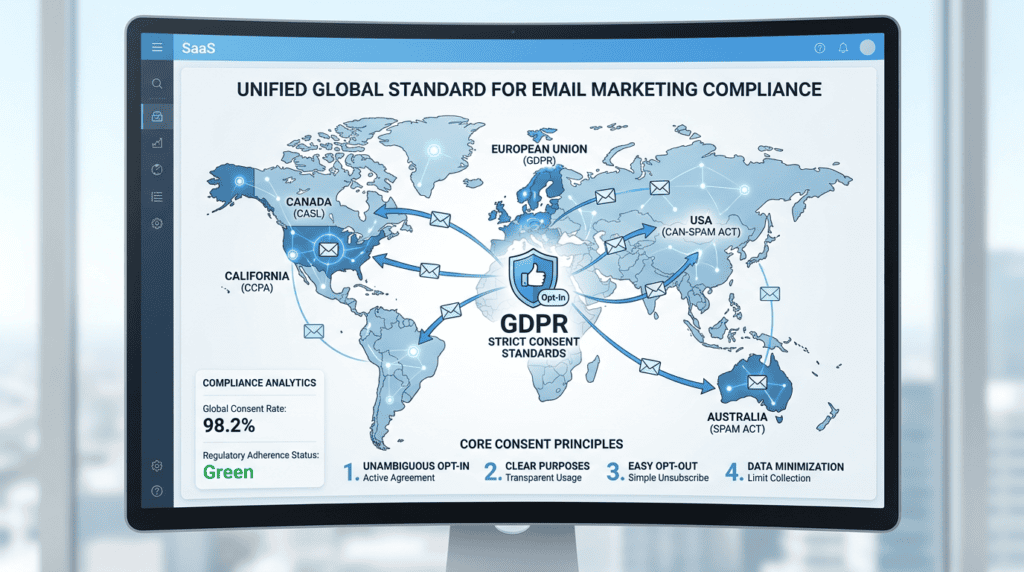
Instead of trying to segment lists and apply different rules, the most effective and safest strategy is to adopt the strictest standard (GDPR) for all subscribers. This single-policy approach simplifies operations, reduces risk, and builds universal trust with your audience. Treat every subscriber as if they are protected by GDPR, and you will automatically comply with CAN-SPAM and other regional laws. This means prioritizing explicit consent, easy opt-out mechanisms, and transparent data handling across your entire email list. Embracing this global standard for email marketing regulations ensures you’re always on the right side of the law, no matter where your subscribers live.
Frequently Asked Questions (FAQs)
Do email marketing regulations apply to B2B emails?
Yes, email marketing regulations generally apply to B2B emails. CAN-SPAM covers all “commercial electronic mail messages,” regardless of whether they are sent to a business or consumer address. GDPR applies if the recipient is an individual within the EU, even if their email address is business-related.
What’s the difference between a transactional email and a marketing email?
A transactional email facilitates an agreed-upon commercial transaction or provides updates about an existing relationship (e.g., order confirmations, shipping notices, password resets). A marketing email primarily promotes a product, service, or brand. While transactional emails have some exemptions from certain regulations, they still must adhere to rules regarding deceptive headers and accurate sender identity.
Can I email someone who gave me their business card?
Under CAN-SPAM, you can generally email someone who gave you their business card, as this often implies an existing business relationship or interest. However, under GDPR, simply receiving a business card is usually not sufficient for explicit consent to send marketing emails. Best practice is to follow up with a clear opt-in request for marketing communications.
How long do I have to keep records of consent under GDPR?
You must keep records of consent for as long as you process a subscriber’s data, and for a reasonable period afterward to demonstrate compliance if audited. This typically means maintaining a clear audit trail of when, how, and what consent was given for each subscriber.
Do I need a privacy policy on my website to be compliant?
Yes, absolutely. A comprehensive privacy policy is a fundamental requirement under GDPR and a best practice for transparency under CAN-SPAM. It informs users about what data you collect, how you use it, who you share it with, and their rights regarding their data.
What should I do if I realize my current list isn’t compliant?
If your current list isn’t compliant, especially with GDPR’s strict consent requirements, you should immediately stop sending marketing emails to those subscribers without verifiable consent. Consider running a re-permission campaign to ask for explicit opt-in from your existing list members, clearly explaining what they’re signing up for. Simultaneously, clean your list by removing inactive or unconsented contacts.