
Choosing the right SEO tools can feel like navigating a maze, especially when you’re trying to stretch a budget and maximize your digital marketing efforts. Many business owners and content creators find themselves at a crossroads, wondering where to invest their hard-earned money for the best return. They often hear about powerful, all-encompassing platforms and specialized, niche tools, but understanding which one truly fits their specific needs is the real challenge.
This is exactly the dilemma many face when comparing Ahrefs Vs Answer The Public. While both are valuable assets in the SEO toolkit, they serve fundamentally different purposes and cater to distinct user profiles. This guide aims to cut through the noise, providing a clear, practical breakdown of these two popular platforms so you can confidently decide which tool, or combination of tools, will best support your search engine optimization and content strategy.
Quick Verdict: Ahrefs vs. Answer The Public
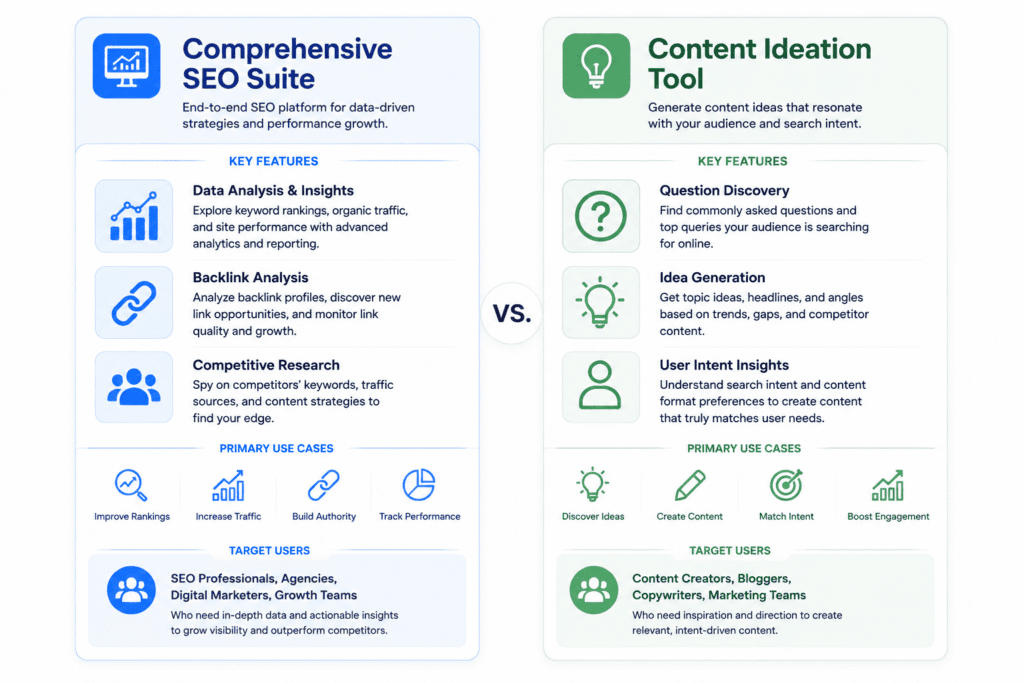
Complete Verdict Table
| Factor | Ahrefs | Answer The Public | Winner |
|---|---|---|---|
| Primary Use Case | All-in-one SEO platform | Keyword & content ideation | Tie (Different purposes) |
| Keyword Research | Data-driven, competitive | Question-based, semantic | Ahrefs (for depth) |
| Content Ideation | Good, data-backed | Excellent, user-focused | Answer The Public |
| Pricing Model | High-tier monthly subscription | Freemium & lower-cost pro plan | Answer The Public |
| Ease of Use | Moderate learning curve | Extremely intuitive | Answer The Public |
| Target User | SEO professionals, agencies | Content marketers, bloggers | Tie (Different users) |
| Overall Value | High (for dedicated SEOs) | High (for content creators) | Tie (Depends on need) |
Best For
- Ahrefs: This comprehensive SEO tool is the go-to for SEO professionals, marketing agencies, and businesses that need a deep dive into competitive analysis, backlink tracking, rank tracking, and technical site audits. If you’re managing a complex SEO strategy, aiming to outrank competitors across numerous keywords, or need to understand your entire backlink profile, Ahrefs provides the robust data and features required. It’s built for those who need to see the full SEO picture and execute advanced strategies.
- Answer The Public: Content marketers, bloggers, social media managers, and strategists will find Answer The Public invaluable for quickly generating a wealth of user-centric content ideas, questions, and long-tail keywords. It excels at showing you exactly what questions people are asking around a topic, making it perfect for crafting highly relevant blog posts, video scripts, or FAQ sections that directly address your audience’s immediate queries.
Not Ideal For
- Ahrefs: Beginners, small-scale bloggers, or businesses on a very tight budget who primarily need content ideas and don’t require advanced SEO analytics will find Ahrefs to be overkill. Its extensive feature set comes with a steeper learning curve and a significant cost, which might not be justified if your needs are limited to basic keyword ideation or surface-level content planning.
- Answer The Public: Users who need accurate search volume data, competitive backlink analysis, or technical SEO audit capabilities will quickly hit the limits of Answer The Public. While fantastic for ideation, it doesn’t provide the quantitative metrics or comprehensive site analysis features necessary for a full-fledged SEO strategy. It’s not designed to tell you how many people search for a term or who links to your competitors.
Bottom Line
When you look at Ahrefs Vs Answer The Public, it’s clear they aren’t direct competitors in the traditional sense. Instead, they are specialized tools designed for different stages and aspects of the SEO and content creation process. Choose Ahrefs if you need a powerful, all-in-one SEO suite to manage and scale your entire search marketing strategy, from technical audits to competitor analysis. Opt for Answer The Public if your primary goal is to generate a rich stream of content ideas that directly answer your audience’s questions, especially if you’re a content creator or blogger on a budget. They can even be complementary, with Answer The Public feeding initial content ideas that Ahrefs then helps you optimize and track.
Understanding the Core Difference: SEO Suite vs. Ideation Tool
Ahrefs as the All-in-One SEO Platform
Ahrefs positions itself as a comprehensive ecosystem for search engine optimization, acting as a true “command center” for digital marketers and SEO professionals. It’s not just a collection of tools; it’s an integrated platform designed to manage nearly every facet of a website’s organic search presence. From the moment you start a new project, Ahrefs can help you conduct thorough site audits to identify technical issues, dive deep into competitor analysis to uncover their strategies, perform extensive keyword research to pinpoint opportunities, track your rankings over time, and even explore content ideas that are already performing well.
For a growing agency or an in-house SEO team, Ahrefs becomes indispensable. It provides the strategic overview needed to understand market dynamics, identify gaps, and measure the effectiveness of ongoing campaigns. Beginners might find its sheer depth a bit overwhelming at first, given the vast array of metrics and reports available. However, as usage grows, its ability to connect the dots between technical SEO, content strategy, and link building becomes a powerful asset, allowing users to make data-driven decisions that impact an entire website’s search ecosystem. It’s about managing the entire lifecycle of a website’s search visibility, not just individual tasks.
Answer The Public as the Specialized Content Ideation Engine
In stark contrast, Answer The Public (ATP) is a highly specialized tool, focusing almost exclusively on content ideation through search listening and visualization. Its core function is to tap into the “voice of the customer” by uncovering the actual questions, prepositions (like “for,” “with,” “without”), comparisons, and alphabetical queries that real users type into search engines. ATP sources this data primarily from Google’s autocomplete and other search engine suggestions, presenting it in a unique, visually engaging “data wheel” format.
This tool excels at helping content marketers, bloggers, and social media managers understand the specific curiosities and pain points of their target audience. It’s less about quantitative metrics and more about qualitative insight into user intent. For someone struggling with writer’s block or needing to ensure their content directly addresses user needs, ATP is a quick and effective solution. It helps you move beyond generic topics to create highly relevant and engaging content that resonates with specific user queries. While it doesn’t offer the broad analytical capabilities of a full SEO suite, its precision in uncovering user-centric content ideas is unparalleled for its niche.
Why a Direct Comparison Can Be Misleading
Trying to compare Ahrefs Vs Answer The Public directly is akin to comparing a high-tech Swiss Army Knife to a specialized chef’s knife. Both are incredibly useful tools, but they serve fundamentally different purposes and excel in different domains. Ahrefs is built for the comprehensive, multi-faceted demands of an entire SEO strategy, requiring a deep understanding of data and competitive landscapes. Answer The Public, on the other hand, is a focused instrument for generating content ideas by understanding user queries, making it a powerful asset for the initial stages of content creation.
Their distinct market positions mean that one isn’t inherently “better” than the other; rather, they are designed to solve different problems for different users or different stages of a marketing workflow. Understanding this core difference is crucial before diving into their individual features, as it clarifies why a business might need one, the other, or even both, depending on their specific goals and resources.
Feature & Capability Breakdown: What Do You Actually Get?
Keyword Research: Data-Driven Metrics vs. Semantic Exploration
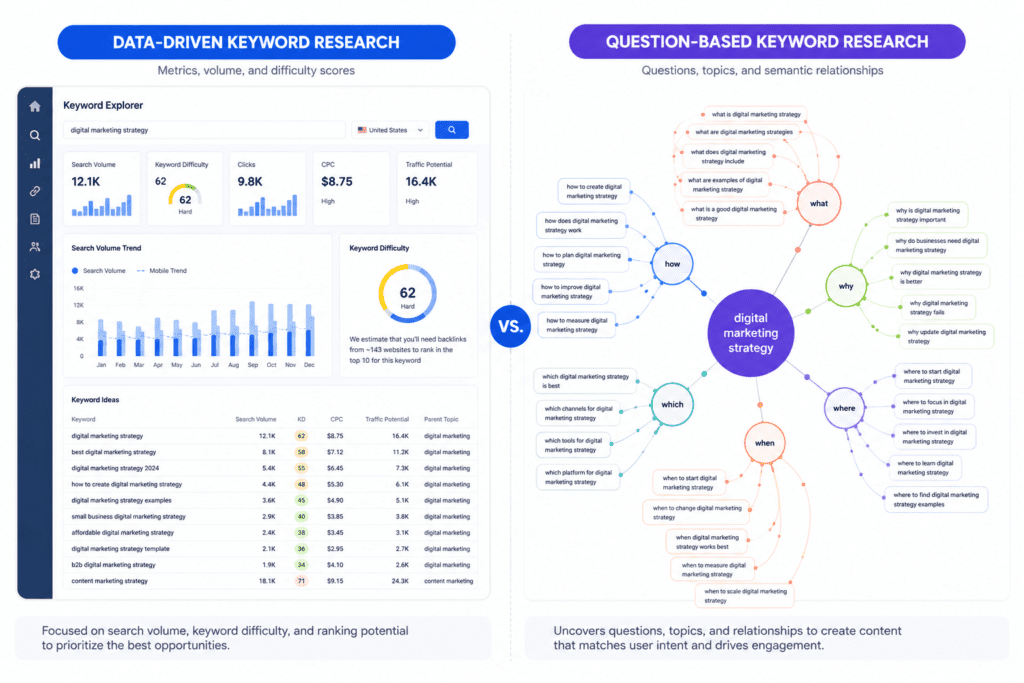
How Ahrefs’ Keywords Explorer provides search volume, keyword difficulty, and SERP analysis.
Ahrefs’ Keywords Explorer is a powerhouse for data-driven keyword research. When you enter a keyword, it doesn’t just give you a number; it provides a comprehensive suite of metrics essential for strategic targeting. You get detailed monthly search volume (both local and global), a Keyword Difficulty (KD) score that estimates how hard it will be to rank for that term, and a “Clicks per Search” metric that indicates how many searches actually result in a click. Beyond these, Ahrefs shows you historical search volume trends, parent topics to understand broader themes, and an invaluable SERP (Search Engine Results Page) overview. This SERP analysis reveals the top-ranking pages, their Domain Rating (DR), the number of backlinks pointing to them, and estimated organic traffic.
For SEOs, this depth of data is critical. It helps them prioritize keywords, estimate potential organic traffic, and understand the competitive landscape before investing significant resources into content creation. For instance, an affiliate marketer might use Ahrefs to identify a high-volume, low-difficulty “long tail keywords” that competitors are overlooking, allowing them to carve out a niche. The frustration for many beginners with other tools is the lack of this granular data, making it hard to gauge true opportunity or competitive viability. Ahrefs provides the numbers needed to make informed decisions about where to focus your efforts for maximum impact.
How Answer The Public visualizes questions, prepositions, and comparisons without hard metrics.
Answer The Public takes a completely different approach to keyword research. Instead of numerical metrics, it focuses on the *semantic relationships* and *natural language queries* users employ. When you input a broad topic, ATP generates a visually striking “data wheel” that organizes related questions (who, what, where, when, why, how), prepositions (for, with, without, near), comparisons (vs, like, and), alphabetical listings, and related searches.
The key distinction here is the *absence* of hard metrics like search volume or keyword difficulty. ATP’s value lies in its ability to uncover the specific curiosities and problems users have around a topic. For example, if you search for “coffee,” ATP might show “how to make coffee without a machine,” “coffee for weight loss,” or “coffee vs tea.” These are invaluable for understanding user intent and generating hundreds of specific content ideas, but they don’t tell you how many people search for them or how hard it is to rank. It’s a tool for discovery and brainstorming, helping content creators ensure their articles directly answer user pain points, even if they don’t provide the quantitative data to prioritize those answers.
Which tool is better for building a strategic keyword list vs. finding blog post titles.
When it comes to building a strategic keyword list that underpins your entire SEO strategy, Ahrefs is the clear winner. Its comprehensive data allows you to identify high-potential keywords based on search volume, difficulty, and competitive analysis, enabling you to prioritize efforts for maximum organic search traffic. You can build a list of primary keywords and supporting long-tail keywords with a clear understanding of their potential impact.
For finding a wealth of specific blog post titles, FAQ sections, or social media prompts that directly address user queries, Answer The Public excels. It’s perfect for content creators who have a broad topic and need to flesh out specific angles and subtopics. It helps ensure your content is user-centric and answers the actual questions people are asking, making it a powerful tool for content ideation and ensuring relevance. A beginner might be confused, thinking they need to pick one for “keyword research.” The reality is, they serve different stages and needs within the keyword research workflow.
Content Ideation: Where the Lines Blur
Using Ahrefs’ Content Explorer to find popular, high-traffic content.
Ahrefs’ Content Explorer offers a powerful way to approach content ideation by reverse-engineering success. Instead of guessing what content might perform well, you can use Content Explorer to find articles, guides, and blog posts that have already garnered significant organic traffic, social shares, and backlinks within your niche. You can search for any topic and filter results by language, publication date, referring domains, organic traffic, and even social shares.
This feature is invaluable for understanding what types of content resonate with an audience and attract links. For example, an ecommerce business selling sustainable products could use Content Explorer to find articles on “eco-friendly living” that have gone viral or attracted many backlinks. This insight helps them identify proven content formats, topics, and angles, informing their own content strategy to create similar, but better, pieces. It’s about identifying successful content models and adapting them, rather than starting from scratch.
Using Answer The Public’s data wheels to brainstorm angles and subtopics.
Once you have a broad topic or a primary keyword identified (perhaps even through Ahrefs), Answer The Public’s data wheels become an exceptional tool for brainstorming specific angles and subtopics. While Content Explorer shows you *what* content is performing, ATP helps you understand *how* users are thinking about that topic. Its visual outputs break down a subject into hundreds of specific questions, comparisons, and related terms.
For a content creator, this means moving beyond a generic article title to a comprehensive piece that addresses every facet of a user’s query. If your main topic is “email marketing software,” ATP might reveal questions like “email marketing software free trial,” “email marketing software for small business,” “email marketing software comparison,” or “email marketing software integrations.” These directly translate into subheadings, FAQ sections, or even entirely new blog posts, ensuring your content is thorough and highly relevant.
Real-world example: Finding a primary topic with Ahrefs, then using ATP to flesh out the article subheadings.
Consider a scenario for a SaaS blog focused on productivity tools. First, the team uses Ahrefs’ Keywords Explorer to identify a high-potential primary keyword like “best project management software for remote teams,” noting its decent search volume and achievable keyword difficulty. They also use Content Explorer to see what types of articles on this topic are already ranking well and attracting backlinks.
Once the primary topic is chosen, they turn to Answer The Public. Inputting “project management software remote teams” into ATP quickly generates a visual map of user queries. They discover questions like “project management software for remote teams free,” “project management software for remote teams comparison,” “how to choose project management software for remote teams,” and “project management software for remote teams pros and cons.” These specific questions become the perfect foundation for the article’s subheadings, ensuring the content directly addresses the audience’s most pressing concerns and provides comprehensive answers. This workflow demonstrates how Ahrefs Vs Answer The Public can be highly complementary, with Ahrefs providing the strategic foundation and ATP enriching the content with user-centric detail.
Competitive Analysis: A One-Sided Battle

Ahrefs’ deep dive into competitor backlink profiles, top pages, and paid search strategies.
When it comes to competitive analysis, Ahrefs stands as an undisputed leader. Its Site Explorer tool allows users to plug in any competitor’s domain and instantly gain a deep understanding of their SEO strategy. You can see their entire backlink profile, including referring domains, anchor text, and new/lost links, which is crucial for understanding their link-building tactics and identifying potential link opportunities for your own site. Ahrefs also reveals a competitor’s top organic keywords, showing you exactly what they rank for and how much traffic those keywords bring. Furthermore, you can uncover their top-performing content, allowing you to identify their content strategy and replicate or improve upon their successes.
Beyond organic search, Ahrefs provides insights into a competitor’s paid search strategies, showing their paid keywords, ad copy, and estimated ad spend. This level of actionable intelligence is invaluable for businesses looking to gain market share, understand their rivals’ strengths and weaknesses, and identify untapped opportunities. For a marketing agency, this data is essential for pitching new clients and demonstrating how they can outperform the competition. As a business scales, this deep competitive analysis becomes a non-negotiable part of staying ahead.
Why Answer The Public has no direct competitive analysis features.
Answer The Public, by its very design, offers no direct competitive analysis features. Its purpose is to uncover user queries and content ideas, not to analyze the SEO performance or strategies of other websites. You cannot input a competitor’s domain into ATP and expect to see their backlinks, organic keywords, or traffic estimates. This is a fundamental difference in scope and highlights that ATP is a specialized content ideation tool, not a comprehensive SEO suite. Users who rely solely on ATP would completely miss out on crucial competitive intelligence, which is a significant trade-off if understanding your market rivals is a key business objective.
Reporting & Data Visualization: Dashboards vs. Data Wheels
Ahrefs’ customizable dashboards and historical data tracking.
Ahrefs provides robust reporting and data visualization capabilities, primarily through customizable dashboards and extensive historical data tracking. Users can set up project dashboards to monitor key metrics for their websites, including organic traffic, keyword rankings, backlink profiles, and site audit progress. These dashboards offer a quick, at-a-glance overview of performance and allow for deep dives into specific areas. Crucially, Ahrefs tracks historical data, meaning you can see how your keyword rankings have evolved over months or years, how your backlink profile has grown, or how technical SEO fixes have impacted site health.
This long-term tracking and reporting functionality is vital for demonstrating ROI, making data-driven adjustments to an SEO strategy, and presenting performance to clients or stakeholders. For an agency managing multiple client sites, the ability to generate detailed, exportable reports on demand is a significant workflow advantage. It allows for continuous performance measurement and strategic refinement, ensuring that SEO efforts are always aligned with business goals.
Answer The Public’s unique but functionally limited visual outputs.
Answer The Public’s primary data visualization is its iconic “data wheel” or “search cloud.” This unique visual presentation organizes user queries into categories like questions, prepositions, comparisons, and alphabetical listings, making it incredibly intuitive for brainstorming and understanding semantic relationships. The visual nature is highly effective for quickly grasping the breadth of user interest around a topic.
However, while visually engaging, ATP’s outputs are functionally limited compared to Ahrefs. They are essentially static snapshots of current search queries. You cannot track changes over time, integrate this data with other performance metrics, or generate traditional, customizable reports. The data wheels are excellent for initial ideation and understanding user intent, but they don’t offer the capabilities for long-term performance tracking, trend analysis, or demonstrating the impact of content efforts over time. For users needing to show progress or analyze historical data, this limitation means ATP serves a very specific, front-end purpose in the content creation workflow.
Pricing & Value: What Are You Really Paying For?
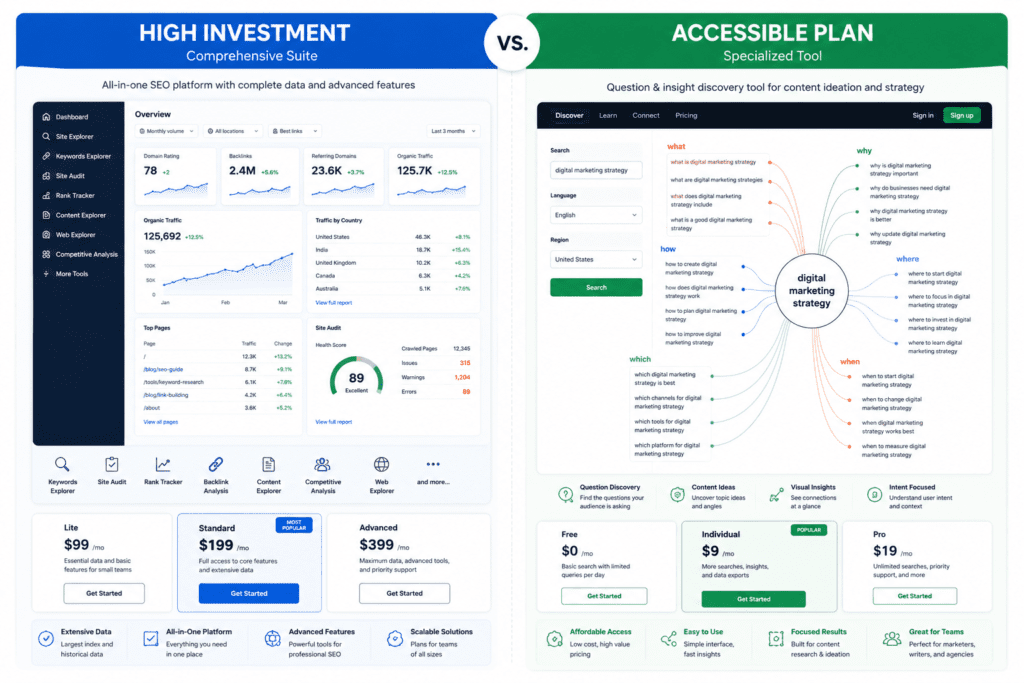
When you’re deciding between Ahrefs and Answer The Public, the price tag is often a major factor. But it’s not just about the monthly fee; it’s about the value you get for that investment and how it aligns with your specific needs. Understanding the pricing models and what they truly offer helps clarify who gets the most bang for their buck.
Ahrefs’ Subscription Tiers and Long-Term Costs
Ahrefs operates on a tiered subscription model, and let’s be frank, it’s a significant investment. Their plans typically start with “Lite” around $99/month (or $83/month if billed annually), moving up to “Standard” at $199/month, “Advanced” at $399/month, and “Enterprise” which can run into thousands. These aren’t just numbers; they represent a commitment.
A key aspect of Ahrefs’ pricing is its credit system. You don’t just get unlimited access; you get a certain number of “credits” for things like rows in reports, site audits, or keyword searches. For example, a Lite plan might give you 500 tracked keywords and 10,000 crawl credits. This credit system can be a hidden cost or a source of frustration for heavy users. If you’re constantly pulling large reports or auditing multiple sites, you might quickly hit your limits and need to upgrade or pay for additional credits. This means the advertised monthly cost can sometimes creep up, especially for agencies or large teams.
Is the high cost justified? For a comprehensive SEO professional, marketing agency, or a business with a serious SEO strategy, absolutely. Ahrefs provides an unparalleled depth of data for competitor analysis, backlink profiles, site audits, and keyword research. It’s a full-fledged SEO operating system. The long-term cost is justified by the potential ROI in organic traffic, lead generation, and competitive intelligence it provides. However, for someone who only needs basic keyword ideas, this investment is likely overkill.
Answer The Public’s Freemium Model and Pro Plan
Answer The Public takes a much more accessible approach with its freemium model. You can use it for free, typically getting one or two searches per day. This free tier is fantastic for occasional use or for getting a quick snapshot of questions around a topic. However, it comes with limitations: you can’t export data, and the visualizations often have watermarks.
For more serious users, the Pro plan is remarkably affordable, usually starting around $9/month (or $10/month if billed monthly). This unlocks unlimited searches, high-resolution image downloads, and crucial CSV data exports. This means you can pull all the question-based keywords and related phrases and then easily integrate them into your content planning spreadsheets.
The value proposition of the Pro plan is clear: it’s a specialized tool that saves content creators a ton of time. Instead of manually sifting through forums or Google searches, you get a visual map of user intent in minutes. For its specific purpose, the Pro plan offers excellent value, especially when compared to the broader, more expensive SEO suites.
Calculating the ROI: Who Gets More Value Per Dollar?
When it comes to return on investment (ROI), the answer depends entirely on your role and goals.
For an agency or a large in-house marketing team, the ROI on Ahrefs is often clear and quantifiable. They use its data to win new clients, identify lucrative keyword opportunities, track client progress, and ultimately drive significant organic traffic and revenue. The ability to perform deep competitor analysis, monitor backlink profiles, and conduct thorough site audits directly translates into client results and business growth, easily justifying the hundreds or thousands of dollars spent monthly. An agency might use Ahrefs to uncover a competitor’s successful content strategy, replicate it, and secure a top ranking for a high-value keyword, leading to thousands in new business.
For a solo blogger, freelance content writer, or small business owner focused primarily on content creation, the ROI on Answer The Public is measured in saved time and the quality of content ideas generated. For a fraction of Ahrefs’ cost, ATP helps them quickly identify long-tail keywords and user questions that can form the backbone of engaging, high-ranking articles. This leads to more targeted content, better engagement, and ultimately, more organic traffic without the need for a deep dive into technical SEO metrics. A blogger might use ATP to find 50 relevant questions for a single blog post, ensuring their content directly addresses reader needs and ranks well for specific queries, which is invaluable for their content strategy.
Real-World Scenarios: Which Tool Wins for Your Job?
Comparing Ahrefs and Answer The Public isn’t about finding a single “best” tool. It’s about understanding which one fits your specific workflow and objectives. Let’s look at a few common scenarios.
Scenario 1: The SEO Agency
Goal: Onboard a new client, perform a site audit, identify technical issues, build a comprehensive content strategy, and track keyword rankings over time.
Winner: Ahrefs, without question.
For an SEO agency, Ahrefs is the command center. When a new client comes on board, the first step is often a thorough site audit using Ahrefs’ Site Audit tool to uncover technical SEO issues like broken links, crawl errors, and slow pages. Then, the agency dives into competitor analysis with Site Explorer, dissecting their backlink profiles, top-performing content, and organic keyword rankings. Keywords Explorer is indispensable for identifying high-volume, low-difficulty keywords to target, while Rank Tracker monitors progress and proves ROI to the client.
Answer The Public might be a minor tool in the agency’s arsenal, perhaps used by a content writer on the team for brainstorming blog post angles once a core topic has been identified by Ahrefs. However, it’s not central to the agency’s core SEO operations, which demand comprehensive data, competitive intelligence, and robust reporting.
Scenario 2: The Freelance Content Writer/Blogger
Goal: Find a compelling topic for a new blog post, identify common questions to answer within that post, and structure the article to address user intent effectively.
Winner: Answer The Public.
A freelance content writer or blogger often works with a tight budget and needs to produce engaging content efficiently. For them, Answer The Public is a game-changer. Imagine you’re writing about “sustainable living.” You plug that phrase into ATP, and within seconds, you get a visual map of hundreds of questions people are asking: “How to start sustainable living?”, “Sustainable living tips for beginners,” “Sustainable living vs. zero waste,” and so on. This immediately provides a framework for your article, ensuring you cover what your audience actually wants to know.
Ahrefs, while powerful, would be overkill and cost-prohibitive for this specific goal. While its Keywords Explorer could give you search volume and difficulty, the sheer volume of data and the learning curve would slow down the content ideation process for someone whose primary job isn’t deep SEO analysis. ATP provides the necessary ideation framework quickly and affordably, making it the clear winner for content-focused individuals.
Scenario 3: The In-House Marketing Manager
Goal: Balance a comprehensive SEO strategy with a consistent content production schedule, ensuring both technical SEO health and engaging content that drives traffic.
Winner: Both.
This is the ideal use case for leveraging the strengths of both tools. An in-house marketing manager needs a holistic view. They’d use Ahrefs for strategic planning: monitoring overall site health, tracking competitor movements, identifying large-scale keyword opportunities, and overseeing backlink acquisition. Ahrefs helps them understand the big picture of their organic search performance and where their biggest SEO wins can come from.
Once Ahrefs identifies a high-value topic or keyword cluster (e.g., “best CRM for small business”), the marketing manager can then empower their content team to use Answer The Public. The content team plugs “best CRM for small business” into ATP to uncover all the specific questions, comparisons, and prepositions users are searching for. This ensures that the content created is not only optimized for the target keyword but also comprehensively answers user intent, leading to more engaging articles and better search engine visibility. In this scenario, Ahrefs provides the strategic direction, and Answer The Public ensures the content execution is precise and user-focused.
Honest Take: The Hidden Limitations & Trade-Offs
No tool is perfect, and both Ahrefs and Answer The Public come with their own set of hidden limitations and trade-offs that aren’t always obvious from their marketing pages. Understanding these can help you make a more informed decision.
Ahrefs’ “Overkill” Factor
For many users, Ahrefs can feel like buying a commercial jet when all you need is a bicycle. Its vast array of features – site audit, backlink analysis, content gap analysis, rank tracking, competitive research, and more – means that for a significant portion of its user base, 80% or even 90% of its capabilities go unused.
This “overkill” factor isn’t just about unused features; it translates into a steep learning curve and a high financial cost that can be a significant barrier. If your primary need is simply to find content ideas or basic keyword suggestions, investing $99/month or more in Ahrefs is inefficient. You’re paying for a powerful engine designed for complex tasks, but only using it for simple ones. Beginners often feel overwhelmed by the dashboards and metrics, struggling to extract actionable insights without significant training. It’s a tool built for SEO professionals, and if you’re not one, you might find yourself paying for power you don’t need or know how to wield.
Answer The Public’s “Data Vacuum”
Answer The Public’s biggest strength – its intuitive visualization of user questions – is also its most significant limitation: the complete lack of quantitative data. While it excels at showing *what* people are asking, it provides no information on *how many* people are asking it (search volume) or *how hard* it would be to rank for those questions (keyword difficulty).
This “data vacuum” means that ideas generated by ATP must always be validated in another tool. You might find a fascinating question cluster, but without knowing if it has any search volume, you could be spending time creating content for a query that almost no one is searching for. This adds an extra, crucial step to the workflow. You’ll need to export the ideas from ATP and then plug them into a tool like Ahrefs (or even Google Keyword Planner) to get the necessary metrics. This trade-off means ATP isn’t a standalone solution for strategic keyword research; it’s an ideation engine that requires a data-driven companion.
The Workflow Reality
The most effective SEOs and content marketers rarely choose one tool *or* the other. Instead, they integrate both into a complementary workflow that leverages each tool’s strengths.
Here’s the reality: a savvy marketer might start with Ahrefs to identify a high-value, high-volume keyword opportunity with manageable difficulty. For example, Ahrefs might reveal that “best project management software for small teams” has decent search volume and a reasonable keyword difficulty score. This is the strategic “money keyword” they want to target.
Once that core opportunity is identified, they then plug that keyword into Answer The Public. ATP then reveals all the related questions, prepositions, comparisons, and alphabetical variations users are searching for around “best project management software for small teams.” This allows the content creator to discover subtopics like “project management software free trial,” “project management software comparison,” “project management software features,” or “what is project management software used for?” By incorporating these into a comprehensive article, they ensure the content is thorough, answers user intent, and has a much better chance of ranking for the main keyword and numerous long-tail variations. This combined approach maximizes both strategic insight and content relevance.
Final Recommendation: Should You Buy Ahrefs or Answer The Public?
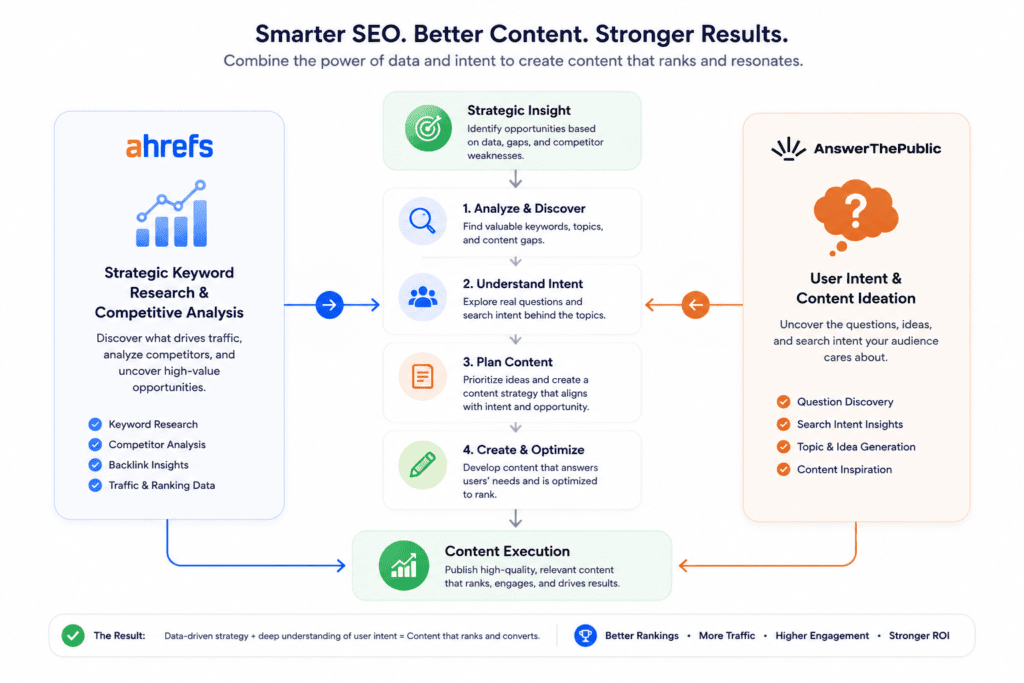
As we’ve explored throughout this article, framing the choice between Ahrefs and Answer The Public as a direct “vs.” battle often misses the point. These tools serve distinct, albeit complementary, purposes within the broader SEO and content marketing landscape. Your decision hinges entirely on your specific needs, budget, and primary role.
Invest in Ahrefs if: You are a professional SEO, run a marketing agency, or manage the search presence for a serious business. The comprehensive data on backlinks, organic search, paid traffic, and technical SEO, coupled with its robust keyword research capabilities, makes the investment necessary for competitive, data-driven results. It’s the strategic command center for understanding your market and competitors.
Invest in Answer The Public if: You are primarily focused on content creation, need to overcome writer’s block, and want to understand user intent on a deeper level without a huge financial commitment. Its strength lies in surfacing the questions, prepositions, comparisons, and alphabetical variations people are actively searching for, providing an invaluable framework for ideation and content structuring.
The Power User’s Choice: The most effective strategy, as highlighted in our “Workflow Reality” discussion, is to use both. Leverage Ahrefs for the “what” – identifying high-value strategic opportunities, analyzing competitor performance, and validating market demand. Then, use Answer The Public for the “how” – diving deep into user intent to structure comprehensive, authoritative content that directly answers audience questions. If budget constraints mean you can only afford one, your choice depends entirely on whether your primary role is technical/strategic SEO and competitive analysis, or focused content ideation and creation.
FAQs
Can Answer The Public replace Ahrefs for keyword research?
No, Answer The Public is designed for content ideation and understanding user intent, not for quantitative keyword research. It lacks essential metrics like search volume, keyword difficulty, and SERP data that Ahrefs provides for strategic analysis.
Does Ahrefs have a free version like Answer The Public?
Ahrefs offers Ahrefs Webmaster Tools (AWT) for free, which allows you to audit and track your own website’s performance. However, it does not provide the competitive research or comprehensive keyword research capabilities found in the paid Ahrefs subscription.
How accurate is the data from Answer The Public?
Answer The Public’s data is highly accurate in reflecting real user queries because it’s sourced directly from Google’s autocomplete suggestions. However, it does not provide any quantitative data on the search volume or popularity of these queries.
Is the Ahrefs credit system a problem for most users?
For casual users or those on lower-tier Ahrefs plans, the credit system can be a significant limitation, requiring careful management of reports and data exports. For agencies or larger businesses on higher-tier plans, the increased credit allowances generally make it less of an issue.
If I buy Answer The Public, will I still need another SEO tool?
Yes, if your goals include understanding search volume, assessing keyword difficulty, tracking your rankings, or performing competitive analysis, you will need to supplement Answer The Public with a dedicated SEO tool like Ahrefs or a similar platform.