
Imagine you’re an agency owner or an in-house SEO manager tasked with uncovering untapped keyword opportunities for a new client or product launch. You know that getting your keyword strategy right from the start can make or break a campaign. But with so much data out there, and so many tools promising the moon, how do you efficiently and accurately extract the most valuable keywords that will actually drive traffic and conversions? This isn’t just about finding words; it’s about understanding search intent, competitive landscapes, and ultimately, your audience.
The challenge often boils down to choosing the right platform to do the heavy lifting. Two giants dominate the SEO tool space: Ahrefs and Semrush. Both are incredibly powerful, but their strengths, data presentation, and overall workflows can differ significantly, especially when your primary goal is robust keyword extraction. Deciding between them isn’t just a matter of features; it’s about aligning the tool with your specific business needs, budget, and team’s expertise.
This article cuts through the noise to give you a clear, practical comparison. We’ll dive deep into Ahrefs For Keyword Extraction Vs Semrush, examining their core capabilities, performance, pricing structures, and real-world applicability. By the end of this section, you’ll have a solid understanding of which platform is likely to be the better fit for your keyword research and extraction tasks, helping you make an informed decision that impacts your bottom line.
Quick Verdict: Ahrefs vs. Semrush for Keyword Extraction
When it comes to efficiently extracting valuable keywords, both Ahrefs and Semrush bring serious firepower to the table. However, their approaches and strengths for keyword extraction can cater to different types of users and specific SEO strategies. Before we dive into the nitty-gritty, here’s a quick overview to help
Comparing Ahrefs and Semrush Pricing for Keyword-Focused Users

Understanding the cost structure of Ahrefs and Semrush is crucial for anyone relying on these tools for keyword extraction. Both platforms offer powerful capabilities, but their pricing models, especially concerning keyword data access, differ significantly. This isn’t just about the monthly fee; it’s about how your actual usage translates into costs, particularly for heavy keyword research.
How Ahrefs’ Credit System Impacts Keyword Extraction Costs
Ahrefs operates on a credit-based system for many of its core features, which can feel less straightforward than a simple subscription fee. When you perform actions like running a Site Explorer report on a competitor’s domain or using Keywords Explorer to dig deep into a niche, you consume “credits.” These credits reset monthly, and understanding their consumption is key to managing your budget.
For instance, a single Site Explorer report on a large domain might cost several credits, especially if you’re pulling extensive organic keywords data. Similarly, using Keywords Explorer to analyze thousands of keyword ideas or to check their historical search volume trends will also draw from your credit balance. API calls, which are essential for advanced users needing to integrate Ahrefs data into custom dashboards or tools, also consume credits based on the volume of data requested.
Scenario: Calculating the cost of analyzing 10 competitors’ keyword profiles.
Imagine you’re an agency or an in-house SEO specialist tasked with a comprehensive competitor analysis. You need to extract the top 10,000 organic keywords for each of 10 competitors. In Ahrefs, each Site Explorer report for a domain consumes credits. If a typical report for a domain with 10,000 keywords costs, say, 50 credits (this is a hypothetical example, as actual credit consumption varies based on data volume and report type), analyzing 10 competitors would consume 500 credits. If your plan includes 1,000 credits, you’ve just used half of your monthly allowance on this single task. Any subsequent deep dives into Keywords Explorer or additional competitor analyses will further deplete your remaining credits. This system means that while the base price might seem reasonable, frequent, large-scale data pulls can quickly add up.
Hidden Costs: What happens when you hit your monthly credit limits?
The primary hidden cost with Ahrefs’ credit system is the potential for overage charges or, more commonly, a hard stop to your research. Once you exhaust your monthly credit allowance, you typically have two options: either wait until the next billing cycle for your credits to reset, or purchase additional credits. These additional credits often come at a premium, making an already extensive keyword extraction project significantly more expensive. For a busy SEO team, hitting a credit wall mid-month can be a major workflow disruption, forcing delays or unexpected budget increases. This can be particularly frustrating for beginners who underestimate their usage or for growing businesses whose keyword research needs scale faster than their initial plan.
Understanding Semrush’s Tiered Plans and Keyword Report Limits
Semrush, in contrast, offers a more traditional tiered subscription model with clearly defined limits on features and data access. Their main plans are Pro, Guru, and Business, each designed for different user needs and offering increasing levels of access.
- Pro Plan: Typically starts around $129.95/month (or less with annual billing). This plan is generally aimed at freelancers and small in-house teams. It includes limits like 10,000 results per report in the Keyword Magic Tool, 3,000 reports per day, and 250,000 pages to crawl with the Site Audit. For basic keyword extraction, it’s a solid starting point, but heavy users will quickly hit its ceilings.
- Guru Plan: Usually priced around $249.95/month. This is Semrush’s most popular plan for growing agencies and marketing consultants. It significantly increases limits, offering 30,000 results per report in the Keyword Magic Tool, 5,000 reports per day, and 1,000,000 pages for Site Audit. It also unlocks historical data and content marketing features, which are invaluable for comprehensive keyword strategy.
- Business Plan: Often starts around $499.95/month. Designed for large agencies and enterprises, this plan provides the highest limits, including 50,000 results per report, 10,000 reports per day, and 5,000,000 pages for Site Audit. It also adds API access and white-label reporting.
Limits on Keyword Magic Tool reports, domain analytics, and daily exports.
Each plan imposes specific limits on how many reports you can generate daily, how many results appear in those reports (e.g., how many keyword ideas you can extract at once), and how many rows of data you can export. For example, if you’re trying to extract all possible long-tail keywords for a broad topic using the Keyword Magic Tool, a Pro plan’s 10,000-result limit per report might mean you need to run multiple, more refined searches to get all the data you need. Similarly, daily report limits can become a bottleneck for agencies managing many client projects simultaneously. Understanding these numerical limits upfront helps prevent unexpected interruptions in your workflow.
Long-Term Value: Which Semrush plan offers the best value for heavy keyword research?
For users focused on heavy keyword research, the Guru plan often provides the best long-term value. While the Pro plan is a good entry point, its limits can quickly become restrictive for anyone doing more than occasional keyword lookups. The Guru plan’s increased report limits, access to historical data (crucial for identifying keyword trends and seasonality), and higher daily report allowances make it much more suitable for sustained, in-depth keyword extraction and analysis. For large enterprises or those requiring extensive API integration, the Business plan becomes necessary, but for most dedicated SEOs and agencies, Guru strikes a strong balance between cost and comprehensive functionality for keyword research.
Head-to-Head Value: Which Tool is More Cost-Effective in 2026?
Determining which tool is more cost-effective for keyword extraction in 2026 largely depends on your specific usage patterns and team structure.
Ahrefs can be more cost-effective for users who require extremely deep backlink data as a primary driver for keyword discovery and who can manage their credit consumption carefully. If your strategy heavily relies on reverse-engineering competitor backlinks to find their ranking keywords, and you don’t need to run a massive volume of varied reports daily, Ahrefs’ credit system might align with your needs. However, for those who frequently hit credit limits or need to perform broad, exploratory keyword research across many different topics and domains, the credit system can quickly lead to higher, less predictable costs. Its value shines for specialized backlink-driven keyword analysis and for power users who leverage its API for specific, high-value data pulls.
Semrush generally offers more predictable costs and can be more cost-effective for users who require a broader suite of tools beyond just keyword extraction, including PPC research, content marketing insights, and site auditing. Its tiered plans provide clear boundaries, making budgeting easier. For teams that need to perform a high volume of keyword research, generate many reports, and integrate keyword data into a wider marketing strategy, Semrush’s Guru plan often provides superior value. The ability to access a large volume of keyword suggestions, historical data, and PPC insights without constantly worrying about credit depletion makes it a strong contender for overall cost-effectiveness, especially for all-in-one marketers and agencies.
Ultimately, if your primary need is extensive, varied, and high-volume keyword extraction across organic and paid channels, Semrush’s tiered model often provides better long-term cost predictability and value. If your keyword strategy is more narrowly focused on competitor backlink analysis and you have precise control over your data pulls, Ahrefs can be efficient, but its credit system demands careful monitoring to avoid unexpected expenses.
Core Keyword Extraction Capabilities: A Side-by-Side Test
Beyond pricing, the true test of Ahrefs For Keyword Extraction Vs Semrush lies in their core capabilities. We’ll put their organic, PPC, and bulk analysis features head-to-head to see which tool excels in different keyword extraction scenarios.
Organic Keyword Extraction: Uncovering Competitor Rankings

Understanding what keywords your competitors rank for organically is foundational to any SEO strategy. Both Ahrefs and Semrush offer robust tools for this, but their approaches and the depth of data can vary.
Ahrefs (Site Explorer): When you plug a competitor’s domain into Ahrefs’ Site Explorer, you get an incredibly detailed breakdown of their organic search performance. Its strength lies in its vast backlink index, which often correlates strongly with organic rankings. Ahrefs is excellent for analyzing a competitor’s accuracy, historical data, and ability to filter by traffic, position, and intent. You can quickly see which keywords drive the most traffic, their current ranking positions, and how those positions have changed over time. The historical data is particularly strong, allowing you to track a competitor’s keyword performance evolution over several years. Filters are granular, letting you narrow down keywords by search volume, keyword difficulty, traffic share, and even by SERP features. This makes it ideal for identifying high-value, attainable keywords that your competitors are already winning. For example, an affiliate marketer can quickly identify “money keywords” that a successful competitor ranks for, then filter by low keyword difficulty to find quick wins.
Semrush (Organic Research): Semrush’s Organic Research tool also provides a comprehensive view of a competitor’s organic keyword profile. Its strength often lies in its sheer keyword suggestion volume and its detailed SERP feature data. When evaluating its keyword suggestion volume, position tracking accuracy, and SERP feature data, Semrush often surfaces a slightly larger pool of keyword variations and long-tail opportunities, which can be invaluable for content brainstorming. Its position tracking accuracy is generally reliable, and it provides excellent insights into which SERP features (like featured snippets, local packs, or video carousels) a competitor is ranking for. This is crucial for understanding search intent beyond just a traditional organic listing. For instance, a local business trying to outrank a competitor can use Semrush to see if the competitor is dominating local pack results and then tailor their own local SEO strategy accordingly.
Verdict: For uncovering a competitor’s organic keyword footprint, Ahrefs often gives a more complete picture of *why* a competitor ranks, especially when considering its deep backlink integration and historical ranking data. Its focus on the interplay between backlinks and organic performance provides a richer context. However, Semrush often provides a broader initial list of keyword suggestions and superior insights into SERP features, making it excellent for content strategy and identifying diverse ranking opportunities. If your goal is to understand the full historical journey and backlink-driven success of a competitor’s keywords, Ahrefs has a slight edge. If you need a wider net for keyword ideas and detailed SERP feature analysis for content planning, Semrush is often more comprehensive.
PPC Keyword Extraction: Analyzing Paid Search Strategies

Analyzing competitor paid search strategies is a distinct discipline from organic SEO, requiring specialized data. Both tools offer features for this, but with different levels of depth.
Ahrefs (Paid Search): Ahrefs’ Paid Search report, found within Site Explorer, is capable of identifying paid keywords and ad copy that competitors are bidding on. It provides useful data such as estimated traffic from paid ads, ad positions, and the actual ad copy used. This can be helpful for a quick overview of a competitor’s paid strategy and for spotting their primary paid keywords. However, it’s generally not as granular or historically rich as Semrush’s offering. For example, while you can see the ad copy, the historical evolution of that ad copy or the specific landing pages used might not be as easily accessible or as detailed. It’s a good feature for SEOs who occasionally dabble in PPC insights but not for dedicated PPC professionals.
Semrush (Advertising Research): Semrush’s Advertising Research tool is a powerhouse for PPC keyword extraction. It offers a deep dive into its ad history, PLA research, and display advertising intelligence. You can see not only the keywords competitors are bidding on but also their historical ad copy variations, landing pages, estimated ad spend, and even display ads. The tool excels at showing how a competitor’s paid strategy has evolved over time, which ad copies perform best, and which keywords they’ve consistently invested in. For an e-commerce store, being able to see a competitor’s Product Listing Ads (PLAs) and the products they’re promoting can be a game-changer for their own shopping campaign strategy. The level of detail here is significantly higher, making it invaluable for competitive PPC analysis.
Verdict: For analyzing competitor ad spend and keyword targeting, Semrush is the clear winner. Its Advertising Research suite is far more comprehensive, offering deeper historical data, more granular insights into ad copy and landing pages, and broader coverage of different ad types (search, display, PLA). If PPC intelligence is a critical part of your keyword strategy, Semrush provides the tools necessary to truly dissect and learn from your competitors’ paid efforts.
Bulk Keyword Analysis: Which Tool Handles Large Datasets Better?
When you’re dealing with hundreds or thousands of keywords, the ability to process them efficiently in bulk becomes paramount.
Testing Ahrefs’ Batch Analysis and Semrush’s Keyword Overview for up to 1,000 keywords.
Ahrefs offers a “Batch Analysis” tool that allows you to input up to 200 URLs or domains at a time to get a quick overview of their SEO metrics. While useful, for *keyword* bulk analysis, you’d typically export data from Keywords Explorer or Site Explorer and then use external tools or spreadsheets. However, if you’re looking to quickly check metrics for a list of up to 1,000 keywords, you can paste them into Keywords Explorer, and it will provide metrics like search volume, keyword difficulty, and CPC. The processing is generally fast, and the data is rich.
Semrush’s “Keyword Overview” tool allows you to input up to 100 keywords at a time for a quick snapshot. For larger lists, the “Keyword Manager” lets you store and analyze up to 1,000 keywords (or more on higher plans) with detailed metrics. You can then export this data. Semrush’s Keyword Magic Tool also allows for extensive filtering and export of large keyword lists.
Comparing processing speed, data richness, and export functionality.
Both tools are generally fast for processing up to 1,000 keywords.
- Data Richness: Both provide essential metrics like search volume, keyword difficulty, CPC, and SERP features. Ahrefs often provides a slightly more nuanced “Traffic Potential” metric, while Semrush excels in providing a broader range of keyword variations and intent classifications.
- Export Functionality: Both offer robust export options (CSV, Excel). Semrush often provides more pre-filtered export options directly from its tools, which can save time. Ahrefs’ exports are comprehensive but sometimes require more manual manipulation in a spreadsheet to get exactly what you need.
For managing and analyzing large lists of keywords (e.g., 1,000+), Semrush’s Keyword Manager and Keyword Magic Tool often provide a more integrated and user-friendly workflow for bulk analysis and organization. While Ahrefs can handle large exports, Semrush’s tools feel more purpose-built for managing and segmenting extensive keyword lists directly within the platform, making it slightly more efficient for ongoing, large-scale keyword list management.
API Performance: Custom Workflows and Data Integration
For advanced users, developers, and large enterprises, API access is critical for automating data extraction, integrating SEO data into custom dashboards, or building proprietary tools.
Comparing the API documentation, rate limits, and data points available from each platform for keyword extraction.
Both Ahrefs and Semrush offer powerful APIs, but they cater to slightly different needs and have varying structures.
Ahrefs API: Ahrefs provides a comprehensive API that allows access to its vast backlink index, organic search data, and keyword metrics. Its API documentation is thorough, providing clear examples and endpoints. For keyword extraction, you can pull data like search volume, keyword difficulty, CPC, and SERP features for specific keywords or retrieve organic keywords for domains. The rate limits are typically generous on higher-tier plans, but as discussed in the pricing section, API calls consume credits, which can be a significant cost factor for high-volume usage. Its strength lies in its ability to integrate backlink-driven keyword insights into custom applications.
Semrush API: Semrush also offers a robust API, primarily available on its Business plan. Its API documentation is well-organized and provides access to a wider array of data points, including organic keywords, advertising keywords, keyword magic tool data, and even content marketing metrics. Semrush’s API is particularly strong for those needing to integrate a broad spectrum of marketing data, not just SEO. Its rate limits are typically defined by the plan, and while it doesn’t use a credit system in the same way Ahrefs does for API calls, high-volume usage still requires a higher-tier subscription. For example, an agency building a custom reporting dashboard for clients that pulls in organic rankings, paid ad performance, and content gaps would find Semrush’s API more versatile due to its broader data coverage.
For pure keyword extraction and integration into custom workflows, both APIs are highly capable. However, Semrush’s API often provides a broader range of marketing data points beyond just SEO, making it more versatile for comprehensive digital marketing platforms. Ahrefs’ API excels if your custom workflow is heavily focused on backlink-driven keyword discovery and competitor analysis. The choice here often comes down to the breadth of data you need to integrate and your budget for higher-tier plans.
Workflow & Usability: How Easy Is It to Extract and Use Keywords?
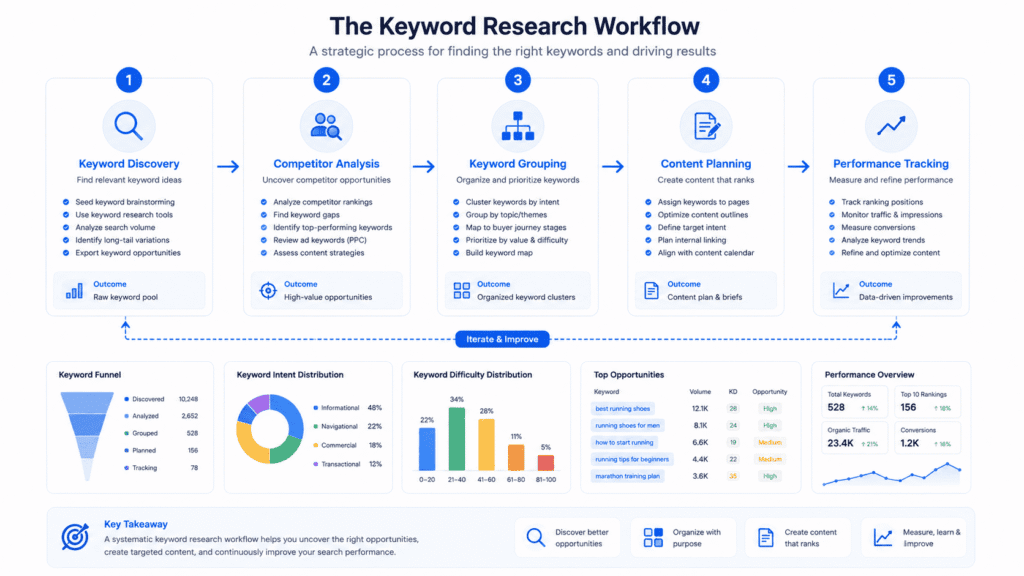
Beyond raw data, how a tool feels to use day-to-day can make or break your workflow. For keyword extraction, this means how quickly you can find, filter, and organize the keywords you need. Both Ahrefs and Semrush have distinct approaches to user experience, which impacts their learning curve and overall efficiency.
The Ahrefs Experience: A Data-First, Expert-Oriented Interface
Ahrefs is often described as a “power user’s” tool, and its interface for keyword extraction reflects that. When you dive into Site Explorer to analyze a competitor’s organic keywords, you’re immediately presented with a wealth of data. You’ll see estimated organic traffic, top pages, and a comprehensive list of keywords they rank for. The Keywords Explorer tool, on the other hand, is where you’d start with a seed keyword to generate ideas.
Navigating these tools involves using a robust set of filters. You can filter by search volume, keyword difficulty, traffic potential, SERP features (like featured snippets or image packs), word count, and even “parent topic” to group related keywords. This level of granular control is incredibly powerful for experienced SEOs who know exactly what they’re looking for. They can quickly narrow down massive keyword lists to highly specific, actionable targets.
However, this data-dense approach can feel overwhelming for new users or those who aren’t steeped in SEO metrics. The learning curve for Ahrefs is steeper; it doesn’t hold your hand as much. You’re expected to understand what each metric means and how to apply the filters effectively. For a beginner trying to perform Ahrefs For Keyword Extraction Vs Semrush, the sheer volume of options might slow them down initially, leading to frustration until they master the interface. What gets easier over time is understanding the relationships between different data points and how to leverage the advanced filters to uncover hidden gems. What can become frustrating is hitting credit limits if you’re constantly running large reports without a clear strategy.
The Semrush Experience: An Integrated, Guided Workflow
Semrush takes a more guided, all-in-one approach to its interface, which often translates to a smoother experience for a broader range of users. When you start with Organic Research to check a competitor, you get a clear overview, and then you can easily click into their “Positions” report to see all their ranking keywords. For generating new ideas, the Keyword Magic Tool is a standout. It’s designed to help you build and manage keyword lists intuitively.
The Keyword Magic Tool allows you to start with a broad topic and then use filters to refine your search. You can filter by intent (informational, navigational, commercial, transactional), keyword difficulty, search volume, and even group keywords into clusters. Once you’ve found relevant keywords, you can add them to the Keyword Manager, which acts as a central hub for organizing your target lists. This integrated workflow helps users move seamlessly from discovery to organization, making it easier to plan content or PPC campaigns.
For beginners, Semrush’s interface is generally more intuitive. The visual cues, clear navigation, and guided steps make it less intimidating to start with Ahrefs For Keyword Extraction Vs Semrush. Advanced SEOs might find some of the default views a bit too simplified, but the depth is still there if you dig into the advanced filters and custom reports. The main benefit is that it helps users, especially those managing multiple marketing facets, keep their keyword research organized and actionable without needing to be an SEO expert from day one.
Content Gap Analysis: Finding Opportunities in Each Tool
Content gap analysis is a powerful strategy for finding keywords your competitors rank for, but you don’t. Both tools offer robust features for this, but with slightly different approaches and outputs.
Ahrefs’ Content Gap tool is found within Site Explorer. You enter your domain and up to 10 competitor domains. Ahrefs then cross-references their ranking keywords against yours, showing you where they overlap and, crucially, where your competitors rank, but you don’t. You can filter these “gap” keywords by search volume, keyword difficulty, and even the number of competing domains that rank for them. The output is a raw, comprehensive list of potential opportunities. It’s excellent for identifying specific long-tail keywords or topics where you’re missing out. The practical implication is that it helps you prioritize content creation efforts by showing you exactly what your rivals are winning on.
Semrush’s Keyword Gap tool offers a similar function but with a bit more guidance. You can compare up to five domains (including your own) and choose different keyword types (organic, paid, PLA). What sets Semrush apart here are its unique filters: “Weak,” “Strong,” “Missing,” and “Untapped.”
- Missing keywords are those your competitors rank for, but you don’t.
- Weak keywords are those where your competitors rank higher than you.
- Untapped keywords are those where at least one competitor ranks in the top 10, but you don’t rank at all.
These filters provide a more nuanced view of the competitive landscape, helping you not just find missing keywords but also identify areas where you’re underperforming. For an in-house content marketer, the “Untapped” filter is particularly valuable for finding new content ideas with less competition. The actionable insights from Semrush’s Keyword Gap often feel more immediately categorized and ready for strategic planning.
Real-World Scenarios: Which Tool Wins for Your Role?
Choosing between Ahrefs and Semrush for keyword extraction often comes down to your specific role and the types of tasks you perform daily. What works for an agency juggling dozens of clients might not be ideal for a solo blogger.
For the SEO Agency: Managing Multiple Client Campaigns
An SEO agency needs tools that can handle scale, provide clear reporting, and facilitate team collaboration. They’re constantly performing initial keyword research for new clients, monitoring competitor performance, and tracking progress across many projects.
In this scenario, both tools have strengths. Ahrefs excels at deep-diving into competitor backlink profiles and organic keyword data, which is crucial for comprehensive initial audits. Its robust API is a huge advantage for agencies that need to integrate data into custom dashboards or internal reporting systems like Looker Studio. However, the credit system can be a hidden frustration. Analyzing 10 competitors’ keyword profiles for 5 new clients could quickly consume credits, leading to unexpected costs or workflow interruptions if not managed carefully. The data-first UI, while powerful, might require more training for junior team members.
Semrush, with its more predictable tiered pricing and higher limits on reports and projects, often offers better scalability for agencies. Its project-based structure allows for easy management of multiple client domains. The reporting features are generally more polished and client-friendly, making it easier to generate white-label reports. Semrush also offers collaboration tools, allowing team members to share projects and tasks. While its API is also powerful, the overall user experience is often cited as more streamlined for managing diverse client needs, from organic keyword research to PPC and content marketing. For an agency, the ability to quickly onboard new clients and generate comprehensive, easy-to-understand reports without constantly worrying about credit limits can be a significant advantage.
For the In-House Content Marketer: Fueling the Blog and Landing Pages
A content manager’s primary goal is to find relevant, low-difficulty, high-intent keywords to drive organic traffic through blog posts, landing pages, and other content assets. They need a tool that helps them identify content gaps and prioritize topics.
Ahrefs’ Keywords Explorer is excellent for this. Its “Parent Topic” feature helps identify the overarching theme for a cluster of keywords, making content planning more efficient. The “Keyword Difficulty” (KD) score is widely respected for helping marketers gauge how hard it will be to rank for a term. Combining KD with “Traffic Potential” (an estimate of total organic traffic to the top-ranking page for a keyword) helps content marketers prioritize topics that offer the best return on effort. However, the data can be overwhelming, and finding low-difficulty gems sometimes requires a lot of filtering and manual sifting.
Semrush’s Keyword Magic Tool shines here. Its intent filters (informational, commercial, navigational, transactional) are incredibly useful for content marketers looking to match content to user needs. The ability to group keywords into clusters automatically helps in building comprehensive content strategies. Semrush’s Keyword Difficulty score is also reliable, and its integration with the SEO Writing Assistant (which helps optimize content for target keywords) creates a more seamless workflow from research to creation. For a content marketer, the guided approach and the ability to quickly build and manage keyword lists for content clusters often make Semrush a more efficient choice. It helps them move faster from keyword idea to content brief.
For the PPC Specialist: Optimizing Google Ads Campaigns
PPC specialists need granular data on competitor ad strategies, bidding trends, and negative keyword opportunities to optimize Google Ads campaigns and improve ROI.
Ahrefs’ Paid Search report within Site Explorer provides valuable insights into competitor ad keywords, ad copy, and estimated traffic. It’s good for understanding what keywords competitors are bidding on and seeing their ad creatives. However, it’s not Ahrefs’ primary focus, and the data might not be as comprehensive or historically rich as a dedicated PPC tool.
Semrush’s Advertising Research tool is a powerhouse for PPC specialists. It offers an incredibly deep dive into competitor ad strategies, including historical ad data, ad copy, landing pages, and even Product Listing Ads (PLA) research. You can see estimated ad spend, traffic, and the number of keywords a competitor is bidding on. The “Keyword Gap” tool can also be used to find paid keywords your competitors are bidding on but you aren’t. This level of detail is invaluable for identifying new keyword opportunities, understanding competitor bidding strategies, and finding negative keyword ideas to refine campaigns. For a PPC manager, Semrush provides more actionable data and a more complete picture of the paid search landscape, making it the clear winner for optimizing Google Ads campaigns.
Honest Take: The Hidden Trade-Offs Most Reviews Miss
When comparing Ahrefs For Keyword Extraction Vs Semrush, it’s easy to get caught up in feature lists. But real-world usage reveals trade-offs that often go unmentioned in marketing materials. Understanding these can help you avoid buyer’s remorse.
The Ahrefs Trade-Off: Power vs. Complexity and Cost
Ahrefs is undeniably powerful. Its backlink data is often considered industry-leading, and its organic keyword data is incredibly deep, especially for competitor analysis. For an experienced SEO who needs to perform large-scale, intricate data analysis, Ahrefs offers the raw power and filtering capabilities to get the job done. The ability to see historical keyword rankings and traffic estimates for virtually any domain is a huge asset.
However, this power comes with a significant trade-off: complexity and cost. The credit system, which dictates how many reports you can run or how many rows of data you can export, can be a constant source of anxiety for intensive users. What starts as a seemingly reasonable monthly fee can quickly escalate if you’re frequently running large Site Explorer reports or using the API. Many users find themselves hitting limits unexpectedly, which can halt workflows and force them to upgrade or wait. This is a hidden frustration that most marketing pages ignore.
Furthermore, the data-dense UI, while powerful for experts, can be genuinely paralyzing for others. Beginners often struggle to navigate the myriad of options and understand which metrics are most important. It’s like being given the keys to a Formula 1 car without any driving lessons. While it can achieve incredible speeds, many users will crash or simply not know how to get it moving efficiently. This means a steeper learning curve and a longer time to productivity, which is an opportunity cost for businesses.
The Semrush Trade-Off: Usability vs. Raw Data Nuance
Semrush’s “all-in-one” approach is a huge selling point. It covers everything from SEO and PPC to content marketing, social media, and competitive research. This breadth of features, combined with a more intuitive and guided user interface, makes it incredibly appealing to marketers who wear many hats or teams that need a single platform for diverse digital marketing needs. Its usability means faster onboarding for new team members and a smoother workflow across different marketing disciplines.
However, the trade-off for this broad usability and feature set can sometimes be a lack of granular depth in specific areas compared to a specialized tool. While Semrush’s keyword data is extensive and generally accurate, some power users argue that Ahrefs might offer a slight edge in the sheer volume or historical depth of organic keyword data for certain niche markets or very specific types of competitor analysis. For example, if your entire business hinges on understanding the most obscure long-tail keywords in a tiny industry, Ahrefs’ raw data might sometimes feel more comprehensive.
Another potential trade-off is the accuracy of data in smaller, niche markets. While both tools are excellent for high-volume keywords and established industries, some users report that Semrush’s search volume estimates or keyword difficulty scores might be less precise for extremely low-volume, hyper-niche terms compared to Ahrefs. This isn’t a deal-breaker for most, but for businesses operating in very specialized niches, this nuance can be important. The “all-in-one” approach, while convenient, means that no single feature might be the absolute best in class, but rather “very good” across the board.
Final Recommendation: Should You Choose Ahrefs or Semrush in 2026?

Recap of Key Strengths and Weaknesses
Throughout this comparison, we’ve seen that both Ahrefs and Semrush are industry leaders, each with distinct strengths. Ahrefs consistently stands out for its deep, data-first approach, particularly in backlink analysis and comprehensive competitive intelligence, albeit with a steeper learning curve and a credit system that can impact intensive use. Semrush, conversely, excels as an intuitive, all-in-one marketing suite, offering a more guided workflow and broader integrations, making it highly accessible for varied roles, though sometimes at the expense of the granular data nuance Ahrefs provides in specific areas. The trade-offs discussed earlier – Ahrefs’ power vs. complexity, and Semrush’s usability vs. raw data depth – remain central to their identities.
Choose Ahrefs for Keyword Extraction If…
- You are an SEO specialist who lives and breathes competitor analysis. If your primary focus is dissecting competitor strategies, understanding their link profiles, and uncovering advanced keyword opportunities through a data-intensive lens, Ahrefs’ robust tools are unparalleled.
- You need the most comprehensive backlink data to inform your keyword strategy. Ahrefs’ renowned backlink index is crucial for identifying high-authority pages, understanding link equity, and discovering keywords that competitors rank for due to strong domain authority.
- You rely heavily on API access for custom tools and large-scale data pulls. For developers, agencies managing extensive datasets, or those building bespoke SEO dashboards, Ahrefs’ API is often preferred for its depth and flexibility.
Choose Semrush for Keyword Extraction If…
- You are a marketer or business owner who needs an intuitive, all-in-one toolkit. Semrush’s integrated platform, which seamlessly connects keyword research with content creation, technical SEO, and even social media, offers a more holistic and user-friendly experience for those managing multiple marketing facets.
- Your role involves both organic (SEO) and paid (PPC) keyword research. As highlighted in the PPC specialist scenario, Semrush’s Advertising Research tools provide a more integrated and actionable approach for optimizing both organic and paid search campaigns simultaneously.
- You prioritize a smooth workflow from keyword discovery to content creation and tracking. Semrush’s guided tools, like the Keyword Magic Tool and SEO Writing Assistant, streamline the entire content lifecycle, making it easier to move from keyword identification to publishing and performance monitoring.
The Ultimate Verdict and Why It Matters for Your Goals
The ultimate verdict isn’t about one tool being definitively “better” than the other; it’s about alignment with your specific goals, expertise, and operational scale. Both Ahrefs and Semrush are powerful, indispensable tools for keyword extraction in 2026. Your choice should be a strategic decision based on whether you prioritize deep, specialized SEO data and competitive intelligence (Ahrefs) or a comprehensive, integrated marketing suite with a focus on workflow efficiency across multiple channels (Semrush). Consider your team’s skill set, your budget, and the breadth of your marketing responsibilities. The right tool is the one that empowers *your* specific objectives most effectively.
Frequently Asked Questions (FAQs)
Is Semrush or Ahrefs more accurate for keyword volume?
Both Semrush and Ahrefs provide estimated keyword volumes, and while neither is 100% precise, their accuracy can vary by niche and methodology; both serve as reliable indicators for strategic planning.
Can I use the free version of Ahrefs or Semrush for keyword extraction?
While both offer limited free tools (like Ahrefs Webmaster Tools or Semrush’s basic free account), comprehensive keyword extraction and advanced features primarily require a paid subscription to either platform.
How do the API costs for Ahrefs and Semrush compare?
API access for both Ahrefs and Semrush is typically an add-on or included in higher-tier plans, with costs scaling based on usage and data requests; Ahrefs is often favored for its extensive data access for developers, but Semrush also provides robust API options.
Which tool is better for finding low-competition keywords?
Both Ahrefs and Semrush offer effective keyword difficulty metrics and filtering options to identify low-competition keywords, with Semrush’s Keyword Magic Tool often providing a more guided experience for beginners, while Ahrefs’ traffic potential metric offers unique insights.
Does Ahrefs or Semrush have better integration with other marketing tools like Google Analytics or Looker Studio?
Semrush generally offers broader and more direct integrations with a wider array of marketing tools, including Google Analytics and Looker Studio, aligning with its all-in-one marketing suite philosophy.
If I can only afford one tool for a small business, which should it be?
For a small business needing an intuitive, all-in-one marketing suite that covers SEO, PPC, content, and more, Semrush is often the more practical choice due to its broader utility and integrated workflows.