
Are your emails underperforming? Many businesses send email marketing campaigns without truly knowing what resonates with their audience. They guess at subject lines, content, and send times, leaving significant money on the table. This guide provides a complete framework for A/B testing your emails. We’ll move beyond theory to show you exactly which variables to test, how to set up a valid experiment, and how to interpret the results to consistently improve your email marketing metrics.
Effective ab testing emails isn’t just about tweaking a word or two; it’s a strategic approach to understanding your subscribers. By systematically testing different elements, you gather real data on what drives opens, clicks, and conversions. This process transforms your email strategy from hopeful speculation into a data-driven powerhouse, ensuring every message you send works harder for your business.
What Is Email A/B Testing and Why Is It Essential for Growth?
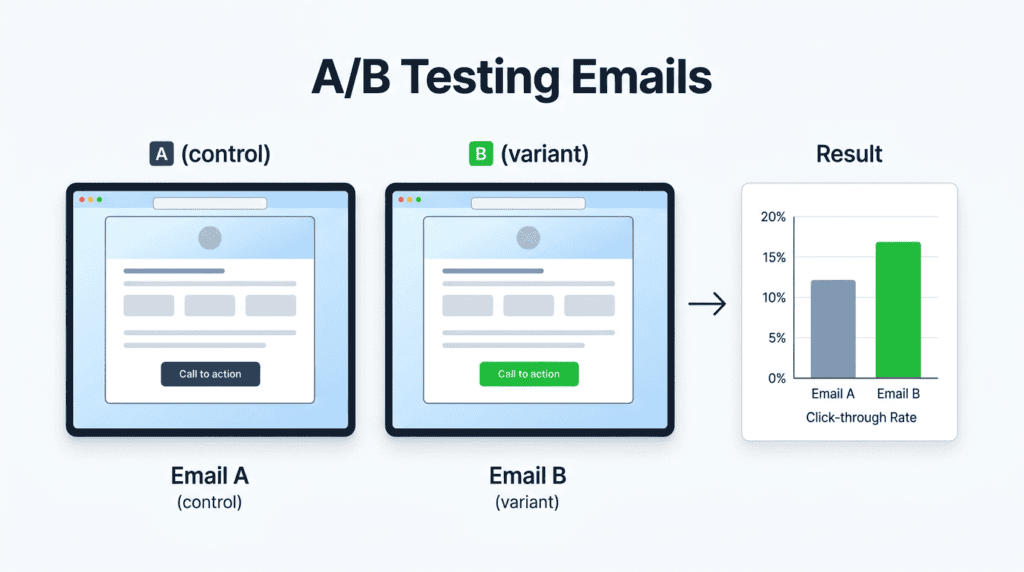
Defining A/B Testing in an Email Context
A/B testing, often called split testing, in email marketing means sending two different versions of an email to a small, random segment of your subscriber list. Version A is your control, and Version B is your variant, with only one specific element changed between them. The goal is to see which version performs better based on predefined metrics. For example, you might test two different subject lines to see which one gets a higher open rate, or two different call-to-action buttons to see which drives more clicks. This systematic comparison helps you understand what your audience responds to.
The Core Benefit: Moving From Guesswork to Data-Driven Decisions
The biggest advantage of ab testing emails is that it replaces assumptions with hard data. Instead of relying on gut feelings or industry best practices that might not apply to your unique audience, you get concrete evidence of what works. This data-driven approach allows for continuous optimization of your email marketing campaigns. You learn directly from your subscribers, making each subsequent campaign more effective. This shift from intuition to data is critical for sustainable growth.
> Don’t fall into the trap of only testing when you have a problem; continuous A/B testing should be a foundational part of your email strategy, even when things are going well.
How A/B Testing Directly Impacts Key Metrics (Open Rate, CTR, Conversions)
A/B testing directly influences the core performance indicators of your email campaigns. By optimizing variables, you can see tangible improvements across the board.
- Open Rate: Testing different subject lines, “from” names, or preview text directly impacts how many people decide to open your email. A higher open rate means more eyes on your message.
- Click-Through Rate (CTR): Once an email is open, the next goal is to get clicks. Testing elements like email body copy, call-to-action (CTA) buttons, images, or even the layout can significantly boost your CTR, guiding more subscribers to your website or landing page.
- Conversions: Ultimately, email marketing aims to drive conversions, whether that’s a purchase, a download, or a sign-up. By optimizing your content, offer presentation, and overall email design, A/B testing helps you fine-tune your messaging to encourage more desired actions, directly impacting your bottom line.
For instance, I once worked with an e-commerce client who was struggling with their abandoned cart email series. We hypothesized that a more direct, benefit-driven subject line combined with a small discount offer in the email body copy would perform better than their existing generic reminder. After running an A/B test on these two variants, the new version not only increased their open rates by 15% but also boosted their conversion rate from abandoned carts by a staggering 22% over a month. This single test generated thousands in extra revenue.
The Risk of Not A/B Testing: Stagnation and Missed Opportunities
Ignoring A/B testing means you’re essentially flying blind. Without it, your email performance will likely stagnate, or even decline, as audience preferences evolve. You’ll miss out on crucial opportunities to learn about your subscribers and refine your strategy. This can lead to lower engagement, reduced ROI from your email efforts, and a slower growth trajectory for your business. In a competitive digital landscape, relying on outdated assumptions is a costly decision that few businesses can afford.
The 8 Most Impactful Email Variables to A/B Test (And Where to Start)
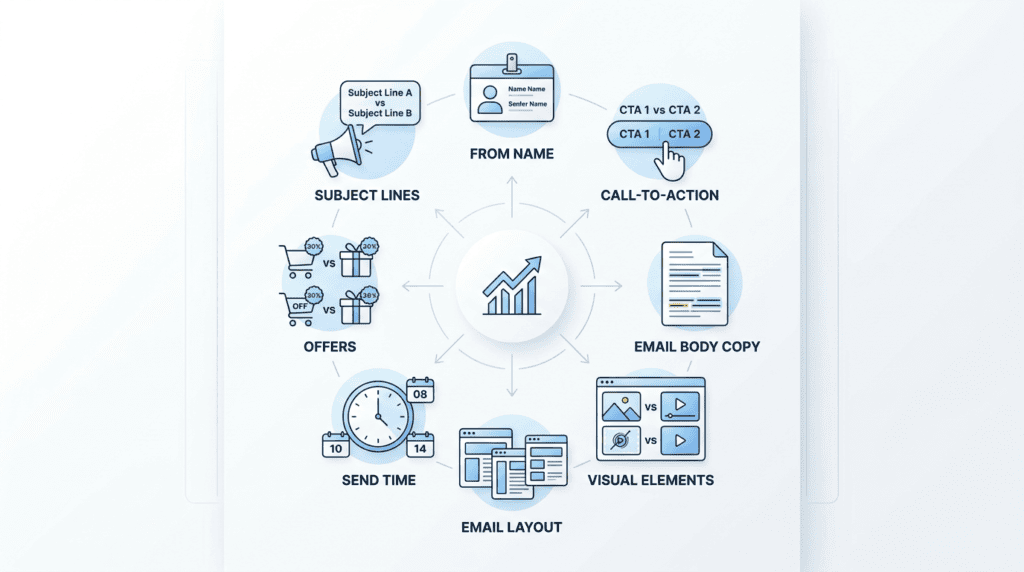
When you’re running email marketing campaigns, knowing what to test can feel overwhelming. The goal of A/B testing emails isn’t just to change things; it’s to make data-driven decisions that improve your email performance metrics. We’ll look at the most common and effective elements to test, generally ordered by how much impact they tend to have on your results. Starting with these variables can give you the quickest wins and the most valuable insights into your target audience.
1. Subject Lines: The Gateway to Your Email
Your subject line is often the first, and sometimes only, impression your email makes. It directly affects your open rates. A strong subject line encourages subscribers to click, while a weak one gets ignored. Testing different approaches here is crucial for optimizing click rates and overall email engagement.
- Testing Length (Short vs. Long): Some audiences prefer short, punchy subject lines that get straight to the point, especially on mobile devices. Others might respond better to longer, more descriptive lines that offer more context. You might find that a subject line length of 40-50 characters works best for one segment, while another responds to 70+ characters.
- Using Questions vs. Statements: A question can spark curiosity and encourage an open, like “Are you missing out on this deal?” A direct statement, such as “Limited-time offer inside,” can create urgency. The best approach depends heavily on your campaign goals and the specific offer.
- Including Emojis vs. No Emojis: Emojis can make your subject line stand out in a crowded inbox and convey emotion quickly. However, overuse or inappropriate emojis can make your email seem unprofessional or even trigger spam filters. It’s a variable that requires careful testing with your specific list.
- Personalization (e.g., Using the Subscriber’s Name): Adding a subscriber’s name or other personalized email content to the subject line can significantly boost open rates. This makes the email feel more relevant and less like a mass send. However, ensure your data is clean; a misspelled name can do more harm than good.
2. “From” Name and Sender Address: Building Trust and Recognition
The “From” name is right next to the subject line in the inbox, and it plays a big role in whether someone trusts your email enough to open it. It’s about recognition and credibility.
- Testing a Person’s Name vs. Company Name (e.g., “Jane from Company” vs. “Company”): Often, emails from a real person’s name (e.g., “Sarah from [Your Brand]”) feel more personal and less like a marketing blast than those from just the company name. This can build a stronger connection with your subscribers. We once ran an A/B test where changing the “From” name from “Our Company Support” to “John from Our Company” increased open rates by 7% for a specific customer service campaign. It showed us the power of human connection, even in a small detail.
3. Call-to-Action (CTA): Driving the Desired Action
Your call-to-action is where you tell subscribers what to do next. Optimizing your CTA is critical for conversion rate optimization and driving clicks.
- Button Text (e.g., “Shop Now” vs. “Explore the Collection”): The words on your CTA button can make a huge difference. “Learn More” might be too generic, while “Get My Free Guide” is specific and benefit-driven. Test action-oriented language that clearly communicates the next step.
- Button Color and Design: A CTA button color that contrasts with your email design layout can draw the eye. Don’t just pick a color you like; test what stands out and encourages clicks without clashing.
- CTA Placement (Above the Fold vs. End of Email): Placing your primary CTA where it’s immediately visible (“above the fold”) can capture attention quickly. However, for longer emails, a CTA at the end, after the reader has absorbed all the information, might convert better. Sometimes, having both can be effective.
4. Email Body Copy and Messaging: Refining Your Pitch
Once someone opens your email, the email body copy is what keeps them engaged and moves them towards your goal. This is where you build your case.
- Tone of Voice (e.g., Formal vs. Casual): Your brand’s voice should be consistent, but you can test variations within that. A more casual, conversational tone might resonate better with some target audience segments, while others prefer a more formal, authoritative approach.
- Copy Length (e.g., Concise vs. Detailed): Some campaigns benefit from short, punchy copy that gets to the point quickly. Others, especially for complex products or services, might need more detailed explanations to persuade the reader.
- Framing (e.g., Highlighting Benefits vs. Features): Do your subscribers respond better to a list of features, or do they prefer to hear about the benefits those features provide? For instance, instead of “12-megapixel camera,” try “Capture stunning, vibrant photos even in low light.”
5. Visual Elements: Capturing Attention
Visuals can break up text, convey information quickly, and make your emails more appealing.
- Using Images vs. Text-Only Emails: While images can enhance engagement, some audiences or email types (like plain text vs html) might perform better with minimal or no images, especially for deliverability or if subscribers have images blocked by default.
- Testing Different Hero Images: The main image at the top of your email can set the tone. Test different styles, subjects, and even stock photos versus custom photography to see what resonates most.
- Animated GIFs vs. Static Images: GIFs can add dynamic flair and quickly demonstrate a product or process. However, they can also increase email size, potentially affecting load times and deliverability.
6. Email Layout and Design: Structuring for Readability
The overall email design layout impacts how easily subscribers can read and understand your message. A well-structured email guides the eye.
- Single-Column vs. Multi-Column Layouts: Single-column layouts are generally easier to read on mobile devices and provide a clear path for the eye. Multi-column layouts can present more information but might feel cluttered or break on smaller screens.
- Testing the Order of Content Blocks: The sequence in which you present information can influence how much of your email is read and which CTAs are clicked. Experiment with placing your most important message or offer higher up.
7. Send Time and Day: Reaching Subscribers at the Right Moment
Even the best email won’t perform if it’s sent when your audience isn’t checking their inbox. Send time optimization is about catching them when they’re most receptive.
- Weekday vs. Weekend: Many businesses find weekdays perform better, but some niches might see higher engagement on weekends when people have more leisure time.
- Morning vs. Afternoon vs. Evening: Test different times of day. For example, a “lunch break” email might perform well for office workers, while an evening email could be better for parents after their kids are asleep. Your email analytics tools can often provide initial insights into peak open times.
8. Offers and Promotions: The Core Incentive
For many marketing campaigns, the offer itself is the primary driver of conversions. Testing different offers helps you understand what truly motivates your list.
- Percentage Discount vs. Dollar Amount Off: Is “$10 off” more appealing than “10% off”? This often depends on the price point of your product. For a $50 item, $10 off is 20%, which sounds better. For a $1000 item, $10 off is negligible, but $100 off (10%) is significant.
- Free Shipping vs. a Discount: Free shipping is a powerful incentive, sometimes even more so than a direct discount of similar value. It removes a common barrier to purchase. Test which type of offer drives more sales for your products.
> Tactical Takeaway: When deciding which variables to test, always prioritize those that directly impact your primary marketing campaign goals, whether that’s increasing open rates, click-through rates, or conversions.
How to Set Up and Run a Statistically Valid Email A/B Test: A 5-Step Process
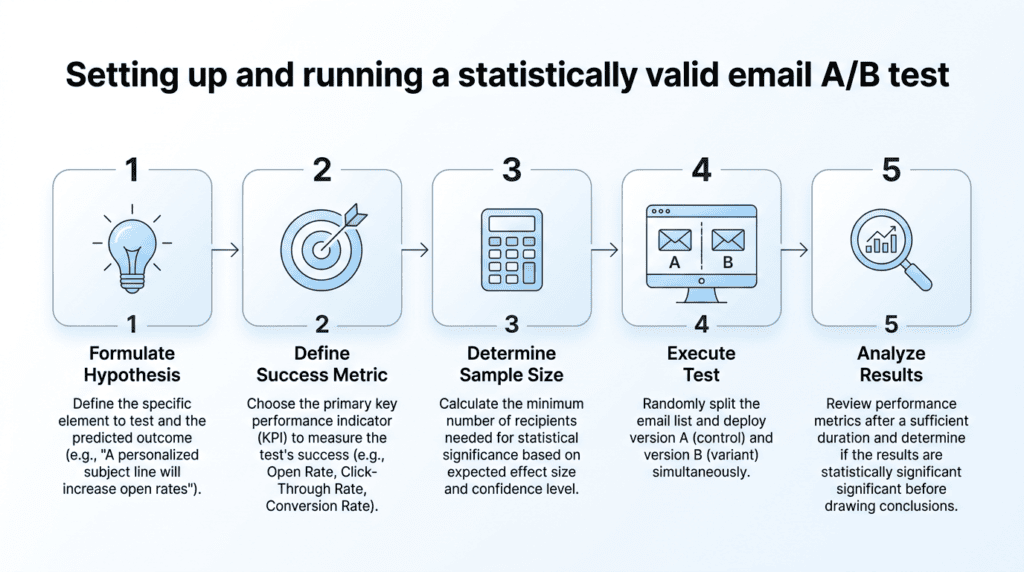
Running effective A/B tests on your email campaigns requires more than just sending two different versions. You need a structured approach to ensure your results are reliable and lead to real optimization. This 5-step process helps you move from a vague idea to actionable data-driven decisions.
Step 1: Formulate a Clear Hypothesis
Before you even think about creating variants, you need a clear, testable statement. This is your hypothesis. It’s an educated guess about what will happen and why.
What is a hypothesis?
A good hypothesis follows an “If…then…because…” structure. For example: “If I change the CTA button color from blue to orange, then the click-through rate will increase because orange stands out more against the email’s background design.” This isn’t just a guess; it’s a prediction with a reason.
- Why you should only test one variable at a time: This is fundamental to valid A/B testing emails. If you change the subject line *and* the CTA button color *and* the hero image all at once, and one version performs better, you won’t know which specific change caused the improvement. By testing one variable at a time, you isolate the impact of that single change, allowing you to understand what truly moves the needle. This is often referred to as running split tests.
Step 2: Define Your Success Metric
Every A/B test needs a clear way to measure success. This metric should directly align with your hypothesis and the variable you’re testing.
- Aligning your metric with your hypothesis: If you’re testing subject lines, your primary success metric will likely be the open rate. If you’re testing CTA button text or placement, you’ll focus on the click-through rate (CTR). For offers, the conversion rate (e.g., sales, sign-ups) is key. Having a clear metric from the start prevents confusion when analyzing results and helps you determine a clear a b test winner.
Step 3: Determine Your Sample Size and Test Duration
Statistical significance is what makes your test results trustworthy. Without enough data, you can’t be confident that your “winner” isn’t just due to random chance.
- Why sample size matters for statistical significance: A small sample size can lead to misleading results. If you send an email to only 100 people per variant, a few extra opens or clicks can skew the data dramatically. A larger sample size smooths out these random fluctuations, giving you more reliable data.
- Using an A/B test calculator to find the right audience size: Many free online tools can help you calculate the necessary test sample size based on your current conversion rates, desired improvement, and statistical confidence level. For example, if I’m aiming for a 5% improvement on a 2% conversion rate with 95% confidence, a calculator will tell me I need thousands of recipients per variant, not just hundreds. This ensures your results are statistically significant results and not just noise.
Step 4: Execute the Test in Your Email Service Provider (ESP)
Most modern email service provider (ESP) software makes running split tests relatively straightforward.
- A general overview of how this works in platforms like Mailchimp, ConvertKit, or Klaviyo:
- You typically select an A/B test option when creating a new email campaign.
- You’ll choose the variable you want to test (e.g., subject line, from name, content).
- You’ll create your control and treatment variants (e.g., Subject Line A and Subject Line B).
- You define the percentage of your email list that will receive the test (e.g., 10% of your list gets Variant A, 10% gets Variant B).
- You set a test duration (e.g., 4 hours, 24 hours) after which the ESP will automatically send the winning variant to the remaining subscribers.
- The ESP handles the segmentation and sending, then reports on the performance of each variant.
Step 5: Analyze the Results and Document Your Learnings
The test isn’t over when the winner is declared. The real value comes from understanding *why* one variant performed better.
- Looking beyond the “winner” to understand the “why”: Don’t just celebrate a winner; dig into the data. Did a specific word in the subject line resonate? Did the new CTA button color genuinely improve visibility? User behavior analysis can provide deeper insights. This understanding helps you refine your email marketing strategy for future campaigns.
- Creating a simple log of test results to inform future campaigns: Maintain a spreadsheet or document where you record:
- The hypothesis
- The variable tested
- The variants (control and treatment)
- The sample size
- The success metric and results (open rates, CTR, conversions)
- The statistical significance
- Key learnings and next steps
This continuous testing process builds a valuable knowledge base about your audience, allowing you to make data-driven decisions consistently.
Common A/B Testing Mistakes That Invalidate Your Results
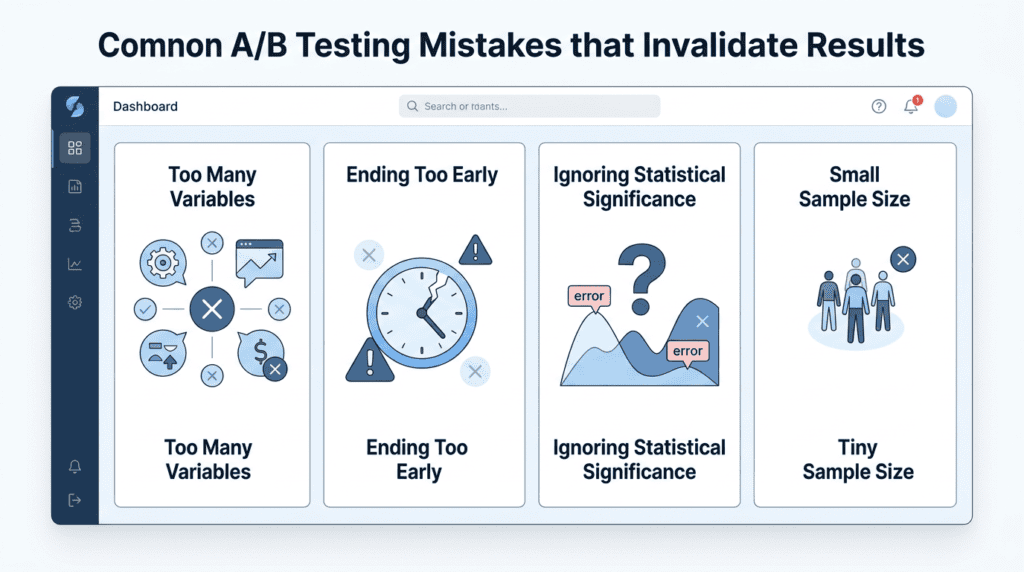
Even with the best intentions, it’s easy to make errors when running email A/B tests that can skew your data and lead you down the wrong path. Understanding these common pitfalls is crucial for getting reliable results and making smart optimization decisions for your email marketing campaigns.
Mistake 1: Testing Too Many Variables at Once
This is perhaps the most frequent mistake. When you change multiple elements in your email variants – say, the subject line, the hero image, and the call-to-action (CTA) button color – and one version performs better, you won’t know *which* change caused the improvement. Was it the catchy subject line, the compelling image, or the vibrant button? To truly understand what drives performance, you must isolate your variables. Each test should focus on one specific element.
Mistake 2: Ending the Test Too Early
Patience is key in A/B testing. Ending a test prematurely, before it has gathered enough data or run for a sufficient duration, can lead to false positives or negatives. You might see an early lead for one variant, but that could just be random chance. It’s vital to let your test run long enough to account for daily fluctuations in recipient behavior and to reach statistical significance.
Mistake 3: Ignoring Statistical Significance
Just because one email variant got more clicks doesn’t mean it’s a true “winner.” Statistical significance tells you how likely it is that your results are due to the changes you made, rather than just random luck. Without reaching a statistically significant threshold (often 90% or 95%), you can’t confidently declare a winner or apply those learnings to future email sends. Many email service providers (ESPs) have built-in tools to help determine this, or you can use an online statistical significance calculator.
> Critical Warning: Never make major strategic changes based on test results that aren’t statistically significant; you’re essentially guessing, which defeats the purpose of data-driven optimization.
Mistake 4: Testing on a Sample Size That Is Too Small
A small sample size means your test audience isn’t representative of your entire email list. If you only send your A/B test emails to a handful of subscribers, any observed differences in open rates or click-through rates might not hold true for your broader audience. This leads to unreliable data and poor decisions. Always aim for a test sample size large enough to provide meaningful insights, often determined by an A/B test calculator based on your list size and desired confidence level.
Mistake 5: Not Re-Testing Winning Elements Over Time
What works today might not work tomorrow. Audience preferences, market trends, and even your own brand messaging evolve. A “winning” subject line style or CTA button color from a year ago might not be the most effective now. I’ve personally seen campaigns where a previously successful element started to underperform, only for a re-test to reveal a new winner that boosted engagement. Continuous testing and re-evaluation of past winners are essential for ongoing email performance optimization.
Reality Check: When Should You NOT A/B Test?
While A/B testing emails is a powerful tool for improving metrics, it’s not always the right approach. There are specific situations where running a test might be impractical, unnecessary, or even detrimental. Knowing when to hold back can save you time and resources.
For Very Small Email Lists (Under 1,000 Subscribers)
If your email list is tiny, you’ll struggle to achieve a statistically significant sample size for your A/B tests. The audience for each variant will be so small that any differences in open rates or clicks will likely be due to chance rather than the variable you’re testing. In these cases, it’s often better to focus on growing your list and implementing email marketing best practices rather than spending time on tests that won’t yield reliable data.
For Time-Sensitive, Urgent Communications
Imagine you need to send an urgent alert about a security breach or a flash sale that ends in two hours. This isn’t the time to run an A/B test on subject lines or send times. The priority is to get the message out to your entire audience as quickly and effectively as possible. Delaying the send to run a test could mean missed opportunities or, worse, a failure to communicate critical information.
When You Lack the Resources to Analyze and Implement Findings
A/B testing isn’t just about running the test; it’s about analyzing the results and then implementing the learnings. If you don’t have the time, tools, or expertise to properly interpret the data and act on it, then the effort of running the test is wasted. I’ve seen teams get excited about A/B testing, run a few tests, and then let the data sit there because they didn’t have a clear process for review or a plan to integrate the “winner” into their ongoing email strategy. Testing without action is just data collection. Make sure you have a plan for what happens *after* the test concludes.
A/B Testing Scenarios: From Simple to Advanced
To help you visualize how A/B testing emails works in practice, let’s walk through a few common scenarios, ranging from straightforward to more complex. These examples illustrate how to apply the principles of hypothesis, variable isolation, and metric alignment.
Beginner Scenario: Improving Open Rates for a Weekly Newsletter
This is a great starting point for anyone new to split testing.
- Hypothesis: A subject line with an emoji will get more opens than a plain text subject line for our weekly newsletter.
- Variable: Subject Line (specifically, the presence of an emoji).
- Metric: Open Rate.
- Execution: You’d create two subject line variants. Variant A: “Your Weekly Marketing Tips Are Here!” Variant B: “Your Weekly Marketing Tips Are Here! 🚀”. You’d then send these to a small, equal percentage of your list (e.g., 10% for Variant A, 10% for Variant B). After a set time (e.g., 4-6 hours), your email service provider (ESP) would automatically identify the winner based on the higher open rate and send that winning subject line to the remaining 80% of your subscribers.
Ecommerce Scenario: Increasing Sales for a Product Launch
For an e-commerce business, driving clicks to product pages is often a primary goal, making visual elements a key testing area.
- Hypothesis: A hero image showing the product in use will drive more clicks than a standard product-on-white-background shot in our new product launch email.
- Variable: Hero Image (the main image at the top of the email).
- Metric: Click-Through Rate (CTR) to the product page.
- Execution: You’d design two email variants, identical except for the hero image. One features the product in a lifestyle context (e.g., someone wearing the new watch), and the other shows the watch on a clean white background. You’d send these to a segment of your audience and monitor which variant generates a higher CTR to the product page. This helps optimize the visual appeal for your target audience segments.
Advanced Scenario: Optimizing a Multi-Email Welcome Series
Automated email workflows, like welcome series, offer significant opportunities for optimization, but testing them requires a longer view.
- Hypothesis: Sending the first email in our welcome series immediately after signup vs. after a 1-hour delay impacts overall engagement (open rate and CTR) across the entire series.
- Variable: Send Time/Delay for the *first* email in the series.
- Metric: Open Rate and CTR of the *entire series* (e.g., average open rate across all 3 emails, or total clicks on CTAs within the series).
- Execution: This is a more complex test. You’d set up two distinct automation paths. Path A sends the first welcome email instantly. Path B delays the first email by one hour. New subscribers would be randomly assigned to Path A or Path B. You’d then track the performance of all emails in the series for both groups over several weeks or months to see which initial send time leads to better long-term engagement and conversion rates. I’ve found that even small tweaks to automated email workflows can have a significant impact on subscriber engagement and ultimately, conversions.
Final Recommendations: Building a Culture of Continuous Improvement

Don’t just run one test and stop. The goal of A/B testing is to create a system of continuous learning and optimization. Start with the high-impact variables like your subject line and CTA. Document every result, and let the data from each test inform the hypothesis for your next one. This iterative process is how you achieve sustainable, long-term growth in your email marketing program.
For those with established email marketing campaigns and larger subscriber lists, prioritize advanced A/B testing emails across multiple variables like email body copy, design, and even send time optimization. You have the data volume to achieve statistically significant results faster. If you’re just starting or have a smaller list, focus your split testing variables on foundational elements like subject lines and calls-to-action to build initial momentum and understanding. Avoid extensive A/B testing when your list size is too small to yield reliable data, as discussed earlier; instead, focus on best practices until your audience grows. The cost of not consistently A/B testing is significant: you’re leaving money on the table, missing opportunities to boost engagement, and allowing your competitors to pull ahead with data-driven insights you’re ignoring.
> Consistent, data-driven A/B testing is not an option; it’s a non-negotiable strategy for maximizing your email marketing ROI.
Frequently Asked Questions (FAQs)
How long should I run an email A/B test?
You should run an email A/B test until it reaches statistical significance, which means the results are reliable and not due to chance. This often depends on your email list size and engagement rates, but typically ranges from a few hours for large lists to several days for smaller ones to gather enough data.
What is a good sample size for an A/B test?
A good sample size for an A/B test is one that allows you to detect a meaningful difference between your variants with a high degree of confidence. You can use an A/B test calculator to determine the appropriate test sample size based on your current metrics and desired statistical significance.
Can I A/B test on my entire email list?
Yes, you can A/B test on your entire email list, but it’s more common and often safer to test on a segment of your audience first. Once a clear winner is identified, you then send that winning email variant to the remaining, larger portion of your target audience segments.
What’s the difference between A/B testing and multivariate testing?
A/B testing involves comparing two versions of an email (A and B) by changing only one variable at a time, like a subject line or CTA button color. Multivariate testing, on the other hand, tests multiple variables simultaneously to see how they interact and affect email performance metrics.
How often should I be A/B testing my emails?
You should be A/B testing your emails continuously as part of an ongoing optimization strategy. Every major email marketing campaign, especially those with high stakes, presents an opportunity for a new test to improve open rates, clicks, and conversions.
What do I do if my A/B test results are inconclusive?
If your A/B test results are inconclusive, it means there wasn’t a statistically significant difference between your variants. You might need to re-evaluate your hypothesis, increase your test sample size, run the test for a longer duration, or test a more impactful variable in your next ab testing emails experiment.