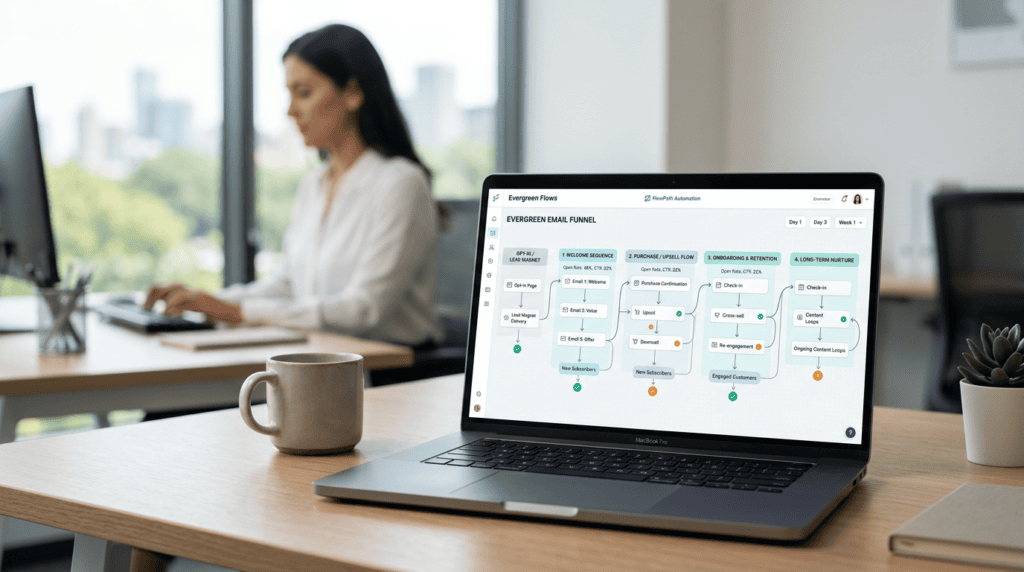
Tired of inconsistent sales and manual follow-ups? Many online businesses struggle to scale revenue without constantly launching new products or running live promotions. This often leads to burnout and a feast-or-famine cycle, making sustainable growth feel out of reach. The truth is, you don’t need to be “on” all the time to make consistent sales.
The solution lies in building evergreen email funnels. These automated systems work around the clock, turning new leads into paying customers without your direct, daily intervention. This guide explains how to build and optimize evergreen email funnels to generate consistent, automated revenue for your business. We’ll move beyond theory and provide a step-by-step framework, real-world examples, and the essential tools you’ll need to turn new subscribers into loyal customers on autopilot.
What is an Evergreen Email Funnel and How Does it Generate Revenue?
An evergreen email funnel is a pre-built, automated sequence of emails designed to guide a subscriber through a specific journey, typically from initial interest to a purchase decision. Unlike one-off broadcasts or live launch campaigns, these funnels are always “on,” continuously attracting new leads and converting them into customers without manual effort once set up. This automation is key to generating consistent, predictable revenue.
> Don’t mistake “evergreen” for “set it and forget it” entirely; while the automation runs continuously, consistent optimization and testing are crucial for long-term performance.
Defining the “Evergreen” Concept: Set It and Forget It?
The term “evergreen” implies something that remains fresh and relevant over time, much like an evergreen tree. In email marketing, it means your sales process isn’t tied to a specific date or a live event. Once you build an evergreen email funnel, it can run indefinitely, attracting new leads and converting them into sales every single day. This creates a powerful engine for passive income streams. However, a common misconception is that “evergreen” means zero maintenance. While the core automation workflow handles the heavy lifting, you still need to monitor metrics, refresh content, and split test elements to ensure it stays effective and profitable.
The Core Difference: Evergreen vs. Live Launch Funnels
Understanding the distinction between evergreen and live launch funnels is critical for your sales strategy. Live launch funnels are time-sensitive, often built around a specific product release, webinar, or promotional period. They create urgency and scarcity through deadlines, typically leading to a concentrated burst of sales. Think of a product launch that runs for a week, culminating in a cart close.
Evergreen email funnels, on the other hand, operate continuously. They don’t rely on specific dates or external events. A new subscriber entering your funnel today will experience the same sequence and offers as someone who joined six months ago. This allows for steady, predictable revenue generation and a more stable business model, especially for digital product sales or ongoing service offerings. While live launches can create spikes, evergreen funnels build a foundation of consistent revenue.
How Automation Drives Consistent Sales Cycles
The magic of evergreen email funnels lies in email marketing automation. Once a lead enters your system – perhaps by downloading a lead magnet optin or signing up for your newsletter – they trigger a pre-programmed sequence of emails. This automated follow-up sequence nurtures your subscribers, builds trust, and presents relevant offers at strategic points in their customer journey.
This means you don’t have to manually send emails to each new person who joins your list. Your email service provider (ESP) handles the timing and delivery, ensuring every lead receives the right message at the right time. For example, I once set up an automated email workflow where new sign-ups for a free guide immediately received a welcome email sequence, followed by educational content, and then a soft pitch for a related course. This automated sales funnel consistently brought in new customers, freeing up my time to focus on content creation and traffic generation. This continuous, automated process is what drives consistent revenue without constant manual effort.
Visualizing the Customer Journey: From Lead Magnet to Purchase
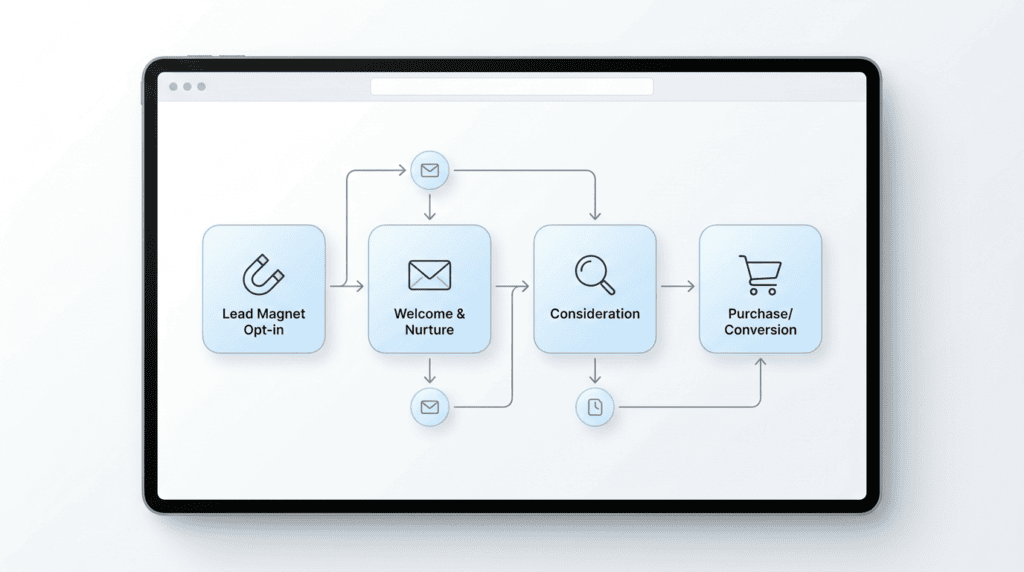
An effective evergreen email funnel maps directly to your customer’s journey. It starts with an initial touchpoint, often a valuable lead magnet, which captures a potential customer’s email address. From there, the funnel guides them through stages of awareness, consideration, and ultimately, conversion.
Here’s a typical flow:
- Awareness: A potential customer discovers your content (e.g., blog post, social media ad) and opts into your email list for a free resource like an e-book or checklist. This is your lead magnet optin.
- Nurturing/Education: Over several days or weeks, a welcome email sequence delivers valuable content, builds rapport, and demonstrates your expertise. These emails address pain points and introduce solutions, establishing you as an authority.
- Consideration: As trust grows, you introduce your core offer. This might be a low-cost product, a trial, or a direct pitch for your main service. The goal is to move them from a free subscriber to a paying customer.
- Conversion: The final stage involves a clear call to action, often leading to a high-converting sales page. This is where the sale happens, generating revenue.
This structured approach ensures that every email serves a purpose, moving the subscriber closer to becoming a loyal customer.
The 5 Essential Components of a High-Converting Evergreen Funnel
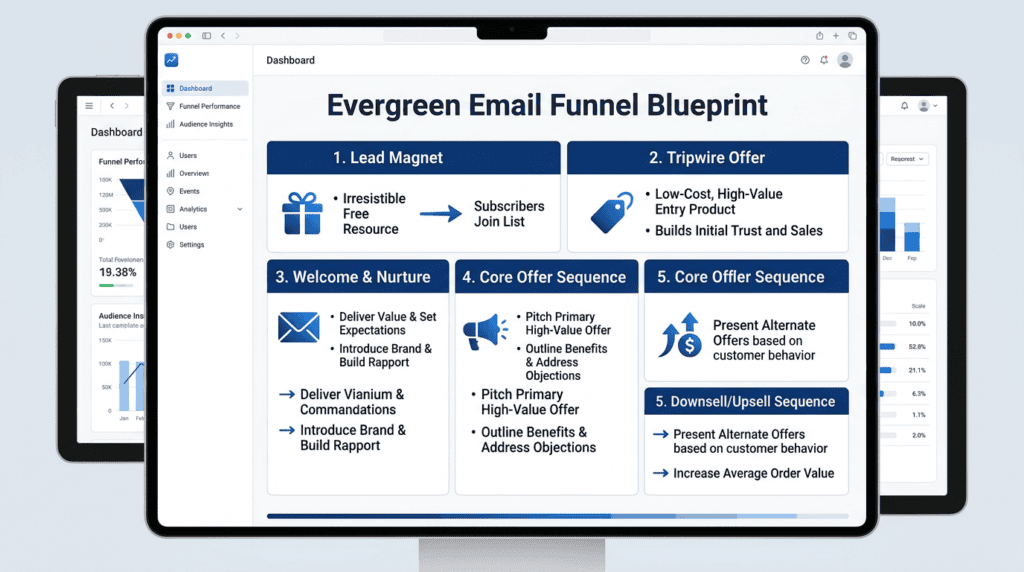
Building an effective evergreen email funnel isn’t about throwing a few emails together. It requires a strategic sequence of elements designed to move subscribers smoothly from curious leads to loyal customers. Each component plays a specific role in nurturing your audience and driving consistent revenue. Think of it as a well-oiled machine where every part contributes to the overall sales automation.
1. The Lead Magnet: Your High-Value Entry Point
The lead magnet is the very first interaction many potential customers will have with your brand. It’s a piece of valuable content or a tool offered for free in exchange for an email address. Its primary job is to attract your ideal audience and get them onto your email list. A strong lead magnet doesn’t just offer something for nothing; it provides a tangible solution to a specific problem your target audience faces, directly related to your core product or service.
Examples of effective lead magnets include:
- Checklists: Practical, actionable guides that simplify a process.
- Mini-courses: Short, focused educational content delivered via email or video.
- Webinar replays: Access to previously recorded, high-value training sessions.
- Templates: Ready-to-use documents or designs that save time.
> A truly effective lead magnet acts as a micro-commitment, offering immediate value that builds trust and primes the subscriber for future offers.
2. The Tripwire Offer: The Irresistible Low-Cost Purchase
Once a lead magnet has brought a new subscriber into your evergreen funnel, the tripwire offer is the next step. This is a low-cost, high-value product designed to convert a subscriber into a paying customer as quickly as possible. The goal isn’t necessarily massive profit from the tripwire itself, but rather to change the relationship from free content consumer to paying customer. This psychological shift is powerful. For instance, if I’m selling a premium course on affiliate marketing, my tripwire might be a $7 guide to finding profitable niches. It’s a small commitment, but it establishes a buyer-seller relationship.
3. The Welcome & Nurture Sequence: Building Trust and Authority
After someone opts in or makes a tripwire purchase, the welcome and nurture sequence kicks in. This series of emails is crucial for building rapport and establishing your authority. It’s not about selling immediately; it’s about delivering value, setting expectations, and demonstrating your expertise. These emails should introduce your brand, share helpful content, and subtly position your core offer as the ultimate solution to their problems. This sequence ensures your subscribers feel understood and valued, making them more receptive to future sales messages.
4. The Core Offer Sequence: The Strategic Sales Pitch
This is where you present your main product or service – your core offer. The core offer sequence is a carefully crafted series of emails designed to educate, persuade, and ultimately convert subscribers into buyers. It leverages the trust and authority built in the nurture phase. A common structure for these emails follows a classic sales copywriting framework:
- Problem: Clearly articulate the pain points your audience experiences.
- Agitation: Deepen their understanding of the negative impact of these problems.
- Solution: Introduce your core offer as the definitive answer.
- Social Proof: Share testimonials, case studies, or success stories.
- Urgency: Provide a compelling reason to act now, such as a limited-time bonus or a deadline.
This sequence is the engine for generating significant sales and revenue within your evergreen funnel.
5. The Downsell/Upsell Sequence: Maximizing Customer Lifetime Value
The customer journey doesn’t end with a single purchase. The downsell/upsell sequence is designed to maximize the lifetime value of each customer.
- Downsell: If a customer declines your core offer, a downsell presents a smaller, more affordable alternative. This could be a stripped-down version of your main product or a complementary, lower-priced item. The aim is to still get them to make a purchase, even if it’s not the primary offer.
- Upsell: For those who *do* purchase your core offer, an upsell presents a premium, higher-priced product or service that enhances their initial purchase. This could be an advanced course, one-on-one coaching, or a bundle of related products. This strategy helps increase the average transaction value and overall revenue.
Step-by-Step: Building Your First Evergreen Email Funnel
Now that we’ve covered the essential components, let’s walk through the practical steps of building your very first evergreen email funnel. This process involves careful planning, content creation, and technical setup to ensure your sales automation runs smoothly.
Step 1: Define Your Funnel’s Goal and Core Offer
Before writing a single email or designing an opt-in form, you need absolute clarity on what you’re selling and why. What specific product or service is at the heart of this evergreen funnel? Is it a digital course, a software subscription, or a coaching program? Once you know your core offer, define the primary action you want a subscriber to take. Is it to buy your $497 course, sign up for a free trial, or book a consultation? This clarity guides every decision you make in the subsequent steps and ensures your entire email sequence is aligned with your business objectives.
Step 2: Create a Compelling Lead Magnet Your Audience Actually Wants
Your lead magnet is the gateway to your evergreen funnel. It must be highly desirable to your target audience and directly related to your core offer. For example, if your core offer is a course on advanced SEO, your lead magnet shouldn’t be a generic “5 Productivity Tips.” Instead, it could be a “Keyword Research Blueprint” or a “Local SEO Checklist.”
Once you have your lead magnet, you’ll need to create:
- Effective landing pages: These are dedicated web pages designed solely to capture email addresses in exchange for your lead magnet. They should be clean, persuasive, and have a clear call-to-action.
- Opt-in forms: These are the actual forms on your landing page (or embedded on your blog) where visitors enter their email. Keep them simple, usually just asking for a name and email address to reduce friction.
I’ve found that aligning the freebie with the paid offer is critical. If your lead magnet solves a small part of the problem your paid product solves, it acts as a perfect bridge.
Step 3: Map Your Email Sequence Logic and Timing
This step involves planning the entire journey your subscribers will take through your email automation. You’ll decide:
- How many emails will be in each sequence (welcome, nurture, core offer, downsell/upsell)?
- What are the delays between each email? (e.g., Email 1 immediately, Email 2 after 24 hours, Email 3 after 48 hours).
- How will you use segmentation tags to create personalized paths? For instance, if someone buys the tripwire, they should be tagged as a buyer and removed from the tripwire sales sequence, moving them into a different nurture path. If they click a link but don’t buy, they might get a follow-up email addressing common objections.
> Carefully mapping your email sequence logic is paramount; a well-designed flow ensures subscribers receive relevant messages at the right time, preventing annoyance and maximizing conversion potential.
Step 4: Write High-Impact Email Copy for Each Stage
The words in your emails are what connect with your audience and drive action. Each email in your evergreen funnel needs compelling copy.
- Crafting subject lines that get opened: These are your first impression. Use curiosity, benefit-driven language, or personalization to stand out in a crowded inbox.
- Balancing value-driven content with sales messaging: Especially in nurture sequences, provide genuine value. Share tips, insights, or stories. When you transition to sales, make the pitch clear but always tie it back to the value and solution your offer provides.
- Writing a compelling call-to-action (CTA): Every email should have a clear next step. Whether it’s “Download the Checklist,” “Learn More Here,” or “Buy Now,” your CTA needs to be prominent, action-oriented, and tell the reader exactly what to do.
Step 5: Choose Your Tech Stack and Set Up the Automation
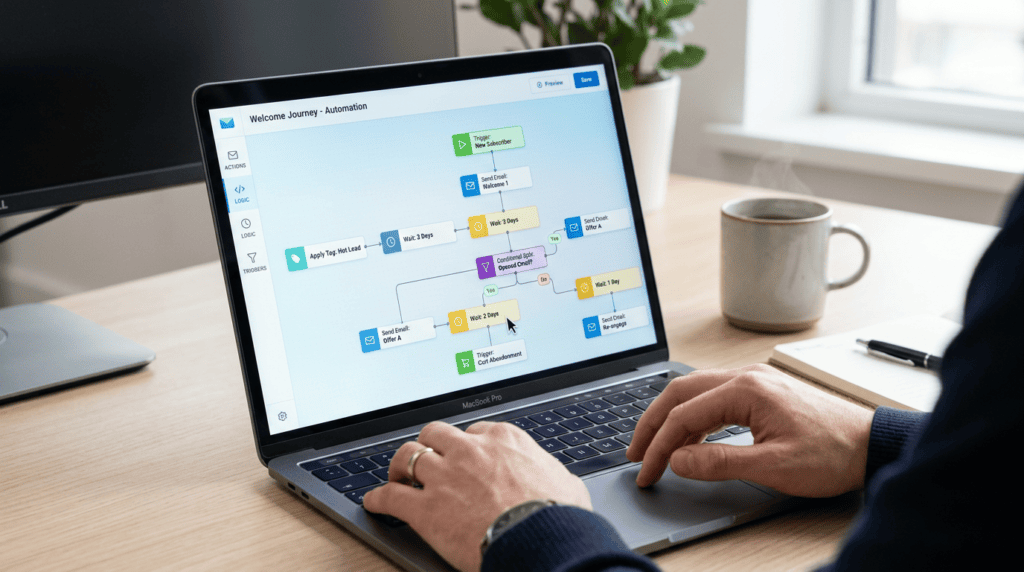
Finally, you need the right tools to bring your evergreen email funnel to life.
- Essential tools:
- Email marketing platform: This is the backbone of your automation. Platforms like ActiveCampaign, ConvertKit, or MailerLite allow you to build sequences, segment your audience, and track performance.
- Landing page builder: Tools like Leadpages, Unbounce, or even built-in features of your email platform help you create those high-converting opt-in pages.
- Connecting your opt-in form to your email sequence: This is where the automation begins. When someone fills out your opt-in form, your email marketing software should automatically add them to your list and trigger the welcome sequence.
- Setting up purchase tags to move users out of the sales sequence: This is crucial for a good customer experience. If a subscriber buys your core offer, they should immediately be tagged as a customer and removed from any ongoing sales pitches for that product. Instead, they might enter a post-purchase onboarding sequence or an upsell campaign. This prevents them from receiving irrelevant emails and ensures your evergreen funnel is smart and responsive.
Real-World Evergreen Funnel Examples for Different Businesses
To make the strategy concrete, this section provides specific scenarios showing how different business types can apply these principles. Building effective evergreen email funnels isn’t a one-size-fits-all approach; it requires tailoring the strategy to your specific business model and audience. I’ve seen these frameworks work across various niches, consistently generating automated sales and leads.
For Course Creators: Selling a Signature Digital Course
For course creators, an evergreen email funnel is a powerful way to sell digital products without constant live launches. The goal is to guide potential students from curiosity to enrollment.
- Lead Magnet: Free 5-day email course
This could be a mini-course delivered over several days, offering actionable tips related to your signature course topic. For example, if your main course teaches advanced SEO, the lead magnet might be “5 Days to Better Keyword Research.” This builds immediate value and positions you as an expert.
- Tripwire: A $27 mini-workshop
After the free mini-course, offer a low-cost, high-value tripwire. This could be a recorded workshop, a template pack, or a comprehensive guide that solves a specific, smaller problem related to your main offer. The purpose is to convert a subscriber into a paying customer, even for a small amount, which significantly increases their likelihood of buying your core product later.
- Core Offer: The $497 signature course
The nurture sequence following the tripwire (or directly after the lead magnet for those who don’t buy the tripwire) then strategically introduces your signature digital course. This sequence will highlight student testimonials, outline the course curriculum, address common objections, and emphasize the transformation students will experience. This automated sales funnel works around the clock.
For Coaches & Consultants: Generating Qualified Leads
Coaches and consultants often need to generate high-quality leads for their services, which typically involve a higher price point and a more personalized sales process. An evergreen funnel can pre-qualify and warm up these leads.
- Lead Magnet: A case study or strategic PDF guide
Offer something that demonstrates your expertise and the results you achieve. A case study showing how you helped a client overcome a specific challenge, or a strategic guide like “The 7-Step Blueprint to Scaling Your Online Business,” works well. This attracts leads who are already interested in solving the problems you address.
- Nurture Sequence: Emails showcasing client results and overcoming objections
The email sequence here focuses heavily on building authority and trust. Share success stories, provide valuable insights, and proactively address common concerns or hesitations potential clients might have about hiring a coach or consultant. Each email should reinforce your value proposition and expertise.
- Core Offer CTA: “Book a Discovery Call”
Instead of a direct sale, the ultimate call-to-action in this evergreen marketing campaign is to book a no-obligation discovery call. This allows you to personally connect with qualified leads, understand their specific needs, and present your services as the solution. This strategy effectively funnels interested prospects into your sales pipeline.
For E-commerce Stores: Automating First-Time Buyer Sales
E-commerce businesses can use evergreen email funnels to convert website visitors into first-time buyers and then encourage repeat purchases.
- Lead Magnet: 15% off first purchase coupon
A simple yet effective lead magnet for e-commerce is a discount code for a first purchase. This incentivizes sign-ups and provides an immediate reason for a new subscriber to buy.
- Nurture Sequence: Highlighting best-sellers and brand story
After the initial discount, the welcome email sequence should introduce your brand, share your unique story, and showcase popular products or collections. You can also include user-generated content or testimonials to build social proof. The goal is to build a relationship and guide them towards a purchase.
- Core Offer: Driving traffic to key product category pages
The emails in this sequence will feature specific product categories, new arrivals, or curated collections, with clear calls-to-action linking directly to those pages on your online store. This automated follow-up sequence helps convert new subscribers into paying customers by making product discovery easy and appealing.
Common Mistakes to Avoid When Building Your Funnel
Even with a solid strategy, it’s easy to stumble. Avoiding these common pitfalls can significantly improve the performance of your evergreen email funnels and ensure you’re building trust with subscribers, not alienating them.
> Don’t treat your evergreen funnel as a one-and-done project; it requires ongoing attention and optimization to truly deliver consistent passive revenue.
Mistake #1: The “Hard Sell” in the First Email
- Why you must build trust before pitching
Many beginners make the mistake of immediately pitching their core offer in the welcome email or the very next message after someone opts in. This is a quick way to increase unsubscribe rates. People sign up for your lead magnet because they want value, not an immediate sales pitch. Your initial emails should focus on delivering on the promise of the lead magnet, providing additional helpful content, and building rapport. Value-first content strategy is crucial for long-term subscriber engagement.
Mistake #2: Forgetting to Tag and Segment Users
- The risk of sending sales emails to existing customers
Neglecting proper segmentation is a major oversight. If someone has already bought your core product, they shouldn’t receive the sales sequence for that same product. Similarly, if they clicked on a link for a specific product category, you should tag them as interested in that category for future targeted email list promotions. Without proper tagging and segmenting your audience, you risk annoying your subscribers with irrelevant offers, which hurts your open and click-through rates and can lead to unsubscribes.
Mistake #3: No Follow-Up for Cart Abandonment
- How to recover potentially lost sales automatically
For e-commerce or digital product sales, cart abandonment is a common issue. If a customer adds items to their cart but doesn’t complete the purchase, an automated email workflow can be a powerful recovery tool. A simple sequence of 1-3 emails reminding them about their cart, perhaps offering a small incentive, can significantly recover potentially lost sales. Many email service provider platforms offer built-in features for this.
Mistake #4: Treating It as “Set and Forget”
- The importance of reviewing performance metrics monthly
While “evergreen” implies automation, it doesn’t mean “never touch again.” The most successful evergreen funnels are regularly reviewed and optimized. Market conditions change, audience preferences evolve, and your offers might need tweaking. You need to monitor your analytics, test different elements, and refine your strategy. Ignoring your funnel after launch is a missed opportunity for continuous growth and improved conversion.
Measuring Success: The Key Metrics for Your Evergreen Funnel
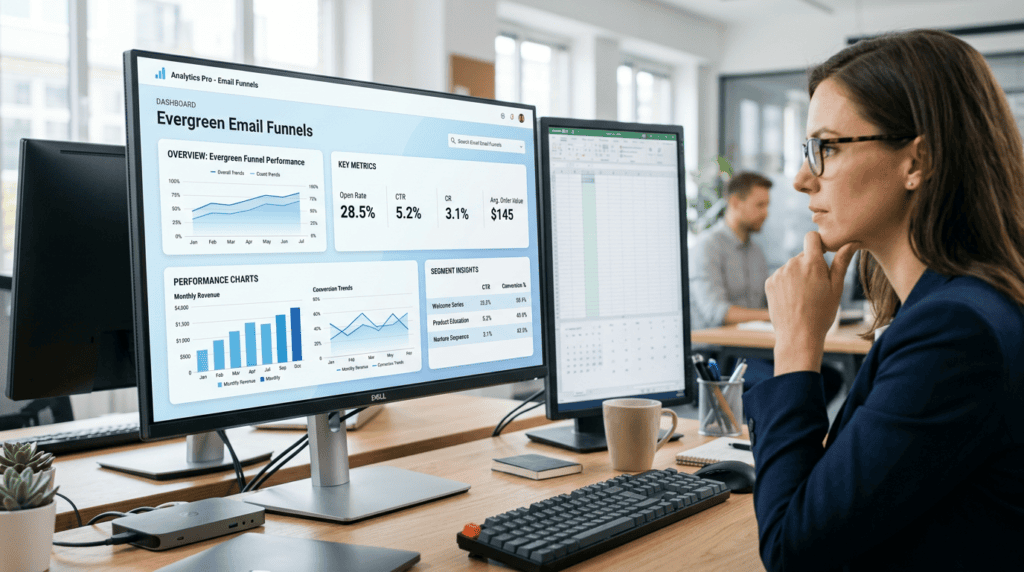
You can’t optimize what you don’t measure. To ensure your evergreen email funnels are performing as expected and generating consistent revenue, you need to track specific metrics. These insights help you identify bottlenecks, understand your audience better, and make data-driven decisions for optimization. I always tell my clients that if you’re not looking at these numbers, you’re flying blind.
Landing Page Conversion Rate
This metric tells you how many visitors to your lead magnet opt-in page actually sign up for your email list. A high conversion rate here means your lead magnet is compelling and your landing page design is effective. If this rate is low, you might need to test different headlines, calls-to-action, or even the lead magnet itself. This is the first step in building an email list, so it’s critical.
Email Open and Click-Through Rates (CTR)
These rates indicate how engaged your subscribers are with your emails. The open rate shows if your subject lines are enticing enough to get people to open your messages. The click-through rate (CTR) reveals if your email content and calls-to-action are compelling enough to drive traffic to your offers or valuable content. Low rates here suggest issues with your email copywriting, targeting, or deliverability.
Sales Conversion Rate (by email)
This is perhaps the most direct measure of your funnel’s effectiveness in generating revenue. It tracks the percentage of subscribers who make a purchase after going through your sales sequence. You’ll want to segment this by the specific email campaign or sequence to understand which parts of your automated sales funnel are most effective at driving digital product sales or service bookings.
Average Order Value (AOV)
AOV measures the average amount of money a customer spends per transaction. While not directly tied to the email funnel’s conversion, it’s crucial for understanding the overall profitability of your customer base. An evergreen funnel can influence AOV through upsell and downsell sequences, encouraging customers to purchase higher-priced items or additional products, thereby maximizing customer lifetime value.
Subscriber Lifetime Value (LTV)
LTV represents the total revenue you can expect from a single subscriber over the entire period of your relationship. This metric helps you understand the long-term impact of your evergreen email funnels. By nurturing your subscribers and offering relevant products over time, you can significantly increase their LTV, leading to more sustainable and passive income streams for your business.
Final Recommendation: Is an Evergreen Funnel Right for Your Business?

An evergreen email funnel is absolutely right for your business if you’re looking to build consistent passive revenue and scale your sales without constant manual effort. This strategy is ideal for entrepreneurs, course creators, coaches, and e-commerce store owners who have a clear product or service and an audience ready to buy. It’s a powerful automated sales funnel that works around the clock.
Who should invest in an evergreen email funnel?
- Those with a proven offer: If you’ve already sold your product or service manually and know there’s demand, an evergreen funnel will automate and amplify those sales.
- Businesses seeking predictable revenue: If you want to move away from the feast-or-famine cycle of live launches and create a steady stream of income, this is your path.
- Anyone building an email list: If you’re actively generating leads and want to monetize your subscribers effectively, an automated sales sequence is essential.
Who should hold off?
- Businesses without a clear product or audience: If you’re still figuring out what to sell or who your ideal customer is, focus on that first. An evergreen funnel won’t fix a foundational business problem.
- Those unwilling to invest time in setup and optimization: While it’s “set and forget” *after* setup, the initial build and ongoing testing require commitment.
The cost of inaction here is significant. Without an evergreen funnel, you’re leaving money on the table, relying on manual outreach, or constantly launching to generate sales. This limits your growth, creates burnout, and prevents you from truly monetizing your email list and traffic.
> An evergreen email funnel is your ultimate tool for turning leads into loyal customers on autopilot, freeing you to focus on growth and innovation.
I’ve personally seen the transformative power of these automated email workflows in my own businesses, allowing for consistent sales and a much healthier work-life balance.
Frequently Asked Questions (FAQs)
What’s the best email marketing software for building evergreen funnels?
The best email marketing software depends on your specific needs and budget, but popular choices for robust evergreen funnels include ActiveCampaign, ConvertKit, and Kajabi, offering advanced automation, segmentation, and analytics features essential for these campaigns. These tools allow you to create intricate automated email sequences and manage your subscribers effectively.
How many emails should be in an evergreen sales sequence?
An evergreen sales sequence typically includes anywhere from 5 to 15 emails, depending on the complexity of your offer and the customer journey you’ve mapped out. The key is to deliver value, address objections, and build trust over several touchpoints, rather than rushing the pitch in a single email.
How do I create urgency in a funnel that’s always available?
You can create genuine urgency in an evergreen funnel through personalized deadlines using software like Deadline Funnel, or by offering limited-time bonuses that expire for each individual subscriber. This ensures that while the funnel is always running, the specific offer or bonus has a real, unique expiration for each person.
Can I build an evergreen funnel without a tripwire offer?
Yes, you can build an evergreen funnel without a tripwire offer, especially if your primary goal is lead generation for a high-ticket service or a direct sale of a core product. However, a tripwire is highly effective for converting subscribers into paying customers early, building trust, and offsetting ad costs for your evergreen marketing campaigns.
How much does it cost to build and run an evergreen email funnel?
The cost to build and run an evergreen email funnel varies widely, from a few hundred dollars a month for basic email service provider (ESP) and landing page tools, to several thousand for advanced marketing automation platforms and specialized deadline software. Your main expenses will be your ESP, any paid traffic, and potentially copywriting or design services.
How often should I update or optimize my evergreen funnel?
You should plan to update and optimize your evergreen email funnel at least quarterly, or whenever you notice a significant drop in key metrics like open rates, click-through rates, or conversion rates. Regular testing of subject lines, email copy, and offers is crucial to maintain its effectiveness and ensure consistent revenue.