
Struggling to turn your newsletter into real income? Many creators get stuck here. While building an email list is crucial, simply having subscribers doesn’t automatically translate into a sustainable business. The real challenge for many isn’t growing their audience, but understanding how to make money with an email newsletter effectively, matching the right monetization strategy to their specific audience and content.
This guide cuts through the noise, offering proven methods to monetize your newsletter, whether you’re just starting out or already have a substantial list. We’ll explore various strategies, from direct sales to sponsorships, helping you identify the best path to generate consistent revenue. The goal is to build a profitable newsletter business that provides genuine value to your audience while securing your income.
Which Monetization Model Is Right for Your Newsletter? (Quick Guide)
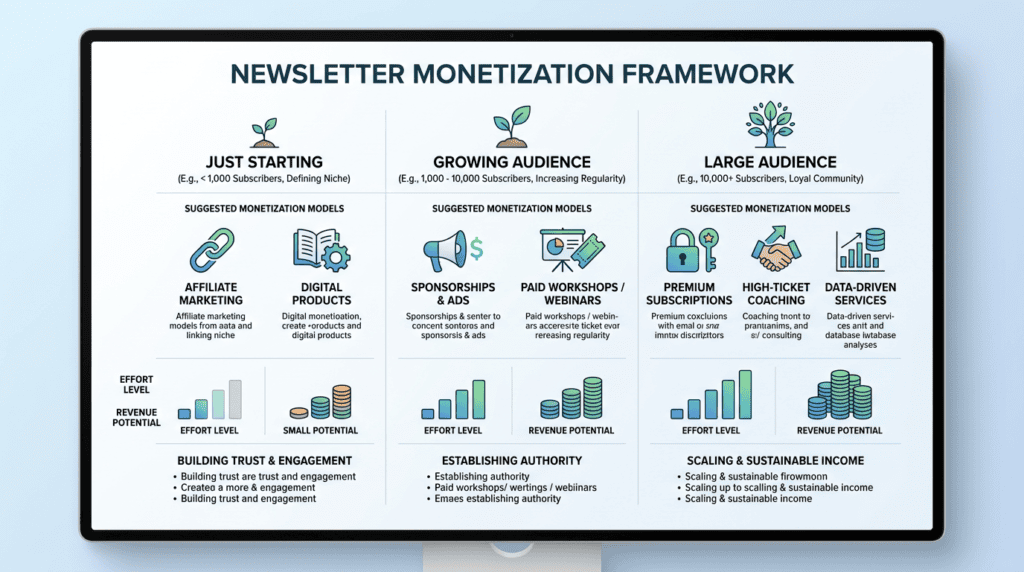
Before diving deep into specific tactics, it’s smart to get a bird’s-eye view of your options. Not every monetization strategy fits every newsletter or every audience size. What works for a massive daily news digest won’t necessarily work for a niche weekly update, especially when you’re trying to figure out how to make money with an email newsletter for the first time. This quick guide helps you align your current situation with the most suitable monetization models, saving you time and effort.
Quick Decision Table: Match Your Newsletter to a Monetization Strategy
| Your Situation | Best Monetization Model | Effort Level | Revenue Potential |
|---|---|---|---|
| Just Starting (Under 1,000 Subs) | Affiliate Marketing, Tipping | Low-Medium | Low-Medium |
| Growing Audience (1k-10k Subs) | Affiliate Marketing, Digital Products | Medium | Medium-High |
| Niche Authority (Any Size) | Digital Products, Consulting/Services | Medium-High | High |
| Large Audience (10k+ Subs) | Sponsorships, Premium Subscriptions | High | Very High |
| Existing Business/Ecommerce | Selling Your Own Products/Services | Medium | High |
The Core Principle: Why Audience Trust Is Your Most Valuable Asset
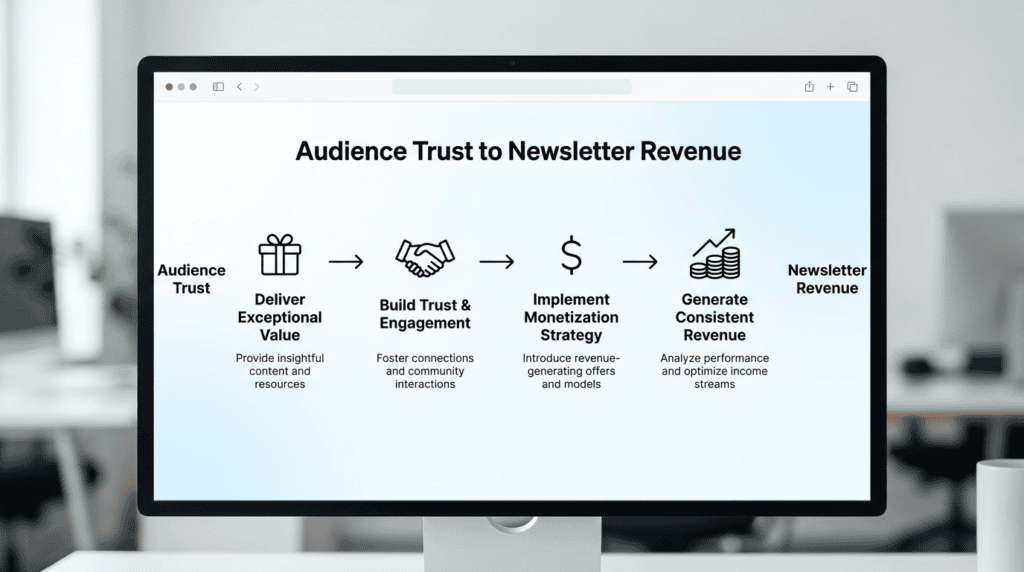
Regardless of the monetization method you choose, one truth remains constant: audience trust is your most valuable asset. Every strategy for how to make money with an email newsletter hinges on your subscribers believing in your recommendations, expertise, and the value you provide. If you break that trust, even once, it’s incredibly difficult to earn back.
> Always prioritize delivering exceptional value to your subscribers before attempting to monetize; this builds the foundation for long-term revenue.
I’ve personally seen newsletters with smaller, highly engaged lists generate significantly more income than those with massive, disengaged audiences. For example, a newsletter I ran focused on a very specific SaaS niche, and even with only 3,000 subscribers, our affiliate marketing efforts consistently outperformed a general marketing newsletter with 30,000 subscribers because our audience trusted our deep-dive reviews and specific product recommendations. This trust means higher open rates, better click-through rates, and ultimately, more revenue for you.
Strategy 1: Selling Your Own Products and Services
Selling your own products and services directly through your newsletter is often the most profitable way to monetize your audience. It gives you full control over the offering, pricing, and customer experience. This strategy works best when you’ve already built trust and authority with your subscribers, who then see you as a reliable source for solutions to their problems.
How to Monetize by Selling Digital Products (Courses, Ebooks, Templates)
Digital products are a fantastic way to make money with an email newsletter because they have high-profit margins and can be sold repeatedly without additional inventory costs.
- Identifying a problem your audience will pay to solve: Start by listening to your subscribers. What questions do they ask? What challenges do they mention in replies or surveys? Their pain points are your product opportunities. For instance, if you run a newsletter about productivity, your audience might struggle with time management or organizing their digital files.
- Validating your product idea with your subscribers *before* building it: Don’t spend weeks creating something nobody wants. Send out a quick poll or survey asking if they’d be interested in a specific solution. You can even offer a pre-sale at a discounted rate to gauge demand and fund development. This feedback loop is crucial.
- Example: A finance newsletter selling a “Personal Budgeting” spreadsheet template: Imagine a newsletter focused on personal finance. After seeing many subscribers ask about tracking expenses, the creator develops a simple, easy-to-use Google Sheet template. They launch it to their list, highlighting how it solves the common problem of budget management. This digital product could sell for $19–$49, providing recurring income with minimal ongoing effort.
> Tactical Takeaway: Always validate your digital product idea with your existing subscribers before investing significant time and resources into creation. Their feedback is invaluable.
Using Your Newsletter to Drive Sales for Physical Products (Ecommerce)
If you have an existing e-commerce business or plan to launch one, your email list is a powerful sales channel.
- Announcing new product drops and exclusive discounts to subscribers: Treat your newsletter subscribers as VIPs. Give them first access to new items or special discounts not available to the general public. This creates excitement and a sense of exclusivity, encouraging immediate purchases.
- Using subscriber data to inform new product development: Pay attention to which products get the most clicks or purchases from your email campaigns. This data can guide your inventory decisions or even inspire entirely new product lines that you know your audience already finds appealing.
- Example: A fashion newsletter offering early access to a new clothing line: A fashion blogger with an email list could send out an exclusive email to their subscribers a day before a new collection officially launches. This email would include a direct link to shop and maybe a special subscriber-only discount code, driving initial sales and buzz.
Offering High-Ticket Services and Consulting
For those with specialized expertise, offering services or consulting can be a highly lucrative way to make money with an email newsletter.
- Positioning yourself as an expert through high-value content: Your regular newsletter content should consistently demonstrate your knowledge and provide actionable advice. This builds your authority over time, making subscribers view you as a trusted expert.
- How to seamlessly transition from free advice to paid retainers: Instead of a hard sell, offer a free mini-training, a webinar, or a discovery call. These steps allow potential clients to experience your expertise firsthand before committing to a paid service. I’ve personally seen this work well; a well-crafted email sequence can guide a subscriber from reading free tips to booking a $500 strategy session.
- Who this works best for (B2B, coaches, freelancers): This strategy is particularly effective for business-to-business (B2B) newsletters, life coaches, marketing consultants, web developers, or any freelancer offering specialized skills. Your newsletter acts as a lead generation tool, warming up prospects for your premium services.
Strategy 2: Leveraging Affiliate Marketing for Passive Income
Affiliate marketing is a popular method for creators to monetize an email newsletter without creating their own products. You earn a commission by recommending products or services from other companies. This can generate significant passive income if done correctly.
Finding and Vetting the Right Affiliate Partners
Success in affiliate marketing hinges on promoting products that genuinely benefit your audience and align with your content.
- Where to find relevant affiliate programs (partner networks, direct outreach): Many affiliate programs are available through large networks like ShareASale, Impact, or PartnerStack. You can also directly visit the websites of products or services you love and look for an “Affiliates” or “Partners” link in their footer.
- The importance of promoting products you’ve actually used and believe in: Authenticity is key. Your audience trusts your recommendations. If you promote something you haven’t tried or don’t genuinely endorse, that trust erodes quickly. Always prioritize value for your subscribers over potential commission.
- Red flags to watch for in an affiliate program: Be wary of programs with extremely low commission rates, a history of non-payment, or products with poor customer reviews. A product that generates complaints will reflect poorly on your brand.
How to Integrate Affiliate Links Without Annoying Your Readers
The goal is to make affiliate recommendations feel like helpful suggestions, not aggressive sales pitches.
- Natural placement within valuable content vs. blatant “sales” emails: Weave affiliate links into your regular content where they add value. For example, if you’re discussing email marketing strategies, naturally mention an email service provider you use. Avoid sending emails that are *only* affiliate promotions unless clearly marked as a deal or resource guide.
- Using dedicated “Tools I Use” or “Resource” sections: Create a recurring section in your newsletter or a dedicated page on your website (which you link to in your newsletter) listing your recommended tools, books, or services. This allows subscribers to explore at their own pace.
- FTC disclosure requirements and building transparency: In the US, the Federal Trade Commission (FTC) requires clear disclosure of affiliate relationships. Always state that you may earn a commission from purchases made through your links. A simple “Note: This email contains affiliate links, which means I may earn a commission if you make a purchase” at the top or bottom of your email is usually sufficient. Transparency builds trust and is non-negotiable for long-term success.
Affiliate Marketing Examples for Different Niches
Affiliate marketing can be adapted to almost any niche.
- Tech newsletter: Recommending software or hardware: A tech newsletter might review a new AI writing tool and include an affiliate link for readers to try it. Or, they could recommend specific computer peripherals for remote work setups.
- Parenting newsletter: Recommending baby gear or educational toys: A parenting newsletter could share a “best strollers” guide, linking to specific models on Amazon or other retailers. They might also recommend age-appropriate educational toys.
- Cooking newsletter: Recommending kitchen tools or specialty ingredients: A cooking newsletter could feature a recipe that requires a specific type of blender, then link to that blender. They might also recommend unique spices or gourmet food kits.
Strategy 3: Securing Paid Sponsorships and Advertisements
Once your newsletter builds a consistent audience, brands will pay to get in front of your subscribers. Securing paid sponsorships and advertisements can be a significant revenue stream, especially for niche newsletters with engaged readers.
When Is Your Newsletter Ready for Sponsorships? (Audience Size & Engagement)
Brands aren’t just looking for big numbers; they want to reach the *right* people.
- Why engagement metrics (open rate, click-through rate) matter more than subscriber count: A newsletter with 5,000 highly engaged subscribers (e.g., 40% open rate, 10% click-through rate) is often more valuable to a sponsor than one with 50,000 subscribers and low engagement. Sponsors want to know their message will actually be seen and acted upon.
- The 1,000-subscriber and 5,000-subscriber milestones: While some smaller newsletters can land sponsorships, many brands start considering partnerships once you hit around 1,000 engaged subscribers. Reaching 5,000 subscribers often opens the door to more consistent and higher-paying opportunities.
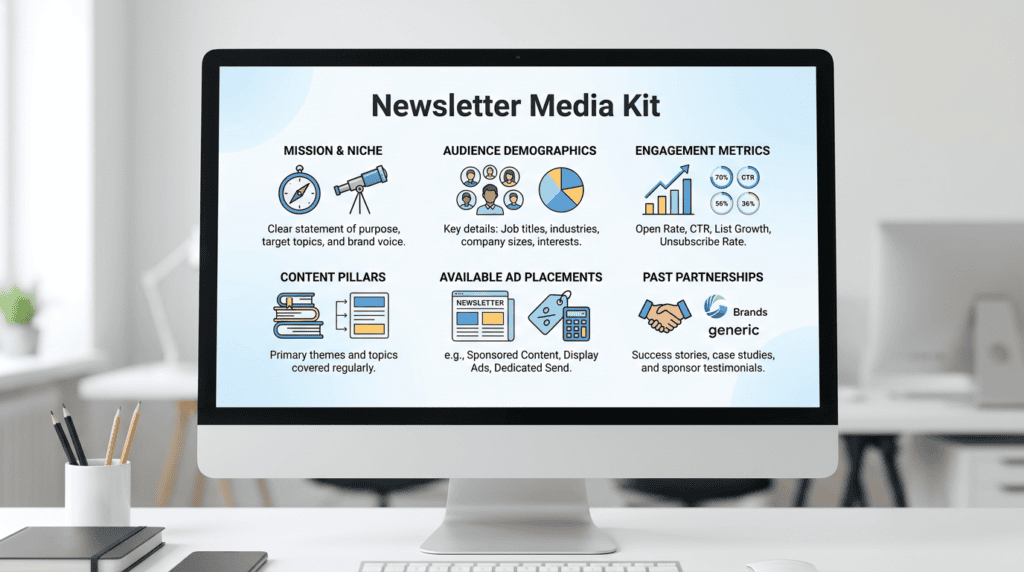
- Creating a media kit: What to include (demographics, stats, pricing): A professional media kit is essential. It’s a document that showcases your newsletter’s value to potential sponsors. It should include:
- Your newsletter’s mission and niche
- Audience demographics (age, interests, location)
- Key performance indicators (average open rate, click-through rate, subscriber growth)
- Testimonials (if any)
- Available ad placements and their pricing
- Past successful sponsorships (if applicable)
How to Price Your Newsletter Sponsorships
Pricing can feel tricky, but there are common models and strategies.
- Common pricing models: Flat fee vs. CPM (Cost Per Mille):
- Flat fee: You charge a set amount for a specific placement (e.g., $200 for a dedicated email, $50 for a banner ad). This is simpler and often preferred by smaller newsletters.
- CPM (Cost Per Mille/Thousand): You charge a rate per 1,000 subscribers or impressions. For example, if your CPM is $20 and you have 5,000 subscribers, a full newsletter sponsorship might be $100 ($20 x 5).
- Setting your initial rates and when to increase them: Start with rates that feel fair for your audience size and engagement. As your list grows and your engagement remains strong, you can gradually increase your prices. Don’t be afraid to test higher rates.
- Example pricing for a niche newsletter with 5,000 subscribers: For a highly engaged niche newsletter with 5,000 subscribers, a flat fee for a dedicated sponsor section might range from $100–$300 per issue. A full, dedicated email could command $500–$1,000 or more, depending on the niche and expected ROI for the sponsor.
Finding and Pitching Potential Sponsors
Proactively seeking out sponsors is often more effective than waiting for them to come to you.
- Identifying brands that align with your audience’s interests: Think about products or services your audience already uses or would find valuable. Look for companies that advertise in similar newsletters or on websites your audience frequents.
- Using platforms like Paved and Swapstack vs. direct outreach:
- Platforms: Services like Paved and Swapstack connect newsletter creators with brands looking for sponsorships. They can simplify the process but might take a cut of your earnings.
- Direct outreach: This involves researching brands and sending personalized pitch emails. It’s more time-consuming but can lead to higher-paying, direct relationships.
- Crafting a pitch email that gets a response: Your pitch should be concise and clearly articulate the value you offer. Highlight your audience demographics, engagement rates, and how their product or service is a perfect fit for your readers. Make it easy for them to say yes by suggesting specific sponsorship packages.
Strategy 4: Creating a Paid (Premium) Newsletter
Moving beyond advertising and affiliate commissions, a paid newsletter offers a direct path to recurring revenue by charging subscribers for exclusive content. This model transforms your newsletter into a subscription business, fostering a highly engaged and invested audience.
Is a Paid Subscription Model Right for You?
Deciding to put your content behind a paywall involves a trade-off. While it can lead to slower subscriber growth compared to a free newsletter, the audience you do attract is often far more committed and values your expertise deeply. The key question is: what kind of content is valuable enough to warrant a recurring payment? This usually means offering deep analysis, unique insights, expert interviews, or exclusive access to a community or resources that can’t be found elsewhere for free.
Many creators find success with this model by providing content that helps subscribers solve a specific problem or gain a competitive edge. Platforms like Substack, Ghost, and ConvertKit have made it much easier for creators to set up and manage a paid newsletter subscription model, handling everything from payments to content delivery.
> Tactical Takeaway: Your paid content must offer a clear, tangible benefit or solve a specific, recurring problem for your audience. If it’s easily found elsewhere, it won’t convert.
The Freemium Model: How to Convert Free Subscribers to Paid Members
The freemium model is a popular and effective strategy to grow a paid newsletter. It involves offering a free tier of your newsletter to build trust and demonstrate the quality of your work, while reserving your most valuable content for paid members. The goal is to provide so much value on the free tier that subscribers naturally want to upgrade for even more. This means consistently delivering high-quality content that showcases your expertise.
To convert free subscribers, you need a clear value proposition for the paid tier. What exactly do they get that free subscribers don’t? This could be exclusive content, deeper dives, members-only Q&As, or early access. Using teasers and previews of your premium content in your free emails can be a powerful way to entice readers to upgrade. For example, I’ve seen many successful newsletters offer the first paragraph or two of a premium article in their free edition, then link to the full piece behind the paywall. This gives readers a taste of the exclusive content and encourages them to become paid members.
Strategy 5: Unlocking Niche Monetization Methods
Beyond the primary strategies, several niche monetization methods can significantly boost your income and deepen your connection with your audience. These often work best as supplementary revenue streams, building on the trust and community you’ve already established.
How to Use a “Tip Jar” or Donations for Audience Support
For creators who prioritize community and direct connection, a “tip jar” or donation model can be a surprisingly effective way to monetize an email newsletter. Platforms like Buy Me a Coffee or Ko-fi allow your most appreciative subscribers to offer financial support directly. The psychology here is less about selling and more about allowing your audience to show gratitude for the value you provide. It works best when you’re consistently delivering high-quality content and have built a strong, personal rapport with your readers. You’re not demanding payment; you’re simply offering an option for those who feel compelled to contribute. I’ve found that a simple, heartfelt note explaining why donations help you continue creating can go a long way.
Monetizing Through Paid Communities and Masterminds
Your newsletter can serve as an excellent top-of-funnel for more exclusive, high-value offerings like paid communities or masterminds. If your content attracts a specific niche audience eager to connect, learn, and grow together, a paid community can be a natural extension. Platforms like Circle or even private Discord servers can host these groups. What makes a paid community valuable? It’s often a combination of exclusive access to you, networking opportunities with like-minded individuals, live Q&A sessions, or even structured online events. This method leverages your authority and the trust you’ve built to create a space where members pay for ongoing interaction and specialized knowledge.
Selling “Micro-Products” and Info-Products
“Micro-products” are smaller, more accessible digital products that can be a low-risk way to test your audience’s willingness to pay for your expertise. Think of them as stepping stones to larger courses or services. A micro-product could be a single webinar recording, a short, actionable guide, a checklist, a template, or a mini-ebook. These info-products are typically priced lower than full courses, making them an easy impulse purchase for engaged subscribers. They allow you to sell digital products without the extensive development time of a full course, providing immediate value and generating income while you gauge interest for more substantial offerings.
The Foundation: Building an Audience Worth Monetizing
No matter which monetization strategy you choose, the absolute bedrock of success is a healthy, engaged email list. You can’t make money with an email newsletter if you don’t have an audience that trusts you and opens your emails. This section focuses on the critical steps to build and maintain that essential foundation.
Choosing the Right Email Service Provider (ESP) for Growth
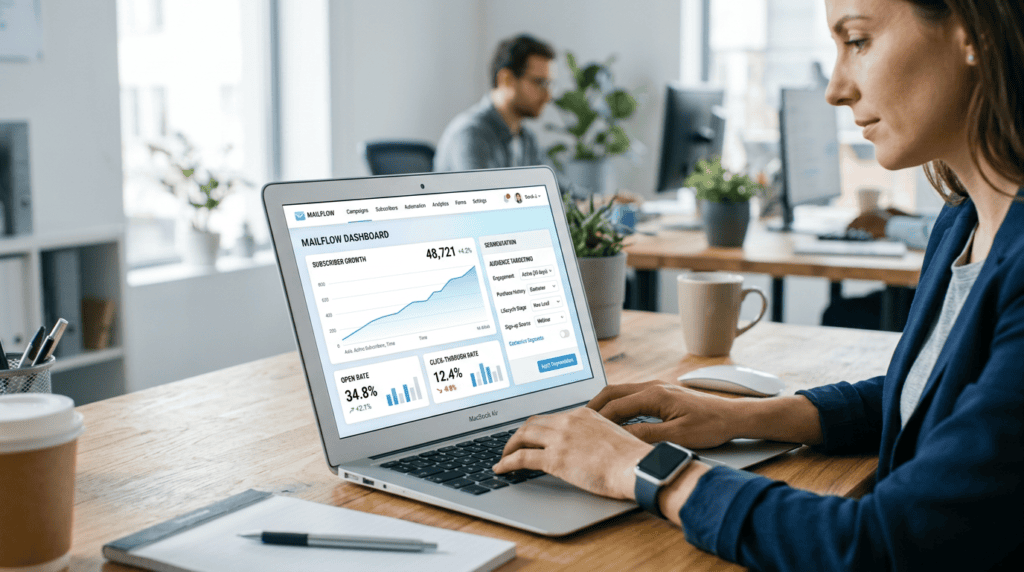
Selecting the right email service provider (ESP) is a foundational decision for any newsletter creator. Your ESP is the engine behind your email marketing efforts, handling everything from sending emails to managing your subscribers list. Key features to look for include robust automation capabilities (for welcome sequences, for instance), segmentation options (to send targeted emails), and excellent deliverability rates (so your emails actually land in inboxes).
While free platforms like Mailchimp can be a good starting point, as your list grows and your needs become more sophisticated, investing in a paid platform like ConvertKit or Beehiiv becomes crucial. The right ESP will scale with your growth and offer the tools you need to effectively monetize your audience. I personally moved from a free plan to a paid one when I realized the advanced segmentation features would allow me to tailor content and offers, directly impacting my revenue.
> Critical Warning: Don’t choose an ESP solely based on price. Poor deliverability or limited features will cost you far more in lost engagement and potential revenue down the line.
Proven Strategies for Gaining Your First 1,000 Subscribers
Building an email list takes consistent effort, but there are proven strategies to gain your first 1,000 subscribers and beyond. A compelling lead magnet is often the most effective tool: offer something valuable for free (an ebook, a checklist, a mini-course) in exchange for an email address. Promote your newsletter everywhere your target audience hangs out – on social media, prominently on your website, and through guest content on other blogs or podcasts. A simple, effective landing page dedicated to your newsletter sign-up, clearly articulating the value subscribers will receive, is also non-negotiable. Focus on quality over quantity; 1,000 engaged subscribers are far more valuable than 10,000 disengaged ones.
Writing Content That Keeps Subscribers Engaged and Opening Emails
Once you have subscribers, keeping them engaged is paramount. This means consistently delivering high-quality content that resonates with your audience. Establish a consistent sending schedule so your readers know when to expect your emails. Crafting subject lines that demand to be clicked is an art; they should be intriguing, benefit-driven, or create curiosity without being clickbait. Finally, balance value-driven content with promotional content. A good rule of thumb is the 80/20 rule: 80% of your emails should provide pure value, education, or entertainment, while 20% can be used for promotions or monetization efforts. This approach builds trust with subscribers and ensures they keep opening your emails, making your monetization strategies far more effective.
Honest Take: What Most People Get Wrong About Newsletter Monetization
Many aspiring creators jump into the newsletter game with high hopes, only to hit a wall when it comes to actually making money. This isn’t because the strategies don’t work, but often because of fundamental misunderstandings about the effort involved.
The “Build It and They Will Pay” Fallacy
It’s easy to think that once you have a decent number of subscribers, the money will just roll in. This is a common misconception. Monetization is an active, ongoing process, not a passive outcome of simply having a list. You need to actively seek out sponsors, develop and market your own products, or consistently promote affiliate offers. Building a valuable audience is just the first step; converting that value into revenue requires strategic action. Without a clear plan and consistent execution, even a large email list can remain unmonetized.
The Hidden Costs: Time, Software, and Consistency
Beyond the obvious email service provider (ESP) fees, there are other investments to consider. The biggest hidden cost is often time – the hours spent researching, writing, editing, and formatting your content. Then there’s the cost of other software for design, analytics, or payment processing. More critically, the mental toll of maintaining consistency and avoiding burnout is significant. Many creators underestimate the sustained effort required to keep a newsletter going, let alone to effectively monetize it.
Why Chasing Multiple Monetization Streams Too Early Is a Mistake
While it’s tempting to try every method for how to make money with an email newsletter, attempting to implement too many monetization strategies at once can dilute your focus. You might end up doing a mediocre job at several things rather than excelling at one. For instance, trying to manage sponsorships, launch a digital product, and run an affiliate marketing campaign simultaneously can overwhelm you and your audience. It’s far more effective to master one monetization model, prove its success, and then thoughtfully integrate a second. This focused approach helps you refine your processes and understand what truly resonates with your audience before expanding.
Final Recommendation: Your First 90-Day Monetization Plan

Deciding how to make money with an email newsletter can feel overwhelming, but a structured approach can simplify the process. The biggest mistake you can make is delaying action. Every day you wait to implement a monetization strategy is a day you’re leaving potential income on the table and missing opportunities to deepen your relationship with your audience.
For New Newsletters (0-1,000 Subscribers)
If you’re just starting out, your primary focus should be on building a strong foundation.
- Month 1: Dedicate 100% of your effort to subscriber growth and maintaining content consistency. Focus on delivering immense value to your audience.
- Month 2: Identify one or two highly relevant affiliate products or services that genuinely benefit your audience. Test them naturally within your content, ensuring transparency with disclosures.
- Month 3: Add a simple “Buy Me a Coffee” or similar tip jar link to your newsletter footer. Analyze the performance of your affiliate links to understand what resonates.
For Growing Newsletters (1,000-10,000 Subscribers)
With a growing list, you have more options to explore and can start to scale your efforts.
- Month 1: Optimize your top-performing affiliate partnerships. Simultaneously, begin brainstorming a digital product idea that solves a specific problem for your audience.
- Month 2: Validate your product idea by surveying your audience directly. Start compiling a simple media kit with your newsletter’s key statistics and audience demographics, preparing for potential sponsorships.
- Month 3: Launch your first small digital product (like an ebook or template) or begin soft-pitching potential sponsors whose brands align perfectly with your content and audience.
> The key to successful newsletter monetization isn’t about having the largest list, but about building deep trust and consistently delivering value to an engaged audience.
Frequently Asked Questions (FAQs)
You can start to make money with an email newsletter with very few subscribers, sometimes even under 100, especially through affiliate marketing or selling your own small digital products. Larger monetization methods like sponsorships typically require at least 1,000 engaged subscribers.
The income from a newsletter with 10,000 subscribers varies wildly, but a highly engaged list could realistically earn anywhere from $500 to $5,000+ per month, depending on your niche, monetization strategies, and audience’s purchasing power. Paid subscriptions or high-ticket products can push this income even higher.
Is it better to have sponsors or sell your own products?
Selling your own products generally offers higher profit margins and more control over your revenue, as you keep a larger share of each sale. Sponsorships can provide a more consistent income stream with less product development effort, but you’re trading a portion of your audience’s attention for a fee. Many successful newsletters combine both monetization methods.
For starting a paid newsletter, platforms like Substack, ConvertKit, and Beehiiv are excellent choices. They offer integrated tools for managing paid subscriptions, audience growth, and content delivery, making it easier for creators to monetize their content.
You don’t typically need an LLC immediately when you start to monetize your newsletter, especially if your income is low. However, as your newsletter income grows, forming an LLC can provide legal protection for your personal assets and may offer tax advantages for your newsletter business model.
Income from your newsletter is generally considered self-employment income by tax authorities. You’ll need to meticulously track all revenue and business expenses, pay estimated quarterly taxes, and consult with a tax professional to ensure you’re compliant with all regulations for your newsletter earnings.