By 2026, the real question in Semrush Vs Seranking isn’t which tool has more features. It’s which one fits your workflow, your budget, and how serious your SEO needs are. If you’re running a small business, agency, blog, or ecommerce store, the wrong SEO tool can slow you down fast. Too much complexity becomes a drag. Too little data becomes a problem when you’re trying to rank, compete, and grow.
That’s why this comparison matters. Semrush is the broader, more advanced seo platform, while SE Ranking is built to be more affordable and easier to use. Both can help with keyword research, rank tracking, site audits, and competitive analysis, but they serve different buyers in different ways.
In this article, we’ll compare features, pricing, ease of use, performance, integrations, customer support, pros and cons, and overall value so you can decide whether Semrush vs SE Ranking is the better fit for your business.
Quick Verdict: Semrush vs SE Ranking
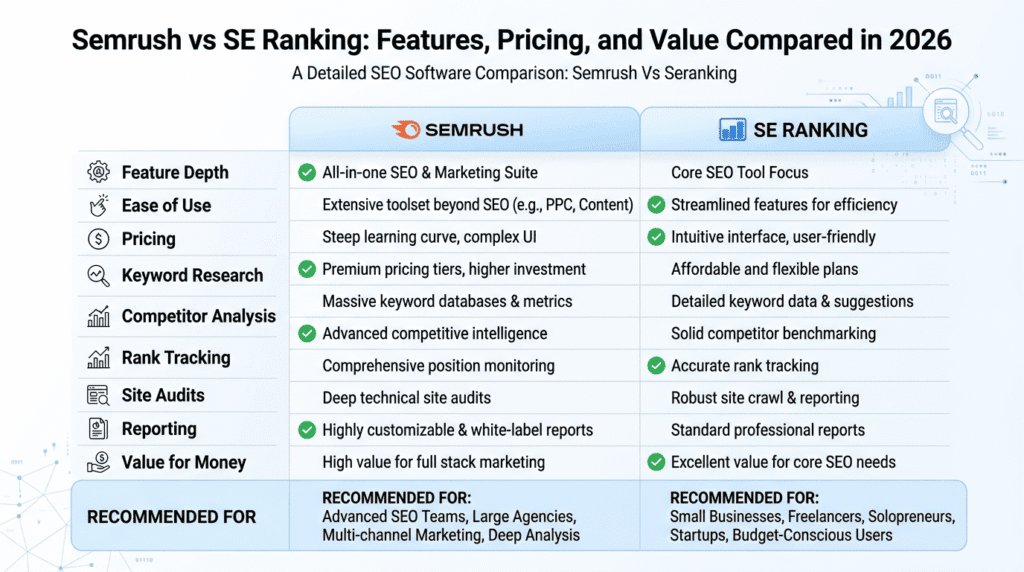
Semrush is usually the better pick if you need deeper data, broader competitive intelligence, and a more powerful all-in-one seo tool. SE Ranking is often the better choice if you want core SEO features, a cleaner learning curve, and stronger value for money.
Complete Verdict Table
| Category | Semrush | SE Ranking | Winner |
|---|---|---|---|
| Overall SEO feature depth | Very strong | Strong | Semrush |
| Ease of use | Moderate learning curve | More beginner-friendly | SE Ranking |
| Pricing | Higher cost | More affordable | SE Ranking |
| Keyword research | Excellent | Good to very good | Semrush |
| Competitor analysis | Excellent | Good | Semrush |
| Rank tracking | Strong | Very strong for the price | Tie / SE Ranking for budget users |
| Site audits | Advanced | Solid and user-friendly | Semrush |
| Reporting | Advanced | Clean and agency-friendly | Tie |
| Customer support | Strong knowledge base and support | Responsive and accessible | Tie |
| Value for money | Best for advanced users | Best for small businesses | Depends on use case |
Best For
- Semrush: agencies, advanced SEO teams, content marketers, and businesses needing deep competitive intelligence
- SE Ranking: small business owners, freelancers, beginners, and budget-conscious teams wanting core SEO tools without enterprise-level cost
Not Ideal For
- Semrush may be overkill for users who only need basic rank tracking and audits
- SE Ranking may feel limited for advanced SEO teams needing deeper data, broader integrations, and enterprise-level competitive research
Bottom Line
Choose Semrush if you need the more powerful all-in-one SEO and digital marketing platform. Choose SE Ranking if you want a more affordable, user-friendly seo tool with strong essentials and better value for money.
Semrush vs SE Ranking: Core Differences That Matter Most
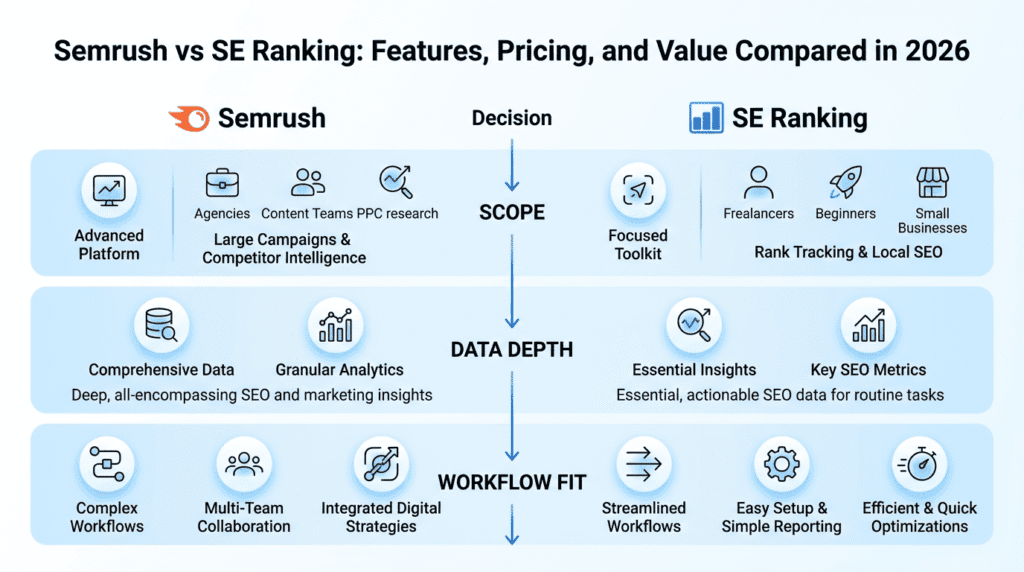
The semrush vs se ranking comparison comes down to scope, depth, and price. On the surface, both platforms help you research keywords, track rankings, audit sites, and analyze competitors. But the way they handle those jobs is different enough that the better choice depends on how you work.
Platform Positioning: Advanced SEO Suite vs Affordable SEO Toolkit
Semrush is built like a full marketing intelligence platform. It doesn’t just help you with SEO. It also supports content marketing, competitive research, paid search analysis, and broader digital strategy. That makes it attractive for agencies and teams that need one seo platform to support multiple channels.
SE Ranking takes a simpler approach. It focuses on the core work most small teams need: keyword research, ranking data, site audits, backlink checks, and local seo tracking. That narrower focus is part of why many buyers choose SE Ranking over larger tools. It’s easier to get started with, and it usually takes less time to understand what matters.
That difference becomes more obvious as businesses grow. A freelancer or local business owner often wants answers, not layers of menus. A larger agency or in-house SEO team usually wants more data, more segmentation, and more ways to compare performance across markets.
Data Depth And Competitive Intelligence
This is where Semrush vs SE Ranking becomes less about preference and more about scale.
Semrush generally provides deeper keyword data, stronger competitor analysis, and a broader view of market opportunities. Its keyword tools are especially useful when you need to compare terms, estimate difficulty, and build content plans around search demand. For teams doing serious keyword research, that extra depth can save time and improve decision-making.
SE Ranking provides solid data too, and for many smaller websites it’s enough. But when you’re working in a competitive niche, you may notice the gap. Semrush’s larger database and more mature research features can surface more ideas, more comparison points, and more strategic context. That matters when you’re trying to figure out not just what to rank for, but how to rank better than the sites already on page one.
Here’s the practical takeaway:
- Use Semrush if you need a deeper competitive picture
- Use SE Ranking if you mainly need dependable day-to-day SEO data
- Don’t overpay for depth you won’t use
For a blogger, SE Ranking may cover the basics well. For an agency tracking dozens of clients in tough SERPs, Semrush often becomes the safer long-term choice.
Workflow Fit: Specialist Teams vs Lean Operators
Workflow is one of the most overlooked parts of picking an seo tool. A platform can be powerful and still be frustrating if your team doesn’t use it often enough to justify the complexity.
Semrush fits best when SEO is a dedicated function. If you have a specialist, strategist, or content lead working inside the platform every week, the deeper feature set starts to pay off. You can move from research to auditing to reporting without bouncing between tools as much. That’s valuable for teams with repeatable processes.
SE Ranking fits better when one person is wearing multiple hats. A founder, freelancer, or marketing generalist can usually move through the platform faster. That lower friction matters. You’re less likely to ignore the tool because it feels heavy or complicated.
This is one reason the se ranking and semrush decision often comes down to workflow, not just feature lists. If you want speed and simplicity, SE Ranking is easier to live with. If you want a more complete research environment, Semrush is stronger.
Where The Tools Overlap
Both platforms cover the core SEO jobs most buyers care about. If you’re comparing se ranking vs semrush, these shared areas matter:
- Keyword research
- Rank tracking
- Site audits
- Backlink analysis
- Competitor research
- Reporting
- Local SEO tools
- Content-related features
That overlap is important because it means you’re not choosing between “complete” and “incomplete.” You’re choosing between a more advanced seo tool and a more streamlined one.
Some of the overlap can be misleading, though. Two tools may both offer keyword research, but one gives you more depth, better filtering, and more strategic context. Two tools may both track rankings, but one may be easier to manage across multiple projects. That’s why the se ranking vs semrush question is really about how much capability you need now, and how much you expect to need later.
If your business is still small, SE Ranking may be all you need. If your SEO program is becoming a serious growth channel, Semrush usually has more room to grow with you.
Semrush Features vs SE Ranking Features
Keyword Research Features Compared
Semrush and SE Ranking both handle keyword research well, but they serve different types of users once you get past the basics.
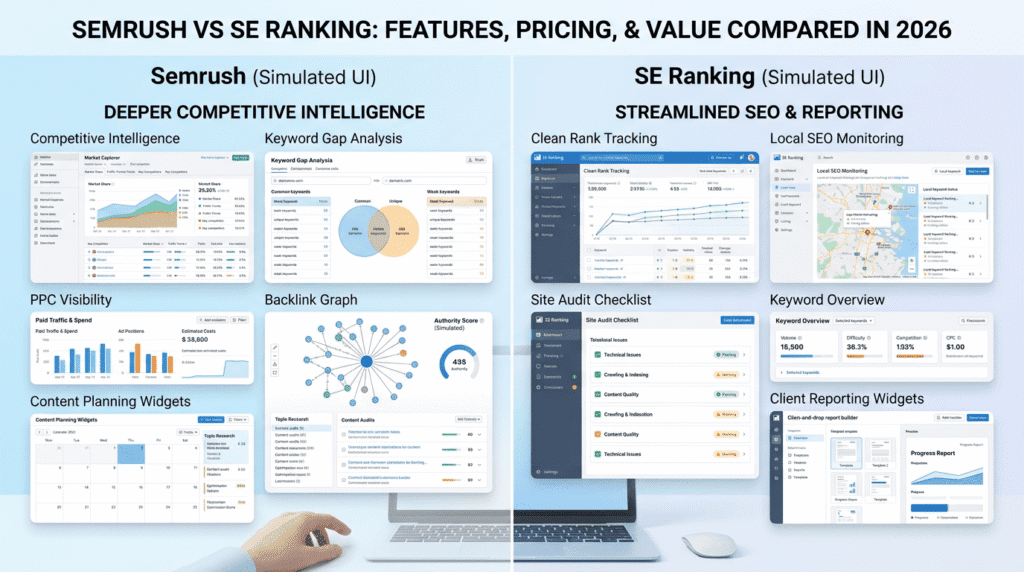
Semrush usually gives you the deeper pool of keyword data. That matters when you’re trying to build a full content strategy, not just find a handful of blog topics. Its keyword database is larger, so you’re more likely to uncover variations, intent shifts, and terms that competitors are already getting traffic from. That makes it useful for agencies, SaaS teams, and sites that publish at scale.
SE Ranking still covers the core workflow well. You can research keywords, check volume, review difficulty, and build content ideas without feeling lost in the interface. For many small businesses, that’s enough. The tool doesn’t try to overwhelm you with every possible data point, which can actually be a plus if you’re managing SEO alongside other jobs.
The main trade-off is depth versus simplicity. Semrush tends to be better when you need to compare multiple keyword angles, evaluate search intent more closely, or plan content around competitive gaps. SE Ranking is easier to live with if you just need practical keyword ideas and a clean path from research to execution.
A common beginner mistake is overestimating keyword difficulty scores. In both tools, those numbers are helpful, but they’re still only estimates. They work best as a direction, not a hard rule. If you’re choosing between the two, ask whether you need broad discovery or efficient day-to-day research. That answer usually points you to the right platform.
Competitor Analysis Features Compared
This is one of the clearest areas where Semrush tends to pull ahead.
Semrush is built for people who want to study competitors in depth. You can look at organic keywords, paid search activity, traffic estimates, domain-level overlap, and keyword gaps in one place. That broader view matters when you’re trying to understand why a competitor keeps outranking you, or how they’re splitting SEO and PPC across the same topic.
SE Ranking also offers competitor analysis, and for many users it’s perfectly usable. You can compare domains, review keyword overlap, and find gaps worth targeting. But the data layer usually feels lighter. That’s not necessarily a flaw if you only need a directional read. It becomes a limitation when you’re making larger content or budget decisions based on competitive research.
Semrush is especially useful when the stakes are higher. For example, a SaaS team launching into a crowded market may want to study both organic and paid visibility before building landing pages. An ecommerce brand may want to see which product terms competitors are buying versus ranking for naturally. SE Ranking can support that process, but Semrush is usually the stronger choice when the research needs to be broader and more detailed.
Another thing that gets overlooked is workflow friction. In a lean setup, you may not need all the layers Semrush provides. But once a business starts tracking multiple competitors across multiple markets, those extra layers become valuable. That’s when the deeper view starts paying off.
Rank Tracking And SERP Monitoring
Rank tracking is one of the places where SE Ranking stands out.
It’s built for users who want consistent tracking without paying for a bigger platform than they need. The tool is especially appealing if you care about local ranking, device-specific results, and day-to-day movement in the SERPs. For agencies and local businesses, that makes it practical. You can keep a close eye on whether rankings are moving in the right direction without digging through a lot of extra noise.
Semrush also does rank tracking well, and it gives you strong monitoring and historical context. That said, SE Ranking often feels more competitive here because the experience is focused and the pricing is usually easier to justify for rank-heavy workflows. If your main job is to track dozens or hundreds of keywords across locations, SE Ranking can be a very efficient fit.
A useful way to think about it:
- Semrush is stronger when rank tracking is part of a bigger intelligence workflow
- SE Ranking is stronger when rank tracking itself is one of the main reasons you’re paying for the tool
Historical data is another practical detail. Older ranking trends help you separate random movement from real changes in performance. That becomes important when you’re testing content updates, link building, or technical fixes. Both tools support this to some degree, but users who need the deepest context usually end up leaning toward Semrush.
Site Audit And Technical SEO Features
For site audits, Semrush is typically the more advanced option, while SE Ranking is easier for many teams to use.
Semrush tends to be better when technical SEO is a regular part of your workflow. It gives you a wider set of checks and more room to investigate site issues in depth. That can matter for larger sites where crawl issues, duplicate content, redirects, and internal linking problems can quietly drag performance down over time.
SE Ranking still covers the fundamentals well. It can surface technical problems, flag broken links, and help users spot issues that need attention. For a smaller site, that may be all you need. The audit process is also easier to digest if you’re not a technical SEO specialist. That’s a real advantage for freelancers, solo site owners, and small business teams.
Here’s the practical split:
| Category | Semrush | SE Ranking |
|---|---|---|
| Crawl depth | Stronger for deeper analysis | Solid for most smaller sites |
| Issue prioritization | More advanced | Easier to follow |
| Technical complexity | Better for SEO specialists | Better for beginners |
| Site scale fit | Larger sites and agencies | Small to mid-size sites |
The hidden frustration with audits is that most users don’t need more issue flags. They need clearer priorities. If a tool creates too many alerts without helping you decide what to fix first, it slows you down. Semrush is stronger for teams that can interpret the data. SE Ranking can be more comfortable for users who want a simpler checklist-style audit process.
Content And On-Page SEO Tools
Content and on-page SEO is another area where the difference is more about workflow than raw capability.
Semrush offers a more mature content stack, including its SEO Content Template and Writing Assistant. Those tools are useful when you’re planning articles before you write them, especially if you want guidance on target terms, semantic ideas, and on-page optimization signals. That makes Semrush attractive for content marketing teams that publish regularly and want a repeatable process.
SE Ranking includes its own content editor and on-page SEO tools, and they’re useful in a more streamlined way. The workflow is easier to approach if you’re not trying to run a full content operation. That can be enough for small businesses, solo bloggers, or agencies handling a manageable number of pages.
The difference shows up over time. Beginners often overvalue content scoring tools at first. The score can feel like a shortcut. But as usage grows, the real value is in how well the tool fits into planning, drafting, editing, and publishing. Semrush is stronger when you want deeper planning support. SE Ranking can be more practical when you care about speed and simplicity.
For example:
- A content team at a SaaS company may use Semrush to map articles to keyword clusters before publishing
- A local business may use SE Ranking to improve service pages and check basic on-page issues without building a complex workflow
Neither tool replaces good writing or strong search intent research. They just make it easier to stay consistent.
Semrush vs SE Ranking Pricing: Plans, Limits, And Long-Term Costs
Semrush Pricing In 2026
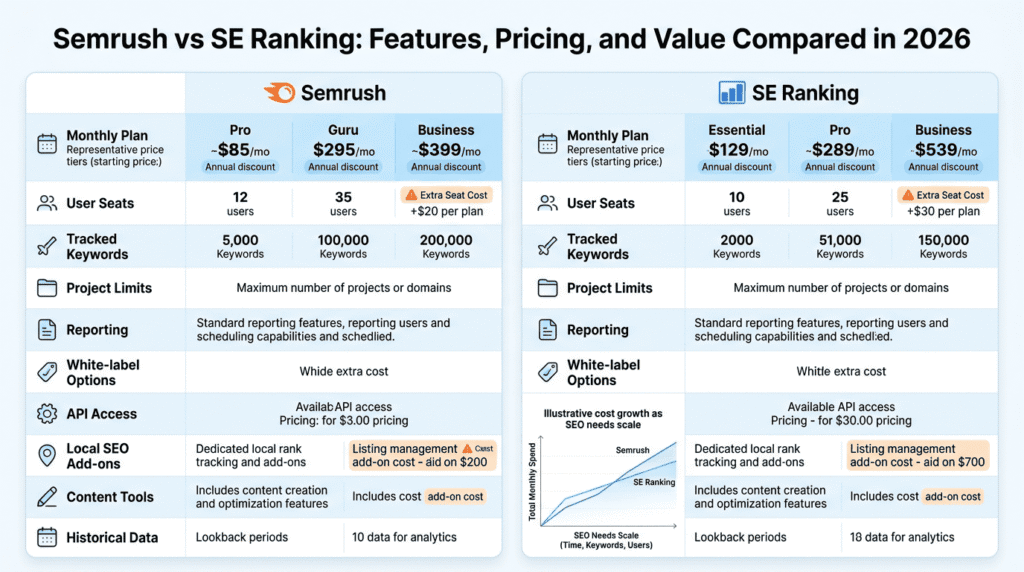
Semrush pricing changes from time to time, so it’s smart to verify current numbers before buying. In general, Semrush sits in the higher-cost part of the SEO tool market. That higher entry point makes sense only if you’ll actually use the platform’s broader data and deeper workflow features.
When comparing plans, don’t just look at the monthly price. Look at what that price includes:
- Project limits
- Keyword tracking limits
- User seats
- Add-ons
- Historical data access
- Local SEO features
- Content-related extras
This is where the real cost often shows up. A plan may look manageable at first, but extra users or add-ons can push the total higher fast. That’s especially true for agencies and teams that need multiple logins or more tracked keywords than the base plan allows.
The most common pricing mistake is buying Semrush for one narrow task. If you only need rank tracking or a basic site audit, you may not use enough of the platform to justify the spend. But if you’re using keyword research, competitor analysis, site audits, and content planning together, the cost makes more sense.
SE Ranking Pricing In 2026
SE Ranking is structured to be more flexible, and that’s a big reason many smaller teams prefer it.
Its pricing usually scales based on usage, so the total cost depends on things like tracked keywords, update frequency, user seats, and project volume. That makes it easier to start small and expand only when needed. For businesses that don’t want to commit to a large platform cost right away, that flexibility matters.
When evaluating SE Ranking plans, pay attention to:
- Rank tracking frequency
- Keyword limits
- Project limits
- User seats
- Reporting options
- Agency features
- Local SEO add-ons
This is where SE Ranking often feels easier to manage. You can build a setup that fits a specific business stage without paying for a much larger tool set than you need. For freelancers and small agencies, that can reduce waste.
Still, it’s worth watching how usage grows. A plan that feels comfortable for one site can become cramped once you add clients, locations, or more tracked keywords. That’s not unique to SE Ranking, but it shows up faster when your workflow becomes more complex.
Hidden Costs And Usage Limits To Watch
The sticker price is only part of the story.
Both tools can become more expensive once you add the extras that matter in real work. The most common hidden costs are easy to miss during the trial phase:
- Extra users
- Additional tracked keywords
- API access
- White-label reporting
- Content tools
- Local SEO features
- Export limits
- Historical data depth
These details matter because they affect the actual cost of running SEO, not just trying the platform. For an agency, white-label reporting can be a must-have. For a SaaS team, API access might matter more. For a local business, location tracking can be the feature that drives value.
A lot of buyers focus on whether the tool “has” a feature. They forget to check whether that feature is included in the base plan or tied to a higher tier. That’s where surprises happen. It’s also why switching tools later can be annoying. Once a workflow depends on a specific export or tracking limit, moving to a different plan may force changes in process.
Value For Money: Which Tool Gives You More For The Price?
The answer depends on how you work.
- Beginner: SE Ranking usually gives more usable value because it’s easier to understand and less expensive to run
- Small business: SE Ranking is often the better fit if you want core SEO tools without paying for advanced extras you won’t use
- Freelancer: SE Ranking can be a strong choice if you manage several client sites and need dependable tracking
- Agency: Semrush may justify the higher cost when you need deeper research, broader reporting, and more competitive intelligence
- Growing SEO team: Semrush often becomes more valuable as the workflow gets more complex
- Enterprise-style marketing team: Semrush usually fits better because the data depth and broader platform scope matter more at scale
The key idea is simple: SE Ranking tends to win on affordability and practical coverage, while Semrush can win on return when your team actually uses its advanced capabilities. If the tool helps you make better content, search, and competitive decisions every week, the higher cost can be easier to defend.
Ease Of Use: Which SEO Tool Is More User-Friendly?
Semrush and SE Ranking both organize a lot of information, but they don’t feel the same in daily use.
SE Ranking’s dashboard is usually easier for new users to follow. The layout is simpler, the toolset feels more focused, and it’s easier to get from setup to actual work. That matters when you’re trying to handle SEO without spending half the day learning software.
Semrush has more going on. That’s part of its strength, but it also means the interface can feel crowded at first. There are more menus, more reports, and more places to explore. Once you learn the platform, that breadth becomes useful. Before that, it can slow people down.
For users who like clean onboarding and fast setup, SE Ranking often feels better on day one. For users who want more control and are willing to spend time learning the system, Semrush becomes more powerful over time.
Learning Curve For Beginners
Beginners usually struggle with two things: understanding SEO terms and learning the tool at the same time.
SE Ranking reduces that friction. It gives new users a more approachable place to start, which helps when you’re still figuring out what to track, what to ignore, and how to connect data to action. A small business owner or solo marketer can get productive faster.
Semrush is not hard because it lacks structure. It’s hard because it offers so much. That breadth can overwhelm new users who only wanted to check rankings, research keywords, or audit a site. People often buy it thinking they’ll use everything, then end up sticking to just a few reports.
That’s why beginners often prefer SE Ranking. It lets them build confidence before they deal with deeper data layers.
Workflow Speed For Experienced SEOs
Experienced users often move faster in Semrush once they know where everything lives.
That’s because Semrush is built for layered workflows. You can move from keyword research to competitor analysis to content planning without changing tools. For an SEO specialist, that can save time. It can also support more complex decisions, especially when you’re comparing multiple markets or campaign paths.
SE Ranking can still be fast, especially for rank tracking and site monitoring. But it usually feels more lightweight. That’s good if your process is simple. It can feel limiting if you’re used to building larger SEO strategies inside one platform.
In practice, this means Semrush is often better for experienced SEOs who want depth and are comfortable with complexity. SE Ranking can still be efficient, just in a more streamlined way.
Reporting Clarity For Clients Or Non-SEO Stakeholders
Reporting is where clarity matters more than feature count.
SE Ranking often works well for clients, business owners, and managers who just need the important points without a lot of clutter. Its reports can be easier to explain, which helps when you’re sharing results with people who don’t live inside SEO software every day.
Semrush reports are powerful, but they can also feel more technical. That’s not a problem if your audience understands SEO metrics. It becomes a problem when you need to communicate results quickly to non-technical stakeholders.
A simple way to think about it:
- Clients usually want progress, not raw data
- Business owners want outcomes tied to traffic or leads
- Marketing managers want enough detail to act
- Executives usually want a short summary with clear trends
SE Ranking often makes that communication easier. Semrush gives you more to work with, but you may need to do more editing before the report is ready to send.
Performance, Data Quality, And Reporting Accuracy
Keyword And Traffic Data Reliability
No SEO tool gives you perfect numbers. That’s true for Semrush Vs Seranking, too. Both platforms estimate search volume, traffic, and ranking data using their own data models, so the real question is how useful those estimates are for decisions.
Semrush usually feels stronger when you need broader keyword research and a bigger view of market demand. Its database is larger, so you’re more likely to uncover keyword variations, competitor opportunities, and related terms that help shape a content plan. That matters if you’re building a serious SEO strategy and want more than the obvious targets.
SE Ranking is solid for day-to-day tracking and planning. For many small businesses, that’s enough. You may not need the widest keyword database if your main goal is to monitor a few hundred terms, follow local ranking shifts, and keep content moving in the right direction.
The hidden frustration here is that beginners often trust keyword volume too much. A keyword showing 1,000 monthly searches might not be worth chasing if the intent is weak or the SERP is crowded. That’s where Semrush’s deeper research tools can help you think better, not just look at bigger numbers. SE Ranking can still do the job, but it’s easier to outgrow if you rely on keyword research every day.
For ranking data, both tools are useful, but neither should be treated like a perfect source of truth. Rankings can shift by location, device, and personalization. The best use is trend spotting. If a page is climbing over 30 days or slipping after a content update, that’s the signal that matters.
Backlink Data And Domain Analysis
Backlink analysis is one of the areas where Semrush clearly pulls ahead. Its backlink index and domain-level research are built for broader competitive analysis, so it’s easier to compare domains, spot linking patterns, and find prospects for link-building campaigns.
SE Ranking also gives you backlink data, referring domains, and link analysis, and that’s enough for many teams. If you’re a local business, solo marketer, or small agency, you may not need the largest backlink database available. You mostly need something practical: what links do you have, where are competitors getting links, and what looks worth chasing next.
Where Semrush becomes more valuable is scale. When you’re comparing multiple competitors, running prospecting campaigns, or trying to understand why a rival outranks you across dozens of pages, the extra depth saves time. It also helps when you’re dealing with larger sites that have hundreds or thousands of linking domains.
A simple way to think about it:
- Choose Semrush if backlink research is a core part of your SEO workflow
- Choose SE Ranking if backlink checks are important but not the center of your process
One thing many marketing pages don’t mention is that backlink tools are often overused by beginners. A huge link report looks impressive, but the real value comes from filtering out junk, checking relevance, and finding patterns you can act on. Semrush does that better. SE Ranking does enough for most smaller campaigns, but it isn’t trying to be the deepest link intelligence platform.
Site Audit Performance And Issue Prioritization
Both tools can find technical SEO issues, but the real difference is how easy they make those findings to use.
Semrush is usually stronger for teams that want a more advanced audit workflow. It can surface a large number of issues, group them by severity, and support deeper technical analysis. That’s useful if you’re managing a growing site, working with developers, or reviewing a site with multiple problem layers.
SE Ranking’s site audit is easier to digest. For a beginner, that matters more than raw depth. If the report tells you about broken links, missing tags, redirect issues, duplicate content, and speed-related concerns in plain language, you’re more likely to act on it. That’s a big reason smaller businesses often stick with it.
The trade-off is clear: the simpler the audit, the easier it is to follow, but the less likely it is to satisfy an advanced SEO team that wants detailed technical breakdowns. Semrush may surface more data, but that can also create noise if you don’t know what to prioritize.
This is where workflow matters. A solo founder usually wants the next three fixes, not a 200-item crawl report. An agency may want the full report, plus the ability to explain which issues are hurting rankings and which ones can wait.
Reporting And Analytics For Ongoing SEO Campaigns
Reporting is where both tools do important work, but they serve slightly different users.
Semrush provides robust reporting for SEO campaigns, especially if you need to combine keyword rankings, technical progress, competitor data, and content performance in one view. That’s useful for agencies and larger in-house teams that need to show what changed, why it changed, and what happens next.
SE Ranking is often easier for straightforward client reporting. Its dashboards and scheduled reports are clean, and that can save time when you’re sending monthly updates to clients or internal stakeholders. If the person reading the report isn’t deep in SEO every day, clarity matters more than fancy detail.
Here’s the practical difference:
| Category | Semrush | SE Ranking |
|---|---|---|
| Automated reports | Strong and flexible | Strong and easy to set up |
| Custom reports | More advanced | Clean, simpler options |
| White-label options | Available on higher plans or add-ons | Well suited for agencies |
| Scheduled reporting | Strong | Strong |
| Client-ready dashboards | Very detailed | Easier for non-experts |
| Progress tracking over time | Deep historical view | Practical and readable |
The main mistake buyers make is assuming better reporting means more charts. It doesn’t. Better reporting means the right data is easy to understand and tied to action. If you spend too much time editing reports, that’s a cost. If your clients don’t understand the report, that’s another cost.
For ongoing campaigns, Semrush is better when the story behind the numbers matters. SE Ranking is better when you need reliable reporting without turning every update into a project.
Integrations, Customer Support, And Team Collaboration
Semrush Integrations
Semrush connects well with the tools many marketing teams already use. Common integrations and workflows include Google Analytics, Google Search Console, Google Looker Studio, Google Business Profile, Trello, Zapier, WordPress-related workflows, and social or PPC tools where relevant.
That range matters because SEO rarely lives alone. If your team is already moving data between content, analytics, ads, and project management, integrations can save a lot of manual work. You can pull SEO data into reports, connect it to broader marketing metrics, and keep campaigns moving without bouncing between too many dashboards.
The real benefit shows up as teams grow. A freelancer may not care much about integrations at first. A growing agency usually does. Once clients expect cleaner reporting, faster updates, and a more connected workflow, the platform needs to fit into the stack—not sit outside it.
Semrush is strong here because it’s built for broader marketing use, not just rank checking. That makes it more useful if you manage content marketing, organic search, paid search, and reporting in the same place.
SE Ranking Integrations
SE Ranking supports the core integrations most small businesses and agencies actually use: Google Analytics, Google Search Console, Looker Studio, Zapier, API access, and reporting workflows.
That’s enough for many users. In practice, most teams don’t need dozens of integrations. They need the right few connections to keep reporting clean and tasks organized. SE Ranking does that well.
Its API access can also matter if you’re building custom workflows or moving data into internal systems. For agencies, that can make it easier to connect SEO reporting with other client processes. But if you want a very broad ecosystem, Semrush tends to feel more complete.
A common misconception is that more integrations automatically mean a better SEO platform. Not always. If your business only needs rank tracking, reporting, and light collaboration, SE Ranking’s simpler setup may be the better fit.
Customer Support Compared
Customer support is one of those areas people ignore until they’re stuck. Then it becomes a big deal.
Semrush has a strong knowledge base and support resources, and that helps because the platform has a lot going on. The downside is that the learning curve can make support feel more necessary, especially for newer users. If you’re paying for a more advanced seo platform, you may also need more time to learn how to get the most out of it.
SE Ranking often feels more approachable from a support standpoint. Its interface is simpler, so users can usually solve problems faster. That tends to reduce the number of support requests in the first place. For small businesses and beginners, that can be a big plus.
The best support experience depends on your plan and your expectations. Lower-tier users often want quick answers and simple setup help. Agencies and advanced teams usually want faster, more technical guidance. Semrush is built for the latter more often. SE Ranking is often easier for the former.
Team And Agency Collaboration Features
If more than one person touches SEO, collaboration features matter fast.
Semrush and SE Ranking both support workflows that help teams stay organized, but they approach collaboration a little differently. Semrush is built for larger, more complex teams. SE Ranking is often easier for smaller agencies and leaner groups.
The practical collaboration items to compare are:
- User seats
- Role management
- Client access
- White-label reporting
- Shared dashboards
- Project organization
Semrush fits better when multiple specialists are involved. For example, one person may handle keyword research, another handles technical audits, and another manages reporting. That setup benefits from a more advanced platform, even if it costs more.
SE Ranking can be the smarter choice for a small agency or consultant who wants to keep things simple. You can organize clients, share reports, and keep work moving without paying for more complexity than you need.
The long-term issue is team growth. A tool that feels perfect for a 2-person shop can start to feel cramped at 8 or 10 users if reporting and permissions become harder to manage. That’s where Semrush often scales better. But if you’re still running a lean operation, SE Ranking can be the more practical choice.
Real-World Use Cases: Who Should Choose Semrush Or SE Ranking?
Best For Small Businesses
For many small businesses, SE Ranking is the easier fit. It covers the core SEO needs most owners actually care about: track a set of keywords, watch local rankings, run site audits, and keep reporting simple.
That matters because small businesses usually don’t need an oversized seo tool. They need something they can use without hiring a specialist. A local plumber, dentist, law firm, or service company may only want to track a handful of service keywords and local map terms. SE Ranking handles that kind of job well.
A few practical examples:
- A local service business can track local ranking changes and see whether pages are moving after content updates
- A small ecommerce store can monitor category keywords and spot technical issues before they hurt traffic
- A startup can keep an eye on visibility while spending most of its time on product and sales
Semrush can still work for small businesses, but it’s often more tool than they need. If the team isn’t using competitor research, broader content planning, or paid search data, a lot of the extra cost gets wasted. That’s the part buyers miss: a powerful platform only pays off if someone uses the power.
Best For Agencies And Consultants
This is where the decision becomes more nuanced.
A solo consultant or small SEO freelancer may prefer SE Ranking because it keeps costs predictable and still gives enough data for client work. It’s easier to explain, easier to onboard, and usually easier to price into monthly retainers.
Semrush becomes more attractive as the agency grows. If you’re handling multiple clients, more complex competitive analysis, or broader marketing services, the extra depth starts to matter. It also helps when clients ask tougher questions, like why a competitor is winning across content, backlinks, and paid search at the same time.
Different agency types lean differently:
- Small SEO consultant: SE Ranking often makes the most sense
- Growing agency: Semrush may be worth it for deeper research and reporting
- Full-service digital marketing agency: Semrush usually fits better
- PPC plus SEO agency: Semrush has the stronger multi-channel advantage
The pricing difference matters here too. If your team is billing high enough to cover the platform, Semrush can pay for itself through saved research time and better insights. If you’re still trying to keep overhead low, SE Ranking may be the smarter move.
Best For Bloggers And Content Marketers
For bloggers and content-focused teams, both tools can help, but they serve different writing styles and workflows.
Semrush is stronger when content strategy needs to be more competitive. It gives you deeper keyword research, better topic discovery, and stronger competitor content analysis. That’s useful if you’re trying to build topical authority, map content clusters, or reverse-engineer what’s working in your niche.
SE Ranking is a strong fit for budget-conscious bloggers and smaller content teams. It still supports keyword research, on-page seo, and content optimization workflows without adding as much complexity. If you’re publishing regularly and want a tool that helps you improve posts without spending hours inside the platform, it can be enough.
A useful rule of thumb:
- Choose Semrush if content planning is a major growth channel
- Choose SE Ranking if you need practical content support without a heavy price tag
Neither tool will magically create better content. They just make it easier to make better decisions before and after publishing. The more content you produce, the more you start to care about patterns, gaps, and ranking movement over time. That’s when Semrush’s larger ecosystem starts to show its value.
Best For Ecommerce SEO
Ecommerce teams usually care about four things: category keyword research, technical health, competitor tracking, and content gaps. Both platforms can help, but Semrush tends to be stronger when the store is larger or the competition is intense.
Semrush gives you more room to compare product pages, analyze competitors, and find new keyword opportunities across a wider market. That matters if your store sells in a crowded niche and every ranking position counts.
SE Ranking can still be a great fit for smaller ecommerce stores. If you’re tracking a limited number of category pages, monitoring product terms, and checking technical issues regularly, it gives you the essentials without the extra complexity.
The main trade-off is scale. Once an ecommerce business has hundreds of SKUs, more content layers, and multiple competitors in the same space, deeper data becomes more valuable. That’s where Semrush usually starts to justify its higher cost.
Best For Advanced SEO Teams
Advanced teams usually get more out of Semrush. That’s not just because it has more features. It’s because the platform supports a more serious research workflow.
Advanced SEO teams often need:
- Broader keyword research
- Deeper competitor analysis
- More detailed backlink research
- Stronger content planning
- Better reporting for stakeholders
- More room to grow across channels
Semrush does all of that more comfortably. It’s especially useful when SEO isn’t the only concern and the team also cares about PPC, brand visibility, and content marketing. If you’re building SEO strategies across multiple markets or managing several large domains, the extra data depth is hard to ignore.
SE Ranking can still serve advanced users in some cases, especially if rank tracking and reporting are the core jobs. But if the team regularly needs deeper intelligence, it may feel like a step below what they want long term.
Honest Pros And Cons: What You Gain And What You Give Up
Semrush Pros And Cons
What Semrush does well:
- Advanced SEO features
- Strong competitor analysis
- Large keyword and domain databases
- Broad marketing toolkit
- Powerful reporting and research tools
Where it falls short:
- Higher pricing
- Steeper learning curve
- Some features may be unnecessary for small users
- Add-ons can increase total cost
Semrush is the better choice when you need depth and can actually use it. That’s the key. If your SEO process includes frequent research, client reporting, competitor monitoring, and content planning, the platform can earn its place fast. If you only need a basic seo tool, it can feel like paying for a control panel you won’t fully touch.
SE Ranking Pros And Cons
What SE Ranking does well:
- Better affordability
- User-friendly interface
- Strong rank tracking
- Good all-in-one SEO coverage
- Practical reporting for small teams and agencies
Where it falls short:
- Less advanced competitive intelligence
- Smaller overall data ecosystem
- May be limiting for enterprise SEO
- Some advanced users may outgrow it
SE Ranking is the better fit when simplicity and value matter more than maximum depth. It gives you enough to manage real SEO work without overwhelming the user. That’s why many beginners and small teams like it: they can actually keep using it every week.
The downside shows up at scale. As your site grows, you may start to want deeper backlink research, broader keyword coverage, and richer multi-channel analysis. That’s when switching tools becomes a real possibility.
What Most Buyers Miss Before Choosing
Most buyers compare feature lists and pricing, then miss the real decision factors.
The biggest overlooked questions are:
- How many keywords do you actually need to track?
- Do you need PPC and competitor ad data, or just organic SEO?
- Are reports for internal use, or do clients need to understand them?
- Can your team actually use advanced features?
- Does lower monthly pricing matter more than deeper data?
These questions matter because they reveal the cost of unused features. A cheaper plan can become expensive if it doesn’t support the work you need to do. A pricier plan can be worth it if it saves time, improves decisions, and reduces the need for extra tools.
In the Semrush Vs Seranking decision, the best choice usually isn’t about which platform has more features. It’s about which one matches how you work now, and how much complexity you expect to handle later.
Decision Guide: How To Choose Between Semrush And SE Ranking
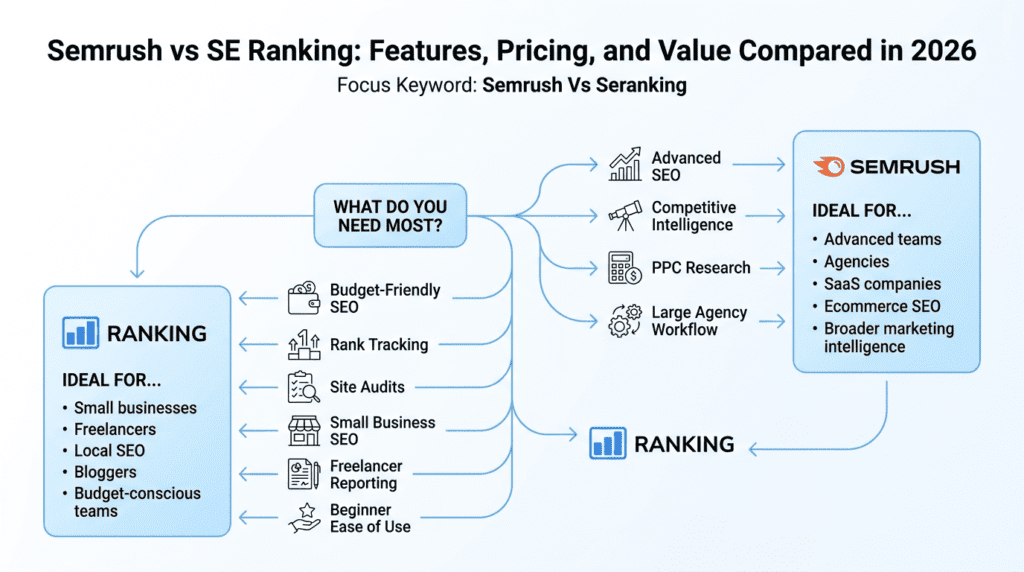
Choose Semrush If
Choose Semrush if you need a platform that can support deeper SEO decision-making, not just day-to-day tracking.
Use it when:
- You need advanced competitor analysis
- You manage multiple SEO campaigns
- You rely heavily on keyword gap and backlink research
- You need broader marketing intelligence
- You have the budget to use the platform fully
- You want advanced features beyond basic SEO tracking
Semrush makes the most sense when SEO is part of a larger growth strategy and you will actually use the extra research depth.
Choose SE Ranking If
Choose SE Ranking if your main goal is to get solid SEO coverage without paying for a premium platform you may not fully use.
Use it when:
- You want better value for money
- You need a user-friendly SEO platform
- You are a small business, freelancer, or beginner
- Rank tracking and site audits are your main priorities
- You want useful SEO features without paying Semrush-level pricing
SE Ranking is often the smarter choice when practicality, simplicity, and budget matter more than advanced market intelligence.
When Neither Tool Is The Best Fit
Neither tool is ideal if your workflow is built around a very specific SEO need rather than a broad platform.
Consider alternatives if you mainly need:
- Ahrefs for backlink-heavy SEO workflows
- Moz for simpler SEO education and authority metrics
- Surfer SEO or Clearscope for content optimization-first workflows
- Screaming Frog for technical SEO crawling
- Google Search Console for free basic SEO performance tracking
If your needs are highly specialized, a focused tool may serve you better than an all-in-one suite.
Key Questions To Ask Before Buying
Ask these questions before choosing:
- How many sites will you manage?
- How many keywords do you need to track?
- Do you need client reports?
- Do you need backlink analysis?
- Do you need PPC competitor data?
- Is your team beginner, intermediate, or advanced?
- Will the tool save enough time to justify the cost?
If the answer to most of these is “basic” or “limited,” SE Ranking is usually enough. If the answer is “multiple,” “advanced,” or “expanding,” Semrush is more likely to pay off.
—
Final Recommendation: Semrush vs SE Ranking Winner By User Type
Overall Winner For Advanced SEO: Semrush
Semrush is the stronger choice for teams that need deeper research, broader data, and more competitive intelligence.
It is the better fit when SEO work depends on:
- High-volume keyword and competitor research
- Multi-channel marketing analysis
- More advanced reporting and campaign strategy
- A larger toolkit that goes beyond rank tracking and audits
If your team can use the full platform, Semrush delivers more strategic depth.
Overall Winner For Budget And Simplicity: SE Ranking
SE Ranking is the better fit for users who want strong SEO fundamentals in a cleaner, more affordable package.
It is the better choice for:
- Small businesses
- Freelancers
- Beginners
- Teams that prioritize rank tracking and audits
- Buyers who want a practical tool without premium pricing
If you want an easier path to everyday SEO execution, SE Ranking is the safer pick.
Best Value For Money
SE Ranking usually offers the better value for smaller teams because it covers the essentials well without pushing costs up quickly.
Semrush offers better strategic value when you actively use its advanced feature set. In other words, Semrush is worth more only if you need what it does best.
Final Bottom Line
Pick Semrush if SEO is a major growth channel and you need advanced research depth.
Pick SE Ranking if you want a practical, affordable, user-friendly SEO tool that covers the essentials well.
—
FAQs About Semrush vs SE Ranking
Is Semrush Better Than SE Ranking?
Semrush is better for advanced SEO and competitive research, while SE Ranking is better for affordability and ease of use.
Is SE Ranking Good Enough For Small Business SEO?
Yes, SE Ranking is often enough for small businesses that need rank tracking, keyword research, audits, and basic competitor insights.
Which Tool Has Better Pricing?
SE Ranking is usually more affordable, especially for smaller teams. Semrush can cost more once you factor in plan limits and add-ons.
Which Is Easier To Use, Semrush Or SE Ranking?
SE Ranking is generally easier for beginners, while Semrush has a steeper learning curve.
Which Tool Is Better For Agencies?
SE Ranking works well for small agencies, but Semrush is usually stronger for larger agencies or advanced SEO consulting.
Which Tool Has Better Customer Support?
Both provide helpful support resources, but SE Ranking often feels more accessible for smaller users, while Semrush offers broader documentation and training resources.
Which Tool Is Better For Rank Tracking?
Both are capable, but SE Ranking is especially strong for rank tracking relative to its pricing.
Which Tool Is Better For Competitor Research?
Semrush usually wins for deeper competitor analysis, keyword gaps, traffic insights, and broader market research.
Can I Use SE Ranking Instead Of Semrush?
Yes, in many small business and freelancer workflows. It may not be enough for advanced SEO, PPC research, or large-scale competitive analysis.
What Are The Best Alternatives To Semrush And SE Ranking?
Depending on your main need, good alternatives include Ahrefs, Moz, Serpstat, Screaming Frog, Surfer SEO, and Google Search Console.