
A lot of SEO buyers hit the same wall: they want better keyword data, better ranking insights, and clearer competitor research, but they don’t want to overpay for features they may never use. That’s where the Mangools Vs Semrush decision gets real. The choice isn’t just about which platform looks stronger on paper. It’s about which one fits your workflow, your budget, and how deep you actually need to go.
Mangools is usually the easier pick for people who want a cleaner interface and a lower monthly cost. Semrush is the more advanced SEO platform, with broader data, deeper analysis, and more tools for long-term growth. In other words, one is built for simplicity, while the other is built for scale.
In this comparison, we’ll cover features, pricing, ease of use, performance, integrations, customer support, pros and cons, use cases, and the final recommendation so you can make a smarter decision without guessing.
Quick Verdict: Mangools vs Semrush in 2026
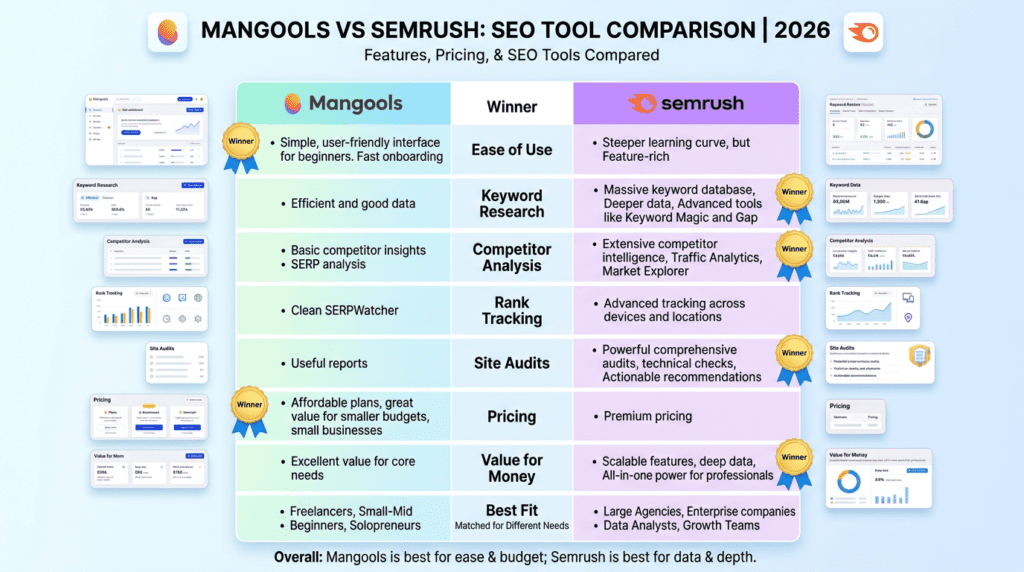
Complete Verdict Table
| Category | Mangools | Semrush | Winner |
|---|---|---|---|
| Ease of use | Very beginner-friendly | More complex but powerful | Mangools |
| Keyword research | Simple and clean | Larger database and deeper analysis | Semrush |
| Competitor analysis | Basic to moderate | Advanced competitive intelligence | Semrush |
| Rank tracking | Strong for simple tracking | More scalable and detailed | Semrush |
| Site audits | Limited | Advanced technical SEO audits | Semrush |
| Pricing | More affordable | More expensive | Mangools |
| Value for money | Great for small teams | Better for serious growth teams | Depends |
| Best fit | Beginners, bloggers, small businesses | Agencies, ecommerce, advanced marketers | Depends |
Best For
- Mangools: beginners, bloggers, small businesses, and users who want a clean, affordable SEO toolkit.
- Semrush: agencies, ecommerce brands, advanced SEO teams, and businesses needing deeper competitive data.
Not Ideal For
- Mangools: technical SEO teams, large agencies, or users needing advanced reporting and integrations.
- Semrush: users with very small budgets or beginners who only need basic keyword research.
Bottom Line
Choose Mangools if you want a user-friendly SEO tool with strong value for money. Choose Semrush if you need advanced features, deeper data, stronger reporting, and a platform that can scale with serious SEO campaigns.
Ease Of Use Comparison: User-Friendly Mangools vs Full-Scale Semrush
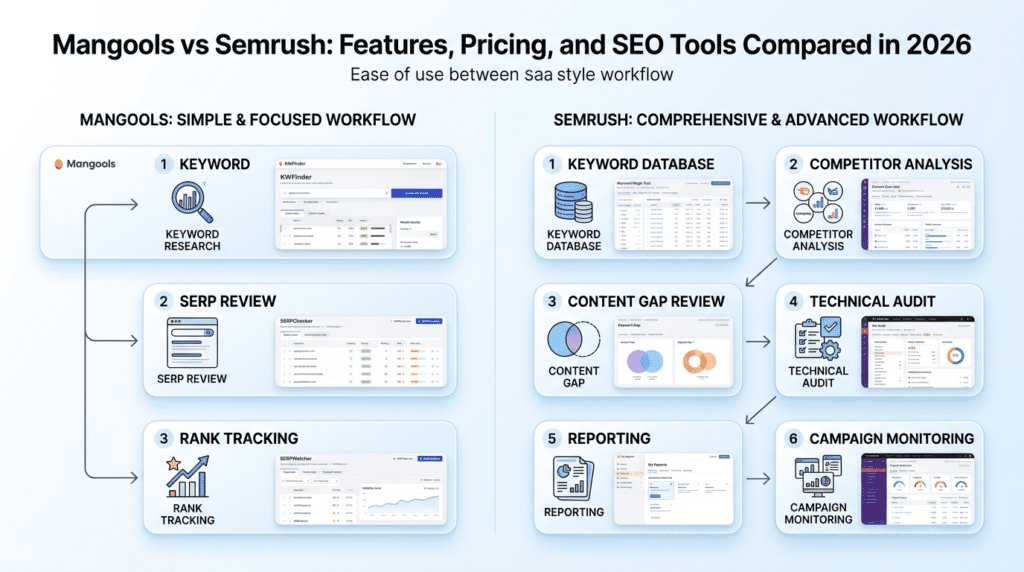
Beginner Learning Curve
Mangools focuses on simplicity from the first login. The menus are easy to scan, the visual layout is clean, and the main tools feel separated in a way that makes sense. That matters a lot for beginners who just want to do keyword research, check ranking, or review a backlink profile without digging through layers of settings.
Semrush asks for more patience. It’s not that the platform is hard to use, but it gives you many more paths to take. New users often feel lost because there are so many reports, toolkits, and filters on screen at once. If you’re new to SEO, that can slow you down before you even get to the actual work.
This is one of the biggest differences in the Mangools Vs Semrush comparison: Mangools helps you start faster, while Semrush takes longer to learn but gives you more control later.
Daily SEO Workflow
For day-to-day SEO tasks, Mangools usually feels lighter. A blogger or solo affiliate marketer can move from keyword research to SERP review to rank tracking with very little friction. The workflow is straightforward, and that can save time when you’re checking 10 or 20 keyword ideas at a stretch.
Semrush is better when the work goes beyond quick checks. If you’re building content clusters, comparing multiple competitors, or reviewing a larger campaign, the extra depth pays off. The trade-off is that simple tasks can take longer because there are more filters, tabs, and reports to sort through.
A practical way to think about it:
- Use Mangools when you want fast core SEO tasks with minimal setup.
- Use Semrush when the SEO work involves deeper analysis and repeated review across multiple projects.
That difference becomes more obvious as usage grows. What feels “advanced” in week one can feel normal in month six, but only if you’re using the extra data often enough to justify the learning time.
Dashboard And Reporting Experience
Mangools presents data in a way that most non-technical users can understand quickly. Charts are simple, keyword metrics are easy to spot, and the interface doesn’t crowd the screen with too many competing elements. For freelancers and small business owners, that clarity can be more useful than a long list of features.
Semrush gives you more reporting depth, but it also asks you to interpret more information. That’s a plus if you need detailed exports for a client, a manager, or a larger marketing team. It’s less helpful if the person reading the report just wants a clear answer on what to do next.
A common issue with Semrush is that users sometimes build reports that look impressive but don’t actually simplify decision-making. Mangools tends to do the opposite: fewer layers, less clutter, and faster understanding. If your audience is not SEO-savvy, that can be a real advantage.
Common Ease-Of-Use Mistakes
A lot of frustration with both tools comes from user mistakes, not just software design.
- New users may treat keyword difficulty as a final answer instead of a rough guide.
- Beginners often chase volume and ignore search intent.
- Semrush users sometimes pay for the platform but only use 10% of it.
- Mangools users may overlook deeper competitor signals because the interface makes everything feel simpler than it really is.
The biggest misconception is that more data automatically leads to better SEO. In practice, it usually leads to more questions. Mangools reduces that problem by narrowing the view. Semrush solves it by letting you dig deeper, but only if you know what to look for.
SEO Performance And Data Quality: How Reliable Are Mangools And Semrush?
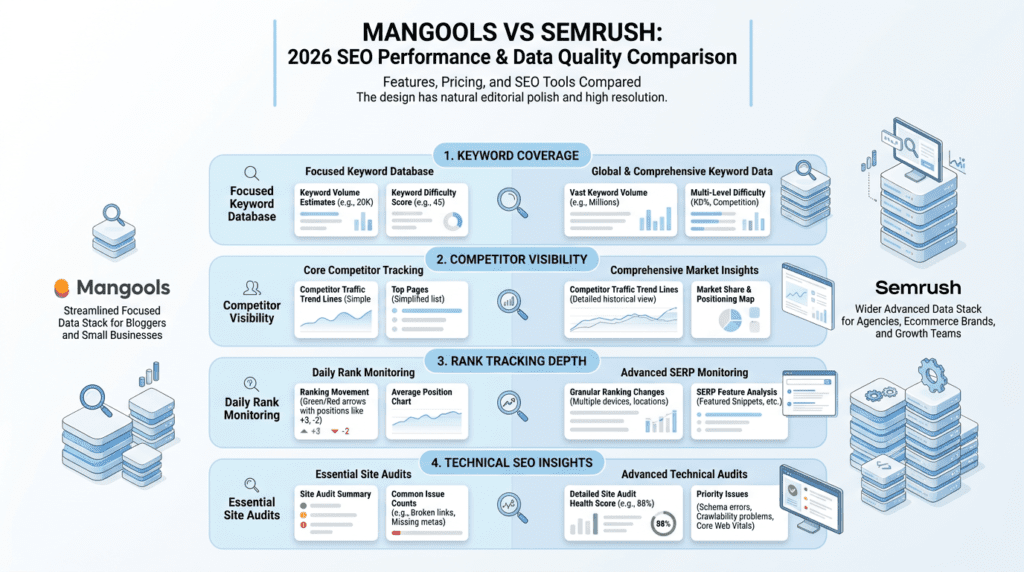
Keyword Data Accuracy And Coverage
No SEO tool gives perfect data, and that’s an important reality check. Search volume is always estimated, difficulty scores are always modeled, and regional keyword data can shift depending on the market. So the real question in Mangools Vs Semrush isn’t which one is “exact,” but which one is more useful for the job.
Semrush generally gives broader coverage, which helps when you’re doing competitive research across many topics or markets. That wider database can surface more keyword ideas and more variations, especially for larger sites. Mangools can still be strong for focused keyword research, but it’s more likely to feel limited when you’re working in a crowded niche or trying to build out a big content map.
One thing users often overestimate is the precision of the difficulty score. A keyword with a higher score isn’t always impossible, and a lower score isn’t always easy. Real ranking depends on content quality, link strength, site authority, and how well your page matches search intent. That’s why keyword research should be treated as a direction guide, not a final answer.
Competitor Data And Market Visibility
This is where Semrush clearly pulls ahead for serious market analysis. It offers much stronger visibility into competitor traffic patterns, paid search activity, content gaps, and ranking trends. If you’re in ecommerce, SaaS, or a highly competitive niche, that broader view can change what you publish and where you spend your effort.
Mangools is still useful for smaller projects where the main goal is to see who ranks, what the SERP looks like, and which keywords are worth targeting. It does the core work well enough for many bloggers and small sites. But it does not try to be a full competitive intelligence platform like Semrush.
That difference matters most when you’re making business decisions, not just SEO decisions. For example, an agency might use Semrush to understand why a competitor is pulling ahead across 200 keywords. A solo site owner might only need Mangools to spot the top-ranking pages and build a content plan around them.
Rank Tracking Performance
Rank tracking is one of those features that seems simple until you use it every week. Mangools is solid for tracking a manageable set of keywords, especially if you want a clean view of movement without extra noise. That makes it a good fit for smaller sites and local businesses that only care about a few important terms.
Semrush becomes more useful when rank tracking is part of a larger reporting system. Its tracking is better suited for campaigns with more keywords, more competitors, and more locations. If you’re watching performance across different devices or markets, the extra structure helps.
A simple way to separate them:
- Mangools: best when you want quick visibility and low-friction monitoring.
- Semrush: better when ranking data needs to support deeper reporting and strategy.
One hidden frustration with rank tracking is that people often check it too often. Daily movement can look dramatic even when nothing meaningful changed. The tool matters, but the habit matters more.
Technical SEO And Site Performance Insights
Semrush is much stronger if technical SEO is part of your workflow. Its site audit tools can uncover crawl issues, broken internal links, HTTPS problems, and structured data concerns that can affect ranking over time. For larger sites, that kind of monitoring becomes less optional and more routine.
Mangools is not built for heavy technical SEO. It can support basic checks, but it won’t replace a deeper audit platform. If your site is small and your main need is keyword research and rank tracking, that may be fine. If you’re managing a large ecommerce catalog or a content-heavy site with thousands of URLs, it may not be enough.
This is where long-term consequences show up. A tool that seems “good enough” at 50 pages may feel restrictive at 5,000 pages. As your site grows, technical issues become harder to spot manually, and that’s where a platform like Semrush becomes more valuable.
Reporting, Integrations, Customer Support, And Scalability
Reporting For Freelancers, Teams, And Agencies
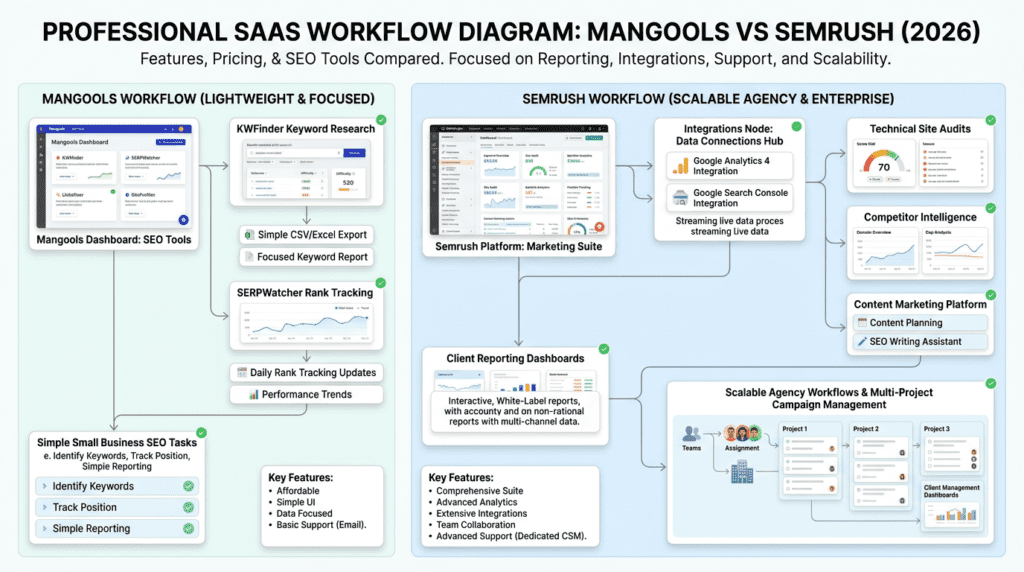
Reporting is one of the clearest places where Mangools and Semrush separate into different lanes. Mangools is fine for straightforward exports and simple updates, especially if you’re sending reports to a client who just wants the basics. The layout is easy to explain, and that can save time for freelancers and solo consultants.
Semrush is built for more elaborate reporting workflows. It works better for agencies that need recurring client reports, multiple projects, and more detailed performance breakdowns. It also gives you more room to present search data in a way that supports client conversations, not just internal analysis.
Here’s the practical difference:
| Category | Mangools | Semrush |
|---|---|---|
| Best For | Solo users, small businesses, basic reporting | Agencies, teams, multi-client reporting |
| Pricing | Lower monthly cost | Higher monthly cost |
| Ease of Use | Easier to learn and explain | More complex but more flexible |
| Key Strength | Simple reporting with low friction | Deeper reporting for larger workflows |
| Biggest Limitation | Less customizable at scale | Can feel heavy for simple reporting |
If you’re only sharing results with one or two stakeholders, Mangools may be enough. If reporting is part of your service delivery, Semrush usually gives you more room to grow.
Integrations And Workflow Compatibility
Integrations are easy to ignore at the start and hard to ignore later. If you’re running a lean SEO operation, you may not care whether a tool connects deeply with other platforms. But once you start working across Google Analytics, Google Search Console, client dashboards, or broader marketing systems, integrations begin to matter.
Semrush fits better into larger workflows because it connects more naturally with common marketing tools and team processes. That makes it a stronger fit for businesses that want SEO data to support content planning, campaign reviews, and cross-channel reporting.
Mangools keeps things simpler, which is useful if you want fewer moving parts. That simplicity can be a real plus for beginners and smaller teams. The downside is that you may eventually hit a point where manual exports and copy-paste workflows start to slow you down.
A good rule of thumb: if SEO is your whole job, integrations are helpful. If SEO is one part of a bigger marketing system, they become much more important.
Customer Support And Learning Resources
Semrush offers more learning resources because the platform itself is more complex. That’s not just a nice extra; it’s a necessity. New users often need help understanding which tool to use first, how to interpret the data, and how to turn reports into actions. The upside is that there’s usually more guidance available when you need it.
Mangools doesn’t require as much hand-holding, which is part of its appeal. The simpler interface means fewer support questions and less time spent figuring out where things live. For many small users, that’s a better experience than a huge help center they never plan to read.
The trade-off is straightforward:
- Semrush helps more if you’re willing to learn.
- Mangools helps more if you want to move quickly without much training.
Support matters most when something breaks, but learning resources matter most when you’re trying to build a repeatable workflow. That’s usually where the real value shows up over time.
Scalability For Growing SEO Campaigns
Scalability is where the choice between Mangools and Semrush becomes clearer as a business matures. Mangools works well in the early stage when the goal is to find keywords, track rankings, and keep SEO work simple. It can serve small sites for a long time if the scope stays narrow.
Semrush starts to make more sense when the campaign gets bigger. More target keywords, more competitors, more pages, more audits, more reporting, and more team members all push you toward a platform with deeper structure. That’s where Semrush’s broader setup begins to pay off.
A few signs that a business may be ready to move beyond Mangools:
- You’re tracking a large keyword set across multiple locations.
- You need stronger technical SEO visibility.
- You manage several clients or brands.
- You want more detailed competitor analysis.
- Your reporting has to support larger decisions, not just weekly checks.
Not every business needs that level of complexity. But once SEO becomes tied to revenue at scale, the limits of a simpler tool tend to show up fast.
Mangools vs Semrush Pros And Cons
Mangools Pros
Mangools has a few clear strengths that make it appealing for everyday SEO work.
First, the pricing is easier to justify if you’re running a small site or a side project. You’re not paying for a huge platform you’ll barely touch. That matters a lot when you only need a keyword research tool, rank tracking, and basic backlink analysis.
The interface is another major plus. Mangools focuses on simplicity, so beginners usually get results faster. KWFinder, in particular, is easy to learn. You can search a keyword, review the difficulty score, and scan the SERP without digging through layers of menus. For a lot of users, that’s enough.
It’s also a good fit for bloggers, small business owners, and affiliate marketers who want practical SEO data without a steep learning curve. If your workflow is mainly finding topics, checking competition, and watching a handful of rankings, Mangools can feel refreshingly lightweight.
Just as important, it avoids the “too much software” problem. Some SEO platforms try to do everything and end up slowing people down. Mangools keeps the process simple, which helps users stay consistent.
Mangools Cons
Mangools starts to show limits once SEO gets more serious.
The biggest gap is depth. It’s fine for everyday keyword research and rank tracking, but it doesn’t offer the same level of competitor analysis or technical SEO insight that Semrush does. If you’re trying to understand a market in detail, Mangools can feel narrow.
Its site audit and backlink analysis tools are also less advanced. That may not matter for a personal blog, but it becomes a problem for larger sites, agencies, and ecommerce stores with more moving parts. As a site grows, those missing details matter more.
The software ecosystem is smaller too. Fewer integrations and reporting options mean less flexibility for teams that need to connect SEO work to other tools or send polished client reports.
So while Mangools is great for focused SEO tasks, it can feel limited once you need broader visibility, deeper analysis, or more scalable workflows.
Semrush Pros
Semrush is built for depth, and that’s its biggest advantage.
It gives you a much broader toolkit for SEO and digital marketing. Keyword research is deeper, competitor research is stronger, and the site audit tools go further than what most smaller platforms offer. If you need one platform to handle more of your workflow, Semrush is hard to ignore.
It also shines in areas where growth-focused teams need detail. You can explore keyword ideas, compare competitors, review backlink profiles, and dig into technical SEO issues all in one place. That saves time when you’re managing multiple pages, campaigns, or clients.
Reporting and integrations are another strength. Agencies and in-house teams usually care less about a pretty dashboard and more about repeatable workflows. Semrush supports that better than Mangools.
Long term, this matters. A platform like Semrush can grow with a business instead of being outgrown after the first stage of SEO work. That makes the cost easier to defend if the data is actually being used.
Semrush Cons
Semrush is powerful, but that power comes with trade-offs.
Pricing is the first one. It costs more than Mangools, and the real bill can climb once you add extra users, higher limits, or add-ons. For a small site, that can be hard to justify.
The learning curve is another issue. Beginners often sign up expecting a simple keyword tool and end up facing a full SEO platform with a lot of menus, reports, and options. That can slow down adoption, especially if the user only wanted a few core SEO tasks.
There’s also the danger of overbuying. Some users pay for Semrush because it sounds like the “serious” choice, but they never use most of it. That’s wasted money if your workflow is basic.
So Semrush is a stronger platform overall, but it’s not always the smarter purchase. If you don’t need its deeper features, it can feel like too much software for the job.
—
Real-World Use Cases: Who Should Choose Mangools Or Semrush?
Best For Small Business SEO
For many small businesses, Mangools is enough.
If you’re a local service provider, a solo consultant, or a small ecommerce shop with a manageable site, Mangools handles the core SEO tasks well. You can do local keyword research, check whether a page can realistically rank, track a few important keywords, and watch how your competitors show up in search.
That’s often all a small business needs at first. Owners usually want clear answers, not a giant dashboard. Mangools gives them a simpler path to those answers.
But there are cases where Semrush is the better move. If you’re in a competitive city, a crowded niche, or a market where competitors publish a lot of content, deeper data starts to matter. Semrush can show more about competitor visibility, keyword gaps, and site issues that might be holding you back.
A good rule of thumb: choose Mangools if you need straightforward SEO support. Choose Semrush if search is a real growth channel and you’re competing against more advanced players.
Best For Bloggers And Affiliate Site Owners
Bloggers and affiliate site owners usually care about a few things: finding low-competition keyword ideas, checking SERPs, tracking rankings, and planning content that can actually move.
Mangools fits that workflow nicely. KWFinder is simple to use, and that matters when you’re searching for dozens of keyword ideas each week. SERPWatcher also keeps rank tracking easy to follow without a steep setup process.
For lean content operations, that simplicity is valuable. You can spend more time writing and less time learning software.
Semrush is the stronger choice when content strategy gets more competitive. If you want to study competitor pages, find content gaps, compare multiple domains, or build a broader topic plan, it gives you more to work with. That’s especially useful when a site is no longer just a hobby blog and needs to grow traffic in a more structured way.
So for solo creators, Mangools is often the cleaner fit. For creators who treat content like a serious business, Semrush gives more room to scale.
Best For Ecommerce Brands
Ecommerce brands usually benefit more from Semrush.
That’s because ecommerce SEO is rarely just about keywords. You need category-level research, product-page optimization, technical SEO audits, competitor tracking, and sometimes paid search research too. Semrush handles that wider mix better than Mangools.
A store with hundreds or thousands of URLs also needs more than basic tracking. Technical problems can affect indexing, crawlability, and ranking at scale. Semrush’s audit and competitive tools make it easier to spot those issues before they cost traffic.
Mangools can still help smaller stores or product lines that only need simple keyword research and rank tracking. But once the catalog grows, it tends to feel limited. The data may still be useful, but it won’t cover enough of the SEO workload.
If your ecommerce site is a side business with a few dozen products, Mangools may be enough. If SEO is tied directly to revenue and inventory growth, Semrush is usually the better fit.
Best For Agencies And Consultants
Agencies and consultants usually need more than research. They need repeatable workflows, client reporting, competitive analysis, and enough data depth to support recommendations.
That’s where Semrush stands out. It gives teams more flexibility for audits, reporting, and ongoing campaign management. When clients ask why rankings changed or which competitor is gaining ground, Semrush often has the broader set of answers.
Mangools can work well for freelancers or consultants who keep their client load small. If you only need clean keyword research and simple rank monitoring, it’s easier to manage and easier to explain to clients. Lower pricing also helps protect margins.
The trade-off is scale. As a consultant or agency grows, manual work becomes a problem. If you need more projects, more users, or more robust deliverables, Semrush is usually the safer long-term choice.
In short: Mangools works for lightweight client work. Semrush is better when SEO has to support a more professional reporting process.
Best For Beginners vs Advanced SEO Teams
Beginners usually do better with Mangools.
It’s simpler, less intimidating, and easier to learn through trial and error. That matters because new SEO users often struggle more with interpretation than with the tool itself. A cleaner interface helps them focus on the basics: keyword intent, search difficulty, SERP quality, and whether a page has a real chance to rank.
Advanced teams are a different story. Once SEO becomes part of a broader growth system, they need deeper data, better reporting, and more ways to connect research to execution. Semrush is built for that kind of workflow.
A team should think about this in stages. If you’re still learning how to pick keywords and monitor rankings, Mangools is a sensible starting point. If you already know your process and need more power, Semrush is the logical upgrade.
That upgrade usually makes sense when the question changes from “Can I rank this page?” to “How do we beat multiple competitors across several channels?”
—
Honest Trade-Offs Most Buyers Miss
Simplicity vs Depth
This is the biggest trade-off in the Mangools vs Semrush decision.
Mangools is easier because it does less. That’s not a flaw by itself. In fact, for many users, it’s a strength. The tools are easier to learn, the screens are less cluttered, and the path from keyword research to action is shorter.
Semrush is harder because it offers more. You get more data, more reports, more filters, and more ways to slice the market. That depth is valuable, but only if you know what to do with it.
The mistake many buyers make is assuming more depth automatically means better results. It doesn’t. A tool only helps if it matches the user’s workflow and skill level.
If your SEO process is still basic, Mangools may be the better fit. If your process is mature and you’re making decisions from lots of moving parts, Semrush is the stronger option.
Budget Savings vs Missed Opportunities
Saving money with Mangools makes sense on paper. The catch is what you may miss by not having deeper data.
Semrush can surface competitor gaps, technical problems, and content opportunities that a simpler platform might not expose as clearly. Those insights can turn into traffic, leads, or sales. So the cheaper tool is not always the cheaper choice in practice.
That said, paying more only makes sense if you can act on the data. If a team isn’t going to use advanced reports or audits, then the extra spend becomes wasted overhead.
This is why the real question isn’t just “Which tool costs less?” It’s “Which tool helps us earn back the cost through better SEO decisions?”
Advanced Features You May Not Actually Use
A lot of users sign up for Semrush because it sounds like the serious option. Then they use 10% of it.
That happens more than people admit. Features look impressive in demos, but day-to-day SEO work often stays focused on a few core SEO tasks. If your team only checks keyword rankings and does occasional research, you may never touch the more advanced parts of the platform.
This is where software selection should follow execution capacity. A tool should match how often you’ll use it, not just how many features it has.
A powerful platform doesn’t replace strategy. It doesn’t create content ideas, fix poor site structure, or make weak pages rank on its own. The tool supports the work, but the work still has to happen.
When To Consider Alternatives To Both
Sometimes neither tool is the perfect answer.
If backlink analysis is your main priority, Ahrefs may be a better fit. If you want a more affordable rank tracking option or a different balance of features, SE Ranking can be worth a look. Moz, Ubersuggest, and Serpstat may also make sense depending on budget, workflow, and how deep you need the data to go.
These alternatives matter most when your needs are narrow. For example, a team that mainly cares about rank tracking and reporting may not need the broader marketing suite that Semrush offers. A solo blogger who wants a simpler keyword tool may also find another platform easier to live with.
Still, for most buyers comparing Mangools and Semrush, the real decision is about simplicity versus depth. If you want a cleaner tool for core SEO work, Mangools is the easier path. If you want a larger SEO platform built for growth, Semrush is usually the stronger choice.}}## Decision Guide: When To Choose Mangools vs When To Choose Semrush
Choose Mangools If
- You want an affordable SEO tool.
- You mainly need keyword research, SERP analysis, and rank tracking.
- You are a beginner, blogger, freelancer, or small business owner.
- You prefer a clean and user-friendly interface.
- You do not need advanced technical audits or complex reporting.
Choose Semrush If
- You need an all-in-one SEO and marketing platform.
- You manage multiple websites, clients, or competitive campaigns.
- You need advanced competitor research, site audits, content tools, and reporting.
- You want stronger integrations and scalability.
- You can justify the higher pricing through revenue, clients, or growth goals.
Switch From Mangools To Semrush When
- Your SEO campaigns become more competitive.
- You need deeper competitor analysis.
- Technical SEO becomes more important.
- You manage more projects, keywords, or clients.
- Reporting and integrations become part of your workflow.
Final Recommendation: Is Mangools Or Semrush Better In 2026?

Best Overall SEO Tool
Semrush is the stronger overall SEO platform for users who need advanced features, deeper data, competitive analysis, and scalability. Its higher cost makes sense when SEO directly supports growth, client work, or revenue.
Best Budget-Friendly SEO Tool
Mangools is the better choice if you care most about ease of use, affordability, and practical keyword research. It fits beginners, bloggers, freelancers, and small businesses that do not need a full enterprise-style SEO suite.
Final Buying Advice
Choose based on your SEO maturity, budget, and execution capacity. If you need simple SEO research and rank tracking, Mangools is the smarter value. If SEO is a serious growth channel and you need deeper insights, Semrush is the better long-term investment.
FAQs About Mangools vs Semrush
Is Mangools Cheaper Than Semrush?
Yes, Mangools is typically more budget-friendly, while Semrush costs more because it includes broader functionality.
Is Semrush Worth The Extra Cost?
Yes, if you run an agency, ecommerce store, or competitive SEO program and need advanced reporting, audits, and competitor analysis. It may be overkill for basic SEO work.
Which Is Easier To Use, Mangools Or Semrush?
Mangools is easier for beginners. Semrush has a steeper learning curve, but it offers more advanced capabilities once you get comfortable with it.
Is Mangools Good Enough For Small Business SEO?
Yes, Mangools is often enough for basic keyword research, tracking, and competitor checks. A small business may need Semrush if competition is intense or the SEO program is more complex.
Can Mangools Replace Semrush?
Mangools can replace Semrush for simpler workflows, but it does not fully replace Semrush for technical SEO, competitive intelligence, reporting, or large-scale campaigns.
What Are The Best Alternatives To Mangools And Semrush?
Ahrefs, SE Ranking, Moz, Serpstat, and Ubersuggest are strong alternatives. The best option depends on budget, backlink needs, reporting requirements, and campaign complexity.