
If you’re trying to choose between ConvertKit and Flodesk, the real issue isn’t just features. It’s whether your email platform fits the way you actually work. A creator who wants fast, beautiful newsletters has very different needs from someone building funnels, tagging subscribers, and running a more complex email sequence.
That’s why the Convertkit Vs Flodesk decision gets messy fast. Both tools can send emails, but they’re built around different priorities. One leans into creator automation and list management. The other leans hard into design and simplicity.
Why Email Marketing Software Choice Matters More as Your Email List Grows
When your email list is small, almost any decent email marketing software feels fine. You can send a newsletter, make a simple landing page, and move on. But once you start growing, tiny limitations turn into daily friction.
A 500-subscriber list is forgiving. A 10,000-subscriber list is not. At that point, you start caring about tagging, segmentation, automation depth, analytics, deliverability, and whether your workflow still feels manageable when you’re running launches or content funnels every week.
What Most Creators Get Wrong About Convertkit Vs Flodesk
The biggest mistake is assuming one tool is “better” in a vacuum. That’s not how this works. Flodesk can feel like the better pick if you care about design, speed, and a clean editor. ConvertKit usually makes more sense when your business depends on more sophisticated automation and subscriber organization.
A lot of creators also underestimate how much their business model matters. A newsletter-first brand, a course creator, and an ecommerce store all use email differently. The right platform is the one that matches your actual workflow, not the one with the nicest homepage.
The Honest Take on Convertkit And Flodesk Before You Commit
There’s a real big difference between Flodesk and ConvertKit once you look past the surface. Flodesk makes beautiful email creation easy. ConvertKit gives you more control over subscriber behavior, segmentation, and growth workflows. Neither is perfect.
If you want something simple and visually polished, Flodesk is easy to love. If you want a platform that scales with more moving parts, I’d recommend ConvertKit more often. But the right answer still depends on whether you need prettier emails or smarter systems.
Quick Verdict: Convertkit Vs Flodesk at a Glance
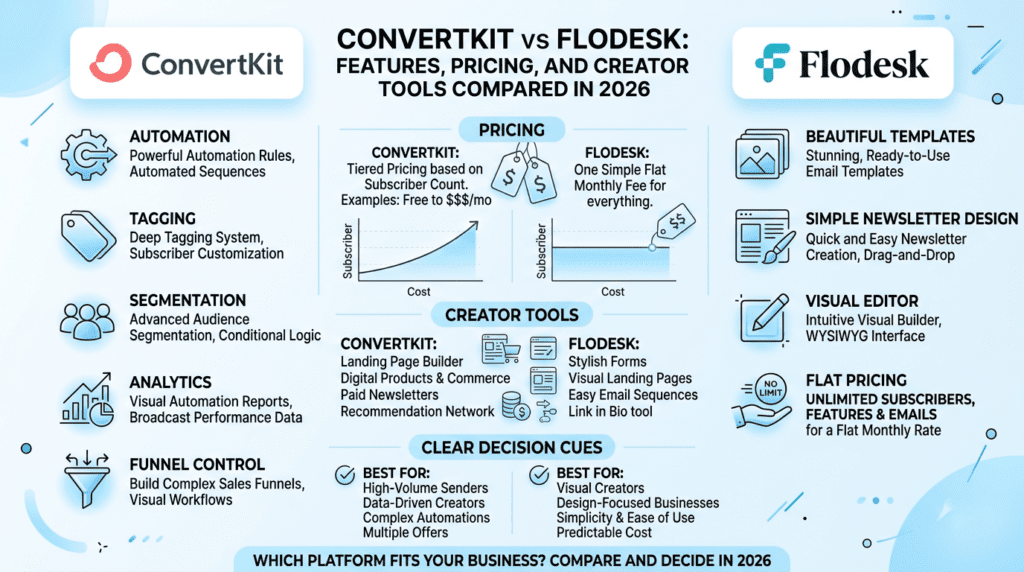
Complete Comparison Table
| Category | ConvertKit | Flodesk |
|---|---|---|
| Best for | Creators who need tagging, automation, and audience segmentation | Creators who want simple, beautiful newsletters and an easy editor |
| Starting price | Free plan available; paid plans typically start around $29/month | Flat rate pricing starts around $38/month, depending on current plan structure |
| Free plan | Yes | Yes, but plan access and limits can change |
| Ease of use | Moderate; more powerful, but takes longer to learn | Very easy; faster for beginners |
| Email editor | Functional and clean, but less design-forward | Strong visual editor with polished templates |
| Automation | More advanced automation and branching | Simpler visual automation |
| Tagging and segmentation | Strong | More limited |
| Landing pages and forms | Solid creator tools | Simple and attractive |
| Analytics | Better for list and funnel tracking | Basic reporting |
| Deliverability | Strong reputation | Generally solid, but not as operationally deep for advanced users |
| Best value for | Growing creators and marketers who need flexibility | Solo creators and small brands that value design and simplicity |
| Main limitation | Can feel more complex than you need | Can feel limiting as your business grows |
Best For
ConvertKit is best for creators who plan to grow into more complex workflows. If you care about tagging, audience segments, and building a system around launches, lead magnets, and email funnels, it’s the stronger operational choice. It’s also a better fit for people who expect to migrate into more serious email marketing later instead of starting over.
Flodesk is best for solo creators, coaches, designers, and newsletter publishers who want a beautiful email editor without a learning curve. If your priority is sending polished emails quickly and you don’t need deep backend complexity, Flodesk works well.
Not Ideal For
ConvertKit isn’t ideal if you mainly want a gorgeous email editor and don’t care much about workflow depth. Some users simply don’t need all the moving parts, and ConvertKit can feel heavier than expected.
Flodesk isn’t ideal if your business depends on detailed automation logic, advanced subscriber behavior tracking, or more robust segmentation. It’s a cleaner experience, but that simplicity comes with trade-offs.
Bottom Line
If you’re comparing ConvertKit and Flodesk strictly on creator utility, ConvertKit usually wins for scalability and automation. Flodesk usually wins for ease and design. The right pick comes down to whether you want an easier newsletter tool or a more flexible email system that can grow with you.
Convertkit Vs Flodesk: Features, Automation, and Creator Tools Compared
Convertkit Automation vs Flodesk Visual Automation
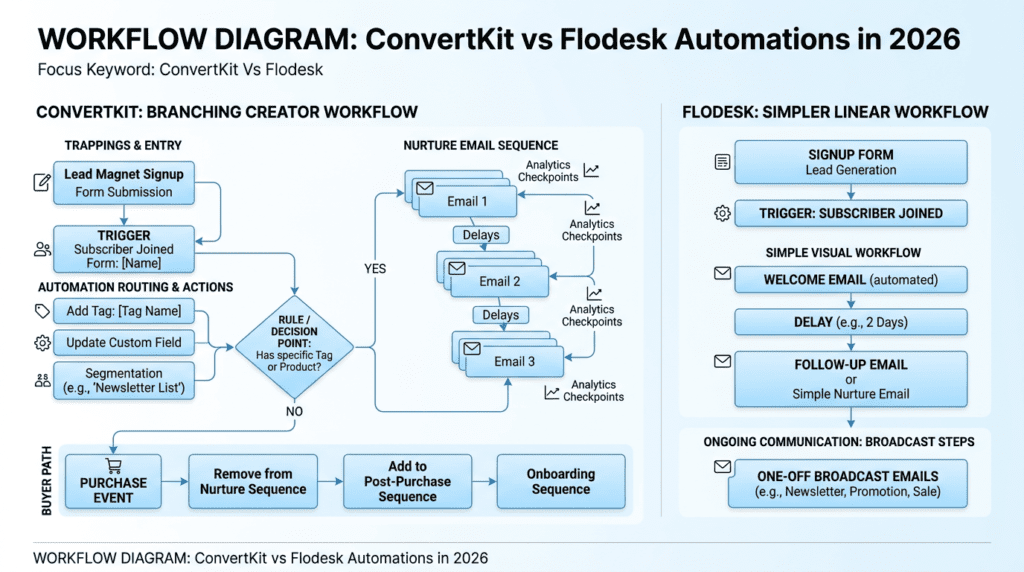
This is where the separation gets clear. ConvertKit’s automation system is built for more serious email marketing workflows. You can segment subscribers by behavior, trigger actions from form signups, and build paths that feel more like a system than a sequence of emails. That matters if you run multiple lead magnets, product launches, or buyer journeys.
Flodesk’s visual automation is easier to understand at a glance. The workflow builder feels friendly, especially for beginners who don’t want to wrestle with logic trees. But that simplicity can become a ceiling. Once you start wanting more branching, more advanced subscriber logic, or tighter list management, you may feel the limits. Flodesk doesn’t currently try to compete with ConvertKit on depth, and that’s fine if you don’t need that depth.
For a course creator, this can be the difference between a basic welcome flow and a more useful funnel that adjusts based on what someone clicked, bought, or ignored.
Email Sequence Building: Series of Emails, Tagging, and Workflow Options
ConvertKit allows more flexibility when building a series of emails around tags and actions. That makes it easier to separate buyers from leads, webinar attendees from cold subscribers, or freebie signups from paid customers. The workflow logic is the real value here, not just the ability to send emails on a schedule.
Flodesk can still handle a simple sequence of emails, and it’s pleasant to build. But the structure is lighter. If you’re the kind of creator who likes to keep things simple, that may be enough. If your business grows and you need smarter routing, the difference starts to matter fast.
A lot of users don’t notice this until they hit a messy list and realize manual cleanup is eating time every week.
Landing Page and Form Builder Differences
Both platforms include landing page and form tools, but they serve different moods. ConvertKit’s pages are practical and creator-focused. They’re built to convert, not impress. You can get a lead magnet page or newsletter signup page live without much effort.
Flodesk’s landing page and form builder feels more design-led. It’s easier to create something visually polished without design experience. That’s a real advantage if brand presentation matters to you. The trade-off is that the tools are less flexible when you want more granular customization.
For a blogger or independent coach, Flodesk can be the faster path. For a creator building a larger funnel, ConvertKit’s structure is usually more useful over time.
Newsletter Creation and Template Flexibility
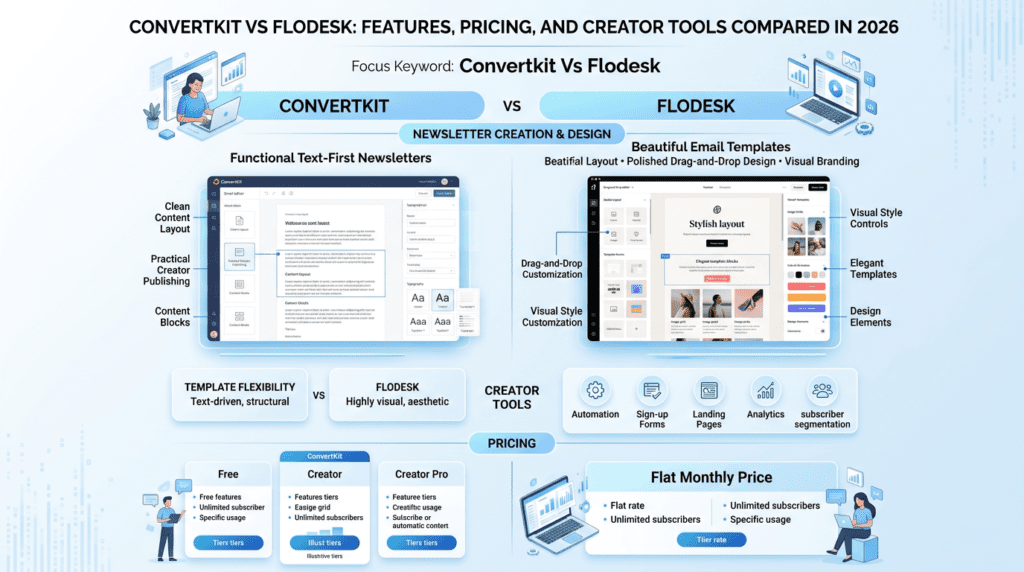
Flodesk’s email editor is the headline feature for many users. It makes beautiful email creation feel natural, and the template library is a big part of that appeal. If your newsletter needs to look polished with minimal effort, Flodesk is often the easier choice.
ConvertKit’s editor is more restrained. It’s not trying to be flashy. That can actually help if you send mostly text-based newsletters and want to keep the focus on the message. But if you care a lot about visual styling, Flodesk’s email templates are more satisfying out of the box.
A practical way to think about it: use Flodesk if design is part of your brand promise. Use ConvertKit if the email itself is the product, not the layout.
Analytics and Reporting: What You Can Actually Track
ConvertKit generally gives you more useful analytics for list growth and campaign performance. You can better track subscriber behavior, sequence performance, and how your list is moving through the system. That matters once your list becomes a revenue asset, not just a contact database.
Flodesk keeps reporting simpler. You’ll still see the basics, but it doesn’t go as deep for users who want to study funnel behavior or optimize by segment. If you only care about open rate, click rate, and a few campaign-level metrics, that may be enough.
But once you start asking questions like “Which lead magnet converts better?” or “Which tag produces buyers?”, ConvertKit is the stronger tool.
Convertkit Vs Flodesk: Pricing, Plans, and Value for Money
Convertkit Pricing vs Flodesk Pricing in Real-World Use
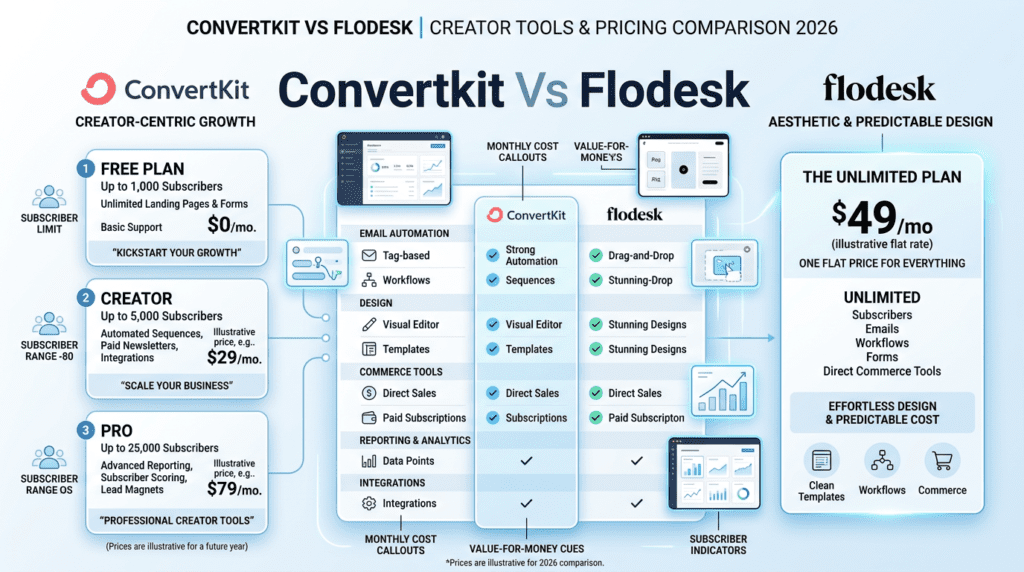
ConvertKit pricing usually starts with a free plan and paid plans that begin around $29 per month, then rise as your subscriber count grows. That pricing model is familiar, but it can feel expensive once you hit larger email list tiers.
Flodesk uses flat rate pricing, which is a big reason people like it. The current pricing structure often starts around $38 per month, and the appeal is obvious: you don’t get punished as quickly for growth. If your subscriber count climbs, the bill doesn’t always climb with it in the same way.
That said, flat pricing isn’t automatically cheaper. If you’re a small creator with a modest list, ConvertKit can be more affordable. If your list grows quickly, Flodesk can become the more predictable option.
Value for Money for New Creators vs Growing Email Lists
For new creators, the best value usually comes down to what you’re actually using. If you’ve just started your email list and only need a basic newsletter plus a simple email sequence, ConvertKit’s free plan can be a strong entry point. You can test the workflow before paying anything.
Flodesk may feel more premium right away, especially if you care about the look of your emails. That can be worth it for creators whose brand depends on visual polish. A photographer, designer, or boutique brand may love Flodesk because it makes every send look cleaner with less effort.
As the business grows, ConvertKit often becomes the better value for users who need more structure. The price may rise, but so does the usefulness of the system.
Hidden Cost Differences That Matter Over Time
The hidden cost isn’t always monthly price. It’s time. It’s cleanup. It’s workarounds. If your platform makes you manually manage segments, rebuild workflows, or export data to fill gaps, you’re paying for it in labor.
ConvertKit can cost more, but it often saves time for users who need automation depth. Flodesk can look cheaper or easier, but if you keep running into feature limits, you may end up switching later. And switching email marketing software is never fun. You have to migrate, reconnect forms, rebuild automations, and watch for broken links or missing tags.
That’s the part most buyers ignore until they’re already halfway into the wrong system.
When Flodesk Feels Cheaper and When Convertkit Costs Less
Flodesk feels cheaper when your list is growing and you want one predictable bill. It’s especially appealing if you don’t need heavy segmentation or complex funnels. For some users, that flat rate pricing is the whole story.
ConvertKit can actually cost less when you’re just getting started and still under the limits of the free plan or a lower paid tier. It also costs less in operational frustration if you need its automation tools anyway. In other words, the cheaper platform isn’t always the one with the smaller monthly invoice.
If you mostly send a newsletter and want a beautiful email editor, Flodesk is easy to justify. If you need serious creator infrastructure, ConvertKit often pays for itself through better workflow control.
FAQ
Is ConvertKit better than Flodesk for creators?
Yes, for most creators who need automation and segmentation, ConvertKit is better. It gives you more control over tags, workflows, and subscriber behavior.
Flodesk is better if your main goal is to send beautiful emails quickly without much setup. It’s simpler, but that simplicity comes with limits.
Is Flodesk worth it for beginners?
Yes, Flodesk is worth it for beginners who care about design and want an easy email editor. It’s one of the smoother tools to learn.
If you only need a basic newsletter and a landing page, it can be a very comfortable starting point. If you expect to build more advanced funnels later, you may outgrow it sooner.
Can you migrate from ConvertKit to Flodesk?
Yes, you can migrate from ConvertKit to Flodesk, but it takes work. You’ll need to move subscribers, rebuild forms, and recreate automations manually in most cases.
The bigger issue is making sure your tags, sequences, and links transfer cleanly. A careful move matters more than a fast one.
Which platform is better for email deliverability?
ConvertKit has the stronger reputation for deliverability in more advanced creator workflows. That said, both platforms can perform well if you maintain a clean list and write relevant emails.
Deliverability also depends on your sender habits, subject line quality, and how often you clean inactive subscribers. The platform matters, but it’s not the whole story.
Deliverability, Subscriber Management, and List Growth
Deliverability is where a lot of people get surprised. On paper, both platforms can send emails well, but the real-world experience is shaped more by how you build your list, how clean your subscriber data is, and how often you email. A creator with a small, engaged list can get solid results on either platform. A messy list with bad subject lines, weak engagement, and stale contacts can make either tool look bad.
The bigger issue in Convertkit Vs Flodesk is not just whether messages arrive. It’s how easy it is to keep the list organized as your email marketing grows. That’s where the gap starts to matter.
Convertkit and Flodesk Deliverability Expectations
Convertkit generally gives more confidence to creators who care about structure, tagging, and long-term email system health. It’s built with list management in mind, so you can segment by behavior, purchase intent, or source without fighting the platform. That usually helps you maintain cleaner sends over time, which is a practical deliverability advantage.
Flodesk can absolutely work for regular newsletter sending, and many flodesk users are happy with the simplicity. But flodesk’s email setup tends to be more design-first than system-first. If you’re using it for a beautiful email and straightforward broadcasts, that’s fine. If you want deeper control over subscriber paths and cleanup rules, the limits show up faster. Neither platform can save a weak list from spam complaints or poor engagement, so the subject line still matters, and so does consistency.
Subscriber Tagging, Segmentation, and List Organization
This is one of the biggest differences in how the platforms feel after a few months of use. Convertkit allows more flexible tagging and segmentation, which makes it easier to group people by lead magnet, purchase behavior, webinar attendance, or interest. A coach can tag one subscriber as “lead magnet A,” “consult call booked,” and “customer,” then send targeted follow-up without creating a tangled workflow.
Flodesk keeps organization simpler, which many people like at first. You can still manage subscribers, but the system is less about deep branching and more about keeping things visually clean. That works if your email list is small and your content is straightforward. It gets less comfortable when you need multiple audience paths, conditional follow-ups, or finer control over who sees what.
If you’re building an email list for one product, one offer, or one newsletter, Flodesk can feel easy. If your business has multiple segments, Convertkit usually feels less limiting.
Managing an Email List as It Scales
Once you get past a few hundred subscribers, the small decisions start to matter. At 500 contacts, a simple workflow can feel perfectly fine. At 5,000 or 20,000, you start noticing whether a platform helps you stay organized or quietly creates more cleanup work.
Convertkit is better suited for that scaling phase because it handles complexity with less friction. You can build a more detailed workflow, separate audiences by tags, and make your list easier to maintain. That matters when you’re sending different email sequences to buyers, prospects, and inactive subscribers.
Flodesk works well for creators who want a lighter system and don’t want to spend time managing technical clutter. The trade-off is that you may end up with more manual sorting later. That’s not a problem on day one. It becomes a problem when your list grows and you realize you’ve outgrown the simple structure.
What Changes When Your Subscriber Count Grows
Growth changes the job. At 1,000 subscribers, you’re mostly focused on writing and sending. At 10,000, you’re also thinking about segmentation, cleanup, open rate trends, and which subscribers deserve different follow-up. At that point, the platform starts shaping your workflow instead of just hosting it.
That’s why some people eventually move back to Convertkit after trying something simpler. The issue isn’t that flodesk stops working. It’s that the business grows, and the need for a more serious system shows up. If you only want to send a newsletter and a few welcome emails, Flodesk still makes sense. If you want to build a more durable email marketing stack, Convertkit tends to age better.
Ease of Use: Convertkit vs Flodesk for Beginners and Busy Creators
Ease of use is where Flodesk usually gets attention first. Its interface is calmer, and the visual polish makes the whole process feel less technical. Convertkit is still fairly approachable, but it asks you to think more like a system builder. That’s not a flaw. It just means the two platforms are solving different problems.
For a busy creator, the real question is not “which one looks nicer?” It’s which one gets you from signup to first send with fewer unnecessary steps, fewer second guesses, and fewer places to get stuck.
Setup Experience and First-Campaign Workflow
Flodesk is usually easier to start with. The onboarding feels lighter, and the drag and drop experience helps new users move quickly from idea to email. If you just want to connect flodesk, choose a template, and send your email, the path is pretty direct. That’s a real advantage for someone who doesn’t want to tinker with every setting.
Convertkit takes a little more thought at setup, mainly because it wants you to set up the right structure early. That pays off later, but it can feel slower on day one. The upside is that convertkit allows more organized list building from the start, so your first workflow is often more durable even if it takes longer to build.
A beginner who wants a simple email sequence and a newsletter can get moving on either platform. The difference is how much the platform expects you to plan ahead.
Template Experience and Newsletter Design Speed
Flodesk’s stunning email editor is one of its biggest selling points. It makes beautiful email creation fast, which matters when you’re publishing weekly and don’t want to spend 45 minutes making one template look decent. The design system feels polished, and the visual results are usually strong without much effort.
Convertkit’s email editor is more restrained. It’s built for speed and function more than visual flair. That’s great if you care about content first and want to send without fuss. It’s less appealing if your brand depends on highly styled templates or image-heavy layouts.
Here’s the practical trade-off:
- Use Flodesk: if your newsletter is design-led and you want fewer layout headaches.
- Use Convertkit: if you care more about writing, tagging, and fast publishing than visual polish.
How Much Manual Work Each Platform Saves
Flodesk makes a lot of routine tasks feel lighter. The platform reduces the need to fight with formatting, and that helps when you’re sending often. For a solo creator, those saved minutes add up fast.
Convertkit saves time in a different way. It reduces manual list management once your workflow gets more complex. You might spend more effort upfront, but later you’re less likely to manually move people between segments or rebuild email paths every time you launch something new. That’s why many creators prefer it once they start doing more than a basic newsletter.
Where Beginners Usually Feel Frustrated
Beginners usually get frustrated when the platform doesn’t match their actual goal. Someone who only wants a beautiful simple email can feel overwhelmed by Convertkit’s extra structure. Someone who wants deeper automation can feel boxed in by Flodesk’s simpler approach.
The frustration usually shows up in three places:
- figuring out tags and segments
- deciding how much automation to build now versus later
- understanding why a clean-looking newsletter tool isn’t always enough for a growing business
That’s the part people miss when comparing convertkit and flodesk. Ease of use isn’t just about the first 10 minutes. It’s about how much the platform asks from you at month 10.
Integrations, Workflow Flexibility, and Creator Stack Fit
This is where the conversation shifts from features to fit. A platform can look great in isolation and still feel awkward once you plug it into your actual stack. Your store, checkout tool, course platform, webinar software, and forms all shape the real experience. If the integration layer is weak, you end up doing more manual work than you expected.
Integration Depth for Email Marketing Software
Convertkit usually wins when you want broader workflow flexibility. It tends to fit better with a creator stack that includes landing pages, forms, purchase tracking, and outside apps through native integration or tools like Zapier. That makes it easier to trigger actions from real behavior instead of just basic signups.
Flodesk also offers useful connections, but the setup is generally simpler and narrower. That’s fine if your stack is minimal. It’s less ideal if your business depends on multiple tools talking to each other cleanly. If you regularly move contacts between platforms, log purchases, or trigger different sequences from different sources, Convertkit is usually the safer bet.
Workflow Control for Solo Creators, Coaches, and Small Businesses
For solo creators and coaches, workflow control can mean the difference between a calm system and a messy one. Convertkit gives you more room to build around actual business behavior. You can separate buyers from non-buyers, send different follow-ups, and keep your automation from turning into a pile of overlapping steps.
Flodesk is easier if your workflow is simple. A single newsletter, one lead magnet, and a short welcome series fit it well. The moment you need more layers, the platform starts feeling less flexible. That doesn’t make it bad. It just means it’s optimized for a lighter creator business.
A small business owner with one offer and limited tech help may use Flodesk for a clean, low-friction setup. A coach running webinars, calls, and several email sequences will usually get more mileage from Convertkit.
When Convertkit Fits Better Than Flodesk
You should lean toward Convertkit when your business depends on behavior-based email marketing. If you need tags, segments, and more detailed automation, Convertkit is the better long-term choice. It also makes more sense if your stack includes a course platform, ecommerce tools, or multiple lead sources.
It’s usually the stronger pick if:
- you plan to grow beyond a basic newsletter
- you need more control over subscriber organization
- you want workflows that can change as your business grows
That’s why many creators who start simple eventually recommend convertkit. It’s not always prettier, but it’s more adaptable.
When Flodesk Makes More Sense Than Convertkit
Flodesk makes more sense when you want the least complicated path to a nice-looking email. If you’re focused on publishing content, sending a weekly newsletter, and keeping setup time low, flodesk works well. It’s also appealing if your brand depends heavily on design and you don’t want to wrestle with the email editor.
Flodesk tends to fit best when:
- your workflow is basic
- you value design speed over deep segmentation
- you don’t need a heavy automation system
If that sounds like your business, there’s no reason to overbuild. Simple tools are often the right tools until they’re not.
What Most Blogs Miss About Convertkit Vs Flodesk
Most comparisons stop at features, price, and a few screenshots. That misses the part that actually matters: how the tool changes once your business is no longer tiny. A platform can feel great during setup and still become a pain once you need better reporting, tighter segmentation, or a more reliable workflow.
This is where the convertkit vs flodesk debate gets more honest. The best choice depends less on aesthetics and more on how much operational weight your email system needs to carry.
The Trade-Off Between Simple Design and Deeper Automation
The core trade-off is straightforward. Flodesk gives you a cleaner, more beautiful editor and a lower-friction publishing experience. Convertkit gives you more system depth. You can’t fully maximize both at the same time because they’re solving different problems.
That matters more than people admit. A simple newsletter creator may never need deep branching logic. But once you start selling products, running launches, or segmenting by behavior, the lack of deeper automation becomes obvious fast. On the other hand, if your main concern is sending polished emails without a lot of setup, Convertkit can feel like more machinery than you need.
Why Creators Moved to Flodesk and Later Moved Back to Convertkit
This pattern shows up a lot. Creators start with Flodesk because it feels easier and looks better. They love the visual editor, the clean workflow, and the fact that they can move quickly without touching a complicated system. That’s a real advantage early on.
Then the business grows. They want better segmentation, more flexible subscriber logic, stronger control over their workflow, or tighter connections to their stack. That’s when some people move back to Convertkit. Not because Flodesk failed, but because the business outgrew the simplicity.
If you started your email list with a simple content plan, Flodesk may be enough for a while. If your offers multiply, that same simplicity can turn into a ceiling.
What Changes When You Need More Than a Newsletter Tool
The moment you need more than a newsletter tool, everything changes. You stop asking only how good the email looks and start asking what happens after someone subscribes, clicks, buys, or disappears. That’s where Convertkit becomes more useful.
You may need:
- a more detailed email sequence
- better subscriber paths
- stronger analytics on clicks and behavior
- cleaner ways to manage different audience groups
Flodesk can still send the email. What it doesn’t do as well is support the messy middle of a growing business. That’s often the real issue.
Hidden Limitations That Only Show Up After Migration
Migration exposes the hidden stuff. Moving from Convertkit to Flodesk can feel attractive at first because the interface is simpler and the email editor looks better. But after you migrate, you may realize some things are harder to rebuild, especially if you relied on tags, complex automation, or multiple segments.
The reverse happens too. Moving from Flodesk to Convertkit can require more setup than you expected, and the new structure can feel clunky for a few weeks. That’s normal. New systems always create friction at first.
The real mistake is switching before you know what you’re giving up. If you currently use one platform and are only tempted by prettier design, that’s not always enough reason to move. But if your business is hitting operational limits, the switch may be worth it.
Migration and Switching: Convertkit to Flodesk, Back to Convertkit, and List Transfers
Switching email platforms sounds simple until you’re the one doing it. The list export is rarely the hard part. The real friction shows up in tags, sequences, forms, automations, and all the little bits of structure that keep your email list organized. That’s where Convertkit Vs Flodesk gets practical fast, because the right choice depends on how much rebuilding you’re willing to do.
If you’re planning to migrate from one platform to the other, the question isn’t just whether your subscriber data moves. It’s whether your actual workflow survives the move without breaking. A creator with one newsletter and a few welcome emails has a very different experience than a business with multiple forms, segment rules, and layered automations.
How Hard It Is to Migrate Subscriber Data and Tags
The raw subscriber export is usually manageable. Most platforms let you download contacts in CSV format, then import them into the new system. Names, emails, and basic tags often come over cleanly enough. The trouble starts when you rely on deeper organization, because tags aren’t always interpreted the same way on both sides.
If you currently use ConvertKit, you may have tags tied to purchases, lead magnets, or behavior-based segments. Those can usually be rebuilt in Flodesk, but not always mirrored one-for-one. The same is true in reverse. A subscriber can transfer, but the logic behind that subscriber often needs to be recreated by hand.
That’s why migrations take longer than people expect. For a small list of 500 to 2,000 subscribers, the data move might take an afternoon. Rebuilding automations, forms, and segmentation can take several days, especially if you have multiple entry points or a few email sequence paths already running.
Convertkit to Flodesk: What Usually Transfers Well
A convertkit to flodesk move tends to be smoother if your setup is simple. Basic subscriber fields, tags, and list segments usually migrate without much drama. That’s one reason some creators test switching to Flodesk after starting with ConvertKit, especially if their main goal is easier design and faster newsletter creation.
What usually does not transfer perfectly is the structure around your marketing logic. Flodesk’s visual automation style feels cleaner for simple workflows, but it may not map every ConvertKit rule exactly as-is. If you’ve built a detailed funnel with multiple conditions, you’ll probably need to recreate parts of it manually.
The best-case scenario is a creator with a newsletter, a few opt-in forms, and a short welcome series. In that setup, migration is mostly a data task. If you’ve built a more advanced system, the move is still possible, but it starts to look like a partial rebuild.
Moved to Flodesk vs Moved Back to Convertkit: Common Reasons
People who moved to flodesk often say the same thing: it felt easier to launch beautiful emails fast. That’s real. Flodesk’s email editor is one of its biggest strengths, and for creators who care about visual polish more than complex branching, it can feel refreshing.
Then reality changes. The business grows, the email marketing gets more layered, and the platform starts feeling a little tight. That’s when some users move back to ConvertKit. They want better automation control, more precise tagging, and a system that handles growth without making every workflow feel like a workaround.
A lot of these shifts aren’t about which platform is “better” in a general sense. They’re about fit. Someone building a simple newsletter brand may love Flodesk for years. Someone running launches, lead magnets, and segmented sequences may eventually recommend ConvertKit after hitting the edges of what Flodesk currently supports.
Risks to Watch Before You Switch Email Marketing Platforms
The biggest risk is assuming your setup will behave the same after migration. It usually won’t. Even when the subscriber data lands correctly, the surrounding workflow can break in subtle ways. Forms may need to be re-embedded. Subject line formatting may need to be reviewed. Automation triggers may need to be rebuilt from scratch.
There’s also timing. If you switch in the middle of a launch or a promo cycle, you increase the chance of sending the wrong email or missing a segment entirely. That can hurt open rate, click rate, and trust. A cleaner move is to migrate during a quiet week, test every form, and send a few internal test emails before turning anything live.
A few practical risks to check first:
- Tag logic: Make sure your most important tag rules can be recreated.
- Active sequences: Pause or duplicate any live email sequence before moving.
- Forms and landing pages: Reconnect them and test each signup path.
- Integrations: Confirm your native integration or Zapier setup still fires correctly.
- Historical reporting: Don’t expect old analytics to transfer in a useful way.
Which Is Better for Your Situation: Convertkit or Flodesk?
This is where the decision gets easier. The best platform depends on what you’re actually trying to do this quarter, not what looks nicest in a feature list. A solo creator sending one newsletter a week has different needs than a course creator with launch funnels, lead magnets, and a more complicated subscriber journey.
If you want a simple answer, think in terms of workload. Flodesk is often better when speed, design, and simplicity matter most. ConvertKit is usually better when your email marketing needs more control, more branching, and more room to grow. Neither platform wins every category, and that’s the point.
Best Choice for Newsletters and Simple Email Marketing
If your main job is to send a clean weekly newsletter, Flodesk is often the easier fit. The editor is quick, the templates look polished, and you can produce a beautiful email without wrestling with layout choices for 30 minutes. That matters more than people admit, especially for busy creators who want to publish consistently.
For a personal brand, photographer, coach, or local business sending one or two simple newsletters per week, Flodesk works well. You can build a nice-looking email list presence without needing a lot of technical setup. If your workflow is mostly “write, design, send,” Flodesk usually feels lighter.
The trade-off is that simple email marketing stays simple. Once you need more advanced segmentation or more detailed automation paths, the ease starts to give way to limits.
Best Choice for Automation and Email Sequences
ConvertKit is the stronger choice when automation is the core of your business. If you need to tag subscribers based on behavior, send different follow-ups after a form fill, or run a multi-step welcome sequence, ConvertKit gives you more room to work.
That matters for creators selling digital products, courses, or services. A single subscriber might enter through a lead magnet, receive a series of emails, skip one branch, and later get moved into a launch segment. ConvertKit handles that kind of structure more naturally. It’s not just about sending emails. It’s about controlling the path.
If your email marketing platform needs to support launches, evergreen funnels, and ongoing segmentation, ConvertKit is usually the safer pick. It takes a little more setup, but the workflow scales better.
Best Choice for Creators Who Value Templates and Fast Design
Use Flodesk if visual design is the priority and you don’t want to spend time making every email look decent. Its beautiful email style is a real advantage for newsletters, announcements, and brand-led communication. The drag and drop editor is simple enough that most users can publish without training.
This is where Flodesk’s email editor earns its reputation. You’re not paying for bells and whistles you won’t touch. You’re paying for speed and polish. For creators who want to send your email quickly and make it look good on mobile, that can be enough.
The limitation is obvious: design speed doesn’t equal deeper control. If you later need more granular automation or tighter list management, you may feel the platform narrowing.
Best Choice for Growing Businesses That Need More Control
ConvertKit is the better long-term choice for growing businesses that care about structure. As your business grows, the platform needs to support more than a newsletter. You may need separate audience paths, smarter tagging, stronger sequence control, and a workflow that doesn’t become messy after 3,000 or 10,000 subscribers.
That’s where ConvertKit tends to separate itself. It gives you more room to organize your system without rebuilding everything every time you launch something new. It’s not the prettiest option in the room, but it’s often the more practical one.
For agencies, course creators, SaaS brands, and businesses with multiple offers, that control is usually worth more than a prettier template. The business problem is not appearance. It’s keeping the email system usable as complexity rises.
Recommend Convertkit or Flodesk Based on Your Use Case
If you want a quick decision rule, here it is:
- Choose ConvertKit if you need deeper automation, stronger segmentation, and more flexibility as your list grows.
- Choose Flodesk if you want simple newsletters, fast design, and a cleaner visual workflow.
- Choose ConvertKit if your business depends on launches, funnels, or tagged subscriber behavior.
- Choose Flodesk if you mostly want to publish polished emails without dealing with complex setup.
If you’re still unsure, ask one question: do you need more control, or do you need less friction? That answer usually makes the choice for you.
Final Verdict: Convertkit Vs Flodesk

The honest answer is that both platforms are good, but they’re good for different jobs. ConvertKit is the more capable system overall. Flodesk is the easier one to live with if your needs stay simple. That’s the big difference between them, and it’s why so many comparisons keep circling back to the same conclusion.
For most serious creators, ConvertKit is the safer long-term pick. For creators who care most about design speed and a lightweight workflow, Flodesk can be the better day-to-day fit. The best email marketing platform is the one that matches how you actually work, not the one with the longest feature page.
Final Recommendation for Most Creators
If you’re building a business that expects to grow, recommend ConvertKit. It handles more complex automation, gives you more control over subscriber management, and tends to age better once the email list becomes central to revenue. That matters more than a prettier interface.
Flodesk still makes sense if your business is small, your newsletter is the main product, or you’re tired of overbuilt tools. But for most creators who want room to expand, ConvertKit is usually the better default. It’s less flashy, sure. It’s also less likely to box you in later.
When to Choose Convertkit
Choose ConvertKit if you need email sequences, tag-based workflows, better segmentation, or a setup that can support launches and growth. It’s also the better call if you already know your email marketing will get more layered over the next 12 months.
This is the platform to use if you value control over speed. It may take a little longer to learn, but it gives you more room to build a system that doesn’t fall apart when your business gets busier.
When to Choose Flodesk
Choose Flodesk if your main goal is to create beautiful emails quickly and keep your workflow simple. It’s a strong fit for newsletters, personal brands, and creators who care more about design than advanced logic.
If you’re starting fresh and want a platform that feels less technical, Flodesk can be a relief. Just go in with clear expectations. It’s easier to use, but it doesn’t currently match ConvertKit’s depth for automation-heavy businesses.
Frequently Asked Questions About Convertkit Vs Flodesk
Is Convertkit Better Than Flodesk for Email Marketing?
Yes, ConvertKit is better for more advanced email marketing. It offers stronger automation, tagging, and segmentation, which matters once your business starts doing more than sending a simple newsletter.
Flodesk is better for fast, attractive emails and a lighter workflow. If you need deeper control, ConvertKit usually wins.
Is Flodesk Good for Newsletters and Email Sequences?
Yes, Flodesk is good for newsletters and simple email sequences. Its visual email editor makes it easy to build clean campaigns without much setup.
It’s best for straightforward workflows. If your sequence logic gets more complex, you may run into limits faster than you would with ConvertKit.
Does Convertkit Have Better Automation Than Flodesk?
Yes, ConvertKit has better automation than Flodesk. Its workflow tools are stronger for tagging, branching, and subscriber behavior.
That difference becomes obvious when you build multiple entry points or run launches. Flodesk’s automation is usable, but it’s more basic.
Can You Migrate from Convertkit to Flodesk Without Losing Subscribers?
Yes, you can usually migrate subscribers from ConvertKit to Flodesk without losing the core contact data. Email addresses, names, and many tags can be exported and imported.
What you may not transfer perfectly is the full workflow structure. Rebuild your automations, forms, and sequences carefully before going live.
Which Platform Is Better for Beginners: Convertkit or Flodesk?
Flodesk is usually better for beginners. It’s easier to use, faster to design with, and less intimidating when you’re just getting started.
ConvertKit is still beginner-friendly enough for many users, but it asks for more setup. If you want a smoother first week, Flodesk is often the simpler path.
Is Convertkit Vs Flodesk Worth Switching If You Already Have an Email List?
Sometimes, yes. If your current platform is slowing you down, lacks automation depth, or makes every campaign harder than it should be, switching can be worth it.
Just don’t switch for novelty. Move only if the new platform solves a real operational problem, because rebuilding a list setup always takes more time than expected.