
If you’re paying for one SEO tool, the decision has to hold up in real work, not just on feature lists. In 2026, the Ahrefs Vs Semrush debate matters because both tools have grown into full SEO platforms, but they still solve slightly different problems. One may feel sharper for backlink analysis and keyword discovery. The other may be more useful when your day includes site audits, local SEO, PPC, and broader marketing reporting.
That difference sounds small until you’re the one building monthly reports, chasing keyword opportunities, or trying to fix a technical issue before it drags down rankings.
What Buyers Usually Get Wrong About Ahrefs and Semrush
The most common mistake is treating ahrefs and semrush like they’re interchangeable. They aren’t. Buyers often look at surface features, then assume the better-looking dashboard wins. That usually leads to regret two months later when the team realizes the real bottleneck is keyword research depth, crawl limits, or how awkward the workflow feels for daily SEO tasks.
Another miss: people assume the “best” tool is the one with the largest feature set. Sometimes that just means more noise. If your team only needs keyword research, content ideas, and backlink checks, paying for a giant all-in-one platform can feel bloated fast.
Honest Take on Ahrefs and Semrush for Real SEO Work
In practical use, semrush and ahrefs each shine in different parts of the SEO workflow. Ahrefs often feels cleaner for research-heavy work, especially if you spend a lot of time on backlinks, keyword analysis, and finding content gaps. Semrush gives you more breadth. It’s often the stronger pick when your work crosses into technical seo, PPC, local seo, rank tracking, or broader marketing operations.
That doesn’t mean one is “better” in every case. A solo blogger and an agency managing 30 client sites do not need the same seo toolkit. And that’s where the trade-off starts to matter.
How This Ahrefs Vs Semrush Comparison Is Evaluated
This comparison is based on the parts that actually affect day-to-day SEO work: data reliability, keyword research, competitor research, site audit depth, reporting usefulness, ease of use, and value for different business types. It also accounts for workflow friction. A tool can be powerful and still slow you down if the interface or limits get in the way.
The goal here is simple: compare ahrefs and semrush on what they do in real use, not just on what they promise on paper.
Quick Verdict: Ahrefs Vs Semrush in 2026
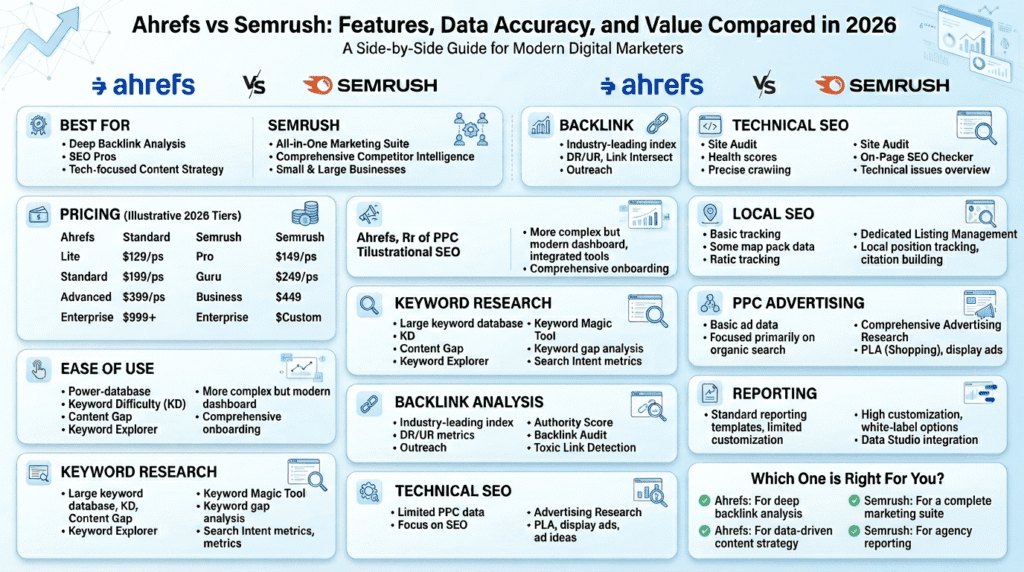
Complete Comparison Table
| Category | Ahrefs | Semrush |
|---|---|---|
| Best For | Backlink research, keyword discovery, content-led SEO | Full-stack SEO, local SEO, technical seo, PPC, reporting |
| Not Ideal For | Teams wanting broad marketing coverage in one platform | Users who want the cleanest interface or strongest backlink-first workflow |
| Starting Price | Typically starts around $129/mo | Typically starts around $129.95/mo |
| Free Plan | No true free plan; limited free tools available | No true free plan; limited free tools available |
| Ease of Use | Cleaner, easier to navigate for core SEO work | Broader but busier, with more moving parts |
| Key Strength | Strong backlink data and focused keyword research | Wider feature set, especially for audits and local SEO |
| Biggest Limitation | Less useful outside core SEO tasks | Can feel complex and expensive for smaller teams |
| Overall Recommendation | Best if SEO is your main job and research quality matters most | Best if you want one platform for SEO plus adjacent marketing work |
Best For
Choose Ahrefs if your work revolves around content SEO, link analysis, and finding new keyword opportunities without too much clutter. It’s usually the easier pick for bloggers, affiliate sites, niche publishers, and in-house SEOs who care more about research speed than all-in-one marketing extras.
Use Semrush if you need one platform for seo tasks across multiple areas. Agencies, local businesses, and teams doing seo and ppc together usually get more mileage from it. Semrush provides more breadth, and that matters when one person has to own audits, rankings, competitive tracking, and reporting.
Not Ideal For
Ahrefs is not the best fit if you want deep local SEO workflows, broad marketing add-ons, or built-in PPC support. It can do a lot, but it isn’t trying to be the entire marketing stack.
Semrush is not ideal if you want the simplest interface or you mainly need backlink research and keyword discovery. Some users end up paying for features they barely touch. That’s a common subscription problem in SEO software: the plan is technically good, but the workflow is heavier than expected.
Bottom Line
If you want the cleaner research engine, choose Ahrefs. If you want a broader seo platform with more adjacent tools, use Semrush. The real difference between Ahrefs and Semrush is not just data. It’s how much of your workflow each platform can support before you feel the need to bolt on another tool.
Ahrefs Vs Semrush: Core Differences That Matter Most
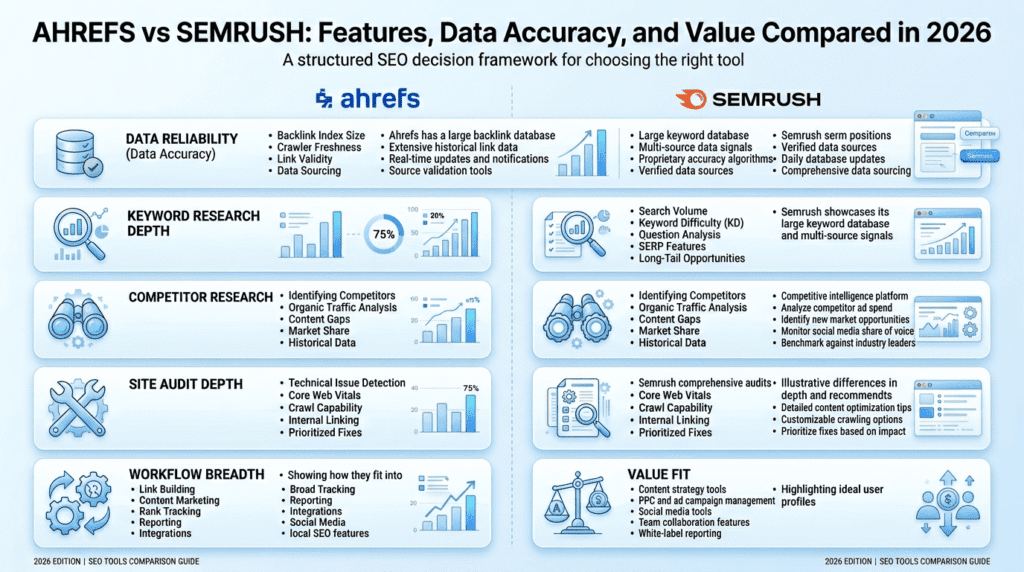
Ahrefs and Semrush Data: Where Each Tool Feels Stronger
Ahrefs tends to feel strongest when you’re looking at backlink profiles, organic keyword opportunities, and content-driven search behavior. The data presentation is usually straightforward, which helps when you need to move quickly. Semrush, on the other hand, often feels broader and more operational. It’s built to connect SEO with audits, local visibility, PPC, and reporting.
That difference matters more than people think. If you run a blog or affiliate site, ahrefs offers a very focused research experience. If you manage multiple channels, semrush gives you more context in one place. The trade-off is complexity. Broader tools can be useful, but they also create more tabs, more filters, and more chances to get lost.
Keyword Research Tool Strengths in Ahrefs vs Semrush
For keyword research, both tools are strong, but they approach it differently. Ahrefs is often favored for clean keyword discovery and fast filtering. Its keyword explorer is easy to work with when you’re hunting for content ideas and want fewer distractions. Semrush’s keyword magic tool goes wider, which can be useful when you’re building large topic clusters or comparing many keyword groups at once.
Semrush also tends to surface more surrounding data for each semrush keyword, which helps when you need to map intent, variants, and content structure. Ahrefs can feel better when you want a quick answer. Semrush can feel better when you want more angles.
The catch is that neither tool removes judgment from the process. A keyword tool can suggest 500 terms, but you still need to decide whether they fit your site, your authority, and the search intent you can realistically serve.
Competitor Research Depth: Comparing Ahrefs vs Semrush
Both platforms are strong for competitor research, but they don’t emphasize the same signals. Ahrefs is often better for seeing how competitors win through backlinks and content. Semrush gives you more layers across organic, paid, and broader visibility data, which can be useful if you want to compare more than just rankings.
That makes Semrush especially handy for agencies and brands that want to see the full competitive picture, not only seo performance. Ahrefs still holds its own when the question is, “What content and links are helping this site rank?” For many teams, that’s the real question anyway.
Site Audit and Technical SEO Capabilities Compared
This is where Semrush often has the edge. Its site audit features are broader and more comfortable for teams that need to manage technical seo at scale. Semrush site audit is especially useful for finding crawl issues, internal linking problems, and on-page mistakes across larger sites.
Ahrefs has a capable site audit too, and it’s perfectly usable for routine checks. But if your workflow involves repeat audits, issue prioritization, and sharing findings with non-SEOs, Semrush usually feels more complete. The difference is not just the checks themselves. It’s how the platform organizes the work after it finds a problem.
Local SEO Support: When Semrush Has the Edge
If local seo matters, Semrush is usually the stronger option. It offers more built-in support for location-based tracking, map visibility workflows, and local reporting. That makes it more practical for agencies, franchises, clinics, service businesses, and any brand with multiple physical locations.
Ahrefs can still be used for local keyword research and content tracking, but it isn’t designed around local operations in the same way. If your revenue depends on city-level visibility or you need to manage business listings and nearby search performance, use semrush rather than forcing Ahrefs into that role.
Best Value for Different SEO Workflows
Best value depends on what you actually do every week. If your work is mostly content planning, backlink review, and organic opportunity tracking, Ahrefs may deliver better value because you’re paying for fewer distractions. If your workflow includes audits, local SEO, client reporting, and PPC research, Semrush can justify its price more easily.
A solo creator might be fine with Ahrefs and a couple of extra lightweight tools. A growing agency may find Semrush cheaper in practice because it replaces several separate subscriptions. That’s often the hidden value equation people miss.
Ahrefs Vs Semrush: Data Accuracy and Trustworthiness
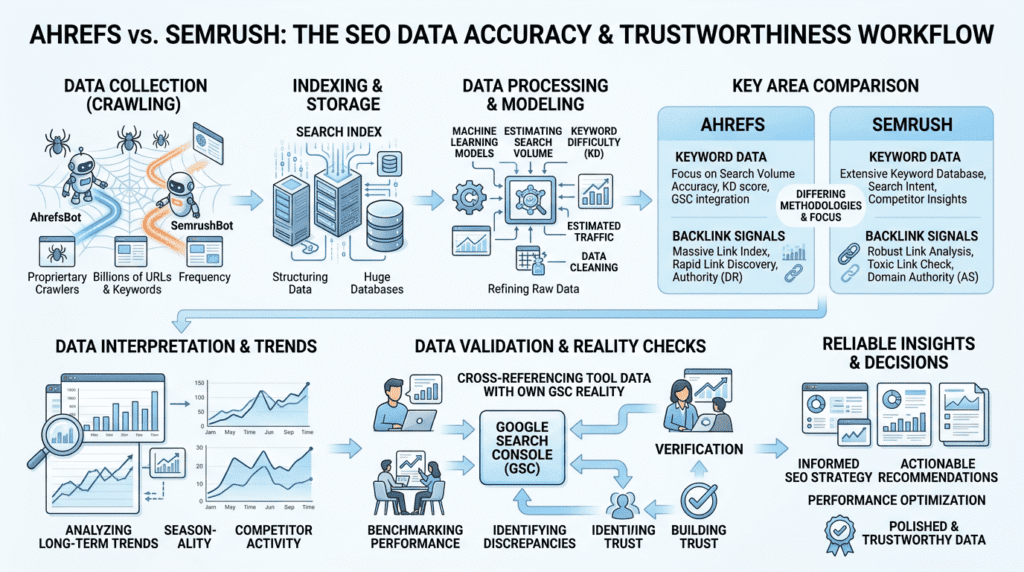
How Ahrefs and Semrush Data Is Collected and Interpreted
Neither platform is pulling live Google data in real time, so both rely on their own crawlers, indexes, and modeling. That means the numbers you see are directional, not absolute. Ahrefs and Semrush data is useful because it helps you make decisions faster, not because it perfectly matches every search result at every moment.
This is where a lot of buyers get nervous for the wrong reason. They compare one report against Google Search Console, see differences, and assume one tool is “wrong.” Usually, they’re just measuring different things. One tool estimates. One platform reports from actual site data. Those are not interchangeable.
Keyword Database Coverage and Ranking Confidence
Keyword data coverage matters because the best keyword research tool is only useful if it actually sees enough volume and variation to be worth trusting. Semrush often feels stronger for broader database coverage, especially when you want more semantic variants and wider topic discovery. Ahrefs can feel tighter and more focused, which many SEOs prefer for cleaning up keyword lists and spotting realistic opportunities.
The ranking confidence issue is more subtle. A keyword difficulty score is only a guide. It should never replace manual review of the top 10 results. If the top pages are huge brands, government sites, or forums, the score may look manageable while the real opportunity is weak. That’s why experienced SEOs use the score as a filter, not a verdict.
Backlink Data and Competitor Research Reliability
Ahrefs is widely known for backlink research, and that reputation still holds. It tends to be the tool many users trust when they need a clean look at link profiles, referring domains, and lost link trends. Semrush also has strong backlink features, but its reputation is broader than that, which sometimes makes the backlink experience feel like one part of a larger system rather than the main event.
For competitor research, both tools are reliable enough to guide decisions, but you should still validate what you find. A competitor’s spike in ranking might come from new content, internal linking changes, or links that the tool hasn’t fully surfaced yet. That’s normal. No seo checker catches every variable.
Reality Check: When Data Differences Actually Change Decisions
Most data differences don’t matter until they affect a business decision. If Ahrefs shows 1,200 monthly searches and Semrush shows 1,700, the exact number is less important than whether the keyword has commercial value, decent ranking feasibility, and content demand. The same goes for backlink counts and ranking snapshots.
What does matter is direction. If one tool consistently shows a site gaining links, rising visibility, or expanding into a topic cluster, that trend is useful. If the data is close enough to help you choose which page to build or which page to update, it’s doing its job. Precision matters less than consistency.
What Most Blogs Miss About SEO Tool Accuracy
Most blogs treat accuracy like a simple scorecard. It isn’t. The real issue is whether the platform helps you make the right call quickly and with enough confidence. A tool can be “less accurate” on paper and still be more valuable if it surfaces better opportunities faster.
That’s why some teams choose ahrefs over semrush for research-heavy work, while others prefer semrush for broader operational visibility. The right tool isn’t the one with perfect numbers. It’s the one that reduces bad decisions in your actual workflow.
Ahrefs vs Semrush: Keyword Research and Keyword Research Tool Comparison
Keyword Discovery Workflow in Ahrefs and Semrush
Ahrefs and Semrush both support keyword research well, but the experience feels different. Ahrefs usually gives you a faster path from seed keyword to usable list. That’s helpful when you’re building content ideas for a niche site, newsletter, or product-led blog. The workflow feels lean, which saves time.
Semrush gives you more branching paths. The keyword magic tool is built for deeper exploration, clustering, and filtering. If you’re managing hundreds of pages or a content calendar for a larger brand, that extra depth can help. It also means more setup, more sorting, and more chances to overthink the list.
Keyword Difficulty, Search Intent, and Opportunity Signals
Both platforms provide keyword difficulty indicators, but you should read them carefully. A keyword difficulty score helps narrow the field, yet it doesn’t tell you whether your site can actually compete. Search intent matters just as much. A keyword might have moderate difficulty but still be a bad fit if the top results are dominated by category pages, video results, or major publications.
Semrush tends to be a little more explicit with intent signals and related keyword ideas. Ahrefs often feels better when you want a cleaner review of opportunity without a lot of noise. Use whichever gives you a clearer answer faster, but always check the SERP manually before you commit content resources.
Long-Tail Keyword Research for Content Planning
Long-tail keyword research is where both tools can pay for themselves, especially if you run a content site or ecommerce store. Ahrefs often makes it easier to move from a broad keyword into specific long-tail variations. Semrush can uncover a wider set of semrush keyword variations, which is useful when you’re planning clusters around one buyer problem.
A practical example: a Shopify store selling home office gear might start with “standing desk.” From there, the tool should help surface terms like size, comparison, assembly, and use-case variants. That’s where content planning becomes real. You’re not just collecting terms. You’re building pages people might actually search for.
Which Tool Is Better for Keyword Research in Practice
If your main job is keyword research, Ahrefs often feels better for speed and clarity. It’s easier to scan, easier to narrow, and easier to turn into a content plan without too much cleanup. If your keyword work sits inside a larger marketing operation, Semrush usually gives you more structure and more surrounding data.
A useful rule: use Ahrefs when you want a cleaner research tool; use Semrush when you want the broader seo toolkit around it. That’s the simplest way to compare ahrefs vs semrush in practice.
Common Keyword Research Mistakes Buyers Make
The biggest mistake is trusting the numbers too much. Search volume is useful, but it’s not the whole story. Another common error is chasing high-volume terms that are clearly out of reach for a smaller site. That usually leads to wasted content and slow momentum.
People also forget to compare keyword sets against business intent. A keyword might bring traffic, but not conversions. For an ecommerce brand or SaaS company, that difference matters a lot. Good keyword research should support revenue, not just rankings.
Ahrefs vs Semrush: Site Audit and Technical SEO Comparison
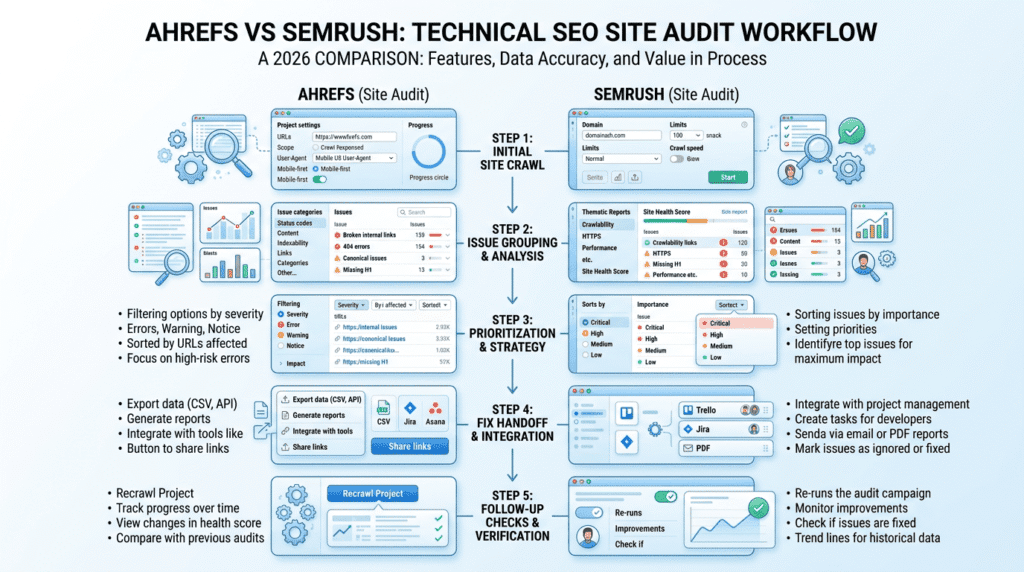
If your site audit keeps finding the same problems month after month, the tool itself starts to matter less than the workflow behind it. That’s where Ahrefs Vs Semrush gets more interesting than a simple feature checklist. One of them tends to feel cleaner for fast issue discovery, while the other gives you more breadth when you need to connect technical SEO issues with broader marketing work.
The real question is not which platform can crawl a site. Both can. It’s which one helps you move from problem to fix without wasting time, missing priorities, or drowning in warnings that don’t change anything.
Site Audit Depth and Technical SEO Issue Detection
Semrush usually feels stronger for broad technical SEO coverage. Its site audit checks are wide, and the interface does a decent job of grouping errors, warnings, and notices so you can see what needs attention first. For larger sites, that matters. A blog with 2,000 pages and a storefront with 50,000 product URLs do not need the same kind of report. Semrush gives you more scaffolding for that mess.
Ahrefs offers a solid site audit too, but it often feels more streamlined. You get the important crawl issues, indexability concerns, internal linking problems, and performance-related flags without as much visual noise. That can be a good thing if you already know how to read an audit and just want to move. For a smaller team, less clutter means less second-guessing.
The trade-off is simple. Semrush gives you more layers and more context. Ahrefs gives you a tighter read on what’s broken. If your technical SEO process depends on handoffs between SEO, content, and development, Semrush usually fits better. If you want a faster, cleaner audit pass, Ahrefs can feel easier to live with.
Crawl Limits, Error Prioritization, and Workflow Fit
Crawl limits matter more than most people expect. A site audit that stops too early or buries important errors in a long checklist can slow down every other SEO task. Semrush tends to be more workflow-friendly for teams that need scheduled audits, issue tracking, and recurring checks tied to larger marketing operations. It’s useful when the audit is just one part of a bigger process.
Ahrefs is often better when you want a lighter, more direct review. You can run a crawl, spot the main problems, and move on. That simplicity helps consultants and smaller teams who don’t want to turn every audit into a project management exercise. Still, once a site gets large, the limits start to show. You may need more manual sorting to decide what actually deserves dev time.
A practical way to think about it: use Semrush if technical SEO is part of an ongoing workflow across multiple people. Use Ahrefs if the audit is mostly about identifying the top 10 fixes and getting out of the tool.
On-Page SEO Guidance and Fix Prioritization
This is where many users get frustrated. An audit that finds 300 issues is not the same thing as an audit that tells you what to fix first. Semrush usually does a better job of turning raw technical findings into actionable next steps. Its recommendations often fit teams that want a cleaner bridge between audit output and actual implementation.
Ahrefs can identify on-page problems well enough, but it leans more toward diagnosis than hand-holding. That’s fine if you already have an SEO lead or developer who knows what to do with the report. It’s less helpful if the person reading the audit is also expected to prioritize fixes, rewrite content, and coordinate with engineering.
The best fit often comes down to process maturity. If your team needs an SEO checker that nudges everyone toward action, Semrush has the edge. If you only need the essentials and already have a strong internal process, Ahrefs won’t feel limiting.
Who Should Use Ahrefs for Site Audits
Choose Ahrefs if you run smaller to mid-sized sites and want a cleaner technical SEO review without a lot of operational overhead. It works well for solo consultants, content-focused blogs, and teams that already know how to interpret crawl data. It’s also a good fit if you don’t want your site audit tool pulling you into unrelated marketing workflows.
Ahrefs over Semrush can make sense when speed and clarity matter more than depth of reporting. If you’re doing recurring audits for a few clients or one main brand, the simpler experience can save time. You’ll still need a separate process for fixing issues, but the audit itself feels less heavy.
Who Should Use Semrush for Technical SEO
Use Semrush if technical SEO is part of a larger marketing stack and you need more than just crawl results. Agencies, in-house teams, and ecommerce brands often get more out of Semrush because it connects audits with keyword work, content planning, and reporting. That helps when the same team is responsible for multiple SEO tasks at once.
Semrush also makes more sense for sites with recurring technical issues, lots of pages, or multiple stakeholders. The platform gives you more structure, and for many teams that structure is the difference between an audit that gets ignored and one that actually gets used.
Ahrefs vs Semrush: Competitor Research and SEO Strategy
Competitor research is where the difference between tools starts to feel strategic instead of cosmetic. You’re not just checking rankings. You’re trying to understand where competitors get traffic, how they earn links, what content themes they own, and where your own site can still break through. That takes more than one report.
For many teams, this is the section that determines whether they use Ahrefs and Semrush side by side or commit to one platform. Both can reveal useful patterns, but they don’t surface the same kind of insight with the same speed.
Backlink Analysis and Link Intersect Workflows
Ahrefs is still one of the strongest tools for backlink analysis. Its backlink index is built for deep link review, and that shows up fast when you’re checking referring domains, anchor text patterns, and link growth over time. The workflow feels natural for agencies and SEOs who spend a lot of time on link building or cleanup.
Semrush also provides backlink data, and semrush provides useful link intersection features that help you compare your site with competitors. The platform is especially handy when you want to see which domains link to multiple rivals but not to you. That’s the kind of insight that turns into outreach lists.
If your main job is link analysis, Ahrefs usually feels more direct. If your link work is part of a larger SEO and content planning stack, Semrush makes the data easier to fold into the rest of the process.
Organic Competitor Research and Content Gap Analysis
Organic competitor research is useful only when it leads to decisions. Ahrefs is strong at showing what a competitor ranks for, how that traffic might be shifting, and where content gaps exist. It’s especially good for comparing pages and looking for topics where a rival has built depth you haven’t matched yet.
Semrush offers similar analysis, but it tends to feel broader. You can move from organic competitors into keyword opportunities, topic ideas, and even ad-level insights without changing tools. That matters when a team wants one research tool to support planning across content, SEO, and paid channels.
The difference between Ahrefs and Semrush here is not just data volume. It’s how quickly you can convert research into a roadmap. Ahrefs often feels stronger for pure organic gap analysis. Semrush is better if you want those gaps tied to broader campaign planning.
PPC and SERP Intelligence in Semrush
This is one area where Semrush stands out clearly. If you care about seo and ppc together, Semrush gives you more to work with. You can study paid keywords, ad copy patterns, and competitor visibility in a way that Ahrefs doesn’t really match.
That makes Semrush especially useful for brands that want to understand search intent from both sides of the SERP. A SaaS company, for example, may use Semrush to see which keyword themes competitors are bidding on while also checking where organic content can win. That combined view can save time and reduce guesswork.
Ahrefs can still support strategy, but it’s not built with the same advertising research depth. If paid search is part of your planning, Semrush is usually the more complete choice.
Comparing Ahrefs vs Semrush for Competitive SEO Planning
When comparing ahrefs vs semrush for strategy work, the right choice depends on how broad your planning needs are. Ahrefs is often better for teams that focus heavily on organic rankings, backlinks, and content gaps. It feels sharp and focused.
Semrush is better when strategy needs to stretch beyond SEO. It helps if you’re tracking competitors across organic search, paid search, branded terms, and local visibility. That wider view can be valuable, but it can also slow you down if you only needed a simple organic analysis.
If you’re building a pure SEO roadmap, Ahrefs may feel more efficient. If you’re building a full search strategy that includes multiple channels, Semrush usually offers more context.
Hidden Frustrations in Competitor Research Workflows
This is the part most product pages skip. Competitor research sounds clean until you have to turn it into action. One tool may show a keyword opportunity, but it doesn’t tell you whether your team can realistically rank for it in 3 months. Another may show a link gap, but not whether those links are even worth pursuing.
The frustration is that both tools can create more questions than answers if you don’t have a clear process. A content team might find 200 competitor keywords and still not know which 10 matter. An agency might have backlink data, but no simple way to turn it into client-ready priorities. That’s not a software flaw as much as a workflow problem, but the better tool makes the handoff easier.
Semrush tends to reduce that friction when the strategy spans multiple channels. Ahrefs tends to reduce it when the main goal is fast organic insight.
Ahrefs Vs Semrush Pricing and Best Value
Pricing is where the conversation gets less theoretical. A lot of buyers compare features in the abstract, then feel trapped once they hit user caps, report limits, or upgrade prompts. The monthly number matters, but the real cost usually shows up in how quickly a team outgrows the plan.
For Ahrefs and Semrush, the list price is only part of the picture. The better question is what kind of SEO work each subscription actually supports before it starts feeling cramped.
Ahrefs and Semrush Pricing Compared
Both platforms sit in the premium SEO software tier, and both can run well above entry-level budgets. Ahrefs and Semrush usually start around the low $100s per month on their basic plans, with higher tiers moving up fast once you need more users, more projects, or more report capacity. Exact pricing changes often, so buyers should check current plan pages before committing.
The important thing is not which one is cheaper by a few dollars. It’s which one fits your workflow without forcing upgrades too early. A solo consultant might find the starter plan enough for a while. A small agency with multiple clients could hit limits almost immediately.
Semrush subscription costs can climb faster if your team needs more seats or more advanced reporting. Ahrefs can be easier to justify when backlink analysis and keyword research are the core use cases, but it still gets expensive once the team grows.
Which Plan Delivers the Best Value for SEO Teams
Best value depends on usage intensity. For a team that mostly needs keyword tracking, content research, and occasional audits, Ahrefs can feel like the stronger value because the interface is focused and the core workflows are fast. You pay for the work you actually do.
Semrush offers better value when the team uses multiple modules regularly. If you’re doing site audit work, keyword research, competitor tracking, local SEO, and reporting in one place, the broader toolkit can justify the higher cost. It’s not always cheaper, but it can replace other subscriptions.
For a marketing manager overseeing 3 to 5 people, Semrush often looks better on paper because it supports more adjacent work. For a freelancer or niche SEO specialist, Ahrefs can be the cleaner spend.
Hidden Costs, Usage Limits, and Upgrade Pressure
This is where buyers get surprised. Both tools use limits that can push you into a higher plan faster than expected. You may run into caps on tracked keywords, projects, reports, crawled pages, or user access. That’s fine if you know it upfront. It’s annoying when you don’t.
The hidden cost is often time, not money. If your team keeps exporting reports to work around limits, the software feels cheaper but becomes clunkier. If your agency has to split work across logins or keep one analyst from using a favorite feature because of seat restrictions, the monthly plan starts to feel smaller than it looked.
Semrush can also create upgrade pressure when you want to use several modules at once. Ahrefs can do the same if you rely heavily on keyword research and backlink tracking at scale. The best approach is to estimate actual monthly usage before buying, not after.
Best Value for Solo SEOs, Freelancers, and Agencies
For solo SEOs and freelancers, Ahrefs often feels like the simplest value play. It gives you strong organic research, a solid site audit, and deep backlink data without making the workflow feel bloated. If you bill by project, that simplicity matters.
Agencies are different. They usually get more value from Semrush because one subscription can support seo tasks across many client types, including reporting, audits, competitor research, and local seo. The platform also fits client communication a little better when multiple stakeholders need access to different parts of the workflow.
A small content studio might lean toward Ahrefs for research quality. A full-service agency usually has more reasons to use Semrush.
When Ahrefs Over Semrush Makes Financial Sense
Choose Ahrefs over Semrush when your team is mostly doing organic SEO, backlink research, and keyword analysis, and you don’t need the broader marketing stack. That’s often the smarter spend for bloggers, consultants, and lean in-house teams.
It also makes financial sense when the simpler workflow saves enough time to offset the subscription. If your team can move faster because the tool is easier to navigate, the real value goes up. You’re not just paying for features. You’re paying to avoid friction.
Ahrefs vs Semrush: Ease of Use and Learning Curve
Ease of use sounds soft until you’re training a new hire or trying to ship reports on a deadline. A powerful seo tool that feels awkward can slow down an otherwise good workflow. The difference between a clean dashboard and a cluttered one shows up fast in daily use.
Ahrefs and Semrush both have learning curves, but they feel different. One is usually easier to explore. The other is better at giving teams more to do once they know where to look.
Dashboard Experience and Workflow Speed
Ahrefs generally feels more focused. The dashboard is cleaner, and the most common research actions are easy to find without much hunting. That makes it appealing if you move between keyword research, backlink checks, and site audit reviews throughout the day.
Semrush gives you more on-screen, which can be useful but also crowded. It’s not hard to use once you learn the layout, but first-time users often spend more time figuring out where things live. That’s especially true when they jump between modules without a clear workflow.
For speed, Ahrefs usually wins on first impression. For breadth, Semrush wins once you know the system.
Beginner Friendliness vs Advanced Power
Beginners often prefer Ahrefs because it feels less overwhelming. You can learn the basics of keyword research and competitor review without feeling like you’ve entered a full analytics suite. That said, the simplicity can also hide some limits. A beginner may not realize they need deeper campaign context until later.
Semrush has more advanced power, but it asks for more patience. New users may need time to understand how the modules connect. The payoff is real, though. Once someone learns the platform, they can manage more comprehensive SEO work in one place.
If you’re just getting started, Ahrefs is easier to live with. If your team is growing into more complex workflows, Semrush becomes more attractive.
Reporting, Organization, and Team Workflow
Reporting is where team habits start to matter. Semrush offers more built-in structure for shared work, recurring reports, and multi-step campaigns. That helps agencies and in-house teams that need to keep everyone aligned.
Ahrefs is perfectly usable for reporting, but it feels more research-first than collaboration-first. It’s often better when one analyst owns the work and passes findings to others. That’s not bad. It just means the tool is less focused on team orchestration.
If your group needs a tidy system for recurring checks, Semrush usually feels easier. If your process centers on one strong SEO lead, Ahrefs is often enough.
When Semrush Feels Easier to Use
Semrush feels easier when the goal is not just analysis, but coordination. If you’re managing site audit tasks, local SEO, content ideas, and reporting in the same place, the platform starts to make sense. The structure helps when several people need the same data for different jobs.
It’s also easier when your team wants more guidance built into the workflow. Semrush gives you more prompts, more labels, and more paths. That can reduce confusion after the learning curve passes.
When Users Prefer Ahrefs
Users prefer Ahrefs when they want fewer distractions and faster access to core SEO research. It’s a good fit for people who know what they’re looking for and don’t want to sift through extra menus.
If your day is mostly keyword analysis, backlinks, and content opportunity checks, Ahrefs often feels smoother. The tool gets out of the way more often, which is exactly what some experienced SEOs want.
Ahrefs and Semrush for Different Use Cases
The right tool changes depending on who’s using it and what they’re trying to accomplish. A beginner does not need the same depth as an agency. A local business does not need the same workflow as an enterprise content team. That’s why the best answer isn’t universal.
Best for SEO Beginners
Ahrefs is usually the easier starting point for beginners. It has a cleaner interface and fewer moving parts, so new users can learn the basics of keyword research, backlinks, and site audit work without feeling overloaded.
Semrush can still work for beginners, but it makes more sense once they need broader marketing context. If the goal is learning pure SEO first, Ahrefs is often the simpler path.
Best for Content Teams and In-House Marketers
Semrush is often better for content teams and in-house marketers because it supports more than one type of SEO work. You can move from keyword discovery to site audit checks to competitor monitoring without switching tools as often.
That matters when content decisions have to be tied to traffic targets, internal reporting, and cross-team planning. Ahrefs can still help, but Semrush gives more room to connect the dots.
Best for Agencies and Client Reporting
Semrush usually wins for agencies. It offers more structure for reporting, recurring checks, and client-facing SEO work. The broader toolkit is especially useful when one team handles multiple websites with different goals.
Ahrefs can absolutely support agency work, especially for research-heavy accounts. But Semrush tends to fit the daily reality of client management better.
Best for Technical SEO Work
Semrush is often the better choice for technical SEO because the audit workflow is more comprehensive and easier to distribute across teams. It helps when issues need to be tracked, prioritized, and handed off to developers.
Ahrefs is still strong for fast audit reviews and smaller sites. If technical SEO is only part of your process, it may be enough.
Best for Local SEO
Semrush is the better fit for local SEO. It provides more support for location-based visibility, local tracking, and business-focused search work. That makes it more practical for service businesses, clinics, restaurants, and multi-location brands.
Ahrefs can still support local keyword research, but it does not go as deep in this area.
Best for Competitor Research
Ahrefs is often the stronger choice for competitor research when the focus is organic search, backlinks, and content gaps. It feels sharper for pure SEO intelligence.
Semrush is better when competitor research includes broader search marketing signals, especially seo and ppc. If you need one platform for a wider strategic view, Semrush usually offers more context.
Ahrefs Vs Semrush: Pros, Trade-Offs, and Who Should Choose Each
If you’ve made it this far, the real question isn’t whether either platform is “good.” It’s whether Ahrefs Vs Semrush fits the way you actually do SEO. That’s where the decision gets less tidy. Ahrefs feels sharper for link-focused research and straightforward keyword analysis. Semrush feels broader, with more built-in workflows for seo, content, and paid search.
The catch is that breadth and depth don’t always land in the same place. One tool can be cleaner for daily use while the other gives you more ways to work. That trade-off matters when you’re paying for a monthly subscription and need the software to earn its keep.
Reasons to Choose Ahrefs
Choose Ahrefs if your work is heavily centered on backlink analysis, organic keyword discovery, and a simple research flow. It tends to feel faster when you just want to find a keyword, inspect a page, or compare competing pages without moving through a lot of extra screens. Many SEO users also like the way Ahrefs presents link data because it’s easy to scan, which makes competitor research less tiring.
Ahrefs also works well for smaller teams that want focused seo insights instead of a giant seo toolkit they only use halfway. If you mostly write content, track keyword ranking, and keep an eye on link opportunities, Ahrefs can be the cleaner fit. The trade-off is that it doesn’t try to be everything for everyone, so users who need broader marketing workflows may feel boxed in.
Reasons to Choose Semrush
Use Semrush if you want one platform that stretches beyond core seo tasks. It offers more around content planning, local seo, seo and ppc overlap, and broader competitor research. That makes it attractive for teams that want a research tool, a site audit workflow, a rank tracker, and an advertising layer in one place.
Semrush also provides a more layered environment for marketers who need to hand work across people. An agency might use Semrush for audits, reporting, keyword clustering, and client dashboards without stitching together as many tools. That convenience matters. Still, it can feel heavier than Ahrefs, and some users never touch half the features they’re paying for.
Situations Where Ahrefs Over Semrush Makes Sense
Choose Ahrefs over Semrush when your priorities are clean research, strong backlink visibility, and fast decision-making. It’s often a better match for content teams that care more about finding the right keyword than running a full marketing operation. If your seo process is built around publishing, link analysis, and tracking organic movement, Ahrefs keeps the workflow focused.
This is also where the difference between ahrefs and a broader suite becomes clear. You may not need every extra dashboard if the core job is straightforward. For solo SEOs, bloggers, and niche site owners, fewer distractions can mean better execution.
Situations Where Semrush Over Ahrefs Makes More Sense
Semrush over Ahrefs makes more sense when your work spans multiple channels or needs more structure. If you manage local seo, reporting, content calendars, and ad research in the same week, Semrush gives you more room to operate. It’s especially useful when one team member owns seo and another owns paid search, because the platform supports that overlap better.
It also tends to be the better fit when you need to analyze many moving parts at once. A growing marketing team can use Semrush for seo checker work, site audit reviews, ranking checks, and advertising research without jumping between tools. That said, more capability usually means more setup, more training, and more time spent deciding which report matters.
Key Trade-Offs Buyers Should Not Ignore
The biggest trade-off is not “which tool has more features.” It’s how much friction you want in exchange for breadth. Ahrefs feels tighter and easier to move through. Semrush gives you more surfaces to manage, but that can slow down beginners and even frustrate experienced users who only need a few seo tasks done well.
There’s also the matter of budget and usage limits. Both platforms can get expensive once you need extra users, more reports, or higher query volume. If your team only needs one keyword research workflow and a rank tracker, paying for a full-stack platform can be overkill. If you need a broader system, the extra cost may be justified.
Buying Guide: How to Choose Between Ahrefs and Semrush
The cleanest way to choose is to stop comparing feature lists and start mapping the tool to your actual workflow. Most buyers don’t need “the best” platform in a vacuum. They need the one that matches the work they repeat every week. That’s the part that usually gets ignored in a semrush or ahrefs debate.
A local service business, a content site, and an agency all want seo results, but they don’t work the same way. One needs local visibility and reporting. Another needs keyword research and content planning. The third needs collaboration and client-facing output. The better tool depends on which problem shows up most often.
Match the Tool to Your Main SEO Job
Start with your main job, not the feature set. If your work is mostly keyword research, content optimization, and backlink review, Ahrefs usually feels more direct. If your day includes site audit reviews, local seo, content workflows, and occasional paid search analysis, Semrush offers more coverage.
This is where many buyers overcomplicate the choice. They compare every dashboard and forget that they’ll only use a narrow slice of it. A tool that solves your top 3 seo tasks every week is better than one that does 30 things you barely touch.
Choose Based on Keyword Research vs Technical SEO Priorities
If keyword research is the center of your process, both tools are capable, but they behave differently. Ahrefs is often easier for fast keyword analysis and content ideation. Semrush gives you broader keyword data, more surrounding metrics, and a more feature-rich keyword magic environment for digging through variants.
For technical seo, Semrush usually has the edge because its site audit workflow is more expansive. It helps teams prioritize issues, track progress, and connect audits to larger marketing work. Ahrefs can still cover audit basics well enough, but if technical analysis is a major part of your process, Semrush often feels more complete.
Choose Based on Data Depth vs Workflow Breadth
This is the difference between a sharp research tool and a broader seo toolkit. Ahrefs leans toward depth in the core research experience. Semrush leans toward breadth across more marketing functions. Neither choice is wrong, but they serve different habits.
If your team values fast, focused analysis, choose depth. If your team needs one place to manage seo, reporting, and adjacent marketing tasks, choose breadth. The wrong choice usually shows up later as either tool fatigue or feature waste.
Beginner, Growing Team, and Agency Decision Framework
Beginners often do better with Ahrefs if they want a cleaner learning curve and fewer moving parts. It’s easier to understand when you’re still learning keyword ranking, backlink profiles, and basic competitor research. The interface does less to distract you.
Growing teams and agencies usually lean toward Semrush because collaboration matters more. You may need separate users, reports, and workflows for multiple clients. Semrush also gives more room for process, which helps when SEO work becomes a system instead of a solo habit.
Final Checklist Before You Subscribe
Before you commit, ask these questions:
- Do I need mostly keyword research and backlink analysis, or broader marketing coverage?
- Will I actually use local seo, site audit, and reporting features every month?
- How many users need access right now, and how many will need it in 6 months?
- Am I paying for depth, or just paying for features I might never open?
- Which platform will save me time on the seo tasks I repeat most?
If you can answer those honestly, the choice gets easier. Subscription regret usually starts when the buyer picks for future fantasy workflows instead of current reality.
Final Verdict: Ahrefs Vs Semrush

The final call comes down to how you define value. If value means a focused seo platform with strong research habits, Ahrefs is hard to beat. If value means broader coverage across content, local seo, audits, and adjacent marketing work, Semrush gives you more room to grow. Both can deliver, but they do it in different ways.
Best For SEO in 2026
For pure seo work, Ahrefs is the best fit for users who want speed, clarity, and strong research depth. It’s especially good for content-led teams, affiliate publishers, and SEOs who live in backlinks, keyword analysis, and organic opportunity discovery. It stays focused on the core job.
Semrush is the better pick for teams that need seo plus more. If your workflow stretches into paid search, reporting, and cross-channel planning, it can feel more complete. That makes it stronger for broader marketing departments and agencies.
Best Value Overall
Best value depends on usage, not sticker price. Ahrefs often feels like the better value for solo users and smaller teams who only need a few high-impact features. You’re less likely to pay for extras you won’t use. That matters when a monthly subscription starts to stack up across users.
Semrush can be the better value when one platform replaces multiple tools. If you regularly use its site audit, keyword, reporting, and local seo features, the bundle effect can outweigh the cost. The value disappears fast, though, if you only use 20% of what it provides.
My Final Recommendation
If I had to narrow it down, I’d say choose Ahrefs for focused seo research and choose Semrush for broader marketing operations. That’s the cleanest comparison of Semrush vs Ahrefs in real life. The better platform is the one that fits your operating style, your team size, and how often you need to move from research to action.
If you’re still unsure, lean toward the tool you’ll use most consistently. Consistency beats theoretical power. A slightly simpler platform that gets used every week will usually outperform a bigger one that sits half-finished in the background.
Final Conclusion on Ahrefs Vs Semrush
The difference between Ahrefs and Semrush is less about one being universally better and more about where each one creates momentum. Ahrefs offers focus. Semrush gives breadth. One is not automatically superior to the other, and that’s the part buyers should accept before subscribing.
If you want the tighter seo path, choose Ahrefs. If you want the broader system, use Semrush. Either way, the best decision is the one that reduces friction in your actual workflow, not the one that looks best on a feature chart.
Frequently Asked Questions
Is Ahrefs vs Semrush better for keyword research?
Ahrefs is usually better for fast, focused keyword research, while Semrush is stronger for broader keyword exploration. If you want a cleaner keyword research tool for content planning, Ahrefs often feels easier. If you need deeper filtering and more surrounding marketing context, Semrush gives you more layers.
Is Ahrefs or Semrush better for data accuracy?
Neither tool is perfectly exact, because both estimate seo data from large datasets. Ahrefs often feels more consistent for backlink-related checks, while Semrush can be stronger in broader keyword coverage. The right move is to use the same platform consistently so trend lines stay comparable.
Should I use Ahrefs or Semrush for site audit work?
Use Semrush if site audit work is a major part of your process. Its audit workflow is more detailed and easier to build into ongoing technical seo reviews. Ahrefs can handle audits, but Semrush usually gives you more structure and issue prioritization.
Which is the better SEO tool for local SEO?
Semrush is the better choice for local seo. It offers more support for location-focused workflows, reporting, and broader marketing tasks around local visibility. Ahrefs is better suited to general organic research than location-specific management.
Is Ahrefs over Semrush worth it for backlinks and competitor research?
Yes, if backlinks and competitor research are your main priorities. Ahrefs offers a very strong link-focused workflow and is often the cleaner choice for competitive seo analysis. If you don’t need the extra breadth from Semrush, Ahrefs can be the smarter purchase.
Can I use Ahrefs and Semrush together effectively?
Yes, but only if you have a clear reason. Some teams use one tool for keyword and backlink research and the other for audits or reporting. Just keep in mind that paying for both can get expensive fast, so this usually makes sense for agencies or larger teams with heavy seo demands.