
A lot of teams reach the same point in their growth: email starts working, but the manual follow-up doesn’t. That’s usually when the search for Activecampaign Vs Drip begins. At that stage, the real question isn’t which tool looks nicer in a demo. It’s which one can handle real automation without turning your weekly workflow into a mess.
The decision matters because both platforms can run serious email marketing, but they don’t solve the same problem in the same way. One leans harder into marketing and sales together. The other is built with ecommerce behavior and revenue tracking in mind. That difference sounds small until you’re trying to scale campaigns, segment contacts, or keep your team out of a broken workflow.
Why marketers compare ActiveCampaign and Drip in 2026
In 2026, people compare ActiveCampaign and Drip because both sit in that awkward middle ground between simple email marketing services and full marketing automation platforms. Mailchimp-style tools can feel too light once you need branching logic, lead scoring, or CRM handoff. Enterprise tools can feel oversized and expensive. ActiveCampaign offers more breadth across marketing and sales processes, while Drip keeps its focus tighter on ecommerce and lifecycle messaging.
The comparison comes up most often for two groups: service businesses that want a CRM plus automation, and online retailers that want behavior-based email marketing campaigns tied to purchases. A Shopify store with repeat buyers has different needs than a B2B agency chasing booked calls. That’s where the choice starts to split.
What most buyers misunderstand about ActiveCampaign vs Drip
The biggest mistake is assuming both tools are interchangeable because they both “do automation.” They do, but the automation serves different goals. ActiveCampaign provides a broader CRM-first environment with lead scoring, custom fields, and a deeper sales handoff. Drip specializes in e-commerce lifecycle messaging, so its value shows up when you care about purchase history, customer journey timing, and revenue attribution.
Another common misunderstanding is price. People compare starter prices and stop there. That’s risky. The real cost shows up in list size, user count, feature tiers, and how many workarounds you need to build once the basic plan feels cramped. A cheaper monthly plan can become the more expensive choice if it slows your team down.
The frustration usually isn’t whether the software “works.” It’s whether it works cleanly. Teams run into tangled workflow logic, confusing segmentation rules, and integration gaps between ecommerce platforms, forms, and CRMs. A small mistake in tagging or trigger setup can send the wrong email to the wrong segment, and that creates more cleanup than most buyers expect.
There’s also the human side. Marketers often underestimate how much time automation takes to maintain. Once a workflow is live, it still needs testing, updates, and occasional rewrites when product lines change or a sales process shifts. That’s why the best platform isn’t just the one with the most features. It’s the one your team can actually keep organized.
Quick Verdict: Activecampaign Vs Drip
| Category | ActiveCampaign | Drip |
|---|---|---|
| Best For | Service businesses, B2B teams, and companies that want CRM + automation | Ecommerce brands, especially Shopify and WooCommerce stores |
| Not Ideal For | Teams that only need simple ecommerce email flows | Businesses that need a full CRM and sales pipeline tools |
| Starting Price | Typically starts around $29/month, depending on contacts and plan | Typically starts around $39/month, depending on contacts and plan |
| Free Plan | No free plan | No free plan |
| Ease of Use | Moderate; powerful but can feel busy | Moderate; more focused, but still setup-heavy |
| Key Strength | Strong CRM, lead scoring, and broad automation | Ecommerce segmentation, revenue tracking, and lifecycle email |
| Biggest Limitation | Can feel complex for smaller teams | Less flexible if you need broader CRM and sales features |
| Overall Recommendation | Choose if you want marketing and sales in one place | Choose if your store lives or dies on customer behavior and purchase data |
ActiveCampaign wins when you need one system to manage leads, follow-up, and pipeline movement. Drip is the better fit when your revenue depends on purchase behavior, repeat orders, and store-based segmentation. If your business is split between ecommerce and sales-driven operations, ActiveCampaign can be the safer all-purpose choice. If you run a product-heavy store and want tighter ecommerce logic, choose Drip.
Best For
ActiveCampaign is best for small to mid-sized teams that need email marketing, CRM, and automation in one place. It works especially well for agencies, consultants, SaaS brands, and B2B companies that rely on lead scoring and follow-up sequences. ActiveCampaign serves businesses that want more control over the full customer lifecycle, not just email campaigns.
Drip is better for ecommerce brands that care about purchase history, product interest, and segmentation by buying behavior. It fits store owners who use Shopify or WooCommerce and need stronger revenue visibility from their email marketing efforts. Drip excels when the customer journey is tied to carts, orders, and repeat purchases.
Not Ideal For
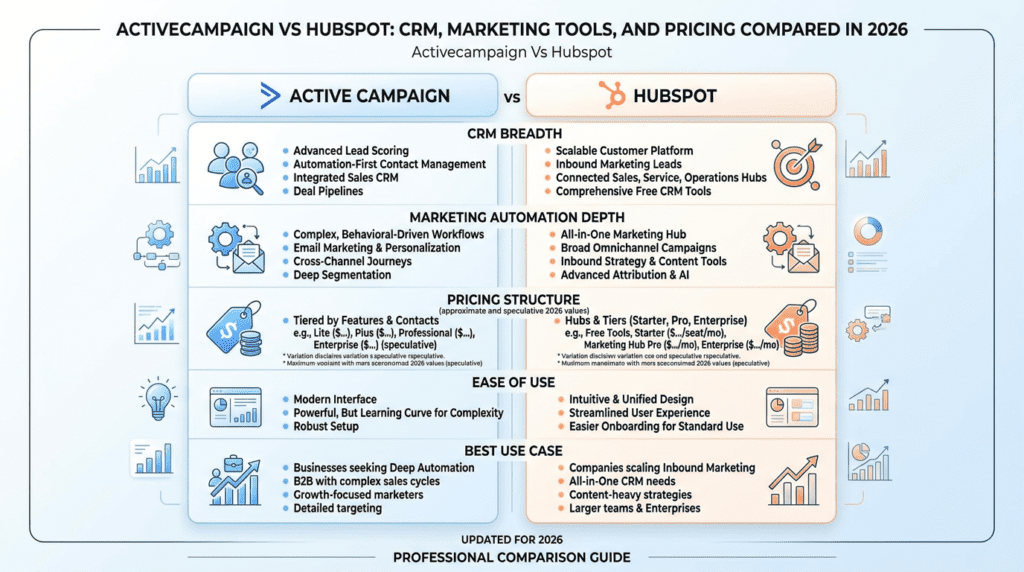
ActiveCampaign is not ideal for teams that want the simplest possible email marketing tool. If you only send a monthly newsletter and a few basic automations, the platform may feel heavier than it should. It can also feel crowded for beginners who don’t need CRM features at all.
Drip is not ideal for teams that need a true sales pipeline, advanced CRM structure, or broader marketing and sales workflows. If your business depends on lead qualification, assigned reps, and deal tracking, Drip can feel too narrow. It’s built for ecommerce first, and that focus shows up fast.
Bottom Line
If your company needs a broader marketing platform with CRM depth, ActiveCampaign is usually the stronger default. If you run an ecommerce brand and want tighter control over revenue attribution, behavioral segmentation, and store-driven automation, Drip is often the better choice. The decision between ActiveCampaign and Drip comes down to business type, not just feature count.
ActiveCampaign vs Drip: Core Differences That Matter Most
ActiveCampaign and Drip at a glance
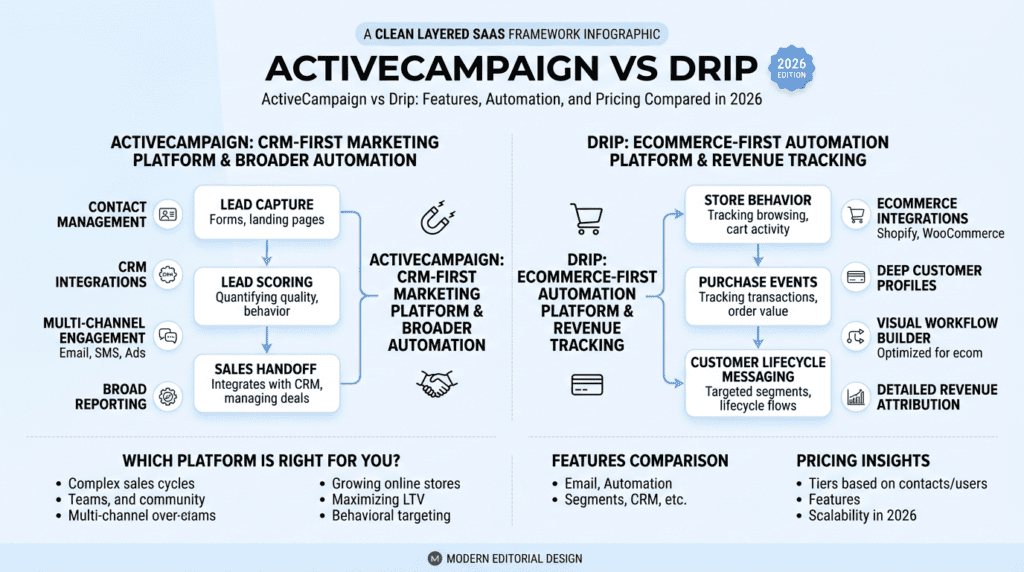
At a glance, ActiveCampaign is the broader tool. It combines email marketing, CRM, lead scoring, and automation into one system. That makes it useful when marketing and sales teams need to share contact data and move people through a structured funnel.
Drip keeps a sharper drip focus on ecommerce. It’s built for brands that want to react to browsing, purchase behavior, and customer value over time. Drip also offers strong revenue attribution and store-aware segmentation, which matters when you’re measuring email against actual orders instead of just opens and clicks.
How each platform approaches marketing automation
ActiveCampaign builds around a flexible automation engine that can connect lead capture, sales processes, internal notifications, and follow-up logic. It gives teams more room to automate across departments, which helps if your workflows go beyond standard newsletters and cart recovery. The trade-off is that setup can take longer, and bad structure becomes obvious fast.
Drip takes a cleaner route. Its automation is less about being the most universal system and more about making ecommerce decisions feel natural. You can react to product views, cart activity, and purchase events without fighting the interface. For stores, that simplicity is useful. For businesses outside ecommerce, it can feel limiting.
Where activecampaign wins and where Drip is stronger
ActiveCampaign wins on breadth. It gives you more room to build around lead scoring, CRM notes, deal stages, and multi-step workflows that connect marketing and sales efforts. If your team needs one place to manage both nurture and handoff, that breadth matters.
Drip is stronger where ecommerce context matters most. It understands product interest, repeat buying, and order value better than general-purpose tools usually do. It’s often the cleaner choice for online retailers that want deep integration with store data and a tighter view of customer experience.
ActiveCampaign vs Drip: Automation Features Compared
Automation builders and workflow depth
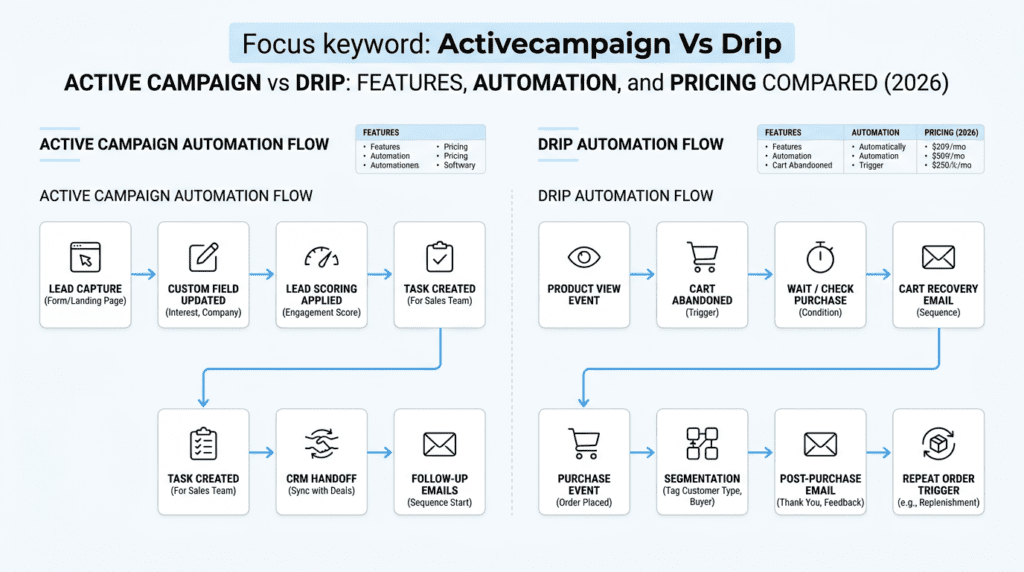
This is where the debate gets serious. ActiveCampaign’s visual workflow builder is deeper and more flexible, which is great if you need layered branching, multiple trigger paths, or CRM actions inside the same flow. You can automate tag changes, email sends, task creation, and deal updates without leaving the system. For teams with complex lifecycle logic, that power is valuable.
The downside is that power adds friction. A messy automation platform usually becomes obvious after a few months, when someone has to edit an old workflow and nobody remembers why a branch exists. That happens more than people admit. ActiveCampaign is excellent when you have a documented process. It’s less forgiving when you don’t.
Drip keeps the workflow experience more ecommerce-centered. It doesn’t try to be everything to everyone, which can make it easier for store teams to build useful automations quickly. A product launch sequence, cart recovery flow, or post-purchase follow-up is straightforward. The trade-off is that once you want cross-functional logic or deeper CRM behavior, Drip can feel narrower than ActiveCampaign.
Behavioral triggers and segmentation
Both tools handle segmentation, but they do it with different intent. ActiveCampaign allows segmentation across custom fields, tags, lead score, site behavior, and CRM data. That’s useful for agencies, SaaS teams, and service businesses where a contact’s source, interest, and deal stage all matter.
Drip leans into behavioral triggers tied to ecommerce. It can segment based on browsing, purchases, cart actions, and product engagement. That makes it easier to target people who viewed a product three times but never bought, or people who spent above a certain threshold in the last 30 days. For ecommerce, that’s practical segmentation, not just clean theory.
Email marketing automation for different business stages
For a startup with a small list, either platform can automate welcome emails, abandoned carts, and basic follow-up. The differences show up as the business grows. ActiveCampaign works well when your email marketing strategies start mixing with sales qualification, onboarding, or service delivery. The platform gives you room to expand without changing systems too often.
Drip makes more sense once your email marketing campaigns are tied to store performance. If you’re sending product recommendations, back-in-stock emails, or repeat purchase sequences, Drip’s structure feels natural. It helps businesses of all sizes, but its strongest fit is still commerce-driven brands that want email content shaped by buying behavior.
Customization, logic, and scalability trade-offs
ActiveCampaign allows more customization, which is both its strength and its headache. You can build advanced logic with custom fields, tags, goals, and conditional branches. That flexibility helps businesses scale, but it also makes setup harder for teams without a clear workflow owner.
Drip scales differently. It’s not as broad, but it’s very good at what it does. If your store grows from 1,000 contacts to 50,000, the platform still feels aligned with ecommerce use cases. The trade-off is that broader marketing and sales processes may eventually require extra tools or integrations. That’s the core decision: do you want a broader system, or a sharper one?
ActiveCampaign vs Drip: Email Marketing and Deliverability
Email marketing tools and campaign management
ActiveCampaign and Drip both handle standard email marketing tasks like broadcasts, automations, audience targeting, and list management. ActiveCampaign offers more control for teams that want multiple campaign types running at once, especially when CRM data needs to influence the send. It’s a stronger fit when email is part of a larger operational system.
Drip keeps campaign management more commerce-oriented. It is easier to organize around lifecycle email marketing, product promotions, and behavior-driven sends. The platform doesn’t try to be a general-purpose inbox replacement; it tries to help stores convert customer activity into revenue. That focus is useful, though it can feel narrower if your messaging needs stretch beyond product-led communication.
Templates, personalization, and message control
ActiveCampaign gives you enough flexibility to shape email content around tags, fields, and contact behavior, but the process can take more setup than beginners expect. The benefit is control. You can personalize messages for lead source, deal stage, or engagement history, which helps if your audience is not just shoppers.
Drip’s email templates and personalization options are more naturally aligned with ecommerce messaging. Product blocks, purchase history, and dynamic recommendations fit into the workflow better. That makes it easier to create relevant messages without building everything from scratch. It’s not glamorous, but in day-to-day work, that saves time.
Deliverability considerations for growing lists
Deliverability is usually less about the brand name and more about how clean your list and sending habits are. Both platforms can perform well if you manage bounces, engagement, and list hygiene properly. Still, as your list size grows, problems get more noticeable. A bad segmentation rule or too-frequent send can hurt open rates quickly.
ActiveCampaign’s broader structure can help teams control suppression logic, engagement tracking, and contact status more carefully. Drip does well when the list is tied to purchase behavior because ecommerce audiences often send with stronger intent. That said, neither platform removes the need for disciplined sending. If your list gets sloppy, the tool won’t save it.
When drip vs activecampaign feels easier in practice
Drip feels easier when you run an online store and want to build behavior-based flows without juggling too many extra fields. A Shopify brand can often move faster because the data model is already ecommerce-friendly. Drip integrates cleanly into that environment, and the automation feels built for product-driven messaging.
ActiveCampaign feels easier when your process spans marketing, sales, and customer follow-up. A service business may prefer one platform where a lead form, sales task, and nurture sequence all live in the same ecosystem. In practice, the easier tool is the one that matches your business model. That’s the part buyers often overlook.
ActiveCampaign vs Drip: Integration and All-in-One Capabilities
Integration breadth and ecosystem depth
ActiveCampaign and Drip both sit in the middle of a crowded stack, so integrations matter more than most buyers expect. If your email marketing depends on Shopify, WooCommerce, Zapier, forms, payment tools, webinar apps, or a help desk, the difference usually shows up in how smoothly data moves, not just how many apps are listed.
ActiveCampaign integrates with a wider range of tools overall, and that makes it easier for mixed teams to build one workflow across marketing and sales. Drip is narrower, but it’s not weak. It tends to fit ecommerce operations better because the app connections are more centered around store behavior, customer activity, and purchase data. If you need a broad range of integration options for a messy stack, ActiveCampaign usually feels safer. If your stack is cleaner and mostly store-led, Drip’s focus is often enough.
CRM, sales pipeline, and all-in-one functionality
This is where the products separate fast. ActiveCampaign provides a built-in crm, deal pipeline tools, lead scoring, and sales automations, so it can act like a light all-in-one system for teams that want marketing and sales in one place. That matters when a small company doesn’t want to pay for a separate crm plus another automation tool plus yet another contact manager.
Drip doesn’t try to be that broad. It’s built more like a marketing automation platform for ecommerce than a full sales hub. You can still manage subscribers well, but if your team needs pipeline stages, sales follow-up, task ownership, and internal handoffs, ActiveCampaign gives you more room to work. The trade-off is real: ActiveCampaign can replace more software, but it also asks for more setup and more discipline. A solo founder might love that. A fast-moving store team without a sales process may not.
Ecommerce and revenue-focused integrations
Drip’s focus shows up clearly here. It’s designed around ecommerce signals, especially for Shopify and WooCommerce stores, and it handles product behavior, order activity, and customer events in a way that feels native to online retail. For brands that care about abandoned carts, repeat purchase timing, and post-purchase nurturing, that tight connection is the point.
ActiveCampaign also works well for ecommerce, and it integrates with Shopify, WooCommerce, and other store systems, but it usually feels more like a flexible generalist. That’s useful if you need ecommerce data plus CRM data plus a broader range of campaigns. Still, if your entire business lives inside an online store, Drip often feels cleaner because the platform is built around that use case instead of around the much wider world of marketing and sales.
How much extra software each platform can replace
If you’re trying to trim your stack, ActiveCampaign usually replaces more. It can combine email marketing, automation, crm, lead capture, and some basic sales processes in one place, which can cut down on subscriptions and reduce handoff friction. For many small businesses, that’s the real value, not the feature list.
Drip replaces fewer tools, but the tools it does replace are highly relevant for ecommerce email marketing. It can remove the need for a separate store-focused automation layer, especially if your team mainly needs segmentation, purchase-based messaging, and lifecycle campaigns. The practical difference is simple: ActiveCampaign can reduce software sprawl for a broader team, while Drip can reduce complexity for a store that wants one strong email engine.
ActiveCampaign vs Drip: Revenue Attribution and Ecommerce Tracking
Revenue attribution in activecampaign and drip
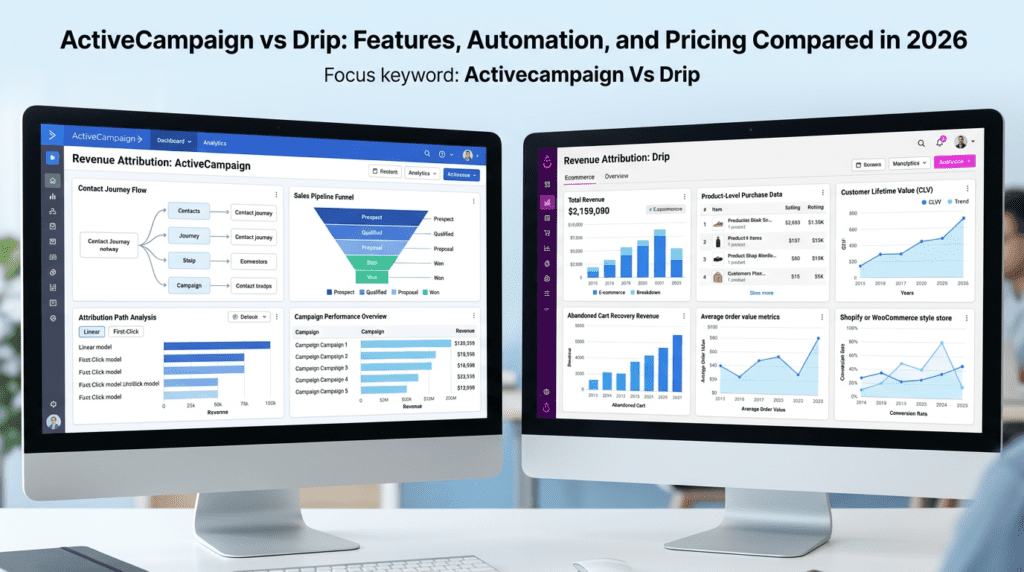
Revenue attribution is one of those features that sounds obvious until you try to use it across a real business. ActiveCampaign and Drip both offer reporting that connects email activity to sales, but the clarity and usefulness depend heavily on how your store is set up and how much of your customer journey happens inside the platform.
Drip usually feels more direct for ecommerce revenue attribution because its drip focus is built around store events and purchase behavior. You can see which campaigns, automations, and segments are tied to revenue more naturally. ActiveCampaign also provides revenue tracking, but it often shines more when the buyer journey is mixed across marketing and sales, not just one store checkout path. If your team wants clean order-based attribution, Drip tends to be easier to interpret. If you need attribution across forms, sales stages, and email sequences, ActiveCampaign has broader context.
Purchase tracking and customer journey visibility
The value of purchase tracking is not just seeing who bought. It’s knowing what happened before and after the sale. Drip provides strong visibility into customer journey behavior, especially for shoppers who browse, abandon, return, and buy again. That makes it useful for retention marketing and post-purchase sequencing.
ActiveCampaign tracks behavior well too, but it usually works best when you’re combining website visits, form fills, CRM events, and sales actions in one workflow. That’s powerful, but it also means the data can become harder to interpret if the account is poorly organized. In practice, Drip is often easier for ecommerce teams that want a clearer path from view to cart to purchase. ActiveCampaign is stronger when the journey is longer and includes more non-store steps.
Ecommerce automation use cases
For ecommerce, the highest-value automations are usually the boring ones that make money quietly. Think abandoned cart sequences, browse abandonment, first-purchase follow-up, replenishment reminders, win-back campaigns, and post-purchase cross-sells. Drip excels at these because the platform is structured around ecommerce signals and customer behavior tied to products.
ActiveCampaign can automate the same ideas, and it can also layer in crm actions, sales alerts, or lead qualification for hybrid businesses. That makes it a better fit if your ecommerce brand also has wholesale leads, demo requests, or high-touch sales. A DTC brand with a simple store model will often find Drip more natural. A brand with multiple funnels, such as ecommerce plus consultations or B2B orders, may find ActiveCampaign more flexible.
What growing stores should expect from each platform
Growing stores often expect one tool to solve tracking, automation, segmentation, and reporting all at once. That’s not how it usually works. Drip gives online retailers a tighter ecommerce engine, but the setup still requires clean product data, sound event tracking, and decent list hygiene. If those basics are messy, the reporting will be messy too.
ActiveCampaign gives businesses of all sizes more room to connect marketing and sales efforts, but that extra room can create more operational overhead. As the number of contacts grows, teams often need stronger naming rules, cleaner custom fields, and more internal process discipline. In other words, both platforms can scale. They just scale different kinds of complexity.
ActiveCampaign vs Drip: Pricing and Value for Money
Plan structure and starting costs
Pricing is one of the biggest differences in activecampaign vs drip, but it’s easy to misread if you only look at the starting plan. ActiveCampaign typically begins at a lower entry price for light use, while Drip tends to be more store-focused and usually prices itself around ecommerce needs rather than generic list building. Exact rates change often, so it’s safer to think in terms of starting tiers and contact-based jumps.
ActiveCampaign’s lower tiers can look friendly at first, especially if you only need basic email marketing and a small crm. Drip’s starting point can feel higher, but many ecommerce teams justify it because the platform is built around revenue use cases. That’s the key question: are you paying for generic marketing automation or for a purpose-built ecommerce automation stack?
Pricing differences as contact lists grow
The real pricing shock usually shows up when the list size grows. Both ActiveCampaign and Drip price by contacts, and that means a list that seems cheap at 1,000 subscribers can get noticeably more expensive at 10,000 or 25,000. This is where buyers get caught off guard. They budget for the starter plan and forget that revenue-focused email marketing campaigns often grow faster than expected.
ActiveCampaign can become more expensive as you move into higher tiers that unlock more automation, lead scoring, or crm functionality. Drip also climbs as the number of contacts increases, but ecommerce brands often accept that because the platform is directly tied to purchase outcomes. If your email list grows fast but sales volume doesn’t keep pace, either platform can feel pricey.
Hidden costs and upgrade pressure
The hidden cost is usually not just the monthly fee. It’s the upgrade pressure created by missing features. ActiveCampaign may push teams toward higher tiers once they need advanced automation, better reporting, or more sales tools. Drip can push teams when they need deeper CRM-like processes, broader team collaboration, or more custom setup outside ecommerce.
There’s also the cost of time. A cheap plan that requires constant workarounds is not really cheap. If your team has to patch gaps with separate tools, Zapier tasks, or manual exports, the true cost rises fast. That’s why the better value is not always the lower sticker price. It’s the platform that reduces friction for the next 12 months, not just the next billing cycle.
Which platform offers better long-term value
ActiveCampaign usually offers better long-term value for businesses that want one platform to handle marketing and sales processes together. It can replace more tools, which often matters more than saving a few dollars on the entry plan. If your business model includes lead nurturing, pipeline tracking, and broader automation, the value compounds over time.
Drip usually offers better value for ecommerce-first brands that care most about revenue attribution, purchase tracking, and lifecycle email. It’s the cleaner choice when your store is the business. The bottom line is simple: ActiveCampaign is often the stronger all-around investment, while Drip is the sharper specialized bet for online retailers.
ActiveCampaign vs Drip: Ease of Use and Setup Experience
Learning curve for beginners
Neither platform is truly beginner-simple, but they frustrate people in different ways. ActiveCampaign has more depth, which means more menu options, more workflow logic, and more chances to configure something incorrectly. That learning curve can feel steep if you’re new to marketing automation. The payoff is flexibility, but you have to earn it.
Drip usually feels easier at first for ecommerce users because the interface is more focused. You’re less likely to get lost in sales features you don’t need. Still, if you’ve never built segmentation rules or automation sequences before, Drip can also feel abstract. The beginner problem is rarely the buttons. It’s understanding how behavior, timing, and data fields affect the whole workflow.
Campaign building workflow
ActiveCampaign’s visual workflow builder is powerful, but that power can slow you down if you want to launch something quickly. You can automate almost anything, yet every branch, tag, and condition adds planning time. Teams with complex marketing and sales setups will appreciate that control. Smaller teams may just want to get an email campaign out the door.
Drip’s campaign building feels more streamlined for ecommerce sequences. It’s easier to map a customer journey around shopping behavior, and that simplicity can save time during setup. The trade-off is that you may hit the edge of its structure sooner if your business needs more than store-led email marketing. In practice, ActiveCampaign is the more configurable workflow builder, while Drip is often the faster path to a polished store sequence.
Day-to-day management for small teams
Small teams usually care less about theoretical features and more about what happens on a Tuesday afternoon. ActiveCampaign can demand more attention because it supports a wider range of automations, custom fields, and crm activity. That’s great if you have one person who owns the system. It’s less great if nobody really owns it.
Drip is often easier to maintain for a lean ecommerce team because the workflow is narrower and more centered on customer events. You still need to watch segmentation and list hygiene, but the daily workload can feel lighter. If your team is under three people, the platform that requires fewer internal decisions often wins in real life, even if the feature list is shorter.
When simplicity matters more than depth
Sometimes the better tool is the one you can actually keep up with. If your team is small, your campaigns are repetitive, and your business mostly runs on shopify or woocommerce orders, Drip’s focus can be a real advantage. You get less clutter and fewer unrelated settings.
ActiveCampaign becomes the better call when the business needs to grow into more complicated marketing and sales workflows. That includes service businesses, hybrid ecommerce brands, and teams that want automation tied to sales processes. Simplicity matters most when speed and consistency beat customization. Depth matters when the business model keeps changing.
ActiveCampaign vs Drip: What Most Blogs Miss About the Trade-Offs
All-in-one convenience versus focused ecommerce automation
A lot of comparisons reduce this decision to “broader vs better for ecommerce,” which is true but not enough. The deeper trade-off is between convenience and focus. ActiveCampaign offers an all-in-one environment that can help businesses avoid tool sprawl. Drip focuses on ecommerce email automation and usually does that job with less noise.
That difference matters when your team is already overloaded. An all-in-one tool sounds efficient, but only if someone keeps it organized. A focused tool sounds limited, but it can be easier to trust day to day. Businesses of all sizes often underestimate how much internal coordination a broad platform creates.
Why growing teams outgrow basic email tools
Basic email marketing services work until they don’t. Once a team wants segmentation, lead scoring, branching workflows, and better handoffs between marketing and sales, simple tools start to crack. You end up with manual exports, disconnected tags, and a workflow that looks automated only on paper.
That’s where activecampaign and drip both move beyond the usual email marketing tool category. They help businesses automate real lifecycle work instead of just sending newsletters. The difference is that ActiveCampaign expands sideways into crm and sales operations, while Drip expands downward into ecommerce behavior and retention. Which direction matters more depends on how the business makes money.
The reality of advanced automation maintenance
Advanced automation is not set-and-forget. It needs cleanup. Tags pile up. Custom fields go stale. Someone changes a form, a product, or a checkout step, and suddenly a workflow breaks in a place nobody noticed. That’s normal, and it’s one reason teams get frustrated with powerful platforms.
ActiveCampaign usually needs more maintenance because it supports more branching logic and more data inputs. Drip needs less system-wide upkeep, but ecommerce teams still have to keep product events, customer segments, and revenue attribution aligned. The more sophisticated the automation, the more likely it is to drift without ownership. That’s the hidden operational cost most buyers miss.
Common expectations that do not match real usage
One common mistake is assuming a better builder automatically means better results. It doesn’t. A sophisticated automation platform can still underperform if the segmentation is weak or the email content is generic. Another mistake is expecting the platform to fix a broken offer, poor list quality, or bad traffic.
The other mismatch is expecting one tool to fit every business type equally well. ActiveCampaign serves mixed marketing and sales teams better. Drip stands out when ecommerce is the core business model. If you choose based on the promise of “more features,” you may end up with more work instead of more revenue.
Which Marketing Platform Should You Choose: ActiveCampaign or Drip?
The real Activecampaign Vs Drip decision usually isn’t about who has more features. It’s about what kind of work you need the platform to do every week. If your team is juggling CRM follow-up, lead scoring, and sales handoffs, ActiveCampaign tends to fit that messier middle ground better. If your business lives and dies by ecommerce email marketing, cart recovery, and purchase-based automation, Drip usually feels more focused.
That’s why this choice gets tricky. Both are powerful marketing automation platforms, but they solve different problems. One leans broader. The other leans deeper for stores. If you pick based on a feature checklist alone, you can end up with a tool that looks impressive on paper and feels awkward in daily use.
Choose ActiveCampaign if you need CRM and broader automation
Choose ActiveCampaign if your marketing and sales processes overlap in a real way. It gives you a built-in crm, pipeline tools, lead scoring, and a visual workflow builder that can support both simple follow-up and more layered automation. That matters for agencies, B2B teams, coaches, and service businesses that need to track contacts through longer sales cycles.
ActiveCampaign also helps when you want one system to handle more than just email marketing. You can segment leads, automate reminders, route prospects, and tie campaigns to sales activity without stitching together a pile of separate apps. That kind of setup is rarely “easy,” but it does reduce tool sprawl. If your team has to coordinate between marketing and sales, ActiveCampaign usually feels more complete.
Choose Drip if you want ecommerce-first email marketing
Choose Drip if your store needs ecommerce automation first and everything else second. Drip specializes in ecommerce, so the workflows, segmentation, and customer purchase tracking are built around how online retailers actually sell. Shopify and WooCommerce users usually feel that focus quickly, especially when they want to send behavior-based campaigns tied to browsing, cart activity, and order history.
Drip’s strength is that it keeps the logic closer to the buying moment. That can make campaigns easier to map for stores with repeat purchases, product launches, and post-purchase sequences. Drip offers a more direct path if your goal is to turn store events into email marketing campaigns without dragging in a heavier crm layer you may never fully use.
Choose ActiveCampaign vs Drip based on business model
The best choice depends on how money moves through your business. A B2B consulting firm, course creator, or local service company usually gets more value from ActiveCampaign because it combines email marketing with CRM visibility and sales processes. You can watch a lead move from form fill to booked call to follow-up sequence inside one workflow.
An ecommerce brand usually has the opposite problem. It doesn’t need a deep sales pipeline. It needs better segmentation, faster automation around purchases, and cleaner revenue attribution. That’s where Drip stands out. If you compare ActiveCampaign and Drip only by generic feature count, you miss the main point: the better platform is the one that matches your revenue model.
Beginner vs advanced user recommendations
If you’re a beginner, Drip can be easier to understand when you run a store and want straightforward ecommerce automation. The intent is clearer. You’re usually building around products, orders, and customer behavior, not a mixed sales funnel.
If you’re advanced, ActiveCampaign gives you more room to build across teams and use cases. But that flexibility comes with more setup and more maintenance. Smaller teams sometimes underestimate that. A powerful marketing platform can become a burden if nobody owns the workflow hygiene, list cleanup, and automation reviews that keep it working.
How to Compare ActiveCampaign and Drip Before You Buy
Before you buy either platform, step back from the feature pages and look at your actual workflow. The best email marketing tool is the one that fits the way your team collects leads, follows up, and tracks revenue. That sounds obvious, but plenty of buyers skip this part and end up paying for unused power.
What matters most is how the system will be used at 30, 90, and 180 days. A setup that feels fine during onboarding can become frustrating once your list grows, your segmentation gets more specific, or your team starts asking for reporting that wasn’t in the original plan. That’s usually where the real differences between activecampaign and drip show up.
Questions to ask about your current workflow
Start with your current process, not the platform demo. Ask where leads come from, who owns follow-up, and whether your team needs a crm or just email marketing automation. Also look at how many touchpoints happen before a sale. If it’s one or two emails, simple tools may be enough. If it’s forms, tags, sales calls, and post-purchase flows, the workflow gets more demanding fast.
It also helps to check what you already rely on. If your site runs on Shopify or WooCommerce, and most of your revenue comes from repeat purchases or abandoned carts, Drip’s focus may be the cleaner fit. If you depend on lead capture, pipeline stages, and service-based nurturing, ActiveCampaign provides more structure. The platform should support the workflow you already have, not force you into a new one just because the builder looks nice.
When it makes sense to switch platforms
Switch when the current platform is costing you time, not just when it feels limiting in theory. If your team spends hours every month patching integrations, rebuilding broken segments, or manually moving contacts between systems, the pain is already telling you something. Another sign is when your campaigns are fine but your reporting is weak enough that nobody trusts the numbers.
A switch also makes sense if your business model has changed. A brand that started with one-off products may now depend on lifecycle automation and revenue attribution. A service business may have grown into a more complex sales operation. In those cases, staying put can be more expensive than migrating. Just don’t switch because a feature list looks better on a comparison page. Migration takes time, and bad logic transfers into the new platform if you don’t clean it up first.
Common buying mistakes with email marketing automation
The biggest mistake is buying for hypothetical scale. Teams see advanced automation and assume they’ll use it all. In practice, most businesses only need a narrow set of flows: welcome, nurture, abandoned cart, post-purchase, and re-engagement. Paying for complexity you won’t maintain is a quiet drain.
Another mistake is ignoring ownership. Someone has to manage segments, check deliverability, test templates, and keep the crm data clean. If that person doesn’t exist, the platform becomes clutter instead of leverage. Buyers also over-focus on the builder and forget that support, documentation, and day-to-day usability matter once the honeymoon ends. A visually impressive workflow is nice. A workflow your team can actually maintain is better.
Real-world factors that should outweigh feature lists
Look at contact growth, team size, and how often you’ll touch the system. A 2-person ecommerce brand has different needs than a 12-person marketing team with sales reps and multiple funnels. The number of contacts matters too, because pricing and complexity often rise together as your list size grows.
Also think about operational friction. Does the platform integrate cleanly with your stack? Can your team handle the setup without outside help? Will you need one or two integrations, or a range of integrations across checkout, forms, and analytics? The better choice is rarely the one with the longest spec sheet. It’s the one that creates fewer small problems every week.
Final Verdict on Activecampaign Vs Drip

The short answer is simple: choose the platform that matches your business model, not the one with the flashiest demo. ActiveCampaign is usually the stronger pick for businesses that need crm depth, broader automation, and a system that can support both marketing and sales. Drip is the better fit for ecommerce brands that want focused email marketing and behavior-based automation without extra CRM baggage.
If you’re still stuck, ask one question: do you need a sales platform that also handles email, or an email platform built around ecommerce revenue? That answer usually settles it.
The short answer for most buyers
For most service businesses, agencies, and B2B teams, ActiveCampaign is the safer default. It handles contact management, lead scoring, and multi-step workflow design in a way that supports longer buying cycles. If your team needs visibility into leads before the sale closes, ActiveCampaign provides that structure.
For most online stores, Drip is the sharper tool. It excels when your marketing campaigns depend on purchases, browsing behavior, and product-level customer journey signals. If your main goal is to automate ecommerce email marketing and tie messages to revenue, Drip usually feels more natural from day one.
Final recommendation by use case
Use ActiveCampaign if you need:
- CRM and pipeline tracking: Useful for sales teams and service businesses.
- Broader marketing automation: Better when email is part of a larger system.
- More flexibility across departments: Helpful when marketing and sales share data.
Use Drip if you need:
- Ecommerce-first automation: Strong for Shopify and WooCommerce stores.
- Cleaner purchase-based segmentation: Better for stores with repeat buying.
- Revenue-focused email marketing: Good when sales are driven by customer behavior.
If your team sits between these models, ActiveCampaign usually gives you more room to grow. If your store is already producing reliable purchase data, Drip often gets you to useful automation faster.
Why the better choice depends on your growth goals
Growth changes the answer. A smaller brand may care most about ease of use and getting campaigns live quickly. A growing team may care more about control, reporting, and whether the platform can keep up as workflows multiply. That’s why the best choice isn’t fixed.
If you plan to expand into sales outreach, lead scoring, or more complex crm use, ActiveCampaign is probably the smarter long-term bet. If your roadmap is centered on ecommerce retention, repeat purchases, and sharper segmentation, Drip has the cleaner focus. In other words, choose the platform that fits where the business is going, not just where it is today.
Frequently Asked Questions About Activecampaign Vs Drip
Is ActiveCampaign better than Drip for email marketing automation?
ActiveCampaign is better for broader email marketing automation, especially when you need CRM features and sales follow-up. Drip is better when automation is centered on ecommerce events like purchases, cart activity, and product browsing.
If your business sells services or handles longer lead cycles, ActiveCampaign usually wins. If you run an online store and want purchase-driven automation, Drip is often the better fit.
Does Drip or ActiveCampaign offer better pricing for small businesses?
Drip and ActiveCampaign can both fit small businesses, but the cheaper option depends on your list size and feature needs. Pricing changes with the number of contacts, and both platforms can become more expensive as your database grows.
Drip may feel simpler for small ecommerce brands that don’t need crm tools. ActiveCampaign may be better value if you’d otherwise pay for a separate crm or sales automation tool.
Which platform is easier to use: ActiveCampaign or Drip?
Drip is usually easier for ecommerce teams that want a focused setup. The paths are more straightforward because the platform centers on store behavior and product-driven campaigns.
ActiveCampaign is more flexible, but that flexibility can make it feel heavier. Teams often need more time to learn the automation builder and organize the account cleanly.
Can ActiveCampaign and Drip handle ecommerce revenue attribution?
Yes, both platforms can track ecommerce performance, but Drip is more specialized for it. Drip gives online stores a tighter view of purchase behavior and customer journey data tied to revenue.
ActiveCampaign also provides revenue attribution features, but it’s usually stronger when ecommerce tracking is part of a larger marketing and sales system. For stores, Drip often feels more direct.
Should I choose Drip or ActiveCampaign if I need an all-in-one platform?
Choose ActiveCampaign if you want the closer thing to an all-in-one platform. It combines email marketing, crm, automation, and sales tracking more naturally than Drip.
Choose Drip if your priority is ecommerce marketing, not replacing every tool in your stack. It’s more focused, and that focus is exactly why many stores prefer it.