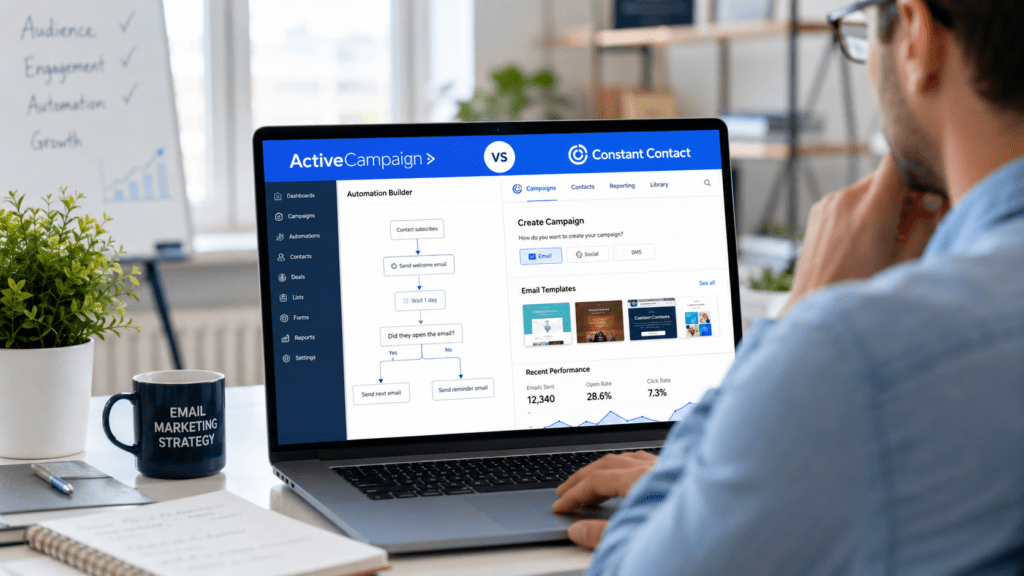
The Activecampaign Vs Constant Contact debate keeps coming up because both tools solve the same basic problem in very different ways. You need email marketing that actually moves subscribers toward a sale, a booking, or a repeat purchase. But the moment you start looking at automation, CRM, pricing, and setup time, the two platforms stop feeling similar.
That’s where the comparison gets useful. One platform leans into powerful marketing automation and deeper contact data. The other stays focused on simple email marketing, faster setup, and a cleaner day-to-day experience for teams that don’t want extra complexity.
What Most Buyers Expect From Each Email Marketing Platform
Most buyers want the same few things: easy email creation, solid templates, basic automation, decent segmentation, and pricing that doesn’t jump too fast as the contact list grows. They also want an email marketing platform that plays nicely with the tools they already use, whether that’s Shopify, WordPress, Zapier, or a CRM.
What often gets missed is that people don’t always need the same kind of system. A local business sending newsletters and promotions usually wants something simple and easy to use. A SaaS company, agency, or ecommerce brand often needs automation that can trigger based on behavior, lead stage, or purchase history. That difference matters more than any feature checklist.
Honest Take on ActiveCampaign Vs Constant Contact for 2026
If you want the short version, ActiveCampaign is usually the better fit for businesses that care about automation, segmentation, and CRM-driven email marketing. Constant Contact is usually better for teams that want a simpler tool for sending campaigns without spending a week learning the platform.
That doesn’t mean one is always “better.” It means they serve different operating styles. ActiveCampaign can feel more like a marketing automation platform, while Constant Contact feels more like a straightforward email marketing tool with some useful extras. If your team is small and your needs are simple, Constant Contact may be enough. If you’re building funnels, nurturing leads, or sending behavior-based campaigns, ActiveCampaign usually pulls ahead.
The Hidden Frustrations People Run Into With Email Marketing Platforms
The hard part with email marketing software is rarely the first campaign. It’s what happens after week three. Lists get messy. Segmentation gets inconsistent. A trigger breaks because a tag wasn’t applied the way you expected. Or someone on the team needs to update a template and can’t find the right workflow.
That’s why hidden friction matters. Some tools look easier at the start, but become limiting once the subscriber count climbs past a few thousand or the team wants more control. Others are powerful enough to scale, but the learning curve can be annoying if all you really wanted was a simple newsletter tool. The real decision is less about features on paper and more about how much operational complexity you’re willing to carry.
Quick Verdict: Activecampaign Vs Constant Contact
| Category | ActiveCampaign | Constant Contact |
|---|---|---|
| Best For | Behavior-based automation, CRM-linked campaigns, lead nurturing, ecommerce flows | Simple newsletters, event promos, local businesses, faster setup |
| Not Ideal For | Teams that only need basic email and want near-zero learning curve | Users needing deep automation, advanced segmentation, or more robust CRM logic |
| Starting Price | Typically starts higher than basic newsletter tools; pricing depends on contacts and plan level | Typically starts lower for simpler email marketing needs |
| Free Plan | No traditional free plan; usually a free trial is available | No free plan in the usual sense; free trial availability may vary |
| Ease of Use | More capable, but with a learning curve | Very user-friendly and easier for beginners |
| Key Strength | Powerful automation, segmentation, CRM, and integrations | Simplicity, quick campaign creation, dependable basic email marketing |
| Biggest Limitation | Can feel overbuilt if you only need simple email sends | Automation depth is limited compared with ActiveCampaign |
| Overall Recommendation | Best when email drives sales and follow-up logic matters | Best when speed, simplicity, and basic campaigns matter most |
Best For: ActiveCampaign fits growing businesses that need automation, CRM, and segmentation that can scale with more complex email marketing campaigns. Constant Contact is a better match for users who want to move fast and keep things simple.
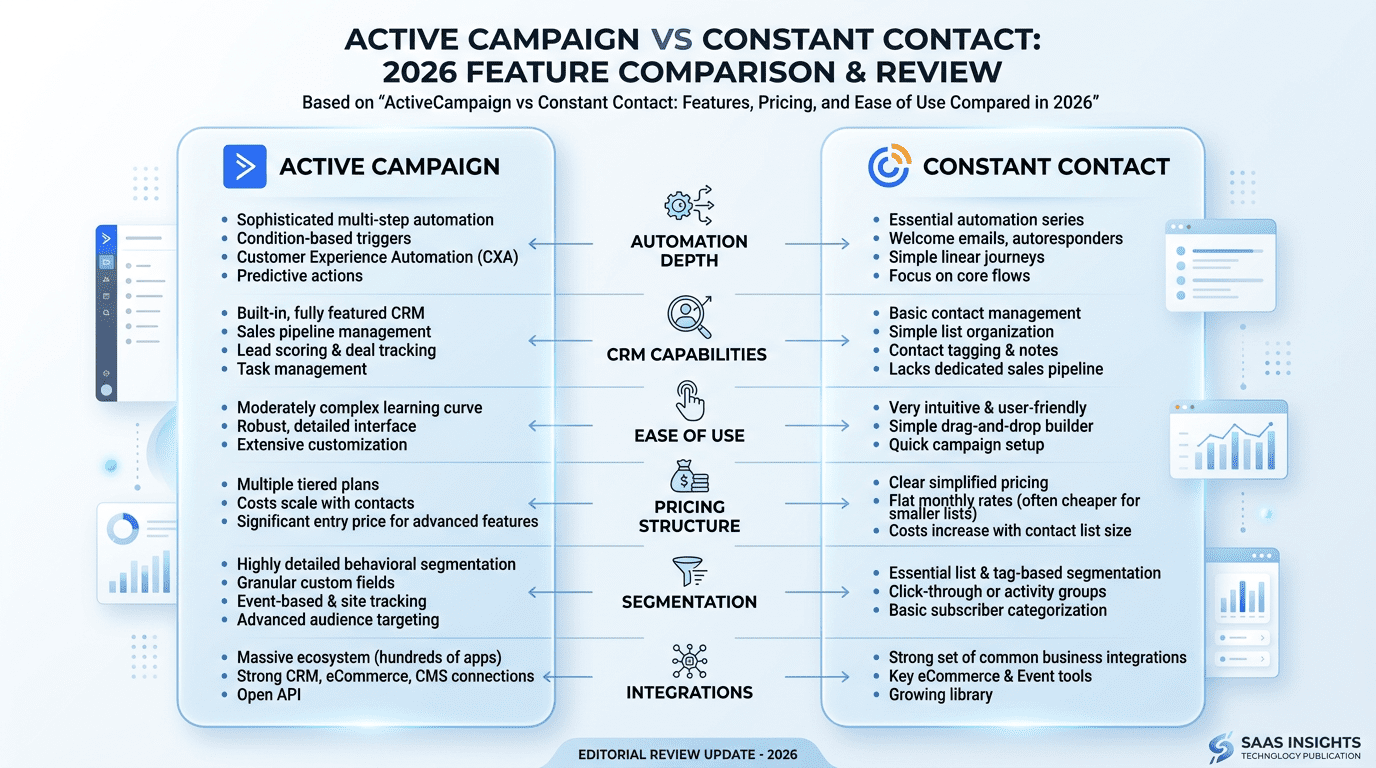
Not Ideal For: ActiveCampaign is usually too much for a business that only sends occasional newsletters. Constant Contact becomes frustrating when you need deeper automation and more detailed behavioral triggers.
Bottom Line: If your email strategy is simple, Constant Contact is easier to live with. If you want more control over how contacts move through a funnel, ActiveCampaign is the stronger long-term choice.
Activecampaign Vs Constant Contact: Core Differences That Matter Most
Automation and Marketing Automation Depth
This is the biggest split between the two tools. ActiveCampaign is built for automation. You can automate based on tags, page visits, purchases, form submissions, and many other actions and conditions. That makes it much easier to create workflows that feel connected to real customer behavior. A visitor downloads a guide, gets tagged, enters a sequence, and later receives a sales follow-up. That kind of logic is where ActiveCampaign earns its keep.
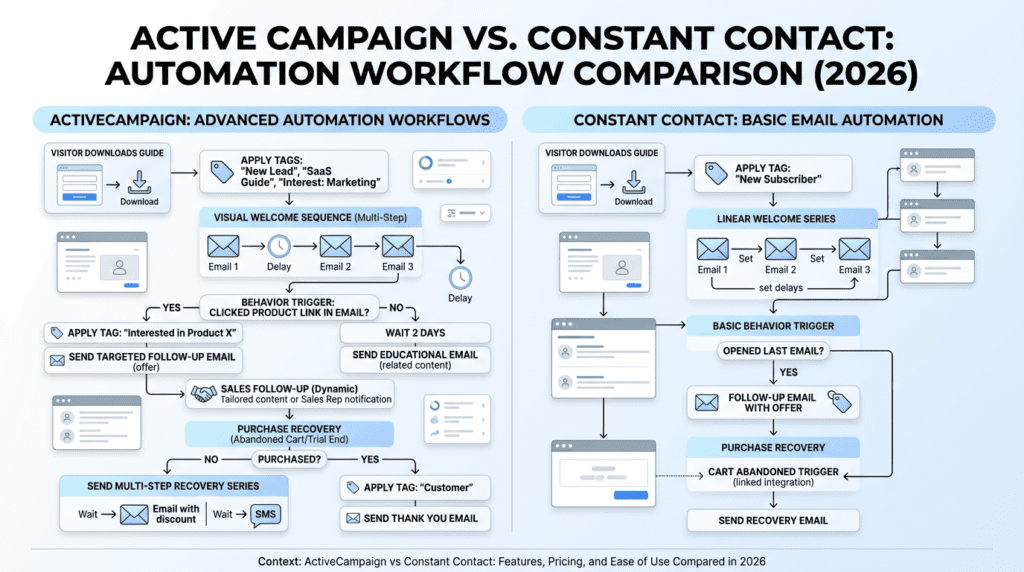
Constant Contact has automation, but it’s much simpler. You can set up welcome series, basic follow-ups, and some triggered messages. That’s useful, but it’s not the same thing as a full marketing automation platform. If you’ve ever tried to force a basic email tool into a sales funnel, you know the pain: you spend more time working around limitations than building useful campaigns.
For businesses that rely on lead nurturing, behavioral messaging, or abandoned cart campaigns, ActiveCampaign is the clearer winner.
Ease of Use and Setup Experience
Constant Contact wins on first-use simplicity. The dashboard is straightforward, the email editor is approachable, and most users can send a campaign without much training. If your team has never used email marketing tools before, that matters.
ActiveCampaign is still usable, but it asks more from you. There’s more to set up, more to understand, and more decisions to make. That’s not necessarily bad. In fact, it’s part of why the platform is so capable. But there is a learning curve, especially when you start building automation or connecting multiple integration points.
If your priority is quick execution, Constant Contact feels easier. If your priority is building a smarter system over time, ActiveCampaign is worth the extra effort.
CRM Capabilities and Contact Management
ActiveCampaign includes a CRM, and that changes how the platform works in practice. You’re not just storing contacts. You can track contact details, lifecycle stages, and sales activity in a way that connects email marketing to follow-up. That’s especially helpful for service businesses, consultants, agencies, and SaaS brands that need to move leads from interest to conversion.
Constant Contact is better at contact management than it is at full CRM logic. You can organize a contact list, segment subscribers, and track campaign engagement, but it doesn’t behave like a deeper sales system. That’s fine for straightforward campaigns. It’s less fine when marketing and sales need to operate from the same contact record.
If your team already uses HubSpot or another CRM, Constant Contact can still fit well as a lightweight sending tool. If you want the email platform itself to manage more of the sales journey, ActiveCampaign offers more structure.
Segmentation and List Targeting
Segmentation is one of those features that sounds basic until your list grows. Then it becomes the difference between relevant campaigns and annoying ones. ActiveCampaign gives you more ways to divide subscribers by behavior, engagement, lifecycle stage, and custom data. That means better targeting and usually better conversion quality.
Constant Contact has segmentation too, but it’s more limited and easier to outgrow. You can separate contacts by list, engagement, or some contact fields, which is enough for newsletters and simple follow-ups. But once you want more advanced branching or dynamic targeting, you may start feeling boxed in.
A boutique ecommerce brand, for example, might want one sequence for first-time buyers and another for repeat customers. ActiveCampaign handles that kind of segmentation more naturally. Constant Contact can support basic separation, but it doesn’t have the same depth.
Integrations and Ecosystem Fit
Both platforms offer strong integration options, but they serve different ecosystems. ActiveCampaign integrates well with a wide range of SaaS tools, ecommerce platforms, CRMs, and automation tools. It also connects through Zapier when you need to bridge gaps between systems. That makes it a good fit for businesses with a messy, multi-tool stack.
Constant Contact also integrates with useful business apps, especially for small businesses, events, and ecommerce workflows. It’s often enough if you just need forms, website tools, or a simple connection to your store or website builder. Constant Contact and ActiveCampaign both cover common use cases, but ActiveCampaign tends to go deeper when custom workflows matter.
If your tech stack changes often, ActiveCampaign is usually easier to build around. If you want fewer moving parts, Constant Contact is less demanding.
ActiveCampaign vs Constant Contact Pricing and Value for Money
Starting Price and Plan Structure
Pricing is where buyers often get surprised. Constant Contact usually starts at a lower entry point, especially for simple email marketing needs. That makes it more accessible for small businesses that mainly want to send campaigns, newsletters, and basic automated messages.
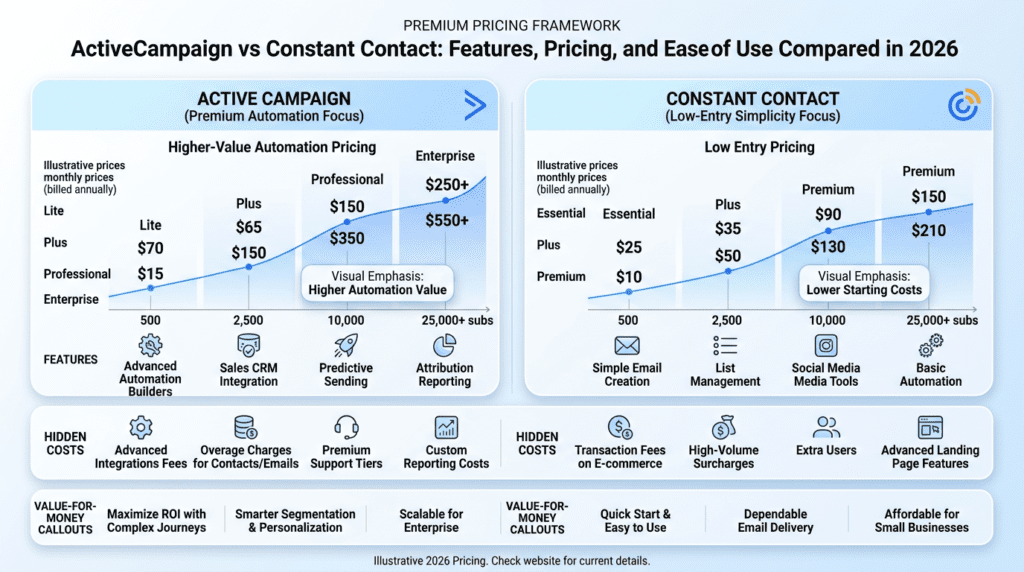
ActiveCampaign typically starts higher because you’re paying for more automation capability, CRM features, and more advanced list logic. The exact monthly cost depends on your subscriber count and the plan tier you choose, and both platforms tend to scale pricing as your contact list grows. That matters. A tool can look cheap at 500 subscribers and feel very different at 10,000.
If your main concern is getting started without much financial pressure, Constant Contact is often easier to justify. If your main concern is long-term workflow value, ActiveCampaign can be worth the higher entry cost.
What You Get at Each Price Tier
At the lower tiers, Constant Contact gives you the basics: email templates, list management, standard reporting, and a simple automation layer. That’s enough for users who send a few campaigns a month and don’t need a complex funnel.
ActiveCampaign’s lower tiers already lean into more advanced functionality, though plan details vary. You’re more likely to get useful automation building blocks, tagging logic, and CRM-related tools earlier in the plan structure. That’s a big reason the platform appeals to teams that want one system to do more work.
The catch is that “more value” depends on whether you’ll actually use the extra capability. Paying for advanced automation when you only send a monthly newsletter is wasteful. On the flip side, saving money on a simpler tool can become expensive if you later need to rebuild workflows somewhere else.
Hidden Costs and Add-On Considerations
This is where the real pricing conversation lives. With email marketing platforms, the base fee is only part of the cost. You may also pay indirectly through time spent setting things up, migrating lists, rewriting automations, or adding tools that fill missing gaps.
For example, if you need more advanced CRM behavior, you may end up pairing Constant Contact with another system. If you want deeper landing page or form logic, you may need a separate tool or plugin. ActiveCampaign can reduce some of those add-ons, but it may still rely on external services for things like ecommerce, specialized design work, or niche integration needs.
Also watch contact growth. If your list grows by 20% to 30% in a year, your monthly pricing can rise in a way that feels more painful than expected. That’s normal in this category, but it still catches people off guard.
Which Email Marketing Platform Delivers Better Value
Value depends on usage. Constant Contact delivers better value if you want a dependable, lower-friction system for basic email marketing and you don’t need much beyond that. It’s often the better deal for local services, event-driven businesses, and smaller teams with modest campaigns.
ActiveCampaign delivers better value if automation drives revenue. If your business depends on lead scoring, segmentation, follow-up triggers, or multiple campaign paths, the higher pricing is easier to defend. The platform can replace separate tools and reduce manual work, which is where the value shows up.
If the question is pure price, Constant Contact usually looks friendlier. If the question is total business value, ActiveCampaign often wins once the workflow becomes more serious.
ActiveCampaign vs Constant Contact: Features Compared for Real-World Email Marketing
Email Marketing Tools and Campaign Creation
Both platforms let you build and send campaigns without much trouble, but the experience is different. Constant Contact is built around simple email marketing. Its drag-and-drop email editor is straightforward, and the template selection is designed for quick launch. If you need to send a clean promo or newsletter, it gets out of your way.
ActiveCampaign also supports strong email creation, but it’s more focused on how each message fits into a larger sequence. The email editor is useful, and the customization options are deeper, but it’s easy to get pulled into automation logic before you’ve finished the message itself. That’s great for teams that plan campaigns carefully. It’s less ideal when speed matters more than complexity.
A retailer or coach who sends a few polished campaigns a month may find Constant Contact easier. A SaaS team running layered nurture sequences will usually prefer ActiveCampaign.
Automation Workflows and Advanced Triggers
This is the feature gap that shapes everything else. ActiveCampaign’s automation engine lets you build detailed workflows based on user behavior, contact data, tags, and events. You can create branching paths, trigger messages at the right time, and automate follow-up without a lot of manual cleanup. For many users, this is the difference between a basic email tool and a real marketing automation system.
Constant Contact offers automation, but the workflows are simpler. That’s fine for welcome emails, birthday messages, and basic follow-ups. It’s not the best fit for multi-step lifecycle journeys or deeper behavioral branching.
If you’ve ever needed a campaign to react to a form fill, a page visit, and a purchase in one flow, ActiveCampaign is in a different league. Constant Contact can support simpler sequences, but it doesn’t match that level of precision.
Landing Page Builder and Lead Capture Options
Both tools can help you capture leads, but the depth varies. ActiveCampaign can create landing pages and forms as part of a broader workflow, which is helpful if you want the lead capture process tied closely to segmentation and follow-up. That makes it easier to move from opt-in to nurturing without juggling too many tools.
Constant Contact also offers landing page and form builder options, and they’re generally easier to use for fast campaigns or event signups. The trade-off is that the tools tend to be lighter in customization and workflow logic.
If your landing page only needs a headline, a form, and a signup button, either platform can work. If you want that page to trigger different journeys based on content or source, ActiveCampaign gives you more room to build.
Reporting, Analytics, and Performance Tracking
Reporting in both platforms covers the essentials: opens, clicks, unsubscribes, and campaign performance. Constant Contact is usually enough for teams that want a simple view of what happened after send time. The reports are understandable, and that matters when the person checking metrics isn’t a full-time marketer.
ActiveCampaign goes deeper because it ties reporting to automation and CRM behavior. You can track how contacts move through workflows, which triggers perform best, and where leads drop off. That’s more useful if email is connected to revenue instead of just communication.
The limitation is that better reporting doesn’t automatically mean better decisions. If your team doesn’t have a process for reviewing data, the extra detail can turn into dashboard clutter. Still, for businesses that care about conversion quality, ActiveCampaign’s reporting is more actionable.
Ecommerce Features and Revenue-Focused Tools
ActiveCampaign has the edge for ecommerce because it can support abandoned cart campaigns, purchase-based automation, and behavior-driven follow-up. That matters for stores using Shopify or similar platforms, where one well-timed message can recover a sale or encourage a repeat order.
Constant Contact does support ecommerce use cases, but it’s more limited in how far you can push revenue-focused automation. It’s a better fit for straightforward promotions, seasonal announcements, and occasional product launches than for complex purchase journeys.
If you’re running a small store and mainly want to email customers about sales, Constant Contact can be enough. If you want to automate post-purchase sequences, product-based follow-up, or cart recovery, ActiveCampaign is usually the stronger system.
Ease of Use: Constant Contact and ActiveCampaign for Beginners and Growing Teams

Which Platform Feels More User-Friendly
Constant Contact usually feels easier on day one. The menus are simpler, the drag-and-drop email editor is straightforward, and the average small business can build a campaign without poking through a lot of extra settings. If you want a simple email marketing platform for newsletters, announcements, or basic promotions, that matters a lot. Less time inside the software means less friction getting work out the door.
ActiveCampaign is still usable, but it asks more from the user. The interface is clean enough, yet the depth of the system shows up fast. Once you start moving into automation, segmentation, CRM fields, and conditional logic, the learning curve becomes real. That’s not a flaw if you need those tools. It’s just the trade-off. Beginners often like ActiveCampaign in theory and then slow down once they realize how many decisions they need to make before the first automation runs properly.
Setup Time and Learning Curve
Setup time is one of the biggest practical differences in Activecampaign Vs Constant Contact. Constant Contact can often be set up in under an hour for basic use: import a contact list, choose a template, adjust the email content, and send. That speed is why it works well for teams that need a quick win. There’s less to configure, fewer branching options, and fewer chances to break something.
ActiveCampaign usually takes longer, especially if you want to use its automation strengths correctly. You may need to map contact data, define tags, create segments, connect forms, and build triggers before the workflow is even useful. A simple welcome sequence can take 30 to 90 minutes if you already know the platform, and longer if you’re still learning the system. The upside is that the setup pays off later. The downside is obvious: the first few days can feel slower, especially for users coming from Mailchimp or another lighter email marketing tool.
Everyday Workflow for Small Businesses
For many small businesses, the daily workflow is where Constant Contact feels less tiring. You log in, choose a template, make a few edits, and send a campaign. It’s easy to repeat every week. A local service business, for example, might use it for event reminders, monthly updates, and a simple landing page form without needing a full-time marketing person to manage it.
ActiveCampaign’s everyday workflow is better when you want the system to do more of the work. Once the automation is built, the platform can trigger follow-ups, update contact details, and move subscribers through a funnel with less manual effort. That said, the day-to-day experience can feel heavier. Even small edits sometimes require checking how a tag, trigger, or condition affects other steps. That’s normal in a more advanced marketing automation platform, but it can slow down teams that just want to send simple email marketing campaigns fast.
What Changes When Your Team or Needs Grow
This is where the gap widens. Constant Contact is easy to live with when your team stays small and your email marketing needs stay simple. But once you need deeper segmentation, multi-step automation, or tighter CRM behavior, the simplicity can start working against you. You may find yourself building workarounds or switching tools too late.
ActiveCampaign handles growth better because it was built for more complex automation and contact management. Marketing teams can automate follow-ups based on behavior, create rules around actions and conditions, and keep contact data organized as the database gets larger. That said, growth also exposes the learning curve. If your team doesn’t have someone who likes technical setup, ActiveCampaign can become underused. A powerful tool that nobody wants to maintain is still a problem.
ActiveCampaign vs Constant Contact for Small Businesses and Ecommerce
Best Choice for Small Businesses That Need Simplicity
Constant Contact is usually the safer pick for small businesses that mainly need simple email marketing. It works well for newsletters, promotions, appointment reminders, and basic list management. If the goal is to stay organized and send reliably without a lot of training, this is where it fits.
It’s especially useful for owners who wear too many hats. A bakery, consultant, or local gym probably doesn’t need a full marketing automation platform on day one. They need something easy to use, with decent email templates, a form builder, and a way to create landing pages when needed. Constant Contact offers that without making the team dig through extra layers.
Best Choice for Ecommerce Brands That Need Automation
ActiveCampaign is the stronger fit for ecommerce brands that rely on automation to drive revenue. It handles abandoned cart campaigns, browse-related follow-ups, and segmented post-purchase sequences much better than a simpler email marketing software setup. If you’re trying to turn contact behavior into repeat sales, that matters.
The other advantage is integration depth. ActiveCampaign connects well with Shopify, Zapier, and other tools that ecommerce teams usually depend on. That lets you build automation around purchase history, site activity, and lead source. For stores with enough traffic and subscriber volume, the return can be meaningful because the system helps you automate repeatable revenue work instead of manually chasing every lead.
When Constant Contact Makes More Sense
Constant Contact makes more sense when speed, clarity, and low friction matter more than advanced logic. If your team wants a dependable template library, basic segmentation, and a light workflow, it does the job. You won’t get the same automation capabilities as ActiveCampaign, but you may not need them.
It also tends to fit teams that are still figuring out email marketing needs. If you only send a few campaigns each month and don’t have a detailed funnel yet, paying for advanced features can feel wasteful. In that case, a simpler tool is often the better business decision, not the weaker one.
When ActiveCampaign Is the Better Long-Term Fit
ActiveCampaign is the better long-term fit when your list growth, customer behavior, or sales process starts getting more complex. Once you need more than one trigger, more than one segment, or more than one post-signup path, the platform starts earning its keep. That’s the moment many teams realize the extra setup was worth it.
It’s also the stronger option when your marketing team needs more control over contact details, message timing, and lead qualification. If your business is moving toward CRM-style selling, the gap between activecampaign vs constant contact becomes hard to ignore. Constant Contact can support you for a while, but ActiveCampaign is better built for the next stage.
What Most Blogs Miss About ActiveCampaign and Constant Contact
ActiveCampaign Is Powerful, But Not Always the Fastest Win
A lot of reviews focus on capability and stop there. The reality is that ActiveCampaign can be too much tool for teams that need a quick win, not a big system. If you only want simple email marketing and don’t plan to use automation, the extra features can feel like clutter instead of value.
That’s why some users struggle after switching from a lighter tool. They expect the same setup speed, then run into segmentation rules, CRM fields, and logic branches. The platform is excellent when used well, but it rewards planning. If your team doesn’t have time to build the workflow properly, the power sits unused.
Constant Contact Is Easy, But Simplicity Has Limits
Constant Contact’s biggest strength is also its biggest ceiling. It stays friendly because it avoids too much complexity. That’s great for newsletters and straightforward campaigns. It’s less great when you need layered automation or more advanced subscriber targeting.
The limit shows up when campaigns start depending on behavior. At that point, basic email marketing tools can feel rigid. You may want to trigger follow-ups based on clicks, purchases, or form submissions, but the system is built for simpler use. That’s fine until growth changes the job.
Why Scaling Requirements Change the Verdict
The better choice today may not be the better choice six months from now. That’s the part buyers miss. A team sending 2 campaigns a month to 500 subscribers has very different needs than a brand managing 25,000 contacts, multiple segments, and recurring promotions.
As scale grows, automation, CRM depth, and integration quality matter more. Manual steps become expensive. Small mistakes spread faster. Reporting needs get sharper. The question stops being “Which platform is easier?” and becomes “Which platform can handle our workflow without turning into a bottleneck?” That shift usually pushes growing teams toward ActiveCampaign.
Trade-Offs Buyers Often Underestimate
The biggest hidden trade-off is maintenance. Advanced tools can save time later, but only if someone owns the system. If no one maintains tags, triggers, and segments, automation can turn messy fast. Then the platform starts creating problems instead of solving them.
The other overlooked trade-off is team adoption. A marketing team may love the feature set, while the rest of the business finds it hard to follow. That gap matters. A tool that’s technically strong but hard to use across roles can slow execution. With email marketing platforms, the best email marketing choice is often the one your team will actually use consistently.
Activecampaign Vs Constant Contact vs Mailchimp and HubSpot
ActiveCampaign Vs Mailchimp
ActiveCampaign vs Mailchimp usually comes down to depth versus familiarity. Mailchimp is often easier for beginners and has a broad name recognition advantage, but ActiveCampaign offers stronger automation, better segmentation, and more serious CRM-style workflows. If you need simple campaigns, Mailchimp can still work well. If you need behavior-based email marketing and more advanced automation, ActiveCampaign is usually the better fit.
The deciding factor is often how much logic your team needs. Mailchimp can handle standard newsletters, basic drip sequences, and simple list management. ActiveCampaign goes further when your funnel depends on user actions, contact data, and branching conditions. That difference becomes more obvious as your subscriber list grows.
Constant Contact Vs Mailchimp
Constant Contact vs Mailchimp is a closer comparison for basic users. Both are designed to make email marketing less intimidating, and both are easier to start with than ActiveCampaign. Constant Contact tends to feel more straightforward for small businesses that want support and clean campaign building. Mailchimp often appeals to users who want a slightly broader marketing stack and are comfortable exploring a bit more.
If your goal is simple email marketing campaigns with minimal setup, Constant Contact can feel more direct. If you want more flexibility across templates, list management, and third-party integration, Mailchimp may offer more room to grow. Neither is as automation-heavy as ActiveCampaign, so the decision usually comes down to interface preference and how much complexity you’re willing to manage.
Where HubSpot Fits Better Than Either Tool
HubSpot fits better when email is only one part of a broader sales and marketing system. It brings CRM, marketing automation, content tools, and pipeline management into one place. That makes sense for teams that want a full revenue platform rather than just an email marketing solution.
The catch is cost and complexity. HubSpot can be overkill for small businesses that just need a simple email marketing platform. Even when the entry tools look manageable, the real value tends to show up at higher tiers. If your team needs sales alignment, lead tracking, and a unified contact database, HubSpot may make more sense than either ActiveCampaign or Constant Contact. If not, you may be paying for layers you won’t use.
How to Think About Alternative Marketing Platforms
The smart way to compare these tools isn’t by feature count alone. Start with your workflow. If you send occasional newsletters and want the easiest setup, Constant Contact is hard to beat. If you need powerful marketing automation and better CRM behavior, ActiveCampaign is stronger. If you need an all-in-one platform with sales and marketing under one roof, HubSpot starts to look more relevant.
Think about who will use it, how often, and what happens after the email goes out. The right email marketing platform should reduce manual work, not create more of it. That’s the real filter when you compare email marketing tools, whether you’re looking at ActiveCampaign, Constant Contact, Mailchimp, or a more complete system like HubSpot.
Common Mistakes When Choosing Between Activecampaign Vs Constant Contact
A lot of buyers compare Activecampaign Vs Constant Contact like they’re picking the “better” email tool in a vacuum. That’s where the trouble starts. The right choice usually depends on how much automation you’ll actually build, how messy your contact data is, and whether your team can handle a more powerful workflow without slowing down.
The mistake is not just overpaying. It’s buying a platform that fights your actual process. A simple newsletter business can get buried under a heavy marketing automation platform. A growing team with lead scoring, segmentation, and CRM needs can get boxed in by a tool that feels easy on day one but starts leaking opportunity later.
Paying for Advanced Automation You Will Not Use
This is the most common trap with ActiveCampaign. It offers deeper automation, branching logic, CRM actions, and more control over triggers and conditions. That’s great if you need it. It’s expensive busywork if you don’t.
If all you need is a welcome series, a few follow-ups, and a monthly newsletter, Constant Contact may be enough. Paying for advanced automation you never build usually means you’re paying for complexity, not value. The hidden cost is time. Someone still has to map the workflow, maintain it, and fix it when contact data gets messy.
Choosing Ease of Use Over Long-Term Fit
Constant Contact is easy to start with, and that matters. But ease of use can become a false win if your business outgrows the platform in 6 to 12 months. That’s when people end up re-building lists, forms, and automations in another tool anyway.
The better question is not “Which is simpler?” It’s “Which tool will still work when I add another product, another segment, or another lead source?” A platform that feels slightly harder now can save a painful migration later.
Ignoring Segmentation Needs
Segmentation sounds like a feature people can skip. Then they start sending the same email to everyone and wonder why open rates flatten out. If your audience includes buyers, leads, webinar attendees, inactive subscribers, and repeat customers, segmentation becomes operational, not optional.
ActiveCampaign handles this kind of targeting much better. Constant Contact can segment too, but it’s usually more basic. If your email marketing campaigns need behavior-based targeting, that difference matters fast. A coach, agency, or ecommerce brand with multiple customer types will feel that limit sooner than a single-offer local business.
Overlooking Integration Requirements
A lot of buyers focus on templates and automation, then realize their stack is the real issue. If you need Shopify, WordPress, Zapier, a form builder, a CRM, or a landing page tool to talk to your email platform, integrations become the glue.
Constant Contact covers common use cases well, but ActiveCampaign tends to fit better when the workflow is more layered. If your contact data lives in multiple apps, weak integration support creates manual cleanup and broken triggers. That’s not a minor annoyance. It can ruin follow-up timing and make automation unreliable.
Buying Guide: How to Decide Between Activecampaign Vs Constant Contact
The cleanest way to decide is to work backward from your workflow, not the feature list. Most people don’t need every tool in the box. They need the right amount of automation, a manageable learning curve, and pricing that matches how much value they’ll actually extract each month.
If you’re still comparing activecampaign and constant contact, this is where the choice becomes practical. One platform is built for depth. The other is built for speed and simplicity. The wrong pick usually happens when buyers try to make one tool do the job of the other.
Choose ActiveCampaign If You Need Advanced Automation
Choose ActiveCampaign if your email marketing needs go beyond basic broadcasts. It’s the stronger fit when you want behavior-based automation, lead scoring, CRM-driven follow-up, abandoned cart campaigns, and more detailed segmentation across a growing contact list.
This is especially useful for teams that rely on repeatable workflows. A SaaS company can automate trial follow-ups based on user actions. An ecommerce brand can trigger post-purchase sequences and cart recovery. A service business can route leads based on interest level or source. If your goal is to automate decisions, not just send emails, ActiveCampaign is usually the better long-term move.
Choose Constant Contact If You Want Simplicity
Choose Constant Contact if your priority is getting email marketing live quickly without a steep learning curve. It’s a good fit for users who mainly need newsletters, basic list management, simple email templates, and occasional campaign scheduling.
That makes it appealing for small businesses that don’t want to manage a complex CRM or build multi-step workflows. If your team is lean and your email program is straightforward, Constant Contact keeps things moving without turning every campaign into a project. It’s not the deepest tool, but it is easy to keep running.
Choose Based on Budget, Team Skill, and Growth Plans
Budget matters, but not in the simplistic “cheaper is better” way. You need to match pricing to actual workload. Constant Contact often makes more sense when you want predictable costs and a lighter setup. ActiveCampaign can cost more, but it may replace separate tools if you need CRM, segmentation, and marketing automation in one place.
Team skill matters just as much. If only one person manages email and they’re already stretched thin, a simpler platform may be the smarter operational choice. If your team can handle setup and ongoing optimization, ActiveCampaign’s learning curve becomes more manageable.
Growth plans are the final filter. If you expect your subscriber base, funnels, or integrations to expand over the next 12 to 24 months, buy for that future now. Migrating an email marketing platform after you’ve built dozens of workflows is rarely painless.
Final Decision Framework for Different Business Types
Here’s the simplest way to think about it:
- Solo creators and local businesses: Constant Contact usually wins if the goal is newsletters, events, and basic follow-up.
- Agencies and lead-gen teams: ActiveCampaign is usually stronger because segmentation and automation matter more.
- Ecommerce brands: ActiveCampaign tends to be the better fit if abandoned cart, product-based targeting, and lifecycle automation are part of the plan.
- Growing service businesses: Either can work at first, but ActiveCampaign is often the better fit once lead routing and CRM touchpoints matter.
If you’re still unsure, ask one question: do you need a simple email marketing tool, or a more complete marketing automation platform? That answer usually settles the debate.
Final Verdict: Activecampaign Vs Constant Contact
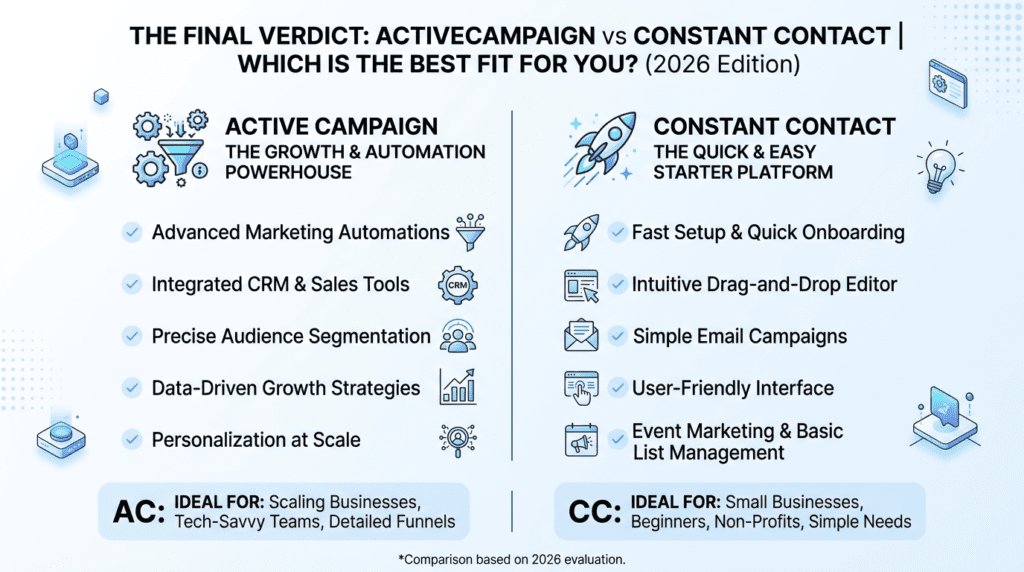
The final call comes down to what you value more right now: depth or simplicity. ActiveCampaign is the stronger platform for automation, segmentation, and growth-focused workflows. Constant Contact is the safer pick for straightforward email marketing and faster day-one execution.
The Clear Winner for Automation and Growth
ActiveCampaign wins if your business depends on behavior-based automation, CRM follow-up, and smarter segmentation. It gives you more ways to trigger campaigns, automate handoffs, and personalize email content based on what people actually do.
That makes it better for teams that want email marketing to do more than send announcements. If your goal is to automate lead nurturing, revenue follow-up, or lifecycle messaging, ActiveCampaign is the clearer winner. It’s more work to learn, but the upside is real when your contact list and workflow get more complex.
The Better Pick for Simplicity and Fast Setup
Constant Contact wins for ease of use. If you need a tool that’s easy to launch, simple to manage, and not overloaded with advanced settings, it fits that job well.
It’s especially practical for small businesses that mainly send updates, promotions, and event emails. You can move fast without spending weeks building the system. The trade-off is that you may hit limits sooner if your segmentation or automation needs grow.
Final Recommendation for Most Buyers
For most buyers, the right answer depends on future needs, not current comfort. If you only need basic email marketing and want the least friction, Constant Contact is the safer choice. If you already know you need more serious automation, CRM support, and deeper segmentation, ActiveCampaign is worth the extra cost and setup time.
A simple rule works well here: choose the tool that matches the next 12 months of your business, not just this week’s sending schedule.
Frequently Asked Questions About Activecampaign Vs Constant Contact
Is Activecampaign Vs Constant Contact Better for Email Marketing?
ActiveCampaign is better for advanced email marketing, while Constant Contact is better for simple campaigns. If you need automation, segmentation, and CRM-driven follow-up, ActiveCampaign has the stronger feature set.
If your focus is newsletters, event emails, and basic campaigns, Constant Contact is easier to live with. The better tool depends on how much control you want over your email marketing campaigns.
Which Is Easier to Use: ActiveCampaign or Constant Contact?
Constant Contact is easier to use. Its interface is simpler, and most beginners can get a basic campaign running faster.
ActiveCampaign has more depth, but that comes with a learning curve. It’s still manageable, just less immediate for first-time users.
Does ActiveCampaign Have Better CRM and Segmentation?
Yes, ActiveCampaign has better CRM and segmentation. It gives you more control over contact data, tags, actions, and conditions, which makes targeting more precise.
That matters when different subscribers need different follow-up paths. Constant Contact can segment lists, but it’s not built for the same level of workflow control.
Is Constant Contact Good for Small Businesses?
Yes, Constant Contact is good for small businesses that want a simple email marketing solution. It works well for newsletters, promotions, and basic list management.
It’s less ideal if your small business needs complex automation or a more advanced CRM. In that case, ActiveCampaign may be the better fit as you grow.
Which Platform Is Better for Ecommerce?
ActiveCampaign is usually better for ecommerce. It handles abandoned cart campaigns, lifecycle automation, and customer segmentation more effectively.
Constant Contact can still support ecommerce marketing, but it’s not as strong when you need deeper automation tied to shopping behavior or order history.
Is ActiveCampaign Worth the Higher Pricing?
Yes, if you’ll actually use the automation and CRM tools. The higher pricing makes sense when those features save time or improve conversions.
If you only need basic newsletters, the extra cost is hard to justify. In that case, Constant Contact is the more practical choice.