
If your email list is growing and you’re trying to turn subscribers into customers, the real problem usually isn’t sending newsletters. It’s building a workflow that follows up at the right time, handles new leads without chaos, and doesn’t become a mess after a few months. That’s why ActiveCampaign vs Brevo comes up so often in 2026. The two platforms can both send campaigns, but they’re built with very different priorities.
What most buyers miss is that one platform is designed to go deeper into automation and CRM, while the other keeps things simpler and often more affordable. That difference sounds small at first, but it changes how the platform feels once you start using it every week.
Why ActiveCampaign vs Brevo matters for email marketing buyers in 2026
For a small team, the wrong choice can show up fast. Maybe you only need monthly email campaigns and basic follow-ups. Or maybe you need lead scoring, pipeline movement, and behavior-based automation that reacts to what a subscriber actually does. ActiveCampaign and Brevo both cover email marketing, but they serve different levels of operational complexity.
What most people misunderstand about ActiveCampaign and Brevo
A lot of buyers compare the two as if they were the same kind of tool with different prices. They’re not. ActiveCampaign leans into automation and CRM-heavy workflows. Brevo focuses more on accessible email marketing, transactional email, and a simpler setup. That difference matters more than a long feature checklist.
The key difference between a marketing automation platform and a simpler email marketing platform
The easiest way to think about it is this: ActiveCampaign behaves more like a marketing automation platform, while Brevo feels closer to a straightforward email marketing platform with useful extras. Both can send campaigns. Both can automate. But ActiveCampaign usually gives you more control, while Brevo tends to be easier to live with if your needs are modest.
Why pricing, automation, and ease of use matter more than feature lists alone
Feature lists can make both tools look similar. In practice, the real decision comes down to pricing, how much automation you actually need, and how much time your team can spend learning the system. A platform that looks cheaper on paper can become expensive if it slows down your workflow. On the other hand, a powerful platform can be overkill if you only need a monthly newsletter and a few basic sequences.
Quick Verdict
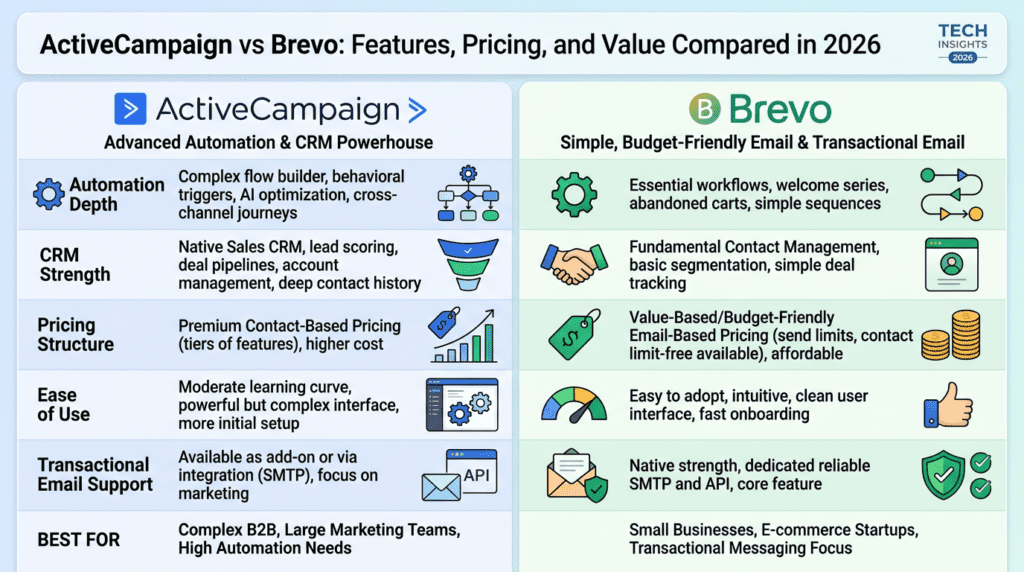
Best for advanced automation and sales-driven workflows
ActiveCampaign is the stronger choice if you need complex automation, CRM-style follow-up, and deeper control over marketing and sales workflows. It usually fits businesses that want to build detailed journeys around leads, tags, custom fields, and pipeline movement.
Best for budget-conscious teams that need one platform for email and transactional email
Brevo is usually the better value if your team wants a more affordable platform that can handle newsletters, basic automation, and transactional email in one place. It’s especially practical for ecommerce, small businesses, and teams that don’t need a heavy learning curve.
Not ideal for users who want enterprise depth without a learning curve
Neither platform is perfect for everyone. ActiveCampaign can feel too complex for simple use cases, and Brevo doesn’t always go as deep as growing teams eventually want. If you want enterprise-level power with no setup effort, that’s where expectations usually get unrealistic.
Bottom line on ActiveCampaign vs Brevo
If your business depends on serious automation and sales follow-up, choose ActiveCampaign. If you want lower pricing, a simpler setup, and decent all-around email marketing with transactional email support, choose Brevo.
ActiveCampaign vs Brevo: Complete Comparison Table
| Category | ActiveCampaign | Brevo |
|---|---|---|
| Best for | Advanced automation, CRM, sales workflows | Budget-friendly email marketing and transactional email |
| Starting pricing | Typically starts higher, often around the mid-$20s per month for basic plans | Usually starts lower, with a free plan and paid tiers often beginning around the low teens |
| Free plan | No permanent free plan, but usually offers a 14-day free trial | Yes, offers a free plan with limited monthly email sends |
| Automation depth | Strong advanced automation and conditional logic | Good basic-to-mid-level automation |
| CRM | Built-in CRM features are more developed | Brevo’s CRM is lighter and less central |
| Transactional email | Available, but not the main draw | One of Brevo’s major strengths |
| Ease of use | More powerful, but steeper learning curve | Easier to get started with |
| Templates | Solid email template options | Good template selection, often more approachable |
| Landing pages | Included on higher tiers | Brevo also offers landing pages on selected plans |
| Best fit | Growing teams that want depth | Smaller teams that want value |
The fastest way to interpret the table before you decide
If you read nothing else, this is the practical takeaway: ActiveCampaign is usually the better long-term fit for teams that care about automation and sales follow-up. Brevo is usually the better short-term value if you want to keep costs down and still get a reliable email system.
One thing to consider is growth. A simple setup can feel perfect at 1,000 subscribers, then start to feel limited at 20,000. That’s where the key difference becomes obvious.
ActiveCampaign vs Brevo: Core Platform Differences
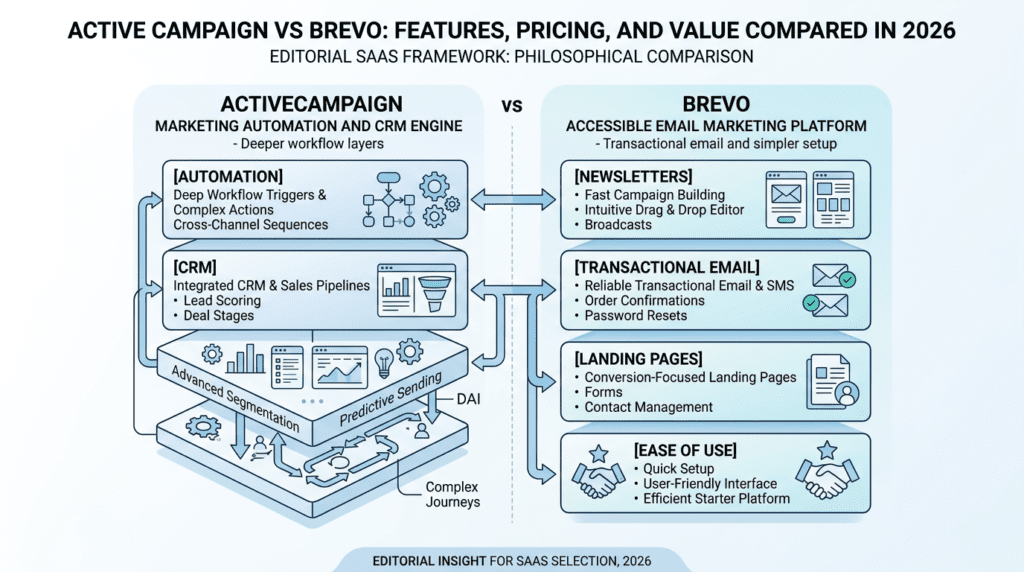
ActiveCampaign as a sales and marketing automation platform
ActiveCampaign is built for teams that want email, CRM, and automation to work together in a tighter workflow. It’s not just about sending a newsletter. It’s about triggering the next action based on behavior, tagging contacts, moving people through a pipeline, and letting the system do more of the follow-up work.
That makes it a stronger fit for businesses with longer sales cycles or multiple lead stages. In practice, that usually means service firms, SaaS companies, consultants, and online businesses with complex funnels. ActiveCampaign offers a more complete setup for marketing and sales coordination, but that extra depth also adds complexity.
Brevo as an email marketing and transactional email platform formerly Sendinblue
Brevo, formerly Sendinblue, takes a more balanced and accessible approach. It gives you newsletter tools, basic automation, a CRM, landing pages, and transactional email in one platform. For many small businesses, that’s enough. In fact, it’s often more than enough.
Brevo’s appeal is practical. It’s easier to start with, easier to explain to a small team, and usually easier on the budget. It also appeals to users who want email marketing and transactional email under one roof, especially if they don’t need a heavy automation stack.
Both platforms include CRM-style features, but they don’t feel equally central.
- ActiveCampaign puts more weight on CRM and pipeline automation.
- Brevo’s crm is useful, but it’s not the core reason most people choose the platform.
- ActiveCampaign also tends to support more complex subscriber routing and contact management.
- Brevo’s newsletter workflow is simpler and often quicker to manage day to day.
If your team mostly sends campaigns and manages a few audience segments, Brevo can feel cleaner. If your workflow depends on marketing and crm coordination, ActiveCampaign is usually the stronger platform.
Which platform feels more complete for day-to-day marketing
This depends on what “complete” means to you. If you want one platform that can grow with a more advanced sales process, ActiveCampaign feels more complete. If you want one platform that covers the basics well, handles transactional email, and stays relatively easy to run, Brevo often feels more complete for smaller teams.
The reality is that completeness is not just about feature count. It’s about whether the platform fits your actual workflow without creating extra friction.
ActiveCampaign vs Brevo: Automation Comparison
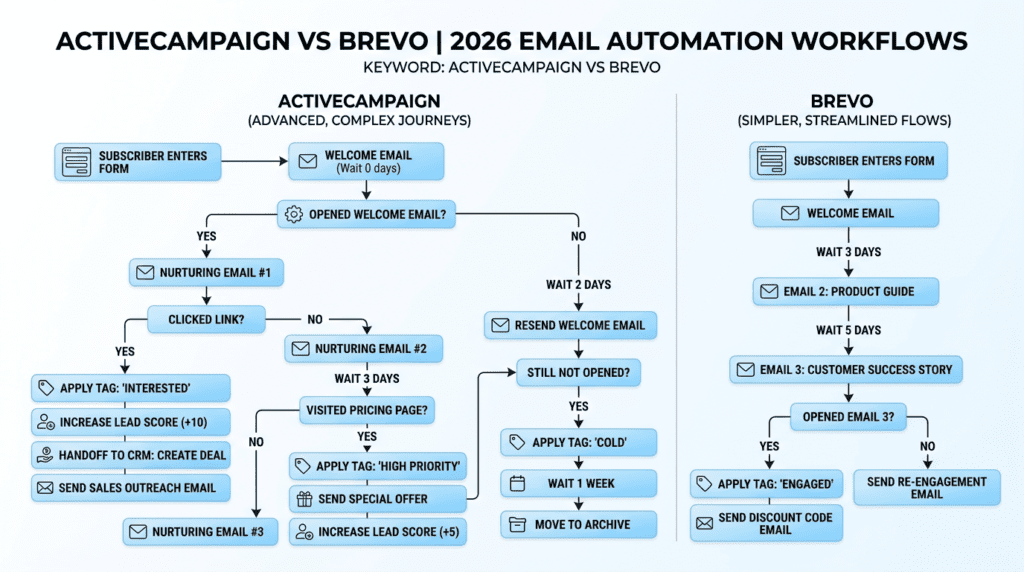
ActiveCampaign automation depth, workflow builder, and conditional logic
ActiveCampaign is known for its automation builder, and that reputation is earned. It gives you more control over triggers, conditions, split paths, and actions. You can create detailed workflow sequences that respond to opens, clicks, form submissions, site activity, tag changes, and more.
This matters when your lead nurturing needs aren’t simple. For example, a buyer who downloads a guide, waits three days, clicks a pricing email, and books a call should not receive the same follow-up as someone who only joined a newsletter. ActiveCampaign handles that kind of branching workflow more naturally.
Brevo automation tools and where they are simpler
Brevo also offers automation, but the system is generally simpler. That’s not automatically a drawback. For many teams, simpler means faster to set up and easier to maintain. You can build useful email automation flows without dealing with a complicated interface.
Where Brevo feels lighter is in advanced branching and nuanced contact behavior. It does the job for common use cases, but it doesn’t usually match ActiveCampaign when the workflow gets layered. If you want fast setup more than deep control, Brevo often makes more sense.
How automation affects lead nurturing, segmentation, and follow-up
Automation changes the day-to-day workload more than most buyers expect. With the right workflow, you stop manually chasing every subscriber. You can segment users by behavior, delay messages, and follow up in a more relevant way. That usually leads to better lead nurturing and fewer dead-end campaigns.
But there’s a trade-off. More automation means more setup, more testing, and more chances for logic errors. A broken trigger can send the wrong message to the wrong person. That’s where advanced systems become operational tools, not just marketing tools.
Which platform is better for beginners versus advanced users
For beginners, Brevo is usually easier. The workflows are more approachable, the interface is less intimidating, and you can get useful automation running without a long learning period.
For advanced users, ActiveCampaign is usually better because it gives you room to grow. If your team is already thinking in terms of lifecycle stages, lead scoring, and conditional follow-up, ActiveCampaign supports that mindset more naturally.
ActiveCampaign vs Brevo: Email Marketing Features Compared
Newsletter creation, campaign setup, and list management
Both platforms handle standard email marketing well. You can build newsletters, schedule sends, manage subscriber lists, and track basic engagement. For most users, the daily campaign flow will feel familiar on either side.
ActiveCampaign tends to shine when campaigns need to connect to deeper automation and crm logic. Brevo is often more straightforward for simple monthly email campaigns or regular promotional sends. If your needs are mostly about consistent communication, Brevo can be enough without adding extra complexity.
Template quality, email builder flexibility, and design options
Both tools offer a drag-and-drop builder and a selection of email template options. ActiveCampaign is generally stronger if you want more control over behavior tied to the email, while Brevo often feels easier for quick design work.
A few practical notes:
- ActiveCampaign’s template system is solid, but the real value comes from what happens after the send.
- Brevo’s template library is useful for common campaign types and easy to adapt.
- Neither platform is trying to replace a dedicated design tool.
- If you send a lot of plain, text-forward campaigns, either platform can work well.
Segmentation, personalization, and testing capabilities
Segmentation is where the gap starts to widen. ActiveCampaign gives you more depth for targeting based on behavior, tags, contact data, and workflow history. That makes personalization more useful, especially as your list grows.
Brevo supports useful segmentation too, but it’s generally lighter. For a small list, that may not matter. For a larger list with different buyer groups, it starts to matter a lot.
Testing is another practical detail. Both platforms support common campaign testing features, but the advanced user tends to get more strategic value from ActiveCampaign because its automation and contact logic can support more refined experiments.
Transactional email support and where Brevo has the edge
This is one of the clearest differences. Brevo offers transactional email as a core part of the platform, which is a big reason many buyers choose it. If your business needs order confirmations, password resets, account notifications, or similar sends, that’s a major advantage.
ActiveCampaign supports transactional email too, but it’s not the reason most people buy the platform. Brevo does this part especially well, and that can reduce the need for a separate email service provider.
A few practical differences worth noting
- ActiveCampaign offers: deeper workflow control and stronger sales alignment.
- Brevo offers: better all-in-one value for newsletter and transactional email use cases.
- Monthly email: both can handle recurring sends, but the workflow around them feels different.
- ActiveCampaign also offers: a more developed path for teams that want to scale into more advanced marketing automation.
- Brevo also: works well for smaller teams that want one tool for marketing and transactional messaging.
The key difference is not whether both tools can send email. It’s whether the platform supports the kind of workflow your business will need six months from now.
ActiveCampaign vs Brevo: CRM and Lead Management Features
ActiveCampaign CRM and sales pipeline capabilities
ActiveCampaign leans harder into sales and marketing automation than Brevo, and that shows in how its CRM works. It gives teams a more structured way to manage deals, track stages, and trigger follow-ups based on behavior. If a contact visits a pricing page, replies to a message, or hits a key workflow step, ActiveCampaign can push that person into a pipeline stage or assign a task without much manual work.
That matters most when marketing and sales share the same lead flow. A small team can use one platform to capture interest, score contacts, and move prospects through a pipeline with less copying and pasting between tools. In practice, that usually means fewer leads slipping through the cracks.
A few things stand out:
• Deal pipelines: Multiple pipeline views help teams separate sales motions by product, segment, or stage.
• Task automation: Follow-up tasks can be created when a trigger fires, which is useful for reps who live in their inbox.
• Lead scoring: Contacts can be prioritized based on actions, not just form fills.
• Custom fields: Useful for storing more context about the lead without cluttering the workflow.
The trade-off is complexity. ActiveCampaign offers more control, but it also asks for more setup. If your sales process is still changing every month, that flexibility can feel like work.
Brevo CRM tools for smaller teams
Brevo’s CRM tools are lighter, but that’s not automatically a weakness. For smaller teams, the simpler approach can be easier to keep up with. You can store contacts, track conversations, and move deals through a basic sales process without spending half a day building rules you may never use.
Brevo also fits teams that want email marketing and CRM in one place without turning the system into a full sales operations hub. That’s often enough for a small agency, local service business, or ecommerce store handling a modest number of monthly leads.
Where Brevo tends to fit best:
• Simple deal tracking
• Basic contact organization
• Lightweight follow-up management
• Teams that want fewer moving parts
The limitation shows up as soon as your workflow becomes more layered. If you need advanced scoring, detailed lifecycle rules, or deeper sales automation, Brevo’s CRM can start to feel like a holding pattern rather than a full operating system.
Contact management, deal tracking, and sales automation differences
This is where the activecampaign vs brevo decision gets practical. ActiveCampaign is better at connecting contact behavior to sales action. Brevo is better at keeping things manageable when your sales process is still relatively simple.
In ActiveCampaign, you can build more detailed rules around contact actions, pipeline changes, and follow-up timing. That gives marketing and sales teams a cleaner handoff. A lead can move from newsletter reader to qualified prospect to sales conversation with fewer manual steps.
Brevo keeps the contact side straightforward. You can manage subscribers, organize prospects, and run basic sales follow-up, but it doesn’t push as far into advanced lifecycle management. For teams with a short sales cycle, that may be perfectly fine. For teams with longer nurture periods or multiple reps, the gap becomes more obvious.
A useful way to think about it:
• ActiveCampaign: Better when sales follow-up depends on behavior, timing, and detailed rules.
• Brevo: Better when your team wants simple contact management and basic tracking.
• ActiveCampaign: Stronger for multi-step pipelines and coordinated handoffs.
• Brevo: Easier to maintain when the team is small and the process is less formal.
Which platform is better for sales and marketing alignment
If sales and marketing need to work as one system, ActiveCampaign usually has the edge. It’s more flexible, more detailed, and better suited for teams that want automation to shape the entire lead journey. That includes lead scoring, workflow branching, and pipeline movement based on engagement.
Brevo can still support alignment, but it’s more limited. It works best when marketing’s job is to generate interest and sales mainly needs a clean list of contacts and basic deal visibility. That’s fine for many smaller businesses. It just isn’t as strong when the handoff between teams needs to be tightly controlled.
The short version:
• Choose ActiveCampaign if sales follow-up, pipeline tracking, and lifecycle automation are central to your process.
• Choose Brevo if you want lighter CRM tools and a simpler setup for a smaller team.
ActiveCampaign vs Brevo: Landing Pages and Form Builder Comparison
Landing pages and embedded form options
Both platforms offer landing pages and forms, but they approach them differently. ActiveCampaign’s landing pages tend to fit into a broader automation system, so they work best when the goal is to capture leads and push them into a deeper workflow. Brevo’s landing page builder is usually more straightforward, which can be useful if you just need a clean signup page fast.
Forms are a similar story. ActiveCampaign gives you more room to connect forms to tagging, scoring, and follow-up logic. Brevo keeps the experience lighter and more direct, which is often easier for teams that don’t want to build a complex funnel every time they launch a campaign.
From a practical standpoint:
• ActiveCampaign forms: Better for complex triggers and segmented follow-up.
• Brevo forms: Better for quick lead capture and simple campaigns.
• ActiveCampaign landing pages: Useful when the page is part of a larger automation workflow.
• Brevo’s landing page builder: Handy for basic opt-ins, newsletters, and event registrations.
If you’re running a one-page campaign or a simple newsletter signup, Brevo is often enough. If the form submission needs to trigger a long chain of actions, ActiveCampaign is stronger.
Lead capture workflows and signup experience
Lead capture is not just about the form itself. It’s also about what happens after someone clicks submit. That’s where the two platforms split further.
ActiveCampaign supports more detailed lead capture workflow design. A subscriber can enter a segmented list, receive a targeted message, get tagged for behavior, and move into a pipeline stage with very little manual follow-up. That kind of workflow is valuable when you’re managing multiple offers or different customer paths.
Brevo keeps signup experiences simpler. For many teams, that’s a plus. You can launch a form, connect it to a list, and start sending messages without a lot of setup. The downside is that the path after signup isn’t as layered, so more sophisticated lead nurturing requires compromises.
This is where many users get confused: a good signup experience doesn’t automatically mean a better conversion system. The real question is how much follow-up logic you need after the opt-in.
Conversion-focused features beyond standard email marketing
Beyond basic email marketing, ActiveCampaign and Brevo both offer tools that support conversion. The difference is how far those tools go.
ActiveCampaign is stronger when conversion depends on sequencing, segmentation, and timing. That makes it a better fit for businesses running consult calls, demo requests, higher-ticket offers, or longer sales cycles. The platform can adapt to what the lead does next.
Brevo offers useful conversion tools too, especially for businesses that want email, forms, and transactional messaging in one place. For ecommerce stores and smaller businesses, that combination can be enough to support real revenue without overcomplicating the stack.
A few conversion tools worth noting:
• Automation triggers tied to behavior
• Lead scoring and tagging
• Signup forms with follow-up rules
• Landing pages for simple campaigns
• Transactional messages that keep order or account communication in one platform
In other words, both platforms help with conversion. ActiveCampaign goes deeper; Brevo keeps the workflow lighter.
Which platform gives marketers more usable tools in one place
If “usable” means straightforward and affordable, Brevo is hard to ignore. It offers a lot of day-to-day marketing value in one platform, especially for teams that want email, transactional email, forms, and basic CRM without too much setup.
If “usable” means a broader system for lead handling, pipeline movement, and advanced workflow logic, ActiveCampaign gives marketers more control. It’s usually the better choice when marketing needs to do more than send campaigns.
So the decision comes down to your operating style:
• Choose Brevo if you want a practical all-in-one tool for smaller teams.
• Choose ActiveCampaign if you need deeper conversion logic and tighter sales coordination.
ActiveCampaign vs Brevo: Integrations and Third-Party Apps
Native integration options for ecommerce, CRM, and analytics tools
Both platforms connect to a wide range of tools, but ActiveCampaign generally has the larger and more mature ecosystem. That matters if your stack includes Shopify, WordPress, CRMs, analytics tools, webinar software, or more specialized apps. The broader the integration layer, the less likely you are to get boxed in later.
Brevo also offers plenty of useful connections. For smaller businesses, that is usually enough. You can connect ecommerce platforms, site builders, and common marketing tools without major friction. Brevo’s integration set tends to favor practical everyday use rather than deep enterprise-style orchestration.
A rough way to compare them:
• ActiveCampaign: Broader integration depth and stronger automation tie-ins.
• Brevo: Solid coverage for common tools, especially for simpler workflows.
• ActiveCampaign: Better if integrations need to pass data through multiple steps.
• Brevo: Better if you mainly need standard connections and basic syncing.
When a business grows, integration quality starts to matter more than the number of logos on a marketing page. A tool that “integrates” but doesn’t pass useful data cleanly can slow teams down fast.
API, workflow connections, and third-party app support
ActiveCampaign is usually the better choice for teams that care about API flexibility and custom workflow connections. That gives developers and operations teams more room to build around the platform rather than inside its limits. If you want to sync data between systems, create custom triggers, or manage more advanced lifecycle logic, that flexibility pays off.
Brevo does offer API access and third-party support, but it is generally more approachable than deep. That works well for common use cases. It’s less ideal when your business needs several tools to talk to each other in very specific ways.
In practice, the difference shows up in how much work your team has to do to keep systems aligned.
• ActiveCampaign: Better for custom objects, detailed event handling, and more layered workflow connections.
• Brevo: Better for standard app support and simpler sync needs.
If you know your stack will change over time, deeper API control can save you from a painful rebuild later.
How integration depth affects long-term flexibility
Integration depth is one of those things that looks minor at the beginning and becomes a headache later. A platform may feel “good enough” when you only send newsletters and capture basic leads. But as requirements grow, the cost of switching grows too.
ActiveCampaign tends to be the safer bet for long-term flexibility because it supports more advanced behavior across tools. If your business adds a CRM, a support desk, a booking app, or a more complex ecommerce flow, it’s easier to keep ActiveCampaign at the center.
Brevo can still scale, but it’s usually best when the workflow stays relatively clean. That’s not a flaw. It’s just a different shape.
One thing to consider:
• If you expect multiple tools to feed one lead system, ActiveCampaign is usually more future-proof.
• If you want a simpler stack and fewer technical moving parts, Brevo is easier to live with.
What most blogs miss about switching costs between platforms
Switching from one platform to the other isn’t just about moving contacts. It’s about rebuilding automation, reworking segmentation, recreating forms, and rethinking how the team handles leads. That takes time, and it’s usually more disruptive than people expect.
The hidden cost is workflow memory. Teams get used to where things live, which tags mean what, and how a lead moves from one stage to another. Once that system changes, even a better platform can slow the business down for a while.
This is why switching costs matter in the activecampaign vs brevo decision. If you’re already deep into one platform, the “better” choice on paper may not be the best practical choice right now. Sometimes the right move is to stay put until the operational gain is clear.
ActiveCampaign vs Brevo: Ease of Use and Learning Curve
Dashboard learning curve and first campaign setup
Brevo is generally easier to learn on day one. The dashboard is more direct, and a first campaign can usually be set up with less friction. For teams that need to send a newsletter, create a form, or launch a basic automated message quickly, that simplicity is valuable.
ActiveCampaign has a steeper learning curve. It’s not hard to use in the long run, but the first few days can feel crowded because there’s more happening under the hood. That extra complexity is part of what makes it powerful, though. You’re not just sending emails; you’re building a system.
In most cases:
• Brevo: Faster to understand for basic email tasks.
• ActiveCampaign: Better once you need structured workflows and deeper automation.
If your team has limited time for setup, that difference can matter more than any feature list.
Workflow building experience for non-technical users
This is where the gap becomes obvious. Brevo’s workflow tools are easier for non-technical users to approach because they’re less overwhelming. You can build simple flows without needing to map out a complicated logic tree.
ActiveCampaign’s workflow builder is more capable, but it asks for more planning. That’s a good thing if your business has multiple triggers, conditions, and follow-up paths. It’s a bad thing if you just want a simple welcome series and a monthly newsletter.
A practical rule of thumb:
• Brevo is easier for straightforward automation and routine tasks.
• ActiveCampaign is better when the workflow has to adapt to different behaviors and lead types.
The reality is that many teams start with simple automation and then add layers over time. That’s where ActiveCampaign often proves its value, but it also means a slower start.
Account setup, migration, and onboarding differences
Brevo is usually less demanding at setup. You can get through account creation, list import, and basic sending with less hand-holding. That makes it attractive for small teams and solo operators who don’t want a long onboarding process.
ActiveCampaign often requires more thought during onboarding because there are more settings, more workflow decisions, and more room for mistakes. If you import data without a clear structure, you can end up with messy tags, confusing lists, or automation rules that don’t fire the way you expected.
A cleaner migration tends to include:
• List cleanup
• Tag mapping
• Form rebuilds
• Workflow recreation
• CRM stage alignment
Neither platform removes that work. ActiveCampaign just exposes it more clearly.
Which platform is easier to manage as your needs grow
Brevo is easier to manage when your needs are simple. ActiveCampaign is easier to manage when your needs are complex. That sounds contradictory, but it’s really about fit.
If you want a small, low-friction setup that doesn’t change much, Brevo stays manageable longer. If you want a system that can grow with richer automation and a deeper CRM structure, ActiveCampaign becomes easier to manage over time because it gives you room to organize that complexity.
So the question isn’t “which platform is easiest?” It’s “which platform stays usable as your workflow gets bigger?” For many growing businesses, that answer is ActiveCampaign. For lean teams with stable needs, Brevo is often enough.
ActiveCampaign vs Brevo: Pricing and Value for Money
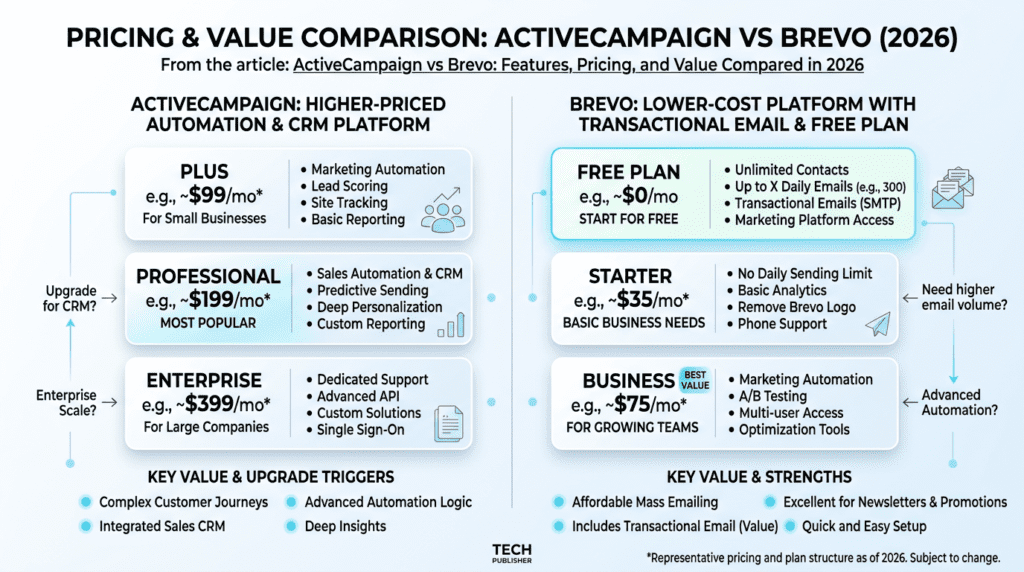
Pricing overview, plan structure, and what each platform includes
Pricing is one of the biggest reasons people compare ActiveCampaign and Brevo. Both platforms can work for small businesses, but they price value differently.
ActiveCampaign pricing usually starts higher because you’re paying for deeper automation, CRM features, and workflow control. Entry plans often begin around the low double digits per month, but costs rise as contact counts increase and as you move toward more advanced features like CRM and richer automation.
Brevo is usually the more budget-friendly option at the start. It offers a free plan and paid plans that often begin at a lower monthly rate than ActiveCampaign. That makes it attractive for teams with modest sending needs or tighter budgets.
A simple way to think about it:
| Platform | Starting point | Best value use case |
|---|---|---|
| ActiveCampaign | Typically higher entry pricing | Advanced automation, CRM, and sales alignment |
| Brevo | Lower-cost entry point, plus free plan | Budget-conscious email marketing and transactional email |
The key difference is that ActiveCampaign charges more for depth, while Brevo tries to stay accessible for simpler use cases.
Free plan differences and who can realistically use them
Brevo’s free plan is one of its most appealing advantages. It lets smaller users get started without paying immediately, which is helpful for new sites, early-stage businesses, and occasional senders. In many cases, it includes a limited monthly email allowance and enough tools to test the platform before upgrading.
ActiveCampaign does not really compete in the same way at the free-plan level. It focuses more on a free trial and paid plans, which makes sense given its positioning. You’re not getting a long-term no-cost platform; you’re evaluating a more advanced system.
Realistically, a free plan works best if:
• You send a modest monthly email volume
• You don’t need complex automation
• You’re testing list growth or a new offer
• You want to validate the platform before committing
If your email operations are already business-critical, the free plan is usually just a short test, not a long-term answer.
Contact-based costs, email sending limits, and upgrade triggers
Both platforms can become more expensive as your audience grows, but the triggers differ a bit.
ActiveCampaign often scales pricing by contact count and feature tier. That means a larger list can push you into a more expensive plan even if your sending volume stays moderate. If you need automation depth or CRM features, you may also have to move up a tier sooner than expected.
Brevo often makes pricing feel more usage-based, especially around monthly email volume. That can be easier for businesses that have a larger contact list but only send selected campaigns. Still, if you send often or need more advanced tools, the cost can rise.
Common upgrade triggers include:
• More contacts or subscribers
• Higher monthly email send volume
• Need for advanced automation
• Need for CRM or pipeline tools
• Need for transactional email at scale
This is where it helps to think beyond the starter plan. A cheap first month doesn’t always stay cheap as the business grows.
Hidden costs tied to automation, CRM, and advanced features
Hidden costs usually show up in the form of add-ons, higher-tier plans, or workflow gaps that force you to use another tool. ActiveCampaign’s advanced features can be worth it, but you may end up paying more once you need CRM depth, advanced automation, or a more polished sales process.
Brevo can also create hidden costs, just in a different way. You might save money on the base plan, then discover that your workflow needs features that sit behind a higher tier or that you need another tool to fill a gap.
Examples of hidden costs:
• Paying more for larger contact lists
• Moving up a plan for better automation
• Adding a separate CRM or landing page tool
• Spending time rebuilding workflows after switching platforms
The true cost isn’t just the monthly fee. It’s the cost of running the business on the platform without constant friction.
Which platform offers better value at different business stages
For early-stage businesses, Brevo usually offers better value. It’s easier to start with, cheaper upfront, and strong enough for newsletters, transactional email, and basic campaigns. If the business is still validating offers or building a list, that makes a lot of sense.
For growing businesses that care about lead nurturing, pipeline management, and advanced automation, ActiveCampaign often becomes the better value even at a higher price. It does more of the heavy lifting in one place, which can reduce the need for extra tools.
A practical split:
• Choose Brevo for low-cost entry, basic campaigns, and simpler workflows.
• Choose ActiveCampaign for growth-stage marketing, sales alignment, and automation-heavy operations.
ActiveCampaign vs Brevo: Email Deliverability Performance
Email deliverability reputation and sending reliability
Deliverability is one of those topics people often ignore until open rates start slipping. Both platforms have strong enough reputations for normal business use, but results still depend on list quality, sending habits, and authentication setup.
ActiveCampaign is often favored by teams that want dependable delivery across more complex workflows. Its reputation is solid, especially for consistent business communication. Brevo also performs well, particularly for teams sending newsletters and transactional messages from the same platform.
The reality is simple: neither platform can rescue a poor list. If your subscribers are cold, imported carelessly, or ignored for months, deliverability will suffer no matter which tool you use.
Newsletter performance, transactional email consistency, and inbox placement
Brevo has a clear advantage when transactional email is part of the picture. It offers strong support for order confirmations, password resets, and other system messages, which helps keep that communication in one platform. That can improve operational consistency, especially for ecommerce and SaaS teams.
ActiveCampaign is strong for newsletter performance and behavioral follow-up, but transactional email is not its main identity. It can still handle important sends, yet Brevo is usually the more natural fit when both marketing and system emails need to live together.
For inbox placement, the usual best practices still apply:
• Use authenticated sending domains
• Keep lists clean
• Avoid sending to unengaged subscribers too often
• Warm up new domains gradually
• Watch bounce and complaint rates closely
Good tooling helps, but it doesn’t replace sending discipline.
Reporting, campaign analytics, and optimization tools
ActiveCampaign tends to give marketers more to work with when it comes to tracking behavior across campaigns and workflows. That’s useful if your goal is to refine automation, not just see who opened an email. The reporting is built to support decision-making across the customer journey.
Brevo’s reporting is more straightforward. It covers the basics well and makes it easier to understand campaign performance without getting buried in details. For a smaller team, that can be enough. You get the numbers you need without a lot of noise.
Useful metrics to watch include:
• Open rate
• Click rate
• Bounce rate
• Conversion rate
• Unsubscribe rate
• Workflow completion rate
If you need deep optimization across multiple lead stages, ActiveCampaign is stronger. If you mainly want clean campaign reporting, Brevo is often sufficient.
Performance trade-offs that matter more than advertised features
Performance isn’t just about send speed or feature count. It’s about how consistently the platform supports the work you actually do every week. That includes setup time, reliability, workflow clarity, and how often you have to patch gaps with another tool.
ActiveCampaign’s performance advantage shows up when your marketing and sales process is more complex. It handles that complexity better, but it also asks for more planning and more budget. Brevo performs well in simpler environments, where speed of execution and lower cost matter more than granular control.
That’s the real trade-off in activecampaign vs brevo:
• ActiveCampaign gives you more power, but you’ll spend more time shaping the system.
• Brevo gives you a simpler operating model, but with fewer advanced options as you scale.
For a lot of businesses, the right answer isn’t the most capable platform. It’s the one that fits the way the team actually works day to day.
Real-World Use Cases: Which Platform Is Better For You?
If your main goal is sending a steady newsletter, Brevo is usually the more practical fit. It keeps the basics simple, and that matters when you just want to write, schedule, and send without spending an afternoon inside an automation builder.
For creators, the real value is usually fast setup, decent list management, and a plan that doesn’t punish you early. Brevo tends to be easier to live with if your monthly email volume is still modest and your workflow is mostly one-way communication.
ActiveCampaign can work here too, but it’s often more than a newsletter-first business needs. If you’re not building lead scoring, multi-step nurture paths, or sales follow-up flows, some of the depth just sits unused.
Best for ecommerce brands and lifecycle marketing
For ecommerce, the decision gets more interesting. ActiveCampaign is stronger when your store needs behavior-based automation, cart follow-up, and tighter customer journeys across the funnel. That’s especially true once you start segmenting buyers by repeat purchases, product interest, or engagement patterns.
Brevo also offers useful ecommerce support, and it can be a smart fit for smaller stores that want email, SMS, and transactional messages in one place. A shop with a lean team may prefer Brevo’s simpler workflow over a more complex system they won’t fully use.
In practice, the platform choice often comes down to how sophisticated your lifecycle marketing really is. If you want a few reliable automations and clean campaign sending, Brevo is often enough. If you want more advanced automation tied to customer behavior, ActiveCampaign usually pulls ahead.
Best for B2B teams that need CRM and sales automation
This is where ActiveCampaign has a clear edge. If marketing and sales both need to work from the same contact history, pipeline stages, and follow-up rules, ActiveCampaign is the more complete platform.
It handles lead routing, CRM tasks, and automation in a way that feels more connected to sales operations. That can save a lot of manual work when deals move across stages and multiple people need visibility.
Brevo’s CRM is fine for smaller teams, but it’s not built for the same level of sales-process complexity. If you’re managing longer deal cycles, multiple reps, or detailed follow-up sequences, ActiveCampaign is usually the safer choice.
Best for small businesses that want affordable email marketing
Brevo is often the better starting point for small businesses that care about pricing first. It’s easier to justify when you’re still testing channels, building a list from scratch, or sending only a few campaigns each month.
The free plan and lower entry pricing make it less painful to adopt. That matters more than people admit, because a tool that’s “powerful” but expensive can become a drag before it ever pays off.
ActiveCampaign can still be worth it, but only if the business already knows it needs deeper automation. Otherwise, the higher cost can feel premature.
Best for teams that need transactional email and marketing in one platform
Brevo is the more natural fit here. It offers marketing campaigns and transactional email in the same platform, which helps teams avoid stitching together separate services too early.
That’s useful for product emails, password resets, order confirmations, and promotional sends. Keeping both under one roof can simplify reporting and reduce the number of tools someone has to manage each week.
ActiveCampaign supports transactional use in some cases, but it’s not usually the first platform people choose for that specific need. If transactional email is central to your workflow, Brevo often has the cleaner answer.
Honest Take on the Biggest Trade-Offs
Where ActiveCampaign justifies its higher complexity
ActiveCampaign earns its keep when automation is not just a nice extra, but part of the business model. If your team relies on nuanced triggers, branching logic, custom follow-up timing, and sales-aware workflows, the extra complexity starts to make sense.
That said, the platform asks for more from the user. Setup takes longer, the learning curve is steeper, and smaller teams may not use half of what they’re paying for. That’s not a flaw so much as a trade-off.
The reality is simple: ActiveCampaign works best when you’ve already outgrown basic email marketing and need a marketing automation platform that can handle process, not just sending.
Where Brevo wins by being simpler and more affordable
Brevo wins when a team wants clarity. You can move faster, get campaigns out the door, and avoid getting buried in advanced settings you don’t need yet.
Its pricing structure is also easier to stomach for early-stage businesses. When the budget is tight, a lower starting cost can matter more than a long feature list.
Brevo doesn’t try to be everything for everyone, and that’s part of its appeal. It gives many teams enough email marketing, enough CRM, and enough automation without turning day-to-day work into a project.
When the wrong choice creates problems six months later
This is where many users get confused. They choose based on today’s budget, not where the business will be in 6 to 12 months.
If you pick Brevo but later need deeper automation, you may hit limits that force a messy migration. On the other hand, if you pick ActiveCampaign for a simple newsletter business, you might spend months paying for power you don’t need.
The expensive mistake isn’t always the higher monthly bill. It’s the workflow friction that shows up later: clunky handoffs, missing triggers, manual follow-up, or a CRM that doesn’t scale with the team.
ActiveCampaign vs Competitors and Alternatives
ActiveCampaign vs Brevo vs other leading email marketing tools
When people compare ActiveCampaign and Brevo, they’re often really comparing two different philosophies. ActiveCampaign is built around advanced automation and sales alignment. Brevo is built around accessibility, email sending, and practical multichannel use.
Against other tools, the fit changes again. Mailchimp is often easier for very basic campaigns, Klaviyo is usually stronger for ecommerce-heavy brands, and HubSpot is broader but more expensive. The right choice depends on whether you care most about simplicity, store data, CRM depth, or marketing workflow.
A useful way to think about it is this: ActiveCampaign is often the better automation engine, while Brevo is often the better everyday value.
Comparison table: ActiveCampaign, Brevo, and top alternatives
| Platform | Best For | Starting Price | Strengths | Limitations |
|---|---|---|---|---|
| ActiveCampaign | Advanced automation and sales workflows | Typically starts higher than Brevo | Deep automation, CRM, behavior-based workflows | More complex, higher cost |
| Brevo | Budget-conscious marketing and transactional email | Usually lower entry pricing | Affordable plans, email + transactional email, simpler setup | Less advanced automation depth |
| Mailchimp | Basic newsletters and familiar UI | Low entry price, but rises quickly | Easy to start, broad awareness | Can get expensive as lists grow |
| Klaviyo | Ecommerce lifecycle marketing | Mid-to-high pricing | Strong store integrations, ecommerce segmentation | Not ideal for non-ecommerce users |
| HubSpot | Teams wanting all-in-one marketing and CRM | Usually the highest cost | Broad platform, strong CRM ecosystem | Expensive for small teams |
When Mailchimp, Klaviyo, or HubSpot may be a better fit
Mailchimp can still make sense if your team wants a familiar newsletter tool and doesn’t need much beyond standard campaigns. It’s often chosen for ease of entry, not for depth.
Klaviyo is the stronger pick for ecommerce brands that want store-driven automation and customer lifecycle tools tied closely to purchase behavior. If your business lives and dies on ecommerce email revenue, it can be the more focused option.
HubSpot may be better when you want a broader marketing and sales system and can support the cost. It’s powerful, but for smaller teams the pricing can climb fast, especially once you start adding seats or more advanced features.
When sticking with ActiveCampaign or Brevo makes more sense
If your workflow already fits one of these platforms well, there’s no need to chase a trend. ActiveCampaign makes sense when automation, CRM, and follow-up logic are doing real work. Brevo makes sense when affordability, send volume, and transactional email matter more.
Switching tools has hidden costs: migration time, broken automations, new templates, list cleanup, and retraining. A lot of teams underestimate that part.
In practice, if your current platform is meeting 80% of your needs, staying put is often the smarter move than rebuilding everything for a small feature gain.
How to Choose Between ActiveCampaign and Brevo
Choose based on automation needs, not just starting price
Price matters, but it shouldn’t be the first filter. If you need advanced automation, the cheaper platform can become the expensive one once you start working around its limits.
Ask a simple question: how much of your marketing depends on automatic follow-up? If the answer is “a lot,” ActiveCampaign is probably worth a closer look. If the answer is “not much,” Brevo may be enough.
This is one of those choices where matching the tool to the workflow matters more than saving a few dollars in month one.
Choose based on CRM depth and sales workflow requirements
If sales and marketing need to share a process, ActiveCampaign is usually the better fit. Its CRM and pipeline tools are built to support that handoff more naturally.
Brevo can handle basic contact management and deal tracking, but it’s not as strong when the sales process gets layered. Teams with multiple reps, longer cycles, or lead scoring needs will feel the difference quickly.
One thing to consider is who will actually use the CRM daily. If it’s just a place to store contacts, Brevo may be enough. If it needs to drive follow-up and revenue tracking, ActiveCampaign is stronger.
Choose based on email volume, transactional needs, and growth plans
Brevo often makes more sense when you send regular campaigns plus transactional email and want everything under one roof. It’s a practical setup for small teams and growing businesses with a mixed send pattern.
ActiveCampaign can still support growth, but the value shows up more when the business needs layered automation and sales alignment. If your send volume is growing but your process is still simple, Brevo may be the more efficient choice.
Think about the next 12 months, not just next month. A platform that fits 5,000 subscribers and basic campaigns might feel tight once you’re managing multiple lists, more segments, and a larger workflow.
Common mistakes buyers make when comparing ActiveCampaign vs Brevo
The biggest mistake is comparing feature counts instead of actual usage. A long list of capabilities doesn’t matter much if your team won’t use them.
Another common mistake is ignoring migration effort. Moving automations, forms, templates, and subscriber data is never as smooth as the sales page suggests.
People also underestimate pricing growth. A starter plan can look attractive until the list expands, the team adds users, or a needed add-on changes the monthly bill. That’s when the real activecampaign pricing discussion starts.
Final Verdict: ActiveCampaign vs Brevo

Who should choose ActiveCampaign
Choose ActiveCampaign if your business depends on advanced automation, stronger CRM workflows, and detailed lifecycle marketing. It’s the better fit for B2B teams, sales-led organizations, and marketers who need more than standard campaign sending.
It’s also the stronger option if your process involves triggers, conditional logic, lead scoring, or multi-step workflows tied to revenue. In short, choose ActiveCampaign when the platform needs to shape the workflow, not just support it.
Who should choose Brevo
Choose Brevo if you want a simpler, more affordable platform that covers email marketing, transactional email, and basic CRM needs in one place. It’s a good fit for small businesses, creators, and ecommerce teams that don’t need heavy automation.
Brevo also works well when budget discipline matters and the team wants to move quickly. If the goal is practical execution over deep customization, Brevo is often the cleaner choice.
The best choice for most beginners, growing teams, and advanced marketers
For most beginners, Brevo is easier to recommend because it’s simpler to learn and easier to justify financially. It gives you a lot of room to get started without overcommitting.
For growing teams, the answer depends on workflow complexity. If the business is scaling into lead nurturing, CRM-driven follow-up, and more advanced automation, ActiveCampaign becomes more appealing.
For advanced marketers, ActiveCampaign is usually the stronger long-term platform. It’s not the cheapest option, but it offers the depth that complex operations tend to need once the basics are no longer enough.
Frequently Asked Questions
Is ActiveCampaign vs Brevo better for small businesses?
Brevo is usually better for small businesses that want lower pricing and a simpler setup. It’s easier to manage when you’re sending newsletters, basic promotions, or transactional emails without a complex sales process.
ActiveCampaign can still work for small businesses, but it often makes more sense when the company already knows it needs stronger automation and CRM workflows.
Which platform has better automation: ActiveCampaign or Brevo?
ActiveCampaign has better automation depth. Its workflow builder is more flexible, and it handles conditional logic and branching behavior more naturally.
Brevo offers automation too, but it’s simpler. That’s fine for basic nurturing and follow-up, but it’s not as strong once the workflow becomes layered or sales-driven.
Does Brevo offer a better free plan than ActiveCampaign?
Yes, Brevo generally offers the better free plan. It gives new users a low-risk way to send email and test the platform before upgrading.
ActiveCampaign is usually more limited on entry-level access and is better known for its paid plans and deeper feature set.
Is ActiveCampaign worth the higher pricing?
It can be, but only if you’ll use the extra capability. If advanced automation, CRM, and sales workflow tools are part of your daily process, the higher cost is easier to justify.
If you only need newsletters and simple email marketing, the pricing may feel unnecessary.
Which is better for transactional email: ActiveCampaign or Brevo?
Brevo is the better choice for transactional email. It’s designed to handle both marketing and transactional sends in the same platform.
That makes it a practical option for order confirmations, account messages, and other triggered emails that need to be reliable and easy to manage.
Is Brevo easier to use than ActiveCampaign?
Yes, Brevo is generally easier to use. Its setup is more straightforward, and the learning curve is lighter for non-technical users.
ActiveCampaign has more depth, but that also makes it harder to learn at first.
Can you migrate from Brevo to ActiveCampaign or from ActiveCampaign to Brevo easily?
You can migrate, but it’s rarely painless. Contacts, tags, forms, templates, and automation rules usually need manual cleanup or rebuilding.
The bigger issue is workflow translation. What looks simple in one platform may not map cleanly to the other, especially with custom fields and advanced automations.
Which platform is better for CRM, landing pages, and long-term growth?
ActiveCampaign is better for CRM and long-term growth if your business is moving toward deeper automation and sales alignment. It gives you more room to build a connected workflow over time.
Brevo can handle landing pages and lighter CRM use, and it may be enough for smaller teams. But if the business is growing fast and the process is getting more complex, ActiveCampaign usually scales better.