
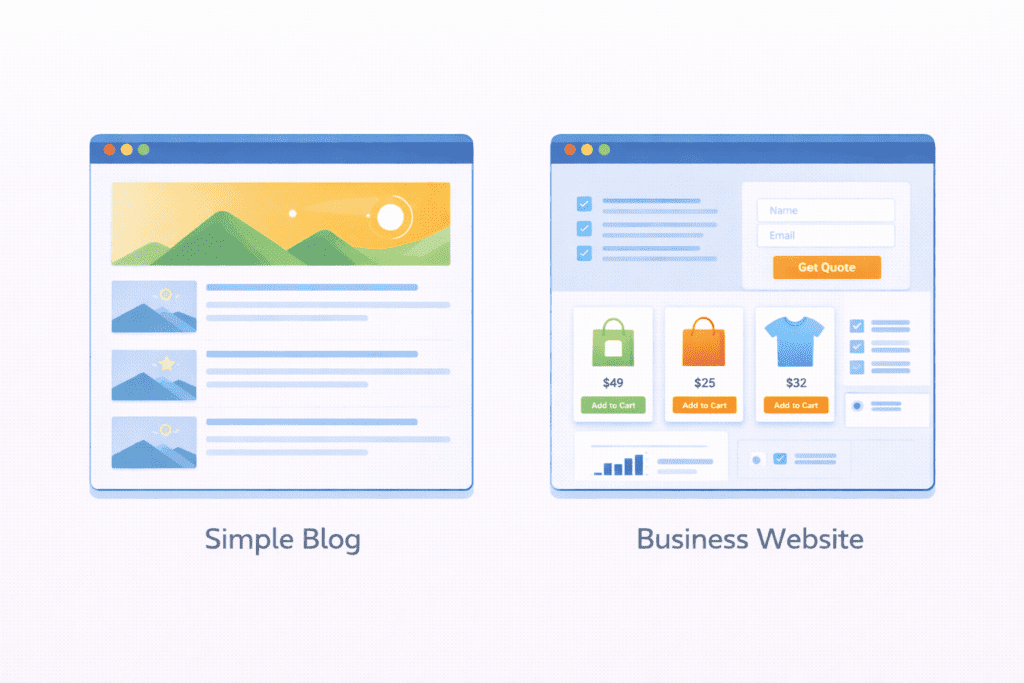
Here’s a simple fact most people miss.
Not all websites need the same kind of hosting.
And yet, a lot of users pick a random hosting plan and assume it’ll work for everything.
That’s exactly how the hosting for blogs vs business websites debate starts. Someone wants to launch a site, maybe to write content or promote a product, and ends up choosing a plan without thinking about what the site is actually supposed to do.
The result is usually one of two problems.
Either the site is overpowered and too expensive.
Or it’s underpowered and struggles as soon as traffic grows.
Both happen because blog hosting and business hosting are built for different goals.
Introduction – Hosting for Blogs vs Business Websites in 2026
In 2026, this choice matters more than it used to.
Websites are heavier. Users expect faster loading. Search engines look closely at performance, reliability, and user experience.
At the same time, more people are trying to make money online, run side projects, or build real online businesses.
So the question isn’t just what host is cheap.
It’s what type of hosting actually fits what you’re building.
Blog hosting is designed for publishing content, writing posts, and growing an audience.
Business hosting is designed for performance, stability, and handling customer interactions.
Both work. But they don’t solve the same problems.
And choosing the wrong one creates limits you don’t notice until later.
Beginner-Friendly Explanation of What Web Hosting Actually Is
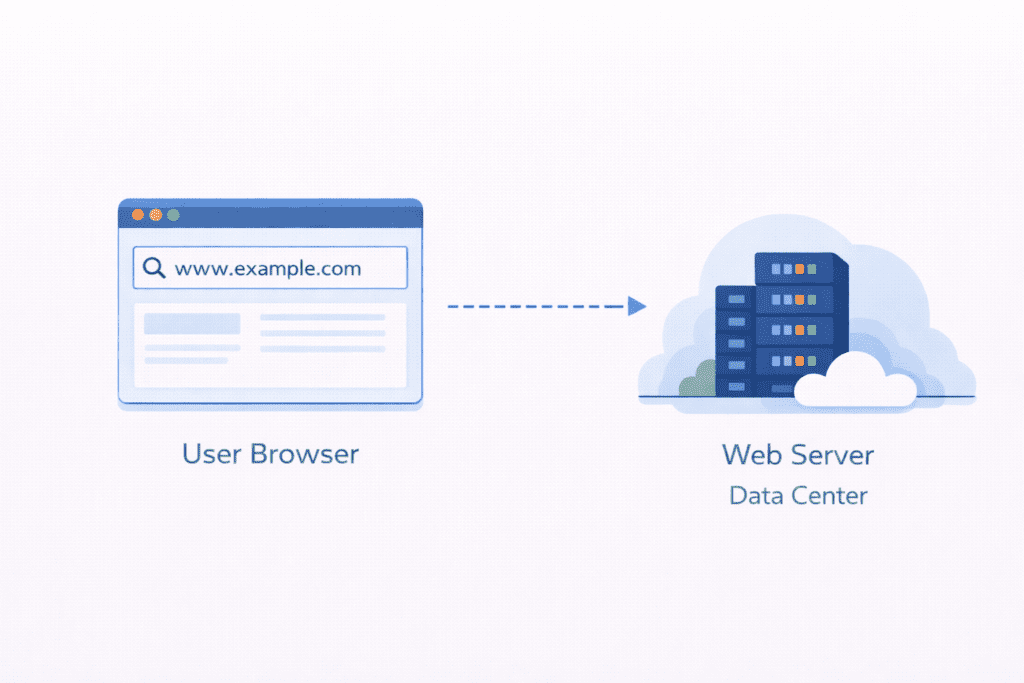
Web hosting is simply the service that keeps your site online.
Your files live on a web host, on a physical machine called a server, inside a data center.
When someone types your domain name, that server sends your site to their browser.
So every website needs hosting.
But not every website needs the same kind of setup.
A personal blog with a few blog posts doesn’t stress a server much.
A business website with forms, payments, or an online store needs more resources and better reliability.
That’s the key difference most beginners overlook.
They think hosting is just storage.
In reality, hosting affects:
Page speed.
Security.
Uptime.
How many users your site can handle at once.
And most importantly, how stressful managing the site feels.
That’s why the difference between blog hosting and business hosting isn’t technical.
It’s practical.
One is built for content and simplicity.
The other is built for performance and reliability.
And in 2026, that gap is bigger than ever.
Quick Recommendation (TL;DR)
Blog hosting: Best for simplicity, low cost, and beginners
Business hosting: Best for performance, security, and scalability
Bottom line: Choose blog hosting for content and small sites. Choose business hosting for serious commercial projects.
How We Compared Hosting for Blogs vs Business Websites
This comparison isn’t about brands or promotions.
It’s about how different hosting types behave in real situations.
The main factors we used were:
Performance criteria.
How fast pages load and how well traffic is handled.
Pricing logic.
Not just first-year deals, but long-term costs.
Security requirements.
What level of protection is included by default.
Support expectations.
How much help is needed when something goes wrong.
Growth potential.
How easy it is to upgrade as the site evolves.
These criteria matter because hosting isn’t a one-time choice.
Your site changes.
Your traffic changes.
Your goals change.
And the right hosting type is the one that still fits after those changes happen.
Before comparing blog hosting and business hosting, it helps to understand what kind of hosting you’re actually buying.
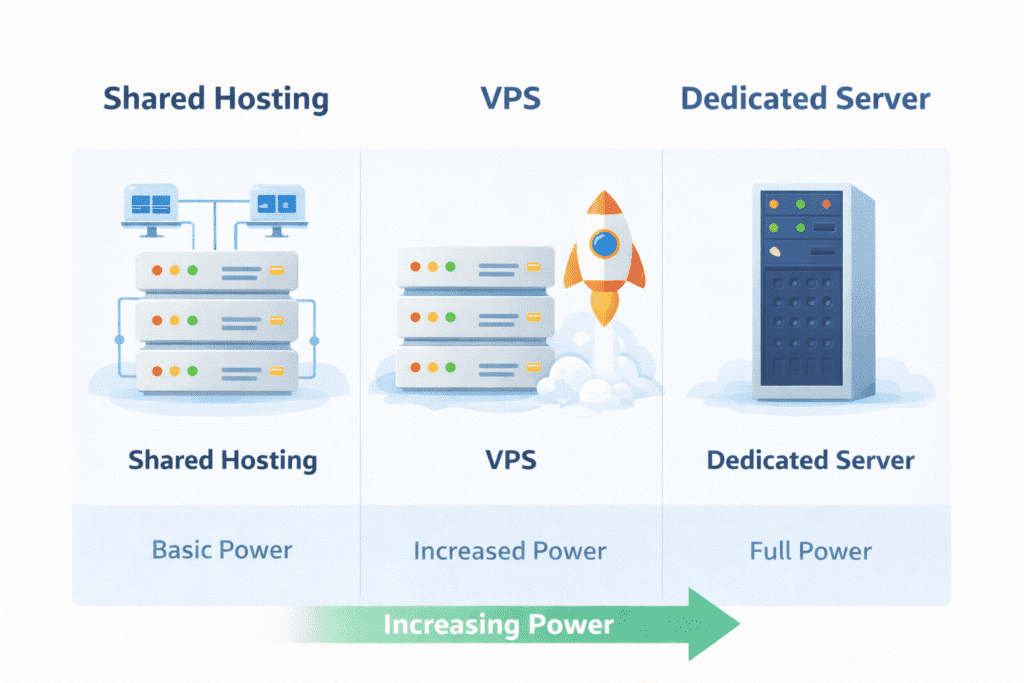
Most hosting plans fall into three categories.
Shared hosting means your site shares a server with many others. It’s the cheapest option and usually enough for small blogs and simple websites.
VPS hosting gives you a virtual slice of a server. You get more resources, better performance, and more control.
Dedicated hosting gives you an entire server. It’s powerful, expensive, and usually meant for large projects.
Both blogs and business sites can use all three.
The difference is which one makes sense for each use case.
Blogs usually start on shared hosting and move to VPS only if traffic grows.
Business websites often start directly on VPS or managed plans because reliability matters more from day one.
So the hosting types are the same.
The priorities are not.
Hosting for Blogs – Full Review

Overview
Hosting for blogs is designed for content publishing and simplicity.
It’s built for people who want to write, share ideas, and grow an audience without managing complex systems.
Most blogs use platforms like WordPress, which makes setup easy and content management simple.
The focus is on writing, not infrastructure.
What Blog Hosting Is Designed For
Blog hosting supports sites that are:
Regularly updated.
Focused on blog content.
Built around articles instead of transactions.
A blog is one type of website where content is usually presented in reverse chronological order, meaning the newest post appears first.
That structure works well for:
Personal blogs.
Niche blogs.
Tutorial sites.
Affiliate marketing projects.
In most cases, the goal is traffic, not direct sales.
Key Features
Blog hosting emphasizes simplicity and efficiency.
The key features usually include:
Easy installation of blogging software.
Basic performance tools.
Simple dashboards.
Affordable hosting plans.
Many blog hosts also include WordPress hosting, automatic updates, and one-click installs.
This reduces technical stress.
You spend more time writing and less time fixing things.
Pros
- Lower costs
- Easier setup
- Optimized for content management
Blog hosting is accessible.
You don’t need technical knowledge. You don’t need to manage servers. You just log in and publish.
That’s why so many people choose blog hosting when they start a blog.
Cons
- Limited scalability
- Lower performance ceilings
- Not ideal for heavy traffic
Blog hosting works well up to a point.
Once traffic grows, pages get heavier, or monetization expands, shared resources start to feel slow.
That’s when users realize they’ve outgrown the plan.
Best For
Hosting for blogs works best for:
Personal bloggers.
Content creators.
Affiliate marketers.
People testing ideas.
If your site is mostly blog posts, educational content, or tutorials, blog hosting is usually enough.
It’s affordable, simple, and flexible.
But it’s not built for heavy business operations.
And that’s where business hosting enters the picture.
Hosting for Business Websites – Full Review

Overview
Hosting for business websites is designed for performance, reliability, and stability.
Unlike blog hosting, the main goal isn’t just publishing content. It’s supporting real operations like customer inquiries, payments, and lead generation.
A business website usually represents a company, brand, or service. Downtime costs money. Slow pages reduce trust. Security issues damage reputation.
So business hosting is built around risk reduction, not just convenience.
What Business Hosting Is Designed For
Business hosting supports sites that:
Sell a product or service.
Collect customer data.
Handle transactions.
Serve as the main digital presence.
These sites often include:
Contact forms.
Booking systems.
Membership areas.
E-commerce tools.
They aren’t just informational. They’re operational.
That’s the key difference between a blog and a business website.
A blog informs.
A business site operates.
Key Features
Business hosting focuses on infrastructure strength.
The core features usually include:
Higher server resources.
Better uptime guarantees.
Advanced security layers.
Priority support.
Many business plans also include managed services, meaning the host takes care of updates, monitoring, and performance tuning.
This reduces risk for website owners who don’t want technical surprises.
Pros
- Better uptime
- Stronger security
- More reliable performance
Business hosting is built for stability.
It handles traffic spikes better.
It recovers faster from issues.
It protects sensitive data more effectively.
For any serious online business, this matters more than saving a few dollars.
Cons
- Higher costs
- More complexity
- Overkill for small projects
Business hosting expects more from you.
More configuration.
More decisions.
More technical awareness.
If your site is simple, this can feel unnecessary.
Best For
Hosting for business websites works best for:
Small business owners.
Service providers.
E-commerce stores.
Professional brands.
If your site is tied directly to business goals, business hosting makes sense.
It’s not about comfort.
It’s about reducing risk and protecting revenue.
Is Blog Hosting or Business Hosting Really Better for SEO?
This is where most people get confused.
They assume more expensive hosting automatically means better rankings.
That’s not exactly true.
SEO depends on:
Page speed.
Uptime.
Security.
User experience.
Both hosting types can rank.
But they perform differently under pressure.
Blog hosting is fine for SEO when:
Traffic is low.
Pages are lightweight.
Content is informational.
Business hosting performs better when:
Traffic grows.
Pages become complex.
Competition increases.
So SEO isn’t about hosting type.
It’s about whether your hosting can handle your growth.
For small sites, blog hosting is enough.
For competitive niches, business hosting becomes a real advantage.
Not because it boosts rankings directly.
But because it prevents performance problems that quietly hurt SEO over time.
Hosting for Blogs vs Business Websites: Performance Comparison
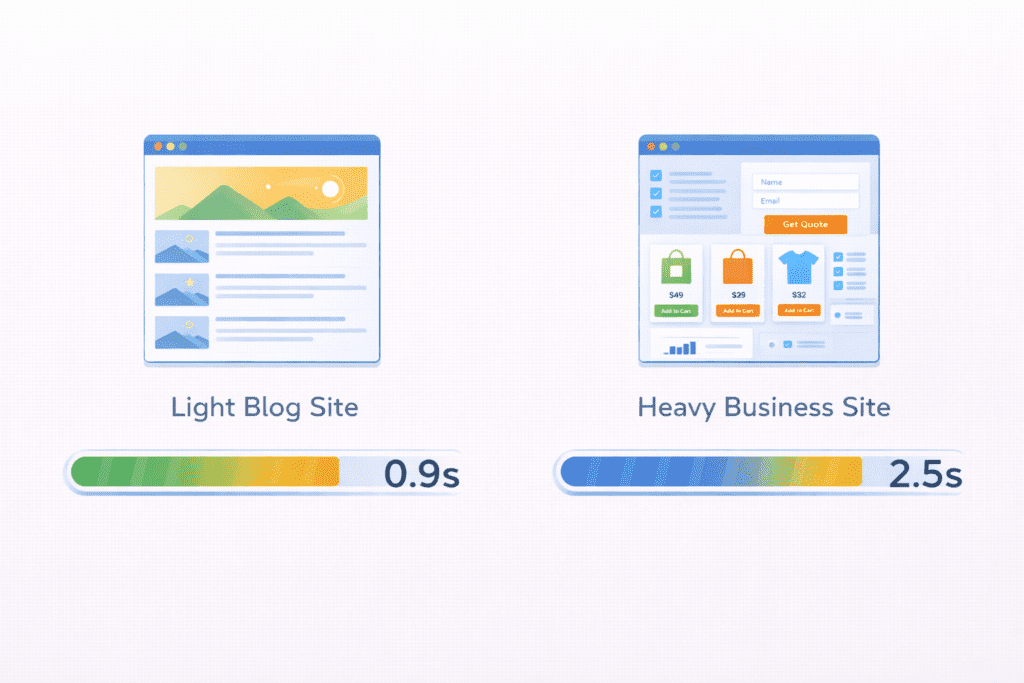
Performance is where the real difference starts to show.
Not on day one. Not when traffic is low. But when people actually begin visiting your site regularly.
Page Speed Expectations
Blog hosting is designed for lightweight pages.
Most blog pages are text-based, with a few images and simple layouts. Shared resources are usually enough to keep things fast.
Business hosting expects heavier pages.
Landing pages, product pages, forms, scripts, and tracking tools all add weight. Business hosting has more resources to handle that without slowing down.
So:
Blogs load fast when content is simple.
Business sites stay fast even when things get complex.
Traffic Handling
This is where many people feel the limit.
Blog hosting handles:
Dozens of users.
Maybe a few hundred at peak.
Business hosting handles:
Hundreds.
Thousands.
Traffic spikes from ads or promotions.
Blog hosting struggles when traffic grows suddenly.
Business hosting is built to absorb it.
That’s the key difference in real-world performance.
Server Resources
Blog hosting gives you shared resources.
CPU, memory, and bandwidth are limited and split across many users.
Business hosting gives you dedicated or semi-dedicated resources.
More power.
More stability.
More consistency.
So performance isn’t about speed alone.
It’s about how much load your site can survive without breaking.
Hosting for Blogs vs Business Websites: Pricing Comparison
Pricing is where most people make emotional decisions.
But hosting costs aren’t about the first month.
They’re about what you pay over years.
Intro Pricing
Blog hosting usually starts cheap.
Low monthly fees.
Big discounts.
Free trials.
Business hosting starts higher because it includes more resources and features.
So if you only look at the first bill, blog hosting always wins.
Renewal Pricing
This is where reality hits.
Blog hosting renews at higher rates, but still stays affordable.
Business hosting renews at premium rates and stays premium.
So long-term:
Blog hosting is cheaper.
Business hosting is more expensive but more capable.
Hidden Costs
Blog hosting has hidden costs when:
You outgrow the plan.
You need better performance.
You need security upgrades.
Business hosting has hidden costs in:
Add-on services.
Managed tools.
Premium support.
So both cost more over time.
They just charge you in different ways.
Hosting for Blogs vs Business Websites: Security Comparison
Security isn’t just about hacks.
It’s about risk exposure.
Backup Systems
Blog hosting usually includes basic backups.
Sometimes weekly.
Sometimes manual.
Business hosting includes automatic daily backups and faster recovery options.
So if something breaks:
Blog hosting recovers slowly.
Business hosting recovers quickly.
Malware Protection
Blog hosting offers basic protection.
Enough for simple sites.
Business hosting includes advanced scanning, firewalls, and monitoring.
Because business sites are bigger targets.
SSL and Compliance
Both offer SSL.
But business hosting often includes:
Compliance tools.
Stronger encryption.
Better logging.
That matters when you handle:
Payments.
Customer data.
Forms.
So security isn’t about fear.
It’s about how much damage a problem would cause.
Hosting for Blogs vs Business Websites: Scalability and Growth
This is where most mistakes happen.
People choose hosting for today, not for what happens later.
When Blog Hosting Breaks
Blog hosting breaks when:
Traffic grows.
Pages get heavier.
Monetization expands.
Shared resources start slowing things down.
Support suggests upgrading.
That’s when users realize blog hosting has limits.
When Business Hosting Becomes Necessary
Business hosting becomes necessary when:
Your site generates income.
Downtime costs money.
SEO competition increases.
At that point, performance and reliability matter more than savings.
So the real decision isn’t about now.
It’s about what you expect your site to become.
Blog hosting supports growth up to a point.
Business hosting supports growth as a strategy.
Comparison Table – Hosting for Blogs vs Business Websites
This table shows the real difference at a glance.
Not marketing promises. Not technical jargon. Just practical impact.
| Feature | Blog Hosting | Business Hosting |
|---|---|---|
| Price | Lower monthly cost | Higher monthly cost |
| Performance | Good for light content | Strong for heavy pages |
| Security | Basic protection | Advanced protection |
| Support | Standard support | Priority support |
| Ease of use | Very simple | Moderate complexity |
| Best use case | Content and traffic growth | Revenue and operations |
The pattern is consistent.
Blog hosting is built for simplicity and savings.
Business hosting is built for stability and performance.
Real-World Scenarios – Which Hosting Fits Which Type of User
This is where the decision becomes personal.
Not everyone needs the same thing.
A personal blogger usually wants:
Low cost.
Easy setup.
Simple publishing.
Blog hosting fits perfectly here.
An affiliate marketer cares about:
SEO.
Speed.
Traffic growth.
They can start with blog hosting, but often move to business hosting once earnings grow.
A small business owner needs:
Reliability.
Security.
Customer trust.
Business hosting makes more sense from the start.
An e-commerce store requires:
High uptime.
Fast pages.
Strong protection.
Business hosting is not optional here.
One real situation shows this clearly.
Someone starts a fashion blog on basic blog hosting. Traffic grows. They add ads, sponsored posts, and digital products.
At first, the site works fine.
Then pages slow down. Downtime appears. Support suggests upgrading.
They move to business hosting and everything stabilizes.
Not because blog hosting failed.
But because the project outgrew it.
That’s the normal path.
Buying Guide – How to Choose Between Hosting for Blogs vs Business Websites
This is the section that actually helps you decide.
Not features. Not charts. Just priorities.
What Actually Matters
Performance matters when your site grows.
If your site loads slowly, users leave.
Business hosting handles growth better.
Reliability matters if downtime costs you money.
Business hosting includes better uptime and monitoring.
Long-term costs matter more than intro deals.
Blog hosting stays cheaper.
Business hosting costs more but supports income.
Support matters when something breaks.
Business hosting usually includes faster help.
What Does NOT Matter
Marketing buzzwords don’t matter.
“Unlimited” claims don’t matter.
Fancy dashboards don’t matter.
What matters is:
How often you need help.
How fast your site needs to be.
How serious your project is.
Common Mistakes Buyers Make
Most people make the same errors.
Choosing Based Only on Price
Cheap hosting looks good.
Until performance becomes a problem.
Overbuying Resources
People buy business hosting for a personal blog.
They pay more for power they never use.
Ignoring Future Growth
People choose blog hosting for business sites.
They outgrow it quickly.
Using Blog Hosting for Business Sites
This causes:
Slow pages.
Downtime.
Lost trust.
It’s the most common mistake.
Who Should NOT Use Blog Hosting or Business Hosting
Some users don’t fit either category.
Hobby users who need free options shouldn’t pay at all.
One-page websites don’t need paid hosting.
Users expecting enterprise features on cheap plans will always be disappointed.
Risks and Limitations of Both Hosting Types
Both have real limits.
Blog hosting risks:
Performance bottlenecks.
Limited security.
Upgrade pressure.
Business hosting risks:
Higher costs.
More complexity.
Overkill for simple needs.
Neither is perfect.
You’re choosing tradeoffs.
Upgrade Paths and Long-Term Cost Analysis
Most people follow the same path.
Start with blog hosting.
Grow traffic.
Move to business hosting.
That’s the natural progression.
Trying to skip steps usually wastes money.
Staying too long on blog hosting usually hurts performance.
The smart move is to match hosting to your current stage, not your ego.
Frequently Asked Questions – Hosting for Blogs vs Business Websites
Is blog hosting enough for making money?
Yes, for ads and affiliate links. For serious revenue, business hosting works better.
Is business hosting overkill for beginners?
Often yes, unless you’re launching a real company site.
Which hosting is cheaper long-term?
Blog hosting is cheaper. Business hosting costs more but supports income.
Can I start with blog hosting and upgrade later?
Yes. That’s the most common path.
Is business hosting better for SEO?
It helps when traffic and competition grow.
Which hosting is more secure?
Business hosting includes stronger protection.
Do I need business hosting for WordPress?
Not at first. But it helps as your site grows.
What happens if my site grows fast?
You upgrade. That’s normal.
What is the main difference between blogs and websites?
A blog is a type of website that posts regular updates, articles, or posts about a particular subject. Websites can be static web pages with information about a business, a product, or services. Blogs are updated frequently and often allow readers to comment, while many websites are static and do not need to be updated as often.
Should I choose hosting for blogs and websites or a hosting service for a business site?
Choose a hosting provider based on what you plan to publish. If you want dynamic content and frequent posts, pick hosting that supports blogs and websites with easy updates. For a company website or main business site, pick reliable hosting companies that offer uptime, security, and support for a custom domain name and e-commerce features to sell products or services.
Can a blog be part of a larger business website?
Yes. Many websites have a blog section to share news, digital marketing tips, or updates that help customer relationships. A blog and a website together can improve SEO, show expertise, and provide content that helps you make money online through monetization methods like sponsored content or selling digital products.
Is hosting more expensive for a blog or a full business website?
Hosting cost depends on features, not just whether it is a blog or website. A simple blog can work on basic shared hosting or a free domain option, while a full-fledged website with e-commerce, many websites or traffic needs will need stronger hosting like VPS or dedicated hosting. Reputable web hosts offer plans for both budgets.
What hosting features matter for blogs and websites that want to make money?
Look for fast servers, good uptime, SSL security, and easy backups. For monetization opportunities you also want e-commerce support to sell products, payment options for selling digital products, and tools for sponsored content or ads. A hosting provider that helps you create a website and set up a blog will save time.
How do blogs and websites differ in content and tone?
Blogs are generally written in a casual or conversational tone and focus on a particular subject. Websites tend to be more formal and professional, especially company website pages that explain services or policies. Both can use dynamic content, but blogs are updated regularly while websites are often static information pages.
Can a blog owner use the same hosting for a business blog and main website?
Yes. A single hosting service can host multiple sites or a main website with a blog section. Using the same hosting provider makes it easier to manage a custom domain name, backups, and website design so the brand looks consistent and you can build a stronger online presence.
Which is better for SEO: a website or a blog?
Blogs help SEO because updated frequently content and targeted posts attract search traffic. Websites are important for stable pages like contact info, services, and company pages. Using both a website with a blog gives the best chance to rank for more keywords and improve digital marketing results.
Final Verdict – Hosting for Blogs vs Business Websites in 2026

There’s no universal winner here.
Just better fit.
If your goal is content, traffic, and learning, blog hosting is enough.
If your goal is income, customers, and growth, business hosting is the smarter choice.
The real mistake isn’t choosing wrong.
It’s choosing without thinking about what your site is supposed to become.