
If you’re building a new website in the US, one of the first questions you’ll hit is:
Should I start with free hosting or pay for hosting?
Here’s what I noticed when I first looked into this – free options sound great. No credit card. No bills. Just sign up and go. But then people start warning you about limits, ads, and poor performance. That’s where the confusion begins.
This guide will help you understand:
- What free web hosting really is
- What paid hosting actually gives you
- And how to make an informed decision for your goals
Most US beginners start free because it feels safe. But is it the best move? Let’s find out.
What Is Free Web Hosting?

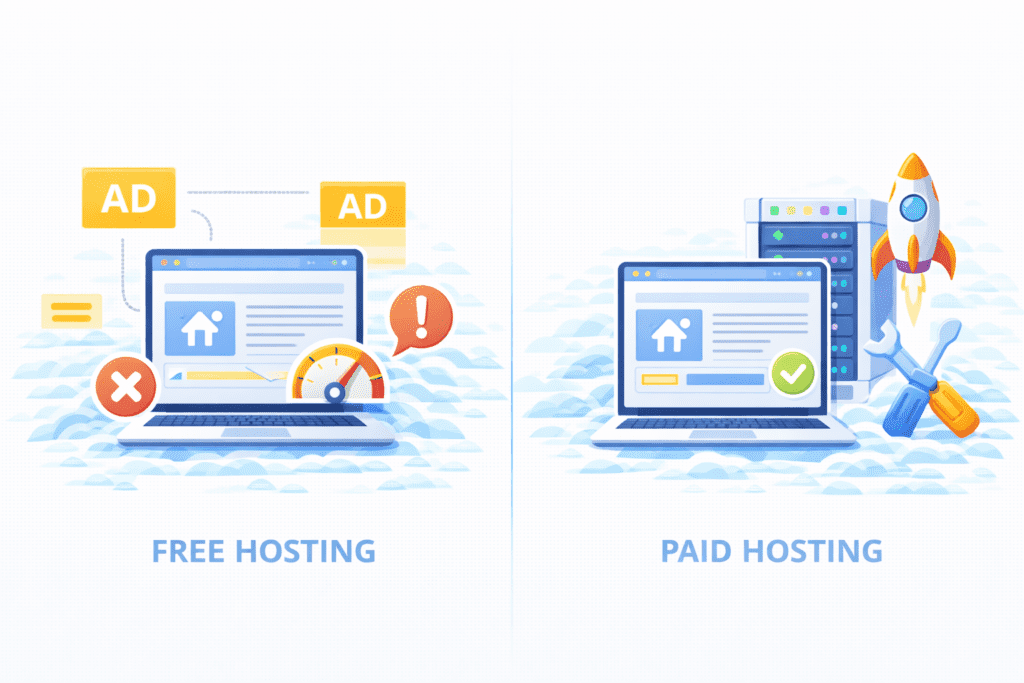
Free web hosting is a hosting service where you don’t pay money to put your site online.
Sounds perfect, right? But here’s the thing.
With most free hosting providers, you:
- Get limited storage and bandwidth
- Use a subdomain instead of a custom domain
- See ads on your website that you can’t remove
- Have little to no technical support
In many cases, free hosting is a service meant for testing, learning, or very small personal projects. The company still needs to make money, so they often show irrelevant ads or push upgrades.
Free hosting may be helpful for practice. But it comes with trade-offs.
What Is Paid Web Hosting?

Paid web hosting means you pay a hosting company a monthly or yearly fee to host your site.
With a paid plan, you usually get:
- Your own custom domain
- Better uptime and stable performance
- More bandwidth and storage space
- Real customer support and technical support
- Security tools like ssl certificates and a firewall
- More customization and complete control
Most web hosting companies in the US offer beginner plans for a few dollars a month. These plans are designed for blogs, business sites, and even e-commerce stores.
In short, paid hosting gives you tools to grow and look professional.
Free vs Paid Web Hosting: The Core Difference
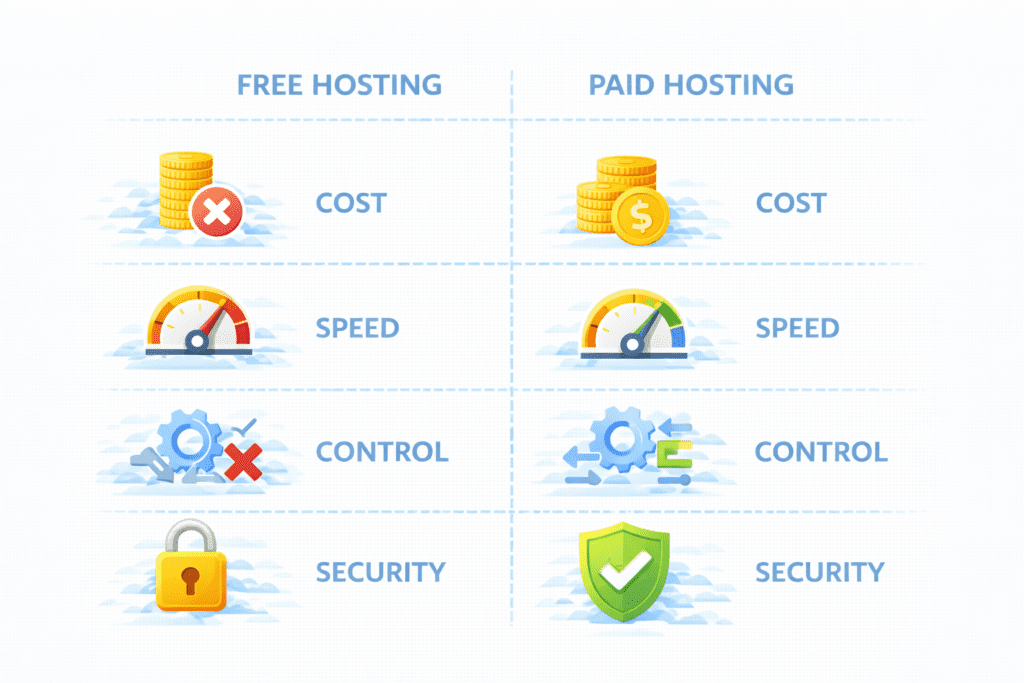
So what’s the real difference between free vs paid web hosting?
Let’s break it down.
💰 Cost vs Features
Free costs nothing. Paid hosting gives you more features for a small fee.
🔒 Control vs Limits
Free hosting limits what you can do. Paid hosting gives more freedom.
🏠 Ownership vs Restrictions
With paid hosting, your site feels like yours. With free hosting, it feels borrowed.
These are the key differences most beginners in the US notice quickly.
This is the heart of the free vs paid debate.
Comparison Table – Free vs Paid Web Hosting
Here’s a simple side-by-side view to show the key differences between free and paid options:
| Feature | Free Web Hosting | Paid Web Hosting |
|---|---|---|
| Cost in the US | $0 | $2–$10/month (starter) |
| Storage & bandwidth | Very limited | More storage and bandwidth |
| Performance | Often slow | Better performance & faster page |
| Custom domain | Rare | Yes, custom domain included |
| Ads & branding | Display ads | No forced ads |
| Security | Basic or none | SSL, firewall, backups |
| Support | Little or none | Real customer support |
| Scalability | Poor | Ability to scale |
| SEO impact | Weak | Higher search engine rankings potential |
These are the main distinctions between free and paid hosting.
Pros and Cons of Free Web Hosting
Let’s talk honestly about the pros and cons.
✅ Benefits of Free Hosting
- No cost – great if you can’t pay
- Easy to start
- Good for learning web development
- Works for testing ideas or school projects
This is why many beginners try free web hosting vs paid at first.
❌ Downsides of Free Hosting
- Ads on your website you can’t control
- Often a subdomain instead of your own name
- Limited bandwidth and slow page loading
- Weak security – harder to protect your website
- Little or no support – a big lack of technical support
- Can look less professional for a business website
- Risk of an error page or shutdown anytime
Free hosting may feel okay at first. But once your site grows, these limits show fast.
Pros and Cons of Paid Web Hosting
Now let’s look at paid hosting.
✅ Benefits of Paid Hosting
These are the advantages of paid hosting most US users care about:
- Faster speed and stable performance
- Better uptime for visitors
- Use your own custom domain
- Stronger security tools
- Real hosting support when you need help
- More server resources
- Easy to scale your website as traffic grows
- Helps with search engine rankings
In most cases, paid hosting provides a solid base for a serious site.
❌ Downsides of Paid Hosting
- You have to pay for hosting every month or year
- Renewal prices can be higher
- Too many plans can confuse beginners
Still, for most goals, these downsides are small compared to the benefits.
Who Should Use Free Web Hosting in the US?
Free hosting can make sense if you are:
- Just learning and experimenting
- Building a test site
- Working on small personal projects
- Not worried about SEO or growth
If your goal is practice, use free options can be fine.
But if your goal is traffic, trust, or income? Free is usually not enough.
Who Should Use Paid Web Hosting in the US?
Paid hosting is better if you are:
- Starting a blog
- Running a business website
- Planning e-commerce
- Using WordPress or another content management system
- Serious about SEO and growth
If you care about website performance, trust, and future success, paid hosting is usually the right move.
How Much Does Paid Web Hosting Cost in the US?

Let’s talk numbers, because this is where many beginners pause.
In the US, most paid hosting plans for beginners fall into these ranges:
- $2–$5/month → basic starter sites
- $5–$10/month → blogs and growing sites
- $10–$20/month → higher traffic or small e-commerce projects
These usually come with:
- A paid plan that includes a custom domain
- Enough bandwidth for beginners
- Decent uptime and security
- Access to customer support
Here’s the thing I noticed from research: the first year is often cheap, but renewals can be higher. Many people forget to check that.
So when you pay for hosting, always look at both the intro price and the renewal.
What Do Most US Users Prefer and Why?
From what I’ve seen, most US beginners start with free. But most serious site owners quickly move to paid.
Why?
Because they care about:
- Speed and faster page loads
- Trust – no irrelevant ads
- Better user experience
- Stronger search engine rankings
- Real technical support when something breaks
For blogs and businesses, paid hosting feels more reliable. Free hosting often feels temporary.
Bottom line?
Free is for testing. Paid is for building something real.
Common Mistakes Beginners Make When Choosing Free vs Paid
Let’s be real for a second. These mistakes show up a lot.
🚫 Starting Free for Serious Projects
Many people build a blog or business website on free hosting, then struggle with limits. Moving later is harder.
🚫 Ignoring Renewal Costs
They see $2/month and forget it may become $8–$12/month later.
🚫 Not Planning for Growth
If you want to grow and develop, free hosting will likely block you.
🚫 Assuming All Hosts Are the Same
Not all web hosting services are equal. Some hosting providers offer great support. Others don’t.
These mistakes can slow your progress fast.
Is Free Hosting Good for SEO in the US?

Short answer? Usually no.
Here’s why free hosting often hurts SEO:
- Uses a subdomain, not a real custom domain
- Slow page loading
- Poor uptime
- Forced ads
- Weak trust signals for Google
All this affects your search engine rankings.
Paid hosting gives:
- Better speed
- Cleaner URLs
- More control
- More trust
That’s why most sites that rank well in the US use paid hosting.
If SEO matters to you, free hosting is rarely the best fit.
Can You Start Free and Upgrade to Paid Later?
Yes, you can. And many do.
But here’s what usually happens:
- You build on free
- Hit limits (speed, ads, space)
- Then move to paid
This move isn’t always seamless. You may face:
- Migration issues
- Broken links
- Lost settings
- Downtime
In most cases, it’s easier to start with paid if your goal is serious.
That said, starting free can be okay if you truly just want to test.
FAQs – Free vs Paid Web Hosting
Is free hosting really free?
Yes, but you “pay” with limits, ads, and less control.
Will free hosting show ads?
Most of the time, yes. You’ll see ads on your website or banners you can’t remove.
Can I use my own domain?
Rarely with free. Paid hosting almost always supports a custom domain.
Is paid hosting worth it for beginners?
In most cases, yes – especially if you want traffic, trust, or growth.
What Should You Do Next After This Comparison?
Now that you’ve seen the free and paid web hosting differences, here’s what I’d suggest you do next.
1️⃣ Decide Your Website Goal
Ask yourself:
- Is this just a test or learning project?
- Or do I want real traffic and trust?
If it’s serious – blog, brand, or business website – paid hosting fits better.
2️⃣ Check Your Budget
Even $3–$5 a month can go a long way in the US market. That small cost can mean:
- Better speed
- Better user experience
- Fewer headaches
3️⃣ Compare Hosting Options
Look at:
- Entry-level shared plans
- Beginner hosting solutions
- What hosting providers offer in terms of support
This helps you choose the best fit for your site.
4️⃣ Think Long-Term
Do you want to:
- Improve search engine rankings?
- Add features later?
- Scale your website as it grows?
If yes, paid hosting saves time in the long run.
This is how you really make an informed decision.
Final Thoughts

Let’s bring it all together in plain English.
Free web hosting is good if:
- You’re just learning
- Testing ideas
- Working on small personal projects
- And don’t care much about SEO or branding
But paid hosting is better if:
- You want a serious blog or new website
- You care about trust and speed
- You don’t want irrelevant ads
- You want better website performance
- You plan to grow into high traffic
From my research, most US beginners who start free end up switching to paid anyway. Not because free is useless – but because it’s limiting.
So what’s my honest take?
👉 If you’re serious, skip the hassle and start with paid.
👉 If you’re just testing, free can be okay for now.
Bottom line?
Paid hosting gives you the foundation to grow and develop something real. Free hosting is just a starting point.
Once you pick the right base, everything else gets easier.