

Running an online store in 2026 is very different from a few years ago. Customers expect fast pages, secure checkout, and zero downtime-especially in the US, where competition is high and patience is low.
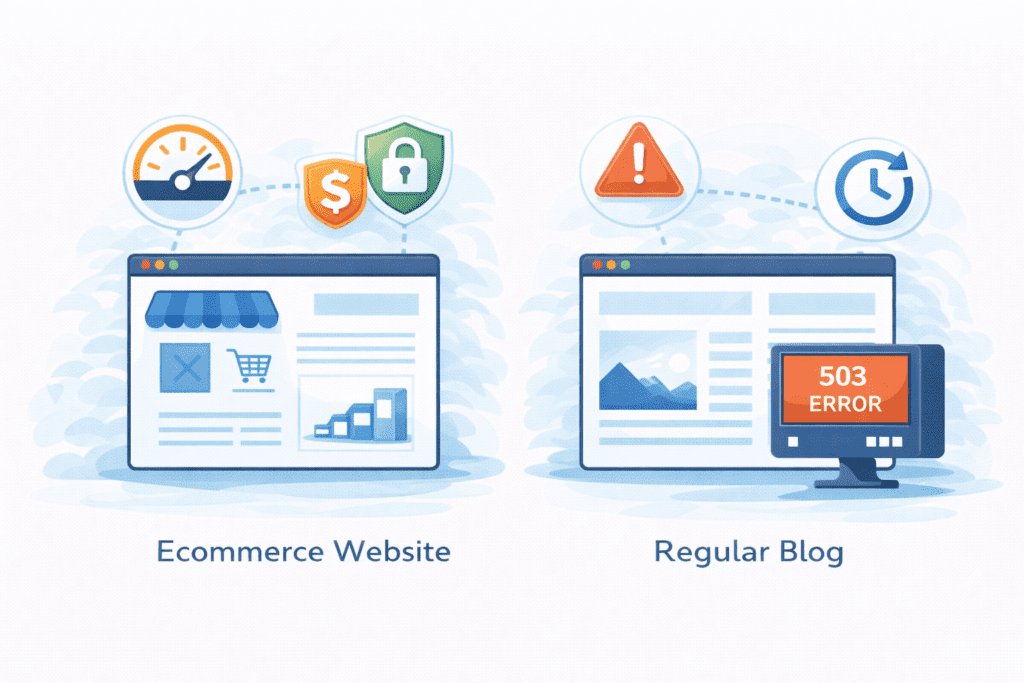
Many beginners assume regular hosting is enough for an e-commerce website. That usually works at the start, but problems show up quickly. Slow product pages, checkout errors, or brief outages can cost real sales. e-commerce hosting needs stronger performance, tighter security, and better reliability than a basic blog or portfolio site.
This guide is for beginners, small online stores, and growing e-commerce brands in the US. If you’re looking for the best hosting for e-commerce websites, this list breaks down which platforms actually support online selling in 2026-and which ones make growth harder than it needs to be.
How We Chose the Best E-Commerce Web Hosting
Not every web host is built for e-commerce. Selling online puts pressure on the server, payment systems, and security setup. That’s why this list focuses on real e-commerce needs, not just marketing claims.
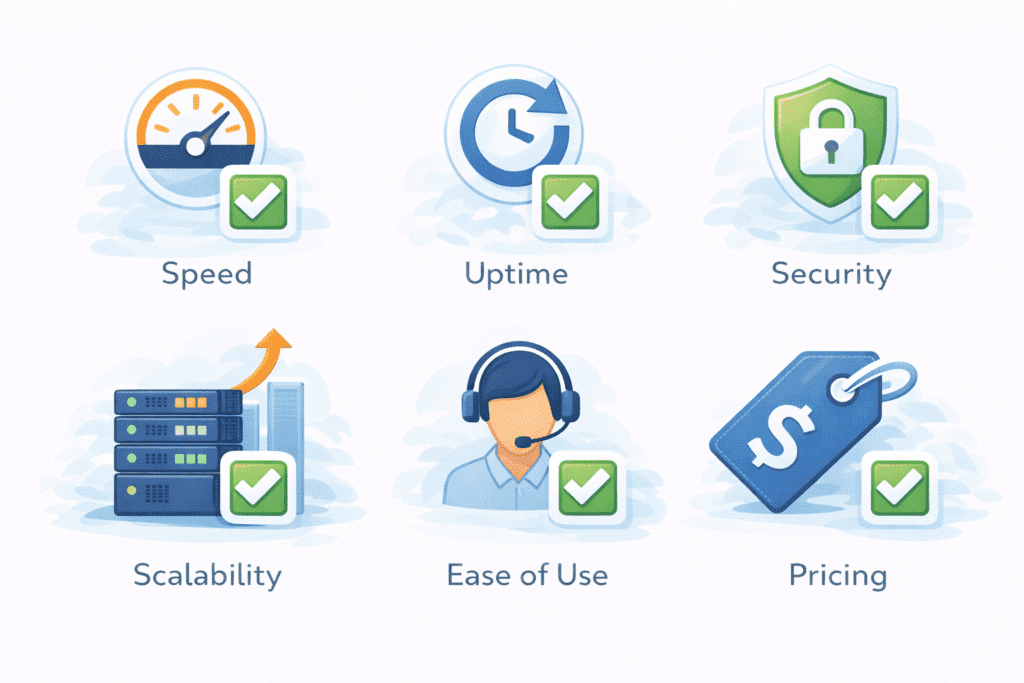
Website speed was a major factor. Product pages and checkout flows must load fast for US shoppers. Hosting providers that deliver consistent performance ranked higher.
Uptime and reliability also mattered. An e-commerce store can’t afford downtime, even for short periods. Hosting companies with strong uptime records stood out.
Security was another priority. e-commerce sites handle payments and customer data, so free SSL, secure servers, and compliance support were essential.
Ease of use was considered too. Many store owners don’t want to manage servers. Hosting solutions that simplify setup and daily management ranked higher.
Scalability played a key role. As an online store grows, hosting must grow with it-especially during sales events or seasonal traffic spikes.
Finally, pricing and long-term value were reviewed. Intro prices look good, but renewal costs and included features matter more over time.
Quick Comparison – Best E-Commerce Hosting Providers (2026)

Each e-commerce hosting provider on this list supports different types of stores.
Some platforms work best for beginners who want everything included. Others are better for WooCommerce users who want control and flexibility. A few focus on cloud performance for fast-growing e-commerce sites.
Price ranges vary, but the goal here isn’t the cheapest option. It’s finding the best hosting for e-commerce websites based on performance, security, and long-term stability for US businesses.
In the next sections, each provider is reviewed in detail so you can match the right host to your online store’s needs.
1. Shopify – Best All-in-One E-Commerce Hosting
Why Shopify Is Popular for Online Stores
Shopify is one of the most widely used e-commerce platforms in the US. It’s popular because everything is bundled together-hosting, security, checkout, and store management.
Hosting, Security, and Payments Included
With Shopify, you don’t need to manage a separate web host. Hosting, free SSL, and payment processing are built in. This makes it a strong choice for beginners who want to launch an online store quickly.
Pros
Easy setup, reliable uptime, and strong e-commerce features out of the box.
Cons
Less flexibility compared to self-hosted platforms, and transaction fees can add up.
Best For
Beginners and small businesses that want a simple, fully hosted e-commerce solution.
2. Bluehost – Best for WooCommerce Beginners

WooCommerce-Optimized Hosting
Bluehost offers hosting plans optimized for WooCommerce. This makes it easier to run a WordPress-based online store without manual configuration.
Performance for US Customers
US-based servers help maintain stable performance for shoppers. Bluehost also includes a free domain and SSL certificate on many plans.
Pros
Beginner-friendly setup, WooCommerce integration, and affordable entry pricing.
Cons
Renewal prices are higher, and advanced performance features are limited on lower plans.
Best For
Small online stores using WooCommerce for the first time.
3. SiteGround – Best for Speed and Reliability

Speed Features for Online Stores
SiteGround is known for fast load times and consistent uptime. Built-in caching and performance tools help e-commerce sites stay responsive.
Built-In Security and Backups
Daily backups, proactive security, and free SSL certificates protect e-commerce websites handling customer data.
Pros
Excellent speed, strong support, and reliable infrastructure.
Cons
Higher pricing compared to budget e-commerce hosting options.
Best For
Store owners who prioritize speed, uptime, and support over low cost.
4. Hostinger – Best Budget E-Commerce Hosting
Affordable Plans for Small Stores
Hostinger is known for low-cost hosting plans that still support e-commerce features. This makes it appealing for small or early-stage online stores.
Performance and Limitations
Performance is solid for small e-commerce sites, but high-traffic stores may outgrow entry-level plans faster.
Pros
Low pricing, modern dashboard, and good value for beginners.
Cons
Limited resources on cheaper plans and fewer advanced e-commerce tools.
Best For
Budget-conscious e-commerce beginners testing their first online store.
5. Cloudways – Best Managed Cloud Hosting for E-Commerce

Managed Cloud Hosting Explained
Cloudways offers a managed cloud setup where the provider handles the server while you focus on your e-commerce site. You choose a cloud infrastructure, and Cloudways manages performance, security, and updates.
Handling Traffic Spikes and Sales Events
This platform is built to handle sudden traffic increases, which is common during promotions and seasonal sales. Scaling resources is easier compared to traditional shared hosting.
Pros
High performance, flexible scaling, and strong reliability.
Cons
More complex than beginner platforms and pricing depends on usage.
Best For
Growing e-commerce stores that need cloud power without managing servers.

Enterprise-Level Performance
WP Engine focuses on premium managed WordPress hosting, with strong support for WooCommerce stores. Servers are optimized specifically for WordPress performance.
Security and Developer Features
Advanced security, daily backups, and staging environments make it easier to manage a serious e-commerce website.
Pros
Excellent speed, strong security, and expert support.
Cons
Higher cost compared to most e-commerce hosting providers.
Best For
Established WooCommerce stores that want premium performance and support.
7. A2 Hosting – Best for Fast Checkout Pages
Speed-Focused Hosting Features
A2 Hosting emphasizes speed with performance-tuned servers. Faster checkout pages can improve conversions for e-commerce stores.
US Server Options
Multiple US server locations help reduce latency for shoppers, which matters during checkout.
Pros
Strong speed focus, flexible hosting plans, and good scalability options.
Cons
Top performance plans cost more than entry-level options.
Best For
Online stores that want faster page loads and smoother checkout performance.
8. BigCommerce – Best for Growing Online Stores

Built-In E-Commerce Tools
BigCommerce includes many e-commerce features out of the box, such as product management, payment options, and analytics.
Scalability for US Businesses
The platform supports growth without requiring major hosting changes, making it suitable for expanding e-commerce businesses.
Pros
Strong built-in tools, scalable infrastructure, and reliable performance.
Cons
Monthly costs are higher, and customization can feel limited.
Best For
Mid-size and growing online stores that want built-in scalability.
9. InMotion Hosting – Best for Business-Focused E-Commerce

Business Hosting Features
InMotion Hosting is built with business needs in mind. It offers solid performance, e-commerce-ready tools, and plans that support growth beyond a basic online store.
Support and Reliability
US-based support and dependable uptime help keep e-commerce sites stable. This matters when stores rely on consistent access for orders and customer service.
Pros
Reliable infrastructure, business tools included, and good support.
Cons
Not the cheapest option for very small stores.
Best For
Small to mid-size e-commerce businesses that want dependable hosting with room to grow.
10. GoDaddy – Best for Simple Online Stores
Easy Store Setup
GoDaddy makes it easy to launch a basic e-commerce website. Tools for domains, hosting, and simple stores are bundled together.
Hosting and Marketing Tools
Email hosting, domain management, and basic marketing features are included, which appeals to beginners who want everything in one place.
Pros
Beginner-friendly setup and familiar interface.
Cons
Average performance and higher renewal pricing.
Best For
Very small online stores or local businesses selling a few products.
Types of E-Commerce Hosting Explained
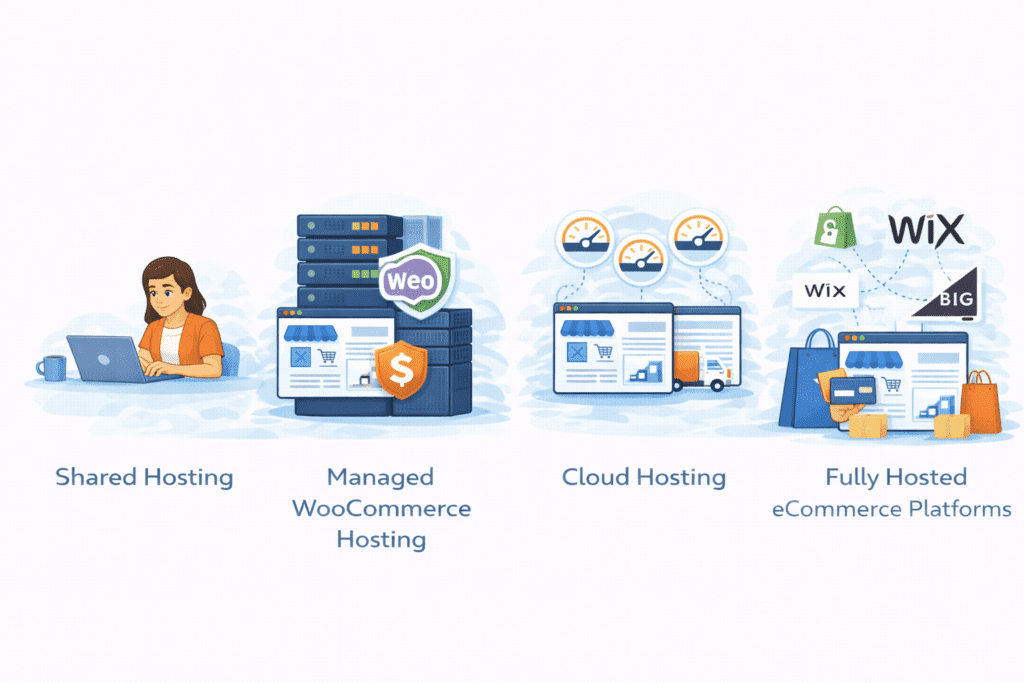
Shared hosting can work for very small online stores, but resources are limited and performance can drop as traffic grows.
Managed WooCommerce hosting focuses on WordPress and WooCommerce stores. Updates, security, and performance tuning are handled by the host.
Cloud hosting is designed for scalability. It’s useful for stores that expect traffic spikes during sales or promotions.
Hosted platforms, like Shopify or BigCommerce, bundle hosting with the e-commerce platform itself. Self-hosted stores use platforms like WooCommerce and choose their own hosting provider.
– A checkout page that slows down during a sale can lose orders even if the rest of the site loads fine.
Key Features E-Commerce Hosting Must Have
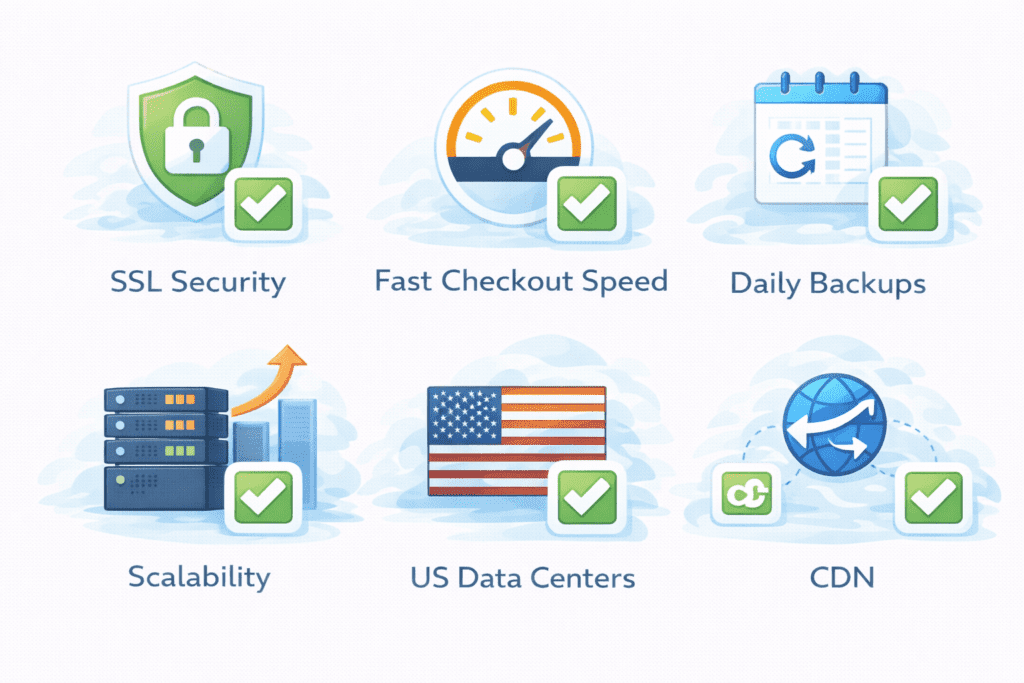
SSL and payment security protect customer data and build trust. Fast load times keep shoppers engaged and reduce cart abandonment.
Daily backups help recover quickly if something breaks. Scalability matters during promotions, holidays, or sudden traffic increases.
US data centers and CDN support improve performance for American shoppers and help maintain consistent speed.
Common E-Commerce Hosting Mistakes to Avoid
Choosing the cheapest plan often leads to slow performance or weak security.
Ignoring security features puts payment data at risk.
Underestimating traffic growth causes crashes during busy periods.
Poor checkout performance directly affects sales and customer trust.
Avoiding these mistakes makes running an e-commerce site smoother.
FAQs – Best Web Hosting for E-Commerce
What is the best hosting for e-commerce in the US?
It depends on store size and platform. Beginners often choose all-in-one platforms, while WooCommerce users prefer optimized hosting.
How much does e-commerce hosting cost in 2026?
Costs range from entry-level plans to premium managed options, depending on features and traffic.
Is shared hosting good for online stores?
Only for very small stores. Most e-commerce sites outgrow shared hosting quickly.
Do I need managed hosting for WooCommerce?
It’s not required, but it simplifies maintenance and improves stability.
Can I switch e-commerce hosting later?
Yes. Many stores change hosts as they grow.
What is the best e-commerce hosting for online stores?
The best e-commerce hosting depends on your online store needs: small shops often start on a shared hosting plan or a cloud startup plan, while growing businesses may prefer VPS hosting or dedicated hosting for performance and security. Look for e-commerce hosting solutions that include PCI compliance, SSL, fast hosting space, and support for popular e-commerce applications and platforms like WooCommerce, Shopify, or Magento to pick the right e-commerce hosting provider.
How do I choose an e-commerce hosting provider for my online business?
Choose an e-commerce hosting provider by comparing hosting packages, hosting types (shared, VPS, dedicated, cloud), managed e-commerce vs unmanaged hosting, available e-commerce hosting plans, and the provider’s reputation among web hosting companies. Consider uptime guarantees, scalability for when you grow your business, backup options, customer support, and whether the hosting you choose includes specialized e-commerce features like payment gateway support and staging environments.
Is shared hosting suitable for e-commerce websites?
Shared hosting plan options can be suitable for new online stores with low traffic because they are cost-effective and often include a website builder and basic web hosting service features. However, because hosting isn’t dedicated, shared hosting may lack the performance, security, and resources required as you scale. Many recommend starting on a shared plan and upgrading to VPS hosting plan or managed e-commerce hosting as sales increase.
Should I use managed e-commerce hosting or unmanaged hosting?
Managed e-commerce hosting is ideal if you want support with server management, security, automatic updates, and backups so you can focus on sales and marketing. Unmanaged hosting gives more control and may lower costs if you have technical skills. For most merchants looking for the right e-commerce hosting with minimal downtime and PCI-compliant setups, fully managed hosting or specialized e-commerce hosting services are the safer choice.
What type of hosting is best for large or high-traffic e-commerce sites?
For high-traffic stores, dedicated hosting or a scalable cloud hosting solution is often best. Cloud hosting is the best for elasticity because it allows you to scale resources during peak seasons. VPS hosting can be a middle ground, providing dedicated resources at a lower price than dedicated servers. Evaluate hosting plans for CPU, RAM, storage, CDN integration, and database performance to ensure your e-commerce web hosting meets demand.
Do web hosting companies provide e-commerce-specific features?
Yes, many web hosting companies now offer e-commerce hosting solutions with features tailored to online stores: PCI-compliant payment processing, one-click installs for e-commerce platforms, staging environments, SSL certificates, dedicated e-commerce features, and performance optimizations for e-commerce applications. When choosing, review the list of the best e-commerce hosting services and confirm they support the e-commerce applications you plan to use.
How important is customer support when picking the best e-commerce hosting provider?
Best customer support is critical because any downtime or checkout issues directly affect revenue. Look for hosting companies that offer 24/7 support, specialized e-commerce expertise, fast response times, and managed services. Providers that advertise great e-commerce support and assistance with migrations, security, and performance tuning will help you manage your e-commerce more effectively.
Can I use a website builder and still get reliable e-commerce web hosting?
Yes, many website builder platforms bundle website hosting with easy e-commerce tools – useful for entrepreneurs who want to create your e-commerce quickly. However, ensure the website builder’s hosting service supports your growth: check hosting space limits, payment integrations, SEO features, and whether you can upgrade to more powerful hosting packages or migrate to a specialized hosting company later.
Which hosting types should I consider if I want to scale my e-commerce store?
Consider cloud hosting, VPS hosting, and dedicated hosting as your scaling options. Cloud hosting providers offer flexible resources and are often the best e-commerce web hosting choice for scalability. VPS hosting plan upgrades give you predictable resources, while dedicated hosting provides maximum performance and control. Choose an e-commerce hosting provider that offers clear upgrade paths and scalable e-commerce plans.
What are the top factors to compare in a list of the best e-commerce hosting providers?
Compare uptime and reliability, speed, security (PCI compliance and SSL), backup and recovery, available hosting packages, pricing, scalability, supported e-commerce platforms (including WordPress hosting plans for WooCommerce), and the provider’s track record among popular web hosting companies. Also factor in specialized hosting for e-commerce, add-on services, and whether the hosting comes with marketing, analytics, or developer tools to help you grow your business.
Final Thoughts – Choosing the Best E-Commerce Hosting in 2026
There’s no one-size-fits-all answer. The best hosting for e-commerce websites depends on how your store operates, how fast you plan to grow, and how much control you want.
Choose a host that supports secure payments, fast checkout, and reliable uptime. When hosting matches your store’s needs, selling online becomes easier-and growth feels manageable instead of stressful.