
Web hosting decides how your website runs every day. It affects speed, security, and how many visitors your site can handle. In 2026, picking the wrong hosting type can slow growth or create problems much sooner than expected.
This guide explains VPS vs Shared Hosting in simple terms. No technical overload. No sales talk. Just clear differences that matter for real websites in the US.
Many beginners start with shared hosting because it’s affordable and easy. Others move to VPS hosting when their site grows. The challenge is knowing when shared hosting is enough and when VPS hosting becomes the better choice.
This comparison is made for:
- Beginners building their first website
- Bloggers expecting traffic growth
- Small businesses planning for stability
By the end of this guide, you’ll understand how VPS vs Shared Hosting works, what each option offers, and which one fits your needs in 2026.


Shared hosting is the most common entry-level hosting option. It’s often recommended for new websites because it keeps costs low and setup simple.
With shared hosting, many websites are placed on the same server. That server stores files, runs software, and delivers pages to visitors. All sites on that machine use the same physical hardware.
Your web host manages the server. You don’t control server settings directly. Instead, you manage your website through a control panel provided by the hosting provider.
This setup lowers costs because the server is shared across many users.
Resources and Server Sharing
In a shared hosting plan, server resources like CPU, memory, and bandwidth are shared among all websites on the same server.
If one site uses too many resources, others may feel the impact. That’s why shared hosting plans usually include usage limits, even if they aren’t always obvious.
This shared server structure works well for small sites but has performance limits.
Typical Use Cases
Shared hosting is commonly used for:
- Personal blogs
- Small business websites
- Informational sites
- New projects with low traffic
For websites with steady but light traffic, shared hosting is usually enough.
Main Advantages
The biggest advantage of shared hosting is affordability.
Other benefits include:
- Easy setup
- No server maintenance required
- Beginner-friendly dashboards
- Simple WordPress installation
For many people, shared hosting is the fastest way to get online.
Main Limitations
Shared hosting also has downsides.
Because resources are shared, performance can drop during busy periods. You have limited control over server settings. Security can be affected if another site on the same server has issues.
As traffic grows, these limits become more noticeable.
What Is VPS Hosting?
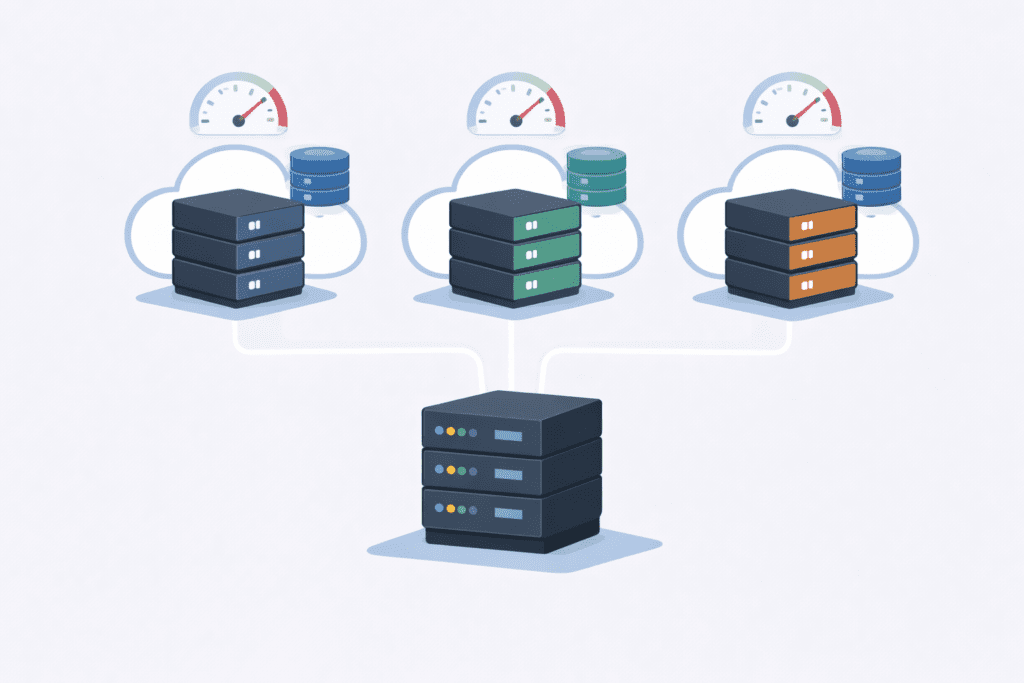
VPS hosting sits between shared hosting and dedicated hosting. It offers more power and control than shared hosting, without the high cost of a full dedicated server. When people compare VPS vs Shared Hosting, this is usually where the difference starts to matter.
How VPS Hosting Works
VPS stands for Virtual Private Server.
In VPS hosting, a single physical server is divided into multiple virtual servers using virtualization technology. Each virtual server acts like an independent server with its own operating system, resources, and settings.
Even though multiple VPS users are on the same physical server, each VPS runs in its own isolated environment. This isolation is what makes VPS hosting more reliable than shared hosting.
Your web host still owns and maintains the physical server, but your website runs inside its own virtual space.
Dedicated Resources Explained
One major difference in VPS vs Shared Hosting is how resources are handled.
With VPS hosting, you get dedicated resources. This means a fixed amount of CPU power, RAM, and storage is reserved for your site. Other websites cannot use those resources.
This prevents performance problems caused by neighboring sites and gives your website consistent speed.
Dedicated resources are especially important for:
- Growing blogs
- Business websites
- Online stores
- Sites with traffic spikes
Virtualization Basics
Virtualization is the technology that makes VPS hosting possible.
It allows one physical server to behave like multiple independent servers. Each virtual server has its own environment, even though the hardware is shared underneath.
This setup gives users the benefits of a dedicated server at a lower cost. That’s why VPS hosting is often seen as the middle ground in VPS vs Shared Hosting comparisons.
Main Advantages of VPS Hosting
VPS hosting offers several benefits over shared hosting.
First, performance is more stable. Since resources are dedicated, your site isn’t affected by traffic on other websites.
Second, you get more control. Many VPS plans allow custom server settings, software installation, and deeper configuration.
Third, security is stronger. VPS environments are isolated, reducing the risk of issues caused by other users on the same physical server.
Main Limitations of VPS Hosting
VPS hosting is not perfect for everyone.
It costs more than shared hosting. While cheaper than dedicated hosting, it may still feel expensive for new websites.
VPS hosting can also require more technical knowledge. Some plans expect users to manage server settings, updates, and security. Managed VPS options exist, but they cost more.
For beginners who don’t need extra power yet, VPS hosting may be more than necessary.
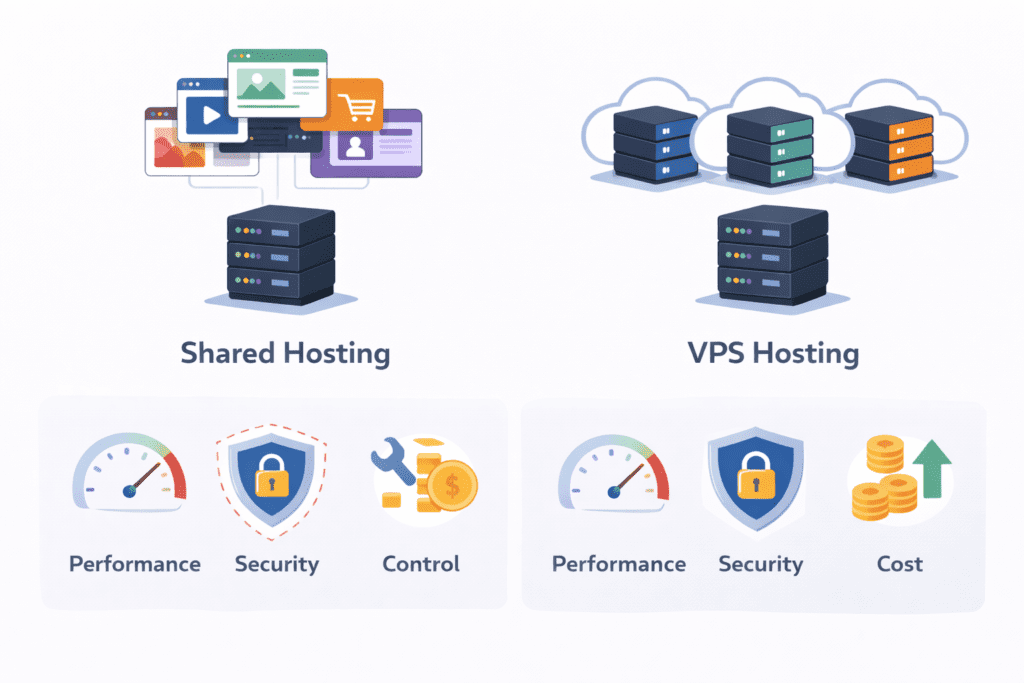
At a high level, VPS vs Shared Hosting comes down to how much control, performance, and stability your website needs. Both options are widely used, but they serve different stages of growth.
Performance and Speed
Shared hosting performance depends on everyone else using the same server. If other websites are busy, your site can slow down. This is common during traffic spikes or peak hours.
VPS hosting offers more consistent speed. Because resources are reserved for your site, performance stays stable even when traffic increases. This is one of the biggest reasons people move from shared hosting to VPS hosting.
Key difference: VPS hosting delivers more predictable performance.
Server Resources
With shared hosting, resources are pooled. CPU, memory, and bandwidth are shared across many websites on the same server. Limits exist, even if they’re not always visible.
With VPS hosting, resources are allocated to your virtual server. Other websites can’t use them, which helps avoid slowdowns and errors.
Key difference: VPS hosting includes dedicated resources; shared hosting does not.
Security Levels
Shared hosting security depends partly on other sites on the same server. If one site is compromised, others may be affected, even with basic protections in place.
VPS hosting isolates each virtual server. This isolation reduces risk and makes VPS hosting a better choice for handling sensitive data or user accounts.
Key difference: VPS hosting offers stronger isolation and security.
Control and Customization
Shared hosting offers limited control. You manage your website, but not the server itself. Custom server settings are usually not allowed.
VPS hosting allows deeper customization. Many plans include root access, letting you configure the server environment, install software, and adjust performance settings.
Key difference: VPS hosting gives more control and flexibility.
Pricing Differences
Shared hosting is the cheapest option. It’s designed for affordability and simplicity.
VPS hosting costs more because it includes dedicated resources and better performance. Managed VPS plans cost even more but reduce technical work.
Key difference: Shared hosting is cheaper; VPS hosting offers more value as sites grow.
Scalability Options
Scaling with shared hosting is limited. Once you hit plan limits, performance issues become more frequent.
VPS hosting scales more smoothly. Resources can be increased without moving to a new hosting provider, making growth easier to manage.
Key difference: VPS hosting scales better over time.
Quick Summary So Far
- Shared hosting is best for low-traffic, simple websites
- VPS hosting suits growing sites that need stability and control
- The VPS vs Shared Hosting choice depends on current needs and future plans

When people research VPS vs Shared Hosting, performance is usually the deciding factor. Speed, stability, and how well a site handles traffic all affect user experience and search rankings.
Website Speed Differences
Website speed depends heavily on how server resources are used.
With shared hosting, many websites run on the same server and share CPU and memory. If one site uses more resources, others can slow down. This can lead to inconsistent load times.
VPS hosting avoids this problem by assigning dedicated resources to each virtual server. Your website speed stays more stable because other sites cannot consume your resources.
In real-world use, VPS hosting delivers faster and more consistent page loading than shared hosting.
Handling Traffic Spikes
Traffic spikes are a common challenge for growing websites.
On shared hosting, sudden increases in visitors may cause slow loading pages or temporary errors. Shared environments struggle when multiple sites peak at the same time.
VPS hosting handles traffic spikes better. Because resources are reserved, your site can absorb higher traffic without crashing. This makes VPS hosting a safer choice for promotions, seasonal traffic, or viral content.
Impact on User Experience
User experience depends on how quickly and reliably a site loads.
Slow pages frustrate visitors and increase bounce rates. Shared hosting may cause unpredictable delays, especially during busy periods.
VPS hosting improves user experience by offering smoother performance. Pages load faster, and errors are less likely to occur during peak usage.
A better user experience leads to longer visits and higher engagement.
Impact on SEO
Search engines consider speed and reliability when ranking websites.
Slow-loading pages can negatively affect rankings. If shared hosting causes frequent delays or downtime, SEO performance may suffer.
VPS hosting supports better SEO outcomes by maintaining stable speed and uptime. Faster load times help meet search engine expectations and improve visibility.
For websites focused on growth, SEO benefits are a major reason to move from shared hosting to VPS hosting.
Performance Takeaway
- Shared hosting performance depends on other websites
- VPS hosting provides consistent speed and stability
- Traffic spikes favor VPS hosting
- Better performance supports better SEO and user experience

Security is one of the biggest differences when comparing VPS vs Shared Hosting. Even if speed feels “good enough,” weak security can undo everything fast.
Shared hosting puts many websites on the same server. While this setup keeps costs low, it also creates shared risk.
If one site on a shared server is hacked or infected with malware, other sites may be affected. This happens because resources and environments are shared. A vulnerability in one account can sometimes expose others.
Another issue is limited control. Shared hosting users usually can’t change server-level security settings. You depend on the hosting provider to protect everyone on the server equally.
For small or low-risk sites, this may be acceptable. But as traffic grows, these risks become harder to ignore.
VPS Hosting Security Benefits
VPS hosting offers stronger isolation. Each virtual private server runs in its own environment, even though it lives on a single physical server.
This isolation reduces the risk of cross-site attacks. If another site on the same physical server is compromised, your VPS remains protected.
VPS hosting also allows more control. You can adjust firewall rules, install custom security software, and manage server settings. This level of access helps protect sensitive data and login systems.
For websites handling customer data, logins, or payments, VPS hosting offers better protection.
Isolation and Data Protection
Isolation is a key security advantage of VPS hosting.
Shared hosting environments mix multiple websites together. VPS hosting separates them using virtualization technology. Each virtual server has its own dedicated resources and operating system layer.
This separation improves data protection. Files, databases, and configurations stay isolated from other users.
For websites that collect personal information, this isolation can make a real difference.
Best Choice for Sensitive Data
If a website stores user accounts, contact forms, or payment details, security matters more.
Shared hosting may be enough for simple blogs or test sites. But VPS hosting is better suited for business sites, e-commerce, or any site handling sensitive information.
Stronger isolation, better control, and dedicated resources all contribute to safer hosting.
Security Takeaway
- Shared hosting has higher risk due to shared environments
- VPS hosting provides isolation and better control
- Sensitive data benefits from VPS hosting security
- Control over server settings improves protection
Control & Flexibility
When choosing between VPS vs Shared Hosting, control is one of the clearest differences. This section explains how much freedom you really get with each hosting type.
Control Panel Access
Both shared hosting and VPS hosting usually include a control panel. This is where you manage files, domains, emails, and databases.
Shared hosting control panels are simple by design. They are made for beginners who want quick access without technical setup. Most settings are locked to protect the shared server environment.
VPS hosting also includes a control panel, but with more options. You can manage deeper server features while still using familiar tools.
If you want simplicity, shared hosting feels easier. If you want flexibility, VPS hosting gives you more room to grow.
Root Access and Server Settings
This is where the difference becomes serious.
Shared hosting does not provide root access. You cannot change core server settings, install custom software, or modify system files. Everything is controlled by the hosting provider.
VPS hosting gives you root access. This means full control over the virtual server. You can adjust server settings, manage security rules, and customize how the server runs.
For developers or growing websites, root access is often a big advantage.
Software and App Installation
Shared hosting limits what you can install. You can only use software approved by the hosting provider. This keeps the shared server stable but limits customization.
VPS hosting allows you to install almost any software that works with your operating system. You can choose specific versions of PHP, databases, or background services.
This flexibility helps websites with custom needs or advanced features.
Custom Configuration Options
Shared hosting environments are standardized. Every user gets nearly the same setup. This is good for beginners but limiting for advanced projects.
VPS hosting lets you customize configurations. You can adjust memory usage, CPU allocation, and server behavior. This helps improve performance and stability for demanding websites.
Custom configuration is especially helpful when traffic grows or when running complex applications.
Control & Flexibility Takeaway
- Shared hosting offers limited control for simplicity
- VPS hosting provides root access and deeper customization
- Custom software is easier with VPS hosting
- Advanced websites benefit from flexible server settings
Pricing is often the deciding factor when choosing between VPS vs Shared Hosting. This section explains what you actually pay, what you get, and how costs change over time.
Shared hosting is the most affordable type of web hosting.
Most shared hosting plans in the US start at a very low monthly price. This is possible because many websites share the same server resources. Costs are split across users, keeping prices low.
Shared hosting plans usually include:
- A basic control panel
- Limited server resources
- Basic security features
- Email hosting and databases
For beginners or small websites, shared hosting can feel like a smart deal. It keeps upfront costs low and avoids technical complexity.
VPS Hosting Cost Range
VPS hosting costs more than shared hosting because resources are not shared in the same way.
A VPS plan gives you dedicated resources inside a virtual private server. You pay for guaranteed CPU, RAM, and storage.
VPS hosting pricing depends on:
- Amount of server resources
- Managed vs unmanaged setup
- Operating system choice
- Extra security or backups
While the monthly cost is higher, you gain better performance, control, and stability.
Long-Term Cost Differences
At first, shared hosting looks cheaper. But long-term costs can change.
As traffic grows, shared hosting may require upgrades, add-ons, or even a forced move to a higher plan. Performance issues can also cost you visitors and revenue.
VPS hosting has higher upfront costs but scales more smoothly. You can upgrade server resources without changing hosting types.
For growing websites, VPS hosting may cost more monthly but reduce long-term headaches.
Value for Money Comparison
Value is not just about price. It’s about what you get for what you pay.
Shared hosting offers good value for simple websites that don’t need high performance or advanced control.
VPS hosting offers better value for websites that:
- Need consistent speed
- Handle traffic spikes
- Require stronger security
- Plan to grow over time
Paying more for VPS hosting can prevent future migrations and performance problems.
Pricing Takeaway
- Shared hosting is cheaper upfront
- VPS hosting costs more but includes dedicated resources
- Long-term value depends on growth and performance needs
- Budget sites fit shared hosting, growing sites fit VPS hosting
Choosing between VPS vs Shared Hosting depends less on labels and more on how your website actually works.
Best for Beginners
For beginners, shared hosting is usually the easiest starting point. It removes technical setup, keeps costs low, and lets a web host handle server maintenance.
If you’re new to web hosting and just want a site online, shared hosting does the job. VPS hosting can feel overwhelming at this stage because it involves more server control and responsibility.
Best for Bloggers
Bloggers with small audiences often do fine on a shared hosting plan. Content-focused sites don’t always need heavy server resources.
But once traffic grows, page speed and stability matter more. At that stage, moving from shared hosting to VPS hosting improves performance and keeps the site responsive.
Best for Small Businesses
Small businesses often outgrow shared hosting faster than expected. Shared servers can slow down during busy hours, which affects trust and sales.
VPS hosting offers better performance and more control, making it a safer long-term choice for business websites that depend on uptime and reliability.
Best for E-Commerce Websites
E-commerce sites need stable server resources, better security, and consistent speed.
VPS hosting is usually the better option here. Shared hosting may struggle with checkout traffic, database load, and payment processing.
“An online store processing just 50 orders a day can slow down fast if it shares a server with dozens of other websites.”
Best for High-Traffic Websites
High-traffic websites should avoid shared hosting entirely. When many websites share the same server, performance becomes unpredictable.
VPS hosting gives isolated server resources, which means traffic spikes won’t affect your site’s stability.
Pros and Cons Summary
Shared hosting is affordable and simple. It’s easy to manage, beginner-friendly, and works well for low-traffic sites.
Resources are shared, performance can drop, and security risks are higher. You have limited control over the server environment.
VPS Hosting Pros
VPS hosting provides dedicated resources, better performance, and more control. It handles growth more smoothly and offers stronger isolation.
VPS Hosting Cons
It costs more and requires more technical knowledge, especially with unmanaged VPS hosting.
Common Mistakes When Choosing Web Hosting
Many people choose hosting based on price alone. That often leads to problems later.
Others overestimate their needs and pay for VPS hosting too early. This can add unnecessary complexity.
Ignoring future growth is another mistake. Hosting that works today may fail tomorrow if traffic increases.
Security is also overlooked. Shared hosting may not be enough for sensitive data or business use.
Start by looking at your website’s purpose. A personal blog and an online store have very different needs.
Think about expected traffic, not just current traffic. Growth matters.
Budget is important, but value matters more. Cheap hosting that causes downtime can cost more in the long run.
Finally, be honest about your technical skills. VPS hosting gives control, but only if you’re ready to manage it or pay for managed support.
VPS hosting offers better performance and control, but shared hosting is easier for beginners.
Yes. Many websites start with shared hosting and move to VPS hosting as they grow.
Do I need technical skills for VPS hosting?
Unmanaged VPS hosting requires technical knowledge. Managed VPS hosting reduces that burden.
Which hosting type is better for SEO?
Better performance and uptime from VPS hosting can help SEO indirectly.
Is VPS hosting worth the extra cost?
For growing or business websites, VPS hosting is often worth it.
Shared hosting is a shared plan where multiple websites share the same hosting server and its resources, making it a low-cost web hosting solution suitable for small sites; VPS hosting (virtual private server) gives you dedicated resources on a virtualized server, offering better performance compared to shared hosting and more control over the hosting environment.
Performance compared to shared hosting is one of the key differences between VPS and shared: a VPS hosting plan provides dedicated CPU, RAM, and disk allocation so your website on the server won’t be as affected by neighbors, while shared hosting can suffer slowdowns when other accounts share resources or spike in usage.
Consider upgrading to a VPS when your traffic grows, you need better uptime, you require a dedicated IP address or custom server configuration, or when shared hosting provider limits (CPU, memory, or concurrent processes) start to constrain your site; VPS hosting makes it easy to scale and is ideal for growing businesses.
Yes, generally VPS hosting requires more technical knowledge because you often manage the virtual server, install software, and handle security; however managed VPS plans or a hosting provider that handles server maintenance can reduce the technical burden similar to shared and vps hosting expectations.
Shared hosting is the most budget-friendly hosting solution because resources are split, while VPS hosting is more expensive because you get dedicated resources; pricing varies by provider, plan type (managed vs unmanaged), and whether you choose cloud hosting or a traditional VPS instance.
You can host multiple websites on some shared hosting plans but you’re still sharing resources, which may limit performance; on a VPS hosting plan you can host many sites with more predictable performance, better isolation, and often the ability to configure a dedicated ip or custom server settings.
Shared hosting is more vulnerable to cross-account issues because files and services coexist on the same server, while VPS hosting offers stronger isolation between accounts-unlike shared hosting, VPS usually has virtual separation and can include additional security controls, backups, and firewall configuration for improved protection.
Is cloud hosting the same as VPS hosting and should I choose cloud server hosting instead?
Cloud hosting is a type of hosting that typically runs on a cluster of servers and can offer better redundancy and automatic scaling; some VPS offerings are cloud-based (cloud VPS) combining benefits of virtual private server isolation with cloud server hosting flexibility-choosing between shared, VPS, or cloud hosting depends on your scalability, performance, and budget needs.
Choose a reliable hosting provider by evaluating uptime guarantees, support quality, scalability options, managed vs unmanaged services, whether the provider offers dedicated ip address options, and the specific vps hosting plan features; consider recommendations for shared hosting provider reliability if starting small and upgrade paths to VPS when growth requires it.
Shared hosting is suitable for small blogs, personal sites, and low-traffic websites because hosting is affordable and easy to manage; VPS hosting is great for growing e-commerce sites, web applications, or agency hosting where you need performance compared to shared hosting, custom server configurations, or dedicated resources for stability and control.
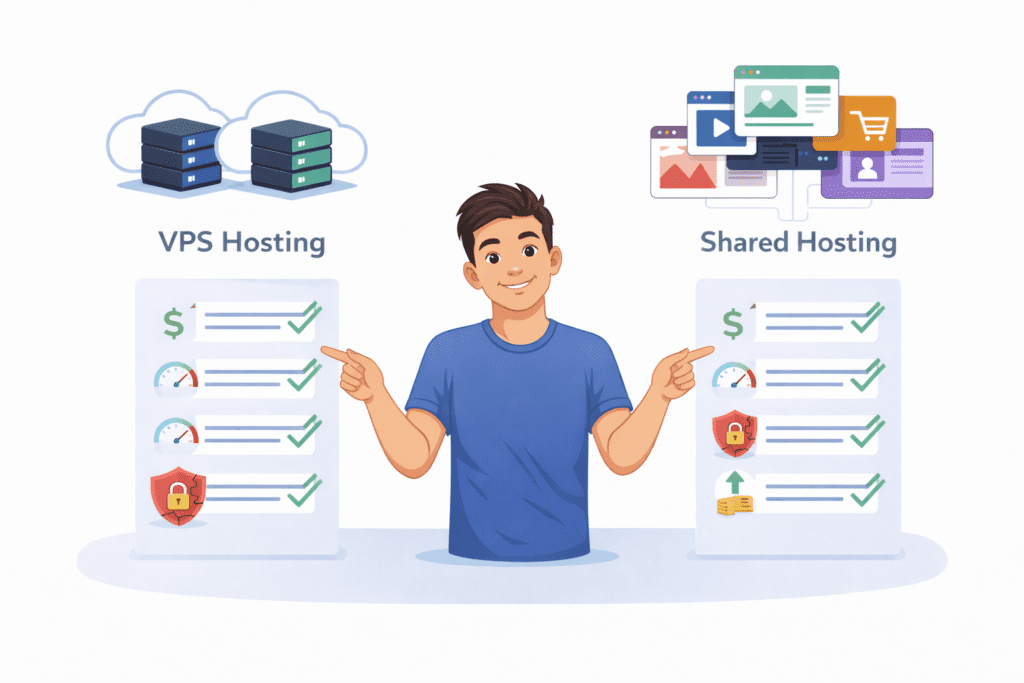
Shared hosting is ideal for small, low-traffic websites and beginners who want simplicity.
VPS hosting is better for websites that need speed, stability, security, and room to grow.
There’s no single best choice. The right option depends on where your website is today and where you want it to go.
If your site feels limited, slow, or unstable, that’s usually a sign it’s time to move beyond shared hosting.