
Struggling to turn your content into consistent income? The creator economy is booming, and premium newsletters have become a powerful way for writers, experts, and niche publishers to build a sustainable business. Moving beyond ad revenue or sporadic sponsorships, a paid newsletter allows you to monetize your most valuable asset: your direct connection with a dedicated audience. It’s about building recurring revenue by delivering exclusive, high-value content directly to their inbox.
However, choosing the right platform isn’t just about features; it’s about understanding the business model behind each one. Many creators overlook the long-term impact of transaction fees and revenue share models, especially as their subscriber list grows. A seemingly small percentage can quickly eat into your profits, making it harder to scale your content business. This guide cuts through the noise, comparing the top 9 paid newsletter platforms so you can make an informed decision tailored to your specific needs as a creator.
> Don’t just look at monthly fees; calculate the total cost of ownership, including transaction fees, as your subscriber count and revenue increase.
Quick Picks: The Best Paid Newsletter Platforms at a Glance
Best Overall: Substack
Substack remains a top choice for creators who prioritize simplicity, a strong network effect, and zero upfront costs. Its straightforward model makes it arguably the fastest way to launch and grow a paid newsletter, especially for writers and journalists focused purely on content creation. They handle all the technical heavy lifting, from email delivery to payment processing, allowing you to focus on writing.
Best for Advanced Creators: Ghost
For creators who demand full control and ownership of their brand and content, Ghost stands out. It’s an open-source solution that provides advanced customization options, letting you build a truly unique publishing experience. While it requires a bit more technical comfort or a willingness to manage your own hosting, the trade-off is unparalleled flexibility and the ability to integrate deeply with other tools. I’ve personally seen how moving to a self-hosted Ghost setup can significantly reduce long-term costs for established publishers with thousands of paid subscribers, effectively putting more revenue back into their pockets.
Best for Community Building: beehiiv
If your goal is rapid growth and deep audience engagement, beehiiv offers a comprehensive suite of tools designed for just that. Its built-in growth features, like referral programs and advanced analytics, provide a robust platform for building a newsletter-first business. Many creators find its monetization options, which include premium subscriptions and ad network access, highly effective for scaling their revenue.
Paid Newsletter Platform Comparison Table
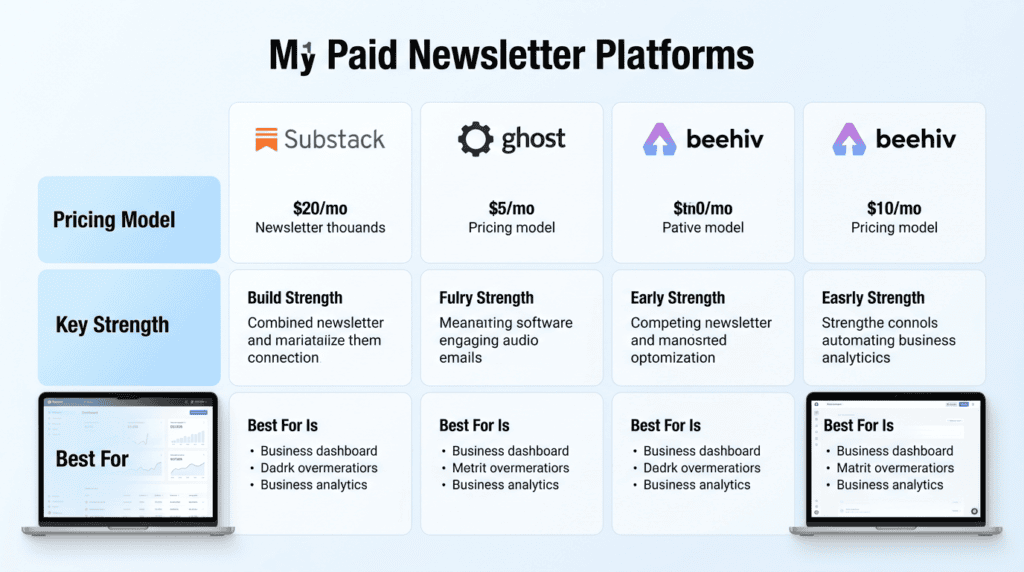
| Platform | Pricing Model | Key Strength | Best For |
|---|---|---|---|
| Substack | 10% of revenue + payment processing fees | Simplicity & Network | Writers & journalists |
| Ghost | Tiered monthly fee (self-hosting available) | Customization & Ownership | Serious creators & publishers |
| beehiiv | Freemium with paid tiers | Growth & Monetization Tools | Growth-focused creators |
| ConvertKit | Freemium with paid tiers based on subscribers | Advanced Marketing Automation | Creators with digital products |
| Memberful | Tiered monthly fee + processing fees | Membership Integration | Creators with existing websites |
| Buttondown | Freemium with paid tiers based on subscribers | Simplicity & Affordability | Independent writers & developers |
| Revue (by Twitter) | 5% of revenue + processing fees | Twitter Integration | Creators active on Twitter |
| Podia | Tiered monthly fee | All-in-One Platform | Creators selling courses & digital products |
| Patreon | Tiered revenue share (5%, 8%, 12%) | Tiered Memberships | Artists, podcasters, & video creators |
How We Evaluated the Top Paid Newsletter Platforms
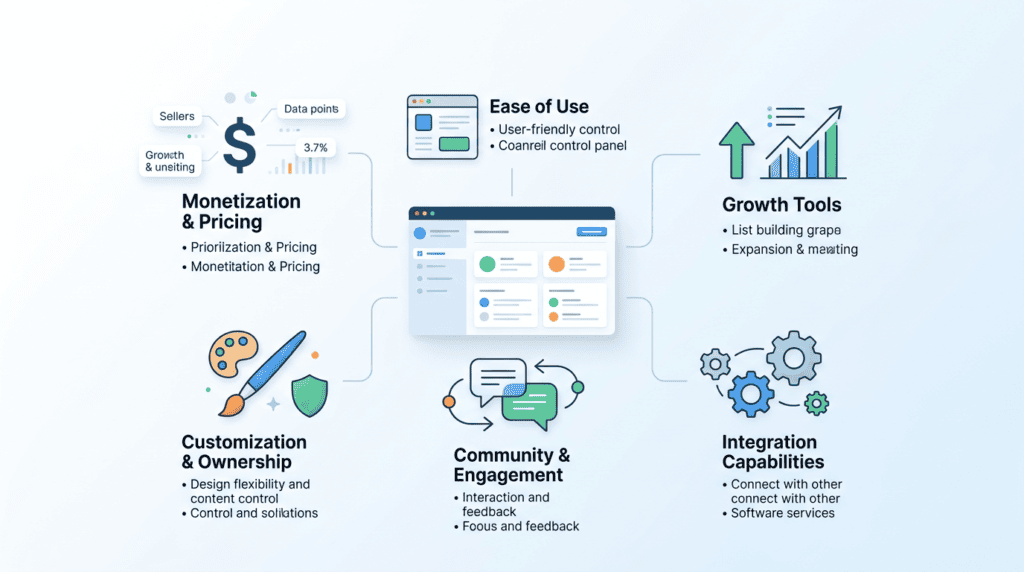
Choosing the right platform to monetize your content is a big decision for any creator. To help you sort through the options, we focused on several key criteria. These factors aren’t just features; they represent the core pillars of a successful paid newsletter business. We looked at how each platform performed in these areas to give you a clear picture of its strengths and weaknesses.
- Monetization & Pricing: This was a primary concern. We dug into the transaction fees, platform fees, and any hidden costs. A platform might seem affordable upfront, but high revenue shares or processing fees can significantly eat into your recurring subscription revenue as your audience grows. We wanted to understand the true cost of doing business on each platform.
- Ease of Use: For many creators, especially those just starting, a straightforward user interface and a simple editor are crucial. We assessed how quickly someone could launch their premium newsletter, write content, and manage subscribers without getting bogged down in technical details. A steep learning curve can be a major barrier.
- Growth Tools: Building an audience is tough. We looked for built-in features designed to help creators expand their subscriber list. This included things like referral programs, robust SEO options for content discovery, and detailed analytics dashboards to track what’s working.
- Customization & Ownership: Your brand is unique. We evaluated how much control each platform offered over design, branding, and content ownership. Can you use a custom domain? How much can you tweak the look and feel of your newsletter and landing pages? This impacts how professional and distinct your offering appears.
- Community & Engagement: A loyal audience often thrives on interaction. We considered features that help foster a community around the newsletter, such as comment sections, polls, and direct messaging capabilities. These tools can turn passive readers into active members.
- Integration Capabilities: No platform exists in a vacuum. We checked how well each paid newsletter platform integrates with other essential tools that creators often use, like analytics software, CRM systems, or other marketing platforms. Seamless third-party integrations can save a lot of time and streamline workflows.
> When I’m evaluating a new tool for my own projects, I always start by calculating the potential revenue impact. A platform with a lower fee structure can mean thousands more dollars in my pocket over a year, especially once I hit a few hundred active paid subscribers.
The 9 Best Paid Newsletter Platforms in Detail
1. Substack: The Platform That Started It All
Substack burst onto the scene by making it incredibly simple for writers to monetize their email list. It’s often seen as the default choice for many, especially those transitioning from traditional media or looking to start an independent publishing platform.
- Pricing Breakdown: The 10% Revenue Share Model
Substack operates on a straightforward 10% revenue share model. This means for every dollar you earn from your paid newsletter, Substack takes 10 cents. On top of that, standard payment processing fees (typically around 2.9% + $0.30 per transaction via Stripe) are also deducted. This model means there are no upfront costs to start, which is a huge draw for beginners. You only pay when you make money.
- Why It’s Great for Beginners: Simplicity and a frictionless setup process.
Getting started on Substack is remarkably easy. You can set up your newsletter, import existing subscribers, and publish your first post within minutes. The editor is clean and intuitive, focusing purely on writing. This frictionless experience allows new creators to focus on producing premium content rather than wrestling with complex software.
- The Substack Network Effect: How discovery features can help you grow.
One of Substack’s unique advantages is its built-in network. Readers can discover new newsletters directly on the platform, subscribe to multiple publications, and even share recommendations. This network effect means your content has a chance to be discovered by an audience already engaged with the Substack ecosystem, potentially accelerating subscriber growth without extra marketing effort.
- Limitations to Consider: Lack of customization and reliance on Substack’s ecosystem.
While simple, Substack offers limited customization options. Your newsletter will largely look like other Substack newsletters, which can make it harder to establish a unique brand identity. You’re also operating entirely within their ecosystem, meaning less control over your data and less flexibility for advanced marketing automation or third-party integrations.
Who Should Use Substack?
Substack is ideal for journalists, thought leaders, and writers who want to focus purely on creating compelling content. If you prioritize ease of use, a built-in audience, and don’t need extensive branding control or complex marketing features, Substack is a strong contender.
2. Ghost: The Open-Source Powerhouse for Publishers
Ghost positions itself as a professional publishing platform, offering a robust content management system with powerful monetization capabilities. It’s designed for serious creators and publishers who want full control and ownership.
- Ghost’s Pricing Tiers vs. Self-Hosting: Understanding the cost and control trade-offs.
Ghost offers two main paths: Ghost(Pro) managed hosting or self-hosting. Ghost(Pro) plans start around $9/month for 500 members and scale up based on subscriber count, handling all the technical aspects. This is a flat monthly fee, with no transaction fees on your revenue (only standard Stripe processing fees apply). Alternatively, you can self-host Ghost on your own server, which requires technical expertise but gives you ultimate control and potentially lower costs if you manage it efficiently.
- Unmatched Customization: How themes and code injection give you full brand control.
Unlike many other platforms, Ghost provides extensive customization. You can choose from a wide array of themes, modify them with code, or even build your own. This allows for a truly unique brand experience, from your website design to your email templates. For creators who view their newsletter as a core part of their brand, this level of control is invaluable.
- Built-in SEO and Membership Features: A look at the native tools for growth and monetization.
Ghost comes with strong native SEO features, including clean URLs, sitemaps, and structured data, helping your content rank higher in search results. Its membership features are also deeply integrated, allowing you to create multiple subscription tiers, offer free and paid content, and manage members directly from your dashboard. It’s a comprehensive tool for monetizing premium content.
The Technical Hurdle: Is Ghost too complex for non-technical creators?
While Ghost(Pro) simplifies much of the technical burden, Ghost still requires a bit more technical comfort than platforms like Substack. Self-hosting, in particular, demands knowledge of server management and command-line interfaces. Even with Ghost(Pro), understanding themes and code injection to fully customize your site can be a learning curve for non-technical creators.
Who Should Use Ghost?
Ghost is best suited for established creators, media brands, and those who demand full ownership and extensive customization over their publishing platform. If you’re comfortable with a bit of technical setup or have a developer on your team, and you want to build a long-term, branded content business, Ghost is an excellent choice.
3. beehiiv: The All-in-One Platform for Newsletter Growth

beehiiv has rapidly gained traction as a powerful, all-in-one platform designed specifically for newsletter growth and monetization. It aims to provide a comprehensive suite of tools that go beyond just sending emails.
- Analyzing beehiiv’s Pricing Plans: From the free plan to the enterprise-level Scale plan.
beehiiv offers a freemium model. The Free plan supports up to 2,500 subscribers with basic features. Paid plans, like the “Grow” plan (starting around $42/month for 10,000 subscribers) and “Scale” plan (starting around $84/month for 10,000 subscribers), unlock advanced features. Crucially, beehiiv charges a flat monthly fee and takes no commission on your paid subscriptions, meaning you keep 100% of your revenue after Stripe processing fees.
- A Deep Dive into Growth Tools: Referral programs, magic links, and the ad network.
beehiiv stands out with its robust suite of subscriber growth tools. Its built-in referral program allows you to incentivize existing subscribers to share your newsletter, offering rewards for new sign-ups. “Magic links” simplify the subscription process, and its native ad network, “Boosts,” lets you promote your newsletter to other beehiiv audiences or find sponsors for your own.
- Monetization Beyond Subscriptions: Exploring boosts, premium posts, and ad placements.
While paid subscriptions are core, beehiiv offers multiple ways to monetize. Beyond the standard paywall for premium content, you can leverage the Boosts network to earn revenue by promoting other newsletters. The platform also supports direct ad placements within your newsletter, giving creators more flexibility in their revenue streams.
- How It Compares to Substack: A direct look at the key differentiators.
Compared to Substack, beehiiv offers significantly more customization, advanced growth tools, and a more favorable pricing model for creators once they start generating substantial revenue (due to the lack of a revenue share). While Substack excels in simplicity and its network effect, beehiiv provides a more powerful, business-oriented platform for creators focused on aggressive growth and diverse monetization.
Who Should Use beehiiv?
beehiiv is ideal for creators who are serious about building a newsletter-based business and want a platform with powerful growth features and flexible monetization options. If you’re looking to scale your audience rapidly and maximize your revenue, beehiiv provides the tools to do so.
4. ConvertKit: The Marketer’s Choice for Newsletters
ConvertKit has long been a favorite among bloggers, course creators, and digital marketers due to its powerful email marketing automation and segmentation capabilities. It’s designed for creators who want to build deep relationships with their audience and sell digital products.
- When ConvertKit’s Subscriber-Based Pricing Makes Sense: Evaluating the cost at scale.
ConvertKit’s pricing is primarily subscriber-based, starting with a free plan for up to 1,000 subscribers (with limited features). Paid plans begin around $9/month for up to 300 subscribers and scale up significantly as your list grows. While it can become more expensive than some other platforms at higher subscriber counts, its value lies in its advanced features, which can drive higher conversions and revenue, justifying the cost for many professional creators.
- Beyond the Newsletter: Leveraging automation, segmentation, and digital product sales.
ConvertKit shines in its ability to go beyond simple newsletters. Its visual automation builder allows you to create complex email sequences, segment your audience based on behavior, and deliver highly targeted content. It also includes native features for selling digital products, landing page builders, and custom forms, making it a comprehensive tool for a creator’s entire sales funnel.
The Learning Curve: Is ConvertKit’s power a double-edged sword for beginners?
With its extensive features, ConvertKit can present a steeper learning curve for absolute beginners compared to simpler platforms. While the interface is clean, mastering its automation and segmentation tools takes time and effort. However, for those willing to invest, the power it offers for personalized marketing is immense.
- Deliverability and Performance: Why it’s trusted by professional creators.
ConvertKit is renowned for its excellent email deliverability rates. This means your newsletters are more likely to land in your subscribers’ inboxes rather than spam folders, which is critical for maintaining engagement and revenue. Its robust infrastructure and focus on email best practices make it a trusted choice for professional creators who depend on reliable email performance.
Who Should Use ConvertKit?
ConvertKit is the go-to platform for bloggers, course creators, and marketers who sell digital products and need advanced email marketing automation and segmentation. If your goal is to nurture leads, build a highly engaged audience, and integrate your newsletter seamlessly into a broader sales strategy, ConvertKit is an excellent fit.
5. Memberful: The Best Way to Add Paid Newsletters to an Existing Site
Memberful isn’t a standalone newsletter platform in the traditional sense; instead, it’s a powerful membership software designed to integrate paid subscriptions directly into your existing website. This makes it ideal for creators who already have a strong web presence.
- How Memberful’s Pricing Works: Platform fees plus Stripe processing.
Memberful offers tiered pricing plans, starting with a “Starter” plan at $25/month plus a 4.9% transaction fee, and scaling up to “Pro” ($49/month + 4.9% fee) and “Premium” ($99/month + 1.9% fee) plans. On top of these platform fees, you’ll also pay standard Stripe payment processing fees. This model means you’re paying for the membership management capabilities, and then a percentage of your revenue.
- Seamless WordPress & Squarespace Integration: Protecting content on your own domain.
Memberful excels at integrating with popular website builders like WordPress, Squarespace, and Webflow. It allows you to protect specific content (posts, pages, files) on your own domain, making it accessible only to paying members. This means you retain full control over your website’s design and content while Memberful handles the subscription logic and paywall.
- Building a True Membership: Going beyond the newsletter with private podcasts and forums.
Memberful is built for comprehensive membership sites. While it can gate access to your newsletter content, it also supports protecting other forms of premium content, such as private podcasts, exclusive videos, or members-only forums. This allows creators to offer a richer, multi-faceted membership experience that extends beyond just email.
- The “Bring Your Own” Model: Why it requires a separate email service provider.
A key distinction for Memberful is its “bring your own” email service provider (ESP) model. It doesn’t have a native email sending feature for newsletters. Instead, it integrates with popular ESPs like Mailchimp or ConvertKit to send your actual newsletter emails. This means you’ll need to manage two platforms, but it also gives you flexibility to choose your preferred email tool.
Who Should Use Memberful?
Memberful is perfect for creators with an established website (especially on WordPress or Squarespace) who want to add a robust membership layer. If you’re looking to protect various types of premium content, maintain full control over your website, and are comfortable integrating with a separate email service, Memberful is an excellent choice.
6. Buttondown: The Minimalist’s Choice for Paid Newsletters
Buttondown is a refreshingly simple and developer-friendly email platform that prioritizes a clean writing experience and powerful underlying features. It’s designed for independent writers and developers who appreciate efficiency and a no-frills approach.
- Affordable and Transparent Pricing: A simple subscriber-based model.
Buttondown offers a free tier for up to 100 subscribers, making it easy to start. Paid plans are subscriber-based and very affordable, starting around $9/month for up to 1,000 subscribers and scaling up. There are no transaction fees on your paid subscriptions, only standard Stripe processing fees. This transparent pricing makes it a cost-effective option for solo creators.
- Markdown-First Writing Experience: Why developers and writers love its simplicity.
One of Buttondown’s standout features is its markdown-first editor. This plain-text, code-like approach to writing allows for fast, distraction-free content creation. For writers who are comfortable with markdown or developers who appreciate its efficiency, this provides a highly productive environment for crafting newsletter content.
- Key Features for Independent Creators: Tagging, metadata, and API access.
Despite its minimalist interface, Buttondown includes powerful features under the hood. It offers robust tagging and metadata options for organizing your content and subscribers, which is great for segmentation. Its comprehensive API access allows developers to build custom integrations and automate workflows, extending the platform’s capabilities significantly.
- Where It Falls Short: Limited design options and native growth tools.
Buttondown’s simplicity comes with trade-offs. Design customization is minimal, focusing on clean, readable emails rather than elaborate layouts. It also lacks the extensive native growth tools (like referral programs or ad networks) found in platforms like beehiiv. Creators will need to rely on external strategies for audience expansion.
Who Should Use Buttondown?
Buttondown is best for solo writers, developers, and hobbyists who value simplicity, cost-effectiveness, and a markdown-first writing experience. If you prioritize clean emails, efficient content creation, and don’t need elaborate design or built-in growth features, Buttondown is a solid, reliable choice.
7. Revue (by Twitter): Best for Leveraging Your Twitter Audience
*Self-correction: As of January 2023, Revue was shut down by Twitter. The following content reflects its historical context and former appeal.*
Revue was a newsletter platform that gained significant attention after being acquired by Twitter. It was designed to help creators easily publish and monetize newsletters, particularly by leveraging their existing Twitter audience.
- The 5% Fee Advantage: How it compares to Substack’s 10% take.
One of Revue’s most attractive features was its competitive pricing model. It charged a 5% commission on paid subscriptions, significantly lower than Substack’s 10% fee. This meant creators kept a larger share of their revenue, making it an appealing option for those looking to maximize their earnings from premium content.
- Deep Twitter Integration: Embedding tweets, pulling in followers, and one-click subscription.
Revue’s primary strength lay in its deep integration with Twitter. Creators could easily embed tweets into their newsletters, import their Twitter followers as subscribers, and offer one-click subscription options directly from their Twitter profiles. This made it incredibly simple for Twitter-native creators to convert their social audience into paying newsletter subscribers.
- The Uncertainty Factor: Navigating the platform’s future under new ownership.
Unfortunately, despite its promise, Revue faced an “uncertainty factor” that ultimately led to its demise. After Twitter’s acquisition by Elon Musk, the platform was shut down in January 2023. This highlights the risk of building a business entirely on a platform that is subject to the strategic shifts of a larger company.
> The shutdown of Revue serves as a critical warning about relying too heavily on third-party platforms that you don’t own. Always consider the long-term viability and control you have over your content and audience.
- Simplicity vs. Functionality: A very basic editor and limited features.
Revue offered a very basic editor and a limited set of features compared to more comprehensive email marketing software. While this simplicity was appealing for quick content creation, it lacked advanced customization, automation, or robust analytics, which could be a drawback for creators with more sophisticated needs.
Who Should Use Revue?
Historically, Revue was best for creators with a large, engaged Twitter following who wanted a frictionless way to monetize that audience directly. Its low fees and deep integration made it a compelling choice for Twitter power users. However, it is no longer available as an active platform.
8. Podia: The All-in-One Platform for Multi-Format Creators
Podia is an all-in-one platform designed for creators to sell digital products, including online courses, digital downloads, webinars, and, of course, paid newsletters. It aims to be the single hub for a creator’s entire online business.
- Zero Transaction Fees on Paid Plans: Podia’s unique pricing advantage.
One of Podia’s most attractive features is its zero transaction fees on all paid plans. While you pay a monthly subscription fee (starting around $39/month for the “Mover” plan), you keep 100% of your sales revenue after standard payment processing fees. This can lead to significant savings compared to platforms that take a percentage of your earnings.
- One Platform, Many Products: Selling newsletters alongside courses, webinars, and digital downloads.
Podia’s strength lies in its versatility. You can seamlessly sell your paid newsletter alongside other digital offerings like online courses, coaching sessions, or digital downloads, all from a single storefront. This integrated approach simplifies management for creators who offer a diverse range of products.
- Is It a Master of All or None? Evaluating the depth of its newsletter features.
While Podia is excellent for selling multiple product types, its dedicated newsletter features might not be as deep or specialized as platforms solely focused on email (like ConvertKit or beehiiv). It provides solid email broadcasting and segmentation, but advanced automation or highly specific newsletter growth tools might require workarounds or integrations.
- Community and Coaching Features: Building a holistic learning environment.
Beyond product sales, Podia also includes features for building a community and offering coaching. You can create member-only communities, host live Q&A sessions, and sell one-on-one coaching packages. This allows creators to build a more holistic learning or engagement environment around their content, fostering deeper connections with their audience.
Who Should Use Podia?
Podia is ideal for educators and entrepreneurs who want a single platform to manage and sell all their digital offerings, including paid newsletters. If you’re selling courses, digital products, and want to integrate your newsletter into a broader content and sales strategy without juggling multiple tools, Podia offers a powerful, consolidated solution.
9. Patreon: The Original Membership Platform
Patreon pioneered the creator-patron model, allowing fans to directly support their favorite creators through recurring payments. While not a traditional newsletter platform, it’s widely used by creators to offer exclusive content, including email updates, to their paying members.
- Understanding Patreon’s Tiered Pricing: 5%, 8%, and 12% revenue share explained.
Patreon operates on a tiered revenue share model. Its “Lite” plan takes 5% of your earnings, “Pro” takes 8%, and “Premium” takes 12%. Each tier offers different features, with higher percentages unlocking more tools and support. On top of this, standard payment processing fees apply. This model means Patreon takes a percentage of every dollar you earn.
- Beyond Newsletters: How to use Patreon for tiered access to content (videos, podcasts, etc.).
Patreon excels at offering tiered access to a wide variety of content. Creators can set up different membership levels, each granting access to exclusive videos, podcasts, behind-the-scenes content, early access to new work, or private community spaces. Newsletters can be one component of these tiered offerings, often delivered as private posts or email updates.
- The “Patron” Mindset: Fostering a community of supporters, not just subscribers.
Patreon cultivates a “patron” mindset, where fans actively choose to support a creator’s work because they value it. This fosters a strong sense of community and loyalty, often leading to higher engagement and retention than a purely transactional subscription model. It’s about building a relationship with supporters who believe in your mission.
- Limitations as a Pure Newsletter Tool: Clunky delivery and lack of email marketing features.
As a pure newsletter tool, Patreon has limitations. Its email delivery system can be clunky, often sending updates as notifications or basic emails rather than fully formatted newsletters. It lacks advanced email marketing features like robust segmentation, automation sequences, or detailed open/click analytics that dedicated email platforms offer.
Who Should Use Patreon?
Patreon is best for artists, podcasters, video creators, and other content producers who offer a variety of exclusive content and want to build a community of direct supporters. If your primary goal is to receive ongoing financial support from your audience and provide tiered access to diverse content formats, with newsletters being just one part of the package, Patreon is an excellent choice.
Honest Take: The Hidden Trade-Offs of Choosing a Platform
Picking the right paid newsletter platform isn’t just about features and pricing on day one. It’s about understanding the long-term implications for your business, your audience, and your sanity. Many creators jump into a platform because it’s easy or “free,” only to find themselves facing unexpected hurdles down the road.
Platforms like Substack or Patreon often boast a “free to start” model, taking a percentage of your revenue once you begin earning. While this sounds appealing for new creators, it can quickly become a significant drain as your subscriber base grows. Imagine giving up 10% or even 12% of your hard-earned recurring subscription revenue when you’re making $10,000 or $20,000 a month. That’s $1,000 to $2,400 going to the platform every single month. For many, the initial convenience can turn into a costly commission fee that eats into profit margins, especially when you factor in payment processing fees on top of that. It’s crucial to project your potential earnings and see how those percentages add up.
Platform Lock-in and Migration Pain: The real cost of moving your audience and content later.
Once you’ve built a substantial audience on a platform, moving everything to a new one can be a nightmare. You’re dealing with exporting subscriber lists, importing them into a new system, re-setting up paywalls, and potentially losing some of your audience in the process. Not all platforms make it easy to export your content or even your subscriber data cleanly. I’ve personally seen creators spend weeks, sometimes months, trying to migrate thousands of subscribers and years of premium content, often encountering technical glitches and frustrated members. This “migration pain” is a hidden cost that many don’t consider when they’re just starting out.
> Tactical Takeaway: Always check a platform’s data export capabilities before committing. Can you easily download your subscriber list (with their payment status) and all your content? This is your insurance policy against future platform changes or the need to scale.
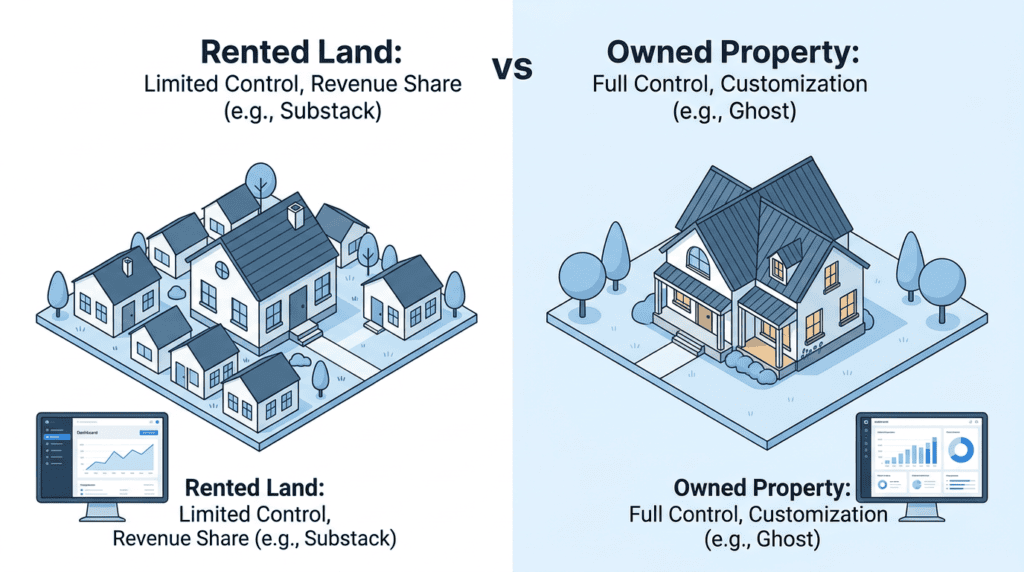
Rented Land vs. Owned Property: The strategic difference between using a platform like Substack versus a self-hosted solution like Ghost.
This is a fundamental strategic decision. Using a platform like Substack means you’re building your business on “rented land.” While they provide the infrastructure, audience, and tools, you’re subject to their rules, their branding, and their ecosystem. They control the user experience, the features, and even the potential for discovery. On the other hand, a self-hosted solution like Ghost, or integrating Memberful with your own website, is like building on “owned property.” You have full control over your brand, your data, your design, and your monetization strategies. This ownership provides long-term stability and flexibility, allowing you to integrate with any tool you choose and truly build an independent publishing platform.
Feature Bloat vs. Focused Simplicity: Why more features aren’t always better for your specific goals.
Some paid newsletter platforms offer a dizzying array of features, from advanced email marketing automation to built-in community forums and digital product sales. While this might seem appealing, it can also lead to “feature bloat” – a situation where you’re paying for many tools you don’t use, or the sheer number of options overwhelms your workflow. For a writer who just wants to publish a premium newsletter, a simpler tool like Buttondown might be more efficient than a complex email marketing software like ConvertKit. Conversely, a creator selling multiple digital products needs those advanced features. The key is to match the platform’s capabilities to your actual needs, not just its potential.
Decision Guide: How to Choose the Right Platform for You
Choosing the right paid newsletter platform boils down to understanding your current stage, your long-term goals, and your technical comfort level. Don’t pick a platform just because it’s popular; pick one that aligns with your specific business model and growth trajectory.
Scenario 1: You’re a Writer Just Starting Out
If your primary goal is to simply start writing and monetizing your content without any technical headaches, you need a platform that gets out of your way.
- Recommendation: Start with Substack or beehiiv’s free plan. Prioritize ease of use and building a writing habit. Substack offers a strong network effect for discovery, and beehiiv’s free tier provides excellent growth tools without upfront cost. Both allow you to focus purely on content creation and building your initial audience.
Scenario 2: You’re a Marketer with Digital Products
You’re not just sending emails; you’re building funnels, segmenting your audience, and selling courses or other digital goods. You need robust email marketing software with powerful automation.
- Recommendation: Choose ConvertKit. Leverage its powerful automation and segmentation to sell products to your email list. Its tag-based system and visual automation builder are ideal for creating sophisticated email sequences that nurture leads and drive sales for your digital products.
Scenario 3: You’re Building a Media Brand and Demand Control
You envision a full-fledged media company, complete with custom branding, advanced SEO, and complete ownership of your content and data. You’re willing to invest time in setup for long-term flexibility.
- Recommendation: Invest in Ghost. The control over branding, SEO, and data is non-negotiable for your long-term vision. Whether you opt for their managed hosting or self-host, Ghost provides a powerful content management system that gives you the independence and customization options a serious media brand requires. I’ve personally used Ghost for several projects, and while it has a steeper learning curve, the control it offers is unmatched for those who want to truly own their platform.
Scenario 4: You Have an Existing Website and Community
You already have a blog, a website, or a community built on another platform (like WordPress or Squarespace) and want to add a paid newsletter or membership layer without migrating your entire operation.
- Recommendation: Use Memberful. It integrates seamlessly with your existing tech stack without forcing you to migrate. Memberful acts as a powerful membership layer that can protect premium content on your own domain and connect with your existing email service provider, allowing you to add a paid subscription model to your established online presence.
> Critical Warning: Don’t let “free” cloud your judgment. While a free tier is great for starting, understand the long-term fee structure. A platform that takes a percentage of your revenue can become significantly more expensive than a flat monthly fee as your business scales.
Final Recommendation

For most creators starting a paid newsletter in 2026, beehiiv offers the best balance of powerful growth tools, fair pricing, and ease of use. It provides a clear path to monetization without the high revenue share of Substack or the technical overhead of Ghost. beehiiv’s built-in referral programs and robust analytics make it an excellent choice for creators serious about scaling their premium content business.
However, if your primary goal is absolute simplicity and you want to focus purely on writing, Substack remains the fastest way to get started. Its network effect can also help with initial subscriber growth. If you demand complete ownership, advanced customization, and a powerful content management system, Ghost is the undisputed professional choice for an independent publishing platform. It’s ideal for those who want full control over their brand and data.
If your core business isn’t primarily a paid newsletter, but rather selling diverse digital products or managing a complex membership site, you might find these three platforms too restrictive. In such cases, specialized tools like ConvertKit (for advanced email marketing with products) or Podia (for all-in-one digital product sales) would serve you better, meaning you should avoid beehiiv, Substack, and Ghost as your primary solution.
Choosing the wrong paid newsletter platform or delaying your decision can lead to significant opportunity costs, limiting your subscriber growth and recurring revenue potential. The right platform empowers your content, but the wrong one can stifle your business.
> Your platform choice is a strategic business decision that directly impacts your long-term monetization and growth.
From my own experience, I’ve seen creators waste months trying to migrate or adapt to a platform that didn’t fit their vision. Make this decision thoughtfully.
Frequently Asked Questions (FAQ)
It can cost anywhere from free to a monthly fee plus revenue share, depending on the platform and your subscriber count. Many paid newsletter platforms offer free plans up to a certain number of subscribers, then transition to a tiered monthly fee or a percentage of your earnings.
Can I move my subscribers if I switch platforms?
Yes, most paid newsletter platforms allow you to import and export your subscriber list. This process typically involves exporting a CSV file from your old platform and importing it into the new one, ensuring you maintain your audience when migrating your premium content.
A good open rate for a paid newsletter typically ranges from 40% to 60% or even higher. Since subscribers are paying for your premium content, they are usually highly engaged, leading to significantly higher open rates compared to free newsletters.
No, you do not necessarily need your own website to start a paid newsletter. Many paid newsletter platforms, like Substack and beehiiv, provide all the necessary tools, including landing pages and content hosting, to run your entire operation directly on their platform.
How do platform fees and payment processing fees differ?
Platform fees are charged by the newsletter platform for using their service, while payment processing fees are charged by the payment gateway (like Stripe) for handling transactions. Platform fees can be a flat monthly fee or a percentage of your revenue, whereas processing fees are typically a small percentage plus a fixed amount per transaction.
Substack vs. Ghost: Which is better for SEO?
Ghost generally offers superior SEO capabilities due to its open-source nature and extensive customization options. While Substack provides basic SEO features, Ghost allows for granular control over meta descriptions, schema markup, and custom domain integration, which are crucial for search engine visibility of your premium content.
Can I offer both free and paid tiers on these platforms?
Yes, most leading paid newsletter platforms support offering both free and paid subscription tiers. This allows creators to attract a wider audience with free content while monetizing their most valuable premium content through a paid subscription model.