
The landscape of digital marketing is always shifting, and sometimes, those shifts are seismic. A few years ago, comparing SEO tools like Ahrefs and Alexa would have involved a deep dive into feature sets, data accuracy, and pricing models. However, a significant industry trend fundamentally changed this discussion: Amazon officially shut down Alexa.com’s marketing services in May 2022. This pivotal event means that for anyone looking for an active, comprehensive SEO platform today, the Ahrefs Vs Alexa comparison is no longer a head-to-head battle, but rather a look at what was and what remains.
This article will explore Ahrefs’ robust, modern SEO capabilities against Alexa’s historical offerings and its current, limited data availability through AWS APIs. Our goal is to clarify why Ahrefs stands as a leading, actively developed solution in 2026, and to explain the fate of its former competitor, helping you understand the practical implications for your digital strategy.
Quick Verdict: Ahrefs vs. Alexa
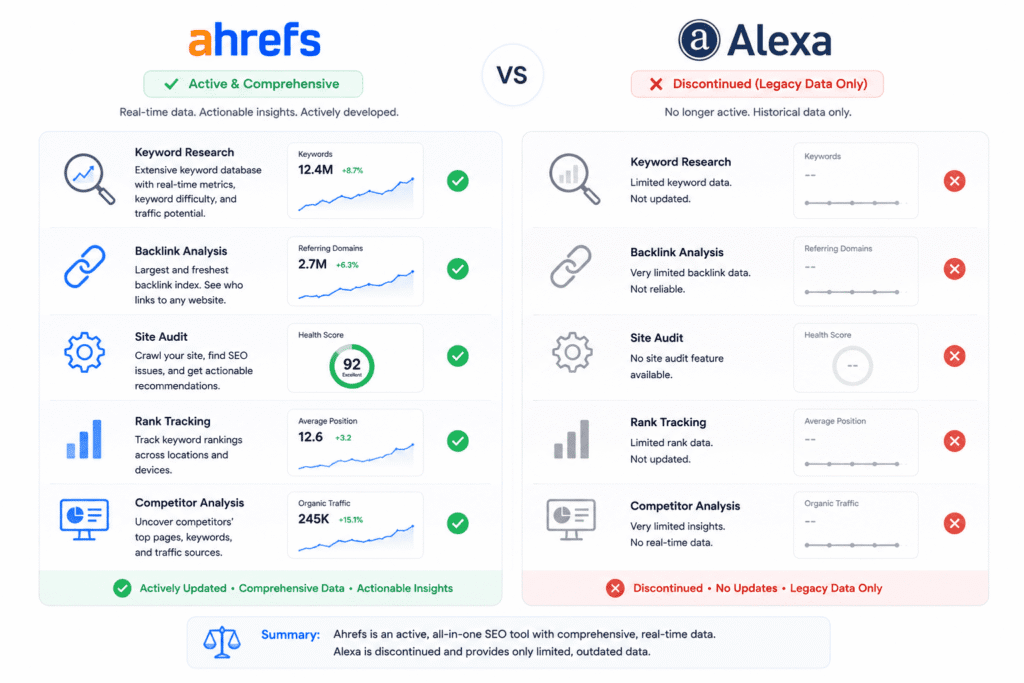
For anyone in 2026 trying to decide between these two platforms for active SEO work, the answer is straightforward: Ahrefs is the only viable option. Alexa.com, as a standalone SEO and web analytics tool for marketers, no longer exists. Its legacy data is primarily accessible via Amazon Web Services (AWS) APIs for specific, often programmatic, use cases, but it doesn’t function as a direct competitor to a comprehensive SEO suite like Ahrefs.
Complete Verdict Table
| Feature | Ahrefs | Alexa (Legacy) | Winner (for 2026 Users) |
|---|---|---|---|
| Status | Actively Developed & Supported | Discontinued (May 2022) | Ahrefs |
| Core Function | All-in-one SEO Platform | Web Traffic Analysis & Ranking | Ahrefs |
| Keyword Research | Best-in-class, massive database | Limited, historically focused on top keywords | Ahrefs |
| Backlink Analysis | Industry-leading backlink index | Basic, less comprehensive | Ahrefs |
| Site Audits | Comprehensive technical SEO audits | Not a core feature | Ahrefs |
| Rank Tracking | Detailed, multi-location tracking | Basic, less granular | Ahrefs |
| Pricing Model | Subscription-based tiers | Discontinued | Ahrefs |
| Data Freshness | Continuously updated | Static, historical data only | Ahrefs |
Best For
- Ahrefs: This tool is built for SEO professionals, content marketers, digital agencies, and businesses of any size that need a complete, active, and powerful SEO toolkit for modern digital marketing. If you’re serious about improving your search engine rankings, understanding your competitors, finding profitable keywords, or building a strong backlink profile, Ahrefs offers the comprehensive data and features you need. It’s particularly strong for those who want to track their performance over time and make data-driven decisions.
Not Ideal For
- Alexa: Simply put, Alexa is not ideal for anyone looking for an active SEO tool. The service is no longer available for new sign-ups or active use by marketers. Its data is now primarily a historical archive, accessible through specific AWS APIs. If you’re a developer or data scientist needing to integrate historical web traffic data into a custom application, the remaining API might be relevant. However, for everyday SEO tasks, content creation, or competitor analysis, Alexa is no longer an option.
Bottom Line
For any practical SEO or marketing task in 2026, Ahrefs is the only viable choice. Alexa.com has been discontinued, making this less of a direct comparison between two active tools and more of an explanation of what each tool *was* and why Ahrefs remains a market leader. If you’re investing in an SEO platform today, your decision will be about choosing Ahrefs or one of its other active competitors, not Alexa.
What Happened to Alexa.com? A Brief History and Current Status
For many years, the name Alexa was synonymous with website ranking and traffic analysis. Before the rise of modern SEO tools, it held a unique position in the digital landscape.
Alexa’s Original Role
Alexa Internet, founded in 1996, quickly became known for its “Alexa Rank.” This metric aimed to estimate a website’s popularity based on its traffic data, becoming a widely cited, though often debated, benchmark for webmasters and marketers. It wasn’t just a ranking system; Alexa also offered insights into audience demographics, traffic sources, and competitor analysis, positioning itself as a key web information company. Its data, while sometimes criticized for accuracy, provided a quick snapshot of a site’s relative standing on the internet.
The Amazon Acquisition
In 1999, Amazon acquired Alexa Internet. This move integrated Alexa’s vast web crawling and data collection capabilities into Amazon’s growing ecosystem. For years, Alexa continued to operate under Amazon, providing its web analytics services and maintaining its famous ranking system. This acquisition initially seemed to secure Alexa’s future, allowing it to leverage Amazon’s infrastructure and resources.
The Shutdown Decision (May 2022)
Despite its long history and association with Amazon, the digital landscape evolved rapidly, and specialized SEO tools began to offer more granular and actionable data. In a significant shift, Amazon announced in December 2021 that it would be retiring Alexa.com. The service officially ceased operations on May 1, 2022. This decision meant that Alexa’s marketing suite, which included its traffic analysis, keyword research, and competitor insights, was no longer available to new or existing users. For anyone looking for an active SEO tool, this effectively removed Alexa from the Ahrefs Vs Alexa comparison.
What Remains
While the user-facing Alexa.com marketing platform is gone, a part of its legacy lives on, albeit in a different form. The Alexa Web Information Service (AWIS) API continues to exist as part of Amazon Web Services (AWS). This API allows developers and businesses to programmatically access some of Alexa’s historical web data, such as site info, traffic statistics, and related links. However, it’s crucial to understand that AWIS is not a user-friendly SEO tool like Ahrefs. It requires technical expertise to integrate and interpret the data, and it primarily offers historical snapshots rather than the continuously updated, actionable insights needed for modern SEO strategies. For most marketers, this API isn’t a practical alternative to a comprehensive SEO platform.
Comparing Ahrefs’ Live Platform to Alexa’s Legacy Features

Understanding the historical capabilities of Alexa’s marketing suite helps to highlight just how far modern SEO tools like Ahrefs have advanced. This section draws a clear line between Ahrefs’ actively developed, comprehensive platform and the now-defunct features Alexa once offered.
Keyword Research & Content Gap Analysis
When it comes to finding the right words to target, Ahrefs’ Keywords Explorer stands out as an industry leader. It offers a massive database of over 10 billion keywords across 171 countries, providing deep insights into search volume, keyword difficulty, traffic potential, and SERP (Search Engine Results Page) overview. Users can easily identify “parent topics” to understand the broader context of a keyword, discover long-tail variations, and analyze the top-ranking pages to understand content strategy. For content marketers, the ability to perform content gap analysis is invaluable; Ahrefs can show you keywords your competitors rank for, but you don’t, revealing untapped opportunities. This depth allows beginners to find low-competition keywords and experienced SEOs to uncover complex content strategies.
Alexa’s legacy keyword tools, while functional in their time, were more basic. They offered keyword difficulty scores and helped identify top keywords driving traffic to a site, along with some basic competitive keyword analysis. However, they lacked the granular detail, the sheer scale of the database, and the advanced features like parent topic identification or sophisticated content gap analysis that Ahrefs provides. Alexa’s focus was often on broader traffic share rather than the intricate keyword strategy required for modern organic search success.
Backlink Profile Analysis
Ahrefs is widely recognized for having one of the largest and freshest backlink indexes in the world. Its Site Explorer tool allows users to dive deep into any website’s backlink profile, showing every referring domain, anchor text, and the quality of those links. Ahrefs maintains multiple indexes – Live, Recent, and Historical – allowing for comprehensive analysis of link acquisition trends over time. This is critical for understanding a site’s authority (via metrics like Domain Rating and URL Rating), identifying toxic backlinks that could harm SEO, and uncovering valuable link building opportunities. For link builders, Ahrefs is indispensable for competitor analysis, finding broken links to reclaim, and discovering new outreach prospects.
Alexa’s backlink data was less comprehensive and less frequently updated. While it could show the number of backlinks and some referring domains, it didn’t offer the same level of granularity or the extensive historical data that Ahrefs provides. Its focus was more on overall site popularity rather than the detailed link quality and strategic insights needed for effective link building campaigns. The ability to perform a thorough backlink audit or identify specific link opportunities was significantly limited compared to Ahrefs.
Competitive Intelligence
Ahrefs provides an unparalleled suite of tools for competitive intelligence. With Site Explorer, you can dissect a competitor’s entire organic and paid search strategy. This includes seeing all the keywords they rank for, their top-performing content, their paid ad campaigns, and even their traffic estimations. The Content Gap feature, mentioned earlier, is a powerful competitive intelligence tool, showing you exactly where your rivals are succeeding that you aren’t. This allows businesses to reverse-engineer successful strategies, identify market trends, and find new opportunities to outrank their competition. For agencies and businesses scaling their online presence, understanding competitor moves is crucial, and Ahrefs provides the data to make informed decisions.
Alexa’s legacy competitive intelligence focused more on audience overlap, traffic sources, and general site comparisons. It could tell you which sites shared an audience with yours or where a competitor’s traffic was coming from (e.g., direct, referral, search). While useful for broad market understanding, it didn’t offer the deep dive into specific organic keywords, paid ad copy, or content performance that Ahrefs delivers. The insights were more high-level and less actionable for direct SEO strategy implementation.
Technical SEO & Site Health
One of Ahrefs’ most powerful features, and one that was largely absent from Alexa’s offering, is its Site Audit tool. This comprehensive crawler analyzes your website for over 140 common SEO issues, including broken links, redirect chains, canonicalization problems, missing meta descriptions, slow-loading pages, and Core Web Vitals performance. It provides actionable recommendations to fix these issues, helping to ensure your site has a strong technical foundation for search engines. A healthy site structure and error-free technical setup are fundamental for good rankings, and Ahrefs makes it accessible even for beginners to identify and address these critical elements.
Alexa’s marketing suite did not include a dedicated technical SEO site audit tool. Its focus was primarily on traffic analysis and audience metrics, not on the underlying technical health of a website. This means that users of Alexa would have needed a separate tool or manual processes to identify and fix technical SEO issues, highlighting a significant gap in its capabilities compared to a modern, all-in-one SEO platform like Ahrefs. For any business serious about search visibility, a robust site audit is non-negotiable, and Ahrefs fills this need comprehensively.
Ahrefs Pricing and Value Proposition in 2026

When considering an SEO tool as powerful as Ahrefs, understanding its pricing structure and overall value is crucial. It’s not a cheap tool, but its capabilities often justify the investment for serious digital marketers. Unlike Alexa’s now-defunct service, Ahrefs operates on a clear subscription model with different tiers designed for varying needs.
Current Ahrefs Pricing Tiers
Ahrefs offers several pricing plans, each tailored to different levels of usage and team sizes. While exact figures can shift, here’s a general breakdown of what you can expect in 2026:
- Lite Plan: Typically starts around $99/month (or $83/month when billed annually). This plan is often suitable for individual bloggers, small businesses, or freelancers just getting started with serious SEO. It includes essential features like Site Explorer, Keywords Explorer, and Site Audit, but with lower limits on reports, tracked keywords, and crawl credits.
- Standard Plan: Usually priced around $199/month (or $166/month annually). This is Ahrefs’ most popular plan, designed for growing businesses and smaller agencies. It offers significantly higher limits, more tracked keywords, and access to features like Content Explorer and advanced filtering options.
- Advanced Plan: Generally costs about $399/month (or $333/month annually). This tier is built for larger marketing teams and agencies managing multiple client projects. It provides even higher data limits, more users, and additional features like historical data for certain metrics and a higher volume of crawl credits.
- Enterprise Plan: Pricing for this tier is custom and typically starts at $999/month or more. It’s for very large organizations, enterprise-level agencies, or companies with extensive data needs and multiple team members. It includes everything in Advanced, plus custom limits, dedicated support, and API access.
It’s important to note that Ahrefs often runs promotions or offers annual discounts, so always check their official website for the most current pricing.
The “Credits” System Explained
One of the most important aspects of Ahrefs’ pricing, and often a point of confusion for new users, is its “credits” system. This isn’t a simple unlimited usage model. Instead, Ahrefs allocates a certain number of “credits” for various actions within the tool, such as:
- Row Credits: Used when you pull data rows from reports (e.g., a list of backlinks, keywords, or pages). Each row consumes one credit.
- Site Audit Credits: Used for crawling your website. The number of pages crawled directly impacts your credit usage.
- Rank Tracker Keywords: Each keyword you track consumes a certain number of credits per update.
For an agency managing multiple clients, this credit system can be a double-edged sword. It ensures you pay for what you use, but it also means you need to be mindful of your usage to avoid overages. An in-house team focusing on one or two domains might find their credit allocation more than sufficient, while an agency running deep competitive analyses for dozens of clients could quickly hit their limits. Understanding your typical workflow and data needs before choosing a plan is key to avoiding unexpected costs.
Hidden Costs & Long-Term Value
While Ahrefs’ pricing is transparent, users can sometimes encounter “hidden costs” in the form of overage charges if they exceed their plan’s credit limits. This is particularly relevant for agencies or power users who frequently pull large datasets. Ahrefs will notify you if you’re approaching your limits, but it’s easy to overlook. These overages can add up, so monitoring your usage is essential.
However, the long-term value of Ahrefs often outweighs these considerations. As your SEO maturity grows, so does your ability to leverage the tool’s advanced features. What might seem overwhelming as a beginner – like understanding advanced filters in Site Explorer or dissecting a competitor’s entire backlink profile – becomes second nature. The insights gained from Ahrefs can directly translate into higher organic traffic, better keyword rankings, and ultimately, increased revenue. For businesses serious about their online presence, the data and actionable insights provided by Ahrefs become an indispensable part of their marketing tech stack.
Is Ahrefs Worth the Investment?
For most businesses and professionals engaged in digital marketing, Ahrefs is absolutely worth the investment.
- For freelancers and small businesses: The Lite plan, despite its limits, offers a powerful suite of tools that can significantly impact your SEO efforts. It helps you identify profitable keywords, analyze competitors, and monitor your site’s health without needing a massive budget.
- For growing agencies and in-house teams: The Standard and Advanced plans provide the depth and breadth of data needed to manage multiple projects, conduct thorough competitive analyses, and drive substantial organic growth. The ability to track thousands of keywords, audit large sites, and explore vast backlink databases is invaluable.
- For hobbyists or those with very limited budgets: Ahrefs might be too expensive. There are free or cheaper alternatives for basic keyword research or site audits, but they won’t offer the comprehensive data and advanced features of Ahrefs.
The return on investment (ROI) from Ahrefs comes from its ability to uncover opportunities that would otherwise remain hidden. It helps you make data-driven decisions, saving time and resources that might be wasted on ineffective strategies.
Who Should Use Ahrefs Today? (Real-World Scenarios)

Ahrefs isn’t just a tool; it’s a comprehensive platform that integrates into various digital marketing workflows. Its versatility means different professionals can leverage its features in unique ways.
For the SEO Agency
For an SEO agency, Ahrefs is often the backbone of their operations. It’s not just about running reports; it’s about strategic decision-making and proving value to clients.
- Client Prospecting: Agencies use Ahrefs’ Site Explorer to quickly assess potential clients’ SEO health, identify immediate opportunities (e.g., broken backlinks, easy-win keywords), and craft compelling proposals. Showing a prospect their current traffic, top keywords, and competitor performance, all backed by Ahrefs data, is a powerful sales tool.
- Comprehensive Audits: The Site Audit tool is indispensable for technical SEO audits. Agencies can uncover critical issues like broken pages, crawl errors, slow loading times, and duplicate content, then present these findings with clear, actionable recommendations.
- Ongoing Reporting: Ahrefs provides the metrics needed for monthly or quarterly client reports. Agencies can track keyword rankings, organic traffic growth, backlink acquisition, and competitor movements, demonstrating the impact of their SEO campaigns.
- Proving Campaign Value: By showing clients how their organic visibility has improved, how new backlinks have been acquired, or how their content is now ranking for high-value keywords, agencies can solidify client relationships and justify their fees.
For the In-House Marketing Team
In-house marketing teams rely on Ahrefs to maintain and grow their brand’s online presence, often focusing on content strategy and competitive advantage.
- Competitive Analysis: Site Explorer is a goldmine for understanding competitors. An in-house team can plug in a rival’s domain and instantly see their top organic keywords, paid search ads, best-performing content, and backlink profile. This helps them identify gaps in their own strategy and capitalize on competitor weaknesses.
- Content Ideation: Content Explorer and Keywords Explorer are crucial for content teams. They can find trending topics, analyze what content performs well in their niche, and discover low-competition keywords with high search volume. This ensures their content efforts are focused on topics that will actually drive traffic.
- Monitoring Brand Visibility: Rank Tracker allows teams to monitor their brand’s keyword rankings across various locations and devices. This helps them quickly react to ranking drops, celebrate successes, and understand their market share in the search results.
For the Content Creator or Blogger
Even individual content creators and bloggers can benefit immensely from Ahrefs, especially if they’re serious about growing their audience and monetizing their site.
- Finding Low-Competition Topics: Keywords Explorer is a content creator’s best friend. It helps them identify keywords with decent search volume but low keyword difficulty, meaning they have a better chance of ranking without competing with massive authority sites. This is a game-changer for new blogs.
- Ensuring Technical Soundness: The Site Audit tool, even on a smaller scale, helps bloggers ensure their site is technically optimized. A slow-loading page or broken link can hurt rankings, and Ahrefs helps catch these issues before they become major problems.
- Backlink Opportunities: By analyzing competitor backlinks, bloggers can find opportunities for guest posting or outreach, helping them build their own domain authority.
For the Small Business Owner
For small business owners, the decision to invest in Ahrefs requires careful consideration.
- Realistic Look at the Lite Plan: The Lite plan can provide significant value for a small business owner who is hands-on with their marketing. It allows them to perform basic keyword research for their local services, monitor their main competitors, and ensure their website is healthy.
- When Simpler Tools Are Better: However, if a small business owner only needs to track a handful of keywords or perform very basic site checks, the cost of Ahrefs might be overkill. Simpler, more affordable tools or even free Google tools (like Google Search Console) might be a better starting point. The key is to assess if the time saved and insights gained from Ahrefs justify the monthly expense for their specific needs and budget.
Honest Take: The Limitations of Ahrefs
While Ahrefs is an incredibly powerful SEO tool, it’s not without its drawbacks. Understanding these limitations helps users set realistic expectations and integrate the tool more effectively into their workflow.
The Learning Curve for Beginners
One of the most common frustrations for new Ahrefs users is the sheer volume of data and features available. It’s like being handed the keys to a spaceship when you’ve only driven a bicycle.
- Overwhelming Interface: The dashboard, while well-designed, can feel overwhelming with its numerous reports, filters, and metrics. Beginners might struggle to know where to start or which data points are most relevant to their goals.
- Data Overload: Ahrefs provides an incredible depth of data, from historical keyword rankings to complex backlink profiles. Interpreting this data, understanding its nuances, and translating it into actionable insights requires a certain level of SEO knowledge and experience.
- Feature Paralysis: With so many powerful features, new users can sometimes experience “feature paralysis,” unsure which tool to use for a specific task or how different tools connect. It takes time and practice to develop an efficient workflow within the platform.
This learning curve means that while Ahrefs is powerful, it’s not a “set it and forget it” solution. It requires dedication to learn and master, which can be a barrier for those without prior SEO experience or the time to invest in training.
The Cost Factor
As discussed in the pricing section, Ahrefs is a premium-priced tool. This is a significant limitation for many potential users.
- Out of Reach for Hobbyists: For individuals running a blog as a hobby or very small businesses with extremely tight marketing budgets, the monthly cost of Ahrefs can be prohibitive. While the value is there for serious marketers, it’s a substantial investment.
- Budget Allocation: Even for businesses that can afford it, the cost requires careful budget allocation. It’s often one of the most expensive tools in a marketing tech stack, meaning other tools or resources might need to be sacrificed.
- Perceived Value vs. Actual Usage: Some users might subscribe to a higher-tier plan, only to find they aren’t utilizing all the features or hitting their credit limits, leading to a feeling of overpaying. It’s crucial to match the plan to actual usage needs.
Potential Data Discrepancies
It’s important to remember that all third-party SEO tools, including Ahrefs, rely on estimates and their own proprietary data collection methods. This means there can be potential data discrepancies.
- Estimated Traffic and Keyword Volume: Ahrefs’ traffic estimates and keyword search volumes are incredibly useful, but they are still estimates. They should be used as indicators and trends rather than absolute, precise figures. Google Analytics or Google Search Console will always provide the most accurate data for your own site.
- Backlink Index Gaps: While Ahrefs boasts one of the largest backlink indexes, no tool can capture every single backlink on the internet. There might be links that Ahrefs hasn’t discovered yet, or links that Google sees but Ahrefs doesn’t.
- Ranking Fluctuations: Rank tracking data can sometimes show slight variations compared to what you might see manually in Google, due to factors like personalization, location, and the timing of data collection.
The key takeaway here is to interpret Ahrefs’ data correctly. It provides powerful insights and trends, but it’s always wise to cross-reference with other sources (especially Google’s own tools) and use the data to inform strategy rather than treating every number as gospel truth.
Final Recommendation: Why Ahrefs is the Clear Choice Post-Alexa
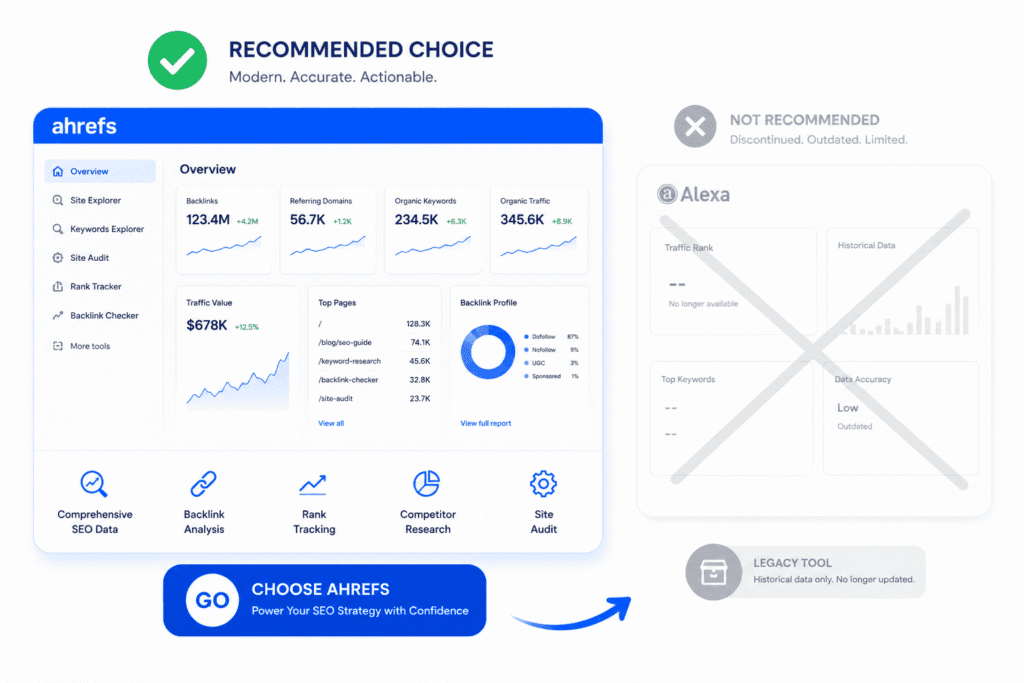
In 2026, the comparison between Ahrefs and Alexa.com as a marketing tool is no longer a fair fight. With Alexa.com’s marketing suite having been retired in 2022, it simply doesn’t exist as a viable option for SEO professionals or digital marketers.
Ahrefs, on the other hand, stands as a complete, actively supported, and industry-leading suite of tools essential for modern SEO. It continues to evolve, providing comprehensive capabilities for everything from keyword research and backlink analysis to site auditing and content exploration. For any user seeking the robust analytical capabilities that Alexa once offered, and indeed a far more extensive array of features critical for today’s digital landscape, Ahrefs is the logical and superior choice. The primary alternatives to Ahrefs in the current market would be other active, comprehensive SEO platforms like Semrush or Moz, not the defunct Alexa.
Ahrefs vs. Alexa FAQ
Is Alexa still used for SEO?
No, the Alexa.com marketing suite was retired in 2022. While some data is available via an AWS API, it is no longer a functional SEO tool for marketers.
What is a good replacement for Alexa.com?
Ahrefs and Semrush are the two leading replacements, offering far more comprehensive features for keyword research, backlink analysis, and competitive intelligence.
How accurate was Alexa Rank?
Alexa Rank was a measure of website popularity based on its user panel. It was often debated and considered a directional metric rather than a precise measure of traffic.
How much does Ahrefs cost in 2026?
Ahrefs pricing starts at around $99/month for the Lite plan, with costs increasing for Standard, Advanced, and Enterprise tiers based on data limits and features, as discussed in earlier sections.
Can I still access my old Alexa.com data?
No, Amazon announced that users had until a specific date in 2022 to export their data before the service was fully decommissioned. That data is no longer accessible.