
Many SEO professionals and digital marketers often find themselves scratching their heads when comparing two of Ahrefs’ most fundamental metrics: URL Rating (UR) and Domain Rating (DR). While both are designed to measure link authority, misunderstanding their distinct purposes can lead to flawed link-building strategies, inaccurate competitor analysis, and ultimately, wasted effort. Knowing the critical difference between Ahrefs UR vs DR is essential for making informed decisions that genuinely impact your search engine rankings.
This guide clarifies the critical difference between Ahrefs’ URL Rating (UR) and Domain Rating (DR). We’ll explain what each metric measures, how they are calculated, and most importantly, how to use them effectively for SEO analysis in 2026. By the end, you’ll know which metric to trust for specific tasks like link building, competitor analysis, and content evaluation.
Quick Verdict
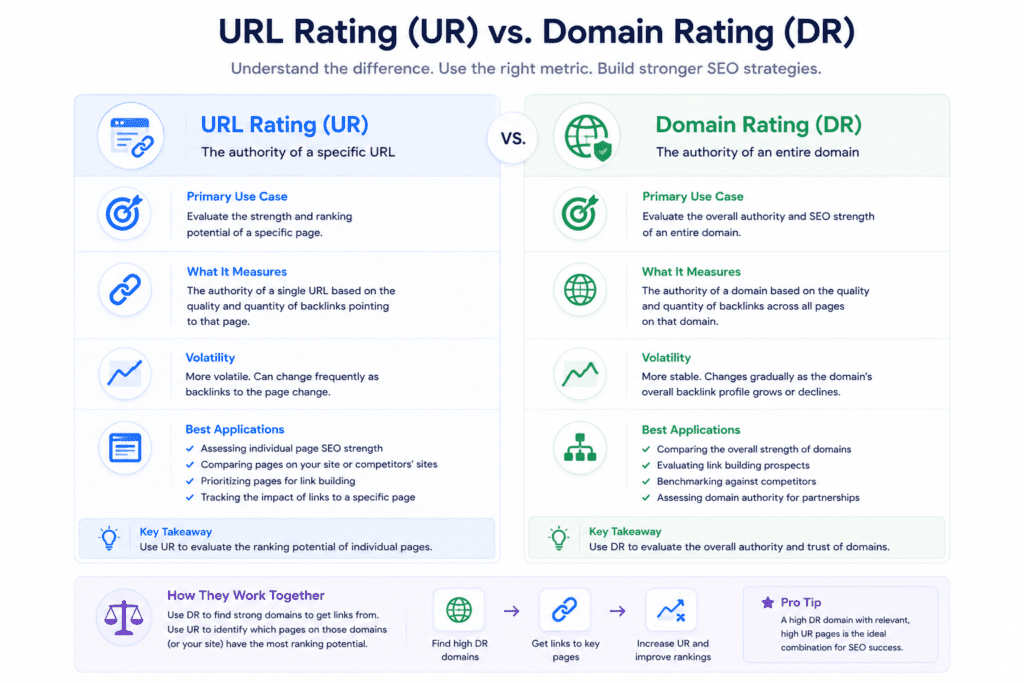
When you’re diving into SEO, especially with a powerful tool like Ahrefs, understanding the core metrics is non-negotiable. The distinction between Ahrefs’ UR and DR is a prime example. They both measure authority based on backlinks, but they operate at completely different scales, impacting how you interpret a website’s strength or a specific page’s potential.
Complete Verdict Table
| Metric | Primary Use Case | What It Measures | Volatility | Best For |
|---|---|---|---|---|
| URL Rating (UR) | Page-level authority | The strength of a specific page's backlink profile. | High | Evaluating individual content pieces, link building targets, and internal linking opportunities. |
| Domain Rating (DR) | Domain-level authority | The overall strength of a website's entire backlink profile. | Low | Gauging a site's overall link equity, high-level competitor analysis, and long-term authority tracking. |
Best For
- UR is best for: Granular, page-level analysis. Use it to assess the link equity of a specific blog post, landing page, or potential link-building target page. For instance, if you’re looking for a strong page to get a backlink from, a high UR on that *specific page* is far more important than the overall DR of the domain it lives on. It helps you identify powerful individual assets.
- DR is best for: High-level, domain-wide assessment. Use it to quickly judge the overall authority of a competitor or track your site’s authority growth over time. When you’re comparing your entire website’s standing against a rival, or trying to understand the general “power” of a domain in Google’s eyes, DR gives you that broad stroke. It’s a key metric for strategic planning and understanding your competitive landscape.
Not Ideal For
- UR is not ideal for: Judging a website’s overall strength. A site can have a low DR but a single page with a very high UR. This often happens with viral content or a highly cited resource page on an otherwise less authoritative domain. Relying solely on a single page’s UR to judge an entire website’s SEO potential is a common beginner mistake.
- DR is not ideal for: Evaluating the ranking potential of a new piece of content. A high DR doesn’t guarantee a new page will rank; its individual UR is more relevant. Just because a site has a DR of 80 doesn’t mean every new blog post will instantly hit the top of the SERPs. The page itself needs to earn its own authority, often through internal links from strong pages or direct external backlinks, which is reflected in its UR.
Bottom Line
Understanding the difference between Ahrefs UR vs DR is crucial for effective SEO. They are not interchangeable. UR measures the authority of a *single page*, while DR measures the authority of the *entire domain*. Think of UR as the specific strength of a single muscle, and DR as the overall fitness level of the athlete. Use UR for tactical decisions (e.g., “Is this a good page to get a link from?” or “Which of my internal pages should I link from to boost this new article?”) and DR for strategic overviews (e.g., “How does my overall site authority compare to my main competitor?” or “Is this a generally authoritative website worth pursuing for a guest post?”). Misusing these metrics can lead to inefficient link building and missed opportunities.
What Is Ahrefs Domain Rating (DR) and How Is It Calculated?
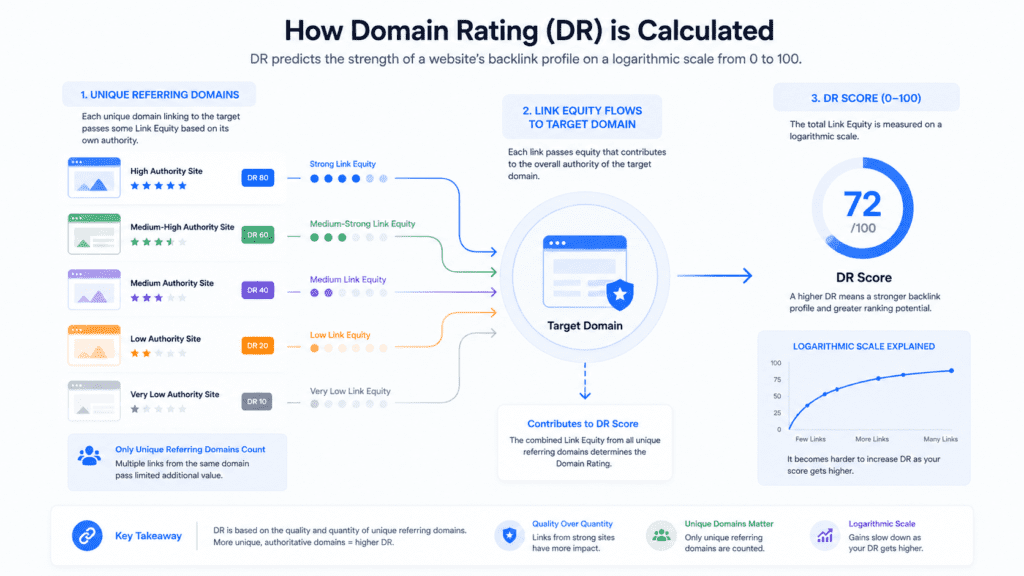
Ahrefs Domain Rating (DR) is a crucial metric for understanding a website’s overall link popularity and authority. It’s one of the first numbers many SEOs look at when evaluating a potential link target or a competitor’s strength. But what does that number really mean, and how does Ahrefs arrive at it?
The Core Concept: Measuring Overall Website Authority
At its heart, Ahrefs Domain Rating (DR) aims to quantify the overall strength of a website’s entire backlink profile. Think of it as a general health score for a domain’s link equity. It doesn’t look at individual pages in isolation but rather considers the cumulative power of all the external links pointing to any page on that domain. This metric helps you quickly gauge how authoritative a website is in the eyes of Ahrefs’ crawler, which in turn gives you a strong indication of its potential to rank in search engines. For affiliate marketers, a high DR often signals a trustworthy platform for promoting products, while for SaaS companies, it indicates a strong competitor with significant organic visibility.
How Ahrefs Calculates DR: The Role of Linking Domains
Ahrefs calculates DR primarily by looking at the number and quality of unique *referring domains* that link to a target website. It’s not just about the sheer quantity of backlinks; it’s about how many *different websites* are linking to you, and how strong those linking websites are themselves. A link from a high-DR website carries significantly more weight than a link from a low-DR site. Ahrefs’ algorithm essentially “passes” link juice from these referring domains to your site. The more high-authority, unique domains linking to your site, the higher your Ahrefs Domain Rating will be. This means that if 100 links come from a single website, it counts as one referring domain, whereas 100 links from 100 different websites would count as 100 referring domains, having a much greater impact on DR.
Why DR is a Logarithmic Scale (and What That Means for You)
Ahrefs Domain Rating operates on a logarithmic scale from 0 to 100. This is a critical detail often overlooked by beginners. What it means in practice is that increasing your DR from 20 to 30 is significantly easier than increasing it from 70 to 80. Each point increase at the higher end of the scale requires exponentially more link equity than at the lower end. For instance, a website with a DR of 80 has a vastly more powerful backlink profile than a site with a DR of 70, even though the numerical difference is just 10 points. This logarithmic nature has practical implications: it sets realistic expectations for growth. Early on, you might see rapid DR increases with a few good links. As your site matures and its DR climbs, each subsequent point becomes a harder-won battle, demanding more strategic and powerful link building efforts. Understanding this helps avoid the frustration of slow progress at higher DR levels.
Common Misconceptions About Domain Rating (DR vs. Traffic)
One of the most common misconceptions is equating a high Ahrefs Domain Rating directly with high organic traffic or guaranteed search engine rankings. While there’s often a correlation – websites with higher DR tend to attract more traffic – DR itself is not a direct ranking factor. Google doesn’t use Ahrefs’ DR in its algorithm. Instead, DR is Ahrefs’ proprietary metric designed to *estimate* a website’s link authority, which *contributes* to ranking potential. A site can have a high DR but low traffic if its content isn’t optimized for relevant keywords, or if it’s targeting highly competitive terms without strong page-level authority. Conversely, a site with a moderate DR might still get significant traffic if it dominates a niche with less competition or has a few exceptionally strong pages (high UR) driving traffic. Therefore, while DR is a valuable indicator of overall link strength, it shouldn’t be the sole metric for evaluating a site’s performance or potential.
What Is Ahrefs URL Rating (UR) and How Is It Calculated?
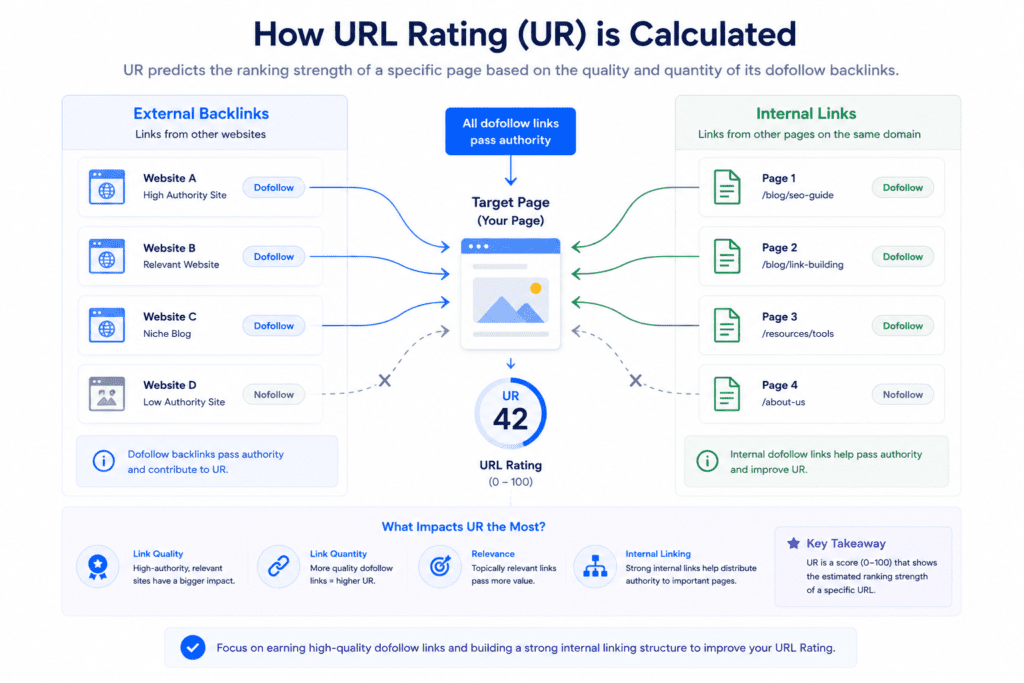
While Ahrefs Domain Rating (DR) gives you a bird’s-eye view of a website’s overall authority, Ahrefs URL Rating (UR) zooms in to provide a more granular picture. Understanding UR is essential for tactical SEO decisions, especially when it comes to individual content pieces and specific link-building opportunities.
The Core Concept: Measuring Page-Level Authority
Ahrefs URL Rating (UR) measures the strength of a *specific page’s* backlink profile. Unlike DR, which aggregates the authority of an entire domain, UR focuses solely on how much “link juice” a particular URL has accumulated. This metric tells you how powerful a single blog post, product page, or landing page is in terms of its incoming links. For example, if you’re evaluating a potential guest post opportunity, you wouldn’t just look at the domain’s DR; you’d also check the UR of the specific page where your link would reside. A high UR indicates that a page is well-linked and likely has strong ranking potential for its target keywords, making it a valuable asset for internal linking or as a target for external backlinks.
How Ahrefs Calculates UR: Internal vs. External Links
Ahrefs calculates UR by considering both external backlinks pointing to that specific page and the internal links from other pages within the same domain. Just like DR, the quality and quantity of these links matter. A link from a high-UR page (whether internal or external) passes more authority than a link from a low-UR page. This means that a page’s UR isn’t just a reflection of how many other websites link to it; it’s also heavily influenced by how well it’s supported by the site’s own internal linking structure. A well-optimized internal linking strategy can significantly boost the UR of important pages, helping them rank higher without needing external links. This is a common tactic for content hubs or pillar pages, where many related articles link back to a central, high-value piece of content.
Understanding the Impact of Nofollow vs. Dofollow Links on UR
The type of link – specifically, whether it’s “dofollow” or “nofollow” – plays a significant role in how Ahrefs calculates URL Rating. Dofollow links are the traditional type of hyperlink that passes “link juice” or authority from the linking page to the linked page. These are the links that directly contribute to a page’s UR. When a high-UR page links to your page with a dofollow attribute, your page’s UR will likely see a positive impact.
Nofollow links, on the other hand, typically do not pass direct link equity. While Google has stated that nofollow links are now treated as “hints” rather than strict directives, for Ahrefs’ UR calculation, dofollow links are the primary drivers of authority. This means that a page with many nofollow links might not see its UR increase significantly, even if those links bring referral traffic. For SEOs focused on improving Ahrefs UR, the emphasis remains on acquiring high-quality, dofollow backlinks from relevant and authoritative sources.
How a Page’s UR Can Be Higher Than Its Domain’s DR
It might seem counterintuitive, but it’s entirely possible for a specific page’s Ahrefs URL Rating (UR) to be higher than its parent domain’s Ahrefs Domain Rating (DR). This scenario typically occurs when a single page on a website attracts an exceptionally strong and numerous backlink profile, often becoming a viral piece of content, a highly cited resource, or a cornerstone piece of evergreen content.
Imagine a new blog (low DR) that publishes an incredibly insightful research report or a groundbreaking infographic. If this single piece of content gets picked up and linked to by dozens of high-authority news sites, industry publications, and other blogs, its individual UR can skyrocket. Meanwhile, the rest of the domain might still be relatively new or have a less robust backlink profile, keeping the overall DR lower. This highlights the power of creating truly exceptional content that earns links naturally. For content creators and affiliate marketers, this means that even on a newer site, a single, well-promoted, high-quality article can achieve significant page-level authority, driving traffic and potentially outranking pages on much higher DR domains for specific keywords. It’s a testament to the idea that individual content excellence can sometimes trump overall domain age or size.
Key Differences: Comparing Ahrefs UR vs. DR Head-to-Head
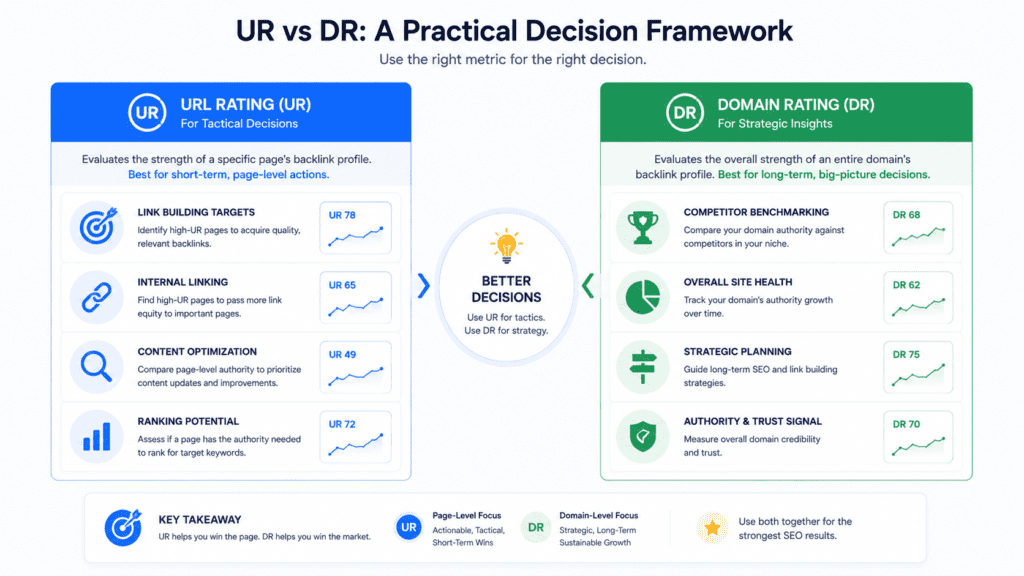
Understanding the individual mechanics of Ahrefs URL Rating (UR) and Domain Rating (DR) is just the first step. The real power comes from knowing how they differ and when to apply each metric for maximum SEO impact. This comparison will clarify the distinct roles these two vital Ahrefs metrics play in your strategy.
Scope of Measurement: Page-Level vs. Domain-Level Authority
The most fundamental distinction between Ahrefs UR and DR lies in their scope. UR is a *page-level* metric, meaning it assesses the link authority of a single, specific URL. It tells you how strong *that particular page* is in terms of its backlink profile and internal link equity. Think of it like evaluating the strength of a single brick in a wall. DR, on the other hand, is a *domain-level* metric. It measures the overall link authority of an *entire website*, considering all its pages and their collective backlink profiles. This is like assessing the structural integrity of the entire wall.
For example, if you’re analyzing a competitor’s blog post to understand why it ranks well, you’d primarily look at its UR. If you’re trying to understand the overall competitive landscape in your niche, you’d focus on the DR of the top players. This difference in scope dictates when and how each metric should be used, guiding your tactical decisions for individual content pieces versus your broader strategic planning for your entire website.
Volatility and Update Frequency: Why UR Changes More Often
Due to their differing scopes, Ahrefs UR and DR exhibit different levels of volatility and update frequency. A page’s UR can change quite rapidly. If a high-authority website suddenly links to one of your blog posts, or if a significant number of links to that page are lost, you’ll likely see a noticeable shift in its UR relatively quickly. This is because UR is focused on a smaller, more concentrated set of links.
DR, however, tends to be much more stable and changes less frequently. Since it represents the aggregate authority of an entire domain, a single new link or lost link will have a much smaller, almost imperceptible, impact on the overall DR. Significant DR changes usually require a sustained effort of acquiring many high-quality referring domains over time or a major loss of a substantial portion of a site’s backlink profile. This difference means you might check UR more frequently for specific content performance, while DR is better suited for tracking long-term authority growth and overall competitive positioning.
Practical Application: Tactical vs. Strategic Insights
The distinct nature of Ahrefs UR and DR makes them suitable for different types of SEO insights and decision-making.
UR provides tactical insights:
- Link Building: When looking for pages to acquire backlinks from, you’d check the UR of the *specific page* you hope to get a link on. A high UR page is more valuable.
- Internal Linking: Identifying high-UR pages on your own site allows you to strategically link from them to important, lower-UR pages you want to boost. This is a powerful way to distribute “link juice” internally.
- Competitor Analysis (Page-Level): If a competitor’s specific article is outranking yours, comparing its UR to yours can reveal if a stronger backlink profile at the page level is a contributing factor.
- Content Evaluation: A high UR for a piece of your content indicates it’s well-regarded by other sites and internally, suggesting it’s a strong asset.
DR provides strategic insights:
- Overall Competitive Landscape: Comparing your DR to top competitors gives you a high-level understanding of your domain’s relative authority in the market.
- Website Health: Tracking your DR over time helps you monitor the overall growth and health of your entire backlink profile. A declining DR could signal a problem with link acquisition or loss.
- Partnerships & Outreach: When evaluating potential partners for collaborations or guest posting opportunities, a high DR indicates a generally authoritative and trustworthy website.
- Brand Authority: DR serves as a quick, industry-recognized proxy for a website’s overall brand authority and trustworthiness in the SEO community.
Understanding this distinction helps you know which metric to prioritize based on the specific SEO task at hand, whether you’re optimizing a single page or planning your long-term domain growth.
Influence on Rankings: Which Metric Correlates More Closely?
When it comes to influencing search engine rankings, both Ahrefs UR and DR play a role, but their correlation strength varies depending on the context. Neither is a direct ranking factor for Google, but they are strong indicators of link equity, which *is* a critical component of Google’s algorithm.
For individual page rankings, UR often correlates more closely. If you have a specific article you want to rank for a competitive keyword, the UR of that page (driven by both external and internal links) will likely have a more direct impact on its ability to climb the SERPs than the overall DR of your website. A page with a high UR signals to search engines that this specific piece of content is highly authoritative and relevant for its topic.
However, a strong DR provides a powerful foundation for all pages on a domain. A high DR means that even new pages on your site can rank more easily and quickly, simply because they inherit some of that domain-wide authority. It’s like having a strong brand reputation; new products from a reputable brand often get more attention. So, while a high UR is crucial for a specific page to rank, a high DR acts as a significant advantage, making it easier for *all* your pages to gain traction.
Ultimately, both metrics are important. A high DR helps establish overall trust and authority for your entire site, while a strong UR is often more indicative of a specific page’s ability to rank for its target keywords. For optimal performance, you want to build both: a robust DR through consistent, high-quality link building to your domain, and strong URs for your most important individual pages through targeted external and internal linking efforts.
When to Use Domain Rating (DR) for SEO Strategy
Ahrefs Domain Rating (DR) is a powerful metric when you need a broad, strategic overview of a website’s authority. Think of it as a quick health check for an entire domain’s backlink profile. It helps you understand where a site stands in the grand scheme of things, especially compared to others in its niche.
High-Level Competitor Analysis: Benchmarking Your Site’s Authority
When you’re first diving into a new niche or assessing your overall competitive landscape, DR is your go-to metric. It helps you quickly benchmark your website’s authority against your main competitors. Why does this matter? Because it gives you a birds-eye view of how much “link equity” you might need to build to compete at a similar level.
For instance, if you’re a new SaaS company and your top competitors all have DRs in the 70s and 80s, you know you have a significant climb ahead. This isn’t about matching their DR point-for-point, but understanding the general playing field. It’s useful for initial market research, setting long-term SEO goals, and communicating overall progress to stakeholders who might not understand granular page-level metrics. Who benefits most? SEO strategists, business owners, and marketing managers who need to grasp the big picture without getting lost in the weeds.
Vetting Potential Link Prospects at the Domain Level
Before you even think about reaching out for a backlink, you need to filter out the noise. DR serves as an excellent initial filter for vetting potential link prospects. If you’re looking for high-quality backlinks, you’ll generally want to target sites with a respectable DR. This helps you avoid wasting time on domains that have little to no authority themselves, which means their links will pass little to no “link juice” to your site.
When should you use it? Early in your link building process. For example, if you’re building a list of 100 potential sites for outreach, you might set a minimum DR threshold, say, DR 30 or 40, depending on your niche. This doesn’t mean a lower DR site is always bad, but it helps you prioritize. The practical implication here is efficiency: you focus your efforts on domains that are more likely to provide valuable links, saving time and resources. However, remember it’s just a first pass; a high DR doesn’t guarantee a relevant or high-quality page.
Tracking Your Website’s Long-Term Link Equity Growth
DR is a fantastic metric for tracking your website’s overall authority growth over time. Since it’s less volatile than UR, it provides a more stable indicator of your long-term link building success. Monitoring your DR monthly or quarterly can show you if your link acquisition efforts are paying off at a domain level.
This is particularly useful for SEO managers and website owners who want to see the cumulative effect of their strategies. A steady increase in your Ahrefs DR suggests that your overall backlink profile is getting stronger, which can correlate with improved organic search visibility over time. It’s a key performance indicator (KPI) that helps justify ongoing link building budgets and demonstrates the long-term value of SEO. Don’t expect dramatic jumps overnight; DR growth is often a slow and steady climb, reflecting consistent effort.
Example: Using DR to Identify Authoritative Competitors in a New Niche
Imagine you’re launching a new online course platform for digital marketers. You want to see who the big players are in terms of overall website authority. You’d plug keywords related to “digital marketing courses” or “SEO training” into Ahrefs’ Site Explorer, then sort the results by DR. You might quickly see sites like HubSpot (DR 92), Search Engine Journal (DR 89), or Moz (DR 90) consistently appearing at the top. This tells you these are the established authorities you’ll be competing with at a domain level. It helps you understand the scale of the challenge and informs your overall content and link building strategy.
When to Use URL Rating (UR) for SEO Strategy
While DR gives you the big picture, Ahrefs URL Rating (UR) is all about the details. It’s a tactical metric, focusing on the strength of individual pages. This makes it incredibly valuable for specific, granular SEO tasks.
Evaluating Specific Link Building Opportunities (Link Prospecting)
Once you’ve used DR to vet potential domains, UR comes into play for evaluating specific pages on those domains. A high DR site might have many pages with low UR, meaning they don’t pass much link equity. Conversely, a lower DR site might have a few incredibly strong pages with high UR due to specific, powerful backlinks.
When you’re doing actual link prospecting, you want to find pages that have a strong UR because a link from such a page is more likely to pass significant “link juice” to your site. This is crucial for link builders. You’d use UR to identify the most authoritative pages on a prospect’s site, ensuring your outreach targets the most impactful opportunities. It helps you prioritize which specific URLs to pursue for a backlink, moving beyond just the domain’s overall strength to the page’s actual power.
Analyzing Your Top-Performing Pages and Content
UR is an excellent indicator of which of your own pages are accumulating the most link equity. By analyzing the UR of your content, you can identify your “power pages” – those that have attracted the most high-quality backlinks. This insight is invaluable for content strategists and SEOs.
Why does this matter? Understanding which pages naturally attract links helps you replicate that success. You can analyze their content, topic, and promotion strategies. Furthermore, these high-UR pages are perfect candidates for internal linking. By linking from your strong UR pages to other important, but perhaps lower-UR, pages on your site, you can strategically distribute link equity and boost their authority. This is a practical way to leverage your existing assets to improve your site’s overall SEO.
Prioritizing Internal Linking to Boost Key Pages
Internal linking is often overlooked, but it’s a critical on-page SEO factor. UR helps you make smart internal linking decisions. If you have a new product page or a crucial service page that isn’t ranking well, you can look for high-UR blog posts or resource pages on your site that are topically relevant.
By adding internal links from these high-UR pages to your target page, you effectively pass some of that valuable “link juice” within your own domain. This can significantly improve the target page’s authority and help it rank higher. This strategy is particularly beneficial for website managers and content creators. It’s a low-cost, high-impact way to improve your site’s performance without needing to acquire new external backlinks. The workflow implication is clear: regularly audit your internal links and leverage your strongest pages to support weaker ones.
Example: Using UR to Find the Strongest Page on a Competitor’s Site for a “Skyscraper” Campaign
Let’s say you’re planning a “skyscraper” content campaign, where you find a popular piece of content, create something even better, and then reach out to sites linking to the original. You’ve identified a competitor’s blog post on “10 Best Email Marketing Tools” that gets a lot of shares. Before you invest hours into creating your “25 Best Email Marketing Tools” guide, you’d check the UR of that specific competitor’s page. If it has a UR of 45, that tells you it’s a well-linked-to page, making it a prime target for your skyscraper strategy. You’d then aim to create a piece of content that not only surpasses it in quality but also aims to attract links from the same referring domains that linked to the competitor’s high-UR page.
Honest Take: The Limitations of Relying on DR and UR
While Ahrefs UR and DR are incredibly useful metrics for SEO, it’s crucial to approach them with a healthy dose of realism. They are powerful indicators, but they are *not* the whole story, nor are they direct Google ranking factors. Relying solely on these numbers can lead to misguided strategies and hidden frustrations.
One of the biggest misconceptions is that a high DR or UR automatically translates to high organic traffic or top rankings. This simply isn’t true. These metrics are third-party estimations of a website’s or page’s backlink strength, based on Ahrefs’ own crawler and algorithm. Google uses hundreds of ranking signals, and while backlinks are a major one, the *quality, relevance, and context* of those links, alongside content quality, user experience, and search intent, are far more important than a raw score.
Beginners often struggle with this, chasing high DR links without considering topical relevance. What happens? They might acquire links from high DR sites that have nothing to do with their niche. A link from a DR 80 site about dog grooming won’t do much for a B2B SaaS company, even if the numbers look good on paper. This can lead to a “toxic” backlink profile over time, which Google might eventually devalue or even penalize.
Another limitation is the potential for manipulation. While Ahrefs constantly refines its algorithms, DR and UR can be artificially inflated, for example, through Private Blog Networks (PBNs) or by acquiring large quantities of low-quality, spammy links. A site might show a high DR, but a manual audit of its backlink profile could reveal a shaky foundation. This is a common frustration for experienced SEOs who know that a high score doesn’t always reflect genuine authority or a clean link profile.
What most marketing pages ignore is that Google’s primary goal is to serve the most relevant and highest-quality content to its users. A site with a lower DR/UR but superior content, better user experience, and perfect search intent alignment can easily outrank a higher DR/UR competitor. For example, a niche blog with a DR 35 might rank #1 for a specific long-tail keyword because its content is incredibly detailed and helpful, even if a DR 70 general news site also covers the topic.
The practical implication here is that DR and UR should be used as *filters* and *indicators*, not as the ultimate decision-makers. Use them to quickly identify potential targets or to get a general sense of a competitor’s strength. But always follow up with deeper analysis:
- Check topical relevance: Is the linking site/page actually related to your content?
- Assess content quality: Is the site publishing valuable, well-written content?
- Evaluate traffic and engagement: Does the site actually get organic traffic and have real users? (Ahrefs’ organic traffic estimates can help here).
- Review the backlink profile manually: Look for signs of spam or PBNs.
As your usage grows, you’ll realize that while these metrics are a fantastic starting point, they become less about the raw number and more about the context. The long-term consequence of over-relying on DR and UR is a potentially inefficient link building strategy that prioritizes quantity or perceived authority over genuine relevance and quality, ultimately hindering your organic search visibility rather than helping it.
How to Improve Your Ahrefs DR and UR (The Right Way)
While the previous section highlighted the limitations and potential for manipulation of DR and UR, understanding how to genuinely improve these metrics is crucial for a robust SEO strategy. The goal isn’t just to inflate numbers, but to build a stronger, more authoritative website that naturally earns higher scores. This involves focusing on ethical, sustainable practices that align with search engine guidelines.
Strategies for Increasing Domain Rating (DR)
Increasing your Domain Rating is fundamentally about enhancing your website’s overall authority and trust in the eyes of Ahrefs’ algorithm. This is achieved through a sustained effort to build a high-quality backlink profile.
- Acquiring high-quality backlinks from unique, authoritative domains. Focus on earning links from websites that themselves have strong DR scores and are relevant to your industry. These links act as powerful votes of confidence, signaling to Ahrefs that your domain is a valuable resource. Prioritize quality over quantity, as a few strong links are far more impactful than many weak ones.
- Focusing on editorially placed, contextually relevant links. The most valuable links are those that are naturally integrated into content because they genuinely add value to the reader. Seek opportunities for guest contributions, expert quotes, or resource mentions on reputable sites where your content naturally fits the topic. This ensures the links are not only powerful but also sustainable and less likely to be devalued.
- Disavowing genuinely toxic links that could harm your profile. Regularly audit your backlink profile for spammy, low-quality, or irrelevant links that could be negatively impacting your DR. While Ahrefs’ algorithm is sophisticated, proactively disavowing links from known spam networks or sites that have clearly violated guidelines can help protect and improve your domain’s perceived authority.
Strategies for Increasing URL Rating (UR)
Improving a specific page’s URL Rating requires a more focused approach, directing authority directly to that content. This is particularly important for your most valuable landing pages, cornerstone content, or product pages.
- Building powerful backlinks directly to your most important pages. Just as with DR, acquiring high-quality, editorially placed backlinks is paramount for UR. However, for UR, these links must point directly to the specific URL you wish to boost. This could involve promoting a specific piece of research, a comprehensive guide, or a unique tool to relevant industry publications and influencers.
- Implementing a strategic internal linking structure. Internal links are a powerful, often overlooked, way to distribute authority within your own site. By linking from high-UR pages on your site to target pages with lower UR, you pass “link equity” and signal their importance. Ensure anchor text is descriptive and relevant, and that the links are contextually appropriate within the content.
- Promoting specific content pieces to earn natural links. Actively promote your best content through social media, email newsletters, and outreach to relevant communities. The more visibility and engagement a piece of content receives, the higher its chances of being discovered and linked to naturally by other websites, directly contributing to its UR.
Final Recommendation: Which Metric Matters More in 2026?

There is no single “winner” when comparing Ahrefs’ Domain Rating (DR) and URL Rating (UR). The more pertinent question is not which metric is superior, but rather which metric is more relevant to your immediate SEO objective. Both serve distinct, valuable purposes within a comprehensive SEO strategy.
- For site-wide, strategic decisions and competitor benchmarking, focus on DR. When you’re assessing the overall strength of your domain, comparing your authority against competitors at a high level, or evaluating the general health of your backlink profile, DR provides the necessary broad perspective. It’s an excellent indicator of your website’s cumulative authority.
- For page-specific, tactical decisions like link building and content analysis, focus on UR. When your goal is to boost the ranking potential of a particular piece of content, identify the strongest pages for internal linking, or pinpoint specific link building opportunities, UR is the more precise and actionable metric. It tells you exactly how much authority a single URL commands.
- The most effective SEOs use both metrics in tandem to get a complete picture of a website’s authority and backlink profile. A balanced approach is key to making informed decisions. By understanding the strengths and applications of both DR and UR, you can leverage them synergistically to identify opportunities, track progress, and refine your SEO efforts for maximum impact.
Ahrefs UR vs DR: Frequently Asked Questions (FAQs)
Can a page’s UR be higher than the site’s DR?
Yes, a page’s UR can indeed be higher than the site’s overall DR if that specific page has accumulated an exceptionally strong backlink profile compared to the average authority distributed across the rest of the domain.
How long does it take to see an increase in my DR or UR?
It varies significantly, but typically, you can expect to see changes in DR or UR within several weeks to a few months, as Ahrefs updates its index periodically and the process of acquiring and recognizing new links takes time.
Is a high DR score a guarantee of high rankings?
No, a high DR score is an indicator of a website’s overall authority and backlink strength, but it is not a direct guarantee of high rankings, as many other factors like content quality, relevance, and user experience also heavily influence search engine results.
Does Google use Domain Rating or URL Rating?
No, Google does not use Ahrefs’ proprietary metrics like DR or UR; these are third-party metrics developed by Ahrefs to estimate a website’s link popularity and authority based on their own algorithms and data.
What is considered a “good” DR or UR score?
A “good” DR or UR score is relative and highly dependent on your industry and competitive landscape, but generally, higher scores are better, with DR 40+ often considered strong for many competitive niches.
Are there any free tools to check DR or UR?
While Ahrefs is a paid subscription service, some limited free tools or browser extensions may offer a basic glimpse of DR or UR, but for comprehensive and accurate data, a paid Ahrefs subscription is necessary.