
Deciding on the right SEO tool can feel like a high-stakes gamble. You want powerful data to grow your online presence, but you also don’t want to overspend on features you won’t use or, worse, underspend and hit frustrating limitations right when you need them most. This common dilemma often surfaces when comparing Ahrefs’ popular plans, especially the Ahrefs Lite Vs Standard options.
Many solopreneurs, small businesses, and even growing agencies find themselves at this crossroads, trying to figure out which subscription offers the best blend of functionality, data access, and value for their specific needs. This guide is designed to cut through the marketing jargon and give you a clear, practical breakdown of the key differences in features, limits, and real-world value between Ahrefs Lite and Standard, helping you make an informed investment for your SEO journey.
Quick Verdict: Ahrefs Lite vs. Standard
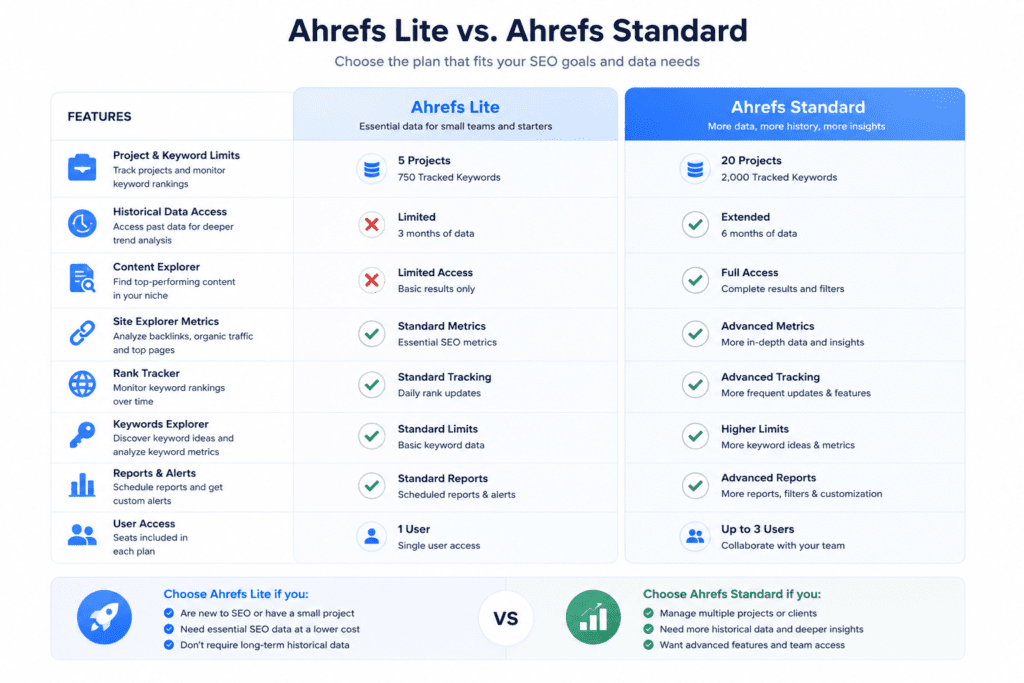
Complete Verdict Table
| Factor | Ahrefs Lite | Ahrefs Standard | Winner |
|---|---|---|---|
| Core SEO Tools | Included (Site Explorer, Keywords Explorer, etc.) | Included | Tie |
| Project & Keyword Limits | Very limited | Significantly more generous | Standard |
| Historical Data Access | No historical index | Full historical index access | Standard |
| Content Explorer | Not included | Full access | Standard |
| Advanced Reports | Limited (e.g., no 'competing domains') | Full access | Standard |
| Ideal User | Solopreneurs, bloggers, small site owners | SEOs, small agencies, growing businesses | - |
| Value for Money | Good for basic SEO monitoring | Excellent for serious growth & analysis | Standard |
Best For
- Ahrefs Lite is best for: Freelancers, bloggers, and small business owners who are primarily focused on tracking a single main website or a very small portfolio. If your main goal is to monitor your own site’s organic performance, perform basic keyword research for content ideas, and check out a handful of competitors, Lite provides the essential tools without the higher monthly cost. It’s ideal for those just starting their SEO journey or managing a personal blog where deep dives into historical trends aren’t a daily necessity.
- Ahrefs Standard is best for: Professional SEOs, small marketing agencies, and in-house teams managing multiple projects or clients. If you need comprehensive data to inform strategic decisions, analyze historical trends, conduct in-depth competitor analysis, or manage a robust content strategy, Standard is your go-to. The expanded limits and features, especially access to Content Explorer and more advanced reporting, are crucial for driving serious growth and understanding the broader market landscape.
Not Ideal For
- Ahrefs Lite is not ideal for: Anyone needing to analyze historical SEO trends (like how a competitor’s backlinks have grown over years), research content ideas efficiently with Ahrefs’ powerful Content Explorer, or manage more than a handful of projects. If you find yourself constantly hitting data limits or needing to switch between multiple projects, Lite will quickly become a bottleneck, leading to frustration and wasted time. It also falls short for agencies that need to generate detailed reports for clients.
- Ahrefs Standard is not ideal for: Absolute beginners or hobbyists who are just dabbling in SEO. The cost, which starts around $199/month (when billed monthly), can be prohibitive if you’re not generating revenue directly from your SEO efforts. For someone managing a very small personal site with minimal commercial intent, the extensive feature set might also feel overwhelming and largely unused, making it an inefficient investment.
Bottom Line
Choose Ahrefs Lite if your budget is tight and your needs are focused on monitoring your own site’s core metrics and performing basic research. It’s a solid entry point to the Ahrefs ecosystem. However, upgrade to Ahrefs Standard the moment your work involves client SEO, in-depth competitor analysis, or a serious content strategy. The expanded limits and features of the Standard plan, particularly historical data access and Content Explorer, provide a far greater return on investment for those committed to significant organic growth.
How Pricing and Value Differ Between Lite and Standard
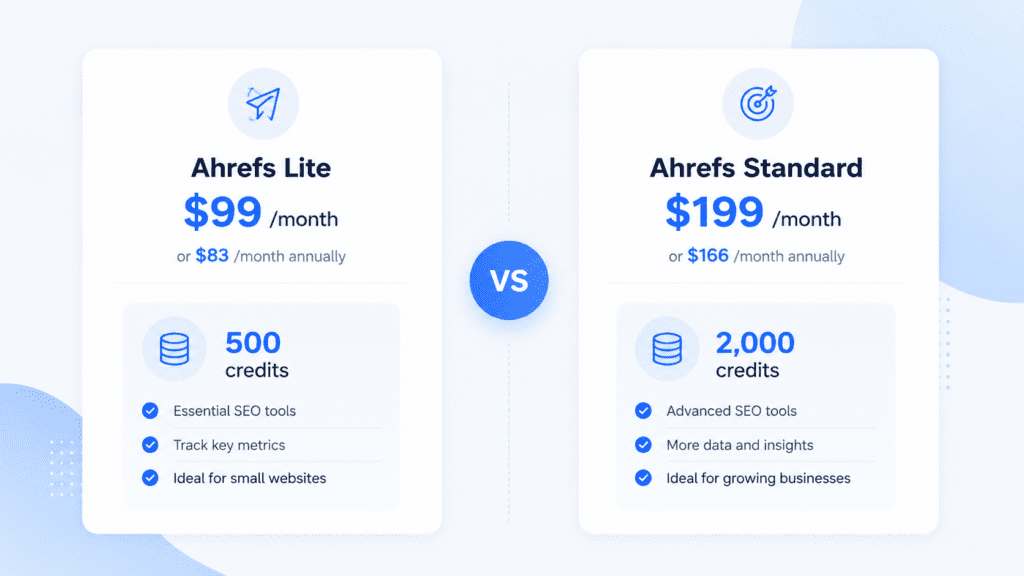
Understanding the financial commitment for an SEO tool like Ahrefs goes beyond just the sticker price. It’s about evaluating what you get for your money, especially when comparing the Ahrefs Lite vs Standard plans. The cost-to-feature ratio, coupled with how Ahrefs manages its credit system, significantly impacts the true value each plan offers.
Ahrefs Lite Pricing Breakdown
The Ahrefs Lite plan is typically priced at $99 per month when billed monthly. If you opt for annual billing, the cost drops to $83 per month, totaling $999 per year. This upfront annual payment offers a noticeable discount, making it a more budget-friendly option for solopreneurs or small businesses committed to using the tool long-term. For this price, Lite provides access to core tools like Site Explorer, Keywords Explorer, and Rank Tracker, but with specific limits on projects, keywords, and data access.
Ahrefs Standard Pricing Breakdown
Moving up to the Ahrefs Standard plan, the monthly subscription costs $199. Similar to Lite, choosing annual billing reduces the effective monthly cost to $166, or $1,999 per year. This higher price point unlocks a significantly expanded feature set, increased limits across various tools, and access to more comprehensive data, including historical indexes and the powerful Content Explorer. The jump in price reflects a substantial increase in capability and data depth, catering to more demanding SEO workflows.
Calculating the True Cost
Beyond the stated monthly or annual fees, Ahrefs employs a “credits” system that can significantly impact your true cost, especially if you’re an active user. Both Ahrefs Lite and Standard plans come with a set number of “credits” each month, which are consumed when performing certain actions like refreshing data, running specific reports, or viewing detailed metrics.
For instance, the Lite plan typically includes 500 credits per month, while the Standard plan offers 2,000 credits per month. If you exceed these allocated credits, Ahrefs operates on a “pay-as-you-go” model, meaning you’ll need to purchase additional credits. This is where the hidden costs can emerge. A beginner on the Lite plan might quickly burn through their 500 credits if they’re frequently checking competitor backlinks, refreshing keyword rankings, or diving deep into Site Explorer reports for multiple domains. Each additional credit pack can add to your monthly expenditure, potentially pushing your Lite plan’s true cost closer to, or even exceeding, the Standard plan’s base price if you’re consistently hitting your limits.
This credit system is a crucial consideration for anyone evaluating Ahrefs Lite vs Standard. For users with moderate to heavy usage, the Standard plan’s more generous credit allowance often provides better value, as it reduces the likelihood of incurring extra charges. It’s a common frustration for Lite users to constantly monitor their credit usage, which can interrupt workflow and add unexpected expenses.
The Long-Term Value Proposition
While the Ahrefs Standard plan carries a higher upfront cost, its long-term value proposition often outweighs that of the Lite plan, especially for growing businesses, agencies, or serious SEO professionals. The expanded features and higher limits on Standard translate directly into more comprehensive data, deeper insights, and ultimately, better strategic decisions.
For example, the access to historical data (which Lite lacks) allows you to analyze long-term trends, diagnose past performance issues, and understand competitor strategies over years, not just months. This kind of insight can prevent costly mistakes and uncover significant opportunities that Lite users would simply miss. Similarly, the Content Explorer tool on Standard can revolutionize a content strategy, leading to more effective content creation and higher organic traffic.
Investing in the Standard plan means you’re investing in a more robust analytical engine that can drive significant ROI through improved rankings, increased organic traffic, and more successful link-building campaigns. For an agency, this might mean landing bigger clients or delivering superior results for existing ones. For an affiliate marketer, it could mean identifying untapped niches or outmaneuvering competitors more effectively. The higher monthly cost of Standard is often quickly justified by the enhanced capabilities that lead to tangible business growth, making it a more cost-effective choice in the long run for those serious about scaling their SEO efforts.
Feature and Limit Comparison: Where Standard Pulls Ahead
When comparing Ahrefs Lite vs Standard, the core differences often boil down to the depth of data, the scope of analysis, and the sheer volume of projects you can manage. While Lite provides a solid foundation, Standard significantly expands these capabilities, offering tools and insights crucial for advanced SEO strategies and scaling operations.
Project & Keyword Tracking Limits
One of the most immediate and impactful differences between Ahrefs Lite and Standard lies in their project and keyword tracking limits. The Lite plan allows you to set up 5 projects and track up to 500 keywords across those projects. In contrast, the Standard plan dramatically increases these allowances to 20 projects and 1,000 tracked keywords.
The real-world impact of these limits is substantial. For a solopreneur managing a single blog, 5 projects might seem sufficient, allowing them to track their main site and perhaps a few key competitors. However, 500 keywords can be quickly consumed, especially if you’re tracking different keyword groups, local variations, or long-tail phrases. As soon as you add a second or third website, or begin managing SEO for clients, the Lite plan’s limits become a significant bottleneck.
The Standard plan, with its 20 projects and 1,000 keywords, offers much more flexibility. This allows you to manage your primary website, several client sites, and a more comprehensive list of direct and indirect competitors. For an agency or a business with multiple niche sites, this expanded capacity is non-negotiable. Beginners often underestimate how quickly keyword limits are reached, leading to the frustration of having to choose which keywords to track or constantly upgrading. Standard provides the breathing room needed for more extensive keyword research and monitoring without constant worry about hitting a ceiling.
The Historical Data Divide
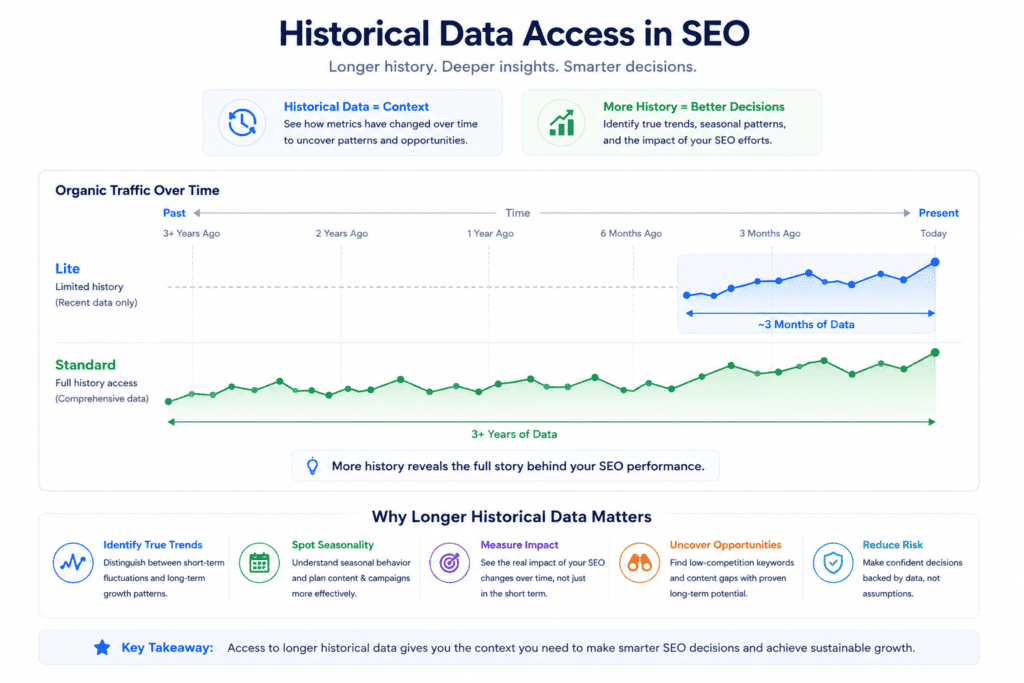
Perhaps one of the most critical distinctions between Ahrefs Lite and Standard is access to historical data. The Lite plan offers limited historical data, typically showing only the most recent 3-6 months of backlink and ranking information. The Standard plan, however, provides access to Ahrefs’ full historical index, which can go back many years.
What does “historical index” mean in practice? It means that for any website or keyword, Standard users can see how its backlink profile has evolved over time, how its rankings have fluctuated, and how its organic traffic estimates have changed, often going back to when Ahrefs first indexed the domain.
Consider this scenario: Your website experiences a sudden drop in organic traffic. With the Standard plan, you can immediately dive into Site Explorer’s historical backlink data. You might discover a major link that was lost six months ago, or a competitor’s backlink profile that surged a year ago, indicating a long-term strategy you need to counter. Lite users, restricted to recent data, would struggle to diagnose the root cause, potentially wasting valuable time and resources on incorrect assumptions.
Another practical application is competitor analysis. With Standard, you can analyze a competitor’s entire backlink growth trajectory, identifying their most successful link-building campaigns from years past, the types of content that attracted links, and their historical anchor text usage. This deep dive allows you to reverse-engineer their long-term strategies and adapt them for your own campaigns. Without this historical context, Lite users are left with only a snapshot, making it incredibly difficult to understand long-term trends or diagnose past performance issues, leading to less informed strategic decisions.
Content Explorer: The Standard Plan’s Killer App

For anyone serious about content marketing and identifying evergreen topics, Content Explorer is often considered one of Ahrefs’ most powerful tools. It’s also a feature exclusively available on the Standard plan and above, making its absence in the Lite plan a significant limitation for content-driven SEO strategies.
Content Explorer allows you to find popular content on any topic, analyze its performance metrics (like organic traffic, referring domains, and social shares), and identify content gaps or link-building opportunities. For example, a blogger looking for new article ideas can use Content Explorer to find articles with high organic traffic but few backlinks, indicating an opportunity to create better content and earn links. An affiliate marketer can identify top-performing content in their niche and analyze why it ranks well.
Its absence in the Lite plan means users must rely on Keywords Explorer for topic ideation, which is excellent for keyword research but doesn’t offer the same level of content performance analysis. Lite users will spend more time manually searching for content ideas, using less efficient methods, and potentially missing out on proven content strategies that their Standard-using competitors can quickly uncover. For content creators, affiliate marketers, and course creators, Content Explorer is a game-changer for finding what resonates with audiences and drives traffic, making its inclusion in the Standard plan a major draw.
Reporting & Analytics Capabilities
The depth and breadth of reporting and analytics capabilities also mark a clear divide between the Ahrefs Lite vs Standard plans. While Lite offers essential reports, Standard unlocks a suite of advanced reports that provide a more holistic and strategic view of the SEO landscape.
Key reports missing from the Lite plan include the “Competing Domains” report within Site Explorer. This report helps you quickly identify other websites that compete for the same organic keywords as your target domain, offering a broader and more accurate picture of your competitive landscape than manual comparisons. Without it, Lite users have to piece together this information manually, which is time-consuming and less accurate.
Another significant advantage of Standard is its Batch Analysis tool, which allows you to analyze multiple URLs or domains simultaneously. This is invaluable for agencies or large businesses needing to quickly assess the SEO metrics of many pages or competitor sites at once. Lite users are restricted to analyzing one domain or URL at a time, severely limiting their efficiency for large-scale tasks. Additionally, Standard provides access to SERP history, showing how search results have evolved over time for specific keywords, which is crucial for understanding SERP volatility and competitor movements.
These advanced reports provide a strategic advantage. Lite users are often working with a more limited view, making it harder to identify emerging competitors, spot broad market trends, or conduct in-depth competitive intelligence. This can lead to a reactive rather than proactive SEO strategy, putting them at a disadvantage compared to Standard users who have access to more comprehensive, actionable insights.
API Access and Integrations
For businesses that require custom reporting, data automation, or integration with other marketing tools, the difference in API access between Ahrefs Lite and Standard is a critical factor. The Lite plan offers no API access whatsoever. This means any data you want to extract for custom dashboards, internal tools, or client reports must be manually exported from the Ahrefs interface.
The Standard plan, however, includes limited API access, typically providing around 10,000 API credits per month. While this isn’t as extensive as the higher-tier Advanced or Enterprise plans, it’s enough to enable basic automation. For example, a small agency could use these API credits to pull specific keyword ranking data or backlink metrics into a Google Data Studio dashboard, allowing for customized client reports that update automatically. This saves significant time and reduces the potential for human error compared to manual data extraction.
For freelancers or small businesses, API access might not be an immediate need. However, as reporting requirements grow, or if there’s a desire to integrate Ahrefs data with other business intelligence tools, the lack of API access on the Lite plan becomes a major workflow limitation. Standard’s API capabilities, even if limited, open up possibilities for more efficient data management and customized reporting, which is a key advantage for scaling operations and delivering professional-grade insights.
Real-World Scenarios: Choosing Your Plan Based on Your Role
Deciding between Ahrefs Lite vs Standard often comes down to your specific role and the scale of your SEO efforts. What works for a solo blogger won’t cut it for an agency, and understanding these real-world scenarios can clarify which plan truly fits your daily grind.
Scenario 1: The Solopreneur Blogger
Imagine you’re a solopreneur blogger running a single niche website. Your main goals are to find low-competition keywords, track your site’s rankings, and keep an eye on your backlink profile. You’re not managing clients, and your budget is tight.
For this scenario, Ahrefs Lite is likely sufficient. It gives you access to core tools like Site Explorer and Keywords Explorer, allowing you to perform basic keyword research, check your site’s backlinks, and monitor your organic search traffic. You can track up to 5 projects and 500 keywords, which is usually plenty for one website. The monthly cost, starting around $99/month (or $83/month with annual billing), is more manageable for a single-site owner. While you won’t get historical data or Content Explorer, your immediate need is to get found and grow your own site, not to conduct deep competitive intelligence across an industry. It’s a solid entry point to Ahrefs’ powerful data without breaking the bank.
Scenario 2: The Freelance SEO with 3-4 Clients
Now, picture a freelance SEO professional juggling 3-4 clients. Each client expects monthly reports, regular keyword movement updates, and periodic site audits. You need to identify new keyword opportunities for them, analyze their competitors’ backlink profiles, and ensure their technical SEO is sound.
Here, the limitations of the Lite plan quickly become apparent. Managing multiple client projects, each with its own set of keywords and competitors to track, would exhaust the Lite plan’s project and keyword limits almost immediately. You’d constantly be deleting and re-adding projects, or worse, paying for expensive “pay-as-you-go” credits. Ahrefs Standard becomes the necessary starting point. With 10 projects and 1,500 tracked keywords, plus more generous crawl credits for Site Audit, you can comfortably manage several clients.
The ability to access historical data is crucial for explaining traffic fluctuations to clients, and the more robust reporting features allow you to present professional, data-driven insights. The investment, starting around $199/month (or $166/month with annual billing), is justified by the increased capacity and professional capabilities needed to serve multiple clients effectively.
Scenario 3: The In-House Marketer at a Growing SaaS
Consider an in-house marketer at a rapidly growing SaaS company. Your responsibilities include not just keyword research and rank tracking, but also deep competitor analysis, identifying content gaps, monitoring brand mentions, and understanding industry trends. You need to inform a comprehensive content strategy and react quickly to market shifts.
For this role, Ahrefs Standard is essential, and you might even find yourself eyeing higher tiers as the company scales. Features like Content Explorer are invaluable for understanding what content performs best in your niche, helping you brainstorm new topics and outrank competitors. The full historical index access allows you to analyze long-term trends in backlink profiles and keyword rankings, giving you a strategic edge. You can see *why* a competitor’s traffic surged or dropped, not just that it happened. Advanced reports, like “Competing Domains,” are critical for identifying new market entrants or understanding who’s truly vying for your audience’s attention.
The ability to perform batch analysis and domain comparisons also speeds up your workflow, letting you quickly assess multiple competitors or potential link targets. This level of insight is non-negotiable for a growing SaaS that relies heavily on organic search for customer acquisition.
The Hidden Trade-Offs: What You Don’t Realize You’re Missing with Lite
While Ahrefs Lite offers a fantastic entry point into powerful SEO data, there are significant hidden trade-offs that aren’t immediately obvious from a feature list. These aren’t just missing tools; they’re missing strategic capabilities that can profoundly impact your growth.
The Inability to See the “Why”
Ahrefs Lite shows you *what* your current rankings are, *what* your current backlink profile looks like, and *what* your current traffic estimations are. It’s a snapshot. But what it often can’t tell you is *why* things changed. Without access to the full historical index, you’re flying blind when it comes to diagnosing performance issues. Did a traffic drop happen because a competitor gained a massive number of backlinks six months ago? Did your rankings plummet because a key backlink was lost last year?
The Standard plan’s historical data allows you to rewind time, seeing how backlink profiles evolved, how keyword rankings fluctuated over months or years, and how content performance changed. This isn’t just a nice-to-have; it’s crucial for understanding cause and effect in SEO. For a small business owner, this might mean guessing at solutions, while a Standard user can pinpoint the exact moment a problem began and identify potential culprits, saving valuable time and resources.
Flying Blind on Content Strategy
One of the biggest strategic disadvantages of the Lite plan is the complete absence of Content Explorer. While Lite helps you find keywords, it doesn’t give you Ahrefs’ powerful content marketing toolkit. Content Explorer lets you discover top-performing content by topic, analyze its backlinks, and see how much organic traffic it generates. It’s a goldmine for content ideation, competitive analysis, and understanding what resonates with your audience.
Without it, Lite users are forced to rely on other, often less integrated, tools and data sources to inform their content strategy. This means more manual work, less comprehensive data, and a higher chance of missing out on high-potential content opportunities. For any business serious about content-led SEO, this isn’t just a missing feature; it’s a significant strategic handicap that can slow down growth and make it harder to compete effectively.
The “Death by a Thousand Credits” Risk
Ahrefs Lite comes with a certain number of “credits” for various reports and data points. While this seems fine for basic usage, heavy users can quickly find themselves burning through these credits, especially if they’re doing more in-depth research or analyzing multiple competitors. Each additional credit purchase adds to your monthly bill.
What often happens is that a Lite user, trying to stretch their budget, ends up paying for numerous “pay-as-you-go” credits throughout the month. Before they know it, their actual monthly expenditure on Lite, plus extra credits, approaches or even exceeds the cost of a Standard plan. This “death by a thousand credits” scenario means you’re paying Standard prices but still operating with Lite’s limitations and without its advanced features. It’s a hidden cost that makes the Standard plan, with its more generous limits and included features, a much better value proposition for anyone whose usage goes beyond the absolute basics.
The Upgrade Path: When Does It Make Sense to Move from Lite to Standard?
Deciding when to upgrade from Ahrefs Lite to Standard isn’t always about hitting a hard limit; it’s often about reaching a point where your strategic needs outgrow the Lite plan’s capabilities. Here are clear, actionable triggers that signal it’s time to make the move.
Trigger 1: You Land Your Second Client
The moment you land your second client, or even consider taking on another project beyond your primary website, it’s time to seriously consider Ahrefs Standard. The Lite plan’s limit of 5 projects and 500 tracked keywords is quickly exhausted when you’re managing multiple professional accounts. Trying to squeeze several clients into Lite means constant juggling, deleting, and re-adding projects, which is inefficient and unprofessional. Standard’s 10 projects and 1,500 tracked keywords provide the necessary breathing room to manage multiple client accounts, track their specific keywords, and run dedicated site audits without constant worry about hitting limits.
Trigger 2: You Need to Analyze a Traffic Drop
If your website, or a client’s site, experiences a significant traffic drop, and you need to understand *why* it happened, that’s a strong indicator for upgrading. Ahrefs Lite can show you the current situation, but it lacks the historical data necessary for deep diagnostic work. With Ahrefs Standard, you can access the full historical index for backlinks and keyword rankings. This allows you to look back months or even years to see when a critical backlink was lost, when a competitor’s profile surged, or when a specific keyword started to decline. This historical context is invaluable for identifying the root cause of performance issues and formulating an effective recovery strategy.
Trigger 3: Your Strategy Shifts to Content-Led SEO
When your business or client’s strategy evolves beyond simply finding keywords to a more comprehensive, content-led approach, the absence of Content Explorer in Lite becomes a major roadblock. If you need to analyze what content performs best in your niche, identify content gaps, or brainstorm new content ideas based on proven success, Ahrefs Standard is essential. Content Explorer provides insights into top-performing articles, their organic traffic, and their backlink profiles, allowing you to craft a data-driven content strategy. Simply finding keywords isn’t enough when you’re aiming to dominate a content vertical.
Trigger 4: Your Reporting Needs to Be More Sophisticated
As your business grows or your client base expands, basic rank tracking and traffic reports often aren’t enough. Stakeholders or clients will start asking for more sophisticated competitive landscape analysis, content gap analysis, and in-depth backlink audits. If you find yourself needing reports like “Competing Domains” or more granular data on competitor strategies, Ahrefs Standard provides the tools to deliver. The ability to generate more comprehensive and insightful reports not only elevates your professional standing but also provides a clearer strategic direction for your SEO efforts.
Final Recommendation: Making the Right Choice in 2026

Ultimately, the decision between Ahrefs Lite and Standard isn’t about identifying a universally “better” plan, but rather selecting the tool that precisely aligns with your current operational needs and strategic objectives. As we’ve explored through various scenarios and feature comparisons, both plans serve distinct user profiles. The right choice empowers your SEO efforts without overspending or underserving your requirements.
- Go with Ahrefs Lite if: You are a solo operator focused on one primary website, your budget is the main constraint, and your needs are centered on basic keyword research and rank tracking. This plan is ideal for individuals just starting out or managing a single, straightforward project, as highlighted in our “Real-World Scenarios.”
- Go with Ahrefs Standard if: You are a professional, manage multiple websites (yours or clients’), and your strategy relies on competitive analysis, historical data, and comprehensive content marketing. For serious SEO work, especially when you need to understand the “why” behind performance changes or leverage Ahrefs’ full content toolkit, Standard is the true entry point, offering the depth required for sophisticated analysis and reporting.
Ahrefs Lite vs. Standard FAQs
Can I get Content Explorer on the Ahrefs Lite plan?
No, Content Explorer is not available on the Ahrefs Lite plan; it is a core feature of the Standard plan and above, essential for comprehensive content strategy.
What happens if I go over my limits on the Lite plan?
If you exceed your monthly limits on the Lite plan, such as for reports or crawls, you will typically be prompted to purchase additional credits or upgrade your plan to continue using the features.
Is the historical data in the Standard plan really worth the extra cost?
Yes, for professional SEOs, the historical data in the Standard plan is invaluable for understanding long-term trends, diagnosing issues like traffic drops, and performing in-depth competitive analysis, offering insights into *why* changes occurred.
Can I downgrade from Standard to Lite if I don’t need the features?
Yes, Ahrefs generally allows you to downgrade your subscription plan at the end of your current billing cycle if your needs change and you no longer require the advanced features of Standard.
Are there any good alternatives if Ahrefs Lite is too limited and Standard is too expensive?
While this article focuses on Ahrefs, other SEO tools like Semrush, Moz, or SERPStat offer varying feature sets and price points that might suit different budgets and needs.