
If you’re comparing Ahrefs Vs Ubersuggest, the real issue isn’t which one looks more impressive on a feature page. It’s whether you’re paying for SEO depth you’ll actually use, or buying a tool that feels easier at first but starts to choke once your content plan gets serious.
That matters because the wrong choice usually shows up later. A solo blogger, local brand, or small agency might be fine with lighter data and simpler workflows for a while. But once you’re tracking more pages, researching more keyword opportunities, and watching competitors move faster, the limits become obvious fast.
Why Ahrefs Vs Ubersuggest matters for different SEO budgets
Budget changes the decision more than most buyers want to admit. Ubersuggest is often attractive because it lowers the barrier to entry, especially for small businesses and creators who need a usable SEO tool without a large monthly bill. Ahrefs, on the other hand, sits in a different pricing tier and usually makes sense when SEO is tied to revenue, not just experimentation.
That gap matters because the value of an SEO tool isn’t just the price tag. It’s how much usable data you get, how often you hit limits, and whether the tool helps you make faster decisions. A $29 tool can be expensive if it keeps forcing workarounds. A $129 tool can be cheap if it replaces two other subscriptions and saves hours every week.
What most buyers misunderstand about Ahrefs vs Ubersuggest
The biggest mistake is treating them like direct clones. They overlap on keyword research, backlinks, and site audit features, but they’re built for different operating styles. Ubersuggest is more approachable and lighter. Ahrefs is deeper, more data-rich, and better suited to serious competitive analysis.
Another common misunderstanding is expecting the same quality of insights from both tools at every level. They can both surface keyword ideas and SEO issues, but Ahrefs usually gives you more confidence when decisions depend on scale, backlink profiles, or broader search data. Ubersuggest can absolutely be useful, but it’s more likely to feel like a smart starter tool than a full-time system.
Honest take: where each SEO tool actually shines
Ubersuggest shines when you want a simpler path into SEO work. It’s useful for basic keyword research, quick content ideas, light site audits, and smaller projects where you don’t need to dig deeply into every competitor or backlink pattern.
Ahrefs shines when SEO is a real growth channel. It’s stronger for backlink analysis, competitor research, keyword analysis at scale, and building a more disciplined content strategy. If you need a tool that can support professional SEO workflows, Ahrefs usually gives you more room to grow without immediately hitting a wall.
Why your SEO needs change as your site grows
A site with 20 pages doesn’t need the same tool as a site with 2,000 pages. Early on, you mostly need direction. Later, you need precision. That shift affects everything: keyword research, technical SEO checks, backlink tracking, and how often you’re auditing pages for SEO issues.
Small sites can survive with fewer data points because mistakes are easier to correct. Bigger sites can’t. Once traffic, content volume, and link-building activity increase, the cost of bad data grows too. That’s where the difference between Ubersuggest and Ahrefs becomes more than a preference. It becomes operational.
Quick Verdict: Ahrefs Vs Ubersuggest at a Glance
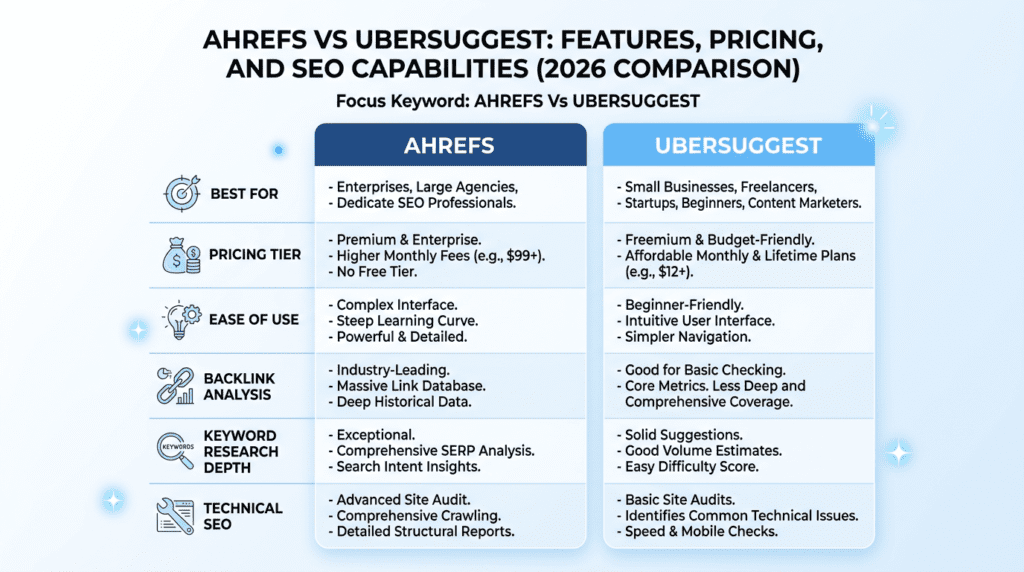
Complete Comparison Table
| Category | Ahrefs | Ubersuggest |
|---|---|---|
| Best For | Agencies, in-house SEO teams, publishers, serious competitor research | Beginners, small businesses, solo creators, lighter SEO workflows |
| Not Ideal For | Tight budgets and users who only need occasional SEO checks | Heavy-duty backlink analysis and advanced competitive research |
| Starting Price | Typically starts around $129/month | Typically starts around $29/month, with lower-cost lifetime-style offers sometimes available |
| Free Plan | Limited free access through Ahrefs Webmaster Tools | Limited free searches and restricted reports |
| Ease of Use | Powerful but more complex | Easier for beginners |
| Key Strength | Deep SEO data, backlink analysis, keyword research, competitive intelligence | Simple workflow, lower cost, usable all-in-one starter SEO tool |
| Biggest Limitation | Cost and plan limits can feel steep for smaller users | Data depth and scale are more limited than premium competitors |
| Overall Recommendation | Best when SEO is central to growth and reporting | Best when budget matters more than advanced data depth |
Best For
Ahrefs is best for users who need strong SEO data and plan to use it regularly. That includes agencies, SEO specialists, content teams, and ecommerce brands that depend on search traffic. If your team needs dependable backlink analysis, competitor tracking, and a more complete keyword research tool, Ahrefs is usually the stronger fit.
Ubersuggest is better for smaller budgets and simpler workflows. It works well for beginners, local businesses, and creators who need a practical SEO tool without a steep monthly commitment.
Not Ideal For
Ahrefs is not ideal if you only check SEO a few times a month or you’re mostly experimenting. The price can be hard to justify if you’re not using it as part of a real SEO process.
Ubersuggest is not ideal if you need deep SEO data, larger-scale competitor analysis, or more reliable research for an expanding content operation. It can do the job, but the gap shows as your needs get more advanced.
Bottom Line
If you want the better value for serious SEO work, Ahrefs usually wins on depth and long-term usefulness. If you want the cheaper, easier starting point, Ubersuggest is the more forgiving option. The best choice comes down to whether you need a starter seo tool or a system you can lean on as your search traffic grows.
Ahrefs Vs Ubersuggest: Feature Differences That Matter Most
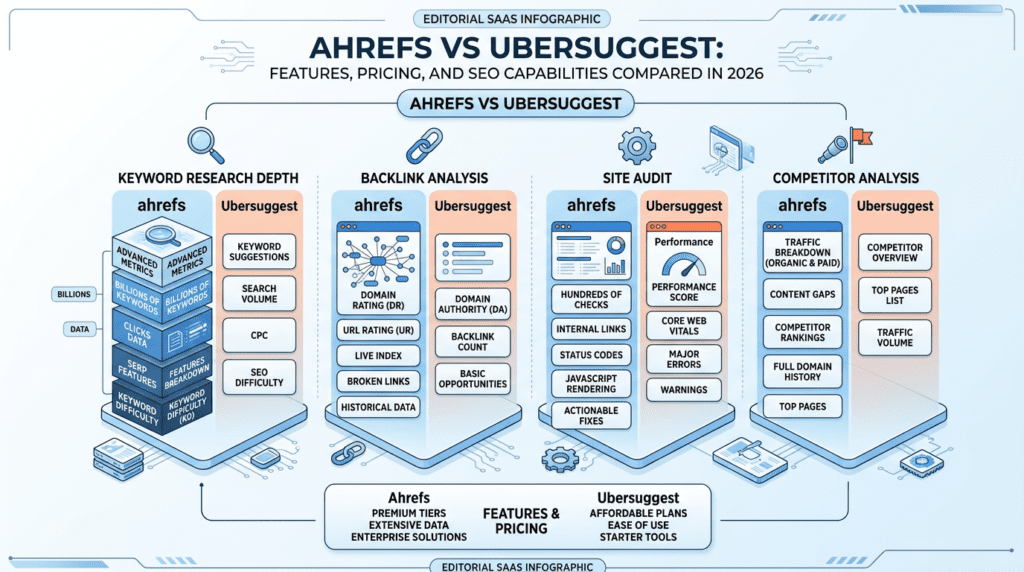
Keyword research depth and keyword difficulty data
Ahrefs generally offers stronger keyword research depth. Its keyword explorer is built for users who want to go beyond a simple list of keyword suggestions and understand the real search landscape. You get more useful keyword analysis, stronger keyword difficulty signals, and better visibility into how hard a term may be to rank for in practice.
Ubersuggest still covers the basics well. It can surface keyword ideas, show approximate search volume, and help you spot content opportunities without much friction. The problem is that lighter datasets can make the results feel less stable, especially when you’re comparing multiple competitor pages or trying to prioritize content for a growing site.
For a blogger, Ubersuggest may be enough. For an SEO team building a larger content roadmap, Ahrefs is usually the safer choice because the data tends to support more confident decisions.
Backlink analysis and link-building research
This is where the gap gets bigger. Ahrefs is widely respected for backlinks and link-building research because it makes it easier to inspect link profiles, understand the number of backlinks pointing to a domain, and identify patterns that matter for off-page SEO. If you’re doing serious link analysis, Ahrefs feels built for the job.
Ubersuggest includes backlink features too, but they’re more limited in depth and practical usefulness. You can still check link data and get a basic sense of authority, but advanced users often outgrow it quickly. If your SEO strategy depends on consistent outreach, competitor link audits, or evaluating link quality at scale, Ahrefs offers more confidence.
This is one of those areas where the difference isn’t just “more features.” It’s whether the tool can support a real link-building workflow without pushing you into manual cleanup elsewhere.
Site audit and technical SEO capabilities
Both tools include site audit features, but Ahrefs is stronger for users who want to diagnose more technical SEO issues across larger sites. It can surface crawl problems, broken links, and broader SEO health concerns in a way that fits recurring audits. That matters when the site has hundreds or thousands of URLs.
Ubersuggest’s audit tool is easier to get into and can be useful for quick checks. It’s fine for smaller sites and simpler on-page SEO maintenance. But for more advanced technical SEO work, it can feel more like a checklist than a full audit system.
If your team is trying to keep a large site clean, Ahrefs is usually the better fit. If you mostly need a practical audit tool to catch obvious issues, Ubersuggest can still do enough.
Content ideas and content planning workflows
Ubersuggest is often appealing here because it keeps things simple. It can generate content ideas and help you see what topics may be worth targeting. For small teams, that ease of use can be the difference between actually publishing and overthinking the process.
Ahrefs gives you a more strategic angle through content explorer-style research and stronger SERP analysis. That makes it easier to connect topic ideas to actual ranking behavior, not just surface-level keyword numbers. For content marketing teams, that’s a meaningful advantage because it helps align ideas with likely performance.
The trade-off is effort. Ubersuggest is faster for casual planning. Ahrefs is more useful when content planning has to support revenue, not just fill a calendar.
Competitor analysis and SERP research
Ahrefs is stronger for competitor analysis. It gives you more ways to study competing domains, compare keyword footprints, and understand why one competitor is winning more search visibility than another. That kind of data matters when you’re building a deliberate SEO strategy rather than just chasing a few keywords.
Ubersuggest can still show you competitor data and basic keyword overlap, but it’s not as robust. You can get directional insight, which is enough for lighter use cases. But if you’re trying to reverse-engineer a competitor’s content engine or see where they’re winning in organic search, Ahrefs is the more capable option.
This is where professional SEO usually separates from casual SEO. The more you need to explain “why they rank and we don’t,” the more useful Ahrefs becomes.
Ubersuggest and Ahrefs: where the feature gap is biggest
The biggest gap shows up in data depth, backlink analysis, and scaling. Ubersuggest is a user-friendly tool that covers the core tasks. Ahrefs goes deeper into the layers that matter once SEO becomes a larger operational system.
That means the difference is less about feature count and more about decision quality. Ubersuggest can help you move. Ahrefs can help you move with more confidence, especially when you’re managing multiple pages, multiple competitors, or a larger seo team.
Ahrefs Vs Ubersuggest: Ease of Use and Learning Curve
Which SEO tool feels easier for beginners
Ubersuggest is easier for beginners, plain and simple. The interface is lighter, the workflow is more forgiving, and it doesn’t overwhelm you with too many moving parts. If someone is new to keyword research or just wants to check a domain, it feels less intimidating.
Ahrefs asks for more patience. It’s still organized, but the sheer amount of SEO data can make it feel dense on day one. That’s not a flaw if you know what you’re doing. It just means the learning curve is steeper, especially for non-specialists.
Workflow differences for daily SEO tasks
Ubersuggest tends to support quick, lightweight tasks. You can run a keyword search, check a site audit, or pull basic competitor data without much setup. That makes it practical for owners who juggle marketing, operations, and content at the same time.
Ahrefs is better when SEO work is part of a repeatable process. It fits better into ongoing audits, content planning cycles, and link review workflows. The downside is that you need to know what you’re looking for. It’s powerful, but it’s not always the most forgiving user-friendly tool for a brand-new user.
A local business owner might appreciate Ubersuggest because it helps answer simple questions quickly. An agency team, though, usually benefits more from Ahrefs because the workflow can support more layers of review.
Ubersuggest keeps the dashboard easier to scan. Reports are less dense, and that helps when you just want a quick read on SEO performance. It’s not the most advanced interface, but it avoids a lot of clutter.
Ahrefs is more informative, yet also more demanding. Navigation is logical, but there’s a lot more to interpret. That’s great if you need detail. It’s not as great if you want a clean answer in 30 seconds.
Reporting is similar. Ubersuggest feels simpler. Ahrefs gives you more to work with, but it also expects you to know what matters and what doesn’t.
How quickly each tool becomes useful for non-experts
Ubersuggest usually becomes useful faster for non-experts. You can get value from it within an hour or two, especially if you’re focused on keyword research or quick site checks.
Ahrefs may take a little longer before the value clicks. Once it does, the payoff is bigger. But for non-experts, the first few sessions can feel like too much information at once. That’s the hidden cost of depth. It’s not just learning a tool. It’s learning how to think about SEO through a more advanced system.
Ahrefs Vs Ubersuggest Pricing and Value for Money
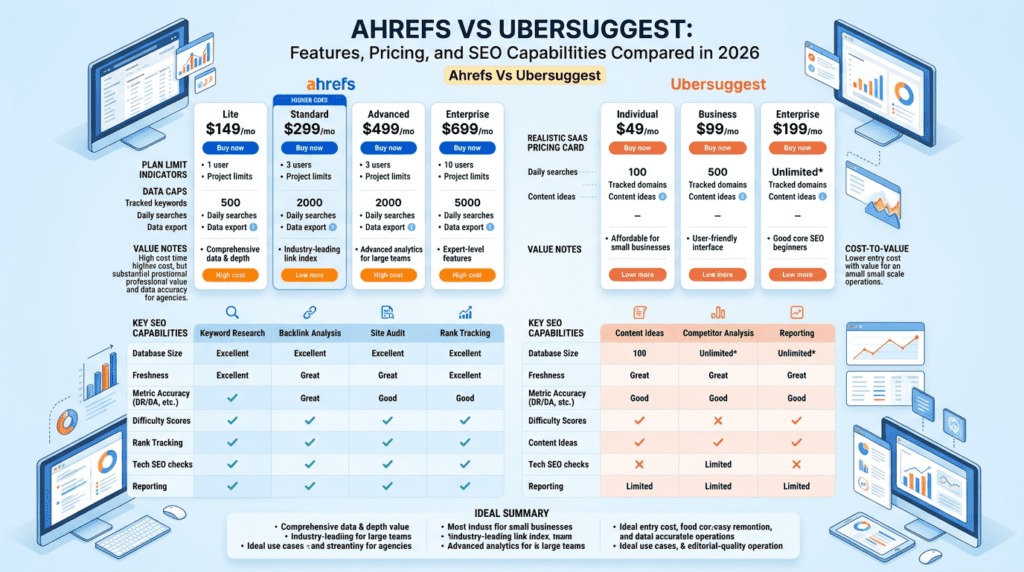
Ahrefs pricing vs Ubersuggest pricing
Ubersuggest is much cheaper to start with. Its paid plans typically begin around $29 per month, and its pricing model has historically included lower-cost access options that make it appealing to smaller buyers. Ahrefs starts much higher, usually around $129 per month for entry-level access, which immediately changes the buying conversation.
That difference is enough to matter for most small businesses. If SEO is only one part of your marketing stack, Ubersuggest can feel like the more rational purchase. If search traffic is core to acquisition, Ahrefs may still be worth the premium because the data and workflows are stronger.
The real issue isn’t just monthly price. It’s what happens when you hit plan limits. Cheaper plans usually come with tighter caps on reports, tracked keywords, projects, or access to historical data. That can create friction fast if you’re running multiple sites or managing a growing content library.
Ahrefs also has limits, and they’re not trivial. Higher price doesn’t mean unlimited access. But the system is usually built for heavier SEO use, so the restrictions tend to feel more workable for teams that rely on the platform daily.
Ubersuggest’s hidden trade-off is often manual work. You save money, but you may spend more time double-checking data or filling in gaps elsewhere. That can be fine for a solo user. It gets tiring in a team environment.
Which SEO tool gives better value at each budget level
At the lowest budget levels, Ubersuggest usually gives better value. If you’re paying for your own site, only need basic keyword research, and aren’t running frequent audits, the lower monthly cost is hard to ignore.
Once you move into a more serious SEO operation, Ahrefs becomes better value in a different sense. You’re paying more, but you’re also getting deeper backlink analysis, more useful competitor research, and stronger support for larger content workflows. That can reduce the need for extra tools and save time across the month.
For an agency or seo specialists handling multiple clients, the higher monthly cost may be easier to justify because the tool supports billable work. For a hobby project, it usually won’t.
When cheaper Ubersuggest access makes sense
Ubersuggest makes sense when you need a practical starter seo tool and cost discipline matters. That includes small businesses, freelancers, new bloggers, and marketers testing whether SEO should become a bigger channel. It also works when you mostly need occasional audits, keyword checks, and lightweight content ideas.
It’s especially reasonable if you already use other tools like Google Search Console for baseline tracking and just need a second source for keyword and backlink checks. In that setup, Ubersuggest can fill the gap without forcing a large subscription.
When Ahrefs justifies the higher cost
Ahrefs justifies the higher cost when SEO directly affects growth, lead flow, or revenue. If you’re managing a content program, scaling link-building, or competing in a crowded niche, the stronger keyword database and backlink data are usually worth the money.
It also makes sense if your team needs one platform to support multiple SEO efforts instead of patching together several weaker tools. In that case, the price is less about software and more about workflow efficiency. A serious ecommerce brand, agency, or in-house seo team often gets more out of Ahrefs because it supports how they actually work, not just how they check rankings.
Ahrefs Vs Ubersuggest for Keyword Research and Content Ideas
If your main job is finding topics that can actually rank, the Ahrefs Vs Ubersuggest debate gets more interesting here than almost anywhere else. Both tools can help with keyword research, but they don’t approach the job the same way. One is built for depth and scale. The other is built to make keyword discovery feel less intimidating.
That difference matters when you’re planning blog posts, affiliate pages, or a content calendar for a small business. A tool can show you search volume and still miss the practical stuff that tells you whether a topic is worth the time. The real question is not just how many keyword suggestions you get. It’s whether those ideas are specific enough, realistic enough, and organized well enough to shape a usable SEO plan.
Keyword discovery breadth and long-tail opportunities
Ahrefs usually gives you the wider net. Its keyword explorer-style workflow tends to surface more variations, more intent angles, and more long-tail opportunities around a core topic. That helps when you’re trying to build a content cluster instead of chasing one keyword at a time. You can move from a head term into dozens of supporting topics without feeling like you’ve hit a wall too early.
Ubersuggest is simpler, but that simplicity can be a real benefit for smaller sites. It’s often easier to scan, easier to understand, and less overwhelming when you just need a usable list of keyword ideas fast. The trade-off is that the keyword database can feel thinner, especially in narrow niches or outside the most common commercial topics. If you publish in a specialized category, you may notice the same suggestions repeat or drift toward broader terms sooner than you’d like.
For a niche affiliate site, that difference shows up quickly. Ahrefs is usually better when you want to mine long-tail opportunities for comparison posts, “best X for Y” pages, and support articles. Ubersuggest works fine when you need a starting point and don’t want to spend an hour filtering through a huge data set.
Keyword metrics you can trust for planning content
Keyword analysis only works if you trust the numbers enough to make decisions from them. Ahrefs tends to be stronger here because its keyword difficulty scores, SERP context, and supporting metrics are built for more serious planning. You can move from keyword overview into search intent and competition analysis with fewer blind spots. That matters when one article might cost several hours of writing, editing, and internal linking.
Ubersuggest does give you the basics: search volume, keyword difficulty, and related suggestions. For simple planning, that’s often enough. But the numbers can feel less nuanced when you’re trying to judge whether a keyword is easy, just oddly distributed, or truly worth targeting. Small businesses and newer site owners sometimes like this because it keeps the process approachable. SEO specialists may find it limiting because they need more confidence before assigning content resources.
The practical issue is not whether a tool shows numbers. It’s whether those numbers help you avoid bad bets. If you’re building a site with 50 to 200 pages, one wrong topic choice is annoying. If you’re managing 1,000 pages or a client portfolio, it becomes expensive.
Content ideas for blogs, affiliates, and niche sites
Ahrefs is usually stronger for turning raw keyword data into content ideas that fit a larger SEO strategy. Its content explorer-style workflows make it easier to spot what’s already earning links, what formats are working, and where the angle is still open. That’s especially useful for content marketing teams that want to combine SEO and content planning in one place.
Ubersuggest is more straightforward. It can help you find blog topics, product-adjacent ideas, and easy content angles without much setup. For a solo blogger, that can be enough. You can pull a keyword, look at a few variations, and start writing. The catch is that the ideas can feel less developed when you need a full content map instead of a single article idea.
A practical example: a local service business might use Ubersuggest to brainstorm service pages and a few FAQ articles. An affiliate site owner, though, will usually get more value from Ahrefs because it’s easier to connect keyword ideas to link potential, traffic potential, and future cluster opportunities.
Ahrefs vs Ubersuggest for competitor keyword gap research
This is where Ahrefs starts pulling ahead in a meaningful way. Competitor keyword gap work needs more than a list of terms your rival ranks for. You need enough keyword depth to find patterns, identify missing sections, and see where your competitors are winning by topic cluster instead of isolated pages. Ahrefs handles that kind of analysis with more confidence.
Ubersuggest can still show you competitor terms and content ideas, and that’s helpful for quick checks. If you just want to see a rival’s top pages or find a few easy gaps, it does the job. But when you want to compare multiple domains, look for overlap, and build a real content roadmap, the limits show up. The data is useful, just less complete.
This matters most for agencies and seo team workflows. One-off competitor checks are easy. Repeating that process across several clients, then turning it into an editorial plan, is where deeper tooling pays for itself.
Best tool for turning keyword data into content strategy
Ahrefs is the better choice if you want keyword data that feeds a real seo strategy. It gives you more room to move from discovery to prioritization to execution. That helps when you’re deciding not only what to publish, but what to publish first, what to cluster together, and where to chase authority topics versus quick wins.
Ubersuggest is better when you want a user-friendly tool that gets you to content ideas without a lot of friction. It’s a solid fit for small businesses, solo creators, and beginners who need clarity more than complexity. The limit is that it can flatten the strategy a bit. You may end up with a list of decent ideas, but not always a strong sense of how those ideas connect.
If your site is new and you’re still learning the ropes, Ubersuggest is often enough. If you’re competing in a crowded niche, Ahrefs offers the deeper keyword research tool workflow most professional seo users eventually want.
Ahrefs Vs Ubersuggest for Backlink Analysis and Competitor Analysis
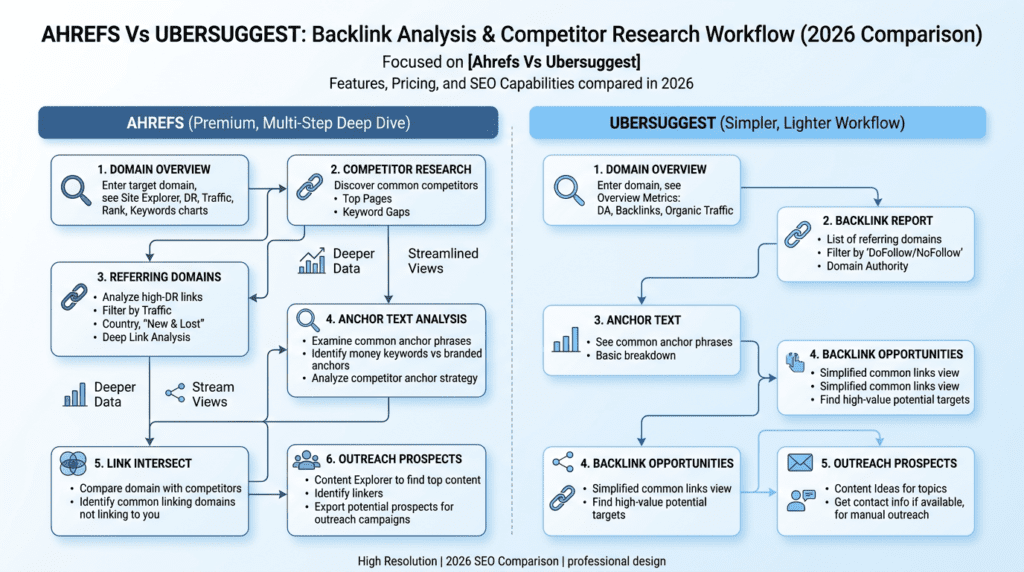
Backlinks are where the gap between these two seo tool options becomes hard to ignore. Keyword research can be “good enough” for a while, but backlink analysis gets demanding fast. Once you start comparing referring domains, link quality, and how a competitor built authority, shallow data becomes a problem. That’s why this section matters so much for anyone doing off-page seo or link building in a serious way.
Ahrefs has long been known for strong backlink intelligence, and that reputation still holds up because the workflow is built around depth. Ubersuggest can still help you see who links to a domain, but it’s generally better suited to lighter research than detailed investigation.
Backlink database size and freshness
Ahrefs typically wins on the number of backlinks it can surface and how useful that data feels in practice. When a backlink database is broad and updated often, it becomes easier to spot new links, lost links, and link patterns that matter. That helps when you’re tracking your own domain or studying a competitor that’s moving quickly.
Ubersuggest provides backlink data too, but the coverage is usually less complete. For a small site, that may be fine. You can still identify some referring domains, check a few links, and get a rough sense of authority. But if you’re trying to understand a site’s full backlink profile, the gaps become noticeable. You may miss smaller links, older links, or the broader shape of a domain’s link acquisition.
For agencies and seo specialists, that difference affects decisions. You don’t just want “some backlinks.” You want enough confidence to judge whether a competitor’s growth is real, temporary, or tied to a handful of strong placements.
Competitor backlink research and link intersect workflows
Ahrefs is stronger for competitor analysis because it makes link discovery more strategic. Its explore-style tools help you compare domains, find shared links, and uncover sites linking to one competitor but not another. That kind of workflow is valuable when you’re planning outreach, building prospect lists, or trying to reverse-engineer why a page is ranking.
Ubersuggest can still show you competitor backlinks and give you directional insight. For many users, that’s enough to identify a few link sources and see whether a rival is getting coverage from niche blogs, directories, or mentions. It just isn’t as deep or as efficient when you need repeatable link intersect research.
The difference is especially obvious for agencies and ecommerce brands. If you’re trying to scale outreach across several campaigns, speed matters. Ahrefs gives you a more polished process. Ubersuggest gives you a simpler one, but it can feel manual sooner.
Anchor text, referring domains, and link quality checks
Good backlink analysis is not just about the number of backlinks. It’s about context. Ahrefs makes it easier to inspect anchor text patterns, referring domains, and the balance between raw link count and actual link quality. That helps you spot spammy patterns, branded mentions, and over-optimized anchors before they become a problem.
Ubersuggest covers the basics, but the reporting is lighter. That can be enough if you just need a quick check on a domain or want to confirm whether a page has any obvious authority. Still, when you’re auditing link quality or comparing several competitor domains, you’ll likely want more detail than Ubersuggest gives.
A local agency might use Ubersuggest to check a prospect’s domain before a sales call. A professional seo team usually needs more than that. They need enough backlink analysis to guide outreach, content promotion, and risk review.
When Ahrefs is stronger for serious link analysis
Ahrefs is the safer pick when backlinks are central to your work. That includes link-building campaigns, digital PR, competitive research, and mature content programs that rely on authority growth. It gives you more data to work with, which matters because link decisions are often made on incomplete evidence.
If you need to study a competitor’s number of backlinks, link velocity, referring domains, and anchor patterns at scale, Ahrefs is the better fit. It’s also more useful when you’re tracking progress over time, because the broader dataset makes changes easier to interpret.
There’s a cost to that depth, though. It takes more time to learn, and the subscription is harder to justify if you only look at backlinks a few times a month.
When Ubersuggest is enough for lighter competitor research
Ubersuggest is enough if your backlink work is occasional rather than central. That describes plenty of small businesses, bloggers, and solo creators. If you just want a basic competitor check, a quick look at a domain’s link profile, or a rough sense of authority, it can do the job without the complexity.
It’s also a practical option if you’re still building your seo process and don’t want to pay for advanced seo tooling before you know how often you’ll use it. The trade-off is clear: you get a simpler workflow, but less confidence when the research gets serious.
Ahrefs Vs Ubersuggest Site Audit and Technical SEO Comparison
Site audit tools are where a lot of buyers discover the difference between “nice to have” and “actually useful every week.” Both platforms can surface seo issues, but the depth, prioritization, and reporting quality are not equal. If you handle technical seo, crawl errors, or on-page cleanup regularly, this section matters more than the marketing pages suggest.
Crawl depth, issue detection, and technical SEO coverage
Ahrefs generally offers the stronger site audit experience. It can crawl deeper, spot more technical seo problems, and present issues in a way that helps you understand what is broken and why it matters. That’s useful when a site has messy internal linking, indexation problems, broken pages, or a growing pile of edge-case issues that don’t show up in a quick manual review.
Ubersuggest’s audit tool is simpler and faster to understand. For a small website with a limited number of pages, that’s often enough. It can catch common seo issues like missing metadata, broken links, and some on-page problems. But once the site gets larger, the audit can feel more surface-level than diagnostic.
A 50-page site and a 5,000-page site are not the same problem. Ubersuggest is more comfortable with the first. Ahrefs is better prepared for the second.
Prioritizing fixes with each SEO tool
A site audit is only useful if it tells you what to fix first. Ahrefs tends to be better at prioritization because the reporting usually feels more connected to real SEO impact. Instead of just listing errors, it gives you a clearer path through the mess. That matters when you’re choosing between redirect work, internal link cleanup, duplicate pages, or indexation fixes.
Ubersuggest makes the audit easier to digest, which is helpful for beginners. The downside is that you may still have to do more thinking on your own. The tool can point out issues, but it won’t always help you separate the urgent problems from the annoying ones.
That gap becomes obvious for agencies and seo teams. If you’re sending tasks to a developer or client, vague issue lists create friction. Clear prioritization saves time and reduces back-and-forth.
Reporting quality for teams and solo site owners
Ahrefs has the better reporting setup for teams because it gives you more to explain, defend, and track. If you’re sharing findings with a client, developer, or content lead, the extra detail is useful. It makes the audit feel more like a working document than a checklist.
Ubersuggest is easier for solo site owners who want a quick health check without a learning curve. It’s less intimidating, and that matters when you’re the one doing everything. You can log in, review the audit, and move on to fixes without building a whole process around it.
For a one-person blog or local business site, that convenience is valuable. For a growing team, it can become limiting because reporting needs to support coordination, not just awareness.
What Ahrefs or Ubersuggest misses in technical SEO workflows
Neither tool replaces a proper technical audit stack, and that’s worth saying plainly. Ahrefs is better, but it still won’t fully replace log file analysis, developer-level debugging, or deeper crawling tools in more advanced workflows. Ubersuggest is even more limited there. It’s helpful, but it won’t expose everything.
So the real choice is not whether one tool does technical seo perfectly. It’s whether you need a strong audit tool inside your broader process or just a basic audit tool to keep a site healthy. If your seo health depends on constant technical oversight, Ahrefs is the stronger fit. If you mostly need a quick audit tool for occasional cleanup, Ubersuggest can be enough.
What Most Blogs Miss About Ahrefs Vs Ubersuggest
Most comparisons stop at features and pricing, then pretend that’s the whole decision. It isn’t. In practice, the bigger issue is how the tool fits your working style, your site size, and the level of seo performance you need to maintain over time. A tool can look simple on day one and still become frustrating by month six.
Why tool choice depends on whether you need data depth or simplicity
This is the real split. Ahrefs is the better choice if you need depth, repeatability, and room to scale. Ubersuggest is better if you want a simpler user experience and faster entry into keyword research and audits. Neither answer is wrong. They just solve different problems.
That’s why some buyers feel Ubersuggest is “good enough” while others get annoyed quickly. One person needs a cleaner workflow and basic reports. Another needs reliable seo data they can build a business on. The same tool can feel helpful in one setup and cramped in another.
The real cost of limited data when a site starts scaling
Limited data is easy to ignore when you only publish a few articles a month. It becomes harder to ignore when you’re managing dozens of pages, multiple authors, or a steady content pipeline. At that point, the cost of weak keyword analysis or thin backlink analysis shows up in wasted time, missed opportunities, and slower growth.
This is where many users outgrow Ubersuggest faster than expected. Not because it stops working, but because the business starts asking harder questions. Which pages should be updated first? Which competitor has the stronger link profile? Which topics deserve support content now versus later? Those decisions need more data than a lightweight setup usually provides.
Hidden frustrations with usage caps and feature limits
Plan limits matter more than most buyers expect. A keyword research tool can look cheap until you run into monthly caps, search limits, or feature restrictions that interrupt actual work. That’s especially true for agencies, freelancers, and content teams that use the platform every day.
The frustration usually isn’t dramatic. It’s small, repetitive stuff: hitting a cap mid-project, needing another export, or realizing a report you want sits behind a higher plan. Those little interruptions add up. Ahrefs tends to be less about friction and more about cost. Ubersuggest tends to be less expensive up front, but the ceilings can show up sooner.
Why some users outgrow Ubersuggest faster than expected
People often choose Ubersuggest expecting a long runway, then discover their workflow has changed. Maybe they started with one site and now manage three. Maybe they went from occasional blogging to more serious content marketing. Maybe they now need more competitor analysis, deeper backlink checks, or better keyword research for multiple campaigns.
That’s when the value conversation changes. Ubersuggest is still a popular seo tool, and for the right user it remains the better buy. But if your work now depends on more advanced seo, more complete seo data, and a stronger keyword database, Ahrefs starts making more sense. The tool didn’t change. Your business did.
Ahrefs Vs Ubersuggest: Who Should Choose Each SEO Tool
The best answer in the Ahrefs Vs Ubersuggest debate is simple: choose the tool that matches how deep you need to go, not the one with the longest feature list. A solo blogger checking a few keyword opportunities each week has very different needs from an agency managing 20 sites and chasing link gaps all day.
That’s where most buyers get tripped up. They compare feature names, then ignore the real workflow. One seo tool may feel lighter and cheaper, but start to feel tight once you need larger keyword research, stronger backlink analysis, or more consistent data for reporting. The other may be far more capable, but it can be overkill if you only need basic site checks and content ideas.
Best choice for beginners and small site owners
Ubersuggest is usually the easier first step for beginners, freelancers, and small businesses that want a user-friendly tool without a steep learning curve. It covers the basics well enough for day-to-day keyword research, simple site audit work, and quick content ideas. That matters when you’re not trying to run a full seo strategy. You just want answers fast.
For a local business, a new blogger, or a one-person affiliate site, the biggest win is speed. You can check a domain, spot a few SEO issues, and get keyword suggestions without digging through layers of advanced filters. The trade-off is depth. Once you need more reliable backlink data, broader keyword analysis, or heavier competitor research, the cracks show.
Best choice for agencies and serious SEO operators
Ahrefs is the stronger choice for agencies, in-house teams, and seo specialists who need more advanced seo data every day. It’s built for scale. The backlink index, keyword database, and explorer tools are more useful when you’re handling multiple clients or making decisions that affect revenue.
This is where professional seo starts to separate from casual use. Agencies and seo team members often need cleaner link data, more confident keyword difficulty signals, and better reporting for clients. Ahrefs also fits off-page seo work better because the backlink database is a real operational asset, not just a nice-to-have. If your team lives in spreadsheets, search console exports, and recurring audits, Ahrefs tends to earn its seat.
Best choice for content marketers focused on keyword research
If your day revolves around content marketing, Ahrefs usually gives you more room to grow. Its keyword explorer and content explorer tools are better for finding topic clusters, estimating search volume, and identifying content gaps that are worth targeting. That makes it easier to build a plan instead of just collecting keyword ideas.
Ubersuggest can still work for content marketing, especially if you’re producing a smaller number of posts each month. But for teams that publish at volume, the limits become obvious. You may get enough data to write an article, but not always enough context to prioritize what should come first. That’s a problem when traffic decisions affect money.
Best choice for backlink-driven SEO strategies
Ahrefs is the clear pick if backlinks are central to your SEO efforts. That includes digital marketing agencies, niche site operators chasing authority, and brands actively building links. The number of backlinks, referring domains, anchor text patterns, and link quality checks are simply more useful when the underlying database is deeper.
Ubersuggest can handle light backlink analysis, but it’s better for quick checks than serious link building. If you only want a rough look at a competitor’s profile, that may be enough. If you’re deciding which pages to pitch, which links to reclaim, or which competitors are outranking you because of stronger off-page seo, Ahrefs is much harder to replace.
Which tool fits your workflow if you only need one platform
If you want one platform and you’re still early in the game, Ubersuggest is the more forgiving start. It’s easier to learn, cheaper to access, and good enough for small businesses that need practical SEO help without a big monthly commitment. Think simple content planning, basic audits, and occasional competitor checks.
If your work is tied to growth, reporting, or client deliverables, Ahrefs is the safer long-term platform. It’s not just about having more features. It’s about reducing uncertainty when the stakes rise. For many buyers, that’s the real answer to ahrefs or ubersuggest: start with the one that fits your current workflow, but don’t ignore how quickly your needs can change.
Ahrefs Vs Semrush Vs Ubersuggest: Where Ahrefs and Ubersuggest Fit
Ahrefs vs Semrush for advanced SEO teams
When people compare ahrefs vs semrush, they’re usually choosing between two serious platforms built for advanced SEO work. Both are strong, but they lean differently. Ahrefs is often better for backlink analysis, keyword research depth, and exploratory research. Semrush is broader, with more built-in marketing modules and more all-in-one utility for teams that want SEO, ads, and content planning under one roof.
For advanced seo teams, the decision often comes down to workflow. If your team cares most about link intelligence and clean SEO data, Ahrefs usually feels sharper. If you want a wider marketing stack with more cross-channel tools, Semrush can be the better operating system. Neither is a casual pick. Both expect you to use the software regularly.
Where Ubersuggest sits relative to Ahrefs and Semrush
Ubersuggest sits in a very different lane. It’s the simpler, lighter, more affordable option for buyers who don’t need enterprise-grade depth. It can absolutely help with keyword research, site audit basics, and content ideas. That makes it attractive to beginners and small site owners.
But compared with Ahrefs and Semrush, Ubersuggest is more of a practical starter tool than a full research engine. The keyword database is smaller, the backlink analysis is less complete, and the reporting isn’t built for large teams. That doesn’t make it bad. It just means it solves a narrower problem. For some users, that’s exactly what they want.
When another SEO tool may be a better fit than either option
There are cases where neither ahrefs and semrush nor Ubersuggest is the best fit. If you mainly need on-page seo checks, a lighter audit tool paired with Google Search Console may be enough. If your team is focused on technical seo at scale, you may want a dedicated crawling platform instead of relying on a general seo tool.
This is especially true for agencies and seo specialists with specific workflows. Some teams need raw data exports. Others need local rank tracking, content planning, or integration with google search console in a very particular way. In those situations, the best seo tool is often the one that fits the process, not the brand name. A cheaper stack can win if it removes unnecessary steps.
Final Verdict: Is Ahrefs Vs Ubersuggest Worth It in 2026?

Key takeaways for value-focused buyers
The biggest takeaway is that value depends on how much depth you actually use. Ahrefs is usually the better long-term buy for teams that need reliable keyword data, stronger backlink analysis, and repeated reporting. Ubersuggest is often the better first buy when budget and simplicity matter more than precision.
Final recommendation based on SEO goals and budget
If your budget is limited and your SEO work is fairly straightforward, Ubersuggest is a sensible place to start. It gives small businesses, bloggers, and newer site owners enough coverage to move forward without feeling buried. You can get useful work done with it.
If you’re serious about ranking growth, competitive research, or link-driven SEO, Ahrefs is usually the stronger investment. It costs more, but the data depth can save time and reduce bad decisions. That matters when one weak keyword call or one missed backlink opportunity can slow growth for months.
Conclusion: Ahrefs Vs Ubersuggest for long-term SEO success
Over the long run, Ahrefs Vs Ubersuggest is less about which platform is “better” and more about which one can keep up with your SEO ambitions. Ubersuggest works well when the job is small and the budget is tight. Ahrefs wins when your seo efforts become more complex and the cost of shallow data starts to show.
If you expect your site to grow, the safer choice is usually the tool that can grow with it. If you only need practical help today, the lighter option may be enough.
Frequently Asked Questions About Ahrefs Vs Ubersuggest
Is Ahrefs better than Ubersuggest for keyword research?
Yes, Ahrefs is better for keyword research in most serious use cases. It usually gives you deeper keyword analysis, stronger keyword difficulty context, and a broader set of keyword ideas for planning content at scale.
Ubersuggest is still useful for basic research and quick topic checks. If you only publish a few pieces a month, it may be enough. If you need to map a larger content strategy, Ahrefs is the safer pick.
Is Ubersuggest good enough for backlink analysis?
Ubersuggest is good enough for light backlink analysis, but not for detailed link-building work. It can show you the basics, which is fine if you’re checking a few competitors or reviewing a domain casually.
If you care about link quality, referring domains, or deeper competitor analysis, Ahrefs is much stronger. That difference becomes more obvious as your site grows.
Which SEO tool is easier to use for beginners, Ahrefs or Ubersuggest?
Ubersuggest is easier for beginners. The interface is simpler, the workflows are lighter, and the learning curve is usually shorter.
Ahrefs is still usable, but it asks more from the user. It’s a better fit once you’re comfortable with SEO basics and want more advanced data.
How does Ahrefs Vs Ubersuggest compare on pricing for small businesses?
Ubersuggest is usually the cheaper option for small businesses. Its lower entry cost makes it easier to justify when SEO is only one part of a larger marketing budget.
Ahrefs costs more, but it can deliver better value if your business relies on ongoing keyword research, backlink work, or competitor tracking. The real question is not price alone. It’s whether the extra data changes decisions often enough to matter.
Can Ubersuggest replace Ahrefs for long-term SEO work?
For some small sites, yes, but only up to a point. Ubersuggest can handle basic SEO work, especially for owners who want simple answers and don’t need deep reporting.
For long-term growth, many users eventually outgrow it. That usually happens when they need more accurate SEO data, larger-scale keyword planning, or stronger backlink intelligence.
Is Ahrefs Vs Ubersuggest the right comparison if I also use Semrush?
Yes, because Semrush sits in the same broader category, but it serves a different kind of buyer. Comparing ahrefs vs semrush helps you understand where Ahrefs fits among advanced tools, while Ubersuggest shows the budget and simplicity end of the market.
If you’re choosing a tool for serious SEO work, looking at all three gives you a clearer view of the trade-offs.