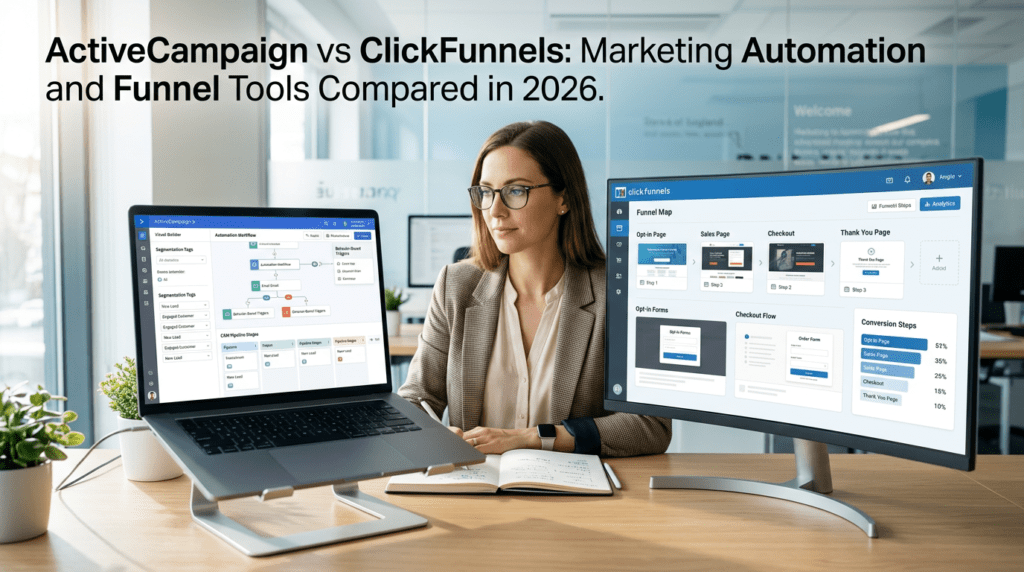
A lot of teams hit the same wall at the same time: leads are coming in, sales are happening, and the follow-up starts slipping. That’s usually when the Activecampaign Vs Clickfunnels decision gets real. You’re not just buying software. You’re choosing how your marketing, sales, and follow-up system will actually run day to day.
The catch is that both platforms solve part of the same problem, but in very different ways. One leans hard into email marketing and automation. The other is built around funnels, pages, and conversion. That sounds simple until you’re trying to decide what matters more for your business, what you can realistically manage, and where the hidden friction shows up after month one.
Why Activecampaign Vs Clickfunnels is a common decision for marketers
Marketers usually compare these two because both can help capture leads and move them toward a sale. On paper, they overlap enough to create confusion. In practice, they solve different problems inside the same growth workflow.
ActiveCampaign tends to appeal to teams that need segmentation, automation, and a stronger CRM layer. ClickFunnels attracts people who want to build a sales funnel fast, connect a landing page to an offer, and keep the buying path simple. If your business depends on email sequences, lead scoring, and long nurture cycles, the comparison looks different than it does for a webinar, course launch, or direct-response funnel.
What most people expect from activecampaign and clickfunnels
Most buyers expect one tool to do everything well. That’s where the disappointment starts. ActiveCampaign offers serious email marketing and marketing automation features, but it’s not trying to be a full funnel builder first. ClickFunnels provides a more complete funnel and page-building experience, but its automation depth is not the same as a dedicated automation platform.
So people often want both at once: pages, email, CRM, and advanced automation in one place. The reality is that activecampaign and clickfunnels both have strengths, but each one asks you to accept a few compromises.
Where buyers usually get stuck choosing between automation and funnels
The real choice is not about features in isolation. It’s about workflow. Do you need to automate complex follow-up, segment contacts, and manage a pipeline over time? Or do you need to launch a funnel, test offers, and capture leads with less setup friction?
This is where buyers stall. They know they need email marketing and automation, but they also want a smooth funnel builder and landing page builder. The wrong choice usually shows up later as either too much manual work or a system that’s easy to launch but weak at scale.
The hidden trade-off is that convenience and depth rarely come together cleanly. ClickFunnels can speed up launch time, but once you start needing more advanced automation tools, the cracks show. ActiveCampaign can become the backbone of marketing and sales, but the learning curve is more noticeable, especially if you want polished pages plus complex workflows.
For growing businesses, that means the best answer is often less about which tool is “better” and more about which bottleneck hurts more right now: weak follow-up or weak funnel execution.
Quick Verdict: ActiveCampaign vs ClickFunnels in 2026
| Category | ActiveCampaign | ClickFunnels |
|---|---|---|
| Best For | Email automation, CRM, segmentation, lead nurturing | Funnel creation, landing pages, offer launches, conversion-focused campaigns |
| Not Ideal For | Teams that want a simple all-in-one funnel launcher | Teams that need deep automation and CRM workflows |
| Starting Price | Typically starts around $15–$29/mo depending on plan and contacts | Typically starts around $97/mo on entry-level plans |
| Free Plan | No permanent free plan, usually a trial | No permanent free plan, usually a trial |
| Ease of Use | Moderate learning curve | More user-friendly for fast funnel setup |
| Key Strength | Advanced automation and segmentation | Funnel builder and page-building speed |
| Biggest Limitation | Page building is not its strongest side | Automation depth is more limited than a dedicated email marketing tool |
| Overall Recommendation | Best when follow-up and CRM matter most | Best when the funnel itself is the priority |
Best for
ActiveCampaign is best for businesses that depend on email marketing, segmentation, and automation across a longer customer journey. Think service businesses, agencies, SaaS brands, and ecommerce teams that need to nurture leads over days or weeks. It’s also a better fit if you want a real crm behind your marketing campaigns.
ClickFunnels is best for businesses that live and die by funnel performance. Course creators, coaches, digital product sellers, webinar marketers, and direct-response teams usually get more immediate value from it because they can launch faster and keep the entire sales funnel in one place.
Not ideal for
ActiveCampaign is not ideal if your main goal is to spin up polished funnels as quickly as possible without much setup. You can build landing pages and automate follow-up, but the experience is not as focused on conversion-page creation as ClickFunnels.
ClickFunnels is not ideal if you need deeper crm logic, more flexible segmentation, or highly detailed automation around lifecycle stages. If your marketing and sales workflow depends on complex branching, scoring, and long-term nurture, you may outgrow it faster.
Bottom line
If your business needs stronger automation, better segmentation, and tighter crm support, use ActiveCampaign. If your priority is a clean, fast funnel system that helps you launch and optimize offers, ClickFunnels is the better fit. The better choice depends less on the software itself and more on whether your biggest bottleneck is follow-up or conversion.
Differences Between ActiveCampaign vs ClickFunnels That Matter Most
Marketing automation vs sales funnel and landing page focus
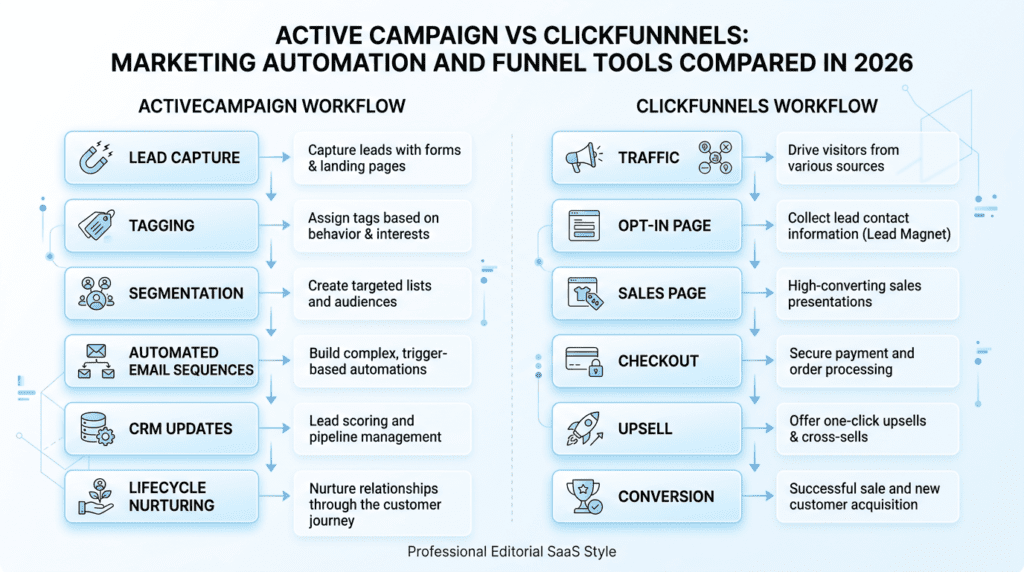
The biggest difference between ActiveCampaign and ClickFunnels is focus. ActiveCampaign is built around automation and email marketing. ClickFunnels is built around the funnel, from opt-in to purchase.
That matters because the software you choose will shape your operating rhythm. With ActiveCampaign, you’re usually thinking in workflows, triggers, contact behavior, and lifecycle stages. With ClickFunnels, you’re thinking in page sequences, offers, upsells, and conversion paths. One supports long-term marketing automation. The other supports direct conversion flow.
If your business needs to nurture leads for 30, 60, or 90 days, ActiveCampaign usually fits better. If you need to move a prospect from ad click to checkout in one clean path, ClickFunnels tends to feel more natural.
Email marketing, CRM, and workflow depth in ActiveCampaign
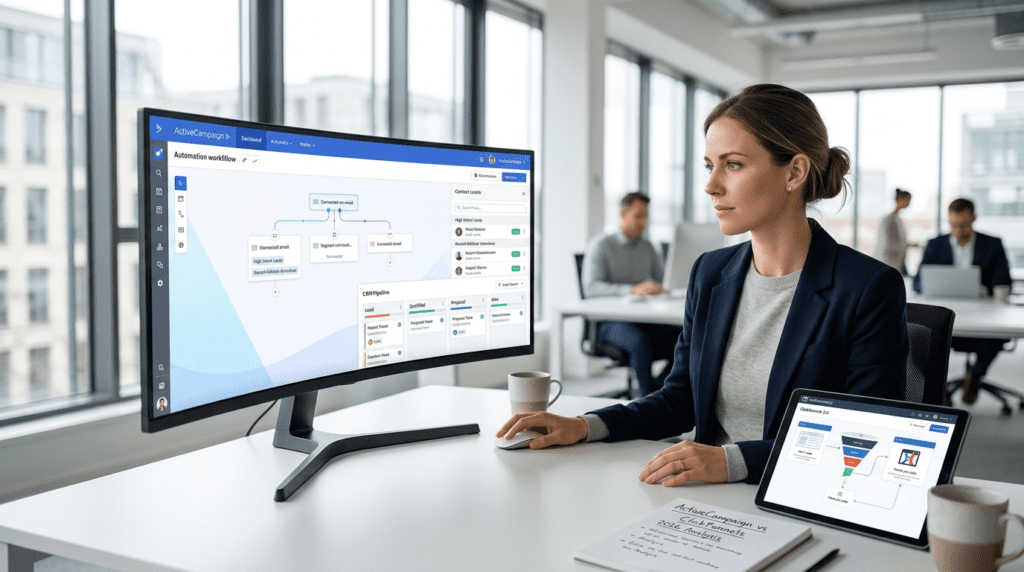
ActiveCampaign excels when the follow-up matters more than the initial opt-in. It gives you more control over email marketing, segmentation, and the logic behind each automation. You can tag contacts, branch based on behavior, and build a workflow that changes depending on what someone clicks, buys, or ignores.
That flexibility helps when your list is growing and the sales process is no longer simple. A small agency might use ActiveCampaign to separate new leads, booked calls, and clients in different pipeline stages. A SaaS brand might automate onboarding, trial reminders, and renewal nudges without building every step by hand.
The trade-off is that this power comes with a learning curve. ActiveCampaign is not hard in the way enterprise software is hard, but it does ask you to think more carefully about structure. Once your sequences get layered, poor setup choices can create messy automation loops or duplicate follow-up that’s hard to unwind.
Funnel building, landing page creation, and conversion tools in ClickFunnels
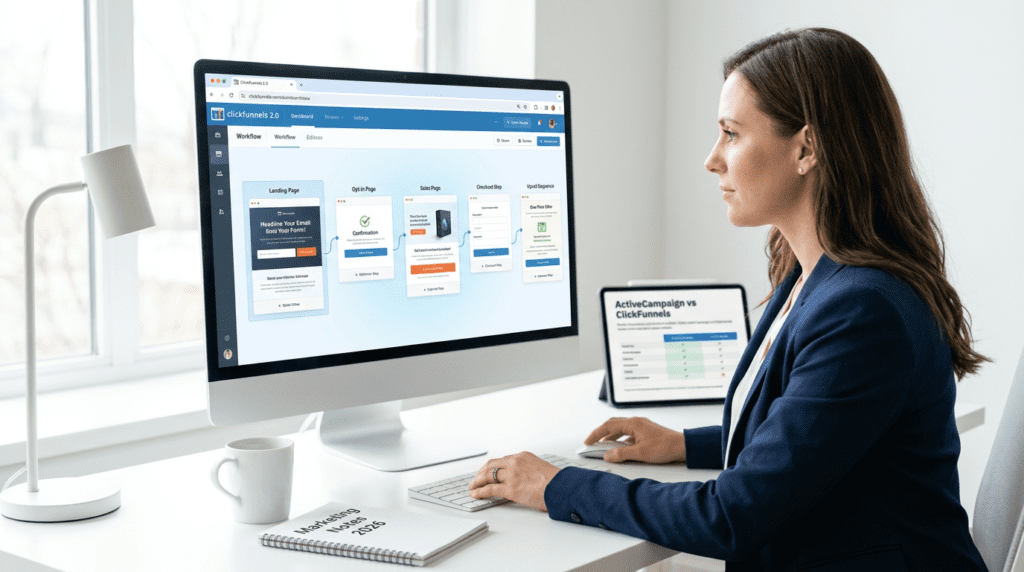
ClickFunnels is mainly about helping you build a funnel that converts without a lot of technical overhead. It gives you a page builder, funnel templates, and a more direct path from visitor to lead to sale. That simplicity is the appeal. You can map out a sales funnel quickly, publish pages, and start testing the offer.
For digital product sellers and webinar hosts, that speed is valuable. Instead of stitching together multiple tools, you can create a landing page, sales page, checkout flow, and upsell sequence inside one system. ClickFunnels provides a structure that makes it easier to launch a campaign fast, especially if you’re not a designer or developer.
The limitation is that funnel convenience can hide operational gaps. As businesses scale, they often need richer segmentation, more specific follow-up, or a better crm handoff. ClickFunnels can absolutely support real growth, but it’s usually strongest at the front end of the buyer journey, not the long tail.
Integration options when you use ActiveCampaign and ClickFunnels together
A lot of businesses end up using ActiveCampaign and ClickFunnels together because the combo solves different problems. ClickFunnels handles the funnel and landing page experience. ActiveCampaign handles the follow-up, automation, and crm logic after the lead comes in.
That setup works well when you want each platform to do what it does best. A lead can opt in through ClickFunnels, then be collected from ClickFunnels and pushed into ActiveCampaign for tagging, segmentation, and email automation. This can create a stronger workflow than forcing one platform to carry every job.
The downside is obvious: more moving parts. More integration points mean more room for sync issues, duplicate contacts, or broken triggers when a form changes. If your team is small and already stretched thin, the stack can become harder to maintain than it looks during the sales demo.
ActiveCampaign vs ClickFunnels: Feature Differences Across the Core Stack
Automation capabilities and workflow flexibility
ActiveCampaign has the stronger automation engine, and that gap matters more once your business starts running multiple campaigns at once. You can automate based on clicks, page visits, purchases, form submissions, tags, and other actions. That makes it useful for complex marketing automation where timing and behavior matter.
ClickFunnels includes automation, but it’s more limited compared to ActiveCampaign. It can support basic follow-up and funnel actions, yet it’s not built to be a deep automation platform first. That’s fine if your workflow is simple. It becomes a problem when you want branching logic, conditional delays, or more detailed nurture sequences.
If your team needs to automate onboarding, abandoned cart follow-up, lead scoring, and reactivation, ActiveCampaign gives you more room to work. If your automation needs are mostly tied to funnel events, ClickFunnels can be enough.
Email marketing tools and segmentation
ActiveCampaign is the stronger email marketing tool by a wide margin. Segmentation is one of its core strengths, which matters because a list is only useful if you can separate people by intent, stage, and behavior. You can send different messages to leads who opened an email, buyers who purchased, or contacts who never clicked.
That kind of segmentation improves conversion over time because the same email campaign doesn’t have to go to everyone. A coach might send one sequence to webinar registrants and a different one to past buyers. An ecommerce brand might separate first-time customers from repeat shoppers and automate different follow-ups for each group.
ClickFunnels can include email-related actions, but it’s not trying to compete as a full email marketing service. If email is central to your revenue, ActiveCampaign is the more serious option.
CRM functionality and pipeline management
ActiveCampaign’s crm features are more useful for businesses that track leads through multiple stages. You can manage a sales pipeline, assign contacts, and build workflows around handoffs between marketing and sales. That makes it a better fit for agencies, B2B services, and SaaS teams that need visibility into what happens after the lead is captured.
ClickFunnels is more focused on the funnel path than on crm depth. It can support sales activity, but the experience is not as strong for ongoing pipeline management. That’s not a flaw if you only need a simple path from click to checkout. It becomes limiting when your sales cycle stretches across calls, emails, and follow-ups.
For businesses where lead status matters just as much as page conversion, ActiveCampaign gives you more control.
Landing page and funnel builder features
ClickFunnels is the better funnel builder and page builder if your main job is getting a page live quickly. Its drag-and-drop editor is built for sales flow, not just design. You can create opt-in pages, sales pages, order forms, and upsells without piecing together separate tools.
ActiveCampaign does offer landing pages, but that’s not where it shines. The pages can work well for simple lead capture, yet they’re not usually the reason people choose the platform. If you want a dedicated landing page builder with a funnel-first mindset, ClickFunnels is more natural.
The practical difference shows up when speed matters. ClickFunnels gets you to launch faster. ActiveCampaign gives you more control after the lead enters your system.
Analytics and reporting differences
ActiveCampaign provides more useful reporting for automation performance, email engagement, and contact behavior. That helps when you want to know not just whether people clicked, but how they moved through the workflow. For email marketing and marketing automation, those metrics are more useful than surface-level traffic numbers.
ClickFunnels focuses more on funnel performance. You’ll care about page views, opt-in rates, purchase rates, and conversion paths. That’s the right lens for funnel optimization, especially if you’re testing headlines, offers, and checkout flow.
The problem is that neither platform replaces a full analytics stack. Once a business starts running traffic across multiple channels, the numbers can get scattered. You may still need external tracking if you want a clearer view of attribution and collected from clickfunnels versus downstream revenue.
Lead capture and follow-up differences
Lead capture is where both platforms overlap, but the follow-up experience is very different. ClickFunnels is good at capturing the lead through a sales funnel and landing page flow. ActiveCampaign is better at what happens next.
That distinction matters because a lead that’s captured but never nurtured is just wasted traffic. ActiveCampaign lets you use activecampaign as your autoresponder, build more detailed follow-up, and automate the next touchpoint based on behavior. ClickFunnels can capture leads efficiently, but the deeper nurture work usually belongs elsewhere.
For most growing businesses, that’s the real decision. If you need to capture leads and move them through a simple offer, ClickFunnels works well. If you need to nurture leads, segment them, and keep the conversation going across multiple stages, ActiveCampaign is the stronger engine.
ActiveCampaign Pricing vs ClickFunnels Pricing: Value for Money in 2026
ActiveCampaign pricing tiers and what you get
ActiveCampaign pricing is usually tied to contact volume, which matters more than people expect once a list starts growing. The entry plans are aimed at smaller teams that need email marketing, basic segmentation, and simple automation. As you move up, the platform adds more advanced automation, CRM features, reporting, and deeper team controls. That structure makes sense if you’re using it as your main marketing automation platform, but it also means the bill climbs as your database grows.
For many businesses, the real cost isn’t just the monthly fee. It’s the point where you want better automation, more users, or more sophisticated segmentation and hit a higher tier. A small brand with 500 to 2,000 contacts may feel fine on a lower plan. A business with 10,000+ contacts, several pipelines, and multiple campaigns running at once often ends up on a much more expensive plan than expected. That’s not a flaw, but it does change how you judge value.
ClickFunnels pricing tiers and what you get
ClickFunnels pricing is typically organized around funnel-building and page-building needs rather than contacts alone. That’s useful if your business lives and dies by a sales funnel. You’re paying for the ability to build landing pages, capture leads, run offers, and push visitors toward conversion without stitching together five different tools. For course creators, coaches, and digital product sellers, that can feel cleaner than managing a scattered stack.
The catch is that ClickFunnels is usually more expensive than people assume for what it does best. You’re buying speed and convenience in funnel creation, not the same depth of email marketing and automation you’d get from ActiveCampaign. If your business needs strong email nurture, CRM logic, and long-term segmentation, ClickFunnels alone can feel incomplete. Once you start adding other tools, the cost gap gets less attractive fast.
Which platform gives better value at different growth stages
At the earliest stage, ClickFunnels can offer better value if your only goal is to launch a landing page, capture leads, and sell one offer fast. You can build a funnel without worrying about integrations, page hosting, or design work across multiple tools. That’s valuable when time matters more than precision.
Once your business starts depending on repeat email marketing, segmented follow-up, and automation that reacts to behavior, ActiveCampaign usually becomes the better long-term value. A SaaS brand, agency, or ecommerce store often gets more mileage out of a stronger crm and automation stack than a pure funnel builder. The value question really comes down to whether you need a conversion-first front end or a deeper lifecycle engine behind the scenes.
Hidden costs, upgrade pressure, and pricing trade-offs
The hidden costs show up in different ways. With ActiveCampaign, upgrade pressure usually comes from contact growth, user seats, and advanced automation needs. With ClickFunnels, the pressure often comes from needing an email marketing service, crm, webinar tools, or extra integration layers because the native stack isn’t enough.
That’s why comparing activecampaign vs clickfunnels only by monthly sticker price can be misleading. A business that starts with ClickFunnels may later add another email automation platform and end up paying for two systems anyway. A business that starts with ActiveCampaign may need separate page-building tools if the sales funnel becomes the priority. The cheaper plan is not always the cheaper stack.
Ease of Use: ActiveCampaign vs ClickFunnels for Beginners and Growing Teams
Setup experience for ActiveCampaign
ActiveCampaign setup is manageable, but it’s rarely instant. You can get an email list imported, forms built, and a few automation rules running fairly quickly. The friction starts when you want the system to behave intelligently. Once you begin creating branching workflows, tagging rules, or behavioral triggers, the setup turns more technical than a basic email platform.
That’s why some teams love it and others stall out. ActiveCampaign gives you room to build a more advanced automation engine, but it asks you to think through your workflow before you start clicking. If you already know how your lead sources, nurture paths, and crm stages should work, the platform is powerful. If not, it can feel like a blank canvas with too many choices.
Setup experience for ClickFunnels
ClickFunnels is usually easier to launch fast. The drag-and-drop editor, funnel template options, and guided page structure make it simpler to build a landing page and connect a sales flow. If your goal is to capture leads or sell a product in one session, ClickFunnels gets out of the way.
That said, the simplicity is somewhat deceptive. A beginner can build a funnel faster than they can build a sensible follow-up system. The visual part is easy. The backend logic is where teams start making mistakes, especially if they don’t connect email, segmentation, and post-opt-in automation properly. The funnel may look finished while the business process behind it is still weak.
Learning curve for automation, funnels, and workflow building
This is where the difference between ActiveCampaign and ClickFunnels becomes obvious. ActiveCampaign has the steeper learning curve because automation is the point of the product. You have to understand triggers, actions, conditions, and branching logic. That creates real power, but it also creates confusion for users who want a simple setup.
ClickFunnels is easier to understand at first, but harder to perfect if you care about the whole system. A funnel is straightforward on the surface. The challenge is making sure each step actually converts and that the follow-up doesn’t fall apart. Teams often underestimate how much email marketing and automation still matter after the page is built.
What is easier to manage day to day
Day to day, ClickFunnels is easier if your team mainly updates pages, swaps offers, and launches promotions. The interface is built around funnel maintenance, which keeps the workflow fairly focused. For a solo creator or a small marketing team, that can save time.
ActiveCampaign is easier once your business lives inside segmented campaigns and automated workflows. You’re not constantly rebuilding pages. You’re managing lifecycle marketing, lead scoring, and crm activity. If you need long-term control over marketing and sales, that structure is cleaner. If you just want to ship offers quickly, it can feel heavier than necessary.
Where beginners usually struggle
Beginners usually struggle in the same three places: automation design, integration setup, and knowing what to automate first. With ActiveCampaign, the issue is often overcomplication. People build too many automations before they understand the customer journey. With ClickFunnels, the issue is usually underbuilding the back end. They launch the funnel, but the nurturing stops there.
Another common frustration is expecting one platform to do everything. ActiveCampaign can build landing pages, but it’s not primarily a funnel builder. ClickFunnels can support email and follow-up, but it’s not primarily a deep automation platform. That mismatch is where beginner confusion usually starts.
ActiveCampaign vs ClickFunnels Performance: Automation, Conversion, and Control
How ActiveCampaign performs for lifecycle automation
ActiveCampaign performs well when the goal is to automate what happens after the first click. It is built for lifecycle marketing, so it handles lead nurturing, segmentation, crm movement, and behavior-based follow-up with a lot more control than a funnel-first tool. If someone opens an email, clicks a link, fills out a form, or stops engaging, you can trigger specific responses without manually managing the process.
That makes it strong for businesses that rely on repeat contact. A SaaS team might separate trial users from demo leads. A course creator might move webinar attendees into different email sequences depending on attendance and purchase behavior. The system is not just sending messages; it’s organizing marketing and sales around customer behavior. That’s where ActiveCampaign excels.
How ClickFunnels performs for sales funnel conversion
ClickFunnels performs best when speed to conversion matters. It’s designed to reduce friction between traffic and an action, whether that action is an opt-in, checkout, or booked call. The built-in funnel structure helps users focus on one conversion path instead of trying to assemble a page, template, and checkout flow from scratch.
The practical advantage is consistency. You can launch a funnel quickly and keep the process simple for the visitor. That often helps with first-step conversion, especially for digital product launches, webinars, and lead magnets. Still, ClickFunnels is strongest at the top and middle of the sales funnel, not at the long-term nurture stage. If your business depends on multi-step email marketing and deeper crm logic, conversion gains at the front can be lost later.
Analytics quality and decision-making value
Analytics are useful in both tools, but they tell different stories. ActiveCampaign gives better insight into contact behavior, campaign engagement, segmentation performance, and automation effectiveness. That’s valuable when you want to know which email campaign actually moved someone toward a purchase or demo.
ClickFunnels gives better visibility into page-level and funnel-level conversion. You can see where people drop off, which landing page performs better, and how a specific offer page is converting. That’s useful for marketers who optimize funnel steps. The problem is that funnel analytics alone can miss what happens after the opt-in. A page might convert well, but the business may still lose leads later because the follow-up isn’t strong enough.
Real-world performance criteria that matter most
The best performance metric depends on the business model. If you sell high-ticket services, the quality of nurturing and pipeline movement matters more than raw opt-in volume. If you sell low-ticket digital products, checkout conversion and landing page performance may matter more. That’s why the difference between ActiveCampaign and ClickFunnels isn’t really about who has “better” analytics overall. It’s about which stage of the funnel you’re trying to improve.
A practical rule helps here:
- Choose ActiveCampaign: When retention, lead nurturing, and crm follow-up drive revenue.
- Choose ClickFunnels: When your main bottleneck is page conversion or funnel speed.
- Use both: When you need strong front-end conversion and strong back-end automation.
Where each platform starts to feel limiting as you scale
ActiveCampaign starts to feel limiting when your business becomes heavily dependent on custom pages, offers, and funnel experiments. It can support landing pages, but it doesn’t feel as native or streamlined as a dedicated funnel builder. That matters when marketing teams want to launch quickly and test multiple offers in one week.
ClickFunnels starts to feel limiting when your customer journey gets more complex. Once you need deeper segmentation, multi-branch automation, advanced crm tracking, or serious lifecycle logic, the platform can become too narrow. At scale, the business usually needs better integration, more automation control, and a more flexible marketing stack. That’s where the operational limits show up.
Use Cases: When to Use ActiveCampaign, When to Use ClickFunnels, and When to Use Both
Use ActiveCampaign if you need deeper email marketing and CRM
Use ActiveCampaign if your business depends on ongoing email marketing and follow-up. It’s a better fit for nurturing leads, managing a sales pipeline, and automating marketing efforts over time. Agencies, B2B service businesses, SaaS companies, and many ecommerce brands usually get more value here because they need more than just a funnel.
This is also the better choice if your crm matters. ActiveCampaign lets you track contact behavior, score leads, move people through stages, and automate handoffs. If you need to nurture leads over days or weeks instead of just pushing them toward one landing page, use ActiveCampaign as your autoresponder and automation engine.
Use ClickFunnels if your priority is funnel creation and landing pages
Use ClickFunnels if your priority is building a sales funnel quickly. It’s strongest when you need a landing page, opt-in path, webinar funnel, or checkout flow that can go live without a lot of technical work. That makes it especially useful for creators, coaches, and digital product sellers who want to move fast.
ClickFunnels is best when the funnel itself is the business lever. If you’re launching a course, testing a new offer, or running a focused promotion, the simplicity is useful. You get a clean path from traffic to conversion without having to assemble a separate page builder, form tool, and funnel structure. The trade-off is that you’ll likely need other tools for deeper email marketing and crm.
Use the ActiveCampaign and ClickFunnels stack when you want both
Use the ActiveCampaign and ClickFunnels stack when you need both a strong front end and a stronger back end. This combination works well when ClickFunnels handles the funnel and ActiveCampaign handles follow-up, segmentation, and automation. It’s a common setup for businesses that care about both conversion and lifecycle marketing.
The stack makes sense when the funnel brings in leads but revenue depends on smarter follow-up afterward. A webinar funnel, for example, might collect leads in ClickFunnels and then move them into ActiveCampaign for targeted email marketing, reminders, and post-event nurture. The downside is obvious: more integration to maintain, more points of failure, and more places where contact data can get messy if the workflow isn’t planned carefully.
Best fit for creators, coaches, agencies, ecommerce, and service businesses
Creators and coaches often lean toward ClickFunnels if they sell one main offer and want fast funnel launches. If they build a larger audience and send regular email campaigns, ActiveCampaign becomes more useful over time. Agencies usually benefit from ActiveCampaign because segmentation, pipeline tracking, and follow-up matter more than flashy page building.
Ecommerce businesses often need ActiveCampaign for segmentation and automation around purchases, abandoned carts, and repeat buyers. Service businesses, especially those with consult calls or long sales cycles, usually need the crm depth more than a simple funnel builder. In practice, the best fit depends on whether your growth problem is getting people into the funnel or managing what happens after they enter it.
Common Differences Between ActiveCampaign and ClickFunnels Buyers Misunderstand
A lot of buyers compare ActiveCampaign and ClickFunnels as if they’re interchangeable. They’re not. That confusion usually leads to bad stack decisions, especially when a business needs both conversion-focused pages and real email automation. One tool can capture interest fast. The other can keep leads moving for weeks or months.
The mistake is assuming a funnel builder can fully replace a marketing automation platform, or that a CRM-heavy email tool can replace a dedicated sales funnel system. That’s where teams get frustrated. The gap only gets wider once the lead list grows past a few hundred contacts and the follow-up process needs real structure.
Funnel tools do not replace full marketing automation
ClickFunnels is built to move people through a funnel quickly. That’s useful when you need a landing page, opt-in, checkout, upsell, or webinar flow without too much setup. But funnel speed isn’t the same thing as marketing automation. A funnel can guide a visitor toward one conversion. It doesn’t always handle ongoing segmentation, behavior-based nurture, or multi-step email automation with the same depth.
That matters once the first sale is done. A course creator, agency, or ecommerce brand often needs more than a single sales funnel. They need post-purchase email marketing, re-engagement flows, lead scoring, and triggered follow-ups based on clicks, purchases, or page visits. ClickFunnels can support parts of that workflow, but it’s not built with the same automation-first mindset as ActiveCampaign. If your growth depends on long-term nurture, the difference becomes obvious fast.
CRM depth matters more than many buyers realize
This is one of the most underestimated differences between ActiveCampaign and ClickFunnels. A simple sales pipeline looks fine at first. Then the team starts juggling leads, stages, handoffs, notes, task reminders, and follow-up timing. That’s when CRM depth starts affecting revenue.
ActiveCampaign offers a more serious CRM and pipeline layer for teams that want marketing and sales to stay connected. You can segment leads, trigger automation based on behavior, and build a workflow around how people actually buy. ClickFunnels can collect leads and route them through a funnel, but the CRM side is lighter. For a small offer with a short sales cycle, that may be enough. For longer buying cycles, it often isn’t. If your business needs to qualify leads before a call or track multiple touchpoints, CRM control matters more than flashy page design.
Conversion-focused pages are not the same as long-term email nurturing
ClickFunnels is strong at helping you get a conversion now. ActiveCampaign is stronger at helping you earn a conversion later. That sounds simple, but in real usage it changes everything. A sales funnel and landing page can capture a lead, sell a digital product, or book a call. Email marketing then carries the relationship forward.
The problem is many teams stop at the page. They build a polished funnel, collect a few hundred contacts, and then wonder why conversions flatten. Without good email marketing and automation, the list goes cold. ActiveCampaign excels here because it can nurture leads through campaigns that respond to actions, not just timestamps. That creates a more durable system for marketing efforts, especially when traffic costs rise and every lead needs more follow-up to convert.
What changes when your lead volume grows
Small lists hide a lot of weaknesses. At 50 or 100 leads, almost any setup feels manageable. At 1,000 or 5,000 leads, the cracks show. Manual tagging gets messy. Broken triggers go unnoticed. Follow-up timing slips. A funnel that looked clean now produces more maintenance than momentum.
This is where ActiveCampaign usually pulls ahead for growing businesses. Its automation, segmentation, and CRM structure hold up better under volume. ClickFunnels can still be useful, especially if your conversion path is straightforward, but the operational load shifts to your team. If you’re collecting leads from ads, webinars, referrals, and ecommerce campaigns at the same time, you’ll feel the difference in workflow discipline pretty quickly.
ActiveCampaign vs ClickFunnels: Honest Take on Long-Term Fit
Long-term fit is where the comparison gets less about feature checklists and more about business model. ActiveCampaign and ClickFunnels can both help you grow, but they don’t scale in the same way. One is built to manage communication and automation over time. The other is built to drive a sale through a defined path. That difference affects how much control you keep as the business gets more complex.
ActiveCampaign is better for automation-led growth
If your growth depends on email marketing, segmentation, and recurring follow-up, ActiveCampaign is usually the stronger long-term choice. It gives you a more complete automation platform for nurturing leads, recovering abandoned actions, and moving people through different journeys based on what they do.
That matters for businesses that don’t sell on the first click. Agencies, B2B service providers, SaaS brands, and content-driven businesses often need more than a funnel. They need a system that can send the right email campaign at the right time, keep contact data organized, and support a pipeline without constant manual cleanup. ActiveCampaign is better for that style of marketing and sales because it’s built around the relationship, not just the page.
ClickFunnels is better for funnel-led selling
ClickFunnels is the better fit when the sale depends on a focused funnel and a fast decision. If you’re selling a webinar offer, a coaching package, a digital product, or a limited-time promotion, ClickFunnels keeps the path clear. The drag-and-drop editor, templates, and funnel builder reduce setup time and help you launch without wrestling with too many moving parts.
The trade-off is that ClickFunnels is primarily a sales funnel system. It can handle lead capture and conversion well, but it’s not trying to be a full email marketing and automation hub. For businesses that live and die on page conversion, that’s fine. For teams that need deep automation afterward, it can feel incomplete. The platform is best when the offer is simple, the journey is short, and the priority is speed.
The real trade-off between control and simplicity
This is the core difference between activecampaign and clickfunnels. ActiveCampaign gives you more control, but that control comes with a learning curve. ClickFunnels gives you more simplicity, but that simplicity comes with limits once you need advanced automation or a more serious CRM structure.
In practice, control matters when your business has multiple audiences, longer buying cycles, or layered follow-up. Simplicity matters when you need to launch quickly and keep the offer tight. A small business owner might prefer ClickFunnels for a single product launch because it’s easier to manage. A growing team might prefer ActiveCampaign because the workflows can evolve without rebuilding everything from scratch. Neither choice is perfect. The better one depends on whether you want to optimize for speed today or structure tomorrow.
When one platform is enough and when it is not
One platform is enough when your business model is narrow. If you only need a few landing pages and one main offer, ClickFunnels can cover a lot of ground. If you mainly need email marketing, CRM, and automation, ActiveCampaign can do the heavier lifting without a separate funnel tool.
It stops being enough when the business gets messy. That usually means multiple lead sources, several offers, recurring launches, or sales and marketing teams that need cleaner handoffs. At that point, the ActiveCampaign and ClickFunnels stack starts making more sense. You use one platform to capture and convert, and the other to automate and nurture. That combination is often more practical than forcing one tool to do both jobs badly.
Final Verdict: Which Is Better for Growing Your Business?
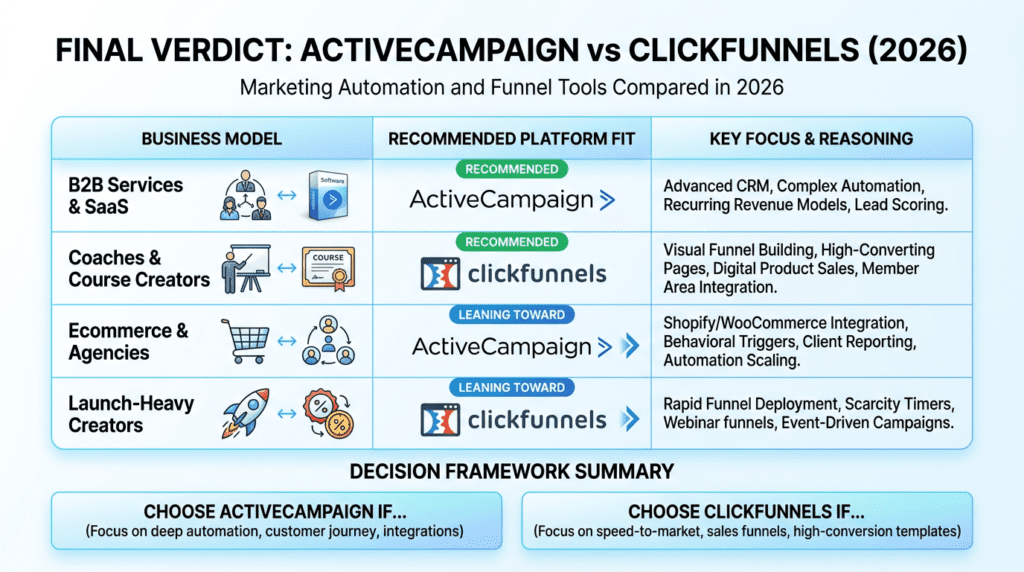
For most growing businesses, ActiveCampaign is the better long-term marketing automation platform, while ClickFunnels is the better short-term funnel builder. The right answer depends on whether your growth problem is follow-up or conversion. If leads are coming in but not moving through a lifecycle, ActiveCampaign usually fixes more. If traffic is fine but your landing page or sales funnel is underperforming, ClickFunnels is often the faster win.
Best overall choice by business model
| Business model | Better choice | Why | Main limitation |
|---|---|---|---|
| B2B services | ActiveCampaign | Strong CRM, automation, segmentation | Less focused on funnel speed |
| Coaches and course creators | ClickFunnels | Fast funnel creation and checkout flows | Weaker long-term nurture depth |
| SaaS | ActiveCampaign | Better lifecycle automation and lead tracking | More setup required |
| Ecommerce | ActiveCampaign | Better follow-up, segmentation, and automation | Not a dedicated storefront tool |
| Launch-heavy creators | ClickFunnels | Better for sales funnel execution | Limited CRM depth |
Best choice for automation-first teams
ActiveCampaign is the better choice if your team cares most about automation, email marketing, and keeping leads organized over time. It works well when the business needs trigger-based follow-up, lead scoring, and a cleaner CRM-linked workflow. That includes service businesses, agencies, SaaS brands, and content businesses with longer sales cycles.
The biggest reason to use ActiveCampaign is consistency. Once the system is built, it can handle a lot of the repetitive work that would otherwise eat up hours every week. If your team is tired of manual follow-up and scattered contact data, ActiveCampaign is the safer bet.
Best choice for funnel-first teams
ClickFunnels is the better choice if your business depends on fast launches, direct-response sales, and conversion-focused pages. It’s especially useful when you need a sales funnel, landing page, and checkout path that are easy to build and deploy. That makes it a strong fit for digital products, webinars, coaching offers, and simple ecommerce promotions.
The catch is that ClickFunnels is strongest at the front of the funnel. If your business needs deeper email marketing and more advanced lifecycle automation, you may outgrow it faster than expected. It’s excellent for speed. It’s less convincing as a full growth system.
Final recommendation on Activecampaign Vs Clickfunnels
If you want the more complete growth platform, choose ActiveCampaign. If you want the faster funnel builder, choose ClickFunnels. For many businesses, the real answer is not either/or. It’s ActiveCampaign for automation and ClickFunnels for conversion.
The clearest rule is simple: use ActiveCampaign when your biggest problem is nurturing and follow-up; use ClickFunnels when your biggest problem is getting the page and funnel to convert. If you’re scaling beyond a single offer, ActiveCampaign usually becomes the more durable foundation.
Frequently Asked Questions About Activecampaign Vs Clickfunnels
Can you use ActiveCampaign and ClickFunnels together?
Yes, you can use ActiveCampaign and ClickFunnels together. Many businesses do exactly that when they want ClickFunnels for the funnel and ActiveCampaign for automation and CRM.
The setup usually looks like this: ClickFunnels captures the lead or sale, then ActiveCampaign takes over with email follow-up, segmentation, and nurture. That stack works well if you want both conversion speed and deeper lifecycle marketing.
Is ActiveCampaign better than ClickFunnels for email marketing?
Yes, ActiveCampaign is better than ClickFunnels for email marketing. It offers stronger automation, segmentation, and behavioral follow-up.
ClickFunnels can include email features, but it’s not built to replace a full email marketing service. If your campaigns depend on triggers, tags, and long-term nurture, ActiveCampaign is the better fit.
Is ClickFunnels better than ActiveCampaign for landing pages?
Yes, ClickFunnels is usually better than ActiveCampaign for landing pages. Its funnel builder and templates are more focused on direct conversion.
ActiveCampaign landing pages work for simple lead capture, but they’re not as strong for full funnel design or sales-oriented page sequences. If page conversion is the priority, ClickFunnels usually wins.
What is the main difference between ClickFunnels and ActiveCampaign?
The main difference is focus. ClickFunnels is primarily a sales funnel and landing page tool, while ActiveCampaign is primarily an email marketing and automation platform.
That means ClickFunnels helps you build the path to a sale, while ActiveCampaign helps you manage the follow-up after the lead enters your system.
Which platform is better for small businesses on a budget?
It depends on the goal, but ActiveCampaign is often the better long-term value for small businesses that need email marketing and automation. ClickFunnels can be worth it if the business needs a high-converting funnel right away.
If budget is tight and the business only needs one core function, choose the tool that solves the main bottleneck. Don’t pay for both unless the workflow truly needs both.
Does ActiveCampaign replace ClickFunnels or vice versa?
No, neither one fully replaces the other. ActiveCampaign does not fully replace ClickFunnels if you need a strong funnel builder, and ClickFunnels does not fully replace ActiveCampaign if you need deep automation and CRM.
The difference between ActiveCampaign and ClickFunnels is about job focus, not just features. One handles nurturing better. The other handles funnel conversion better.