When an email list starts growing past a few hundred names, the platform you picked in a hurry can start getting in the way. Simple newsletter tools are fine at first, but the cracks show up fast once you want better segmentation, smarter follow-ups, or a cleaner way to manage customer data. That’s why the Activecampaign Vs Aweber decision matters more in 2026 than it did a few years ago.
The tricky part is that both tools can send emails well. The real question is what happens after that. Do you need a straightforward email marketing service for broadcasts and basic automation, or do you need a more flexible system that can support marketing and sales processes as your business grows? That’s where the comparison gets more useful than a feature checklist.
Why ActiveCampaign vs AWeber matters for email marketing in 2026
Activecampaign vs aweber is really a comparison between two different philosophies. ActiveCampaign leans into automation and crm depth. AWeber stays focused on simplicity, quick setup, and dependable email marketing for smaller teams. In practice, that means the better choice depends less on popularity and more on how you actually work.
If you’re just sending a newsletter, the gap may not feel huge. But if you’re building email sequences, nurturing leads, or tying email content to purchases, behavior, or tags, the difference becomes obvious pretty quickly.
What small businesses usually misunderstand before choosing an email marketing service
A lot of small businesses compare tools only by monthly price or template count. That’s understandable, but it misses the part that tends to matter later: how much work the platform creates as your list grows. A cheaper plan can become expensive in time if the builder feels clumsy or the automation falls short.
Another common mistake is assuming every email marketing platform should do everything well. It rarely works that way. Some tools are built for speed and ease of use. Others are built for control, segmentation, and deeper automation. The better choice is usually the one that matches your current workflow and the next 12 months of growth.
Hidden trade-offs between simplicity, automation, and long-term growth
This is where many users get confused. A simpler platform can be faster to learn, easier to manage, and less frustrating for a small team. But simplicity often comes with limits. You may get fewer branching rules, lighter reporting, and less control over how subscribers move through your funnel.
On the other hand, a more advanced platform can help automate more of your marketing efforts, but it can also take longer to set up and maintain. That’s not a flaw. It just means you’re paying for flexibility with complexity. Over time, that trade-off matters more than a polished homepage or a long feature list.
Honest take on who this comparison is really for
This comparison is for small businesses, creators, ecommerce brands, and service companies trying to choose the right email marketing platform without overbuying. It’s also useful if you’ve already outgrown a basic tool and are deciding whether to move from AWeber to ActiveCampaign, or whether a simpler service is still enough.
If you want a straightforward approach to email marketing, AWeber can make sense. If you care about automation, segmentation, and crm-driven workflows, ActiveCampaign is usually the stronger long-term option.
Quick Verdict
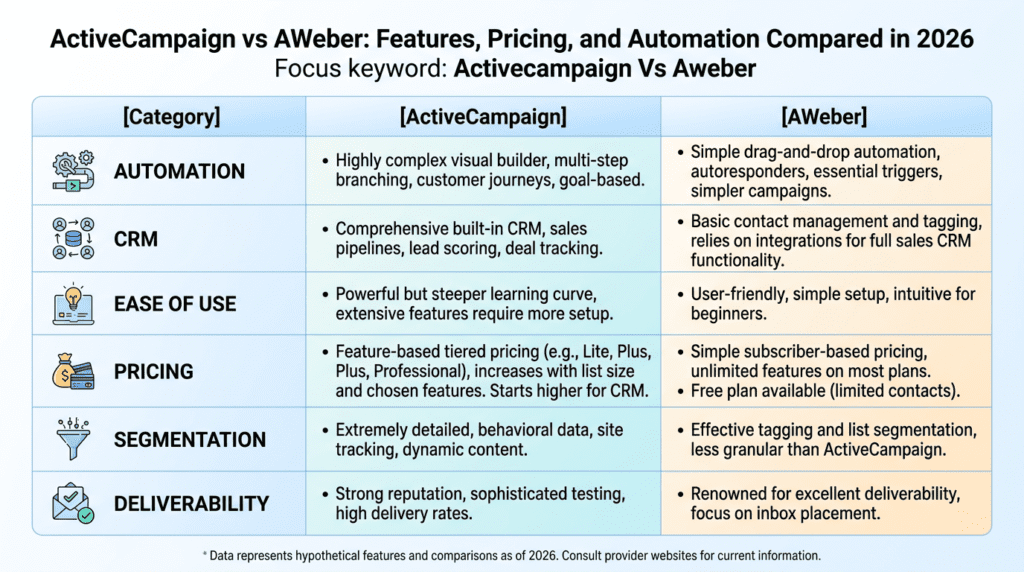
Best for advanced marketing automation and CRM-driven campaigns
ActiveCampaign is the better fit if your email marketing depends on behavior-based automation, sales follow-up, lead scoring, or tighter crm organization. It’s built for teams that want more than just broadcasts and basic autoresponders.
Best for beginners who want a simpler email marketing solution
AWeber is usually the easier starting point. It’s a cleaner email marketing tool for sending newsletters, building simple sequences, and getting started without a steep learning curve.
Who should skip ActiveCampaign
Skip ActiveCampaign if you only need a free plan, basic newsletter sending, or a tool you can learn in an afternoon. It’s powerful, but the setup and ongoing management can be more than some small teams need.
Who should skip AWeber
Skip AWeber if you need deep automation, advanced segmentation, or a more complete automation and crm setup. It can handle the basics well, but complex workflows are not its main strength.
Bottom line on ActiveCampaign vs AWeber
If your priority is long-term flexibility, ActiveCampaign usually wins. If you want a simpler tool with less friction, AWeber is the easier choice. The right email marketing platform depends on whether you’re optimizing for control or convenience.
ActiveCampaign vs AWeber Comparison Table
| Category | ActiveCampaign | AWeber |
|---|---|---|
| Best for | Automation-heavy teams, crm workflows, growing businesses | Beginners, newsletters, simple campaigns |
| Starting price | Typically starts around $29/month | Usually starts around $15/month; aweber offers a free plan |
| Automation | Deep visual automation builder with branching logic | Basic automation and autoresponders |
| Ease of use | Moderate learning curve | Easier to learn and manage |
| Segmentation | Strong tagging and behavioral segmentation | Solid list management, simpler targeting |
| Landing pages | Included on many plans | Included with simpler builder options |
| CRM | Built-in crm features | Limited crm capabilities |
| Deliverability | Strong, with advanced sending controls | Generally reliable for standard campaigns |
| Support | Email support and live chat on higher plans | Live chat and email support; more beginner-friendly help |
ActiveCampaign vs AWeber Key differences in features, pricing, automation, ease of use, and deliverability
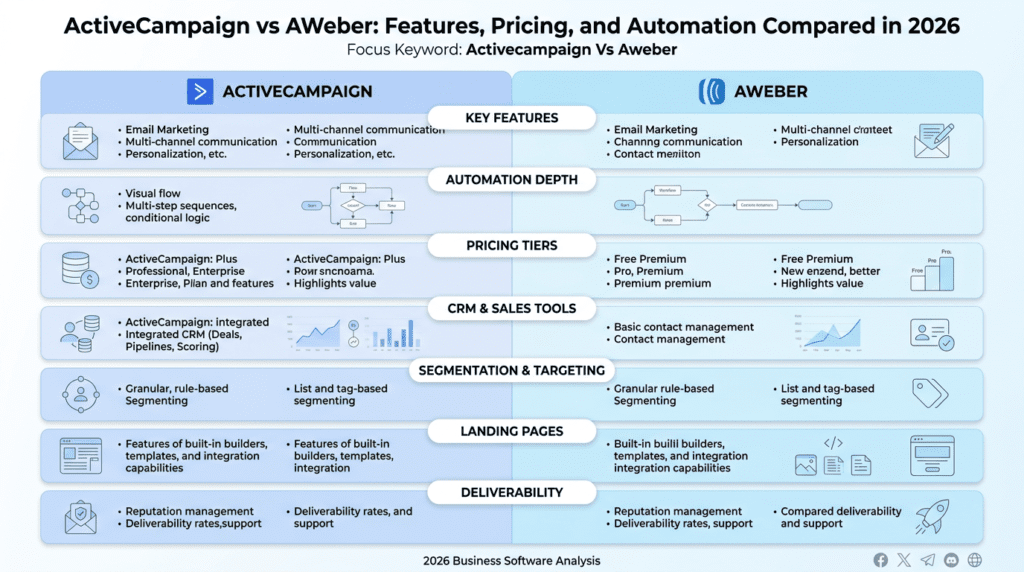
ActiveCampaign vs AWeber: Core Platform Differences
What ActiveCampaign is built to do
ActiveCampaign is built for teams that want email marketing automation, crm organization, and stronger control over subscriber behavior. It’s not just an email service. It’s meant to support lead nurturing, sales handoffs, and more detailed customer journeys.
That makes it useful for businesses with longer sales cycles or multiple audience types. If you’re using tags, triggers, lead magnets, and follow-up flows, ActiveCampaign fits that structure well.
What AWeber is built to do
AWeber is built around a more straightforward email marketing experience. It helps you build and send email campaigns, manage your email list, and stay organized without a heavy setup process. For a newsletter, simple promotions, or basic email sequences, that simplicity can be a real advantage.
AWeber also offers a free plan, which makes it easier for new businesses to get started with email marketing for beginners. That lower barrier is part of why AWeber still has a strong audience.
How each platform fits different email marketing goals
If your goal is to connect with your audience quickly and keep things manageable, AWeber usually fits better. If your goal is to automate follow-ups, segment by behavior, and build more complex marketing campaigns, ActiveCampaign is the stronger match.
In practice, the choice is often about whether you want to send emails or build systems around email. That’s a meaningful difference, especially once a business has more than one product, offer, or customer path.
Which platform offers more room to grow
ActiveCampaign offers more room to grow. It supports more advanced automation and crm use cases, so you don’t hit the ceiling as early. That matters when your subscriber base moves from a few hundred to several thousand.
AWeber can absolutely handle growth, but it’s better suited to businesses that want a straightforward email marketing service rather than a full marketing automation and crm environment. If your marketing strategies are likely to get more complex, ActiveCampaign is usually the safer long-term choice.
Email Marketing Features Compared
Email builder and campaign creation workflow
AWeber’s email builder is easier for most beginners. You can draft a campaign, choose a template, and send without much friction. That makes it practical for small businesses that want to move fast and avoid unnecessary setup.
ActiveCampaign’s email builder is more flexible, but it asks for a little more patience. The payoff is better control over structure, personalization, and how your email content fits into larger automation flows. If you care about workflow depth, that extra effort can be worth it.
Email templates, design flexibility, and branding options
AWeber offers a useful range of email templates that cover common newsletter and promotion formats. It’s enough for most small businesses that want clean, readable email marketing without hiring a designer.
ActiveCampaign also includes email templates, but its real strength is how those templates work inside automated journeys. You can still build branded campaigns, but the platform is more focused on functionality than on giving you a huge template library.
Landing page and form-building tools
Both platforms provide landing page and form tools, which helps if you want to build a simple lead capture flow without another app. AWeber keeps this process relatively easy, which is good for quick campaigns or basic list growth.
ActiveCampaign’s landing page tools are more useful when they’re part of a larger funnel. For example, if a subscriber signs up on a landing page, gets tagged, and then enters a follow-up sequence, ActiveCampaign handles that chain more naturally. That’s one reason platforms like ActiveCampaign are often favored by teams building more structured funnels.
List management, segmentation, and audience targeting
This is one of the biggest differences between ActiveCampaign and AWeber. ActiveCampaign offers stronger segmentation, more tagging options, and better behavior-based targeting. That means you can separate email subscribers by actions, interests, purchases, or engagement level.
AWeber allows list management and segmentation too, but in a simpler way. That works well if your email list is still fairly straightforward. Once you need more nuanced targeting, the system can feel limited compared to ActiveCampaign.
Both tools handle newsletter sending and broadcast scheduling well. If your main job is sending regular email campaigns, either one can cover that base.
AWeber is especially comfortable here because the workflow is direct. ActiveCampaign can do broadcasts too, but it shines more when those broadcasts are part of a larger automation plan. In other words, AWeber feels like a newsletter-first tool, while ActiveCampaign feels like a system that includes newsletters.
Which platform offers the stronger email marketing feature set
ActiveCampaign offers the stronger overall email marketing features set because it does more across segmentation, automation, and crm integration. AWeber is more limited, but that’s not automatically a bad thing.
If you need a simpler email marketing tool, AWeber may actually be the better operational fit. If you need more control and room for advanced workflows, ActiveCampaign clearly delivers more.
ActiveCampaign vs AWeber: Automation Comparison
Visual automation builder and workflow depth
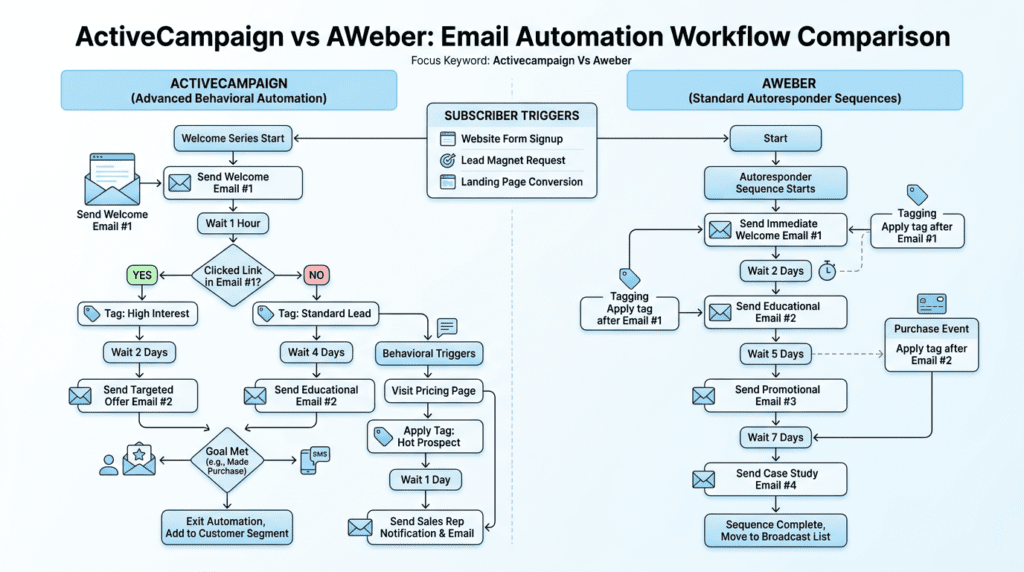
ActiveCampaign automation is the more advanced option here. Its visual automation builder lets you create workflows with multiple paths, delays, conditions, and triggers. You can automate based on clicks, purchases, form fills, page visits, and more.
AWeber also provides automation tools, but the experience is simpler. That can be enough for welcome series, basic onboarding, and a few drip campaigns. It’s just not built for the same depth.
Trigger options, conditions, and branching logic
ActiveCampaign gives you more trigger options and more branching logic inside a workflow. That matters when you want one subscriber to enter a different path based on what they did, not just when they signed up.
AWeber supports the core trigger-and-response model, but it doesn’t go as far with branching. For many small businesses, that’s fine. For teams trying to automate marketing decisions in a more precise way, it can feel restrictive.
Autoresponders, drip campaigns, and behavior-based sequences
Both platforms can automate welcome sequences and drip campaigns. If you’re just sending a welcome email after sign-up, either system can handle that.
The difference shows up in behavior-based sequences. ActiveCampaign makes it easier to automate follow-up based on actions like opening an email, clicking a link, or buying a product. AWeber can automate sequences, but the logic is lighter and less adaptive.
CRM and sales automation capabilities
This is where ActiveCampaign separates itself most clearly. Its built-in crm makes it easier to connect email marketing with sales handoffs, deal tracking, and pipeline organization. For businesses where sales and marketing work together, that connection can save a lot of manual effort.
AWeber does not compete at that level. It’s an email service first, and its automation is meant to support campaigns rather than manage a full crm process.
How ActiveCampaign and AWeber handle advanced marketing automation
ActiveCampaign handles advanced marketing automation with more flexibility, but it also requires more setup and maintenance. That’s the trade-off. You get control, but you need a clearer plan.
AWeber keeps automation simple enough that smaller teams can use it without getting stuck. If you only need a few automated email sequences, it’s a practical solution. If you want to automate more of your sales and marketing processes, ActiveCampaign is stronger by a wide margin.
Which platform is better for automation-heavy email marketing
ActiveCampaign is the better platform for automation-heavy email marketing. It has the depth, the conditions, and the crm support to handle more complex customer journeys.
AWeber wins when the goal is convenience. It’s easier to start, easier to manage, and good for simple campaigns. But once automation becomes a core part of your business, ActiveCampaign is usually the better long-term choice.
ActiveCampaign vs AWeber: Ease of Use Comparison
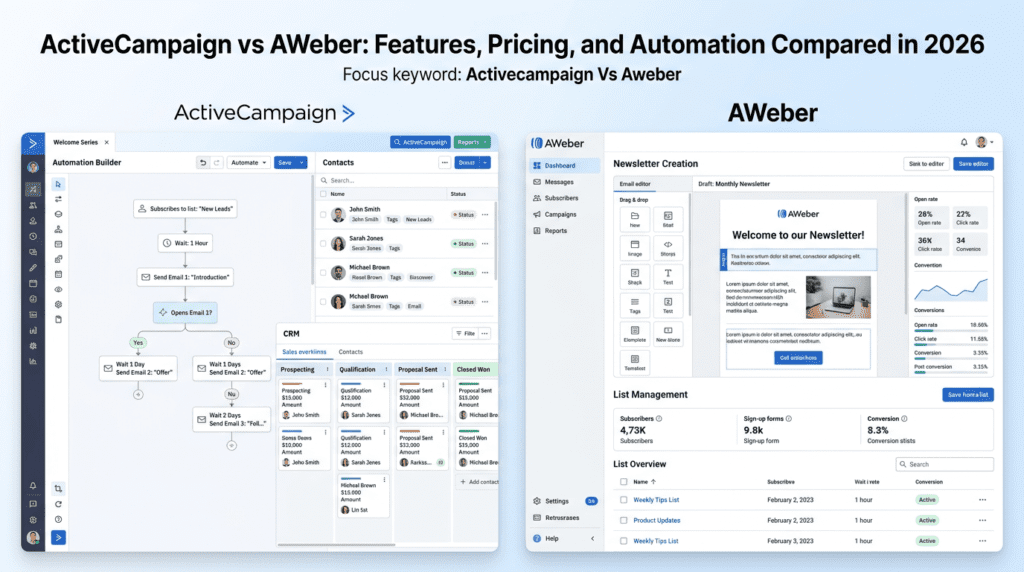
Ease of use is where the ActiveCampaign vs AWeber choice gets more practical than technical. Both can handle email marketing, but they feel different the moment you log in. AWeber leans toward a straightforward workflow, while ActiveCampaign asks a little more from you up front in exchange for more control later.
That trade-off matters. If you’re trying to send a newsletter, build a simple signup flow, and keep moving, a cleaner setup can save a lot of time. If you’re planning more complex marketing automation, it’s worth accepting a steeper learning curve early on.
Dashboard layout and first-time setup experience
AWeber keeps the first few steps simple. The dashboard is built so you can get to a list, template, or campaign without digging through too many menus. That makes it a better fit for people who want to get started with email marketing fast and don’t want to spend an afternoon learning the system.
ActiveCampaign feels denser. There’s more happening in the interface, and that extra depth is useful once you know where things live. But for a brand-new user, it can feel like there are too many options before you’ve sent your first email. This is where many users get confused: more capability does not always mean a better first-day experience.
Email builder usability for beginners
AWeber’s email builder is easier for beginners to understand. The workflow is fairly direct, and the platform offers enough structure that you don’t need to redesign every email from scratch. That’s helpful if your main goal is sending a newsletter, a welcome email, or a few simple email sequences.
ActiveCampaign’s email builder is more flexible, but that flexibility comes with a little friction. You can do more with it, yet it’s not quite as forgiving if you’re still getting started. In practice, that means AWeber usually feels friendlier for someone who wants a straightforward approach to email marketing.
Automation setup learning curve
Automation is where the gap widens. AWeber allows basic autoresponders and simple automations, which is enough for many small businesses. Still, the setup tends to stay within a more beginner-friendly lane.
ActiveCampaign automation goes much deeper. You can build advanced paths, add conditions, and connect behavior-based actions in ways that quickly move beyond basic drip campaigns. The upside is obvious. The downside is that you’ll probably need more planning before building your first workflow.
For teams without a dedicated marketer, that learning curve can become a real bottleneck. What sounds simple in theory can take a few tries in practice, especially when you’re mapping customer journeys or trying to automate follow-ups across multiple offers.
Day-to-day campaign management
Once you’re past setup, AWeber tends to stay light and manageable. Scheduling a campaign, updating an email list, or checking basic performance is usually a quick process. For many users, that’s enough. They don’t want their email service to become another complicated system to maintain.
ActiveCampaign is more powerful for day-to-day operations, but it can also feel heavier. If you’re running segmented campaigns, tracking behavior, and coordinating marketing and sales processes, the extra structure helps. If you’re only sending a monthly newsletter, some of that power may feel unnecessary.
Which platform is easier to use without a team
AWeber wins on ease of use for solo users and small businesses that want to stay lean. It’s the safer choice if you’re managing email yourself and don’t want to rely on a specialist.
ActiveCampaign makes more sense when you have the time, experience, or internal support to use its full range of features. It’s not hard in a bad way, but it does assume you’re ready for more serious workflow building. If you’re comparing Activecampaign Vs Aweber purely on simplicity, AWeber is the easier day-to-day choice.
Pricing Differences and Value for Money
Pricing is one of the biggest reasons people compare ActiveCampaign and AWeber in the first place. At a glance, both look accessible, but the way each platform charges can change the real cost quickly as your subscriber count grows.
That’s important because email marketing pricing rarely stays flat. What looks affordable at 500 subscribers can feel very different at 5,000 or 25,000. The right choice depends less on the starting price and more on what you’ll actually need six months from now.
Starting price and plan structure
AWeber generally starts lower and keeps its entry plans simple. It’s designed to give smaller accounts a manageable way into email marketing without forcing you into advanced tiers right away. AWeber offers a free plan, which can be useful if you’re just getting started or testing a new list-building workflow.
ActiveCampaign usually starts at a higher monthly price, but that reflects the broader feature set. You’re paying for more automation, CRM functionality, and segmentation depth. For businesses that will use those tools, the price can still make sense. For very simple sending needs, it may feel like more than you need.
What features are locked behind higher tiers
This is one of the less obvious differences. AWeber keeps core email marketing features available early, but more advanced functionality is limited compared to ActiveCampaign. If you want deeper automation and more advanced segmentation, you may hit the ceiling sooner.
ActiveCampaign includes more serious tools, but some of the better features sit behind higher plans. That means the platform can look reasonable at first, then climb as you want more from it. If you’re comparing value, don’t just look at the entry price. Look at what happens when your marketing becomes more complex.
Contact-based pricing and how costs scale
Both tools use pricing that can rise as your subscriber list grows, though ActiveCampaign’s structure tends to feel more sensitive once you move into larger lists. That’s normal for an email marketing service, but it’s still worth modeling your costs before you commit.
A list of 1,000 subscribers is manageable for many small businesses. A list of 10,000 changes the equation. If you plan to keep growing your audience, contact-based pricing can become one of the biggest long-term costs in your stack.
Free trial, free plan, and entry-level value
AWeber’s free plan makes it easier to test the platform without much pressure. That’s useful for creators, first-time users, and small teams that want to send a few email campaigns before paying.
ActiveCampaign typically focuses more on trials than a permanently free plan. That may not bother businesses that already know they need advanced automation, but it does matter if you’re still comparing tools or learning email marketing for beginners.
In practical terms, AWeber gives you a lower-risk starting point. ActiveCampaign gives you more depth once you’re ready to pay for it.
Which platform gives better value for small businesses
For small businesses with simple needs, AWeber usually wins on value. The platform offers a cleaner path into email marketing, and the pricing is easier to justify when you’re mostly sending newsletters, welcome emails, or basic follow-ups.
ActiveCampaign becomes the better value when automation and CRM features start saving real labor time. If you’re using it to automate lead nurturing, segment buyers, or manage more advanced campaigns, the higher cost can pay off. If not, you may be paying for tools you rarely use.
Deliverability and Performance
Deliverability is one of those topics people underestimate until it causes problems. A strong email builder and clever automation don’t matter much if your messages keep landing in the wrong place. The goal is simple: your email campaigns should reach the inbox consistently.
In the ActiveCampaign vs AWeber comparison, both platforms are considered reliable, but performance can still vary depending on how you send, what your list looks like, and how well you manage your audience.
Deliverability reputation and inbox placement expectations
AWeber has long been known for solid deliverability, especially for standard newsletters and simple campaigns. It’s built a reputation as a dependable email service for creators and small businesses that want consistent inbox placement without overcomplicating the process.
ActiveCampaign also performs well in this area, particularly for users who keep their lists clean and use segmentation well. The platform’s stronger automation tools can help you send more relevant messages, which often supports better engagement over time.
That said, no platform can guarantee inbox placement. Email providers still judge your sending behavior, list quality, and content.
For plain newsletters, both platforms are reliable enough for most businesses. AWeber is especially comfortable here because its workflow fits recurring sends and simpler content schedules.
ActiveCampaign shines more when automation is doing the heavy lifting. If your email sequences are triggered by user behavior, purchases, or form signups, ActiveCampaign gives you more control over timing and targeting. That can improve the quality of the send, even if it doesn’t magically fix a weak list.
In real-world use, the biggest reliability issue usually isn’t the platform. It’s the workflow behind it.
Reporting, analytics, and campaign performance tracking
AWeber gives you the essentials: opens, clicks, subscriber activity, and basic campaign performance. That’s enough for most users to see whether a newsletter is working.
ActiveCampaign offers deeper analytics and more detailed visibility into how contacts move through automations and sales funnels. If you’re using the platform for marketing and sales processes, that extra reporting matters because it helps you understand what’s actually driving results.
Still, more data isn’t always better if you won’t use it. Some teams need clear, simple reporting. Others need behavior-level detail. The right tool depends on how you plan to act on the numbers.
Reality check on what affects deliverability beyond the platform
This is where many users get tripped up. A platform can have a strong deliverability reputation and still perform poorly for your account if your list is messy.
A few common issues matter more than people expect:
- List quality: Old, unengaged subscribers drag down performance
- Sending habits: Sudden spikes can look suspicious
- Content: Spammy subject lines or sales-heavy copy can hurt inbox placement
- Authentication: SPF, DKIM, and DMARC setup matter
- Segmentation: Sending the same content to everyone usually performs worse
So while deliverability is part of the ActiveCampaign vs AWeber debate, your own email marketing practices matter just as much.
Which platform performs better in real-world email marketing use
AWeber wins for straightforward, dependable sending. It’s a good fit if your main goal is to deliver newsletters and basic campaigns without a lot of complexity.
ActiveCampaign performs better when campaign quality depends on behavior-based automation, segmentation, and customer tracking. If you run more advanced email marketing efforts, that extra control can improve results. For simple email marketing, AWeber is usually easier to live with.
CRM, Integrations, and Ecosystem
Once email marketing becomes part of a larger sales process, the surrounding ecosystem starts to matter a lot. Integrations, contact management, and CRM tools can make the difference between a helpful platform and one that creates extra manual work.
This is one of the clearest places where ActiveCampaign and AWeber diverge. They both connect to other tools, but they’re built with different levels of operational depth.
ActiveCampaign CRM vs AWeber’s lighter contact management tools
ActiveCampaign includes a built-in CRM, which makes it more useful for teams that need to manage leads, follow-ups, and sales handoffs in one place. That’s a major advantage if your marketing and sales processes overlap.
AWeber is more limited here. It provides contact management features, but it doesn’t try to replace a full CRM. For some users, that’s actually a plus because it keeps things simpler. For others, it means they’ll need another tool to handle lead tracking and pipeline work.
If your business depends on active lead nurturing, ActiveCampaign delivers more value. If you only need to organize subscribers and send email content, AWeber may be enough.
Integrations with ecommerce, websites, and lead capture tools
Both platforms connect with common website builders, ecommerce systems, and lead capture tools. That covers the basics, and for many small businesses, the available integrations are more than enough.
ActiveCampaign usually feels stronger when you want deeper connections between forms, tags, automations, and CRM workflows. It’s the better fit for ecommerce and service businesses that want data to move automatically across systems.
AWeber also provides useful integrations, especially for standard signup forms, landing pages, and third-party tools. It’s not as expansive in workflow depth, but it handles common setup needs without much friction.
How each platform compares with Mailchimp and other common alternatives
People often compare these tools not just with each other but also with platforms like Mailchimp. In that context, AWeber often feels closer to the simpler end of the market, while ActiveCampaign sits nearer the advanced automation side.
If you’re weighing Mailchimp or AWeber, the question is usually about ease of use and basic email delivery. If you’re comparing ActiveCampaign with platforms like ActiveCampaign and Aweber’s more basic peers, the question is usually about automation and CRM strength.
That’s why the right comparison depends on your workflow. The best email marketing services are the ones that match how your business actually operates, not just the ones with the longest feature list.
Which ecosystem makes daily marketing easier
AWeber is easier if you want a lighter system that doesn’t require much coordination. You can connect a few tools, send email campaigns, and keep moving.
ActiveCampaign is easier when your daily marketing depends on connected systems. If you need tags, triggers, CRM notes, and campaign logic to work together, its ecosystem is stronger. Platforms like ActiveCampaign are built for that kind of layered setup.
So if your team wants simplicity, AWeber wins. If your team wants more operational depth, ActiveCampaign usually makes daily work smoother over time.
Best Fit by Use Case
The simplest way to decide between these two is to match the platform to the job. AWeber and ActiveCampaign both help you connect with your audience, but they serve different kinds of users. One is easier to start with. The other grows into more demanding workflows.
That’s why the “best” choice depends less on features in isolation and more on how your business plans to use email marketing over the next year.
Best for small businesses that want simple email marketing
AWeber is a strong solution for small businesses that want a straightforward approach to email marketing. It works well for local services, solo operators, and lean teams that need to send newsletters, promotions, and basic follow-ups without a lot of setup time.
If your main goals are sending reliable messages, managing an email list, and staying organized, AWeber makes the process easy enough to keep up with week after week. For email marketing for beginners, that kind of simplicity is often more valuable than a long list of advanced features.
Best for businesses that need stronger automation and CRM workflows
ActiveCampaign is the better fit when automation and crm features are central to the business. If you’re building lead funnels, scoring contacts, branching email sequences, or coordinating with a sales team, it gives you far more room to work.
This is also where ActiveCampaign enables more advanced follow-up logic than AWeber. For example, you can trigger different paths based on clicks, page visits, purchases, or engagement history. That kind of control matters once your marketing strategies become more layered.
AWeber usually wins for creators and bloggers. If your main job is publishing email content, growing a newsletter, and keeping the workflow light, AWeber feels more natural.
It’s especially appealing if you don’t want your email marketing tool to turn into a project. A simple editor, easy list management, and reliable sending are often enough. AWeber also provides a friendlier path for users who just want to connect with their audience without learning a complex system.
Best for sales-driven teams and multi-step funnels
ActiveCampaign is built for sales-driven teams and more complex funnels. If your marketing and sales processes are connected, the platform gives you more ways to manage handoffs, follow-ups, and lead progression.
It’s a better fit for businesses where each subscriber may need different treatment based on behavior or buying stage. In that setting, the added complexity is worth it because it saves manual work later.
When Mailchimp or another email service may be the better option
Sometimes the real answer isn’t activecampaign vs aweber at all. Another email marketing solution may fit better if your needs are unusual.
You might want to consider another platform if:
- You need a different free plan structure: Some users prefer the free tier on other services
- You already use another CRM: A separate integration may be enough
- You want a different builder experience: Ease of use can be personal
- You need very specific ecommerce tools: Some platforms are better tuned for stores
- You’re comparing mailchimp vs a simpler option: Mailchimp or another email service may fit better if branding, templates, or team collaboration matter more than automation depth
If you’re just getting started with email marketing, the right email marketing platform is the one you can actually use consistently. If you’ve already outgrown the basics, ActiveCampaign is usually the stronger long-term option. If you want a more straightforward email marketing service, AWeber still has a clear edge.
What Most Blogs Miss About ActiveCampaign and AWeber
A lot of comparisons stop at feature lists, but that doesn’t tell you much about how ActiveCampaign and AWeber actually feel once you start using them every week. The better tool on paper is not always the better tool for your team, your workflow, or your patience.
The real difference shows up in the day-to-day stuff: how fast you can send a newsletter, how much time setup takes, and whether the platform keeps helping as your email marketing gets more complex. That’s where Activecampaign Vs Aweber becomes less about specs and more about fit.
Why the better feature list does not always lead to better results
It’s easy to assume more features means better outcomes. In practice, that’s not always true. If you only send one or two email campaigns a week, a deep automation system can sit unused while you still pay for it.
AWeber often wins in situations where people want a straightforward email marketing service that doesn’t slow them down. The platform offers enough structure for basic campaigns, newsletters, and simple email sequences without forcing you to think like a lifecycle marketer.
ActiveCampaign, by contrast, gives you more control. That matters if your marketing strategies depend on segmentation, branching logic, and follow-up paths tied to user behavior. But if your team never uses those tools, the extra range of features can become clutter rather than value.
How team skill level changes the best choice
This is where many users get confused. They compare features, then forget to compare the people who actually have to run the system.
A solo creator or a small business owner may prefer AWeber because the setup is faster and the learning curve is lighter. You can build a newsletter, add a form, and start sending without spending half a day inside menus.
ActiveCampaign makes more sense when someone on the team is comfortable thinking through automation and crm logic. If you have someone who can map out triggers, segments, and follow-up paths, the platform can support stronger marketing and sales processes. If not, you may end up using only a fraction of what you’re paying for.
What happens when your email marketing needs become more complex
A simple setup usually feels fine at first. Then your email list grows, your subscriber behavior gets harder to track, and you need more than one message for every lead.
That’s when ActiveCampaign starts to separate itself. It handles more complex email marketing automation, better segmentation, and more detailed workflows. If you’re sending a welcome email, tagging people by behavior, and routing leads into different sequences, it gives you room to build.
AWeber also provides automation tools, but they’re more limited compared to ActiveCampaign. For a basic newsletter funnel or a simple drip sequence, that’s often enough. When the funnel starts involving multiple paths, sales follow-up, or ecommerce triggers, the gap becomes hard to ignore.
Why switching later can be more painful than most buyers expect
Moving from AWeber to ActiveCampaign, or the other way around, is not a small admin task. It usually means rebuilding automations, checking list structure, reworking tags, and testing every trigger again.
The hidden cost is time. Even if the new platform is technically better, migration can slow down campaigns for a week or more, especially if your email content, landing pages, and segmentation rules are already built around the old system.
That’s why choosing only on current needs can backfire. If you expect your email marketing efforts to stay simple for the next year, AWeber can be the cleaner path. If you already know the workflow will get more advanced, starting with ActiveCampaign may save you from a later rebuild.
Common Mistakes When Choosing Between AWeber vs ActiveCampaign
Most bad decisions here come from rushing. Buyers compare a few features, glance at pricing, and pick the platform that looks easier to justify. Then the daily work starts, and the gaps show up fast.
The smarter approach is to think about how you’ll actually use the email marketing platform over the next 12 to 24 months, not just what feels comfortable today.
Picking based on starting price alone
Price matters, but starting price can be misleading. AWeber often looks cheaper at the entry level, especially if you only need a basic email service for a small email list. That makes sense for creators, local businesses, and anyone who just wants to send regular updates.
But contact-based pricing changes the picture as your subscriber count grows. A low entry cost doesn’t help much if the plan structure becomes awkward once you pass a few thousand contacts.
ActiveCampaign can cost more upfront, but that higher number often includes more of the automation and crm features that growing teams eventually need. If you compare only the first monthly bill, you may miss the real cost of having to upgrade later or work around missing tools.
Overestimating how much automation you will actually use
This mistake is common with teams that say they want advanced automation but never get around to building it. They picture full lifecycle funnels, then end up sending one newsletter and a welcome series.
If that sounds familiar, AWeber may be enough. It supports practical email marketing for beginners and simple campaign flows without demanding a complicated setup.
ActiveCampaign is best when automation is not just a nice extra but part of the plan. If you want behavior-based follow-ups, lead scoring, or more detailed triggers, it earns its keep. If you won’t use those tools regularly, the platform can feel heavier than necessary.
Ignoring template, builder, and workflow limitations
A polished feature page can hide a lot of workflow friction. The email builder, template options, and automation screen all affect how fast your team can move.
AWeber offers a more straightforward email builder experience, which is useful if you care about speed and consistency more than deep customization. It’s also easier for people who don’t want to spend time tweaking every email template.
ActiveCampaign provides more flexibility, but that flexibility can come with more decision points. You may get better control over the final result, yet the path to get there takes more attention. If your team needs to publish quickly and often, that difference matters more than people expect.
Choosing for today instead of for the next 12 to 24 months
This is probably the most expensive mistake. A platform that works fine for 500 subscribers may feel very different at 5,000 or 25,000.
If you’re planning to grow, think about what breaks first: segmentation, reporting, campaign structure, or follow-up logic. That’s usually where a simpler tool starts to feel limiting. On the other hand, if your business stays small and your workflows stay simple, a more advanced platform can become unnecessary overhead.
A practical rule helps here: choose for the workflow you expect to run most often, not the one you hope to build someday.
ActiveCampaign vs Competitors
The comparison doesn’t stop with activecampaign and aweber. Once you look at real usage, Mailchimp and a few other tools start to matter too, especially if your team is still sorting out what kind of email marketing setup it needs.
These comparisons are less about brand names and more about how much complexity you want to manage.
ActiveCampaign vs Mailchimp for automation-focused users
If your main goal is automation and crm-connected follow-up, ActiveCampaign usually has the edge. It offers deeper branching, stronger segmentation, and more control over behavior-based flows.
Mailchimp is often easier to start with, and it can work well for simpler email campaigns. But once you want more advanced marketing automation, many users outgrow it and begin looking at platforms like ActiveCampaign. That’s especially true for businesses trying to connect email marketing with sales and lead tracking.
If you know automation will be central to your marketing efforts, ActiveCampaign tends to make more sense than Mailchimp.
AWeber vs Mailchimp for simple email marketing
For straightforward email marketing, AWeber and Mailchimp often sit in the same conversation. Both can handle newsletters, basic forms, and routine sending without much drama.
AWeber usually appeals to users who want a simpler path and a cleaner workflow. Mailchimp can be a strong option too, but its structure may feel more layered depending on how much of the platform you use.
If you want a direct tool for sending emails and managing subscribers without a lot of extra setup, AWeber is often the easier fit. That’s especially true for people focused on consistency over experimentation.
When ActiveCampaign vs other email marketing platforms makes more sense
ActiveCampaign makes the most sense when your email marketing solution needs to do more than send messages. If you want automation tied to customer actions, sales stages, or multi-step nurture campaigns, it can replace several smaller tools.
That becomes useful for ecommerce, service businesses, and teams that care about long-term lead handling. Instead of stitching together separate systems, ActiveCampaign gives you more of that process in one place.
Still, it’s not automatically the best email marketing choice for everyone. If your real need is sending clean newsletters and a few scheduled sequences, a lighter platform can save time and money.
When AWeber is the safer choice over more complex tools
AWeber is often the safer choice when you want less setup risk. You don’t need a long onboarding process, and you’re less likely to get lost in workflow design before sending your first campaign.
For email marketing for beginners, that matters. The platform allows you to build campaigns, manage email subscribers, and keep moving without a lot of technical overhead.
AWeber also makes sense if your team is small, your processes are simple, and your growth plans are moderate. In those cases, choosing the lighter tool is usually a better operational decision than buying extra complexity you won’t use.
Final Verdict: Is ActiveCampaign vs AWeber the Right Choice for You?

At this point, the answer is pretty practical: both platforms can work, but they serve different kinds of users. If you match the tool to the workflow, you’re less likely to regret the decision six months later.
Choose ActiveCampaign if automation, CRM, and scaling matter most
Choose ActiveCampaign if your email marketing depends on automation, segmentation, and tighter crm workflows. It’s the stronger option for teams that want to manage marketing and sales processes in one place.
That includes businesses running multi-step funnels, behavior-based follow-up, or more advanced lead nurturing. ActiveCampaign includes the kind of structure that supports growth without forcing you to rebuild everything later.
It’s also a better fit if someone on your team can actually use the system well. A more powerful platform only helps when the people running it have the time and skill to use it properly.
Choose AWeber if ease of use and straightforward email marketing come first
Choose AWeber if you want a more straightforward approach to email marketing. It’s a better fit for people who need a reliable newsletter tool, simple automation, and a faster setup process.
AWeber offers enough core features for many small businesses, creators, and solo operators. It keeps the workflow lighter, which is useful when your priority is getting campaigns out the door instead of designing complex systems.
If you’re likely to send regular updates, a few automated messages, and not much more, AWeber wins on simplicity.
Best option for beginners, growing businesses, and advanced marketers
For beginners, AWeber usually feels more manageable. It’s easier to start, easier to understand, and less likely to overwhelm you before your first campaign goes live.
For growing businesses, ActiveCampaign becomes more attractive because the platform offers more room to scale your email marketing efforts without hitting an early ceiling. That matters once segmentation, automation, and sales handoff start becoming part of normal operations.
For advanced marketers, ActiveCampaign is usually the stronger long-term choice. It’s not the lightest tool, but it does a better job supporting more serious email marketing strategies and more complex customer journeys.
Frequently Asked Questions
Is ActiveCampaign vs AWeber better for small businesses?
It depends on what the small business needs. If you want simple newsletters, basic forms, and light automation, AWeber is often the easier choice.
If the business already relies on segmentation, lead nurturing, or crm workflows, ActiveCampaign can be the better fit even if it takes more time to learn.
Which platform is easier to use, ActiveCampaign or AWeber?
AWeber is usually easier to use. The setup is more direct, and the learning curve is lighter for first-time users.
ActiveCampaign has more depth, but that also means more moving parts. If your team is new to email marketing, AWeber usually feels less intimidating.
Does ActiveCampaign have better automation than AWeber?
Yes, ActiveCampaign has stronger automation. It supports more detailed triggers, conditions, branching logic, and workflow control.
AWeber does offer automation, but it’s simpler and better suited to basic sequences rather than complex behavior-based campaigns.
Is AWeber cheaper than ActiveCampaign as your list grows?
Often, yes at the entry level, but it depends on your contact count and plan needs. AWeber’s pricing can look more approachable for small lists.
As your subscriber count grows, contact-based pricing on either platform can change the math, so it’s worth checking the current tiers before you commit.
Which platform has better deliverability for email marketing campaigns?
Both platforms are generally solid on deliverability, but results depend on more than the software. Your list quality, sending habits, and email content matter a lot.
If you send to engaged subscribers and avoid sloppy list management, both can perform well. Poor list hygiene will hurt results on either one.
How do ActiveCampaign and AWeber compare with Mailchimp?
ActiveCampaign is usually stronger for automation than Mailchimp. AWeber is often simpler for basic email sending and list management.
Mailchimp sits somewhere in the middle for many users, which is why the choice often comes down to whether you want more automation depth or a more straightforward workflow.
Can you build landing pages and email templates in both platforms?
Yes, both platforms include landing page and template tools. AWeber keeps those tools simpler and more accessible, while ActiveCampaign gives you more flexibility overall.
For many users, the difference is not whether the tools exist, but how much time they take to use well.
Which email marketing solution is better for long-term growth?
ActiveCampaign is usually the better option for long-term growth if you expect your email marketing to become more advanced. It gives you more room to expand automation and crm-driven workflows.
AWeber is better if you expect to stay relatively simple. It’s a strong choice when ease of use matters more than building a complex system.