
Imagine you are a developer building a custom application that requires a specific version of a database and a unique security configuration that standard hosts simply don’t allow. You try to install these tools on a shared plan, but you’re blocked at every turn. This is the moment you realize you need the freedom of unmanaged vps hosting. In this server environment, the training wheels are off, and you have the keys to the entire machine.
Best Unmanaged VPS Hosting for Total Root Control Snapshot
Best Overall: DigitalOcean
Best for: Developers and teams who want a balanced mix of price, features, and powerful developer tools
Best Overall: IONOS
Best for: Cost-conscious builders who want a dependable VPS with total root control on a tight spend
Best Overall: Vultr
Best for: Projects that demand high-frequency CPUs and broad global reach
Choosing to handle your own server administration is about more than just saving money; it’s about having the power to build exactly what you want. With a self-managed virtual private server, you aren’t limited by the “one-size-fits-all” rules of a typical web hosting company. You decide which operating system to run, how to secure your data, and how to optimize your server performance.
This guide will walk you through the world of unmanaged vps hosting to help you find a partner that offers the right balance of speed and reliability. We will look at the best unmanaged vps hosting providers in 2026 and provide practical advice for those ready to take complete control of their digital infrastructure.
What Is Unmanaged VPS Hosting? (Beginner-Friendly Explanation)
To understand this type of hosting, think of it like renting a car instead of taking a taxi. In a managed vps setup (the taxi), the driver handles the route, the maintenance, and the fuel. In unmanaged vps hosting, you are the driver. The hosting provider gives you the “vehicle” a virtual server with random access memory, a CPU, and storage and the rest is up to you.
“Unmanaged” means that the hosting company is only responsible for keeping the physical server online and connected to the internet. They don’t help with server setup, software updates, or protecting your server from hackers. This unmanaged environment provides a “blank slate” where you can get full root access and build your stack from the ground up.
The Power of Total Administrative Autonomy
When you choose unmanaged, you gain access to your server at the deepest level. Unlike shared hosting, where you share a web server with hundreds of others, a virtual server gives you isolated server resources. This means if another site on the same physical server has a traffic spike, your server response times should remain stable.
This level of server control is why developers love these plans. Whether you want to run a custom linux distribution or set up a specialized web server for a high-traffic app, unmanaged vps hosting provides users with the technical playground they need to succeed.
Who Should Choose Unmanaged VPS Hosting (And Who Should Avoid It)
This hosting experience is a powerful tool, but it isn’t for everyone. Unmanaged vps hosting can feel overwhelming if you’ve never used a command line before. You must be comfortable with linux terminal commands and basic networking concepts to keep your virtual server running smoothly.
You should choose a vps that is unmanaged if:
• You are a developer who needs a specific server environment for your code.
• You want to learn linux and server management by doing it yourself.
• You are a startup looking to minimize costs by handling your own server management.
• You need full root access to install custom software like Docker or Kubernetes.
You should avoid this path if:
• You don’t have the time or interest to manage security patches and updates.
• You prefer a control panel like cPanel to handle everything via a mouse click.
• Your business cannot afford any downtime caused by a configuration error you made.
• You want the hosting provider to be responsible for protecting your server.
Why Unmanaged VPS Hosting Is Important in 2026

In 2026, the demand for unmanaged hosting is higher than ever due to the explosion of self-hosted AI models and containerized apps. Developers need control over their server environment to deploy complex workflows that managed vps solutions often can’t support. By having full root, you can optimize every megabyte of random access memory for your specific task.
Another factor is the vps market pricing. As managed vps hosting costs rise due to increased licensing fees for control panels, the best unmanaged vps hosting options remain the most budget-friendly way to get high-performance server resources. It allows tech-savvy users to bypass the “management tax” and put that money directly into faster CPUs and nvme ssd storage.
Automation and the Modern Developer
The rise of “Infrastructure as Code” (IaC) tools has made unmanaged vps servers much easier to handle in 2026. You can now use automation scripts to handle your server setup and security in seconds. This makes unmanaged vps hosting the perfect middle ground for those who want the power of a bare metal server with the flexibility of cloud hosting.
The Trade-Off Between Raw Speed and Manual Maintenance
Choosing a self-managed vps is often a strategic decision to prioritize server performance over convenience. In 2026, the performance gap between managed and unmanaged hosting has widened. Because you aren’t running heavy, background-hungry management software, your virtual private server can dedicate almost 100% of its random access memory and CPU cycles to your specific application.
However, this “clean” vps environment comes with a significant responsibility: manual maintenance. Every security patch, operating system update, and firewall tweak must be handled by you. For a developer who wants to optimize server response times to the millisecond, this trade-off is often the key to building a high-growth platform. It allows for a level of server control that pre-configured plans simply cannot match.
Is Unmanaged VPS Hosting Worth the Risk in 2026?

Operating a self-managed vps is a high-reward strategy that requires a sober look at the risks. In 2026, the primary trade-off is between administrative autonomy and the safety net of a support team. When you get full root access, you are the only one responsible for the firewall, the encryption, and the data integrity of your web server.
However, the server performance gains are undeniable. Without a heavy control panel like Plesk or cPanel consuming your random access memory, your application has more room to breathe. For many developers, the vps benefits specifically the ability to squeeze every ounce of power out of the hardware make the risk of manual server management worth the lower monthly hosting fees.
Key Features to Look for in Unmanaged VPS Hosting
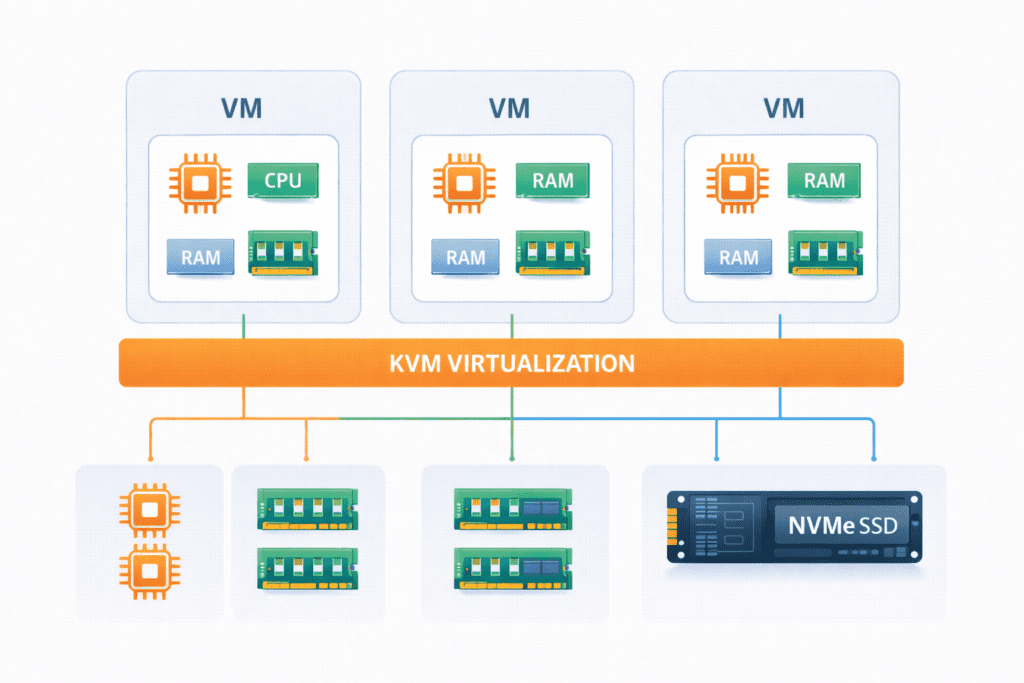
When you choose unmanaged, you aren’t just buying a slot on a machine; you are choosing the foundation for your code. In 2026, a high-quality vps provider should offer specific technical standards to ensure your virtual private server remains fast and reliable.
- KVM-Based Virtualization: Ensure the hosting provider uses KVM (Kernel-based Virtual Machine). Unlike older types of virtualization, a kvm-based vps provides a true unmanaged environment where your resources aren’t “borrowed” by other users on the physical server.
- NVMe SSD Storage: Standard SSDs are becoming obsolete. Look for nvme ssd storage to ensure your web server handles database queries and file transfers with minimal server response times.
- Choice of Operating System: A top unmanaged vps provider should allow you to deploy various linux distributions like Ubuntu, Debian, or Rocky Linux, or even upload your own custom ISO.
- Snapshot and Backup Options: Since you are responsible for protecting your server, having a 1-click snapshot feature is vital. It allows you to “save” your server configuration before making risky changes.
- Scalable Infrastructure: You should be able to increase your random access memory or CPU cores instantly without having to migrate to a new physical server.
Global Data Center Selection
The physical location of your web server has a direct impact on your global users. In 2026, most unmanaged vps hosting providers offer at least 15 to 30 data center locations. For a US-focused site, choosing a location in Virginia, Texas, or California will significantly lower the latency for your visitors. This hardware-level flexibility is a key reason to choose the best provider with a wide network.
Types of Unmanaged VPS Hosting
Understanding the different vps options available will help you select the right unmanaged vps provider for your specific project.
- Linux Unmanaged VPS: The gold standard for developers. It is lightweight, secure, and usually the best unmanaged vps hosting value because there are no licensing fees.
- Windows Unmanaged VPS: Necessary for .NET applications or specialized software. It comes at a higher cost due to the Windows license but still gives you full root (Administrator) access.
- Cloud-Based Unmanaged VPS: These vps servers live on a distributed network, offering much higher redundancy. If one physical server fails, your virtual server can often be rebooted on a different node.
- High-Performance NVMe VPS: Specifically designed for data-heavy tasks like AI training or large-scale web apps, these plans prioritize disk speed and cpu throughput above all else.
For most beginners in the world of unmanaged vps hosting, a linux setup is the most logical starting point. It offers the largest community for troubleshooting and the most flexible vps hosting experience. Once you master the basics of server administration, you can easily scale up to more complex vps configurations.

8 Best Unmanaged VPS Hosting Providers in 2026
Finding the best unmanaged vps hosting requires looking beyond just the price tag. In 2026, the vps market is filled with providers that cater specifically to developers and advanced users who want complete control.
1. DigitalOcean
DigitalOcean is a favorite among startups for its developer-first approach and highly scalable cloud vps instances, known as “Droplets.”
- Configuration Options: Choice of Regular, CPU-Optimized, or Memory-Optimized Droplets.
- Performance: High-speed NVMe SSDs and a 99.99% uptime SLA.
- Pricing: Starts at $4.00/month.
Pros:
• Clean API and excellent documentation for server administration.
• Managed Kubernetes and databases available as you grow.
Cons:
• Support is primarily ticket-based unless you pay for a premium plan.
2. Vultr
Vultr stands out for its massive global footprint and high-frequency unmanaged vps servers that are built for speed.
- Configuration Options: 32 global data center locations.
- Performance: High-frequency instances with AMD EPYC and Intel Xeon CPUs.
- Pricing: Starts at $5.00/month.
Pros:
• Allows you to upload custom ISOs for a unique operating system.
• Flexible hourly billing for short-term testing.
Cons:
• Advanced networking features can have a steep learning curve.
3. Akamai Cloud (Linode)
Akamai Cloud (formerly Linode) provides a reliable hosting experience with straightforward pricing and a focus on long-term stability.
- Configuration Options: Balanced plans ranging from 1GB to 128GB of RAM.
- Performance: 40 Gbps network and 99.99% availability.
- Pricing: Starts at $5.00/month.
Pros:
• Award-winning 24/7/365 human support included.
• Free bundled security features like DDoS protection.
Cons:
• Fewer “one-click” app installs compared to DigitalOcean.
4. Hostinger
Hostinger offers the best unmanaged vps hosting for those who need high performance on a budget.
- Configuration Options: KVM-based virtualization with AMD EPYC processors.
- Performance: All plans use NVMe SSD storage for rapid data access.
- Pricing: Starts at $4.24/month.
Pros:
• Includes a dedicated IP and automated weekly backups.
• Extremely competitive pricing for high RAM totals.
Cons:
• Lowest prices require a 48-month commitment.
5. IONOS
IONOS is a top unmanaged vps provider for European and US-based users looking for the absolute best price.
- Configuration Options: Highly customizable vCore and RAM ratios.
- Performance: Unlimited traffic up to 1 Gbit/s.
- Pricing: Starts at $2.00/month.
Pros:
• Free domain and SSL certificate often included.
• ISO-certified data center security.
Cons:
• The interface can feel a bit dated compared to modern cloud giants.
6. Kamatera
Kamatera is the go-to vps provider for those who need a “Build Your Own” virtual private server with total flexibility.
- Configuration Options: Choose exact CPU, RAM, and storage specs.
- Performance: server response times are minimized by 18 global regions.
- Pricing: Starts at $4.00/month.
Pros:
• 30-day free trial with $100 credit available.
• Scale up to 104 vCPUs and 512GB RAM per server.
Cons:
• The granular configuration can be overwhelming for beginners.
7. OVHcloud
OVHcloud is a global leader in bare metal server and virtualized infrastructure, offering massive bandwidth limits.
- Configuration Options: Variety of plans optimized for value or performance.
- Performance: Included anti-DDoS protection on all plans.
- Pricing: Starts at $6.00/month.
Pros:
• Unmetered traffic and high-capacity network.
• Great for linux gurus who want raw power.
Cons:
• Customer support is notoriously slow for free-tier users.
8. ScalaHosting
ScalaHosting provides a unique balance, offering an unmanaged plan with high-end cloud resources and optional SPanel integration.
- Configuration Options: Choice between Windows and linux environments.
- Performance: Automatic offsite backups and NVMe storage.
- Pricing: Starts at $20.00/month.
Pros:
• Anytime money-back guarantee.
• Excellent server performance on their AWS-integrated nodes.
Cons:
• Higher starting price than “pure” cloud providers.
Unmanaged VPS Hosting Comparison Table
This table summarizes the core specs for the top unmanaged vps hosting providers to help you choose the best fit.
| Provider | RAM Options | Storage Type | Root Access | Starting Price | Best For |
|---|---|---|---|---|---|
| DigitalOcean | 1GB - 128GB | NVMe/SSD | Full Root | $4.00 | Startups |
| Vultr | 0.5GB - 128GB | NVMe SSD | Full Root | $5.00 | Global Apps |
| Hostinger | 4GB - 32GB | NVMe SSD | Full Root | $4.24 | Budget |
| IONOS | 1GB - 24GB | NVMe SSD | Full Root | $2.00 | Starters |
| Kamatera | 1GB - 512GB | SSD | Full Root | $4.00 | Flexibility |
| Akamai | 1GB - 128GB | SSD | Full Root | $5.00 | Stability |
How to Choose the Best Unmanaged VPS Hosting (Step-by-Step Guide)
Selecting the right unmanaged vps provider requires a clear plan. Since you are responsible for the server environment, picking the wrong foundation can lead to a lot of extra work. Follow these steps to choose the best setup for your needs.
- Step 1: Define Your Project Requirements: Determine if you are hosting a simple web server, a database, or a complex containerized application.
- Step 2: Choose Your Preferred Operating System: Decide between various linux distributions or Windows. Most unmanaged vps hosting plans offer Ubuntu as the default.
- Step 3: Estimate Resource Needs: Calculate how much random access memory and CPU power your app needs. It is always better to start small and scale up.
- Step 4: Compare Data Center Locations: Pick a hosting provider with servers close to your target audience to reduce server response times.
- Step 5: Evaluate Scalability Options: Ensure the hosting gives you the ability to add more server resources with a single click as your traffic grows.
- Step 6: Review Pricing and Billing Models: Look for vps options that offer hourly billing if you only need a virtual server for short-term testing.
- Step 7: Select a Trusted Provider: Review our list of unmanaged vps hosting providers and pick the one that fits your budget and technical goals.
Common Mistakes Beginners Make with Unmanaged VPS Hosting
The most frequent error is choosing unmanaged hosting without technical knowledge. If you don’t know how to use an SSH client or update a kernel, unmanaged vps hosting can feel like a nightmare. You should always have a basic grasp of server administration before diving in.
Another mistake is underestimating security responsibilities. In an unmanaged environment, the host won’t fix a security hole for you. You must be proactive about protecting your server. Additionally, ignoring backup strategies is a recipe for disaster. If your virtual private server crashes and you don’t have a snapshot, your data might be gone forever.
Beginners also tend to select insufficient resources to save a few dollars. If your random access memory is too low, the linux OOM (Out of Memory) killer will start shutting down your services. Finally, don’t make the mistake of choosing based only on price. A cheap hosting plan that has poor server performance or frequent downtime will cost you more in the long run.
Unmanaged VPS Hosting vs Other Hosting Options
- Unmanaged VPS Hosting vs Managed VPS: managed vps hosting is for those who want a “hands-off” experience. unmanaged hosting is for those who want complete control.
- Unmanaged VPS Hosting vs Shared Hosting: shared hosting plans are for small sites with no technical needs. unmanaged vps hosting provides users with dedicated power and isolation.
- Unmanaged VPS Hosting vs Dedicated Servers: A bare metal server offers the most power, but unmanaged vps servers are more flexible and affordable for most developers.
FAQs About Unmanaged VPS Hosting
What is Unmanaged VPS Hosting?
It is a virtual server where the provider only manages the hardware, leaving the server management and software to you.
Is Unmanaged VPS Hosting good for beginners?
Only if the beginner wants to learn linux and is prepared for a steep learning curve. Otherwise, managed vps is better.
What is the difference between managed and Unmanaged VPS Hosting?
The main difference between managed and unmanaged is who handles the software updates, security, and maintenance.
Is Unmanaged VPS Hosting cheaper?
Yes, it is usually the most affordable vps hosting because you aren’t paying for the host’s time or a control panel license.
Do I get full root access with Unmanaged VPS Hosting?
Yes, you get full root access, which gives you full control over every file and setting on the server.
Is Unmanaged VPS Hosting secure?
It is as secure as you make it. You are responsible for the firewall, patches, and protecting your server.
Can I install any software on Unmanaged VPS Hosting?
Yes, you have complete control to install any legal software or operating system configuration you require.
How much does Unmanaged VPS Hosting cost?
In 2026, you can find quality vps plans starting as low as $2.00 to $5.00 per month.
Upgrade when you need more server performance, full root, or a custom server environment that shared plans don’t allow.
How do I choose the best Unmanaged VPS Hosting provider in 2026?
Look for vps providers that offer NVMe storage, KVM virtualization, and a wide selection of data center locations.
Can You Switch from Unmanaged VPS Hosting to Managed VPS Later? (Upgrade & Migration Reality)
Yes, but it is rarely a “one-click” process. Since an unmanaged server often uses a custom server setup, moving to a managed hosting plan usually requires a full migration. You would need to sign up for managed vps hosting and move your files and databases over. However, some providers that offer both types can assist with this transition to ensure your hosting experience remains smooth.
Final Verdict: Best Unmanaged VPS Hosting Providers for 2026
Unmanaged vps hosting is the ultimate choice for developers and tech enthusiasts who want to build without limits. It provides the complete control needed to master the cloud while keeping your web hosting costs at a minimum.
- Best Overall: DigitalOcean for its perfect balance of price, features, and developer tools.
- Best Budget: IONOS for offering a reliable virtual private server for as little as $2.00.
- Best High-Performance: Vultr for its high-frequency CPUs and massive global reach.
Ready to take control of your infrastructure? Pick one of our recommended unmanaged vps providers and start building your custom server environment today!